



A PCB factory needs equipment that matches the exact manufacturing scope of the business.
For a simplified mechanical-processing and quality-control workflow, the main PCB production equipment normally includes:
- PCB panel cutting equipment
- CNC drilling machines
- PCB routing machines
- CCD positioning systems
- AOI inspection equipment
- V-CUT or depaneling equipment
- Electrical testing equipment
- Dust collection, material handling, and supporting automation
However, buyers should understand an important distinction.
A factory producing bare PCBs from copper-clad laminate may also need imaging, lamination, developing, etching, plating, solder-mask, surface-finishing, cleaning, and wastewater-treatment equipment.
A factory focused on mechanical board processing, prototype production, secondary processing, or selected production stages may only need cutting, drilling, routing, inspection, separation, and testing equipment.
Therefore, the first purchasing question should not be:
Which PCB machine should we buy?
It should be:
Which PCB manufacturing stages will our factory complete in-house?
That decision determines the real equipment list, investment level, floor plan, utility requirements, staffing needs, and production capacity.
How Should Buyers Define the PCB Factory Scope?
Before requesting quotations, define which type of factory you are planning.
Bare PCB Manufacturing Factory
A full bare-board factory may handle:
- Material cutting
- Inner-layer imaging
- Etching
- Lamination
- Drilling
- Copper plating
- Outer-layer imaging
- Solder-mask application
- Surface finishing
- Routing or V-CUT
- AOI and electrical testing
This type of operation requires mechanical equipment, chemical processing lines, clean production areas, environmental systems, and strict process control.
PCB Mechanical Processing Factory
A mechanical-processing factory may focus on:
- Panel cutting
- Precision drilling
- Contour routing
- Slot machining
- CCD alignment
- Controlled-depth processing
- V-CUT
- Depaneling
This model requires less wet-process infrastructure but still depends heavily on CNC accuracy, tooling, fixtures, dust control, and software.
Prototype or Small-Batch PCB Facility
Prototype facilities normally prioritize:
- Flexible machine setup
- Fast job changeover
- Smaller working areas
- Single-spindle drilling and routing
- CCD positioning
- Easy program management
- Sample testing capability
Maximum output is usually less important than flexibility and repeatability.
High-Volume PCB Factory
Mass-production factories normally need:
- Multi-spindle drilling
- High-throughput routing
- Automatic tool management
- Production-line integration
- Automated loading and unloading
- AOI and electrical-test traceability
- Strong preventive-maintenance systems
The correct equipment plan should be based on the factory model rather than copying another company’s machine list.
PCB Production Equipment Flow at a Glance
| Production Stage | Main Equipment | Primary Purpose | Main Buyer Concern |
|---|---|---|---|
| Material preparation | PCB cutting machine | Cut laminate or panels to size | Board size, edge quality, material compatibility |
| Hole processing | PCB drilling machine | Drill vias, tooling holes, and mounting holes | Accuracy, spindle speed, drill diameter, tool breakage |
| Profile processing | PCB routing machine | Cut outlines, slots, and openings | Edge quality, routing tolerance, dust control |
| Alignment | CCD vision system | Correct panel offset and rotation | Fiducial recognition, software compensation |
| Visual inspection | AOI equipment | Detect visible production defects | Defect coverage, false calls, inspection speed |
| Straight-line separation | V-CUT machine | Create controlled grooves | Groove depth, residual thickness, blade stability |
| Final separation | Depaneling equipment | Separate finished boards | Mechanical stress, edge quality, cycle time |
| Electrical verification | Flying probe or fixture tester | Verify connectivity and isolation | Test coverage, programming, throughput |
| Supporting systems | Dust extraction and handling | Maintain stable and clean production | Integration, maintenance, operator safety |
1. What PCB Cutting Equipment Does a Factory Need?
PCB cutting is the first mechanical step for many production workflows. It prepares copper-clad laminate, FR4 panels, aluminum substrates, or other board materials for later processing.
Common Cutting Methods
Depending on material and precision requirements, buyers may consider:
- Panel saw cutting
- CNC cutting
- Shearing
- Mechanical scoring
- UV laser cutting
- Fiber laser cutting for metal substrates
What Should Buyers Check?
Important purchasing factors include:
- Maximum panel dimensions
- Material compatibility
- Cutting thickness
- Edge quality
- Dimensional tolerance
- Dust or fume extraction
- Tool or laser-source maintenance
- Loading and unloading method
A standard saw may be suitable for basic FR4 panel preparation. Flexible circuits or thin films may require non-contact UV laser processing. Aluminum or copper-based substrates may need different cutting technology and process validation.
Common Purchasing Risk
Do not assume one cutting machine can process all PCB materials equally well.
Ask the supplier to test actual material samples, especially when processing:
- Flexible circuits
- Adhesive-backed films
- Metal-core PCB
- Thick copper
- Coated substrates
- Heat-sensitive materials
2. How Should a Factory Select a PCB Drilling Machine?
Drilling equipment creates:
- Vias
- Through-holes
- Component holes
- Tooling holes
- Mounting holes
- Registration holes
Drilling accuracy can affect plating quality, layer registration, assembly, and final electrical performance.
Single-Spindle PCB Drilling Machines
Best suited to:
- Prototype production
- R&D laboratories
- Small batches
- Frequent design changes
- Factories with moderate output requirements
Advantages include simpler operation, lower investment, easier maintenance, and flexible job changeover.
Two-Spindle PCB Drilling Machines
Best suited to:
- Growing PCB factories
- Mid-volume production
- Repeated orders
- Factories where one spindle has become a bottleneck
A dual-spindle configuration provides a balance between capacity, floor space, operation, and investment.
Four- or Multi-Spindle Drilling Machines
Best suited to:
- High-volume production
- Dense drilling patterns
- Stable repeated orders
- Factories with strong tooling and maintenance systems
More spindles only create value when production volume can fully use the additional capacity.
Key Drilling Specifications
Buyers should confirm:
- Positioning accuracy
- Repeatability
- Spindle speed
- Minimum and maximum tool diameter
- Worktable dimensions
- Tool-magazine capacity
- Automatic tool change
- Tool-length detection
- Tool-diameter detection
- Broken-tool detection
- Dust extraction
- Machine-base rigidity
- Supported file formats
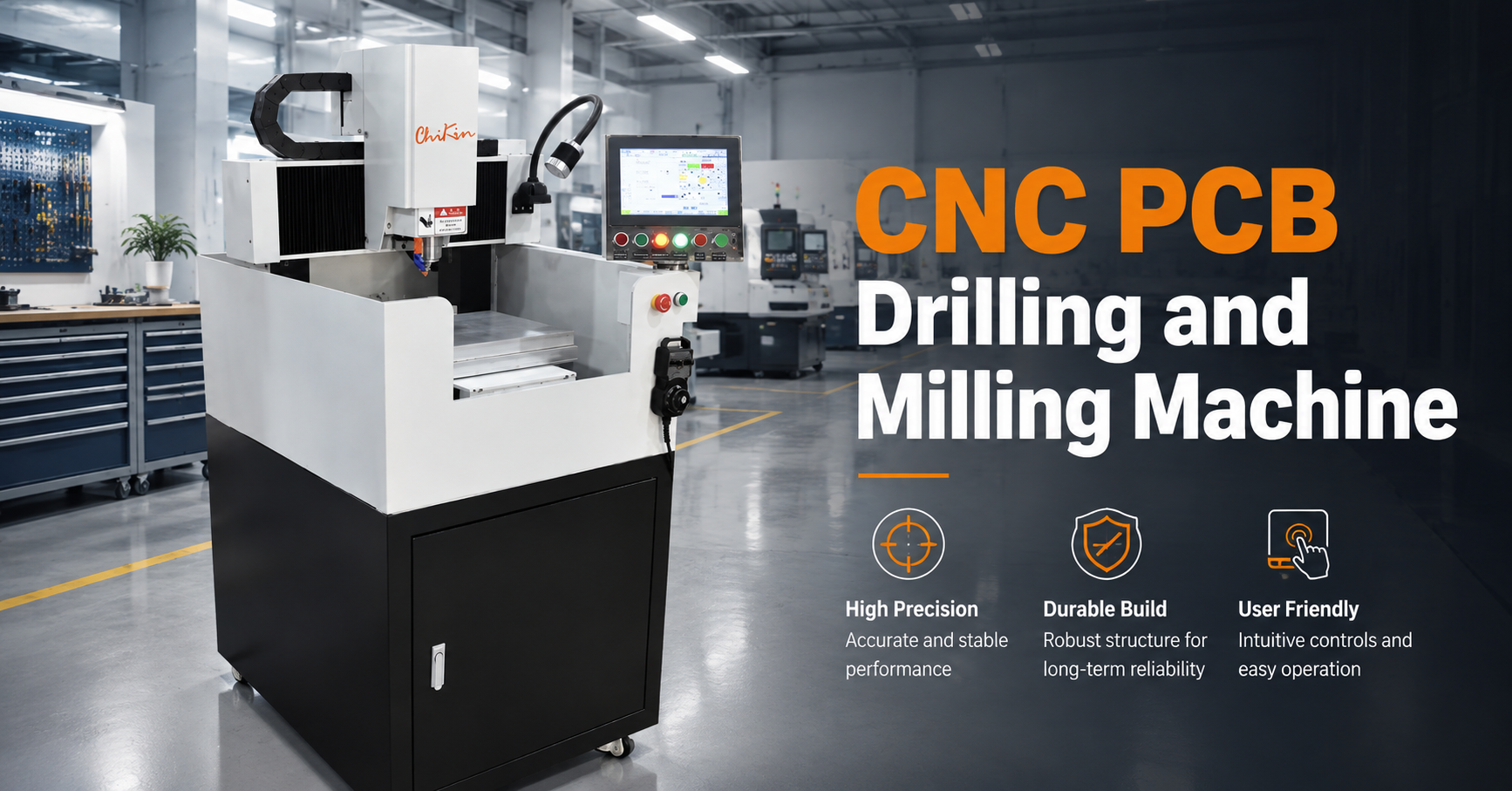
CHIKIN CNC’s PCB product range includes single- and multi-spindle drilling configurations for different output requirements.
For higher-volume production, buyers can review the 4 Spindle PCB Drilling Machine.
3. When Does a PCB Factory Need Routing Equipment?
Routing machines cut:
- Finished board outlines
- Internal openings
- Slots
- Irregular shapes
- Panel separation paths
- Mechanical clearance features
Routing quality affects board dimensions, enclosure fit, connector position, assembly, and visible edge finish.
Routing-Only Equipment
Suitable when the factory already has separate drilling capacity and only needs contour processing.
Combined Drilling and Routing Equipment
Suitable when buyers want to reduce:
- Board transfers
- Re-clamping
- Setup time
- Floor-space use
- Alignment errors between drilling and routing
The PCB CNC Drilling and Routing Machine is relevant for prototype and repeatable board-fabrication workflows.
For mid-volume production requiring automatic fiducial correction, the 1 Drill 1 Route PCB Machine with CCD combines dedicated drilling and routing functions with vision alignment.
For high-throughput factories, the 4 Spindle PCB Drilling and Routing Machine provides a multi-spindle production direction.
Key Routing Specifications
Buyers should verify:
- Spindle speed and torque
- Router-bit diameter
- Spindle runout
- Edge-quality requirement
- Positioning accuracy
- Fixture method
- Worktable flatness
- Dust collection
- Tool-life management
- Tool-change system
- Board-material compatibility
4. Why Is CCD Alignment Important in a PCB Production Line?
CCD systems identify fiducial marks and correct the actual panel position before drilling or routing.
CCD alignment is particularly valuable for:
- High-mix production
- Prototype orders
- Multilayer boards
- Rigid-flex PCB
- Panels with slight placement variation
- Complex board outlines
- Drill-then-route workflows
What Can a CCD System Correct?
Depending on software and configuration, the system may compensate for:
- X-axis offset
- Y-axis offset
- Panel rotation
- Fiducial-position variation
- Flip-side registration
What Should Buyers Evaluate?
- Camera resolution
- Lighting consistency
- Fiducial size and type
- Recognition speed
- Multi-point alignment
- Software compensation
- Surface-finish compatibility
- Fixture stability
CCD vision cannot compensate for a weak machine frame, poor spindle control, or an unstable fixture. It must be part of a complete precision system.
5. What Role Does AOI Play in a PCB Factory?
AOI stands for automated optical inspection. Its purpose depends on where it is installed in the line.
AOI can be used to inspect bare boards, solder paste, or assembled boards, depending on the machine and programming.
Potential defects include:
- Pattern defects
- Missing features
- Surface abnormalities
- Component absence
- Component misalignment
- Polarity errors
- Solder bridges
- Insufficient solder
- Tombstoning
What Should Buyers Check?
- Camera resolution
- Lighting configuration
- Inspection speed
- Defect-library capability
- False-call rate
- Programming time
- Data storage
- MES connectivity
- Review-station workflow
- Traceability requirements
A machine with very high inspection speed may still reduce productivity if it generates too many false calls.
Ask suppliers to test actual boards and demonstrate:
- Defect-detection capability
- Programming workflow
- Operator review time
- Changeover between products
- Data export
6. When Does a PCB Factory Need a V-CUT Machine?
V-CUT equipment creates straight grooves in panelized boards so individual PCBs can be separated later.
It is useful when:
- Boards are arranged in straight rows
- Panelization supports linear separation
- High-speed separation is required
- The board design allows residual material between grooves
Main V-CUT Purchasing Factors
- Groove-position accuracy
- Groove-depth consistency
- Remaining board thickness
- Blade diameter and quality
- Blade alignment
- Panel dimensions
- Cutting speed
- Dust collection
- Blade replacement
- Maintenance access
V-CUT is not appropriate for every board design. Irregular outlines usually require routing, laser processing, or another depaneling method.
7. Which PCB Depaneling Method Should a Factory Choose?
Depaneling separates individual circuit boards from a larger panel.
Common methods include:
- V-CUT separation
- CNC routing
- Punching
- Saw cutting
- Laser depaneling
Depaneling Method Comparison
| Method | Main Advantage | Main Limitation | Suitable Application |
| V-CUT | Fast straight-line separation | Limited to suitable panel designs | Rectangular panelized boards |
| CNC routing | Flexible contour processing | Creates dust and tool wear | Irregular outlines and slots |
| Punching | Fast production cycle | Requires dedicated tooling | Stable high-volume products |
| Saw cutting | Simple straight cuts | Limited geometry | Basic panel separation |
| Laser depaneling | Low mechanical contact | Higher investment and validation | Delicate or fine-feature boards |
Buyers should evaluate mechanical stress, component proximity to board edges, edge-quality requirements, product sensitivity, and production volume.
8. What PCB Testing Equipment Is Needed?
Inspection confirms visible quality. Electrical testing confirms whether the circuit performs according to the intended connectivity.
Common PCB testing options include:
- Flying-probe testing
- Fixture-based electrical testing
- Continuity testing
- Isolation testing
- Functional testing
- Dimensional inspection
- Final visual inspection
Flying-Probe Testing
Suitable for:
- Prototypes
- Small batches
- High-mix production
- Products that change frequently
Advantages include lower fixture requirements and flexible programming.
Fixture-Based Testing
Suitable for:
- Large repeated batches
- High-throughput production
- Stable product designs
The initial fixture cost may be higher, but test speed can be faster for repeated production.
Testing Questions Buyers Should Ask
- What defects must be detected?
- Is continuity and isolation testing required?
- What is the product mix?
- How frequently do designs change?
- What output is required?
- Is test data traceability necessary?
- Does the system need MES integration?
- Who creates and maintains test programs?
What Additional Equipment Does a Full Bare-PCB Factory Need?
The six stages above form a useful mechanical-processing, inspection, and separation workflow. They do not represent every process required to manufacture multilayer bare PCBs from raw laminate.
Depending on factory scope, additional systems may include:
- Inner-layer imaging equipment
- Photoresist coating
- Developing and etching lines
- Automated optical inspection for inner layers
- Layup and lamination presses
- Desmear and hole preparation
- Electroless copper and electroplating
- Outer-layer imaging
- Pattern plating
- Solder-mask coating and exposure
- Legend printing
- Surface-finishing equipment
- Cleaning and drying
- Chemical dosing
- Water treatment
- Waste-gas and wastewater handling
- Material handling and traceability systems
A new investor should first decide whether the business will operate as:
- A full bare-PCB fabrication plant
- A mechanical-processing center
- A prototype facility
- A PCB assembly factory
- A specialized drilling, routing, or testing provider
This prevents underestimating investment and utility requirements.
How Should Equipment Be Matched to Factory Size?
| Factory Type | Recommended Equipment Priority |
| Prototype laboratory | Compact cutting, single-spindle drilling/routing, CCD, flying probe |
| Small PCB factory | Flexible cutting, single/dual-spindle CNC, AOI, V-CUT, electrical test |
| Mid-volume factory | Dual/four-spindle drilling, drilling-routing integration, CCD, automated inspection |
| High-volume factory | Multi-spindle systems, automatic handling, inline AOI, fixture testing |
| FPC specialist | UV laser processing, vision alignment, non-contact handling |
| Metal-core PCB factory | Suitable metal cutting, high-rigidity routing, specialized tooling |
How Can Buyers Calculate the Required Production Capacity?
Do not select PCB production equipment only from monthly sales forecasts.
Calculate capacity from the actual process.
Drilling Capacity
Consider:
- Holes per panel
- Drill travel
- Tool-change frequency
- Panel loading time
- Spindle quantity
- Tool-breakage rate
- Maintenance time
Routing Capacity
Consider:
- Total routing-path length
- Feed rate
- Number of slots
- Tool changes
- Panel setup
- Dust-cleaning time
AOI Capacity
Consider:
- Inspection area
- Programming time
- False-call review
- Product changeover
- Operator availability
Testing Capacity
Consider:
- Number of test points
- Test method
- Fixture changeover
- Retest rate
- Data-processing time
The slowest process determines the practical line capacity.
What Factory Utilities and Infrastructure Are Required?
PCB equipment planning should include:
- Electrical power
- Compressed air
- Cooling water
- Dust extraction
- Fume extraction
- Temperature control
- Humidity control
- Clean working areas
- Network and data systems
- Chemical storage, where applicable
- Wastewater treatment, where applicable
- Maintenance access
- Spare-parts storage
A machine may fit the production specification but still be unsuitable if the facility cannot support its power, air, cooling, extraction, or environmental requirements.
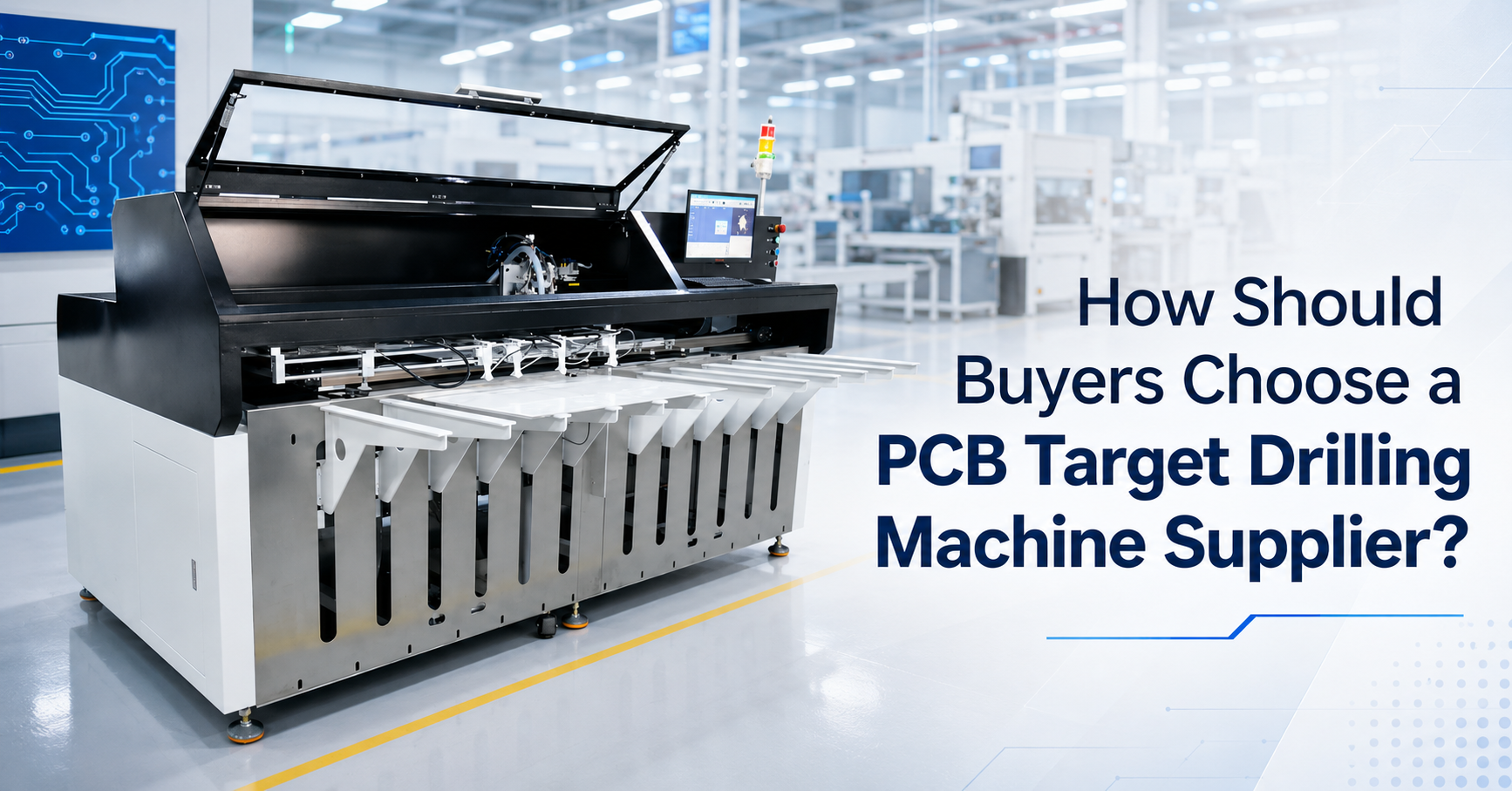
How Should Buyers Evaluate a PCB Equipment Supplier?
A reliable supplier should help convert production requirements into a practical machine configuration.
Manufacturing Capability
Check whether the supplier has:
- Production and assembly facilities
- Mechanical engineers
- Electrical engineers
- Control-system experience
- Calibration capability
- Factory acceptance testing
Learn more about CHIKIN CNC’s manufacturing and R&D background.
Product Range
A supplier with drilling, routing, CCD, cutting, inspection, and testing experience can better understand how equipment connects across the line.
Review the current CHIKIN CNC product portfolio.
Sample Processing
Before ordering, request testing with:
- Actual PCB materials
- Real board dimensions
- Actual hole patterns
- Routing drawings
- Fiducial data
- Required cycle time
Installation and Training
Confirm whether the quotation includes:
- Installation guidance
- Operator training
- Software training
- Calibration instruction
- Preventive maintenance
- Spare-parts recommendations
- Acceptance criteria
Common service questions can be reviewed through the CHIKIN CNC FAQ.
PCB Production Equipment Buyer Checklist
| Requirement | Information to Prepare |
| Factory scope | Full fabrication, mechanical processing, prototype, or assembly |
| PCB materials | FR4, HDI, rigid-flex, FPC, aluminum, copper substrate |
| Panel dimensions | Minimum and maximum |
| Board thickness | Complete thickness range |
| Drilling data | Hole diameter, quantity, tolerance |
| Routing data | Outline, slots, openings, tolerance |
| Alignment | Fiducial type and correction requirements |
| Inspection | Defects to detect and required cycle time |
| Separation | V-CUT, routing, laser, or punching |
| Testing | Flying probe, fixture test, functional test |
| Output | Per shift, day, and month |
| Utilities | Power, air, cooling, extraction |
| Service | Installation, training, spare parts, remote support |
| Expansion | Future materials, products, and capacity |
FAQ: PCB Production Equipment
What equipment is essential for a basic PCB mechanical-processing factory?
A basic line normally includes panel cutting, CNC drilling, PCB routing, dust extraction, inspection, V-CUT or depaneling, and electrical testing.
Does every PCB factory need both drilling and routing machines?
Most factories need both functions, but they may use separate equipment or one combined drilling and routing machine depending on capacity and workflow.
When should a PCB factory use CCD alignment?
CCD alignment is useful for high-mix production, prototype boards, multilayer PCB, rigid-flex boards, and processes requiring accurate fiducial registration.
Is AOI the same as electrical testing?
No. AOI inspects visible features, while electrical testing checks connectivity, isolation, and circuit performance.
Is V-CUT suitable for every PCB?
No. V-CUT is most suitable for straight-line panel designs. Irregular board shapes usually require routing or another depaneling method.
Should a new factory buy single-spindle or multi-spindle equipment?
Single-spindle machines suit prototypes and small batches. Multi-spindle equipment is more suitable for stable, higher-volume production.
What should buyers test before purchasing PCB production equipment?
Test actual materials, board dimensions, hole patterns, routing paths, edge quality, cycle time, alignment, and required accuracy.
How should buyers compare PCB equipment quotations?
Compare machine configuration, tooling, fixtures, software, installation, training, spare parts, warranty, delivery scope, and total cost of ownership.
Can PCB production equipment be customized?
Direct manufacturers may customize working area, spindle layout, fixtures, control systems, enclosures, tool management, and automation interfaces.
What information should be included in a quotation request?
Include factory scope, PCB materials, panel size, thickness, hole data, routing drawings, output target, accuracy, inspection requirements, utilities, and automation expectations.
Conclusion: Build the PCB Production Line Around Your Manufacturing Scope
The answer to “What equipment does a PCB factory need?” depends on the processes the factory intends to complete.
A simplified mechanical-processing line may need:
- PCB cutting
- Drilling
- Routing
- CCD alignment
- AOI
- V-CUT or depaneling
- Electrical testing
A full bare-board fabrication plant also requires imaging, etching, lamination, plating, solder-mask, surface-finish, cleaning, and environmental systems.
The right PCB production equipment plan should be built around:
- Board materials
- Product mix
- Required accuracy
- Daily output
- Process integration
- Factory utilities
- Staffing and maintenance
- Future expansion
Choosing machines individually without mapping the entire workflow can create capacity imbalance, unnecessary investment, and difficult integration.
Request a PCB Production Equipment Consultation from CHIKIN CNC
Planning a new PCB factory or upgrading an existing production line requires a clear understanding of materials, processes, output, accuracy, and factory conditions.
CHIKIN CNC can help review your requirements for PCB cutting, drilling, routing, CCD alignment, inspection, separation, and related automation.
To receive a more useful recommendation, prepare:
- PCB material specifications
- Panel and finished-board dimensions
- Hole-diameter and quantity data
- Routing drawings
- Fiducial and alignment requirements
- Target production volume
- Existing equipment
- Factory floor plan
- Available power, air, and extraction
- Current production bottlenecks
- Future expansion plans
The CHIKIN CNC team can help you compare equipment configurations, discuss sample processing, clarify customization requirements, and plan a practical machine selection for your factory.
Contact CHIKIN CNC to request a PCB production equipment consultation and customized quotation.