



How Can a PCB Chamfering Machine Improve Board Edge Finishing for Factory Production?
For PCB factories, board edge finishing is not only a cosmetic process. A rough edge can affect panel handling, fixture loading, downstream assembly, operator safety, packaging, and final inspection. When PCB edges are sharp, uneven, or inconsistent, operators may spend more time adjusting boards by hand. Panels may not sit smoothly in fixtures. Corners may catch on trays, conveyors, or positioning tools. In some cases, burrs or edge breakout can create extra cleaning work before the board moves to the next production step.
A PCB chamfering machine is used to smooth or bevel board edges so panels feed better, fit more cleanly into downstream assemblies, and reduce edge-related damage during handling. Chikin CNC’s product page describes the machine as a practical solution for buyers running panelized circuit boards where inconsistent edge quality is a common problem. Rough corners can interfere with fixtures, create burrs, or slow manual assembly; a properly selected chamfering setup helps create repeatable edge finishing and supports more stable production flow.
For B2B buyers searching for a PCB edge finishing machine, circuit board chamfering equipment, FR-4 board corner grinder, or PCB chamfering machine manufacturer, the key question is not simply whether a machine can grind an edge. A more useful question is whether it can help the factory standardize the edge finishing process across different board sizes, operators, materials, and production batches.
Why Does PCB Edge Finishing Matter in Real Production?
In PCB manufacturing, edges are easy to overlook because the main technical focus often stays on drilling, routing, plating, imaging, solder mask, testing, and assembly. Yet board edges still affect how the finished product moves through the factory. A clean edge is easier to handle. A consistent bevel can make the board sit better in pallets or fixtures. A smoother corner can reduce scraping during manual transfer.
The product page notes that a PCB chamfering machine is closely related to Circuit Board Chamfering Equipment, FR-4 Board Corner Grinder, and PCB Edge Finishing Machine configurations used in electronics production. Its goal is not cosmetic improvement alone. It is to produce a uniform edge profile that works better with conveyors, pallets, positioning tools, and operators’ hands.
For a factory, this matters in several practical ways:
It can reduce inconsistent manual edge treatment.
It can make board feeding and fixture loading smoother.
It can improve handling comfort for operators.
It can reduce visible edge defects before packaging.
It can support repeatable production standards across shifts.
It can help boards move more predictably through downstream processes.
A PCB board edge grinding machine should therefore be evaluated as a process-control station, not only as an accessory machine.
What Is the Main Selling Point of This PCB Chamfering Machine?
The strongest selling point is repeatable board edge finishing. Chikin’s page explains that most PCB chamfering systems are built to handle panel edges with controlled feed and guided tooling. Depending on the machine design, the system may use a cutter, grinding wheel, or combined finishing mechanism. The practical focus is repeatability, operator safety, and easy adjustment for different board sizes or edge requirements.
This is important because many factories already have some way to deal with rough edges. Operators may use manual deburring tools. A workshop may use a general-purpose grinder. Some panels may be manually cleaned after routing. These methods may work for small batches, but they are difficult to standardize in production.
A dedicated printed circuit board chamfering machine offers a more controlled method. Instead of depending only on hand skill, the board is supported, aligned, and processed in a more repeatable way. This helps reduce operator-to-operator variation and creates a clearer finishing standard.
What Product Features Should B2B Buyers Notice?
| Product / Process Feature | What the Product Page Supports | Why It Matters for PCB Factories |
|---|---|---|
| Board edge smoothing / beveling | Used to smooth or bevel board edges | Helps panels feed better, fit better, and reduce edge-related handling damage |
| Repeatable edge finishing | Designed for controlled, repeatable edge processing | Reduces dependence on manual skill and improves production consistency |
| FR-4 board corner grinding relevance | Related to FR-4 Board Corner Grinder applications | Important because FR-4 requires controlled grinding to avoid fiber breakout |
| Stable board support | Buyers usually look for stable board support and predictable edge removal | Helps keep edge quality consistent across panels |
| Dust collection interface | Common features include dust collection interface and guarding | Important for FR-4 dust control and equipment cleanliness |
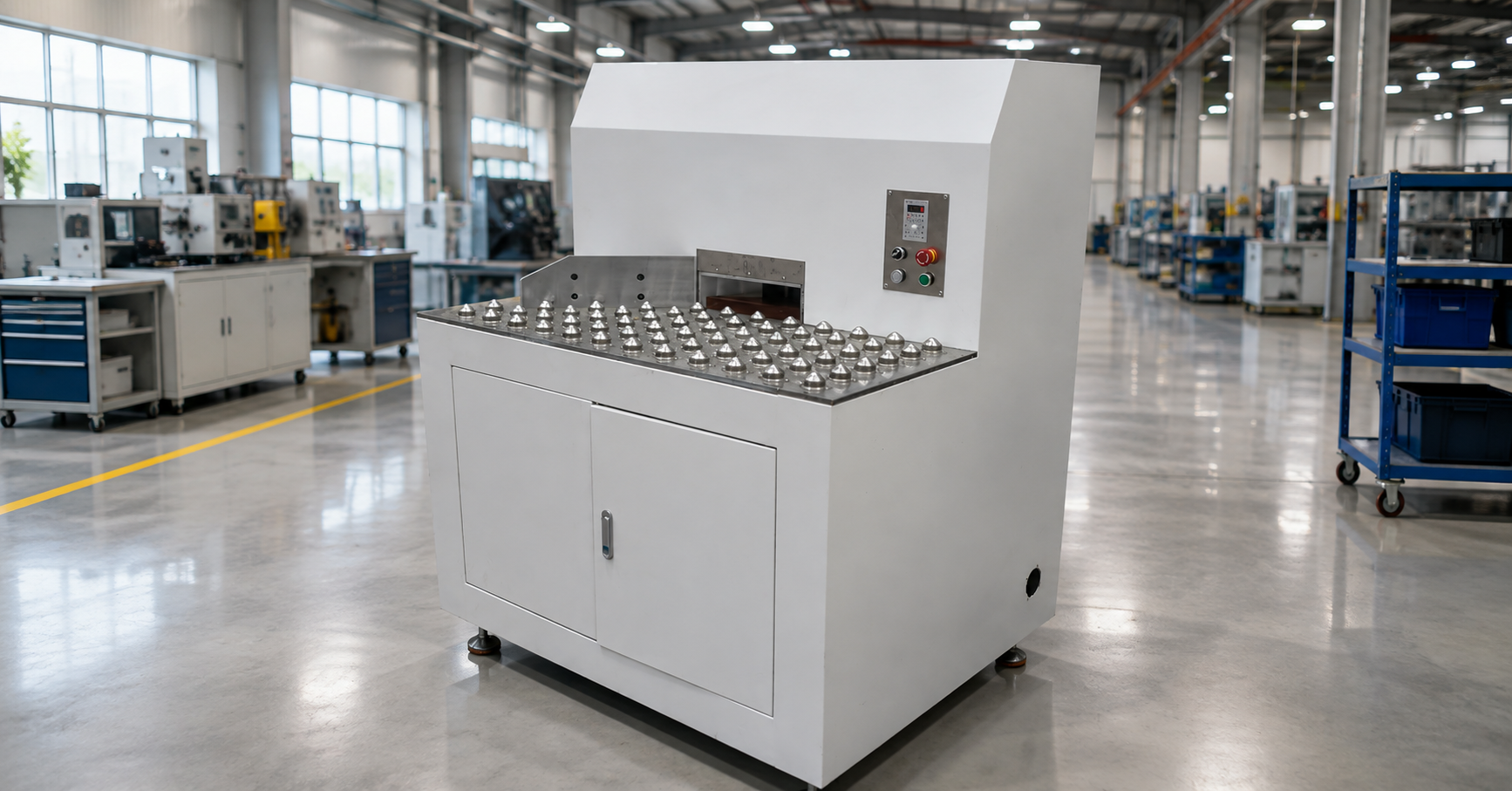
| Serviceable industrial structure | Visible machine image shows floor-standing cabinet, stainless work surface, access doors, leveling feet, and right-side control panel | Suggests a production-oriented machine layout, though exact internal process must be confirmed |
| Adjustable setup | Buyers should define board size range, edge profile target, panel thickness range, and production volume | Helps determine fixture design, motor configuration, dust extraction, and automation level |
| Maintenance focus | Tool wear, alignment drift, and debris accumulation can change finished edge | Buyers should check inspection, cleaning, and replacement of wear parts |
Why Is FR-4 Edge Processing Different from Ordinary Material Grinding?
FR-4 is not simply a plastic sheet. It is a composite laminate with fiberglass reinforcement and resin. When edges are cut or ground, the process must control fiber breakout, dust, heat, and surface condition. Chikin’s page states that for FR-4 material, the cutting or grinding action must be consistent enough to avoid excessive fiber breakout while still improving the corner condition.
This is why a general grinding tool may not be the best long-term solution for PCB factories. A rough or unstable method can create more cleanup work. It can also produce inconsistent edges from one batch to another. If the factory handles repeated FR-4 boards, LED PCBs, panelized boards, or mixed board formats, the process needs controlled guidance and predictable material removal.
A FR-4 board corner grinder should be selected with attention to:
edge profile target
board thickness range
tooling method
dust extraction
operator loading method
fixture support
maintenance interval
surface damage prevention
production volume
The machine’s role is not to remove as much material as possible. The goal is to create a controlled edge condition without damaging the laminate structure or slowing the workflow.
How Does Stable Board Support Affect Edge Quality?
A PCB chamfering process depends heavily on how the board is supported. If the board is not positioned consistently, the edge profile can vary. If the panel moves during grinding, the bevel may become uneven. If the operator has to hold the board manually without a stable guide, the result may depend on experience and hand pressure.
Chikin’s page says buyers usually look for stable board support, predictable edge removal, and a layout that allows safe loading and unloading. For production environments, dependable infeed and consistent corner finish are often more important than high complexity.
That final point is important. In factory purchasing, more complicated equipment is not always better. A PCB factory may prefer a machine that is simple, stable, easy to train on, and easy to maintain. If the main problem is inconsistent edge finishing, a dependable guided chamfering setup can be more valuable than unnecessary automation features.
How Does Dust Control Influence Machine Selection?
Dust control is one of the most important selection points for PCB edge finishing. Chikin’s page states that if the machine is intended for FR-4 board corner work, dust extraction and edge debris control become important because fiberglass and resin dust can affect cleanliness and equipment life.
For a factory, this is not only a housekeeping issue. Dust can settle on nearby equipment, increase cleaning workload, affect operator comfort, and shorten the maintenance interval of machine components. If the chamfering station is close to inspection, assembly, or packaging, dust control becomes even more important.
Before choosing a PCB edge finishing equipment supplier, buyers should ask:
Does the machine include a dust collection interface?
What type of extraction system is recommended?
How should dust be removed from the working area?
Are filters or collection bins easy to access?
How often should operators clean the machine?
Can the dust path be customized for the factory layout?
What safety guidance is provided for FR-4 dust?
A machine that creates a cleaner process is usually easier to operate over time. The lower purchase price of a basic grinder may be less attractive if it creates more cleaning, rework, or maintenance.
How Should Buyers Choose the Right PCB Chamfering Machine?
A good selection process should begin with the board, not the machine photo. The buyer should define what edge problem needs to be solved. Is the factory trying to remove sharp corners? Improve fixture loading? Reduce burrs after routing? Standardize edge treatment across repeated panels? Prepare boards before final packaging? Each goal may require a slightly different configuration.
Chikin’s page recommends that buyers define board size range, edge profile target, panel thickness range, and production volume before ordering. These details help determine fixture design, motor configuration, dust extraction needs, and automation level.
A practical buyer checklist includes:
board material
FR-4 grade or other laminate type
board size range
panel thickness range
current edge quality issue
target bevel or edge profile
daily or monthly production volume
manual, semi-automatic, or automated workflow
operator skill level
dust extraction requirement
available factory space
maintenance capability
supplier support expectation
When these points are clear, the supplier can recommend a more accurate PCB cutting and chamfering equipment solution.
What Makes This Machine Different from Ordinary Market Products?
Many ordinary market products can grind or cut edges. But not all of them are designed for repeatable PCB factory use. Chikin’s product page emphasizes controlled edge treatment, stable board support, dust collection interface, guarding around moving parts, process controls, service access, and repeatable operation. It also describes the visible reference image as a floor-standing industrial cabinet with an enclosed body, stainless-steel work surface, dual front access doors, adjustable leveling feet, and a right-side control panel with digital display and push buttons.
These details separate a production-oriented PCB chamfering machine from a simple workshop grinding tool. The difference is not only appearance. It affects daily operation.
A basic tool may be cheaper, but it may depend more on operator skill.
A production machine should provide more stable support and process control.
A simple grinder may be harder to integrate into a clean PCB workflow.
A PCB-focused chamfering machine should consider dust, fixtures, edge uniformity, and service access.
A general-purpose supplier may not understand board edge requirements.
A PCB equipment supplier should understand FR-4 behavior, panel handling, and downstream assembly needs.
For a B2B factory, those differences can affect yield, training time, and long-term usability.
How Should Buyers Evaluate the Supplier?
Choosing the right PCB chamfering machine manufacturer is as important as choosing the machine. The supplier should not only sell a standard product. It should help the buyer match the machine to the board type, production volume, edge target, and factory process.
Buyers should ask:
Can you review our board samples or drawings?
Can you confirm whether this machine fits FR-4 edge finishing?
What edge profile can the machine produce?
What board size and thickness range can be supported?
What dust extraction system do you recommend?
What tooling or grinding components are used?
How often should wear parts be replaced?
Can guides or fixtures be adjusted for different boards?
Can the machine support different edge requirements?
What service access is provided?
Do you provide training, manuals, and spare parts?
Chikin’s product page invites buyers to share PCB dimensions, material type, edge finish target, and workflow requirements to evaluate the best machine configuration for the production line. This is the right B2B process. The buyer should not request only a price; they should request a configuration matched to the production problem.
Common Mistakes When Buying PCB Chamfering Equipment
The first mistake is choosing by price only. A low-cost machine may look attractive, but poor edge consistency can create hidden costs in rework, cleaning, handling, and rejected boards.
The second mistake is ignoring dust control. FR-4 dust and edge debris can affect the production area and equipment life.
The third mistake is treating chamfering as cosmetic. Edge condition can influence board loading, operator handling, fixture fit, and downstream assembly.
The fourth mistake is not defining the target edge profile. Without a clear edge target, it is hard to judge machine performance.
The fifth mistake is not checking maintenance access. Tool wear, debris accumulation, and alignment drift can change the finished edge over time.
The sixth mistake is assuming all machines work the same for FR-4. PCB laminates need controlled processing, especially when fiber breakout must be limited.
FAQ
What is a PCB chamfering machine used for?
A PCB chamfering machine is used to smooth or bevel board edges so panels feed better, fit more cleanly into downstream assemblies, and reduce edge-related damage during handling.
Why is edge finishing important for PCB factories?
Edge finishing helps reduce rough corners, burrs, handling issues, fixture interference, and manual assembly slowdowns. It also supports repeatable production flow for panelized boards.
Is this machine suitable for FR-4 boards?
The product page connects this equipment with FR-4 Board Corner Grinder applications and notes that FR-4 processing requires consistent cutting or grinding action to avoid excessive fiber breakout while improving corner condition.
What should buyers confirm before ordering?
Buyers should confirm board size range, panel thickness range, edge profile target, production volume, fixture design, dust extraction needs, motor configuration, and automation level.
Why is dust extraction important?
For FR-4 board corner work, dust extraction and edge debris control are important because fiberglass and resin dust can affect cleanliness and equipment life.
Conclusion
A PCB chamfering machine is valuable when a factory needs cleaner, safer, and more repeatable board edge finishing. Its value is not only in smoothing edges. It helps standardize a process that affects board feeding, fixture loading, operator handling, downstream assembly, and final inspection.
Chikin CNC’s product page positions this machine for clean, repeatable board edge finishing. It highlights controlled edge treatment, stable support, dust collection interface, guarding, service access, stainless work surface, industrial cabinet structure, and configuration selection based on board size, edge profile, thickness range, and production volume.
For buyers comparing circuit board chamfering equipment, PCB edge finishing machine, or FR-4 board corner grinder options, the best approach is practical: define the board material, edge target, size range, dust control needs, production volume, and maintenance expectations first. Then choose a supplier that can match the machine configuration to the factory workflow.