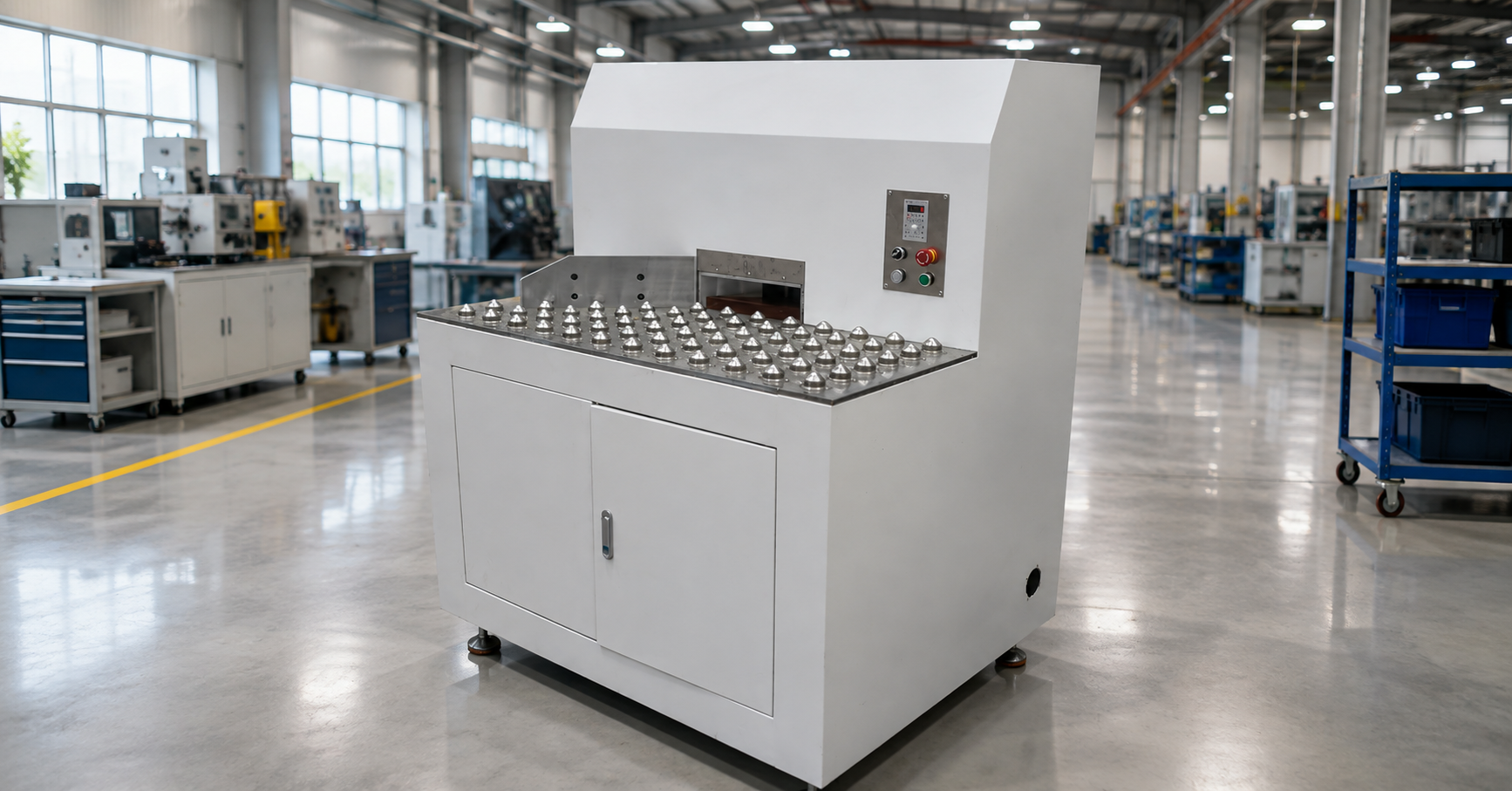




How Should Factories Choose an FR4 Pinning Machine for Stable Board Processing?
For PCB factories and electronics manufacturers, repeatable positioning is often more important than it first appears. A board may look easy to place on a worktable, but once production moves from a small trial run to batch processing, manual alignment can become slow, inconsistent, and difficult to control. Operators may place the same FR4 panel slightly differently from shift to shift. Fixture stops may wear or move. A board may not sit flat enough before the next mechanical step. Over time, these small variations can affect production rhythm, rework rate, and operator confidence.
This is why factories evaluate an FR4 pinning machine when they need a more stable way to place, clamp, and process boards. Chikin CNC describes its FR4 pinning machine as equipment designed to solve a familiar production problem: how to place, clamp, and process boards with consistent position control instead of relying on slow manual alignment. The product page also states that this matters in factory settings where operators need repeatable results across batches, especially for FR4 panels and similar flat workpieces that must be held securely before a mechanical operation.
For B2B buyers searching for PCB pinning equipment, semi-automatic PCB pinning machine, FR4 board processing machine, or PCB board positioning machine, the purchasing decision should not begin with price alone. A better starting point is the production process. What board size needs to be handled? What operation happens after the board is positioned? How often does the product change? How much operator control is required? How much automation is practical for the current line?
An FR4 pinning machine is not just a simple station on the shop floor. When selected properly, it becomes a repeatable positioning platform that helps reduce manual variation and supports stable daily output.
Why Is Board Positioning So Important in FR4 Processing?
FR4 boards and other flat PCB-related workpieces often need controlled positioning before a mechanical or assembly operation. If the board is not aligned consistently, the following process may become unstable. This can affect pin insertion, fixture-based operation, component support, drilling-related handling, test fixture preparation, assembly positioning, or other board-level processes that depend on repeatable placement.
In low-volume production, a skilled operator may compensate manually. That approach can work when the process is simple and the batch is small. But as order volume grows, the factory needs a more repeatable method. Manual alignment slows the workflow and makes results more dependent on individual experience.
A good PCB pinning equipment solution should support three practical goals. It should help the operator position the board faster. It should hold the board more consistently. It should reduce unnecessary variation when the same part is processed many times.
Chikin’s page positions the machine around this same idea. It says the main value is not only the hardware itself, but the repeatable positioning it supports. The page also notes that a stable frame, dual-station layout, and fixed work surface help reduce variation caused by hand placement and improve day-to-day consistency on the shop floor.
For factory buyers, this is the core value: repeatability. The machine should make the process less dependent on hand placement and more dependent on a controlled, guided workstation.
What Is an FR4 Pinning Machine?
An FR4 pinning machine is a fixture-based processing station used to position, clamp, and process FR4 boards or similar flat panels in a controlled way. The exact operation may vary according to configuration, because pinning equipment can be adapted to different board sizes, fixture methods, insertion styles, and workflow requirements.
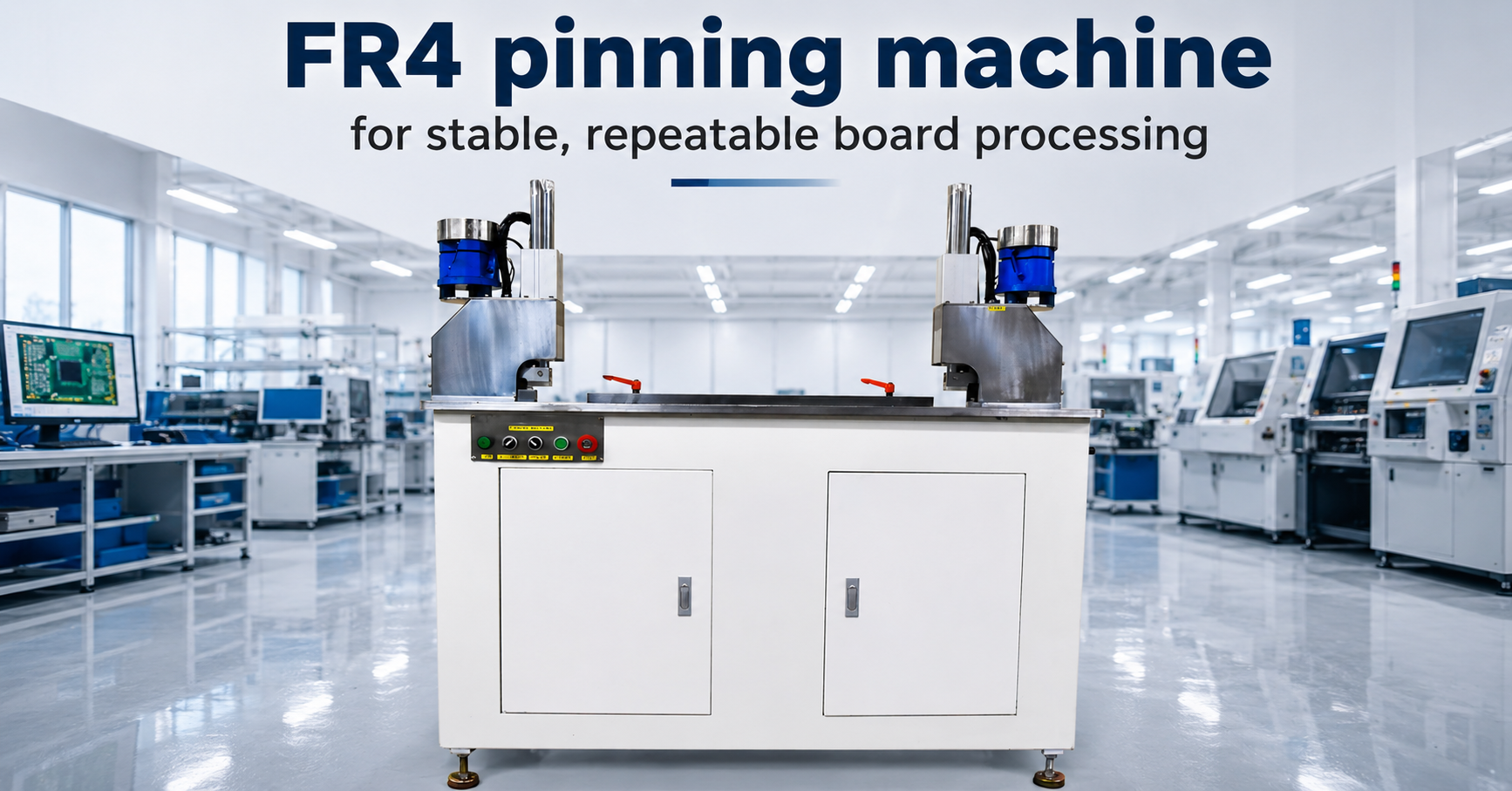
The Chikin CNC product page describes this machine as a floor-standing industrial unit with a cabinet base, flat top bed, and two vertically mounted processing heads positioned at opposite ends of the work area. The page also explains that this structure suggests a station built for repetitive operations where the workpiece is placed on the table, clamped in a central fixture zone, and processed with operator control.
This structure is important for buyers. A flat table gives the operator a defined working surface. A cabinet base supports the equipment as a fixed production station. Dual vertical heads suggest paired operations, mirrored processing, or two-point work. Front controls indicate that operators can manage the cycle directly.
In other words, this type of machine is not designed like a fully enclosed, unattended automation line. It appears better suited to controlled, semi-automatic, operator-managed production where repeatability is needed but flexibility is still valuable.
What Are the Main Advantages of Chikin CNC’s FR4 Pinning Machine?
Based on the product page, Chikin CNC’s FR4 pinning machine has several visible and practical advantages that B2B buyers should pay attention to.
First, it uses a dual-head processing layout. The product page states that two vertical head assemblies suggest paired operations or mirrored processing steps, which can be useful where a part needs attention at two points or where a production cycle benefits from left-right symmetry and fixed reference positions.
Second, it has a long horizontal worktable. Chikin notes that the extended table surface gives operators room to position rectangular parts, long fixtures, or assemblies. This can be useful for FR4 boards and similar flat workpieces that require stable support during processing.
Third, it supports an operator-controlled cycle. The page mentions visible front-panel buttons and an emergency stop-style control, indicating that the operator can start and stop the process directly. Chikin also notes that this is often preferred in batch production, prototyping, and changeover-heavy work where flexibility matters more than a fully automated line.
Fourth, it offers a compact middle ground between hand work and full automation. Chikin states that for factories needing a compact, repeatable, operator-friendly station, this machine format offers a sensible middle ground between hand work and full automation. The page describes the layout as being built around control, stability, and fixture-based processing rather than unnecessary complexity.
These advantages make the machine especially relevant for factories that want better consistency but do not necessarily need a large fully automatic production line.
Key Product Advantages and Buyer Meaning
| Product Advantage | What the Product Page Shows | Why It Matters for B2B Buyers |
|---|---|---|
| Dual-head processing layout | Two vertical head assemblies are positioned at opposite ends of the work area | Supports paired operations, mirrored processing, or two-point board handling |
| Long horizontal worktable | The extended surface gives space for rectangular parts, long fixtures, or assemblies | Helps operators position FR4 panels and similar flat workpieces more comfortably |
| Fixture-based structure | The workpiece can be placed, clamped, and processed in a central fixture zone | Reduces variation caused by manual placement |
| Operator-controlled workflow | Visible start/stop controls and emergency stop-style button suggest manual or semi-automatic operation | Useful for batch production, prototyping, and frequent changeovers |
| Floor-standing industrial body | Cabinet base, flat top bed, and leveling feet indicate a shop-floor workstation | Helps keep the process stable and organized |
| Repeatable positioning value | The page emphasizes stable frame, dual-station layout, and fixed work surface | Supports consistent results across batches |
| Customization potential | Buyers are advised to define board size, fixture style, and process steps | Helps configure the machine around real production requirements |
| Practical middle-ground solution | Chikin describes the format as between hand work and full automation | Suitable for factories that need consistency without unnecessary complexity |
How Should Buyers Choose an FR4 Pinning Machine?
Choosing an FR4 pinning machine should begin with the workpiece and process, not the machine appearance. A buyer should first define what the machine needs to do in the production line.
The first point is board size. If the board is long, rectangular, or requires support across a wide area, the worktable length and fixture design become important. Chikin’s machine uses an extended table surface, which may support rectangular parts, long fixtures, or assemblies, but buyers still need to confirm the actual board size range with the supplier.
The second point is fixture method. FR4 boards may need stops, pins, clamps, holders, or custom tooling depending on the operation. The supplier should understand how the board will be aligned, how it will be held, and how quickly operators need to load and unload it.
The third point is head spacing and head function. Since the Chikin machine uses a dual-head layout, buyers should confirm whether the head spacing can match the board geometry and process step. The page specifically advises that if the line requires semi-automatic PCB pinning, buyers should ask whether head spacing, table length, and control sequence can be adapted to part geometry.
The fourth point is production volume and changeover frequency. A fully automatic system may be useful for very stable high-volume production. But if the factory handles different board formats, engineering samples, small batches, or frequent changeovers, a semi-automatic operator-controlled station may be more practical.
The fifth point is operator safety and control. Visible buttons and emergency stop-style control indicate that the operator manages the process directly. Buyers should still ask about guarding, control logic, emergency stop function, and maintenance access before ordering.
The sixth point is floor stability and leveling. Chikin notes that visible leveling feet are useful on shop floors with uneven surfaces because stable leveling helps protect repeatability and can reduce vibration issues during operation.
The seventh point is serviceability. A pinning machine may look simple, but the table, fixture, heads, controls, and wear points must remain stable over time. Buyers should check how easy it is to inspect, adjust, clean, and maintain the machine.
Why Is Semi-Automatic Operation Often Practical?
Not every factory needs a fully automatic FR4 pinning line. In many real production environments, flexibility matters more than maximum automation. A factory may process multiple board models. Engineering changes may be frequent. Batch sizes may vary. Operators may need direct control over loading and alignment.
Chikin’s product page describes the visible green start button, red emergency stop-style button, and indicator light as signs of a manual or semi-automatic workflow rather than a fully enclosed, unattended line.
This can be an advantage, not a limitation. A semi-automatic PCB pinning machine gives the operator control while still improving repeatability compared with freehand handling. It can reduce alignment variation without creating a complicated automation system that may be expensive or hard to change.
For high-mix production, prototyping, custom automation cells, or fixture-based board handling, this format can be more suitable than a rigid fully automatic line.
How Is This Type of Machine Different from Manual Alignment?
Manual alignment relies on operators to place each board correctly. Even skilled operators may introduce small differences when they work for long periods or handle different board types. Fatigue, lighting, fixture wear, and time pressure can all affect consistency.
An FR4 pinning machine creates a more defined process. The board is placed on a fixed surface. Tooling or stops guide the position. Clamps can hold the workpiece. The operator starts the cycle from a defined control point. The machine structure supports repeatability.
Chikin describes the machine’s layout as a semi-automatic PCB pinning machine or related fixture machine: the operator loads the part, aligns it against tooling or stops, clamps it in place, and initiates the cycle. The page also notes that the dual-head arrangement implies repeatable station work rather than freehand handling.
That difference is important. The machine does not simply make work faster. It makes the work more controlled.
How Is This Machine Different from Fully Automatic Lines?
A fully automatic line may include automated feeding, detection, positioning, insertion, unloading, and line communication. That can be effective for very stable high-volume production. But it may also require higher investment, more setup, more engineering support, and longer changeover planning.
Chikin’s FR4 pinning machine is positioned differently. The page presents it as a compact, operator-friendly station built around fixture-based processing and repeatable positioning. It does not describe the equipment as an unattended production line.
For many B2B buyers, that middle position is useful. It allows the factory to improve consistency without overcomplicating the workstation. If the process still requires operator judgement, part variation, frequent adjustment, or flexible fixtures, a semi-automatic platform may be the better choice.
The best machine is not always the most automated one. It is the machine that fits the actual workflow.
What Should Buyers Confirm Before Purchase?
Because the product page does not disclose a full numerical specification table in readable text, buyers should confirm technical details directly with the supplier. The page itself advises that customization should start with actual board size, fixture style, and process steps because the exact process cannot be confirmed from the image alone.
Before ordering, buyers should confirm:
Board length, width, and thickness range.
FR4 panel size and flatness requirement.
Pinning or insertion method.
Hole pattern or fixture reference point.
Clamping method.
Dual-head spacing.
Whether heads work together or separately.
Table length and usable working area.
Control sequence.
Operator loading and unloading method.
Cycle time expectation.
Changeover frequency.
Required fixture material.
Machine leveling and installation conditions.
Maintenance access.
Spare parts and service support.
These details should be part of the technical discussion before quotation.
Buyer Selection Checklist
| Selection Area | What Buyers Should Ask | Why It Matters |
| Board compatibility | What board size, thickness, and material can the machine support? | Ensures the machine fits actual FR4 panels and flat workpieces |
| Fixture design | How will the board be aligned, clamped, and referenced? | Repeatability depends on fixture quality |
| Dual-head layout | Can head spacing and sequence match the board geometry? | Determines whether the machine fits two-point or mirrored operations |
| Worktable length | Is the table long enough for rectangular boards or custom fixtures? | Prevents poor support during processing |
| Control mode | Is the system manual, semi-automatic, or fully automatic? | Helps match automation level to factory workflow |
| Operator safety | What emergency controls, guarding, and access rules are included? | Supports safer daily production |
| Changeover speed | How quickly can fixtures or settings be adjusted for a new board? | Important for high-mix production |
| Leveling and stability | Are leveling feet and stable installation supported? | Helps protect repeatability on real shop floors |
| Maintenance access | How are heads, fixtures, table, and controls inspected or adjusted? | Reduces downtime and long-term drift |
| Supplier support | Are training, customization, spare parts, and process review available? | Helps the buyer build a stable process after installation |
What Are the Advantages of This Chikin CNC Machine for Factory Buyers?
The first advantage is repeatable positioning. The machine is designed to solve inconsistent manual alignment and help operators place, clamp, and process boards with more consistent position control.
The second advantage is dual-head processing. The two vertical head assemblies can support paired or mirrored operations where a part needs attention at two points.
The third advantage is a long worktable. The extended table gives operators room to position rectangular boards, long fixtures, or assemblies.
The fourth advantage is operator-managed flexibility. The visible controls suggest a manual or semi-automatic workflow, which can be preferred in batch production, prototyping, or changeover-heavy work.
The fifth advantage is shop-floor stability. The visible leveling feet can help maintain repeatability on uneven floors and reduce vibration issues during operation.
The sixth advantage is configuration flexibility. The page recommends discussing board size, fixture style, process steps, board material, hole pattern, insertion method, clamping method, and operator flow before finalizing a build.
The seventh advantage is practical process positioning. The machine format provides a middle ground between manual work and full automation. That can be useful for factories that need better control but do not want unnecessary complexity.
What Type of Factory Is This Machine Suitable For?
This type of machine can be relevant for PCB factories, electronics assembly lines, custom automation cells, and light manufacturing environments where flat parts must be processed one cycle at a time. Chikin lists likely use cases including fixture-based board handling, repetitive component insertion, two-point processing, and controlled work on rectangular assemblies.
It is especially suitable when:
Manual alignment is too slow.
Repeatability needs to improve.
Boards must be held securely before a mechanical step.
The process benefits from two-point positioning or processing.
Production is batch-based rather than fully continuous.
Operators need direct control over the cycle.
Board formats change often enough that flexibility matters.
A compact workstation is preferred over a large automatic line.
It may not be the best choice for every line. If the factory needs unattended continuous high-speed production, a more automated system may be required. If the operation is very simple and low volume, manual tools may still be enough. The right choice depends on the process, not only the machine name.
How Should Buyers Evaluate an FR4 Pinning Machine Supplier?
Choosing the right PCB equipment supplier is just as important as choosing the machine. A supplier should not only provide a product photo and price. It should help the buyer review the process.
A professional supplier should ask about board size, fixture style, process steps, board material, hole pattern, insertion method, clamping method, and operator flow. Chikin’s product page specifically recommends defining these points before finalizing a build, especially for buyers of aluminum PCB pinning machine systems or semi-automatic PCB pinning solutions.
Buyers should evaluate the supplier with these questions:
Can the supplier review real board drawings?
Can the supplier confirm fixture design?
Can head spacing be customized?
Can the table length match the board format?
Can the control sequence be adapted?
Can the machine process FR4 and similar flat workpieces?
Can the supplier explain the workflow clearly?
Can the supplier provide training and operation guidance?
Can spare parts be supplied long term?
Can the supplier support installation and troubleshooting?
A good supplier should understand that pinning is part of a process. The machine must match the board, fixture, operator, and production rhythm.
Why Should Buyers Request a Process Review?
Chikin’s page recommends that buyers comparing PCB pinning equipment should share board size, target process, and fixture requirements, because a clear process review helps determine whether the dual-head platform is the right fit and how it should be configured for production.
This is a good purchasing principle. A machine should not be selected from a product title alone. FR4 pinning equipment may look simple, but the final configuration depends on board geometry, hole pattern, clamping method, insertion process, and operator flow.
A process review can help prevent several problems:
The worktable may be too short for the actual fixture.
The head spacing may not match the board.
The clamping method may interfere with components.
The control sequence may be too slow or too complex.
The operator may not have enough access for loading.
The fixture may not support fast changeover.
The machine may not fit the available workshop space.
A short technical review before ordering can prevent costly corrections after delivery.
Common Mistakes When Choosing an FR4 Pinning Machine
The first mistake is choosing only by price. A cheaper station may become more expensive if it cannot hold the board repeatably or if it requires too much manual adjustment.
The second mistake is ignoring fixture design. The machine frame is important, but repeatability depends heavily on the fixture.
The third mistake is assuming that all pinning machines work the same way. Head layout, table length, control sequence, and operator access can vary significantly.
The fourth mistake is not confirming board size and process steps. The page itself states that customization should start with actual board size, fixture style, and process steps because the exact process cannot be confirmed from the image alone.
The fifth mistake is over-automating. A fully automated solution may look attractive, but a semi-automatic workstation can be more practical for high-mix, batch-based, or changeover-heavy production.
The sixth mistake is skipping supplier service questions. Operators need training, fixtures may need adjustment, and spare parts may be required over time.
FAQ
What is an FR4 pinning machine used for?
An FR4 pinning machine is used to place, clamp, and process FR4 boards or similar flat workpieces with consistent position control. Chikin describes it as a solution for reducing reliance on slow manual alignment and improving repeatability across batches.
What is the main advantage of Chikin CNC’s FR4 pinning machine?
The main advantage is repeatable fixture-based board processing. The machine uses a floor-standing structure, long worktable, and dual-head layout to support stable, operator-controlled production.
Why is the dual-head layout useful?
The two vertical head assemblies suggest paired operations or mirrored processing steps. This can be useful when a part needs attention at two points or when a cycle benefits from fixed reference positions.
Is this machine fully automatic?
The visible green start button, red emergency stop-style button, and indicator light point to a manual or semi-automatic workflow rather than a fully enclosed unattended line.
What should buyers confirm before ordering?
Buyers should confirm board size, fixture style, process steps, board material, hole pattern, insertion method, clamping method, operator flow, head spacing, table length, and control sequence.
Is this machine only for FR4 boards?
The product is positioned for FR4 panels and similar flat workpieces that must be held securely before mechanical operation. The page also mentions aluminum PCB pinning machine workflows, but exact material compatibility should be confirmed with the supplier.
Conclusion
An FR4 pinning machine should be selected as a repeatable positioning solution, not only as a piece of mechanical equipment. For PCB factories and electronics manufacturers, the right machine can reduce slow manual alignment, improve fixture-based control, support stable batch processing, and make operator-managed production more consistent.
Chikin CNC’s FR4 pinning machine is worth evaluating because it is designed around stable board placement, clamping, and repeatable processing. Its visible advantages include a dual-head processing layout, long horizontal worktable, floor-standing cabinet structure, operator-controlled cycle, leveling feet, and a practical semi-automatic format. The product page presents it as a compact middle-ground platform between hand work and full automation, built around control, stability, and fixture-based processing.
For B2B buyers, the best purchasing process is objective and practical. Define the board size, material, hole pattern, fixture style, clamping method, process steps, operator flow, and production volume first. Then ask the supplier whether the head spacing, table length, control sequence, and fixture design can be adapted to the real part geometry.
A well-matched semi-automatic PCB pinning machine can help factories improve repeatability without adding unnecessary complexity. For production teams that want to move from hand placement toward stable board processing, this type of dual-head FR4 pinning platform is a practical option to review.