



How Can a PCB Circuit Board Deburring Machine Improve Controlled Edge Finishing?
For PCB factories, edge finishing is not just a cosmetic step. After cutting, routing, panel separation, or mechanical processing, printed circuit boards may carry burrs, loose particles, rough edges, or small debris. These defects can interfere with assembly, create handling issues, and increase contamination risks in downstream processes. Chikin CNC describes its PCB circuit board deburring machine as equipment designed to remove burrs, rough edges, and loose particles after cutting or routing, helping manufacturers improve edge consistency, reduce manual rework, and support cleaner production flow.
This is an important issue for B2B factories because unfinished PCB edges can create hidden production costs. A rough edge may slow operator handling. Loose particles may move into later cleaning, inspection, or assembly steps. Manual deburring may work for a small batch, but it becomes harder to standardize when board volume increases or when operators change shifts. A dedicated PCB deburring machine gives the factory a more controlled way to manage edge finishing as part of the production process.
For buyers searching for PCB edge deburring machine, PCB edge finishing machine, printed circuit board deburring equipment, or automatic PCB deburring machine, the buying decision should not start only with machine price. It should start with the real edge problem: what type of burr appears, how the board moves through the line, what level of cleanliness is required, and how much manual rework the factory wants to reduce.
Why Should PCB Deburring Be Treated as a Production-Control Step?
PCB deburring usually happens after a mechanical operation. A board may be routed, cut, separated, or trimmed before it reaches final finishing. If the edge condition is poor, the defect may not stay isolated at the edge. It can affect handling, cleaning, inspection, packing, or downstream assembly. Chikin’s product page directly states that unfinished edges can interfere with assembly, cause handling issues, and create contamination risks in downstream processes.
That is why a PCB circuit board deburring machine should be evaluated as process-control equipment, not just as a cleaning accessory. It helps factories move from operator-dependent manual finishing toward a more repeatable workflow. The machine does not only remove material; it supports edge consistency and cleaner production flow.
In a real plant, controlled deburring can help with several daily problems:
It can reduce manual edge cleanup after routing or cutting.
It can help operators handle boards more safely and consistently.
It can lower the risk of loose particles moving into downstream processes.
It can create a more standardized edge-finishing station.
It can support better production rhythm when board volumes increase.
It can reduce variation between different operators and shifts.
A deburring process becomes especially important when the factory handles different PCB formats, small boards, panelized boards, or products with stricter assembly cleanliness requirements.
What Is the Product Positioning of Chikin’s PCB Circuit Board Deburring Machine?
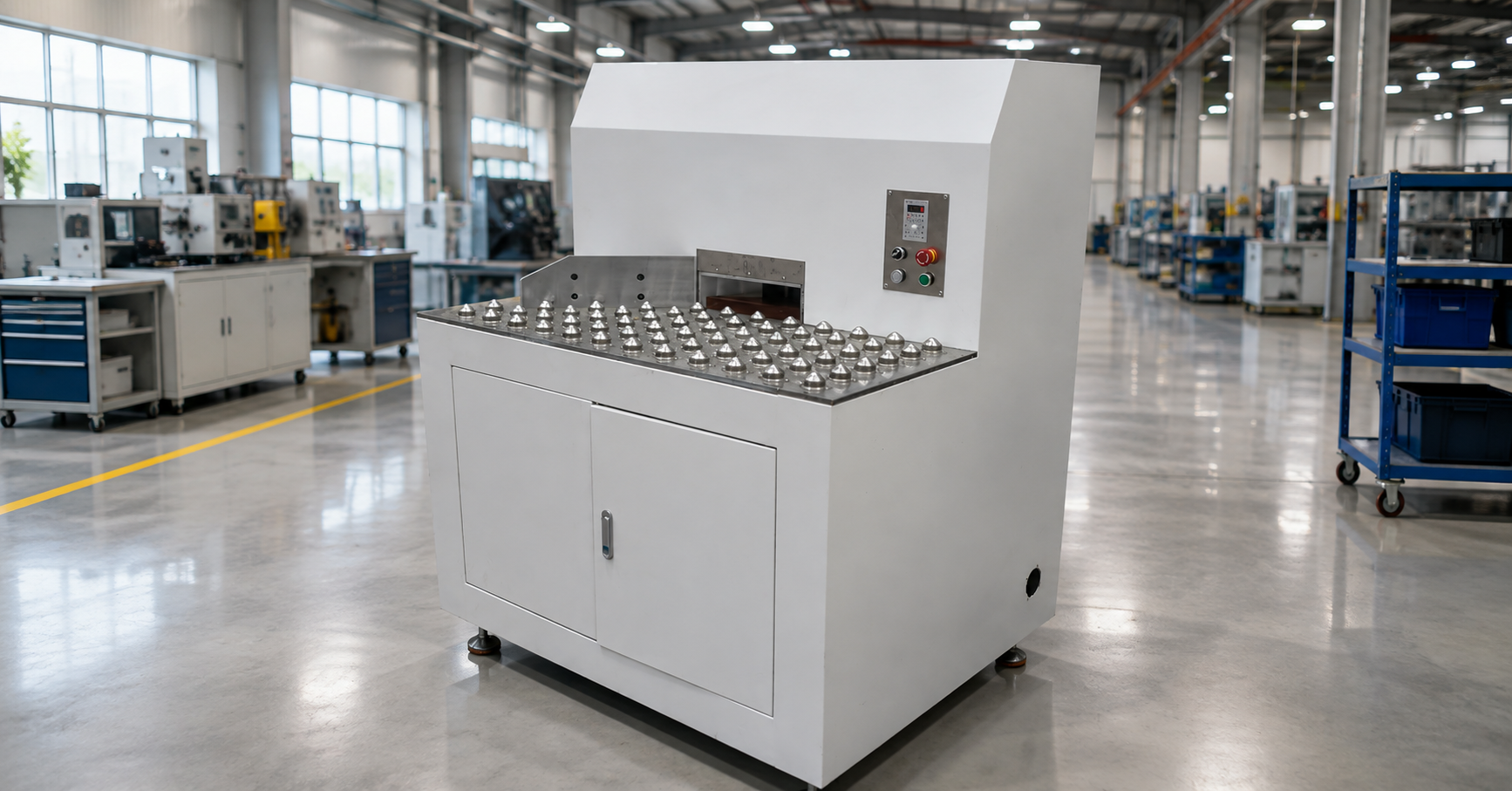
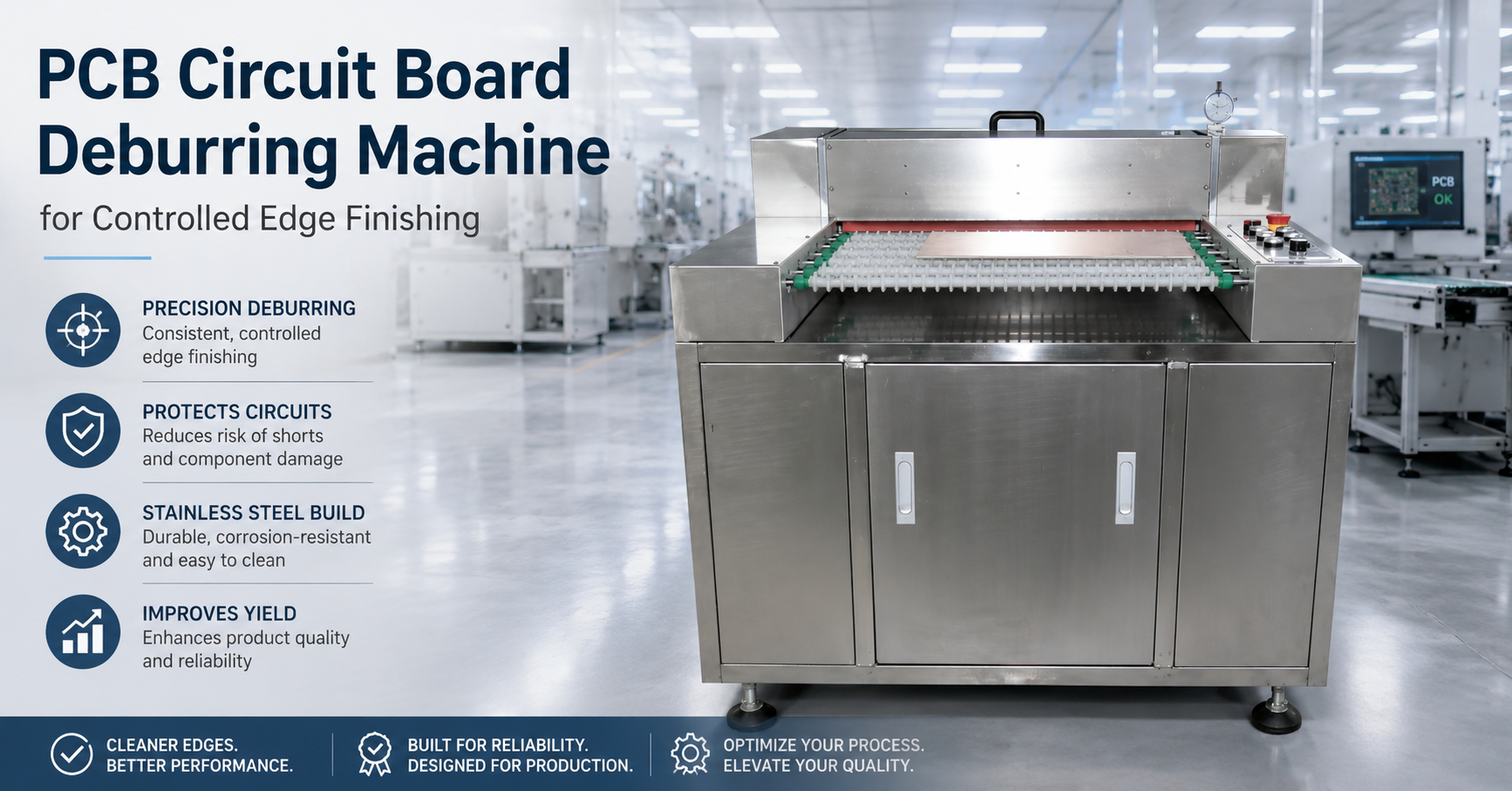
Chikin CNC presents this machine as an industrial stainless-steel unit with a conveyor-style feed section, enclosed processing chamber, and side-mounted controls. The page says the visible structure suggests a compact in-line system suited to factory environments where flat parts or small boards need to move through a controlled surface-treatment step.
This product positioning is important. A compact in-line machine is different from a handheld manual deburring tool or a simple open workbench. The machine is intended to guide parts through a defined process path. Its stainless-steel structure, enclosed chamber, and conveyor-like feed area make it more suitable for repeated factory use.
Chikin also notes that the exact operating principle is not confirmed from the image alone, so buyers should confirm the real deburring method, board support style, dust or waste handling, and available electrical specifications before purchase. This is a useful reminder for procurement teams. Product photos can show structure, but they do not replace technical confirmation.
What Product Selling Points Should B2B Buyers Notice?
| Product Selling Point | Product Page Information | Why It Matters for PCB Factories |
|---|---|---|
| Controlled edge finishing | Removes burrs, rough edges, and loose particles after cutting or routing | Helps reduce manual rework and downstream contamination risk |
| Stainless-steel structure | Machine body appears mainly stainless steel with brushed or matte finish | Supports easier cleaning and better corrosion resistance in many industrial environments |
| Enclosed processing chamber | Enclosed working area helps isolate the process | Supports cleaner and more controlled edge treatment |
| Conveyor-style feed section | Front feed area with roller- or chain-like components is visible | Helps move boards through the machine at a steadier rate |
| Side-mounted controls | Control panel, red emergency-stop style button, switches, and gauge are visible | Allows operators to monitor and interact with the process |
| Serviceable lower base | Enclosed lower base with front access doors is visible | Suggests maintenance or storage access inside the machine body |
| Customization potential | Conveyor width, chamber length, guarding, control logic, and material options can be discussed | Helps adapt the machine to different line layouts and board sizes |
| Buyer confirmation needed | Dimensions, throughput, power, process description, and customization scope should be requested | Prevents wrong selection when full specs are not visible |
The most important selling point is not one single component. It is the combination of enclosed processing, conveyor-style feeding, stainless-steel construction, and repeatable handling. Together, these elements can help a factory move boards through a controlled finishing step instead of relying only on manual cleanup.
Why Does Stainless-Steel Construction Matter?
Chikin’s product page states that the machine appears to be built mainly from stainless steel with a brushed or matte finish. The page also explains that this type of construction is common in industrial equipment because it resists corrosion better than painted mild steel in many environments and is easier to wipe down.
For PCB factories, this can be useful in several ways. Deburring and edge finishing may involve dust, particles, moisture, cleaning cycles, or surface contamination. A machine that is easier to wipe down helps production teams maintain a cleaner work area. Stainless steel can also improve long-term appearance and cleaning convenience compared with more basic painted structures.
However, buyers should not judge the machine only by exterior material. Stainless steel helps the machine body, but the real production result depends on feed alignment, deburring method, board support, operator settings, maintenance access, and cleaning discipline. A good supplier should be able to explain both the visible structure and the internal process.
Why Is Conveyor Feeding Useful for PCB Deburring?
The product page describes a visible front feed area with roller- or chain-like components, indicating a continuous handling setup. For a PCB edge deburring machine, Chikin notes that this feed arrangement can help move boards through the machine at a steady rate and maintain alignment during processing.
This is one of the key differences from manual deburring. Manual finishing depends heavily on operator technique. A conveyor-style feed gives the process a more defined movement path. The board enters from one direction, moves through the processing chamber, and exits after treatment. This can make the process easier to train, inspect, and repeat.
For B2B buyers, the feed section should be discussed carefully. Buyers should ask:
What board size range can the conveyor handle?
How is the board supported during feeding?
Can feed speed be adjusted?
How does the machine keep boards aligned?
Can thin or small boards pass through steadily?
Can the feed section be cleaned easily?
What wear parts are used in the conveyor area?
Chikin notes that exact speed control, board size range, and automation features are not visible and should be confirmed with the supplier. Buyers should follow that advice before ordering.
How Should Buyers Evaluate the Control System?
The product page mentions a right-side control panel, emergency-stop style red button, side switches, and an analog gauge. Chikin states that these parts indicate manual interaction points for operation monitoring, while the gauge may show pressure, temperature, or another process value, but its exact function is not identifiable from the image alone.
This is a practical point. In a factory, the control system should be easy for operators to understand. The machine should clearly show start/stop status, alarms, process settings, and any key operating values. If the machine will be used as part of an in-line process, the control logic should also match the upstream and downstream workflow.
Buyers should ask the supplier:
What does the gauge measure?
What process settings can operators adjust?
Is feed speed adjustable?
Are alarms displayed clearly?
Does the machine have interlocks or guarding signals?
Can the control language be customized?
Can the machine communicate with other line equipment?
What emergency-stop behavior is included?
A PCB finishing machine manufacturer should explain the control system in production terms, not just point to buttons and switches.
How Does This Machine Differ from Ordinary Manual Deburring?
Manual deburring may be suitable for very small batches, prototype boards, or emergency rework. But once production volume increases, manual finishing becomes harder to control. Operators may apply different pressure. Some may miss certain edges. Others may spend too much time on boards that do not need heavy finishing. Over time, this creates inconsistent labor cost and inconsistent edge quality.
Chikin’s machine is presented as a conveyor-based stainless-steel processing platform for controlled PCB-related finishing. It has an enclosed processing chamber, feed section, and side-mounted controls. These features create a more production-oriented process than open manual work.
The difference can be summarized like this:
Manual deburring depends on operator technique.
A conveyor-style deburring machine provides a guided movement path.
Manual finishing can be difficult to repeat across shifts.
Machine-based finishing is easier to standardize.
Manual work may create more direct contact with the board edge.
A controlled machine can reduce unnecessary handling.
Manual cleanup can slow production when board volume rises.
An in-line style machine can support smoother production flow.
The machine does not remove the need for inspection. But it can make the deburring step easier to manage as part of a production system.
How Should Factories Choose the Right PCB Deburring Machine?
Factories should choose deburring equipment based on application fit. The first step is to define where burrs appear and why. Are they caused by routing? Cutting? Panel separation? Board trimming? Are they on the edge only, or also on the surface? Are particles loose, embedded, or attached to laminate fibers? Is the process dry, wet, brushed, scrubbed, or otherwise configured?
Chikin’s product page recommends that buyers focus on how the machine controls part movement, how easy it is to clean, what materials are used in contact areas, whether access doors provide safe maintenance access, and how controls are laid out for operators. It also says buyers should confirm the real deburring method, board support style, dust or waste handling, and electrical specifications.
Before requesting a quote, buyers should prepare:
Target board size.
Board thickness range.
Material type, such as single-side PCB, double-side PCB, or multilayer PCB.
Current burr or edge issue.
Current cleaning or deburring method.
Required edge condition after treatment.
Expected output per shift.
Dry or wet process preference if relevant.
Line layout and available space.
Required conveyor direction.
Cleaning and maintenance requirements.
Electrical requirements.
Need for customization.
The more detailed the inquiry, the easier it is for the supplier to recommend the correct machine configuration.
How Should Buyers Evaluate a Supplier?
A good PCB deburring equipment supplier should not only quote the machine. It should ask about board size, process step, line layout, edge quality target, cleaning requirement, and production volume. Chikin’s page tells buyers to share target board size, process step, and line layout with the supplier because clear application details make it easier to confirm whether the conveyor-based stainless-steel machine matches production needs and what modifications are available.
Buyers should evaluate the supplier by asking:
Can you explain the exact deburring method?
Can you confirm board size and thickness range?
Can the feed section handle our board type?
Can the machine process single-side, double-side, and multilayer PCB formats?
What waste, dust, or water handling is required?
Can conveyor width or chamber length be customized?
What parts require regular cleaning?
How are access doors used for maintenance?
What control logic is included?
What spare parts are recommended?
Can you review our line layout before quotation?
Can sample boards be tested?
A supplier that can answer these questions clearly is more likely to support real factory production.
Common Purchasing Mistakes
The first mistake is choosing only by price. A low-cost solution may still require manual rework if the feed path, deburring method, or board support does not match the application.
The second mistake is ignoring the actual burr source. A machine cannot be selected properly if the factory does not know whether burrs come from routing, cutting, drilling, panel separation, or another operation.
The third mistake is assuming all deburring machines use the same internal process. Chikin’s page specifically notes that the exact operating principle is not confirmed from the visible image alone, so buyers should confirm the real process with the supplier.
The fourth mistake is overlooking cleaning access. Deburring creates or removes particles; the machine must be easy to clean and maintain.
The fifth mistake is not confirming dimensions, throughput, and power requirements. Chikin states that procurement teams should request confirmed dimensions, throughput range, power requirements, process description, and customization scope before purchase.
FAQ
What is a PCB circuit board deburring machine used for?
A PCB circuit board deburring machine is used to remove burrs, rough edges, and loose particles after cutting or routing printed circuit boards. It helps improve edge consistency, reduce manual rework, and support cleaner production flow.
Why is edge deburring important for PCB factories?
Unfinished edges can interfere with assembly, create handling issues, and introduce contamination risks in downstream processes. A controlled deburring process helps reduce these risks.
What visible structure does Chikin’s machine have?
The product page describes an industrial stainless-steel unit with a conveyor-style feed section, enclosed processing chamber, side-mounted controls, and front access doors.
What should buyers confirm before purchase?
Buyers should confirm board size range, throughput, power requirements, exact deburring method, board support style, dust or waste handling, electrical specifications, and customization scope.
Can the machine be customized?
The product page states that buyers can ask about conveyor width, chamber length, guarding, control logic, material options, access doors, feet, gauge placement, and control interface depending on board size, line layout, and operator interaction level.
Conclusion
A PCB circuit board deburring machine is useful when a factory wants to move beyond manual edge cleanup and build a more controlled edge-finishing process. Chikin CNC’s product page positions this machine as an industrial stainless-steel unit with conveyor-style feeding, enclosed processing, side-mounted controls, and serviceable access doors, suitable for flat parts or small boards moving through a controlled surface-treatment step.
For B2B buyers, the best purchasing decision should begin with the production problem. Define the burr source, board size, material type, edge quality target, throughput requirement, cleaning needs, and line layout first. Then ask the supplier to confirm the deburring method, feed design, maintenance access, waste handling, electrical requirements, and customization options.
A suitable PCB edge finishing machine should not only clean the board edge. It should help the factory reduce manual rework, improve edge consistency, and keep PCB finishing easier to manage in daily production.