



A Laser Cutting Machine can solve production problems that are difficult to address with mechanical routing, punching, blade cutting, or manual separation. But that does not mean laser processing is automatically the best choice for every board, material, or factory.
For a PCB or electronics manufacturer, the real purchasing question is more specific:
Can the laser process your exact material stack, geometry, thickness, tolerance, edge requirement, and production volume without creating an unacceptable thermal effect or an unnecessarily high operating cost?
That question matters because an FPC manufacturer cutting thin polyimide circuits has a very different process window from a factory cutting aluminum-core PCB panels. A high-volume rigid-flex depaneling line has different priorities from an R&D laboratory producing twenty prototypes per day. A buyer processing copper, aluminum, FR4, polyimide, or precious metal should not select equipment from the same specification sheet without application testing.
CHIKIN CNC currently offers several laser-processing directions through its Laser Cutting Machine product range, including flexible-circuit laser processing, metal-core PCB cutting, metal plate processing, dual-head PCB separation, marking, and other precision laser applications.
This guide is written for production managers, process engineers, equipment engineers, factory owners, technical buyers, and procurement teams that need to make an application-based decision rather than simply compare machine prices.
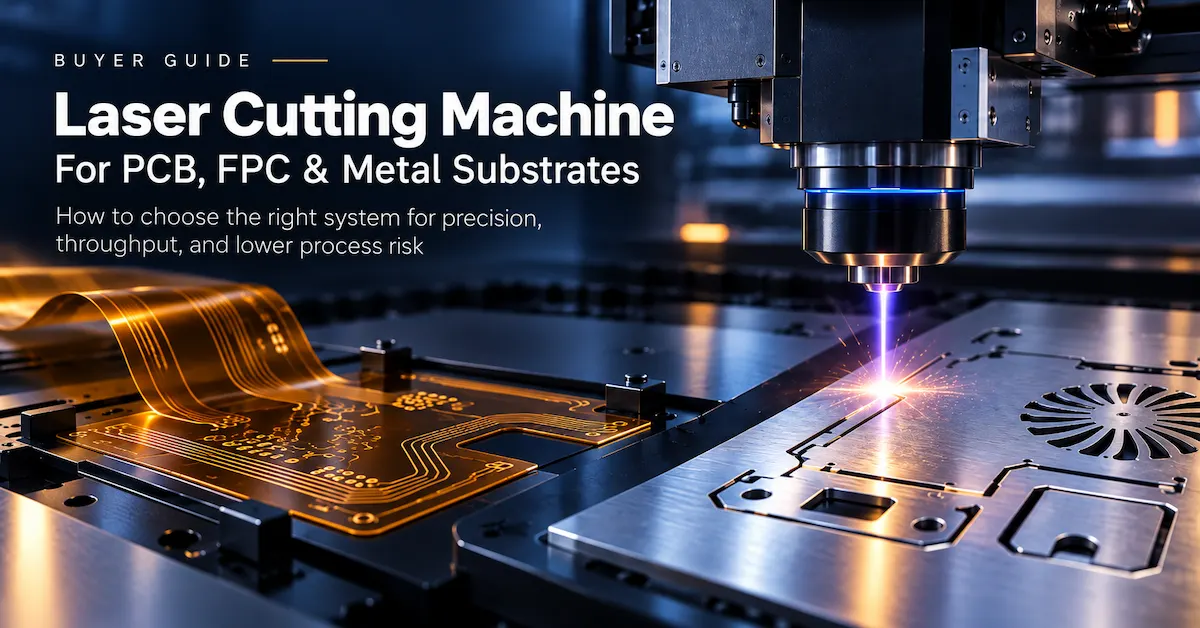
Quick Answer: What Should You Check Before Buying a Laser Cutting Machine?
Before comparing suppliers, confirm these ten items:
-
What material are you processing? FR4, polyimide FPC, rigid-flex, aluminum, copper, stainless steel, or another material?
-
What is the complete material stack? Adhesive, copper, coverlay, resin, glass fiber, coating, and metal layers can react differently to laser energy.
-
What thickness range must be processed?
-
What edge condition is acceptable? Burr, carbonization, discoloration, delamination, recast material, or oxide may matter differently by application.
-
What positional accuracy and repeatability are actually required?
-
Is CCD or fiducial alignment necessary?
-
What is the real cycle-time target, including loading, alignment, cutting, unloading, and inspection?
-
How will fumes, smoke, particles, and process debris be extracted?
-
What safety enclosure, interlock, cooling, electrical supply, and plant utilities are required?
-
Can the supplier prove the process on your actual production samples before you purchase the machine?
If a supplier cannot answer these questions using your own material and drawings, machine power alone is not enough information for a reliable purchasing decision.
What Is a Laser Cutting Machine in Electronics Manufacturing?
A Laser Cutting Machine uses controlled laser energy to remove or modify material along a programmed path. Unlike a mechanical router or blade, the laser does not need a physical cutting edge to contact the workpiece.
That non-contact principle is one of the main reasons laser processing is evaluated for:
-
flexible printed circuits
-
rigid-flex PCB
-
thin PCB substrates
-
complex depaneling contours
-
fine slots and openings
-
metal-core PCB
-
aluminum and copper substrates
-
traceability marking
-
precision metal components
-
high-mix products where mechanical tooling changes are expensive
In electronics manufacturing, however, “laser cutting” describes a process family rather than one universal technology.
The laser source, wavelength, pulse behavior, optics, motion system, focus control, material absorption, extraction system, software, and fixture design all influence the final result.
That is why buyers should avoid asking only:
“What is the laser power?”
A more useful question is:
“What laser source and process configuration can repeatedly produce my required edge quality and tolerance on my actual material stack at the target cycle time?”
This difference in questioning separates technical equipment selection from catalog shopping.
Why Are PCB and FPC Manufacturers Moving Toward Laser Processing?
Mechanical cutting remains practical for many PCB applications. CNC routing is flexible and proven for rigid boards. V-CUT is efficient for compatible straight, pre-scored panels. Punching can be economical for stable high-volume designs with dedicated tooling.
Laser processing becomes attractive when one or more of those methods creates a process limitation.
Common reasons include:
-
excessive mechanical stress on thin or sensitive materials
-
deformation of flexible circuits
-
burrs or edge fraying
-
tooling wear
-
frequent product changeovers
-
expensive dedicated dies
-
complex cut paths
-
small features
-
tight component-to-edge spacing
-
contamination from mechanical debris
-
demand for programmable processing
Industry research presented through IPC has documented these mechanical-process limitations in PCB depaneling and has also shown why laser source selection must be matched to substrate properties.
The key point is not that “laser is always better.”
The point is that the laser creates a different process mechanism.
A mechanical tool transfers force into the board. A laser primarily transfers controlled energy into a localized processing zone. That can reduce mechanical loading, but it introduces another variable that buyers must manage carefully: thermal influence.
For this reason, serious Laser Cutting Machine selection should compare mechanical stress, thermal effect, edge quality, throughput, tooling cost, and process flexibility together.
Who Is a Laser Cutting Machine Best For?
A Laser Cutting Machine is particularly worth evaluating when the buyer handles one of the following conditions.
FPC and Flexible Circuit Manufacturers
Flexible circuits can bend, stretch, wrinkle, or distort under mechanical contact. Fine outlines can also be difficult to process consistently with conventional tooling.
A FPC UV Laser Cutting Routing Machine is therefore relevant to buyers producing:
-
FPC panels
-
flexible interconnects
-
coverlay openings
-
thin electronic films
-
compact consumer electronics circuits
-
wearable electronics
-
camera modules
-
medical electronics
-
high-density flexible assemblies
For these users, the important acceptance criteria are usually not just speed. Edge definition, thermal discoloration, copper protection, registration, deformation, and repeatability matter more.
Rigid-Flex and High-Density Electronics Manufacturers
Rigid-flex designs often combine sensitive flexible sections with rigid board areas and complex contours.
A non-contact process can be attractive where excessive bending during separation could affect traces, joints, or delicate structures.
The supplier should still prove:
-
edge condition
-
alignment accuracy
-
copper-to-edge control
-
heat-affected zone
-
cut consistency
-
panel support
-
extraction performance
on the buyer’s real stack-up.
Metal-Core PCB Manufacturers
Metal-core PCB used in LED lighting, power electronics, automotive systems, power modules, and EV-related products creates a different processing challenge.
The machine must handle metallic substrates while controlling:
-
burr formation
-
heat input
-
oxidation
-
edge finish
-
cut geometry
-
dimensional repeatability
-
material flatness
-
fume and particle extraction
CHIKIN provides a Metal Core PCB Laser Cutting Machine for this processing direction, as well as a dedicated Metal Plate Laser Cutting Machine.
The public metal-plate product information lists aluminum, copper, and stainless substrate applications, a fiber-laser configuration, CCD alignment, assist-gas capability, and a stable machine platform. Exact material thickness, cut speed, tolerance, and gas requirements should still be confirmed against the final machine configuration and sample process.
High-Mix Manufacturers
A factory running many product revisions can spend significant time and money on mechanical tooling.
For these factories, a programmable laser path may reduce dependence on dedicated cutting dies.
This can be valuable when:
-
product geometry changes frequently
-
volumes per model are moderate
-
NPI activity is high
-
customers request engineering revisions
-
fixture investment must be controlled
-
complex contours are common
The economic advantage depends on product mix. A laser may have a higher initial investment but lower tooling-change cost for frequently changing jobs.
High-Volume Depaneling Lines
High volume creates a different requirement: cycle time.
A buyer may consider a multi-head architecture when one laser head becomes the production bottleneck.
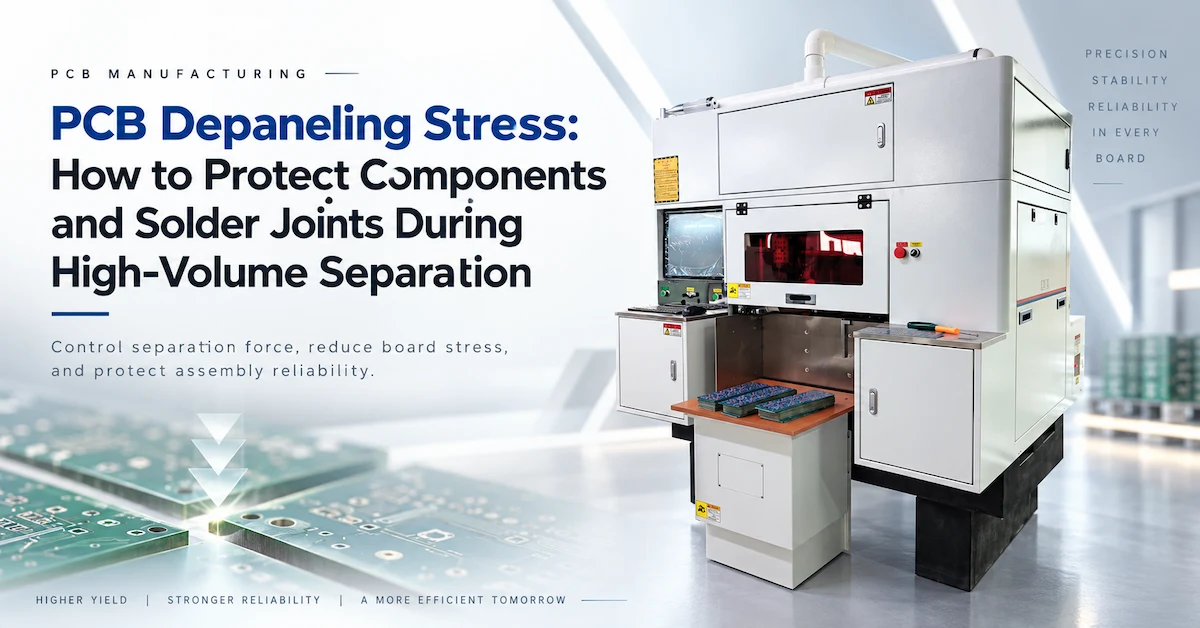
CHICKEN'S Two Heads Laser Cutting Machine uses a dual-head processing concept intended for parallel PCB separation.
For a high-volume buyer, however, the purchase decision should not be based on a theoretical “two heads means twice the output” assumption.
Actual throughput depends on:
-
usable parallelization
-
panel layout
-
cut length
-
laser passes
-
alignment time
-
loading and unloading
-
fixture handling
-
acceleration
-
path optimization
-
inspection
-
extraction recovery
-
material behavior
Ask the supplier to demonstrate actual panel-to-panel cycle time on your job.
Who May Not Need a Laser Cutting Machine?
This is an important question because a professional supplier should be willing to say when another process is more suitable.
A Laser Cutting Machine may not be the most economical choice when:
-
the board is rigid and easily routed
-
the product uses simple V-scored straight lines
-
production geometry rarely changes
-
tolerance requirements are moderate
-
mechanical stress is already acceptable
-
routing tooling cost is low
-
laser thermal influence creates more risk than mechanical cutting
-
annual production volume cannot justify the investment
-
plant extraction or laser-safety infrastructure is difficult to support
For example, factories processing conventional rigid PCB outlines can compare laser processing with PCB drilling and routing equipment.
For straight pre-scored panels, the correct comparison may instead be a V-CUT system. CHIKIN’s broader PCB equipment range includes several processing methods because no single separation technology is best for every board.
A buyer should select the process that gives the lowest acceptable production risk—not the process with the most impressive specification sheet.
UV vs Fiber vs CO2: Which Laser Technology Fits the Application?
One of the most common sourcing mistakes is treating the term “laser” as if every laser source behaves the same way.
It does not.
Material response depends heavily on wavelength, power density, pulse characteristics, absorption, thickness, and thermal properties.
UV Laser
UV lasers are commonly evaluated for fine processing of heat-sensitive or thin materials.
They are especially relevant to:
-
FPC
-
polyimide
-
thin films
-
fine contour processing
-
micro features
-
delicate electronic substrates
The shorter wavelength can provide favorable absorption and localized processing for some polymer-based circuit materials.
In practical purchasing terms, this can help when the buyer prioritizes:
-
fine detail
-
reduced thermal influence
-
narrow processing zones
-
limited mechanical stress
-
clean flexible-circuit geometry
This is why a FPC UV Laser Cutting Machine should be evaluated differently from a high-power metal-cutting machine.
UV is not automatically the fastest choice. Fine processing can require multiple passes, careful parameter control, and lower material-removal rates.
Fiber Laser
Fiber laser systems are commonly evaluated for metals and metal-rich substrates because their wavelength and beam characteristics are suited to many metallic processing applications.
Typical buyer applications include:
-
aluminum substrates
-
copper substrates
-
stainless sheet
-
metal-core PCB
-
precision metal parts
-
traceability marking
For metal cutting, buyers should evaluate:
-
laser source power
-
beam quality
-
focus control
-
assist gas
-
cut thickness
-
oxide formation
-
notch
-
edge condition
-
speed by material and thickness
Do not compare a 1 mm aluminum sample with a 5 mm copper sample using the same expected speed.
The material matters.
CO2 Laser
CO2 laser processing has historically been used for polymeric and organic materials and has also been studied for PCB depaneling.
Its suitability depends on material absorption, thickness, desired edge condition, and thermal tolerance.
Research on flexible PCB materials has demonstrated an important trade-off: a process can be fast but create more thermal influence or carbonization than another source.
This is a useful lesson for buyers.
Maximum speed is not the same as optimum production quality.
Your acceptance test should identify the fastest parameter window that still meets:
-
edge requirement
-
dimensional tolerance
-
HAZ requirement
-
visual standard
-
reliability requirement
Laser Source Comparison
| Laser direction | Typical application direction | Main buyer priority | Key risk to validate |
|---|---|---|---|
| UV | FPC, polyimide, thin electronic materials | Fine detail and low thermal influence | Throughput, carbonization, multi-pass behavior |
| Fiber | Metal, MCPCB, aluminum, copper, marking | Metal interaction and productivity | Oxidation, HAZ, edge condition |
| CO2 | Selected polymers, PCB processing | Material absorption and processing speed | Thermal effect, residue, carbonization |
| Dual-head configuration | High-volume compatible panels | Parallel processing | Real cycle-time gain and process balance |
The correct answer should come from sample processing, not a generic wavelength chart alone.
Laser Cutting vs CNC Routing vs V-CUT vs Punching
A high-converting buying guide should help the buyer decide between technologies, not simply promote one of them.
| Process | Main strength | Main limitation | Best-fit situation |
|---|---|---|---|
| Laser cutting | Non-contact, programmable, complex geometry | Thermal process window must be controlled | FPC, sensitive materials, fine geometry, selected metal substrates |
| CNC routing | Flexible mechanical contouring | Tool wear, dust, mechanical loading | Rigid PCB, slots, outlines, mixed geometry |
| V-CUT | Fast for compatible straight scored panels | Limited to V-score geometry | Repeated rigid panel production |
| Punching | Very fast with dedicated tooling | Die cost and lower design flexibility | Stable high-volume product |
If your panel already has straight V-score lines and runs continuously at high volume, a laser may be unnecessary.
If your FPC panel has narrow curves, changing outlines, and limited tolerance for mechanical force, a laser can become much more attractive.
If your rigid FR4 board requires many routed slots plus an irregular outline but thermal edge conditions are sensitive, CNC routing may still be preferable.
CHICKEN'S PCB depaneling selection guide can be used alongside the laser category when comparing process families.
The 12 Technical Factors That Matter More Than “Maximum Laser Power”
1. Material Compatibility
Ask the supplier to identify exactly which materials have been processed successfully.
Do not accept “PCB material” as a complete answer.
Your application brief should specify:
-
FR4
-
polyimide
-
copper
-
aluminum
-
stainless steel
-
adhesive
-
coverlay
-
solder mask
-
coating
-
composite stack
-
material thickness
Two visually similar boards can require very different laser parameters.
2. Material Stack-Up
FPC and PCB are layered systems.
Different layers absorb and transfer heat differently. A process that cuts the base film cleanly may react differently when copper, adhesive, coverlay, or resin is present.
Send a cross-section or stack description before quotation.
3. Laser Wavelength
Wavelength affects material absorption and therefore cutting behavior.
It influences:
-
efficiency of energy coupling
-
thermal penetration
-
edge condition
-
required power
-
number of passes
-
processing speed
This is one reason UV, fiber, and CO2 should not be compared only by wattage.
4. Beam and Pulse Characteristics
For precision applications, consider:
-
beam diameter
-
focal spot
-
pulse width
-
pulse frequency
-
peak power
-
energy density
-
focus stability
A specification sheet that lists only total power leaves too many unanswered process questions.
5. Positioning Accuracy and Repeatability
Buyers often ask for “accuracy” without defining what is being measured.
Clarify whether the supplier is quoting:
-
axis positioning accuracy
-
repeatability
-
camera registration
-
actual cut-to-fiducial accuracy
-
finished-part dimensional tolerance
These are not the same measurement.
The most useful number is usually the one measured on the finished sample after the complete process.
6. CCD and Fiducial Alignment
For PCB and FPC applications, material can shift, shrink, stretch, or arrive with manufacturing variation.
CCD alignment can help locate:
-
fiducials
-
board edges
-
reference marks
-
workpiece position
This allows the process path to be corrected relative to the actual board rather than assuming every panel is perfectly positioned.
CHIKIN’s laser range includes systems with vision-alignment directions, especially where PCB registration matters.
7. Focus and Height Control
Metal sheet, PCB panels, and flexible substrates are not always perfectly flat.
If focus changes across the workpiece, kerf, edge quality, and penetration can change.
Ask how the machine manages:
-
surface height
-
autofocus
-
warped panels
-
fixture flatness
-
focus calibration
8. Motion Platform
The laser source cannot compensate for a poor mechanical platform.
Check:
-
machine frame
-
guide system
-
ballscrew or linear-drive configuration
-
servo system
-
vibration stability
-
acceleration
-
calibration
CHIKIN’s public metal laser pages describe stable machine structures, precision motion components, and vision-supported processing as part of the equipment concept.
9. Software and File Workflow
Do not assume your engineering files can be loaded directly.
Discuss:
-
Gerber
-
ODB++
-
DXF
-
CAD data
-
nesting
-
path optimization
-
revision management
-
parameter libraries
-
user permissions
-
recipe storage
Software problems can create more downtime than mechanical problems in a high-mix factory.
10. Fume and Particle Extraction
Laser cutting creates by-products.
The type and quantity depend on the material and process.
Extraction should be treated as part of the production system, not an optional accessory.
Ask:
-
where fumes are collected
-
filter stages
-
filter life
-
duct requirements
-
airflow monitoring
-
maintenance intervals
-
replacement cost
-
whether external extraction equipment is required
For electronics manufacturing, contamination control can be as important as cutting speed.
11. Cooling and Assist Gas
Depending on machine configuration, buyers may need:
-
water cooling
-
chiller
-
compressed air
-
nitrogen
-
other assist gas
Confirm consumption and pressure requirements before the machine arrives.
This information affects installation cost and ongoing operating expense.
12. Enclosure and Safety
Industrial laser systems require controlled safety design.
ISO 11553-1:2020 addresses hazards associated with laser processing machines and requires appropriate risk-reduction measures and manufacturer information.
From a buyer’s perspective, ask for documentation on:
-
machine enclosure
-
access doors
-
interlocks
-
viewing windows
-
emergency stop
-
laser classification
-
electrical protection
-
extraction
-
operating instructions
-
maintenance access
Do not treat the enclosure as a cosmetic cabinet.
It is part of the machine safety concept.
Heat-Affected Zone: The Specification Buyers Often Underestimate
The HAZ, or heat-affected zone, is the area adjacent to the cut where material properties may change because of heat.
In PCB, FPC, and metal processing, excessive thermal influence can cause:
-
discoloration
-
resin recession
-
carbonization
-
delamination
-
edge damage
-
copper exposure
-
oxide formation
-
dimensional change
The machine itself does not have one universal “HAZ value.”
The result depends on:
-
wavelength
-
pulse behavior
-
power
-
focus
-
number of passes
-
speed
-
material
-
thickness
-
cooling time
-
assist gas
This means you should not ask:
“Does the machine have a small HAZ?”
Ask instead:
“What HAZ and edge condition can you demonstrate on this exact material stack at the cycle time we require?”
That question is much harder to answer with marketing language—and much more useful for procurement.
Why Sample Cutting Should Happen Before Price Negotiation Is Finished
A Laser Cutting Machine should be evaluated using your production material whenever practical.
A proper sample test can reveal issues that a brochure cannot.
Send the supplier:
-
material samples
-
panel drawing
-
Gerber/DXF/production file
-
stack-up
-
thickness
-
tolerance
-
edge-quality requirement
-
copper-to-edge requirement
-
target cycle time
-
expected annual volume
Then define what the sample report must show.
Recommended Sample Acceptance Table
| Test item | What to measure | Why it matters |
|---|---|---|
| Dimensional accuracy | Finished part dimensions | Confirms real output rather than axis specification |
| Registration | Cut relative to fiducial/reference | Important for PCB/FPC alignment |
| Edge quality | Burr, charring, fray, oxide | Determines downstream usability |
| HAZ | Thermal influence near cut | Critical for sensitive materials |
| Delamination | Layer separation | Important for laminated circuits |
| Notch | Actual cut width | Affects nesting and geometry |
| Cycle time | Complete panel time | Required for capacity planning |
| Repeatability | Multiple consecutive samples | Shows production stability |
| Extraction result | Residue and contamination | Affects equipment and factory cleanliness |
| Visual inspection | Surface and cut condition | Practical production acceptance |
One successful piece is not enough.
Request multiple consecutive samples when repeatability matters.
How to Evaluate Laser Cutting Machine Throughput Correctly
Machine suppliers often advertise maximum cutting speed.
That number can be technically correct and commercially misleading at the same time.
Your factory does not sell millimeters per minute.
It sells finished parts.
Real output includes:
Load → locate → align → focus → cut → reposition → extract → unload → inspect.
For high-mix production, program loading and changeover also matter.
For multi-pass processing, the number of passes matters.
For vision-controlled processing, recognition time matters.
For dual-head processing, path balance matters.
A better capacity calculation is:
Finished panels per hour under the approved process window.
If you are considering the dual-head laser PCB separator, send one representative high-volume panel and request:
-
single-panel cycle
-
sustained multi-panel cycle
-
alignment time
-
cutting time
-
loading/unloading assumption
-
number of passes
-
acceptance quality
Then calculate your required number of machines from that result.
Laser Cutting Machine Price: What Actually Determines Cost?
A buyer searching “Laser Cutting Machine price” is usually asking a much bigger question:
How much investment is required to produce my part reliably?
Machine cost can be influenced by:
-
laser source
-
power
-
wavelength
-
work area
-
optics
-
motion system
-
CCD
-
autofocus
-
extraction
-
enclosure
-
chiller
-
assist-gas system
-
number of laser heads
-
automation
-
material handling
-
software
-
MES integration
-
fixture package
-
export configuration
-
installation
-
training
-
spare parts
Two machines that look almost identical externally can have very different process capability.
That is why quotation comparison should be done line by line.
Calculate Total Cost of Ownership, Not Only Purchase Price
The cheapest Laser Cutting Machine is not necessarily the lowest-cost machine to operate.
Your TCO model should include:
Capital Cost
-
machine
-
laser source
-
automation
-
fixture
-
extraction
-
chiller
-
installation
Operating Cost
-
electricity
-
gas
-
extraction filters
-
optics maintenance
-
consumables
-
labor
-
preventive maintenance
Quality Cost
-
scrap
-
rework
-
rejected panels
-
edge defects
-
thermal damage
-
contamination
Production Cost
-
cycle time
-
loading time
-
changeover
-
downtime
-
calibration
-
maintenance
Lifecycle Cost
-
spare parts
-
source replacement
-
service
-
software
-
training
-
future product changeovers
Laser processing can reduce mechanical tooling dependence, but it does not eliminate operating cost.
The correct investment is the system that produces acceptable parts consistently at an acceptable lifecycle cost.
Factory Utilities to Confirm Before Installation
A machine can pass factory acceptance testing at the supplier and still create problems after installation if your utilities were not reviewed.
Confirm:
-
electrical voltage
-
phase
-
frequency
-
installed load
-
grounding
-
compressed air
-
nitrogen or assist gas
-
cooling water/chiller
-
exhaust connection
-
room ventilation
-
ambient temperature
-
humidity
-
floor condition
-
machine access route
-
door dimensions
-
forklift/crane requirements
-
network connection
-
MES interface
CHIKIN's wider PCB manufacturing equipment buying guide also recommends clarifying utilities, extraction, installation responsibilities, training, spares, acceptance testing, and delivery scope before purchasing production equipment.
What Should Be Included in the FAT?
Factory Acceptance Testing should be agreed before shipment, not invented after a dispute.
For a Laser Cutting Machine, a practical FAT may include:
Machine Checks
-
machine serial/configuration
-
laser source
-
work area
-
motion
-
safety doors
-
interlock behavior
-
emergency stop
-
HMI
-
software
-
extraction
-
cooling
Process Checks
-
buyer sample
-
approved program
-
approved parameters
-
alignment
-
finished dimensions
-
HAZ
-
edge quality
-
cycle time
-
repeatability
Documentation Checks
-
operating manual
-
electrical information
-
maintenance schedule
-
spare-parts list
-
consumables list
-
software backup
-
training scope
Commercial Checks
-
included accessories
-
installation responsibilities
-
packaging
-
shipping scope
-
warranty terms
-
technical support channel
The goal is simple: both parties should agree on what “machine accepted” means before the machine leaves the factory.
How to Evaluate a Laser Cutting Machine Manufacturer
Supplier selection should go deeper than comparing Alibaba-style specification tables.
Ask About Application Engineering
Can the supplier explain why a certain laser source fits your material?
Can its engineers discuss HAZ, focus, edge condition, fixture design, extraction, and parameter optimization?
If every application receives the same answer, technical depth may be limited.
Ask for Sample Processing
A serious supplier should be willing to discuss your actual sample rather than only send a catalog.
Ask How the Machine Is Built
Review:
-
motion platform
-
enclosure
-
electronics
-
control system
-
laser source
-
vision system
-
extraction
-
maintenance access
Ask How Accuracy Is Verified
“High precision” is not a measurement.
Request the test method.
Ask About Changeover
If you run 50 SKUs, changing from one product to another may matter more than maximum cutting speed.
Ask About Maintenance
Laser systems need preventive care.
Discuss:
-
optics
-
filters
-
chiller
-
calibration
-
extraction
-
sensors
-
source maintenance
-
spare parts
Ask About International Support
For overseas equipment purchases, clarify:
-
remote commissioning
-
onsite installation if required
-
operator training
-
software support
-
spare-parts shipment
-
troubleshooting
-
response process
You can review CHIKIN’s company background on its About Us page and its stated service approach under Service Advantages.
CHIKIN CNC Laser Cutting Machine Portfolio: Which Direction Should Buyers Evaluate?
CHIKIN’s current product range covers several distinct laser-processing scenarios.
FPC UV Laser Cutting Routing Machine
Best evaluated for:
-
flexible circuits
-
polyimide
-
fine contours
-
thin substrates
-
precision FPC routing
-
low mechanical loading
Explore the FPC UV Laser Cutting Routing Machine.
Metal Core PCB Laser Cutting Machine
Best evaluated for:
-
MCPCB
-
aluminum substrate PCB
-
copper substrate
-
power electronics
-
LED applications
-
precision electronic metal substrates
Explore the Metal Core PCB Laser Cutting Machine.
Metal Plate Laser Cutting Machine
Best evaluated where the primary workpiece is metal rather than flexible polymer substrate.
The current public product information references fiber laser processing, aluminum/copper/stainless applications, CCD-assisted alignment, assist gas, and precision motion.
Explore the Metal Plate Laser Cutting Machine.
Two Heads Laser Cutting Machine
Best evaluated when:
-
production volume is high
-
the panel supports parallel processing
-
laser depaneling is already technically suitable
-
a single processing head becomes a cycle-time limitation
Explore the Two Heads Laser Cutting Machine.
Laser Marking Machine
Cutting and marking should not be treated as the same purchasing requirement.
For traceability, serial numbers, codes, permanent identifiers, or part marking, review the Fiber Laser Marking Machine.
Precision Jewelry Laser Processing
CHIKIN also lists a Precious Jewelry Laser Cutting Machine for fine-detail precious-metal processing.
This illustrates an important point: the phrase “Laser Cutting Machine” covers very different industrial tasks.
The buyer should begin with the material and production process, not the machine name.
What Information Should You Send When Requesting a Quote?
A technical RFQ produces a better machine recommendation than a message saying:
“Send me laser cutter price.”
Prepare the following.
Workpiece Information
-
material
-
full stack-up
-
thickness
-
panel size
-
finished part size
-
surface coating
-
copper/metal thickness
Drawing Information
-
Gerber
-
DXF
-
ODB++
-
CAD
-
cut path
-
fiducials
-
component clearance
Quality Requirements
-
dimensional tolerance
-
edge-quality standard
-
maximum HAZ
-
allowable discoloration
-
notch
-
burr
-
carbonization
-
delamination
-
surface condition
Capacity Requirements
-
panels/hour
-
parts/day
-
shifts/day
-
models/month
-
annual output
-
high-volume reference product
Factory Requirements
-
voltage
-
compressed air
-
gas
-
exhaust
-
available footprint
-
loading direction
-
automation interface
Commercial Requirements
-
target delivery
-
installation location
-
training
-
spare parts
-
FAT
-
shipping
-
documentation
Sending these details allows the supplier to recommend a configuration based on the process rather than simply quoting the most expensive available machine.
If you are preparing a project, you can also review CHIKIN’s complete equipment portfolio before submitting an application.
Common Buying Mistakes
Mistake 1: Choosing by Laser Power Alone
More power is not automatically better.
Too much energy can increase thermal damage if the process is not optimized.
Mistake 2: Comparing Advertised Speed
Maximum cutting speed does not equal finished-panel output.
Ask for complete cycle time.
Mistake 3: Ignoring Material Stack-Up
“FPC” is not one material.
“PCB” is not one material.
Send the real stack.
Mistake 4: Accepting One Perfect Sample
Request repeat testing.
Production stability matters more than a demonstration piece.
Mistake 5: Ignoring Extraction
Smoke and debris management affects machine maintenance, workplace conditions, and process consistency.
Mistake 6: Forgetting Factory Utilities
A missing chiller, exhaust duct, nitrogen system, or suitable electrical supply can delay installation.
Mistake 7: Assuming Laser Is Always Lower Stress
Laser processing removes mechanical contact, but thermal effects still need to be validated.
Mistake 8: Buying Before Defining Acceptance Criteria
If the contract does not define the required result, disputes become much more difficult to resolve.
FAQ: Laser Cutting Machine Buying Questions
1. What is a Laser Cutting Machine used for in PCB manufacturing?
A Laser Cutting Machine can be used for PCB depaneling, FPC contour cutting, rigid-flex separation, openings, thin substrate processing, metal-core PCB cutting, and selected precision machining tasks. The correct application depends on the laser source and material.
2. Is laser cutting better than PCB routing?
Not always.
Laser cutting is attractive for fine geometry, sensitive materials, flexible circuits, and applications where non-contact processing is important.
Routing remains practical for many rigid PCB outlines, slots, and general contour-processing applications.
The decision should be based on material, tolerance, edge condition, stress, cycle time, and cost.
3. Which Laser Cutting Machine is best for FPC?
UV laser systems are commonly evaluated for FPC and polyimide because they can support fine processing with localized thermal influence.
However, material thickness, adhesive, copper, coverlay, target speed, and edge requirement should be tested before selecting the final configuration.
CHICKEN'S FPC laser cutting equipment is one application direction to evaluate.
4. Which laser is suitable for metal-core PCB?
Fiber laser configurations are commonly evaluated for aluminum, copper, and other metal-rich substrates.
The appropriate source power, assist gas, focus, speed, and optics depend on the metal and thickness.
Review CHIKIN's Metal Plate Laser Cutting Machine and Metal Core PCB Laser Cutting Machine for these applications.
5. Does laser cutting eliminate PCB mechanical stress?
The laser is a non-contact processing method, so it avoids the cutting force created by mechanical blades, routers, or punches.
That can be valuable for sensitive PCB and FPC products.
However, buyers must then evaluate thermal effects, edge condition, fumes, and material-specific behavior.
6. What causes poor laser cut quality?
Typical causes may include:
-
incorrect laser parameters
-
poor focus
-
unsuitable wavelength
-
unstable material position
-
poor fixture support
-
inaccurate alignment
-
excessive heat input
-
extraction problems
-
material variation
-
contaminated optics
Root-cause analysis should be based on the actual defect rather than increasing laser power immediately.
7. Why is CCD important for PCB laser cutting?
CCD or vision alignment can locate board fiducials, edges, or reference features before processing.
This is useful when panel position varies or when the cut must remain accurately registered to circuit features.
8. How do I compare Laser Cutting Machine prices?
Compare the total configuration, not the machine name.
Review the laser source, motion system, CCD, work area, extraction, chiller, gas requirements, software, automation, fixtures, installation, training, spare parts, and service.
Then compare the approved cycle time and sample quality.
9. What should I test during FAT?
At minimum, test:
-
your production sample
-
dimensions
-
registration
-
edge condition
-
HAZ
-
repeatability
-
cycle time
-
software
-
vision
-
extraction
-
safety interlocks
-
included accessories
Document the acceptance result before shipment.
10. What should I send CHIKIN before requesting a Laser Cutting Machine quotation?
Send:
-
material
-
stack-up
-
thickness
-
panel dimensions
-
drawings/files
-
required tolerance
-
edge-quality requirement
-
maximum acceptable thermal effect
-
production volume
-
required cycle time
-
automation level
-
factory utilities
-
installation country
For application review and machine matching, use the CHIKIN CNC contact page.
Conclusion
Selecting a Laser Cutting Machine for PCB, FPC, rigid-flex, MCPCB, or precision metal processing should begin with the production problem—not laser power, headline cutting speed, or machine price.
The strongest purchasing process starts by defining the material stack, thickness, cut geometry, tolerance, edge-quality requirement, acceptable heat-affected zone, production volume, automation level, and factory utilities. From there, buyers can compare UV, fiber, CO2, single-head, dual-head, routing, V-CUT, or other processing methods on a technically fair basis.
For flexible circuits and complex fine-detail products, laser processing can provide a valuable non-contact route that reduces mechanical loading and tooling dependence. For metal-core PCB and precision metal substrates, a properly configured fiber-laser system can provide programmable contour processing without conventional cutting-tool wear. For high-volume PCB separation, multi-head architectures may improve capacity when the panel and cutting path can genuinely support parallel processing.
But none of these benefits should be accepted from a brochure alone.
The most reliable decision comes from sample testing, measurable acceptance criteria, realistic cycle-time analysis, factory utility review, FAT, service planning, and total-cost-of-ownership comparison.
CHIKIN CNC provides laser-processing equipment alongside drilling, routing, V-CUT, testing, inspection, and other PCB manufacturing solutions. Buyers can begin by reviewing the CHIKIN Laser Cutting Machine range and then submit actual materials, drawings, tolerance requirements, production targets, and factory conditions through the CHIKIN CNC contact page.
A technically complete application brief allows the engineering team to recommend a machine around your production requirement instead of simply sending a generic Laser Cutting Machine price.