



Choosing the right PCB raw material cutting machine is an important decision for printed circuit board manufacturers handling large laminate sheets, rigid PCB materials, and repeated panel-sizing operations.
In PCB production, inconsistent cutting can create chipped edges, dimensional variation, material waste, and additional handling before drilling, routing, or other manufacturing processes.
The CHIKIN CNC CK-LS1300 is a vertical industrial cutting machine with a published 1300mm cutting width, 0.075–3.0mm material thickness range, 305mm main saw blade, and adjustable cutting speed of 0–9.5m/min. It is worth evaluating for controlled, straight-line processing of suitable rigid PCB materials.
However, the most effective cutting solution is not necessarily the machine with the highest speed or largest capacity. It must match the actual laminate construction, sheet dimensions, edge-quality requirements, production volume, and factory environment.
This guide explains the CK-LS1300's specifications, cutting-system considerations, material compatibility, quality-control requirements, and purchasing checks to help PCB manufacturers reduce equipment-selection risks.
1. What Is a PCB Raw Material Cutting Machine?
A PCB raw material cutting machine is industrial equipment used to cut suitable laminate sheets or rigid board materials into specified dimensions for subsequent processing.
Depending on the machine design, cutting may involve rotating saw blades, shearing mechanisms, or other mechanical methods.
In PCB manufacturing, such equipment can be used to prepare board blanks, resize large laminate sheets, or complete qualified straight-line cutting operations.
Common applications include:
-
Cutting large rigid PCB material sheets into smaller formats.
-
Preparing FR4 laminate blanks for subsequent operations.
-
Straight-line trimming of suitable rigid panels.
-
Processing qualified copper-clad laminate materials.
-
Preparing consistent panel dimensions for drilling and routing.
-
Supporting batch production where repeated cutting dimensions are required.
Is Raw Material Cutting the Same as PCB Depaneling?
No.
Raw material cutting usually prepares laminate sheets or board blanks during an earlier manufacturing stage.
PCB depaneling separates individual circuit boards from a fabricated or assembled panel, often requiring more careful control of stress near circuits, solder joints, and components.
A machine suitable for cutting unpopulated rigid material should not automatically be considered suitable for populated PCBA assemblies.
For a broader discussion of separation technologies, see CHIKIN's PCB Depaneling Machine Selection Guide.
2. CHIKIN CNC CK-LS1300: Product Overview
CHIKIN CNC, operated by Shenzhen ChiKin Automation Equipment Co., Ltd., provides PCB manufacturing and industrial automation equipment for professional production applications.
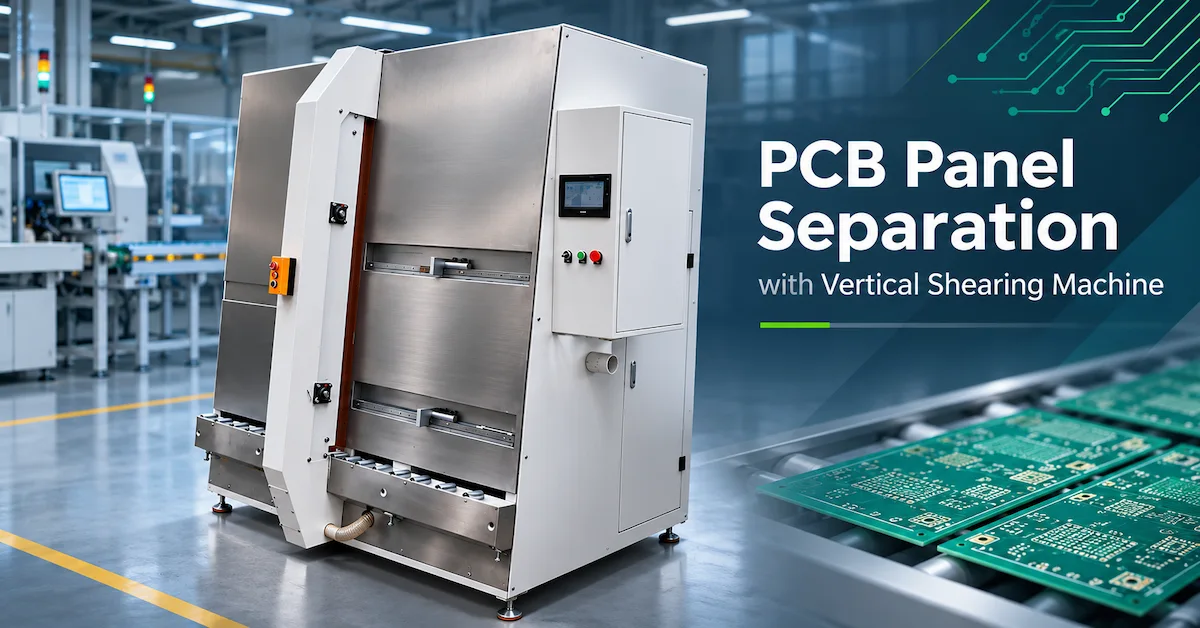
The CK-LS1300 Vertical Shearing Machine is presented as a floor-standing cutting system for controlled processing of suitable rigid PCB materials.
The product photographs show an industrial cabinet with metal enclosure panels, accessible service sections, a control interface, and a substantial lower cutting structure.
These features are relevant to factories requiring repeatable panel handling and a defined cutting workstation.
Main Equipment Features
| Feature | Published Information | Practical Value |
|---|---|---|
| Model | CK-LS1300 | Identifies the machine configuration |
| Cutting width | 1300mm | Supports relatively wide sheets |
| Cutting arrangement | Saw-blade-based cutting specifications | Requires blade and material qualification |
| Blade speed | 2400rpm | Defined spindle operating parameter |
| Adjustable cutting speed | 0–9.5m/min | Allows process-setting evaluation |
| Cabinet structure | Floor-standing industrial enclosure | Organized cutting and service areas |
| Vacuum connection | 75mm diameter | Basis for extraction-system planning |
| Pneumatic supply | 5–7kg/cm² | Requires suitable factory compressed air |
| Electrical supply | Three-phase, five-wire, 380V | Industrial power installation |
The machine is commercially described as a vertical shearing machine. However, its supplied technical sheet includes a rotating main saw blade, blade shaft, and spindle speed.
Therefore, buyers should verify the actual blade arrangement and cutting sequence rather than assuming it operates like a conventional straight guillotine shear.
3. CK-LS1300 Technical Specifications
The following specifications are taken from the supplied CK-LS1300 machine datasheet.
CK-LS1300 Machine Specification Table
| Technical Parameter | Published Specification |
|---|---|
| Machine model | CK-LS1300 |
| Electrical supply | 3-phase, 5-wire, 380V |
| Vacuum tube diameter | Ø75mm |
| Cutting width | 1300mm |
| Main saw blade diameter | Ø305mm |
| Saw blade thickness | 2.5mm |
| Main saw blade shaft diameter | Ø40mm |
| Main saw blade speed | 2400rpm |
| Spindle power | 3kW |
| Cutting speed | 0–9.5m/min |
| Total power | 5.2kW |
| Air pressure | 5–7kg/cm² |
| Minimum cutting size | 150 × 200mm |
| Maximum cutting size | 1300 × 1300mm |
| Material thickness range | 0.075–3.0mm |
| Published maximum shearing height | 30mm, including upper and lower pulp boards |
| Machine dimensions | 2100 × 1600 × 2100mm |
These values are published equipment specifications, not independently verified results. Actual material compatibility, finished-cut accuracy, machine capacity, and operating performance require application-specific testing.
Three Specifications Buyers Should Not Misinterpret
1. Cutting width is not the same as all usable sheet dimensions.
The 1300mm cutting width must be evaluated together with the loading method, material orientation, and the published minimum and maximum cutting sizes.
2. Saw blade thickness is not necessarily finished kerf width.
The published 2.5mm blade thickness describes a blade dimension. Actual material loss can depend on tooth geometry, runout, blade condition, and the cutting process.
3. Maximum shearing height is not the permitted PCB thickness.
The specification separately lists a 0.075–3.0mm material thickness range and a 30mm maximum shearing height that includes upper and lower pulp boards.
These limits describe different aspects of the cutting arrangement and should not be confused.
4. Which PCB Materials Are Suitable for the CK-LS1300?
Material compatibility should be established before comparing cutting speeds or equipment prices.
Rigid PCB materials can differ significantly in hardness, fiber content, metal layers, thickness, and mechanical behavior.
Material Compatibility Evaluation
| Material | Potential Cutting Application | Main Risk |
|---|---|---|
| FR4 laminate | Straight-line sheet cutting | Glass-fiber breakout and edge chipping |
| Copper-clad laminate | Raw material panel sizing | Copper burrs and surface damage |
| Multilayer rigid PCB | Qualified straight cutting | Layer separation and exposed copper damage |
| Thin rigid laminate | Sheet preparation | Flexing and handling deformation |
| Aluminum-core PCB | Application-specific cutting | Metal burrs and blade suitability |
| Specialty PCB laminate | Production blank preparation | Material-specific wear and edge quality |
| Populated PCBA | Requires separate engineering approval | Component damage and mechanical stress |
The published product data identifies rigid PCB cutting and a material thickness range, but it does not establish a complete list of qualified material constructions.
Consequently, copper-clad, aluminum-core, or specialty laminate applications should be verified with the equipment supplier.
Why Is FR4 Cutting Challenging?
FR4 contains glass-fiber reinforcement and epoxy resin.
During mechanical cutting, glass fibers can accelerate blade wear, while poorly controlled cutting conditions may create chipped edges or surface damage.
The appropriate blade should be selected according to the laminate thickness, material structure, spindle arrangement, and required edge condition.
A blade suitable for one material should not automatically be used for another.
5. How Do Saw Blade Specifications Affect Cutting Quality?
The cutting system is one of the most important technical elements of the CK-LS1300.
The published specification identifies a 305mm main saw blade operating at 2400rpm, with a listed blade thickness of 2.5mm and a 40mm main shaft diameter.
However, these dimensions alone do not establish the correct blade for a specific PCB material.
Saw Blade Selection Checklist
| Blade Parameter | What Buyers Should Confirm |
|---|---|
| Outside diameter | Compatibility with the Ø305mm configuration |
| Bore or mounting interface | Correct installation on the spindle arrangement |
| Blade thickness | Cutting clearance and material loss |
| Tooth geometry | Suitability for FR4 or the target laminate |
| Blade material | Wear resistance and cutting performance |
| Maximum rated speed | Compatibility with the actual spindle speed |
| Blade runout | Cutting consistency |
| Replacement procedure | Maintenance and operator requirements |
| Supplier identification | Spare-part availability and traceability |
Why Does Blade Condition Matter?
A worn or damaged blade can increase cutting force and worsen edge quality.
Possible symptoms include:
-
Chipped laminate edges.
-
Excessive glass-fiber breakout.
-
Increased cutting noise or vibration.
-
Unstable cutting load.
-
Greater burr formation.
-
Dimensional variation.
These symptoms do not always indicate blade wear alone. Workpiece support, feeding alignment, and machine condition should also be investigated.
For industrial procurement, request the recommended blade specifications and maintenance procedures as part of the equipment quotation.
6. How Should Buyers Evaluate 1300mm Cutting Capacity?
A wide cutting range can be valuable for factories preparing larger laminate sheets.
However, a machine's published maximum cutting size does not guarantee the same quality across all supported dimensions and materials.
The CK-LS1300 lists a cutting width of 1300mm, a minimum cutting size of 150 × 200mm, and a maximum cutting size of 1300 × 1300mm.
These dimensions provide a starting point for equipment matching.
Sheet Size Evaluation
| Production Requirement | Buyer Verification |
|---|---|
| Large laminate sheets | Confirm loading and usable cutting envelope |
| Small cut blanks | Verify minimum supported dimensions |
| Repeated rectangular formats | Check positioning and stop arrangements |
| Thin sheets | Evaluate clamping and material support |
| Maximum-size sheets | Test material handling and edge quality |
| Multiple output sizes | Confirm adjustment and changeover procedure |
Does a 1300mm Machine Always Offer Better Productivity?
Not necessarily.
If a factory primarily handles small panels, a larger cutting machine may introduce unnecessary space and handling requirements.
Conversely, a smaller machine may require additional cutting operations for larger sheets.
The appropriate cutting width depends on the factory's actual panel mix, desired blank dimensions, material utilization, and available workspace.
Buyers should review representative cutting layouts before selecting the equipment.
7. How Does Cutting Speed Affect Production Output?
The CK-LS1300 lists an adjustable cutting speed of 0–9.5m/min.
This should be understood as a published operating-speed range, not a guaranteed finished-panel production rate.
Actual production output depends on several factors:
-
Sheet loading and positioning.
-
Cutting length.
-
Selected cutting speed.
-
Material thickness and construction.
-
Blade condition.
-
Unloading and handling.
-
Quality inspection.
-
Machine adjustment and maintenance.
A useful calculation is:
Total Cutting Cycle Time = Loading + Alignment + Cutting + Unloading + Required Inspection
Production managers should then calculate accepted output according to the actual number of conforming cut sheets.
Why Is Maximum Speed Not Always Optimal?
Higher cutting speed may reduce processing time, but excessive speed can affect edge quality or increase cutting load under unsuitable conditions.
For abrasive laminates, blade geometry, feed speed, and support should be evaluated together.
The correct process setting is the one that consistently meets the required dimensions and edge-quality standards.
8. Vertical Shearing vs CNC Routing vs V-CUT: Which Process Fits?
PCB manufacturers often need different cutting technologies at different production stages.
A straight-line sheet-cutting machine is not a universal substitute for CNC routing, V-CUT, or laser processing.
PCB Cutting Process Comparison
| Processing Method | Suitable Application | Main Limitation |
|---|---|---|
| CK-LS1300-style straight cutting | Qualified rigid sheet sizing and straight cuts | Not intended for arbitrary contour geometry |
| CNC routing | Complex outlines, internal slots and profiles | Tool wear, dust and cutting time |
| V-CUT scoring | Controlled V-groove preparation | Requires compatible straight score patterns |
| V-CUT separation | Separating suitable pre-scored panels | Depends on board and score design |
| Laser cutting | Selected fine or low-contact applications | Material-specific thermal effects |
| Punching | Repeated fixed shapes | Dedicated tooling and changeover cost |
When Should a PCB Factory Choose Straight-Line Cutting?
It is worth considering when the main requirement is preparing rigid sheets or producing qualified straight cuts with consistent dimensions.
When the finished PCB requires complex outside profiles or internal slots, a PCB drilling and routing machine may be more suitable.
For panels that require controlled V-groove separation, a dedicated V-CUT solution may deserve consideration.
This distinction helps buyers avoid purchasing equipment that cannot complete the intended manufacturing operation.
9. How to Control PCB Cutting Quality
For industrial PCB manufacturing, consistent edge quality and dimensional control are important for downstream processing.
A poor cut may affect panel handling, registration, or subsequent operations.
Recommended Cutting Quality Checklist
| Quality Item | Inspection Objective |
|---|---|
| Cut dimensions | Conformity with the approved drawing |
| Straightness | Consistency along the cutting path |
| Edge quality | Acceptable chipping, burrs and fiber breakout |
| Copper condition | No unacceptable damage to copper layers |
| Laminate integrity | No unacceptable cracks or delamination |
| Surface cleanliness | Controlled cutting debris |
| Panel flatness | No unacceptable deformation |
| Repeatability | Consistency across repeated samples |
| Material utilization | Reasonable cutting allowance and scrap control |
What Standards Should Buyers Consider?
For raw laminate materials, the applicable material specification and customer purchasing requirements should form the basis of acceptance.
IPC-4101, which addresses base materials for rigid and multilayer printed boards, may be relevant to laminate material selection.
For finished printed boards, applicable editions of IPC-A-600 and IPC-6012 can provide additional quality references.
These documents do not independently certify a cutting machine or establish universal cutting tolerances.
Acceptance limits should always be agreed according to the actual material, intended production stage, and customer drawings.
10. Dust Extraction, Operator Safety, and Maintenance
Mechanical cutting of glass-fiber-reinforced laminate can generate dust and debris.
This makes extraction and cutting-area control important during machine evaluation.
The CK-LS1300 specification identifies a 75mm vacuum connection.
However, this connection diameter does not establish the required airflow, filtration performance, or complete extraction-system configuration.
Factory Utility and Safety Checklist
| Requirement | Published Information or Buyer Check |
|---|---|
| Electrical system | Three-phase, five-wire, 380V |
| Total machine power | 5.2kW |
| Pneumatic supply | 5–7kg/cm² |
| Vacuum connection | Ø75mm |
| Machine dimensions | 2100 × 1600 × 2100mm |
| Dust extraction | Confirm airflow, filtration and included equipment |
| Blade guarding | Verify protective systems and interlocks |
| Emergency stop | Demonstrate actual function |
| Maintenance access | Confirm safe blade inspection and replacement |
| Spare parts | Request blade and wear-component information |
Why Is Machine Safety Documentation Important?
An enclosed cabinet can provide a more defined production environment, but the presence of enclosure panels does not by itself establish machine safety compliance.
Buyers should request applicable safety documentation, operating instructions, electrical drawings, and protective-system information.
Relevant industrial machinery safety frameworks may include ISO 12100 for risk assessment and IEC 60204-1 for electrical equipment of machines, where applicable.
Before installation, confirm the destination country's safety and electrical requirements.
11. Factory Acceptance Test: How to Qualify the CK-LS1300
A Factory Acceptance Test (FAT) helps verify that the proposed equipment meets the agreed requirements before shipment.
For the CK-LS1300, the FAT should focus on actual laminate cutting performance rather than general machine appearance.
Recommended FAT Checklist
| Test Item | Verification Method |
|---|---|
| Machine model | Confirm CK-LS1300 configuration |
| Cutting width | Demonstrate required cutting dimensions |
| Material thickness | Test actual customer material |
| Blade specification | Confirm dimensions and approved blade type |
| Cutting speed | Verify the required operating range |
| Edge quality | Inspect chipping, burrs and fiber damage |
| Dimensional accuracy | Measure finished samples |
| Cutting consistency | Compare multiple cuts |
| Material support | Check alignment and workpiece movement |
| Dust extraction | Test the proposed extraction setup |
| Safety functions | Verify guarding, interlocks and emergency stops |
| Utilities | Confirm electrical and pneumatic requirements |
| Documentation | Review manuals, maintenance and warranty terms |
Practical Sample-Cutting Procedure
Step 1 — Provide Representative Materials
Supply the actual laminate grade, thickness, copper construction, and sheet dimensions.
Step 2 — Define Acceptance Criteria
Specify cut size, dimensional tolerance, edge condition, and maximum permitted defects.
Step 3 — Establish Cutting Parameters
Use an approved blade and record the cutting settings.
Step 4 — Produce Repeated Samples
Test representative sheet sizes and material thicknesses.
Step 5 — Inspect Results
Measure dimensions and inspect cut edges, laminate condition, and material handling.
Step 6 — Confirm the Production Cycle
Measure loading, cutting, unloading, and relevant inspection time.
Step 7 — Document Approval
Record the machine configuration, blade specification, approved material range, and acceptance results.
This provides a stronger basis for purchasing than relying solely on catalog specifications.
12. How to Calculate the Total Cost of PCB Sheet Cutting
The machine purchase price is only one part of the production investment.
Factories should also consider consumables, utilities, labor, material loss, maintenance, and rejected sheets.
Main Cost Factors
| Cost Factor | Purchasing Consideration |
|---|---|
| Equipment price | Base machine and included components |
| Saw blades | Replacement frequency and unit cost |
| Material loss | Kerf and cutting allowance |
| Labor | Loading, setup and unloading |
| Electricity | Actual power consumption |
| Compressed air | Facility supply requirements |
| Dust extraction | Equipment, filters and maintenance |
| Quality inspection | Measurement and rejection handling |
| Maintenance | Downtime and spare parts |
| Installation | Floor space and commissioning |
A useful cost metric is:
Cutting Cost per Accepted Sheet = Total Allocated Cutting Expenditure ÷ Number of Accepted Cut Sheets
This helps compare equipment based on actual manufacturing output.
Why Material Yield Matters
If cutting requires a large material allowance or creates excessive rejected sheets, the operating cost can increase significantly.
For expensive laminates, optimizing sheet layouts and cutting quality may be more valuable than maximizing cutting speed.
Buyers should therefore evaluate material utilization and acceptable production output together.
13. What Should Overseas Buyers Ask Before Requesting a Quote?
An effective request for quotation should provide enough technical information for the supplier to evaluate the application.
PCB Raw Material Cutting Machine RFQ Checklist
| RFQ Information | What to Provide |
|---|---|
| Material | FR4, copper-clad laminate or other rigid material |
| Material grade | Relevant laminate specification |
| Thickness | Minimum, nominal and maximum |
| Original sheet size | Length and width |
| Required blank size | Final cutting dimensions |
| Cutting pattern | Straight cuts and layout requirements |
| Cutting tolerance | Dimensional and edge-quality limits |
| Production volume | Sheets per hour or shift |
| Existing process | Manual cutting, saw cutting or other method |
| Current problems | Chipping, dust, material waste or downtime |
| Utility information | Power and compressed-air availability |
| Factory space | Installation and loading clearance |
| Quality requirements | Sample testing and FAT acceptance |
| Commercial terms | Quantity, delivery destination and service scope |
Can the CK-LS1300 Be Customized?
Possible project discussions include loading arrangement, feeding direction, safety guarding, extraction interfaces, controls, and integration with surrounding equipment.
However, customization availability, pricing, and engineering limitations should be confirmed directly with CHIKIN CNC.
The standard model's published dimensions and operating requirements should remain the reference until a customized specification is formally approved.
14. Why Consider CHIKIN CNC for PCB Cutting Equipment?
Shenzhen ChiKin Automation Equipment Co., Ltd. provides PCB manufacturing equipment and industrial automation solutions, including drilling, routing, cutting, and related production systems.
For PCB factories evaluating the CK-LS1300, the main advantage of a technical supplier discussion is the opportunity to match the cutting process to actual panel requirements.
Rather than selecting a machine by maximum cutting width alone, buyers should evaluate material construction, blade compatibility, production volume, edge quality, and factory installation requirements.
CHIKIN CNC's broader PCB manufacturing equipment portfolio also allows manufacturers to consider other processes when straight-line cutting is not suitable.
For additional company information, review the CHIKIN CNC manufacturing and service capabilities.
Request a CK-LS1300 Technical Evaluation and Quotation
Are you planning to cut large FR4 sheets, rigid PCB material, or qualified copper-clad laminates?
Prepare your panel dimensions, material thickness, cutting requirements, and expected production output.
Contact CHIKIN CNC to Request a CK-LS1300 Configuration Review and Quotation.
Providing actual sheet drawings and material information helps establish whether the CK-LS1300 meets your manufacturing needs and what should be verified during sample cutting.
15. Frequently Asked Questions About PCB Raw Material Cutting Machines
1. What is the CK-LS1300 vertical shearing machine used for?
The CK-LS1300 is presented as an industrial cutting machine for suitable rigid PCB materials and panel-processing applications. Its published specifications identify a 1300mm cutting width, rotating saw blade, and adjustable cutting speed.
2. What is the maximum cutting size of the CK-LS1300?
The supplied specification lists a maximum cutting size of 1300 × 1300mm and a minimum size of 150 × 200mm. Actual loading, cutting orientation, and material compatibility should be confirmed.
3. What PCB material thickness can the machine process?
The published material thickness range is 0.075–3.0mm. This does not guarantee identical cutting performance across all material types. Application-specific sample testing is recommended.
4. What saw blade does the CK-LS1300 use?
The specification lists a 305mm main saw blade with 2.5mm blade thickness, a 40mm main shaft diameter, and a spindle speed of 2400rpm. The blade's actual mounting and cutting geometry should be confirmed.
5. Can the CK-LS1300 cut FR4 sheets?
FR4 is a relevant rigid PCB material for evaluating the machine. Buyers should verify the actual laminate thickness, blade suitability, edge quality, and cutting dimensions using representative samples.
6. Is this machine suitable for populated PCBA depaneling?
Not automatically. The machine's published specifications concern rigid board cutting and a blade-based process. Populated PCBA separation requires specific engineering approval because components and solder joints may be sensitive to mechanical stress.
7. What is the maximum cutting speed?
The published adjustable cutting speed is 0–9.5m/min. This is not a guaranteed finished-sheet production rate. Actual output depends on material, cutting length, loading, unloading, and inspection.
8. Does the 30mm shearing height mean it can cut 30mm-thick PCB material?
No. The datasheet specifies a 30mm shearing height including upper and lower pulp boards, while the material thickness range is separately listed as 0.075–3.0mm.
9. What electrical and pneumatic supply does the CK-LS1300 require?
The published specification lists three-phase, five-wire, 380V electrical supply and 5–7kg/cm² air pressure. The total power is listed as 5.2kW. Installation requirements should be confirmed against the delivered configuration.
10. How can overseas buyers request a CK-LS1300 quotation?
Provide material type, sheet dimensions, thickness, required cutting sizes, edge-quality requirements, production volume, electrical supply, and delivery destination. Contact CHIKIN CNC to review technical suitability, sample-cutting requirements, and current commercial terms.
Conclusion
Choosing the right PCB raw material cutting machine requires more than comparing machine size, cutting speed, or purchase price.
For PCB manufacturers, the most important factors are material compatibility, cutting dimensions, blade performance, edge quality, production consistency, and operating cost.
The CHIKIN CNC CK-LS1300 Vertical Shearing Machine provides a published configuration featuring a 1300mm cutting width, 305mm main saw blade, 0.075–3.0mm material thickness range, and adjustable cutting speed of 0–9.5m/min.
These specifications make it a relevant candidate for factories evaluating straight-line cutting of suitable rigid PCB materials and laminate sheets.
However, successful equipment selection depends on verifying the actual cutting process, material support, dimensional results, blade condition, extraction requirements, and accepted production output.
By using representative material samples and a documented factory acceptance procedure, manufacturers can reduce procurement uncertainty and establish a more reliable cutting workflow.
CHIKIN CNC provides PCB manufacturing and industrial processing equipment for customers evaluating production improvements.
Explore the CHIKIN CNC product range or contact CHIKIN CNC for a CK-LS1300 technical evaluation and quotation.
Share your FR4 or rigid PCB material specifications, sheet sizes, cutting requirements, and target production volume to begin an application-based equipment discussion.