



TL;DR — Quick Answer
A PCB circuit board deburring machine removes unwanted burrs, rough surface irregularities, and loose particles from suitable printed circuit boards through a controlled finishing process. For PCB factories, properly qualified deburring helps improve board handling, reduce manual rework, and prepare components for subsequent manufacturing operations.
The CHIKIN CNC CK-650 is a conveyor-type PCB deburring machine with a published grinding-thickness range of 0.4–3.0mm, adjustable conveyor speed of 0–12m/min, 3kW power rating, and included vacuum cleaner.
For industrial buyers, the most important factors are board compatibility, actual burr-removal performance, copper and laminate protection, dust extraction, and accepted production throughput.
This guide explains how to evaluate the CK-650, understand its operating specifications, compare deburring methods, and establish reliable factory acceptance criteria.
Key Takeaways
-
Core application: The CK-650 is intended for controlled grinding, scrubbing, and deburring of compatible PCB materials.
-
Processing thickness: The published grinding-thickness range is 0.4–3.0mm.
-
Conveyor system: Adjustable conveying speed ranges from 0 to 12m/min.
-
Dust extraction: A vacuum cleaner is listed as included, with a 76mm vacuum connection.
-
Production quality: Burr removal must not introduce unacceptable copper damage, laminate scratches, or dimensional changes.
-
Buying recommendation: Verify the internal finishing mechanism, usable board dimensions, and actual sample quality before purchasing.
1. What Is a PCB Circuit Board Deburring Machine?
A PCB circuit board deburring machine is industrial equipment used to remove unwanted material projections, roughness, and certain processing residues from printed circuit boards.
These defects may appear after drilling, routing, cutting, or other mechanical manufacturing operations.
Depending on its configuration, a deburring machine may use brushing, grinding, scrubbing, or another controlled surface-finishing method.
Why Is PCB Deburring Important?
PCB manufacturing requires not only accurate drilling and routing but also controlled board surfaces and edges.
Unwanted burrs and loose particles can cause manufacturing difficulties such as:
-
Interference during board handling and fixture loading.
-
Surface contamination during downstream processing.
-
Additional manual inspection or cleanup.
-
Inconsistent edge conditions.
-
Risk of damage to nearby copper or laminate features.
-
Increased rework and rejected panels.
A qualified deburring process helps manufacturers establish more consistent finishing conditions.
However, deburring is not the same as final cleaning, and the absence of visible burrs does not automatically mean the board meets every cleanliness requirement.
2. Which PCB Manufacturers Need the CK-650?
The CK-650 is relevant to PCB manufacturers looking for a conveyor-based finishing station for suitable board materials.
| Customer Type | Application | Main Requirement |
|---|---|---|
| Single-sided PCB factories | Controlled surface and edge finishing | Consistent burr removal |
| Double-sided PCB manufacturers | Processing compatible copper-clad boards | Copper surface protection |
| Multilayer PCB factories | Post-machining finishing | Laminate integrity |
| FR4 board manufacturers | Fiberglass laminate deburring | Fiber-breakout control |
| PCB routing workshops | Removing suitable routing-related burrs | Edge consistency |
| PCB production engineers | Process standardization | Repeatable settings |
| Equipment procurement managers | Production-line investment | Quality and total cost |
Which Applications Need Additional Evaluation?
The suitability of a PCB deburring machine depends on the processing stage.
For example, a bare PCB with exposed copper surfaces presents different risks from a finished, solder-masked board.
Populated PCB assemblies require particular caution because a grinding or scrubbing mechanism may damage components, solder joints, or protective coatings.
The CK-650 should not be assumed suitable for populated PCBA processing without application-specific approval.
3. CHIKIN CNC CK-650 Technical Specifications
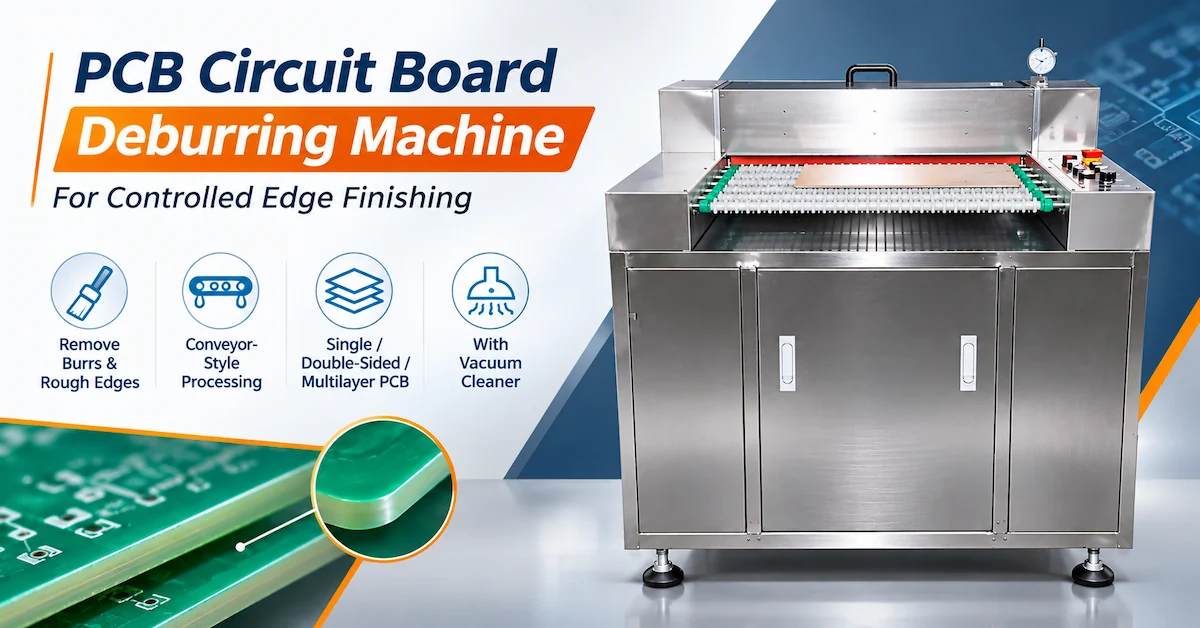
The CHIKIN CNC PCB Circuit Board Deburring Machine is presented as an enclosed industrial system with conveyor-style material handling and a separate control area.
Its supplied specification identifies the following characteristics.
CK-650 Machine Specification Table
| Technical Parameter | Published Specification |
|---|---|
| Machine model | CK-650 |
| Equipment type | PCB deburring / scrubbing machine |
| Working table | 0–650mm (custom) |
| Minimum grinding | 160mm |
| Grinding length | Listed as unlimited |
| Grinding thickness | 0.4–3.0mm |
| Conveyor speed | 0–12m/min |
| Power supply | AC380V / 50Hz |
| Power rating | 3kW |
| Machine dimensions | 1550 × 970 × 1100mm |
| Operating air pressure | 0.5–0.8MPa |
| Vacuum cleaner port diameter | 76mm |
| Machine weight | Approximately 350kg |
| Belt type | A1750 |
| Vacuum cleaner | Included |
Specifications are based on the supplied CK-650 product datasheet. Actual board compatibility, usable processing dimensions, internal tooling, and production capacity should be confirmed before purchase.
Three Specifications That Require Clarification
1. Working table: 0–650mm (custom)
This does not independently establish the maximum usable processing width for every configuration. The buyer should request a drawing identifying the actual conveyor and finishing width.
2. Minimum grinding: 160mm
The source does not explain which workpiece dimension this value describes. It should not automatically be interpreted as minimum board width or length.
3. Grinding length: unlimited
This likely refers to the absence of a fixed programmed length limit in a continuous-feed arrangement. In practice, board support, feeding, handling, and factory layout determine what lengths can be processed.
These details should be confirmed in the final technical specification.
4. How Does a Conveyor PCB Deburring Machine Work?
A conveyor-based PCB deburring system moves the workpiece through a defined processing area.
The CK-650 photographs show a conveyor-style feeding section, enclosed processing chamber, side-mounted controls, and maintenance access panels.
The exact internal grinding or scrubbing mechanism is not fully identified in the supplied information.
A typical evaluation workflow is outlined below.
Step 1: Board Preparation
The operator verifies the PCB material, thickness, dimensions, and type of burr or surface defect.
Step 2: Machine Setup
The machine is configured according to the approved board-processing requirements.
The conveyor and finishing system must be compatible with the workpiece.
Step 3: Board Loading
Boards are introduced into the feeding section using the approved orientation and support arrangement.
Step 4: Controlled Processing
The conveyor moves the board through the deburring or scrubbing area at the selected speed.
The actual amount of material removal depends on the internal tool configuration and operating conditions.
Step 5: Debris Extraction
The vacuum extraction system removes applicable grinding debris.
Extraction effectiveness must be verified through testing.
Step 6: Quality Inspection
Finished boards are inspected for burr removal, surface condition, dimensional changes, and unwanted material damage.
The complete workflow should be validated on representative production material.
5. How to Select Conveyor Speed for PCB Deburring
The CK-650 lists a conveyor-speed range of 0–12m/min.
This provides an adjustable transport parameter, but it does not establish a guaranteed finishing speed or number of boards processed per hour.
Why Does Conveyor Speed Matter?
Conveyor speed affects the time a board spends in the processing zone.
If the machine uses a fixed finishing mechanism, changing feed speed can influence processing exposure.
However, the relationship between conveyor speed and material removal depends on the actual deburring configuration.
| Conveyor Condition | Main Evaluation |
|---|---|
| Lower feed speed | Check for excessive material removal or surface damage |
| Intermediate speed | Evaluate consistency and process stability |
| Higher feed speed | Verify sufficient burr removal |
| Frequent speed changes | Check control stability and repeatability |
| Continuous production | Measure accepted output and handling gaps |
How Should Buyers Determine the Correct Speed?
Start with the supplier's recommended operating conditions for the actual PCB material.
Process sample boards and compare results.
Inspect burr removal, copper surfaces, laminate condition, and dimensional consistency.
Select the operating range that meets the required acceptance criteria.
Maximum conveyor speed should not be treated as maximum qualified production speed.
6. FR4, Double-Sided, and Multilayer PCB Compatibility
Different PCB constructions respond differently to mechanical surface treatment.
Material Compatibility Matrix
| PCB Material | Processing Concern | Recommended Validation |
|---|---|---|
| FR4 laminate | Fiberglass breakout and surface scratches | Edge and laminate inspection |
| Single-sided PCB | Copper-side protection | Surface integrity |
| Double-sided PCB | Damage to either copper surface | Inspection of both sides |
| Multilayer PCB | Board integrity and exposed copper features | Dimensional and material checks |
| Thin rigid PCB | Flexing and conveyor support | Feeding stability |
| Thick rigid PCB | Finishing engagement and clearance | Full-thickness testing |
| Metal-core PCB | Metal burrs and tool compatibility | Separate material qualification |
Can the CK-650 Process Copper-Clad Boards?
Copper-clad materials are relevant to the product category, but compatibility depends on the exact scrubbing method and surface condition.
A process suitable for removing burrs from an unfinished laminate may not be suitable for delicate copper traces or finished solder-mask surfaces.
Buyers should provide actual board samples with the relevant layer construction.
Why Does PCB Thickness Matter?
The CK-650 lists a grinding-thickness range of 0.4–3.0mm.
Thin boards may require careful support to prevent bending or feeding instability.
Thicker boards may have different clearance and contact requirements.
The listed range should be validated for the actual PCB construction, rather than assuming identical results across all materials.
7. PCB Deburring vs Chamfering vs CNC Routing
Deburring, chamfering, and routing are related manufacturing operations, but they perform different functions.
PCB Processing Comparison
| Process | Main Purpose | Typical Result | Key Limitation |
|---|---|---|---|
| PCB deburring | Remove burrs and unwanted projections | Improved surface or edge condition | Cannot automatically create complex board shapes |
| PCB chamfering | Create a specified bevel or rounded edge | Controlled corner or edge profile | Requires suitable tooling |
| CNC routing | Machine outlines, slots and profiles | Programmed board geometry | Tool wear and mechanical cutting forces |
| PCB cleaning | Remove specified particles or residues | Cleaner workpiece condition | Does not necessarily remove attached burrs |
When Should a Factory Choose Deburring?
A deburring machine is worth considering when the geometry has already been produced and the remaining problem involves unwanted burrs, roughness, or suitable surface residues.
For consistent corner-radius processing, a dedicated PCB Chamfering Machine may be more appropriate.
For complex board outlines or internal openings, factories should evaluate PCB drilling and routing equipment.
The best process depends on the actual defect and finished-board requirements.
8. How Does Dust Extraction Affect PCB Deburring Quality?
Mechanical PCB finishing can generate fiberglass, resin, copper, or other material particles depending on the workpiece and processing method.
Dust management is therefore an important part of machine evaluation.
The CK-650 specification lists a 76mm vacuum connection and an included vacuum cleaner.
These are useful procurement details, but they do not establish the filtration efficiency or extraction airflow.
Dust Extraction Evaluation Checklist
| Item | What Buyers Should Confirm |
|---|---|
| Vacuum port | 76mm published diameter |
| Vacuum cleaner | Included equipment configuration |
| Extraction airflow | Required and available airflow |
| Filter system | Filtration type and maintenance |
| Dust collection | Collection and disposal method |
| Chamber sealing | Potential leakage and cleaning access |
| Maintenance | Filter replacement and cleaning procedures |
| Workplace requirements | Applicable dust-control and safety obligations |
Is an Included Vacuum Cleaner Enough?
Not necessarily.
Extraction performance depends on the amount and type of debris generated, equipment design, airflow, filtration, and maintenance.
Buyers should request a demonstration using the actual PCB material.
The presence of a vacuum cleaner does not eliminate the need for downstream cleanliness inspection.
9. How to Evaluate PCB Deburring Quality
A successful deburring operation must remove the unwanted defect without damaging the functional board.
The inspection plan should be defined before production testing.
Quality Control Checklist
| Inspection Item | Acceptance Requirement |
|---|---|
| Burr removal | No unacceptable remaining burrs |
| Edge condition | Acceptable roughness and fiber condition |
| Copper surface | No unintended scratches or material loss |
| Solder mask | No unacceptable coating damage, where applicable |
| Laminate integrity | No cracking or delamination |
| Board dimensions | Conformity with approved drawings |
| Surface particles | Meets the specified cleanliness requirement |
| Processing consistency | Repeatable results across samples |
| Conveyor handling | No unacceptable board deformation |
What Standards Should Buyers Consider?
For finished printed boards, applicable editions of IPC-A-600, Acceptability of Printed Boards, and IPC-6012, Qualification and Performance Specification for Rigid Printed Boards, may provide relevant quality references alongside customer specifications.
The applicable requirements depend on the board type, acceptance class, and production stage.
These standards do not certify the CK-650 or establish a universal permissible deburring depth.
How Can Factories Prevent Over-Processing?
Begin with the actual defect.
Determine whether the objective is removing an edge burr, treating a suitable surface irregularity, or eliminating loose particles.
Set an agreed limit on acceptable material removal.
Then compare sample results under controlled operating conditions.
If the finishing process damages copper or laminate surfaces, the equipment configuration should be reassessed.
10. How to Calculate Actual CK-650 Production Capacity
Production capacity should be based on accepted boards rather than conveyor speed alone.
The complete operation includes loading, feeding, finishing, unloading, and applicable inspection.
Main Throughput Factors
| Factor | Production Impact |
|---|---|
| Conveyor speed | Controls board transport |
| Board length | Influences feed occupancy |
| Spacing between panels | Affects continuous-flow capacity |
| Processing effectiveness | Determines approved operating speed |
| Loading and unloading | May limit line output |
| Board rejection | Reduces accepted production |
| Maintenance | Creates possible downtime |
| Product changes | Require setup adjustment |
For a simplified continuous-feed system:
Theoretical Panel Rate = Conveyor Speed ÷ (Board Length + Required Panel Spacing)
All dimensions must use consistent units.
This formula only estimates the transport rate. It does not include rejects, equipment stops, processing limitations, or downstream bottlenecks.
For purchasing decisions, measure:
Accepted Production Output = Processed Boards × Acceptance Rate
The final cycle-time and output figures should be confirmed during a representative factory trial.
11. CK-650 Installation, Maintenance, and Safety Requirements
The CK-650 is a floor-standing industrial machine requiring electrical power, compressed air, and dust extraction.
Published Installation Specifications
| Requirement | CK-650 Specification |
|---|---|
| Electrical supply | AC380V / 50Hz |
| Power | 3kW |
| Air pressure | 0.5–0.8MPa |
| Machine size | 1550 × 970 × 1100mm |
| Machine weight | Approximately 350kg |
| Vacuum connection | 76mm |
| Vacuum cleaner | Included |
Before installation, confirm the final electrical arrangement, compressed-air consumption, extraction configuration, and necessary service clearances.
What Maintenance Should Be Planned?
Depending on the installed mechanism, maintenance may involve:
-
Inspecting finishing tools and wear components.
-
Cleaning conveyor and support surfaces.
-
Checking conveyor alignment and tension.
-
Inspecting dust-extraction connections.
-
Replacing applicable filters.
-
Checking pneumatic components.
-
Verifying guarding and safety controls.
The A1750 belt designation should be clarified with the supplier before ordering replacement parts.
What Safety Checks Are Necessary?
Industrial deburring equipment may involve moving conveyor components, abrasive tools, dust, and pneumatic systems.
Buyers should verify emergency stops, moving-part guards, safe maintenance access, and electrical protection.
ISO 12100 and IEC 60204-1 are relevant machinery safety references where applicable.
Compliance or certification should only be claimed when supported by appropriate documentation for the actual machine.
12. CK-650 Factory Acceptance Test: What Should Buyers Verify?
A Factory Acceptance Test (FAT) should determine whether the proposed machine meets the agreed production requirements.
The test should use actual PCB materials and clearly defined inspection criteria.
Recommended CK-650 FAT Checklist
| Test Item | Recommended Verification |
|---|---|
| Machine identity | Confirm CK-650 configuration |
| Working width | Verify required board dimensions |
| Minimum processing dimension | Clarify and test the published 160mm parameter |
| Board thickness | Test representative boards within 0.4–3.0mm |
| Conveyor speed | Verify required operating settings |
| Processing method | Demonstrate the actual finishing mechanism |
| Burr removal | Inspect defects before and after processing |
| Copper integrity | Check for unacceptable damage |
| Laminate condition | Inspect scratches and fiber breakout |
| Vacuum system | Demonstrate extraction performance |
| Continuous feeding | Test repeated board transport |
| Production output | Measure accepted boards per hour |
| Safety functions | Verify guarding and emergency controls |
| Documentation | Review operating and maintenance instructions |
Recommended Sample Validation Procedure
Step 1: Provide representative boards, including different thicknesses and surface conditions.
Step 2: Record the existing burrs or defects before processing.
Step 3: Establish the proposed finishing settings.
Step 4: Process a controlled sample batch.
Step 5: Inspect copper surfaces, laminate condition, burr removal, and remaining particles.
Step 6: Repeat the process at the relevant production speeds.
Step 7: Record accepted output, defects, cleaning requirements, and machine operating conditions.
The acceptance report should identify which materials and settings were successfully qualified.
13. What Determines PCB Deburring Machine Price?
The initial equipment price is only one part of the purchasing decision.
Factories should also consider operating costs, finishing-tool wear, dust collection, labor, inspection, and board rejection.
Total Cost of Ownership Checklist
| Cost Factor | Buyer Consideration |
|---|---|
| Equipment price | Included machine configuration |
| Finishing tools | Consumable and replacement cost |
| Conveyor components | Belt and wear-part maintenance |
| Electrical consumption | Operating expenditure |
| Compressed air | Utility costs |
| Vacuum extraction | Filter and maintenance expenses |
| Labor | Loading and inspection |
| Quality control | Measurement and documentation |
| Scrap | Damaged or rejected boards |
| Downtime | Maintenance and changeovers |
| Delivery | Packaging, installation and training scope |
A useful economic indicator is:
Deburring Cost per Accepted Board = Total Allocated Deburring Cost ÷ Number of Accepted Boards
This allows factories to compare manual finishing and industrial deburring equipment using actual production results.
Is Faster Conveying Always More Economical?
No.
A higher conveyor speed may reduce contact time and leave unwanted burrs.
A lower speed may increase processing exposure or create additional surface damage.
The most economical process is the one producing consistently acceptable boards at an appropriate operating cost.
14. CK-650 RFQ Checklist for Overseas PCB Manufacturers
A complete request for quotation helps suppliers determine whether the CK-650 can meet the buyer's needs.
| RFQ Information | Details to Provide |
|---|---|
| PCB type | Single-sided, double-sided, multilayer, or other |
| Material | FR4, copper-clad laminate, or specified construction |
| Board dimensions | Minimum and maximum width and length |
| Board thickness | Actual production range |
| Existing defect | Edge burrs, surface irregularities, loose particles |
| Surface condition | Bare copper, solder mask, or other finish |
| Finishing requirement | Required before-and-after quality |
| Production volume | Boards per hour or shift |
| Conveyor requirements | Feed direction and line integration |
| Dust control | Facility extraction and cleanliness requirements |
| Factory utilities | Power and compressed air |
| Acceptance criteria | Inspection methods and sample tests |
| Commercial requirements | Quantity, shipment destination and service scope |
Why Consider CHIKIN CNC?
CHIKIN CNC, operated by Shenzhen ChiKin Automation Equipment Co., Ltd., supplies PCB manufacturing and related industrial automation equipment.
Its product range includes PCB drilling, routing, cutting, and specialized processing equipment.
The CK-650 is relevant to factories evaluating conveyor-based deburring and scrubbing operations.
For general selection considerations, buyers can also review CHIKIN's PCB Deburring Equipment Supplier Guide.
The most useful purchasing approach is to confirm the machine's real processing mechanism and evaluate actual PCB samples before approving the equipment.
Request a CK-650 Technical Evaluation and Quotation
Are you planning to reduce manual PCB deburring, improve edge consistency, or introduce a conveyor-based finishing station?
Provide your board dimensions, laminate construction, current burr problem, surface-quality requirements, and target production output.
Review the CHIKIN CNC CK-650 PCB Deburring Machine.
Contact CHIKIN CNC for a CK-650 Configuration Review and Quotation.
A complete application brief helps clarify equipment compatibility, processing limitations, and the appropriate factory acceptance tests.
15. Frequently Asked Questions About PCB Deburring Machines
1. What is a PCB circuit board deburring machine used for?
It is used to remove unwanted burrs, roughness, and suitable processing residues from printed circuit boards. The exact function depends on the installed finishing mechanism and material.
2. What is the processing thickness of the CK-650?
The published grinding-thickness range is 0.4–3.0mm. Actual compatibility should be verified for the customer's board construction and surface condition.
3. What is the maximum conveyor speed of the CK-650?
The specification lists an adjustable conveyor speed of 0–12m/min. This does not guarantee the same speed can be used for every PCB material or finishing requirement.
4. Can the CK-650 process multilayer PCBs?
Multilayer PCB processing is included in the product's application positioning. However, the actual laminate structure, copper condition, thickness, and required surface quality must be qualified before production.
5. Does the CK-650 include a vacuum cleaner?
Yes. The supplied specification lists a vacuum cleaner as included and identifies a 76mm vacuum connection. Filter performance and extraction capacity should be confirmed.
6. What does unlimited grinding length mean?
The datasheet lists grinding length as unlimited, but this should not be interpreted literally. Practical processing length depends on continuous feeding, workpiece support, conveyor arrangement, and factory layout.
7. What is the difference between PCB deburring and PCB chamfering?
Deburring removes unwanted projections and roughness. Chamfering creates a specified beveled or rounded edge geometry. Different equipment may be required depending on the intended result.
8. Can a PCB deburring machine damage copper surfaces?
Yes. Unsuitable grinding or scrubbing conditions can create scratches or unwanted material removal. Copper compatibility must be verified through sample testing.
9. What factory utilities does the CK-650 require?
The published specification lists AC380V/50Hz electrical supply, 3kW power, and 0.5–0.8MPa air pressure. The final utility requirements should be confirmed for the ordered configuration.
10. How can overseas buyers request a CK-650 quotation?
Provide the board material, dimensions, thickness, existing defects, required finishing quality, production volume, and factory conditions. Contact CHIKIN CNC to discuss processing compatibility, sample validation, and equipment pricing.
Conclusion
Selecting a suitable PCB circuit board deburring machine requires a clear understanding of the PCB material, existing defects, finishing method, conveyor configuration, dust extraction, and quality-control requirements.
The CHIKIN CNC CK-650 provides a published configuration featuring a 0.4–3.0mm grinding-thickness range, adjustable conveyor speed of 0–12m/min, 3kW power rating, and an included vacuum cleaner.
These features make it a relevant candidate for PCB manufacturers evaluating controlled conveyor-based finishing.
However, purchasing decisions should not rely solely on nominal conveyor speed, processing width, or machine appearance.
Buyers should confirm the actual deburring mechanism, usable board dimensions, material compatibility, surface-protection requirements, and accepted production output.
A documented factory acceptance test using representative PCB samples provides stronger evidence of machine suitability.
For manufacturers seeking consistent PCB finishing and reduced dependence on manual rework, CHIKIN CNC provides a dedicated equipment option within its broader PCB manufacturing portfolio.
Explore the CHIKIN CNC PCB Deburring Machine or review the company's manufacturing and service capabilities.
Contact CHIKIN CNC for an Application-Specific CK-650 Technical Review and Quotation and share your PCB material specifications, board sizes, finishing requirements, and target production volume.
The right combination of qualified processing settings, stable conveyor handling, effective dust extraction, and reliable inspection is the foundation of a dependable PCB deburring process.