



TL;DR — Quick Answer
An FR4 pinning machine is used to prepare, locate, and secure PCB panels through a controlled positioning and pinning process. In multilayer PCB manufacturing, accurate tooling-hole placement and compatible registration pins help establish stable references for subsequent production operations.
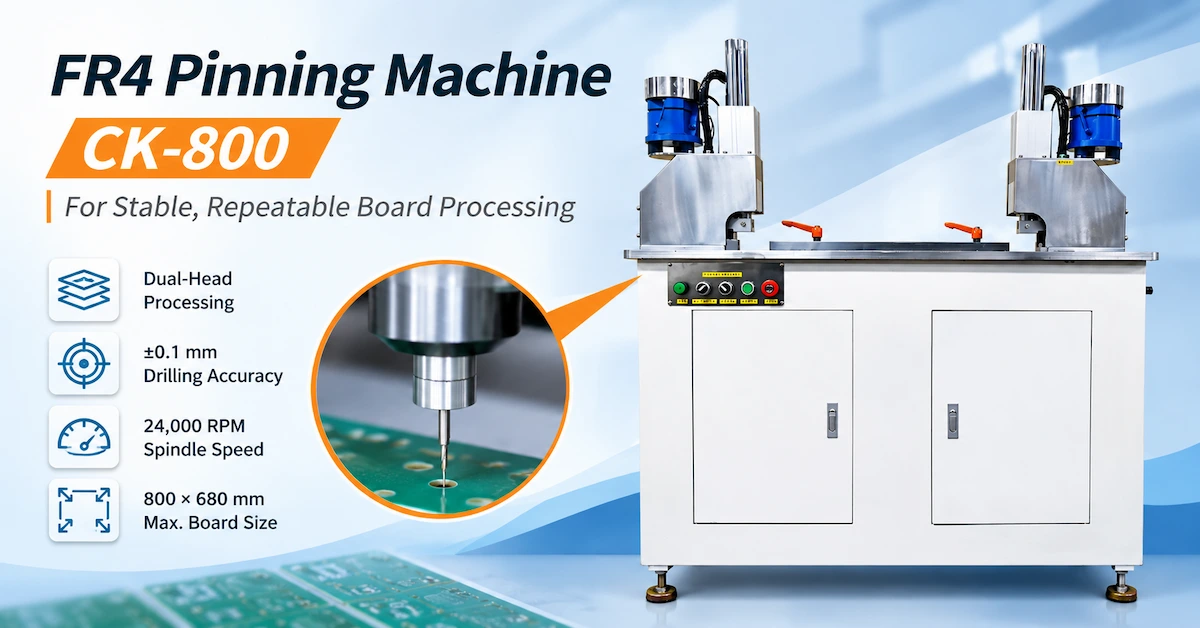
The CHIKIN CNC CK-800 is a dual-head PCB pinning machine with a published maximum board size of 800 × 680 mm, 24,000 RPM spindle speed, 3.175 mm spindle collet, Mitsubishi PLC controller, and ±0.1 mm drilling accuracy specification.
For PCB manufacturers, the most important purchasing factors are board compatibility, actual registration-hole accuracy, pinning-tool configuration, repeatability, and production efficiency.
This guide explains how to evaluate the CK-800, distinguish pinning accuracy from drilling accuracy, compare production methods, and establish reliable factory acceptance criteria.
Key Takeaways
-
Main application: The CK-800 is specified for FR1, FR4, CEM1, and metal-core PCB pinning applications, subject to material qualification.
-
Board dimensions: Published processing sizes range from 250 × 250 mm to 800 × 680 mm.
-
Tooling interface: The spindle collet specification is Ø3.175 mm, which must not be confused with the diameter of the installed registration pins.
-
Processing performance: The published drilling accuracy is ±0.1 mm; finished registration results require separate verification.
-
Automation: The datasheet identifies an automatic pinning method and Mitsubishi PLC control, although the exact material handling and pin-feeding sequence must be confirmed.
-
Purchasing priority: Sample processing and documented factory acceptance testing provide stronger evidence than catalog specifications alone.
1. What Is an FR4 Pinning Machine Used For?
An FR4 pinning machine is a specialized PCB manufacturing machine used in positioning, tooling-hole preparation, and pinning operations involving suitable rigid circuit board materials.
In PCB manufacturing, pin-based registration systems provide mechanical reference points for aligning panels or tooling assemblies during specified production stages.
Depending on the process, these references may support operations associated with board preparation, layer alignment, lamination fixtures, or subsequent handling.
Why Does PCB Registration Matter?
Registration is the controlled relationship between a board's actual position and its intended manufacturing reference.
When tooling holes or registration pins are incorrectly positioned, the resulting alignment error can affect later process steps.
Potential problems include:
-
Inconsistent panel positioning.
-
Incorrect tooling-hole locations.
-
Additional fixture adjustments.
-
Registration errors between processing stages.
-
Increased setup time.
-
Material waste caused by alignment problems.
A dedicated pinning station can help standardize how panels are located and processed.
However, a pinning machine does not independently guarantee multilayer registration accuracy. Material movement, fixture condition, drilled-hole geometry, and subsequent processes also contribute to the final result.
2. How Does the CK-800 Compare with Manual Pinning?
For overseas PCB manufacturers, one of the first purchasing questions is whether to retain manual preparation or invest in a controlled pinning workstation.
| Evaluation Factor | Manual Pinning | CK-800-Style Controlled Pinning |
|---|---|---|
| Board positioning | Operator-dependent | Fixture-based positioning |
| Processing arrangement | Separate manual operations | Dual-head industrial workstation |
| Hole preparation | Depends on existing tools | Published 24,000 RPM spindle |
| Pinning operation | Manual installation | Automatic pinning method listed |
| Process control | Operator instructions | Mitsubishi PLC |
| Repeatability | Depends on operator and fixtures | Requires machine qualification |
| Production flexibility | Useful for occasional tasks | Suitable for evaluating repeated panel operations |
| Main purchasing concern | Labor and variation | Tooling, machine accuracy, and acceptance results |
When Is Manual Pinning Still Practical?
Manual methods may remain suitable for occasional prototypes or low-volume production where the required quality can be consistently achieved.
However, repeated manual positioning can increase operator workload and setup variation.
For factories processing multiple batches of rigid PCB panels, a controlled pinning machine may provide a more standardized operating environment.
The CK-800 should be selected based on verified quality and accepted output, not simply because it offers more automation.
3. CHIKIN CNC CK-800 Technical Specifications
CHIKIN CNC provides PCB manufacturing equipment, including drilling, routing, and specialized board-processing systems.
The featured FR4 Pinning Machine for Stable, Repeatable Board Processing is presented as a floor-standing, dual-head workstation.
Its product description highlights a long worktable, operator-accessible controls, and fixture-based processing.
CK-800 Machine Specification Table
| Technical Parameter | Published Specification |
|---|---|
| Machine model | CK-800 |
| Product category | FR1 / FR4 / CEM1 / Metal Core PCB Pinning Machine |
| Electric spindle speed | 24,000 RPM |
| Spindle collet clamping head | Ø3.175 mm |
| Maximum PCB size | 800 × 680 mm |
| Minimum PCB size | 250 × 250 mm |
| PCB thickness | 10 mm |
| Pinning method | Automatic |
| Drilling accuracy | ±0.1 mm |
| Controller | Mitsubishi PLC |
| Electrical specification | Single-phase 220V / 50Hz / 5kW |
| Machine air pressure | 5 kg/cm² |
| Machine dimensions | 1220 × 545 × 1230 mm |
| Machine weight | Approximately 200 kg |
Specifications are taken from the supplied CK-800 product sheet. Their final meaning, test conditions, and applicability should be confirmed against the quoted machine configuration.
Specifications Requiring Particular Attention
PCB thickness: The datasheet lists 10 mm but does not explain whether this is an absolute processing maximum or a nominal setup condition. The supported range should be confirmed.
Drilling accuracy: The quoted ±0.1 mm requires a defined measurement procedure before it can be used as a production acceptance guarantee.
Automatic pinning: The published term does not establish whether automatic pin feeding, board loading, or other material handling is included.
Spindle speed: The 24,000 RPM specification identifies the machine's spindle speed; it does not prove suitability for every PCB micro-drilling application.
4. Why Does the Dual-Head Structure Matter?
The CK-800 product images show two processing heads positioned along an extended horizontal workstation.
This configuration may support processing at two positions or a paired operation, depending on the installed tooling and control sequence.
Potential Advantages of Dual-Head Processing
Defined processing positions
A two-head arrangement can provide fixed processing references when the workpiece geometry matches the machine setup.
Reduced repositioning requirements
For suitable applications, processing more than one location within a controlled fixture may reduce unnecessary manual handling.
Improved operating consistency
A stable worktable and defined tooling positions can make the setup less dependent on freehand alignment.
Does Dual-Head Mean Both Heads Work Simultaneously?
Not necessarily.
The product photographs show two heads, but the supplied technical specifications do not confirm independent simultaneous operation or cycle-time savings.
Buyers should ask CHIKIN CNC to demonstrate the actual processing sequence.
The important questions are whether the heads operate together or sequentially, how their positions are adjusted, and whether the available spacing matches the required tooling-hole pattern.
5. How to Match the 3.175 mm Collet to PCB Pinning Tools
The CK-800 specifies a Ø3.175 mm spindle collet clamping head.
This is an important machine-tool interface specification.
A 3.175 mm collet is commonly associated with compatible industrial PCB drilling-tool shanks.
However, the collet dimension is not the same as the finished drilling diameter or the installed registration-pin diameter.
Tooling Compatibility Checklist
| Tooling Parameter | What Buyers Should Verify |
|---|---|
| Collet diameter | Ø3.175 mm machine specification |
| Tool shank | Compatible shank dimensions and tolerance |
| Cutting diameter | Matches the required hole |
| Tool length | Appropriate spindle and fixture clearance |
| Point geometry | Suitable for the intended board material |
| Tool material | Appropriate wear and cutting characteristics |
| Tool runout | Acceptable for the required machining quality |
| Tool support | Correct installation and holding arrangement |
| Replacement availability | Compatible spare tools and components |
Why Is Spindle Runout Important?
Runout describes deviation from the intended rotational axis.
Excessive runout can influence hole geometry and tool loading.
For small-diameter PCB drills, these effects may become increasingly important.
The correct tool should therefore be verified as part of the complete spindle and holder assembly.
Is the CK-800 a Dedicated High-Speed PCB Drilling Machine?
The CK-800 is positioned as pinning and registration-related equipment.
Its published spindle speed of 24,000 RPM is different from the much higher spindle speeds used by certain dedicated PCB micro-drilling machines.
Factories requiring large quantities of precision vias should evaluate dedicated PCB drilling equipment rather than assuming the CK-800 performs the same role.
6. Which PCB Materials Can the CK-800 Process?
The machine specification identifies FR1, FR4, CEM1, and metal-core PCB applications.
These materials differ in construction and machining behavior.
Material Compatibility Matrix
| Board Material | Typical Application | Main Validation Requirement |
|---|---|---|
| FR1 | Paper-based rigid board processing | Hole quality and material integrity |
| FR4 | Glass-fiber-reinforced rigid PCB | Tool wear and fiber breakout |
| CEM1 | Composite epoxy laminate processing | Drilling and edge condition |
| Metal-core PCB | Qualified positioning-hole applications | Metal burrs and cutting forces |
| Multilayer FR4 | Registration-related preparation | Position consistency and laminate condition |
Why Is FR4 Processing Different?
FR4 contains epoxy resin and glass-fiber reinforcement.
The fiberglass content can increase tool wear, while the laminate may suffer local chipping or fiber breakout under unsuitable machining conditions.
The appropriate drilling tool, board support, and cutting parameters should be selected according to the actual laminate.
Can One Tool Process FR4 and Metal-Core PCB?
Not automatically.
Metal-core materials may require different tool geometries and cutting conditions.
If a factory processes both FR4 and aluminum-core boards, it should request separate sample tests for each material.
The presence of a material name in the product category is a starting point for compatibility evaluation, not a universal machining guarantee.
7. How Should PCB Registration-Hole Accuracy Be Verified?
One of the most important specifications in the CK-800 datasheet is ±0.1 mm drilling accuracy.
However, buyers should understand what this number represents before incorporating it into a purchasing contract.
Drilling Accuracy vs Registration Accuracy
| Measurement | What It Describes | Why It Matters |
|---|---|---|
| Drilling position accuracy | Hole location relative to a defined reference | Tooling-hole placement |
| Hole diameter accuracy | Finished hole size | Pin and fixture fit |
| Repeatability | Consistency across repeated processing | Batch production stability |
| Hole-to-hole spacing | Relative position between registration holes | Fixture compatibility |
| Board alignment | Position of the workpiece during processing | Overall process consistency |
| Final registration | Alignment achieved across production stages | Downstream PCB manufacturing quality |
A machine's published drilling accuracy should not be treated as a guarantee of final multilayer registration.
How to Measure Actual Hole Position
A practical qualification method is to process representative panels using a defined reference system.
The resulting tooling holes can then be inspected with suitable calibrated dimensional equipment.
Measurement should include the relevant hole positions and spacing.
The test should also record the board material, dimensions, fixture arrangement, processing program, and operating conditions.
Why Is Board Movement Important?
Even when the machine's motion system operates consistently, the workpiece may move if it is poorly supported.
Board positioning should therefore be verified as part of the process.
The correct acceptance question is whether the finished holes meet the customer's positional and dimensional requirements—not simply whether the machine starts and operates correctly.
8. How Does a Typical FR4 Pinning Workflow Operate?
A controlled PCB pinning process can be divided into several steps.
The following workflow is a recommended engineering evaluation sequence. The exact CK-800 operating procedure should be confirmed from the machine manual.
Step 1: Verify the PCB Material
Check the material type, board size, thickness, and required pinning locations.
Step 2: Prepare the Worktable
Ensure the appropriate fixture, reference stops, and support arrangement are installed.
Step 3: Position the PCB
Load the panel and align it against the required datum features.
Step 4: Confirm the Processing Program
Select the approved setup and verify the required processing positions.
Step 5: Perform the Specified Hole Operation
Where required by the application, use the approved drill and operating conditions to prepare the relevant tooling holes.
Step 6: Execute the Pinning Operation
Perform the approved pin installation sequence using the machine's specified tooling and control method.
Step 7: Inspect the Result
Check hole location, pin seating, board condition, and process consistency.
Step 8: Release the Panel
Transfer the accepted panel to the next production stage.
What Should Buyers Confirm About Automation?
The specification describes the pinning method as automatic, while the product imagery shows an operator-accessible workstation.
The buyer should clarify which operations are automated and which require manual intervention.
This distinction affects labor requirements, production cycle time, and integration with surrounding equipment.
9. How Does CK-800 Pinning Relate to PCB Depinning?
Pinning and depinning are different manufacturing operations.
Pinning installs or establishes the necessary mechanical positioning pins for a specific process.
Depinning removes pins when they are no longer required.
These operations may occur at different stages of PCB production.
| Comparison | PCB Pinning | PCB Depinning |
|---|---|---|
| Main purpose | Establish or install positioning pins | Remove installed pins |
| Main concern | Pin location and insertion quality | Complete removal without damage |
| Tooling | Positioning and installation tools | Removal punch and support |
| Quality requirement | Correct location and board integrity | Hole and laminate integrity |
| Related CHIKIN model | CK-800 | CK-16 |
CHIKIN also lists the CK-16 PCB Depinning Machine, intended for controlled removal of compatible pins.
However, compatibility between a CK-800 pinning setup and a CK-16 depinning setup must be confirmed for the actual pin geometry and board construction.
10. What Quality Problems Can Occur During PCB Pinning?
A pinning system can create problems if the tooling, fixture, or operating settings are unsuitable.
Common Defects and Possible Causes
| Problem | Possible Cause | Recommended Check |
|---|---|---|
| Incorrect tooling-hole position | Misalignment or incorrect setup | Verify datums and fixture |
| Oversized hole | Tool condition or runout | Inspect drill and holder |
| Hole burrs | Unsuitable drilling parameters | Check tool geometry and material |
| Laminate cracking | Excessive local loading | Inspect pin installation conditions |
| Poor pin seating | Incorrect pin or hole dimensions | Verify pin and hole compatibility |
| Board deformation | Inadequate support | Check worktable and clamping |
| Inconsistent results | Setup or head alignment variation | Perform repeated sample tests |
| Processing interruption | Tooling or control issue | Review machine operation records |
How Should PCB Pinning Quality Be Controlled?
Quality control should begin with approved drawings and measurable acceptance limits.
For each production setup, define the target hole dimensions, hole positions, pin specifications, acceptable laminate condition, and required sampling method.
Inspection should verify both hole preparation and the completed pinning operation where applicable.
The machine should also be maintained according to the approved operating instructions.
11. How to Estimate CK-800 Production Efficiency
The CK-800 datasheet does not provide a verified number of completed panels per hour.
For this reason, throughput should be established from actual production testing.
A typical cycle-time calculation is:
Total Cycle Time = Loading + Alignment + Processing + Pinning + Inspection + Unloading
Actual output depends on the number of required operations, material size, fixture arrangement, and handling method.
Production Factors to Evaluate
| Factor | Influence on Production |
|---|---|
| Number of registration locations | Affects processing operations |
| Board size | Influences loading and alignment |
| Material thickness | Can affect cutting conditions |
| Fixture design | Influences repeatability and setup time |
| Dual-head operation | May affect the processing sequence |
| Automatic functions | Determine operator involvement |
| Product changes | Require setup adjustments |
| Inspection frequency | Adds quality-control time |
Why Accepted Output Matters
Production capacity should be measured in conforming panels rather than total cycles completed.
Accepted Panels per Hour = Processed Panels per Hour × Acceptance Rate
A faster process does not necessarily provide lower operating costs if it creates additional rework or rejected panels.
For factories comparing manual and controlled pinning, this metric is more useful than an unsupported productivity-improvement percentage.
12. What Should Buyers Verify During CK-800 Factory Acceptance Testing?
A Factory Acceptance Test (FAT) should establish whether the machine meets agreed requirements before delivery.
For the CK-800, testing should cover both equipment functions and actual processing quality.
CK-800 Factory Acceptance Checklist
| Test Item | Recommended Verification |
|---|---|
| Machine model | Confirm CK-800 configuration |
| Maximum board size | Test the required large panel |
| Minimum board size | Verify smaller-format support |
| Board thickness | Confirm the approved processing range |
| Spindle speed | Verify the published 24,000 RPM specification |
| Collet | Confirm Ø3.175 mm tooling compatibility |
| Dual-head arrangement | Demonstrate required processing positions |
| Hole accuracy | Measure finished tooling-hole positions |
| Pinning operation | Confirm the actual automatic sequence |
| Pin seating | Inspect approved pinning samples |
| PLC functions | Demonstrate the required control sequence |
| Air supply | Confirm pressure and operating requirements |
| Electrical system | Verify the supplied configuration |
| Safety controls | Demonstrate protective and emergency functions |
| Documentation | Review manuals, drawings, and acceptance records |
Recommended Sample Testing Method
Select representative boards covering the factory's required size and material combinations.
Provide the intended hole pattern and registration-pin specifications.
Define positional and dimensional tolerance limits before testing.
Process multiple samples under controlled conditions.
Measure the finished holes and inspect the pinning results.
Record any rejected panels, setup adjustments, and measured cycle times.
The resulting test report should identify the machine configuration and operating conditions.
Does the Published ±0.1 mm Accuracy Guarantee Acceptance?
No.
The specification must be evaluated against the buyer's actual drawing requirements.
If the intended process requires a tighter tolerance than the published capability, the buyer should not assume the machine can meet it without additional technical confirmation.
13. Installation, Safety, and Long-Term Maintenance
The CK-800 is a floor-standing machine, so its factory requirements should be reviewed before delivery.
Published Installation Parameters
| Requirement | CK-800 Specification |
|---|---|
| Electrical supply | Single-phase 220V / 50Hz |
| Published machine power | 5kW |
| Air pressure | 5 kg/cm² |
| Machine dimensions | 1220 × 545 × 1230mm |
| Machine weight | Approximately 200kg |
| Controller | Mitsubishi PLC |
The electrical and pneumatic requirements should be checked against the final ordered configuration.
What Safety Systems Are Important?
Industrial pinning and drilling equipment can create hazards associated with moving heads, rotating tools, clamping mechanisms, and pneumatic components.
Buyers should verify guarding, emergency-stop operation, unintended-start prevention, electrical protection, and safe maintenance procedures.
Relevant frameworks include ISO 12100 for machinery risk assessment and IEC 60204-1 for electrical equipment of machines, where applicable.
The presence of an emergency-stop button alone does not prove compliance with a particular safety standard.
What Maintenance Should Be Considered?
Regular inspection may include tooling condition, spindle holding, fixture alignment, pneumatic connections, moving assemblies, and control functions.
The actual maintenance schedule and spare-parts requirements should be confirmed with the supplier.
14. What Determines the Total Cost of an FR4 Pinning Machine?
The initial equipment price is only one part of the investment.
A more complete cost comparison considers installation, tooling, operating time, maintenance, and rejected panels.
Cost Evaluation Checklist
| Cost Factor | What Buyers Should Confirm |
|---|---|
| Base machine | Included CK-800 configuration |
| Processing heads | Standard tooling and available adjustments |
| Drilling tools | Compatible specifications and replacement costs |
| Pinning components | Compatible pins and installation accessories |
| Fixtures | Standard or application-specific requirements |
| Electrical installation | Site preparation and utility requirements |
| Compressed air | Required supply and consumption |
| Operator labor | Loading and inspection requirements |
| Maintenance | Wear parts and support |
| Quality losses | Rework and rejected panels |
| Shipping | Packaging, destination, and delivery conditions |
A useful factory metric is:
Pinning Cost per Accepted Panel = Total Allocated Pinning Cost ÷ Accepted Panels
This helps purchasing managers evaluate the machine based on production value rather than purchase price alone.
15. CK-800 RFQ Checklist for Overseas PCB Manufacturers
A technically complete RFQ allows the equipment supplier to evaluate compatibility with the customer's production requirements.
| Required Information | What the Buyer Should Provide |
|---|---|
| PCB material | FR1, FR4, CEM1, metal-core, or other |
| Board dimensions | Minimum and maximum sizes |
| Board thickness | Actual production range |
| Hole pattern | Registration-hole drawing and datums |
| Hole tolerance | Required positional and dimensional limits |
| Pin specification | Diameter, length, and installation method |
| Processing volume | Panels per shift or hour |
| Loading method | Manual or requested automation |
| Head requirements | Hole spacing and processing positions |
| Production environment | Power, air, available space |
| Quality requirements | Inspection and FAT acceptance criteria |
| Commercial requirements | Quantity, destination, and service scope |
Why Consider CHIKIN CNC?
Shenzhen ChiKin Automation Equipment Co., Ltd. supplies PCB manufacturing and related industrial automation equipment.
The CK-800 is part of the company's equipment range for manufacturers evaluating more controlled board positioning and pinning operations.
CHIKIN also provides information about its manufacturing and service capabilities.
For buyers, the priority should be to establish whether the specified CK-800 configuration can meet the actual board and pinning requirements.
Request a CK-800 Technical Evaluation
Are you planning to improve FR4 registration-hole preparation or standardize pinning operations?
Prepare your PCB drawings, material type, pin specifications, and production requirements.
Review the CHIKIN FR4 Pinning Machine.
Contact CHIKIN CNC for a CK-800 Configuration Review and Quotation.
Providing a complete technical brief will help clarify the machine's tooling, automation scope, and suitability for your production process.
16. Frequently Asked Questions About FR4 Pinning Machines
1. What is an FR4 pinning machine used for?
An FR4 pinning machine supports controlled positioning and pinning operations involving suitable rigid PCB materials. In appropriate manufacturing workflows, it can help prepare registration holes and install pins according to the specified process.
2. What is the maximum PCB size supported by the CK-800?
The published specification lists a maximum PCB size of 800 × 680mm and a minimum size of 250 × 250mm. Actual fixture compatibility should be confirmed for the intended board dimensions.
3. What is the spindle speed of the CK-800?
The CK-800 lists a spindle speed of 24,000 RPM. Buyers should confirm the approved tools, supported hole dimensions, and processing conditions for their materials.
4. Does the CK-800 use a 3.175mm registration pin?
Not necessarily. The Ø3.175mm specification refers to the spindle collet clamping head. The compatible registration-pin diameter must be confirmed separately.
5. What is the drilling accuracy of the CK-800?
The published specification lists ±0.1mm drilling accuracy. Buyers should request the measurement conditions and verify actual hole positions against their approved drawings.
6. Is the CK-800 fully automatic?
The datasheet lists an automatic pinning method. However, it does not fully describe board loading, pin feeding, or the processing sequence. Buyers should request a demonstration of the actual automation functions.
7. Can the CK-800 process aluminum-core PCB materials?
Metal-core PCB is included in the product specification. Actual compatibility depends on the material construction, tooling, and process requirements. Sample testing is recommended.
8. What controller does the CK-800 use?
The published specification identifies a Mitsubishi PLC. The final hardware model, software functions, and available production interfaces should be confirmed before ordering.
9. What is the difference between PCB pinning and depinning?
Pinning establishes or installs positioning pins for a manufacturing process. Depinning removes pins when they are no longer required. The two operations use different tooling and acceptance requirements.
10. What should I provide when requesting a CK-800 quotation?
Provide PCB material, dimensions, thickness, registration-hole drawings, required accuracy, pin specifications, production volume, electrical supply, and preferred automation level. Request sample processing and defined factory acceptance criteria.
Conclusion
Selecting the right FR4 pinning machine requires a complete understanding of board dimensions, tooling-hole accuracy, spindle compatibility, pinning methods, and production requirements.
The CHIKIN CNC CK-800 offers a published configuration featuring a dual-head processing layout, 24,000 RPM spindle speed, Ø3.175mm collet, maximum board size of 800 × 680mm, Mitsubishi PLC control, and ±0.1mm drilling accuracy.
These specifications make it a relevant candidate for PCB manufacturers seeking more controlled registration-related processing and repeatable board handling.
However, successful equipment selection should not depend solely on catalog specifications.
Buyers should verify the actual pinning sequence, hole-position performance, fixture compatibility, material suitability, and accepted production output through representative testing.
A documented factory acceptance procedure helps reduce purchasing risks and supports a clearer understanding of the equipment's real capabilities.
For PCB manufacturers evaluating positioning and pinning equipment, CHIKIN CNC provides the CK-800 within its wider PCB manufacturing equipment portfolio.
Explore the CK-800 FR4 Pinning Machine or contact CHIKIN CNC for an application-specific quotation.
Share your PCB drawings, material specifications, registration-hole requirements, and target production volume to evaluate a configuration suited to your manufacturing workflow.