



What Is a V-CUT Machine, and Which Production Problem Does It Solve?
A V-CUT Machine is used in PCB panel processing, but the name can refer to two different operations: V-scoring, which creates a controlled groove in a rigid panel, and depaneling, which separates individual boards along grooves already made. The distinction matters. A PCB fabrication plant may need to form accurately positioned score lines in bare laminate; an SMT or EMS factory may need to separate fully assembled boards without bending sensitive solder joints or surface-mounted components.
For a procurement team, the correct buying question is therefore not simply “What is the best V-CUT machine?” It is “What operation must this machine perform on our specific board, at what production rate, and with what acceptable risk?” A line that purchases scoring equipment when it needs an assembly separator—or the reverse—can create an expensive process gap even if the machine itself is well built.
This guide focuses on equipment selection for PCB manufacturers, SMT assembly lines, electronics manufacturing service providers, and equipment integrators. It covers the differences between scoring and separation, cutter configurations, technical specifications, quality-control methods, total operating cost, and a practical request-for-quotation (RFQ) and factory acceptance test (FAT).
V-Scoring vs. Depaneling: Confirm the Operation Before Choosing Equipment
PCB V-scoring creates the controlled weak line
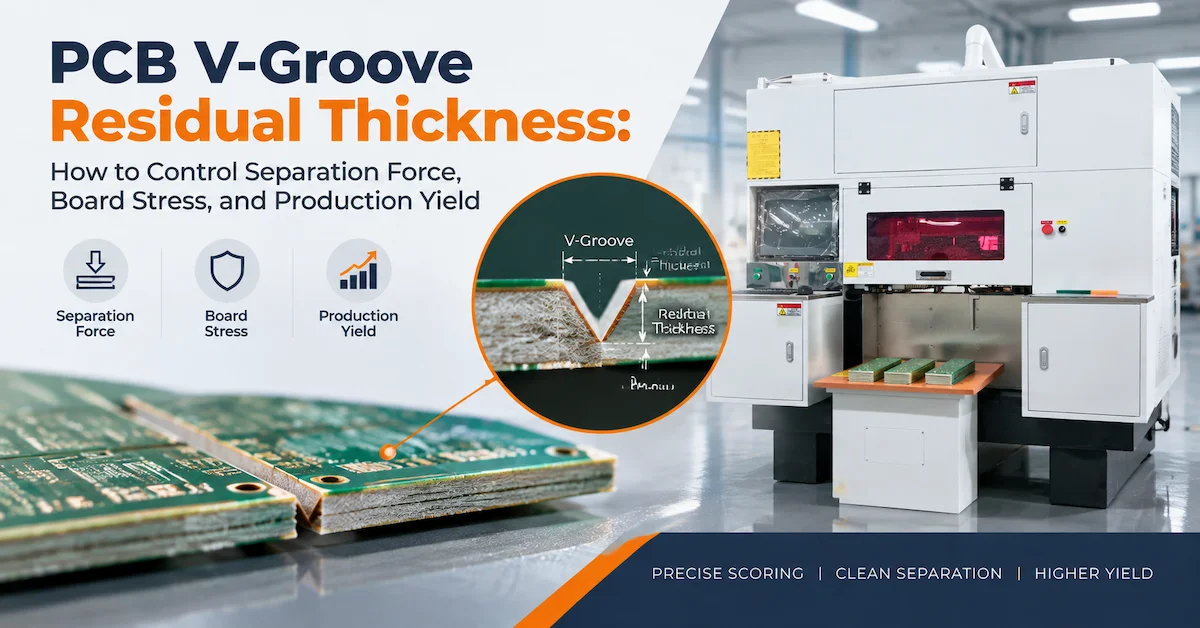
During V-scoring, a cutting tool makes a V-shaped groove along a designed straight separation line. In many PCB processes, grooves are formed from opposite sides of a rigid panel, leaving a controlled residual web thickness of uncut material. That remaining web must be strong enough to keep the panel stable through handling and downstream processes but weak enough to permit the intended separation later.
Scoring is typically considered before the assembly is divided into individual boards. Buyers should specify whether they need single-sided or double-sided scoring, the required groove geometry, panel flatness, material stack-up, and the measurement method. A statement such as “the machine cuts FR-4” is not a complete technical requirement.
PCB depaneling separates the already-scored panel
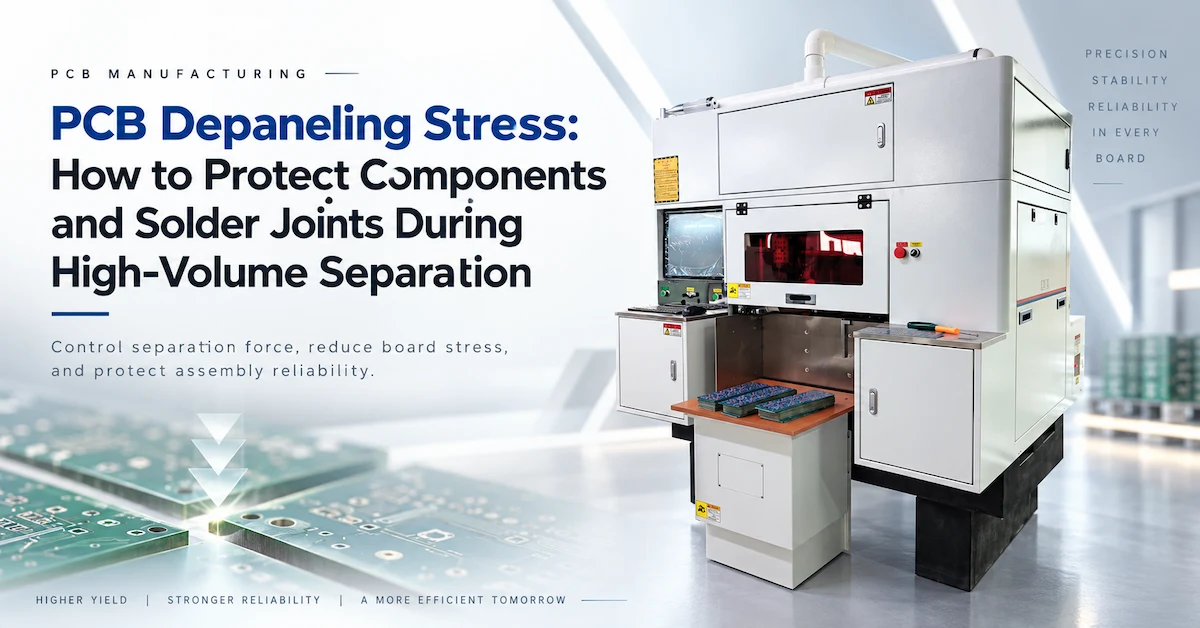
In depaneling, the objective is different: release each finished board along the prepared score line while managing deflection, edge quality, operator contact, and downstream inspection. A pre-scored PCBA may contain tall connectors, ceramic capacitors, mounted shielding, heavy components, or solder joints close to the break line. Even when the board can be separated successfully, excessive bending can produce damage that is not immediately visible.
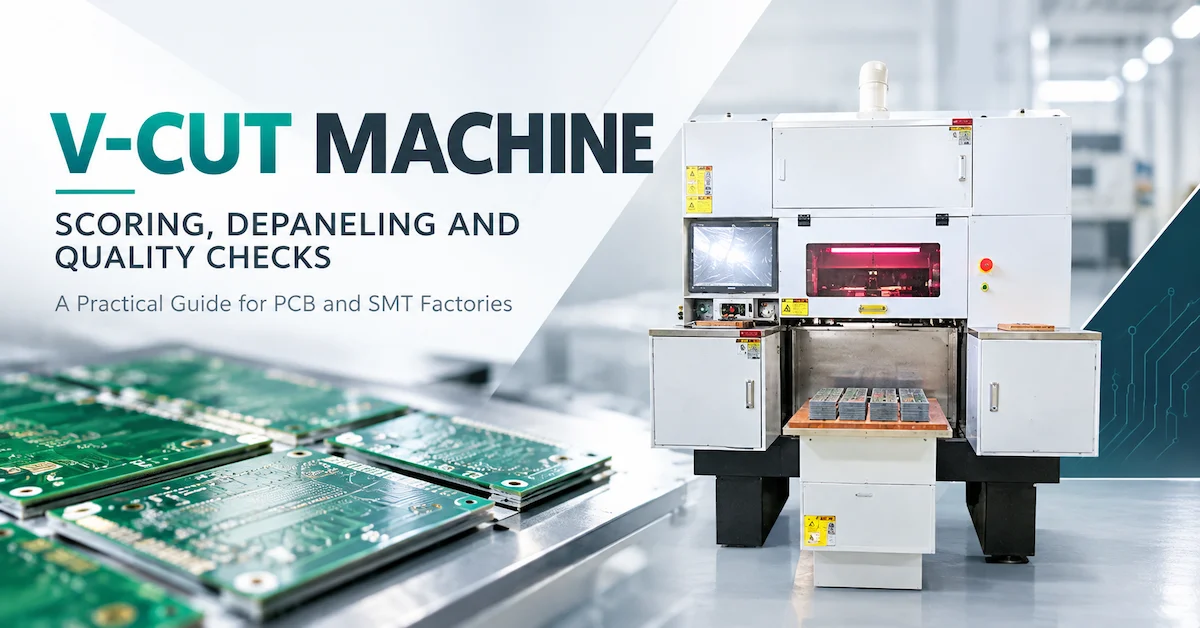
CHIKIN's single-cutter PCB V-cut machine for controlled depaneling is positioned around this controlled separation use case. Its published page shows a guarded machine layout, touchscreen controls, status indication, and a guided work area. Buyers should still obtain the exact model specification and a demonstration of the actual cutting action before approval.
| Buying question | V-scoring equipment | V-groove depaneling equipment |
|---|---|---|
| Main operation | Create one or more V-shaped grooves | Separate boards at existing groove lines |
| Typical material state | Rigid PCB panel before final separation | Bare scored PCB or assembled scored PCBA |
| Key geometry | Groove depth, angle, location and residual web | Board support, alignment, separation path and component clearance |
| Major risks | Wrong web thickness, uneven grooves, material damage | Board flex, solder-joint stress, chipping and component contact |
| Acceptance evidence | Groove measurements across representative panels | Edge inspection, stress-related checks, repeatable good-board output |
Practical rule: ask the supplier to show your exact panel being processed. Some product descriptions use “V-cut,” “V-grooving,” “scoring,” and “separation” interchangeably; the demonstration and written machine scope must resolve any ambiguity.
Which PCB Panels and Factories Are Good Candidates?
A V-CUT Machine is most attractive when the board layout provides straight, accessible separation lines and the process can be repeated under controlled conditions. The following applications have different purchasing priorities:
- PCB fabrication plants: stable V-groove depth, straightness, feed behavior, consistent material removal, and measurable residual web thickness over many panels.
- SMT and PCBA assembly lines: protection of installed components, solder joints and board edges during the last mechanical separation stage.
- EMS and contract manufacturers: changeovers among customer panels, recipe management, adjustable guides, fixture storage, and a predictable time-to-first-good-board.
- LED and metal-core PCB producers: compatibility with the actual aluminum or copper-based stack-up, especially where a long board or heat-sink substrate behaves differently from standard FR-4.
- Automotive, power electronics and industrial-control suppliers: documented process verification, traceable settings, repeatable quality checks, and evidence that the process does not compromise product reliability.
- Prototype and NPI departments: low tooling burden, straightforward setup, and flexibility for frequent design revisions rather than maximum nominal output.
A V-cut process is not automatically suitable for every panel. Curved edges, internal slots, delicate flexible circuits, short discontinuous separation segments, and components located dangerously close to the groove can favor other methods. When the layout requires intricate contours or minimal bending, evaluate a PCB drilling and routing machine, a suitable routing separator, or an application-specific laser processing system instead. The choice must be validated against the material and board design, not merely the advertised process name.
How to Compare Single-, Four-, Six-, and Eight-Cutter V-CUT Machines
The number of cutters is a starting point for selecting a machine architecture—not a guaranteed output multiplier. Actual production capacity depends on how many cutters are simultaneously engaged, how panels are indexed, tool spacing, loading time, score-line count, fixture changeover, and quality-related stops.
| CHIKIN product option | Buying rationale | Best-fit discussion | Verify before ordering |
|---|---|---|---|
| Single Cutter PCB V Cut Machine | Focused controlled separation of suitable V-groove panels | SMT/EMS cells, moderate output, operator-guided process | Whether it forms grooves or only separates pre-scored PCBs; handling and clearance |
| 4 Cutter Auto PCB V Cut Machine | Multiple cutting positions and organized enclosed workstation | Repeat panel jobs that justify greater automation | Tool configuration, usable cutting width, setup time and sampled capacity |
| 6 Cutter Auto PCB V Cut Machine | More cutters for repeatable V-cut processing in a protected operating area | Higher-volume rigid panels with repeatable patterns | Actual score creation versus separation, tool adjustability, service access |
| 8 Cutter Auto PCB V Cut Machine | Multi-cutter format marketed for productive rigid-panel processing | Established, repetitive production families | Simultaneous processing capability, pitch range, sample results and floor space |
The model pages describe different purposes, and some descriptions mix V-scoring and separation terminology. For that reason, this table is a buyer comparison framework, not an assertion that every listed machine uses the same cutting mechanism.
When does a single-cutter machine make sense?
A single-cutter system can be easier to justify when the factory has a limited number of straight groove lines, a modest daily output target, or frequent engineering changes. It may keep initial configuration simpler. However, buyers must confirm whether the required fixture adjustments and manual handling actually support their expected takt time. A low purchase price loses its appeal when the operator must reposition every panel repeatedly.
When should a factory consider multiple cutters?
A multi-cutter arrangement deserves attention when panel families are repetitive and cutting positions or processing stages can be coordinated efficiently. However, moving from four to eight cutters may bring more adjustment points, consumables and maintenance tasks. Request a demonstrated rate measured in accepted panels per hour, not a theoretical rate inferred from the cutter count.
Compare the machine around your panel—not the cutter count alone.
Request a Panel-Based Configuration Review →The Technical Specification Checklist That Matters Most
A useful machine quotation specifies operating limits and measurement conditions. “High precision,” “automatic,” or “industrial-grade” is not enough to compare two suppliers. Use the checklist below to request data and mark each item as confirmed, option-dependent, or subject to sample testing.
| Specification or control | Information the buyer should request | Why it affects production |
|---|---|---|
| Actual process | Scoring, separation, or both; single-/double-sided ability | Prevents buying the wrong process station |
| Panel envelope | Maximum and minimum length/width; effective work area | Determines format compatibility and fixture strategy |
| Board thickness and substrate | Supported thickness range and approved laminate/metal-core materials | Changes load, groove geometry and risk |
| Cutter structure | Cutter count, blade type, diameter, angle, mounting and spacing | Affects groove consistency, wear, and maintenance |
| Score geometry | Groove angle, achievable depth range, position control, residual-web measurement | Controls separation behavior |
| PCB/PCBA clearance | Minimum supported line-to-component and tool-to-component distances | Protects tall or sensitive components |
| Feed, motion and registration | Guide system, datum method, feed rate, alignment/vision if supplied | Reduces setup drift and panel movement |
| Handling | Manual, semi-automatic or inline; load/unload direction | Determines labor and line integration |
| Throughput | Accepted panels/hour on a defined reference job, with loading included | Makes quotations comparable |
| Setup/changeover | Adjustment points, recipe storage, changeover test | Critical for high-mix EMS production |
| Safety and utilities | Guarding/interlocks, emergency stop, extraction, ESD and local power | Supports installation and safe operation |
| Maintenance | Cleaning procedure, blade-change method, spares and inspection intervals | Determines total ownership cost |
| Validation | Sample program, FAT/SAT, reports, measurement instruments | Turns marketing statements into evidence |
| Commercial scope | Incoterms, installation/training, warranty, response channel | Prevents unpriced obligations after delivery |
Do not transfer performance data between machine families. For example, a high-speed CHIKIN drilling machine may publish positioning accuracy or spindle RPM figures, but those values do not describe the accuracy of an unrelated V-CUT Machine. The V-cut specification must be obtained for the actual model and configuration under review.
Groove Geometry, Residual Web Thickness, and Separation Force
Why residual web thickness is a critical process variable
For a double-sided scored panel, the uncut web can be expressed approximately as:
Residual web thickness ≈ total board thickness − top groove depth − bottom groove depth.
This relation is useful for process discussions, but not a universal product tolerance. PCB laminate construction, copper distribution, the location of top and bottom grooves, material variation, and measurement uncertainty affect the actual result. A board with a thicker web may require higher separation force; a web that is too thin may break during handling, transport, stencil printing or assembly. The correct operating window belongs in the customer-approved design and process validation plan.
What buyers should verify on real samples
- Inspect the supplied scoring drawing and confirm the same coordinate reference as the machine program.
- Check the location and straightness of the V-groove relative to finished-board geometry.
- Measure representative groove depths or remaining web thickness at the beginning, middle and end of a processed line, using the approved method.
- Compare results on panels from different locations in the incoming material batch, including panels with expected bow or thickness variation.
- Inspect copper and laminate near the groove for tearing, fraying, chipping or local damage.
- Perform the required separation trial and inspect the resulting edges and nearby components.
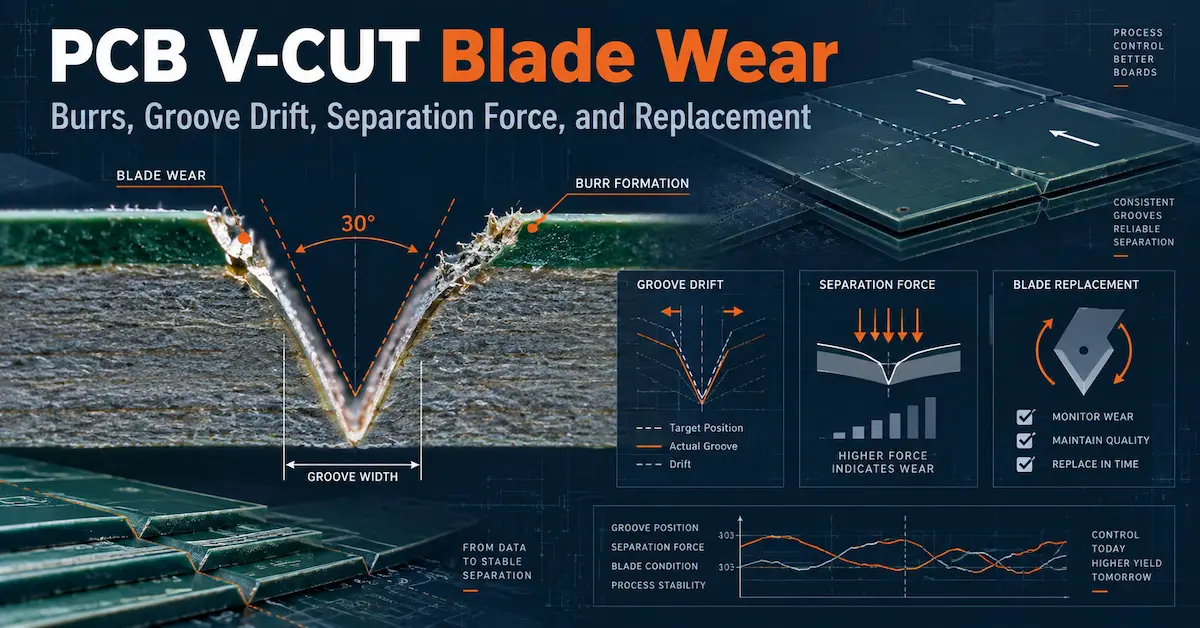
The buyer should also ask how cutter wear, blade runout, panel support and guide adjustment are monitored. An operator may initially produce a clean panel, yet drift may develop after extended cutting. CHIKIN's related technical article on PCB V-CUT blade wear and groove drift discusses why burrs and separation-force changes should trigger a process investigation rather than automatic blade replacement.
Component clearance is not one universal number
For an assembled board, the safe distance from a V-score line to an MLCC, connector, transformer or solder joint depends on the assembly, mechanical support, material and separation method. Do not publish an unexplained clearance number as a universal industry rule. Instead, ask the design and quality teams to identify sensitive zones and validate the proposed method on a populated board. If the panel requires substantial bending near fragile parts, a different separation process may be the better investment.
Production Quality: What Can Go Wrong and How to Diagnose It
Equipment selection should include a defect-response plan. The table below separates symptoms from possible causes; no single symptom proves that a particular part is defective.
| Observed problem | Possible contributors | First checks |
|---|---|---|
| Uneven V-groove depth | Panel thickness variation, blade position, support, fixture contamination | Measure top/bottom depths, panel thickness and tool alignment |
| Burrs or fiberglass fraying | Worn blade, unsuitable feed, material characteristics, misalignment | Compare blade condition, process settings and same-material samples |
| High separation force | Excessive residual web, poor groove consistency, wrong separation method | Measure remaining web and document force trend |
| Edge chips or laminate cracks | Panel movement, wrong cutter condition, too much deflection | Inspect support and high-magnification edge samples |
| Intermittent board damage | Loading variability, warped panels, changing fixtures or shift practices | Compare lots, operators and machine settings |
| Solder-joint or ceramic-component stress | Board bending, inadequate support, components too close to groove | Examine populated test boards and evaluate alternative depaneling |
| Slow output despite many cutters | Loading bottleneck, frequent adjustments, jams or inspection delay | Time the complete accepted-panel cycle, not only machine motion |
Separate the evidence into three groups: machine condition, board design/material, and handling process. That prevents a maintenance team from replacing blades when the true cause is panel warpage or insufficient fixturing. It also makes supplier support more effective: photos, panel drawings, machine settings and defect distributions are much more actionable than a general complaint about “bad cutting.”
Throughput, Line Balance, and Cost per Accepted Board
An automatic V-CUT Machine should be assessed against the production line, not in isolation. For a simple planning estimate:
Gross panels per hour = 3,600 ÷ complete cycle time in seconds.
Good panels per hour = gross panels/hour × operating availability × first-pass yield.
For example, a hypothetical 30-second cycle provides 120 gross panels per hour. At an illustrative 85% operating availability and 99% first-pass yield, the result is about 101 accepted panels per hour. These numbers are only an example of how to calculate capacity; they are not CHIKIN product claims.
The cycle must include loading, alignment, cutting or separation, removal, and required immediate checks. For a line with multiple parallel cutters, record tool time separately from full-station time. For an EMS plant, measure changeover time too: a machine that wins on a long, repetitive batch may lose on a short job requiring frequent guide or fixture adjustment.
Evaluate the cost per good board rather than equipment price alone. A workable accounting model is:
Cost per accepted panel = (allocated equipment cost + labor + cutters/consumables + maintenance + energy + rework + downtime cost) ÷ accepted panels.
The exact accounting method can vary. The key is to include defect losses and downtime alongside capital expense, because the lowest-cost machine on the quotation sheet is not always the least expensive production solution.
What to Include in a V-CUT Machine RFQ
A strong RFQ allows the equipment manufacturer to recommend a machine for a real application and reduces follow-up questions. Attach a panel drawing or Gerber/ODB++ data when permitted by your company, and identify confidential files as controlled design information.
| RFQ field | Example of the information to supply |
|---|---|
| Operation required | Create V-scores on bare panels / depanel pre-scored PCBA / needs clarification |
| Board material | FR-4, multilayer FR-4, MCPCB or other defined stack-up |
| Panel dimensions | Length, width, thickness, flatness limits and panelization count |
| Groove details | Line count, direction, top/bottom score requirement, geometry or drawing reference |
| Assembly state | Bare panel, partially assembled PCB or fully populated PCBA |
| Risk features | Sensitive MLCCs, connectors, copper near edge, tall components |
| Production volume | Panels per shift, shifts per day, peak volumes, number of SKUs |
| Production method | Stand-alone manual loading, semi-auto or inline integration |
| Quality targets | Agreed groove/edge inspection method, acceptable defect limits |
| Plant conditions | Voltage/frequency, compressed air, extraction, ESD controls, footprint |
| Commercial requirements | Delivery destination, required shipping terms, target installation date |
| Validation request | Sample trial, FAT video/data, operator manuals, spare-part proposal |
A technical quotation should then identify the proposed configuration, exclusions, measurable acceptance conditions, operator needs, changeover assumptions and after-sales scope. Where a machine offers optional features, specify whether they are included in the base price.
Have your panel drawing and production targets ready?
Send Your V-CUT Machine RFQ →Factory Acceptance Testing: Prove the Process Before Shipment
A successful demo and a repeatable acceptance test are not the same thing. A buyer should agree on the FAT protocol before the order is finalized, especially when purchasing for a high-reliability product or a plant with expensive assembled boards.
A practical FAT sequence
- Confirm identity and configuration. Record machine model, cutter number, included accessories, controls, and approved machine settings.
- Verify safety controls. Demonstrate emergency stop, guarding, relevant interlocks, alarms, safe restart logic and electrical documentation appropriate to the installation country.
- Check reference samples. Compare incoming panel dimensions, material, stack-up, and groove drawing against the approved test plan.
- Run first-article processing. Document setup procedure, alignment, blade position, groove or separation quality and initial measurement results.
- Repeat over a representative batch. Test enough consecutive panels to observe drift, handling errors and actual flow rather than only one successful panel.
- Inspect quality. Use agreed inspection criteria for score geometry, edges, burrs, cracks, debris and populated-board condition; add relevant electrical or functional inspection where specified.
- Record the real cycle. Include operator loading and unloading, machine motion, interruptions and any required immediate quality gate.
- Perform a changeover if relevant. Repeat on a second panel family when the machine is intended for high-mix production.
- Handover documents. Verify operating instructions, spare-parts list, maintenance plan, settings backup, warranty scope and service contact process.
FAT pass/fail thresholds should be written in advance and tied to the customer's panel design and quality requirements. A supplier's broad “high accuracy” statement does not replace measured acceptance data. The commissioning or site acceptance test (SAT) should separately address facility interfaces, local operation and operator competence.
For selection across fundamentally different separation methods, CHIKIN also publishes a PCB depaneling method comparison. Use that comparison early, before spending effort validating V-cut equipment for a geometry better suited to routing or laser cutting.
Maintenance, Consumables, and Long-Term Reliability
V-cut performance changes with use. Cutter edges wear, resin and dust accumulate, guide surfaces may become contaminated, and fixtures can lose consistent support. A preventive plan should therefore pair a time-based maintenance schedule with evidence from board quality.
A useful operating record includes the cutter part number, installation date, processed material, cumulative cutting length or processed panels, groove/edge inspection observations, setup changes and the reason for each replacement. Blade life cannot be honestly described by one universal number because material, groove depth, production mix and operating conditions vary.
When purchasing replacement tooling, provide the original tool drawing, diameter, bore size, blade angle or tooth format, material, machine speed, and expected groove or edge specification. CHIKIN lists a dedicated PCB V-CUT saw blade product, but buyers should verify dimensional and machine compatibility before treating any blade as interchangeable.
Maintenance access matters as much as maintenance frequency. Ask technicians to demonstrate how to clean debris, access tooling, replace a blade safely, restore alignment and confirm the first acceptable panel after service. If that recovery process is slow or difficult to repeat, the apparent productivity advantage of a more complex machine may shrink.
Supplier Evaluation: What Makes a V-CUT Machine Proposal Credible?
A credible equipment supplier should address the whole manufacturing scenario, not simply send a photograph and a price. Ask for a written scope identifying whether the system creates grooves, separates existing scores, or performs both operations under certain conditions. Then review the actual panel compatibility, controls, guarding, sample-testing evidence, spare parts and contractual support.
CHIKIN CNC presents itself as a Shenzhen-based PCB automation equipment developer and manufacturer, with an R&D and company background and a service-advantage overview. Its published portfolio includes drilling/routing, V-cut options and related equipment. Those are useful reasons to request an engineering discussion, but every model still needs its own verified data sheet and acceptance agreement.
Also compare warranty and service documents carefully. General website banners and individual product pages may describe different periods or levels of support. Record the precise warranty term, exclusions, parts logistics, remote assistance arrangements, training responsibilities and response channels in the quotation or contract. An attractive marketing promise is not a substitute for the signed machine-specific scope.
An efficient buyer approval workflow
- Engineering: approve the actual process and board layout compatibility.
- Quality: approve the sample inspection, risk assessment and acceptance criteria.
- Production: approve capacity, staffing, changeover and physical material flow.
- Maintenance/EHS: approve access, utilities, controls and serviceability.
- Procurement/Finance: approve total landed cost, support terms and measurable deliverables.
This cross-functional review is especially important when equipment is installed downstream of SMT assembly, where damaged boards may already contain substantial component and labor value.
Make the supplier comparison measurable.
Explore CHIKIN PCB Equipment →Frequently Asked Questions About V-CUT Machines
1. Is a V-CUT Machine the same as a PCB separator?
Not always. A V-CUT Machine may refer to a V-scoring system that forms grooves or to a separator that works on already-scored panels. Confirm the operation in writing and test a representative board before ordering.
2. Can a V-CUT Machine cut PCBs after SMT assembly?
Some depaneling configurations are designed for assembled, pre-scored PCB panels. Suitability depends on the actual mechanism, support, tool clearance, nearby components and assembly sensitivity. Do not assume every grooving machine is safe for populated boards.
3. Is an eight-cutter machine eight times faster than a single-cutter machine?
No such ratio can be assumed. The full cycle depends on board geometry, cutter utilization, feeding, repositioning, inspection and downtime. Compare accepted panels per hour on the same job.
4. Can a V-cut process handle aluminum PCB or metal-core PCB?
Possibly, but compatibility depends on the full substrate stack-up, material properties, tool design, groove geometry and manufacturer approval. Request material-specific trials rather than applying FR-4 settings automatically.
5. What is residual web thickness in PCB V-scoring?
It is the material left between the opposite score grooves, or between the groove and the reverse surface in a single-sided design. It affects panel strength and later separation force. The correct value is specific to the product design and approved process.
6. Why do boards crack or chip during V-cut separation?
Likely contributors include excessive flexing, inconsistent grooves, unsuitable residual thickness, worn or misaligned tooling, inadequate panel support and material variation. Compare machine, board and handling evidence before choosing a corrective action.
7. Which is better: V-cut depaneling, routing or laser separation?
For accessible, straight pre-scored lines, controlled V-cut separation may be an efficient choice. Routing is more flexible for complex contours and tabs. Laser may suit certain delicate or fine-feature applications after material-specific validation and extraction planning. There is no universal winner.
8. What documents should I send to a V-CUT Machine supplier?
Send the board/panel drawing, thickness, material stack, score-line layout, photos of nearby components, intended process stage, expected volumes, line layout, power conditions and quality expectations. Include controlled design files when permitted.
9. What should a factory acceptance test include?
At minimum: process demonstration on approved material, machine and safety checks, first-article inspection, repeatability over a defined batch, actual cycle-time measurement, changeover if applicable, and documentation of acceptance results.
10. How should buyers compare V-CUT Machine quotations?
Compare the confirmed work scope, supplied tooling, panel compatibility, demonstrated good-board capacity, line integration, warranty, parts, maintenance, sample testing and total ownership cost. A lower machine price is not automatically the best production value.
Conclusion
The right V-CUT Machine starts with the correct process definition: forming V-scores in rigid panels is different from separating assembled boards along existing grooves. Buyers should match cutter layout and automation level to real panel geometry, component sensitivity, accepted throughput and maintenance capacity—not a headline cutter count. Use representative samples, a documented RFQ and agreed FAT criteria to turn a promising machine into a controlled production decision.
For a configuration review, share your PCB drawings, material, thickness, score-line design and target output through CHIKIN's equipment inquiry channel.
Plan a more reliable PCB cutting or separation station.
Discuss Your V-CUT Machine Project →