



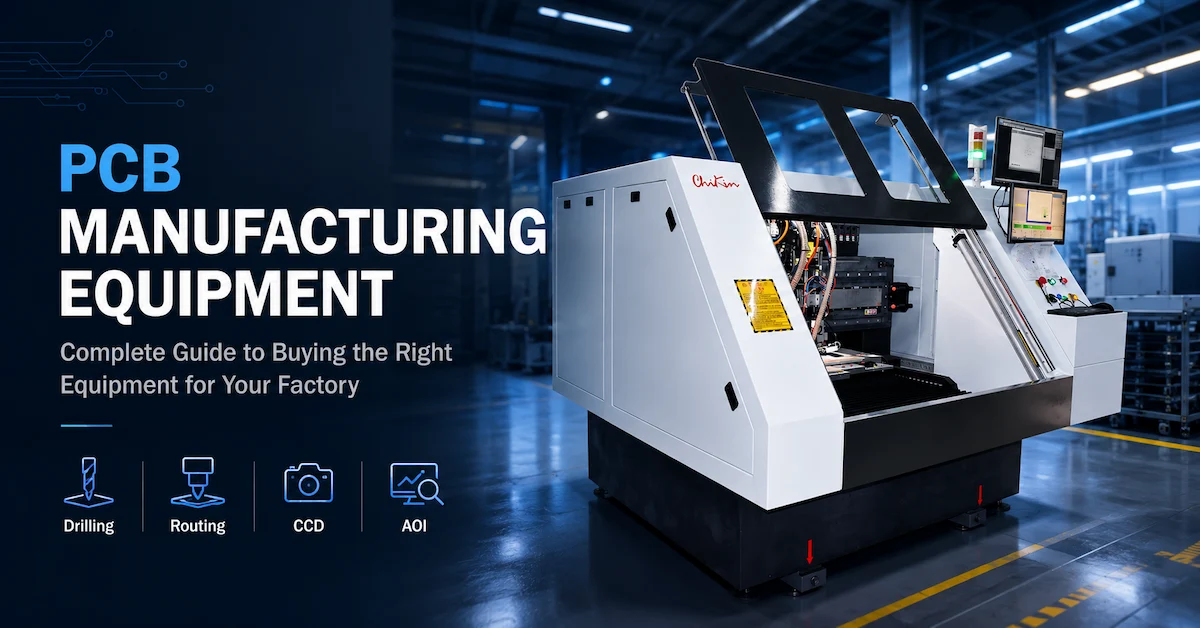
Buying PCB manufacturing equipment is a major investment that affects production capacity, processing accuracy, operating cost, delivery performance, and future factory expansion.
A common purchasing mistake is to evaluate each machine separately. A buyer may purchase a drilling machine based only on spindle speed, a routing machine based only on working area, or an AOI system based only on inspection speed.
However, PCB production is a connected workflow.
A machine that performs well individually may still create problems if it does not match:
- The PCB materials being processed
- Upstream and downstream processes
- Factory output requirements
- Existing file and software systems
- Panel sizes and fixture methods
- Operator experience
- Future automation plans
A better purchasing strategy starts with the entire production process.
Before asking a PCB equipment supplier for a quotation, buyers should determine what boards they will produce, which processes will remain in-house, what production volume is expected, and where quality or capacity risks are most likely to occur.
Buyers can first review the complete range of PCB manufacturing equipment offered by CHIKIN CNC to understand how drilling, routing, CCD alignment, inspection, and related processes fit together.
This guide explains how to plan, compare, and purchase the main equipment needed for PCB drilling, routing, alignment, laser cutting, inspection, V-cutting, and depaneling.
Start With Your PCB Production Requirements
Equipment selection should begin with the product, not the machine catalog.
Identify the PCB Materials
Different PCB materials require different processing methods, spindle configurations, tooling, fixtures, and dust-control systems.
Common materials include:
- FR4
- Multilayer PCB
- HDI board
- Rigid-flex PCB
- Flexible PCB
- Aluminum PCB
- Copper-based substrate
- Thin electronic films
FR4 boards may require stable drilling and efficient dust removal. Flexible circuits may benefit from non-contact laser processing. Aluminum or copper substrates may need stronger cutting capability and suitable tooling or laser technology.
Define the Board Dimensions
Buyers should prepare:
- Maximum panel length and width
- Board thickness range
- Minimum hole diameter
- Slot and outline dimensions
- Panelization format
- Required working area
A machine with an insufficient working area cannot process the intended panels. An oversized machine may increase investment, floor-space requirements, and maintenance costs without creating meaningful production value.
Estimate Production Volume
The production target affects the required equipment configuration.
| Production Type | Main Equipment Priority |
|---|---|
| Prototype and R&D | Flexibility, easy setup, compact equipment |
| Small-batch production | Fast changeover and program storage |
| Mid-volume production | Balanced speed, automation, and cost |
| High-volume production | Multi-spindle output and line integration |
| High-mix production | CCD alignment and flexible fixtures |
A prototype laboratory may only require a single-spindle CNC machine, while a mass-production factory may need multi-spindle equipment, automated loading, inspection integration, and stronger tool-management capability.
Map the Complete PCB Equipment Workflow
A PCB factory should evaluate equipment according to the production stages it plans to perform internally.
The following equipment categories form a practical starting point for factory planning.
1. PCB Drilling Machine
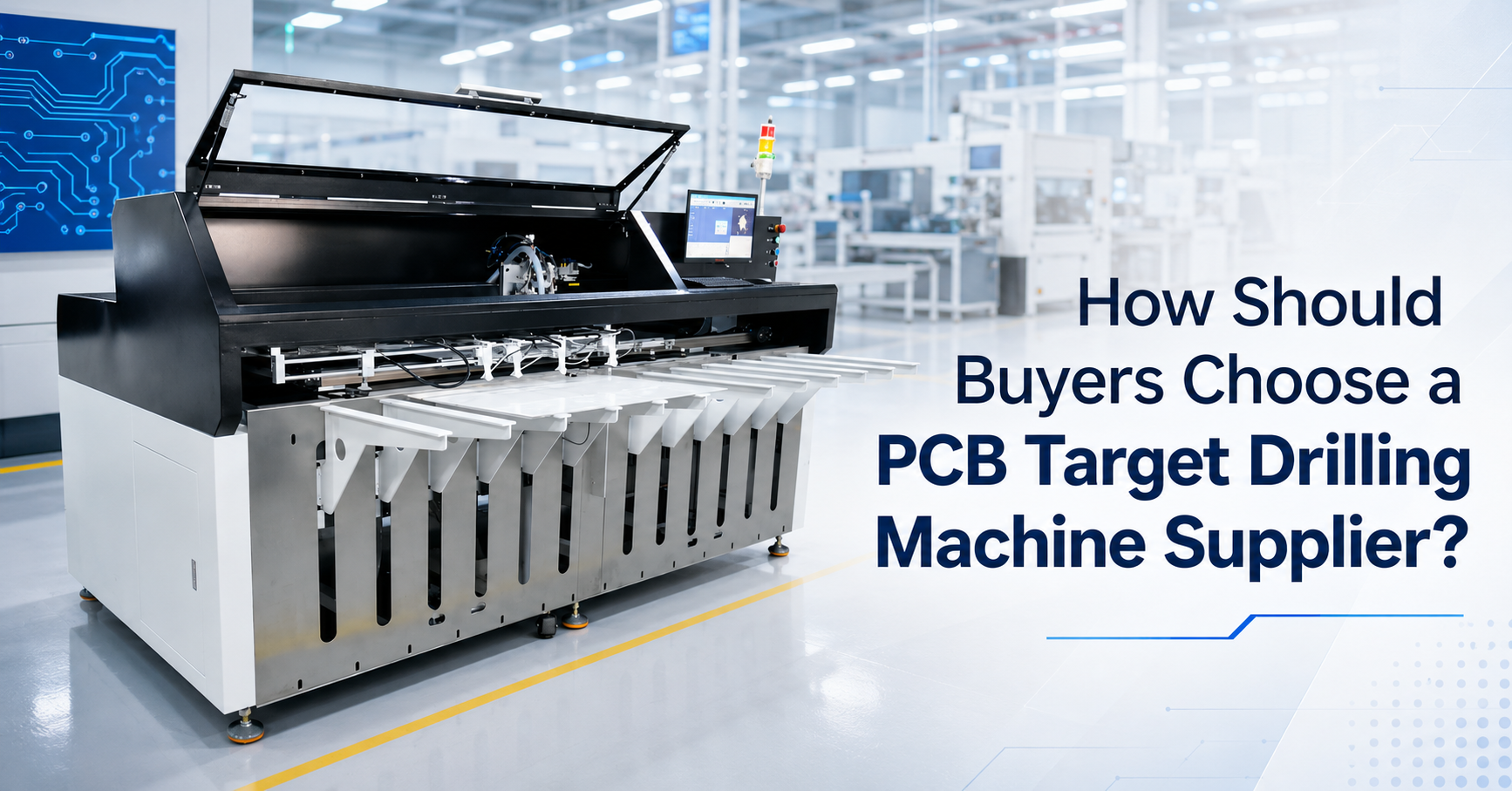
A PCB drilling machine creates vias, through-holes, tooling holes, component holes, and mounting points.
Main Buyer Concerns
Buyers should evaluate:
- Positioning accuracy
- Repeatability
- Spindle speed
- Minimum drilling diameter
- Drill-bit compatibility
- Broken-tool detection
- Automatic tool change
- Dust extraction
- Board clamping
Single-Spindle or Multi-Spindle?
A single-spindle machine is suitable for prototypes and small batches. Two-spindle or four-spindle equipment supports higher production volume. Larger multi-spindle systems are intended for factories with stable, repeated demand.
The correct choice depends on actual cycle-time requirements rather than spindle quantity alone.
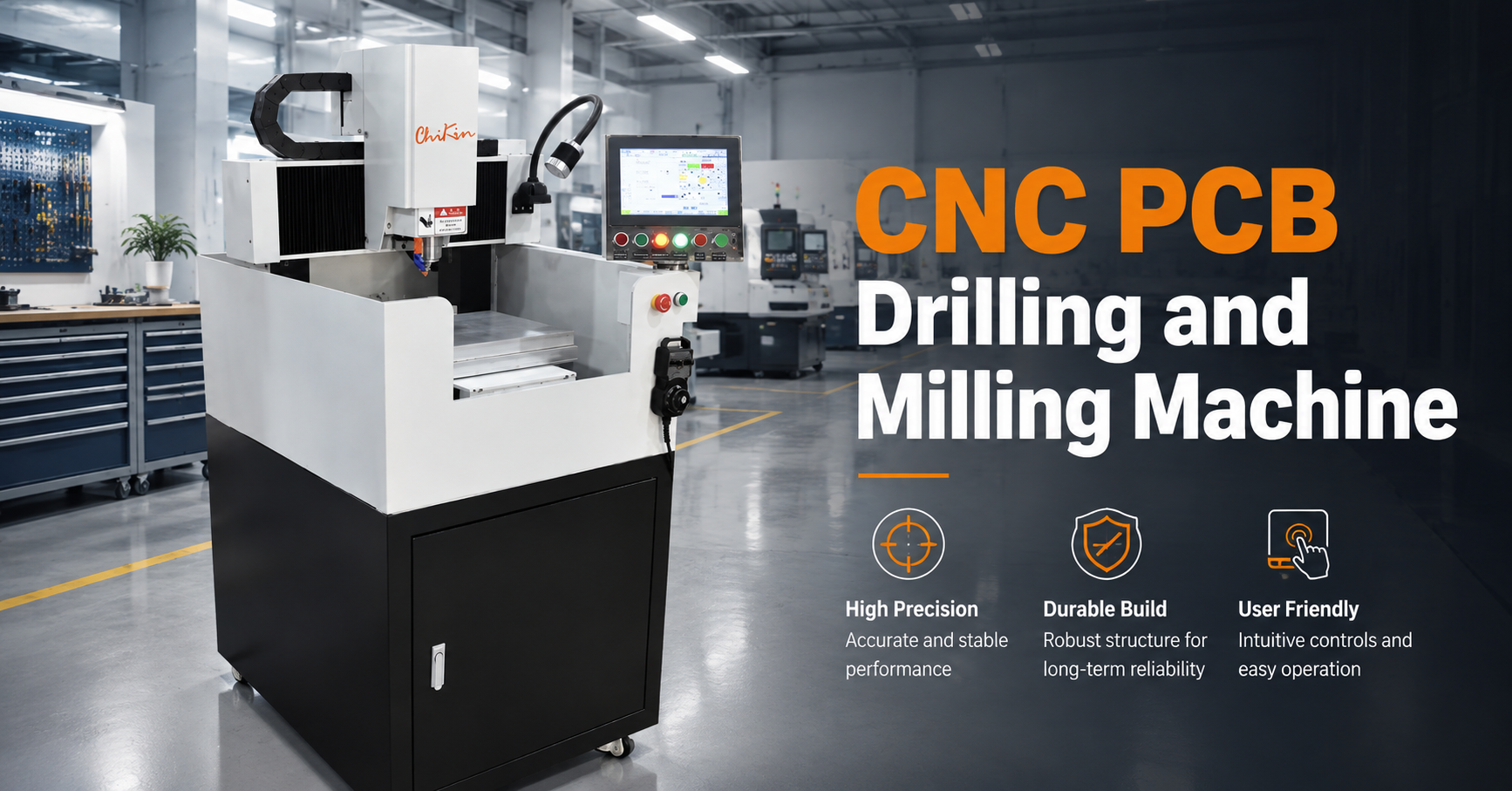
For factories that need a balance between throughput and manageable operation, the 2 Spindle PCB Drilling and Routing Machine can be used as a reference when evaluating combined drilling and routing capacity.
Questions to Ask the Supplier
- What board materials can the machine process?
- What minimum hole diameter is supported?
- How is positioning accuracy verified?
- Is sample drilling available?
- How are broken tools detected?
- What tool-magazine capacity is available?
2. PCB Routing Machine
A PCB routing machine cuts board outlines, slots, internal openings, irregular profiles, and depaneling paths.
Main Buyer Concerns
Routing buyers should focus on:
- Edge quality
- Contour accuracy
- Spindle runout
- Tool diameter range
- Fixture stability
- Dust control
- Program compatibility
- Tool-life management
Routing creates lateral cutting forces. Machine rigidity and fixture design are therefore especially important.
Drilling and Routing Integration
Factories that require both hole processing and contour cutting may benefit from a combined PCB drilling and routing machine.
Integrated equipment can reduce:
- Board transfers
- Re-clamping
- Alignment errors
- Floor-space requirements
- Operator handling
For applications that also require automatic visual positioning, buyers can review the 1 Drill 1 Route PCB Machine with CCD, which combines dedicated drilling and routing spindles with CCD alignment.
However, buyers should confirm whether the combined configuration meets the required production volume for both processes.
3. CCD Alignment Machine
CCD vision systems detect fiducial marks and help correct panel offset or rotation before drilling and routing.
When CCD Alignment Is Valuable
CCD-based equipment is useful for:
- High-mix PCB production
- Multilayer boards
- Rigid-flex boards
- Prototype orders
- Boards with complex contours
- Frequent model changes
- Precision drilling and routing
Key Evaluation Points
Buyers should check:
- Camera resolution
- Fiducial recognition
- Lighting stability
- Multi-point alignment
- Rotation compensation
- Software correction
- Recognition speed
- Compatibility with board surfaces
CCD technology cannot replace mechanical accuracy. It must work together with a rigid structure, precise motion system, stable spindle, and reliable fixtures.
The CCD drilling and routing solution from CHIKIN CNC is relevant for buyers who need drill-then-route processing with automatic fiducial recognition and panel-position correction.
4. Laser Cutting Equipment
Laser equipment provides non-contact processing and is often considered for flexible circuits, fine outlines, delicate substrates, or metal-core PCB applications.
UV Laser Cutting
UV laser processing is commonly considered for:
- Flexible PCB
- Cover films
- Thin electronic materials
- Fine contours
- Low-mechanical-stress processing
Fiber Laser Cutting
Fiber laser systems may be used for:
- Aluminum substrates
- Copper-based materials
- Metal-core PCB
- Thin metal panels
Buyer Evaluation Points
Buyers should confirm:
- Laser source type
- Material compatibility
- Cutting thickness
- Heat-affected zone
- Edge quality
- Fume extraction
- Fixture requirements
- Sample validation
- Laser-source service life
Laser equipment should always be tested with the buyer’s actual material stack because different coatings, copper thicknesses, adhesives, and films can respond differently.
Relevant laser-processing options can be reviewed through the CHIKIN CNC product center.
5. AOI Inspection Equipment
Automated optical inspection helps identify visible defects during PCB or PCBA production.
Depending on the process stage, AOI may detect:
- Missing components
- Component misalignment
- Solder bridges
- Insufficient solder paste
- Tombstoning
- Polarity errors
- Surface abnormalities
Main Buyer Concerns
Buyers should evaluate:
- Camera resolution
- Inspection speed
- False-call rate
- Defect-library management
- Lighting configuration
- Programming time
- MES compatibility
- Data traceability
- Operator review workflow
The fastest AOI system is not always the most suitable. A system that generates excessive false calls can increase manual review time and reduce line efficiency.
Before selecting AOI equipment, buyers should ask the supplier whether inspection programming, defect-library configuration, operator training, and production-data integration are included.
6. PCB V-CUT Equipment
A PCB V-CUT machine creates controlled grooves in panelized circuit boards to support later separation.
Main Buyer Concerns
Buyers should confirm:
- Groove-depth accuracy
- Remaining board thickness
- Blade quality
- Panel size range
- Positioning method
- Cutting consistency
- Dust collection
- Blade maintenance
V-CUT equipment is suitable for panel layouts designed for straight-line separation. It is not suitable for every irregular board outline.
The PCB design and panelization method should therefore be reviewed before selecting V-CUT equipment.
Buyers who need drilling, routing, V-CUT, laser cutting, or inspection solutions from one supplier can compare available options through the CHIKIN CNC equipment range.
7. PCB Depaneling Equipment
Depaneling separates individual boards from a larger panel after manufacturing or assembly.
Common methods include:
- Mechanical routing
- V-CUT separation
- Punching
- Saw cutting
- Laser depaneling
How to Select a Depaneling Method
The correct method depends on:
- Board material
- Panel design
- Component distance from the edge
- Acceptable mechanical stress
- Required edge quality
- Production volume
- Product sensitivity
Mechanical routing is flexible for complex shapes. V-CUT offers fast straight-line separation. Laser depaneling reduces mechanical contact and may suit delicate assemblies, but normally requires higher investment and process validation.
Build a PCB Equipment Specification Sheet
Before contacting suppliers, buyers should prepare one specification document covering all major requirements.
Recommended Buyer Information
| Item | Information to Provide |
| PCB material | FR4, FPC, rigid-flex, aluminum PCB |
| Panel size | Maximum length and width |
| Board thickness | Minimum and maximum |
| Hole diameter | Minimum and common sizes |
| Routing requirement | Outline, slot, opening, depaneling |
| Accuracy target | Drilling, routing, and alignment tolerance |
| Production volume | Per shift, day, or month |
| File format | Existing manufacturing data |
| Automation need | Manual, semi-automatic, or integrated |
| Factory conditions | Power, air, dust extraction, floor space |
| Inspection need | AOI stage and defect requirements |
| Future plan | Capacity expansion or new board types |
A detailed specification helps the PCB equipment manufacturer provide a meaningful recommendation instead of a generic quotation.
Evaluate the PCB Equipment Supplier
Machine specifications matter, but supplier capability determines whether the equipment can be successfully delivered, installed, operated, and maintained.
Manufacturing Capability
Verify whether the supplier has:
- Its own production or assembly facility
- Mechanical and electrical engineering teams
- Machine calibration procedures
- Factory acceptance testing
- Documented quality control
- Experience with PCB applications
A direct PCB equipment manufacturer can usually communicate technical requirements more efficiently than an intermediary.
Buyers can review the CHIKIN CNC company and manufacturing background before evaluating its suitability as a long-term equipment partner.
Product Range
A supplier with experience across drilling, routing, vision alignment, laser processing, inspection, and mechanical cutting may better understand how the machines connect within the production workflow.
A broad product range does not automatically prove quality, but it can demonstrate stronger process understanding.
Reviewing the supplier’s PCB production equipment portfolio also helps buyers determine whether future expansion can be supported without changing vendors.
Sample Processing
Ask the supplier to process actual materials or drawings whenever possible.
Sample testing can verify:
- Hole accuracy
- Routing edge quality
- Laser cutting results
- Alignment performance
- Cycle time
- Tool wear
- Inspection capability
A successful catalog specification does not guarantee success on every buyer’s material.
Installation and Training
Confirm whether the quotation includes:
- Installation guidance
- Operator training
- Software training
- Maintenance instruction
- Process-parameter support
- Acceptance documentation
For international buyers, remote support, video guidance, English documentation, and clear service procedures are especially important.
Common service questions can be reviewed in the CHIKIN CNC technical FAQ.
Spare Parts and Technical Service
Ask:
- Which spare parts should be stocked?
- What is the expected delivery time?
- Which components are standard industrial parts?
- Is remote diagnosis available?
- How quickly are service requests answered?
- How long will software support remain available?
The lowest machine price can become expensive if spare parts or service support are difficult to obtain.
Compare Total Cost of Ownership
PCB factories should compare more than the purchase price.
Total Cost Factors
Include:
- Machine price
- Shipping and insurance
- Installation
- Training
- Fixtures
- Dust or fume extraction
- Tooling
- Software
- Spare parts
- Maintenance
- Energy consumption
- Scrap rate
- Production downtime
A more expensive machine may offer a lower total cost if it improves yield, reduces setup time, simplifies maintenance, or provides better technical support.
New PCB Factory vs Existing Factory Upgrade
The purchasing strategy differs depending on the project.
New Factory Project
A new factory should prioritize:
- Process flow planning
- Equipment compatibility
- Utility requirements
- Floor layout
- Material movement
- Data integration
- Future expansion
Avoid purchasing machines independently without considering how boards will move between processes.
Existing Factory Upgrade
An upgrade project should first identify the bottleneck.
Common bottlenecks include:
- Slow drilling
- Routing delays
- Manual alignment
- High scrap
- Excessive inspection time
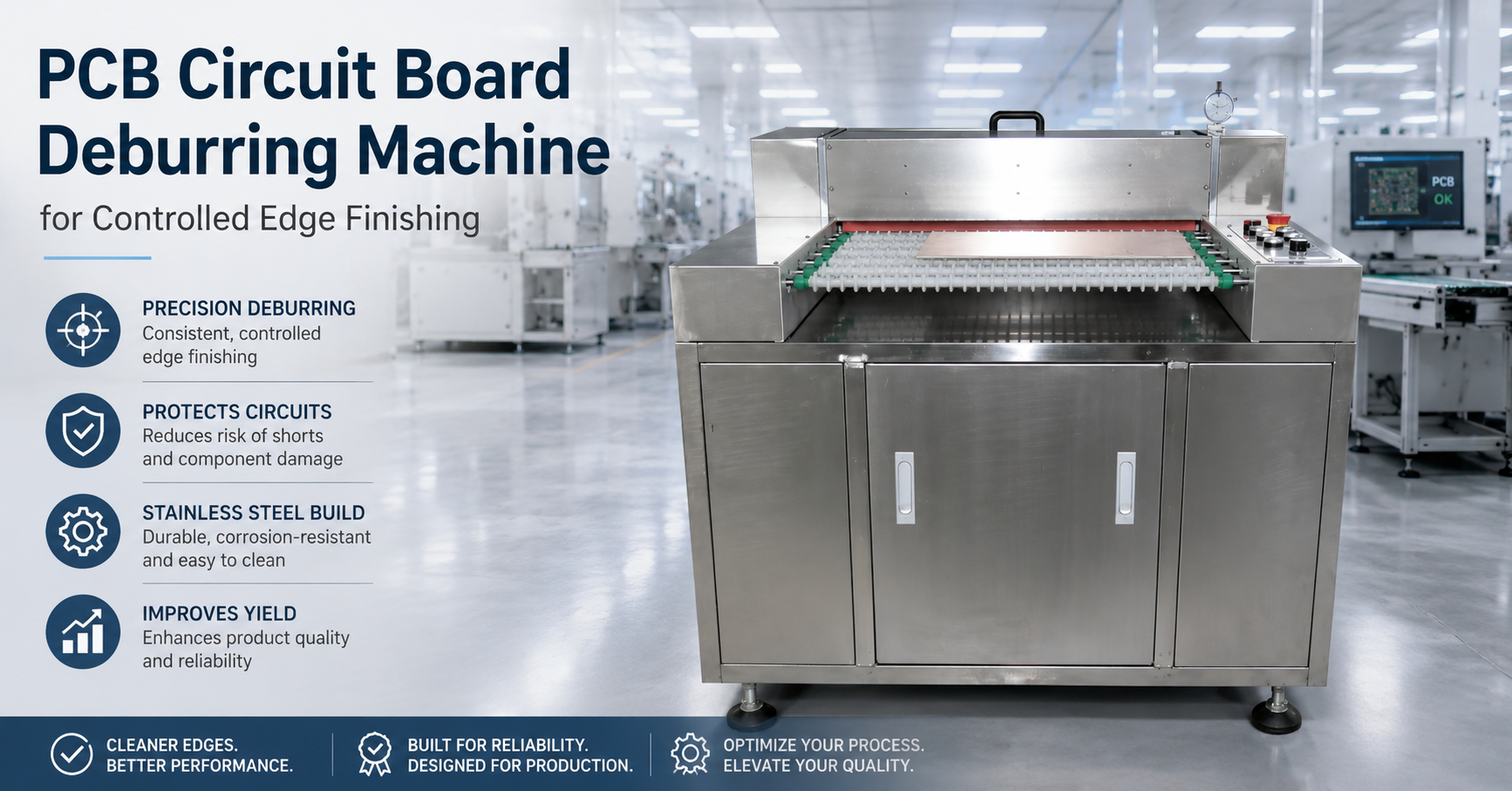
- Difficult depaneling
- Frequent tool replacement
Buy equipment to solve a measured production problem, not simply to add more machines.
Why Consider CHIKIN CNC for PCB Equipment Projects?
CHIKIN CNC focuses on PCB automation and precision board-processing equipment.
Its current equipment direction includes:
- PCB drilling machines
- PCB drilling and routing machines
- Multi-spindle configurations
- CCD alignment solutions
- AOI inspection equipment
- FPC laser processing
- Related mechanical PCB-processing solutions
CHIKIN CNC can support equipment evaluation based on:
- PCB material
- Board dimensions
- Accuracy requirements
- Production volume
- Drilling and routing workflow
- Alignment needs
- Automation plans
For buyers, the main value of working with a direct manufacturer is the ability to discuss machine configuration, sample processing, customization, and technical support with the equipment team.
Buyers can learn more about CHIKIN CNC as a PCB equipment manufacturer and review available PCB manufacturing equipment solutions before requesting a project assessment.
PCB Manufacturing Equipment Buyer Checklist
Before confirming an order, buyers should verify:
- The equipment matches the actual PCB material
- Working area covers current and future panel sizes
- Accuracy has been verified by testing
- Cycle time meets production targets
- Required fixtures and tools are included
- Dust or fume extraction is planned
- Software supports the production workflow
- Installation and training responsibilities are clear
- Spare parts are available
- Warranty and support terms are documented
- Factory acceptance testing is agreed
- Shipping and delivery scope is confirmed
FAQ: PCB Manufacturing Equipment
What equipment is needed to start a PCB factory?
The required equipment depends on which production stages will be completed internally. Common categories include drilling, routing, laser cutting, inspection, V-CUT, depaneling, imaging, plating, etching, and testing equipment.
Should a new factory buy all PCB equipment from one supplier?
Not necessarily. Buyers should select suppliers based on technical strength in each process. However, using compatible systems and working with suppliers that understand the full workflow can simplify integration and service.
What is the difference between PCB drilling and routing equipment?
Drilling equipment produces holes, while routing equipment cuts board outlines, slots, and internal openings. Combined machines can perform both processes in one platform.
When should a factory choose CCD alignment?
CCD alignment is valuable when panel position varies, board designs change frequently, or drilling and routing must follow accurate fiducial references.
Is laser cutting better than mechanical routing?
Neither method is universally better. Laser cutting offers non-contact processing and fine geometry, while mechanical routing can be more economical and flexible for many rigid-board applications.
What should buyers check when selecting AOI equipment?
Evaluate defect coverage, false-call rate, programming time, inspection speed, image quality, MES integration, and the operator review process.
How should buyers compare PCB equipment quotations?
Compare technical configuration, included accessories, fixtures, software, service, spare parts, delivery scope, warranty, and total operating cost, not only the base machine price.
Can PCB manufacturing equipment be customized?
Many direct manufacturers can customize working area, spindle configuration, fixtures, software, handling systems, and automation interfaces when the project requirements are clearly defined.
Should buyers request sample processing?
Yes. Sample processing is one of the most effective ways to verify accuracy, edge quality, cycle time, material compatibility, and process stability.
What information is needed for an equipment consultation?
Prepare PCB materials, drawings, panel dimensions, thickness, hole sizes, routing paths, accuracy requirements, target output, factory conditions, and automation expectations.
Conclusion: Build the Equipment Plan Around Your PCB Production Goals
Buying PCB manufacturing equipment should begin with a clear production plan rather than a list of machine names.
PCB factories should define:
- What boards they will manufacture
- Which processes will remain in-house
- What production volume is required
- What accuracy and quality targets must be achieved
- Which processes create the greatest risk or bottleneck
- What support will be needed after installation
Drilling machines, routing systems, CCD equipment, laser cutting machines, AOI, V-CUT, and depaneling equipment each solve different production problems. The right equipment combination depends on the factory’s products, workflow, budget, and long-term growth plan.
A reliable PCB equipment supplier should help buyers connect these decisions into a practical production solution.
Request a PCB Manufacturing Equipment Consultation from CHIKIN CNC
Planning a new PCB production line or upgrading an existing factory requires careful technical evaluation. CHIKIN CNC can help review your board materials, dimensions, production volume, drilling and routing requirements, inspection needs, and automation goals before recommending equipment.
To receive a more accurate recommendation, prepare:
- PCB drawings or sample panels
- Material and thickness information
- Required hole and routing dimensions
- Target output per shift or per day
- Accuracy and quality requirements
- Existing factory layout
- Current production bottlenecks
- Future capacity plans
CHIKIN CNC can then help you compare suitable PCB manufacturing equipment, discuss sample testing, evaluate customization options, and clarify installation and after-sales requirements.
Contact CHIKIN CNC to request a PCB equipment consultation and develop a practical solution for your factory.