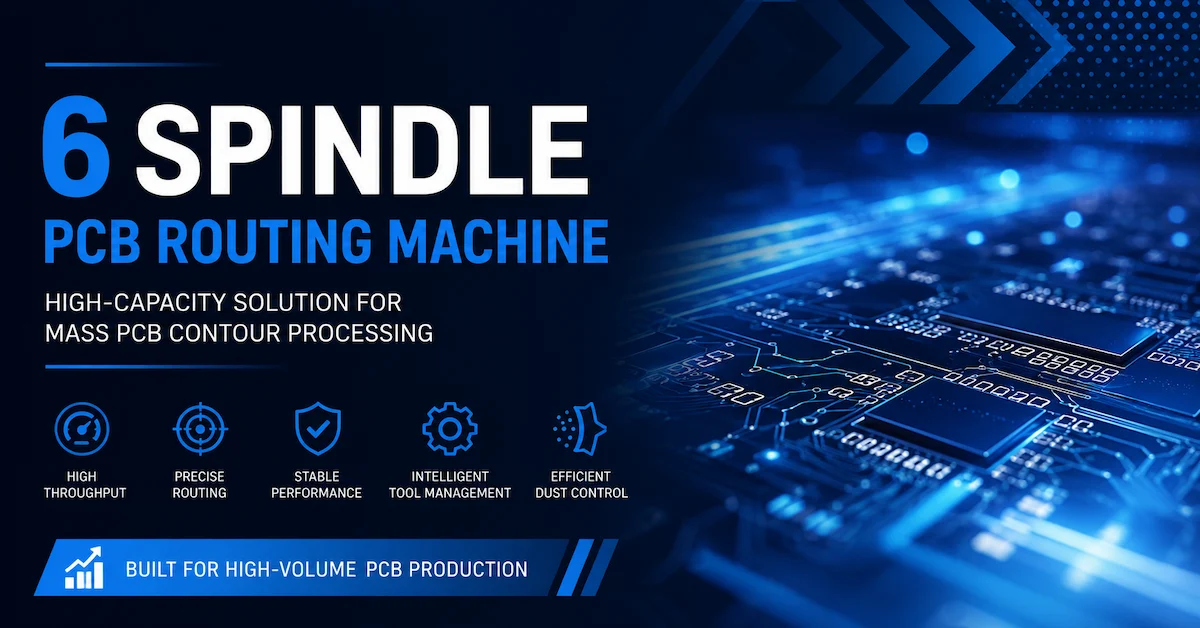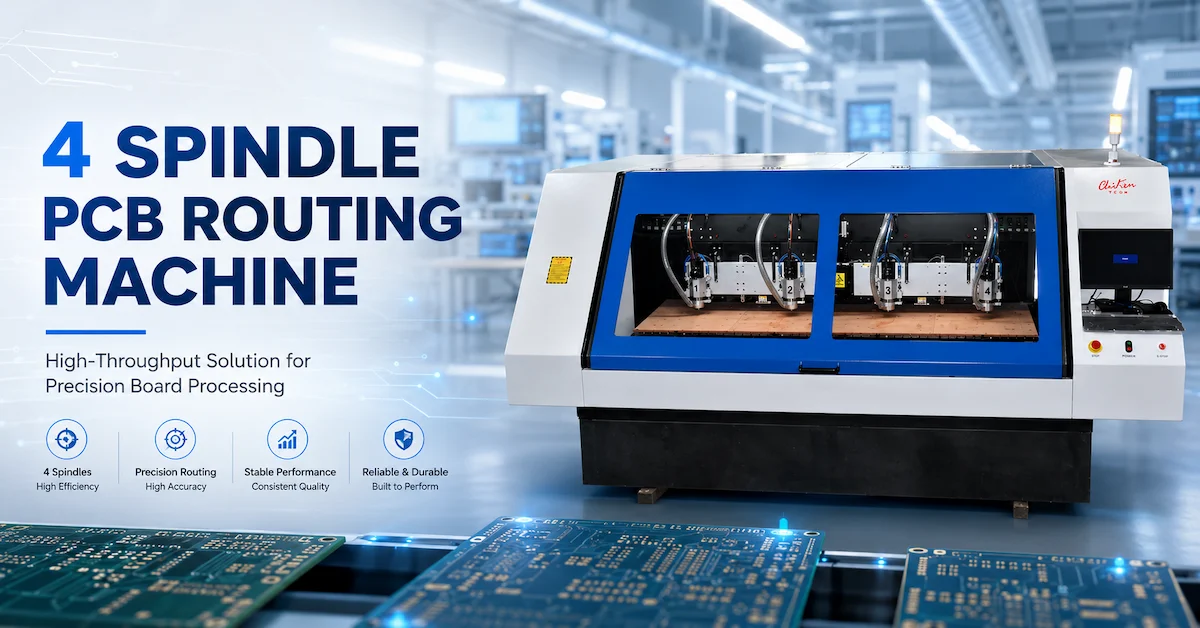




A routing machine is an important piece of equipment for PCB manufacturers that need accurate board outlines, clean edge quality, stable slot processing, and repeatable contour cutting. In PCB production, routing is not only about cutting the board shape. It affects final assembly fit, panel separation, product appearance, edge smoothness, and downstream quality control.
Many buyers first focus on drilling because holes are critical for vias, mounting, and components. However, routing is equally important when the finished PCB needs accurate dimensions, special slots, irregular shapes, or clean separation from a larger panel.
If routing accuracy is poor, factories may face problems such as:
- Rough or chipped board edges
- Board outline deviation
- Incorrect slot dimensions
- Poor fit during assembly
- Extra manual trimming
- Higher scrap rate
- Lower production consistency
That is why choosing the right routing machine should be based on board material, thickness, spindle performance, tool compatibility, fixture stability, software control, and after-sales support.
What Is a Routing Machine in PCB Production?
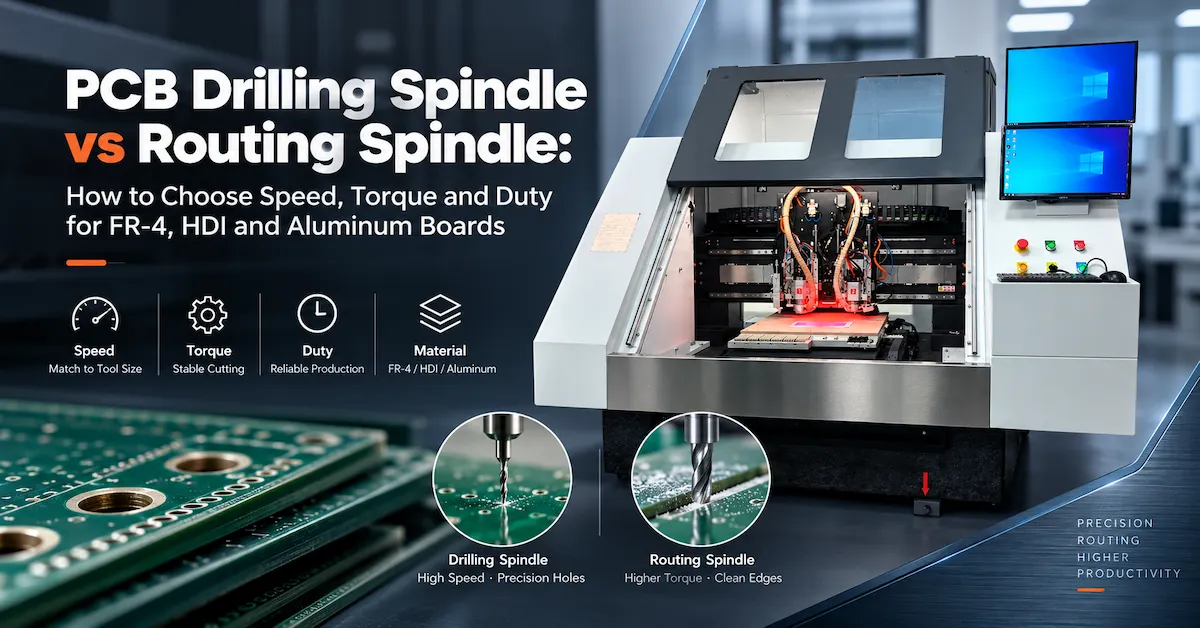
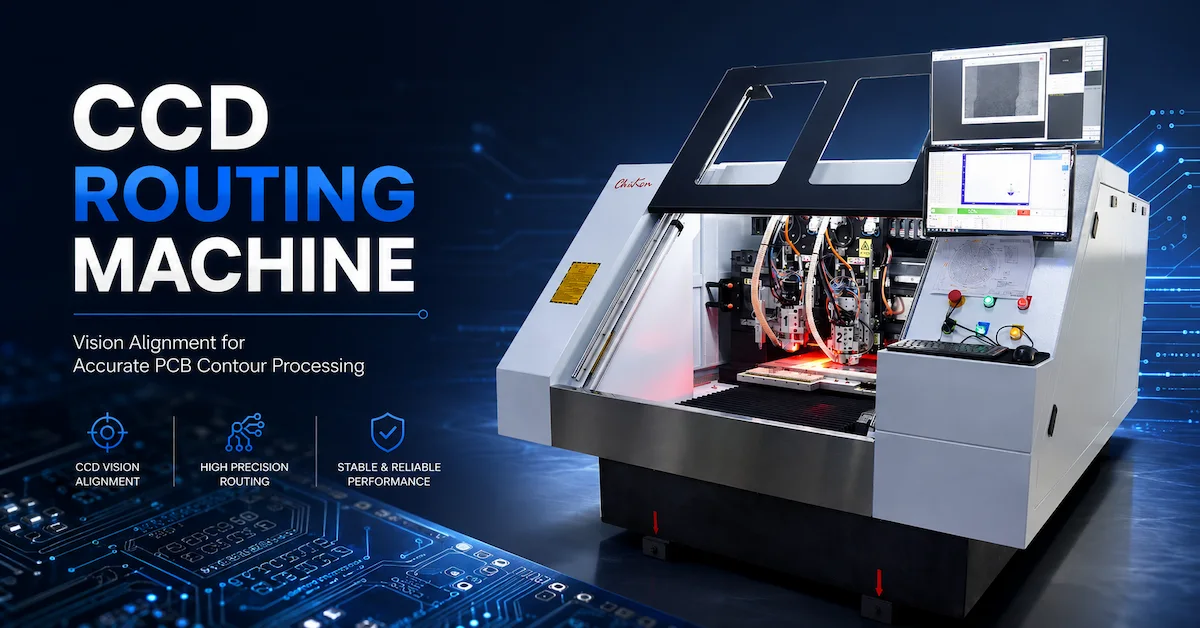
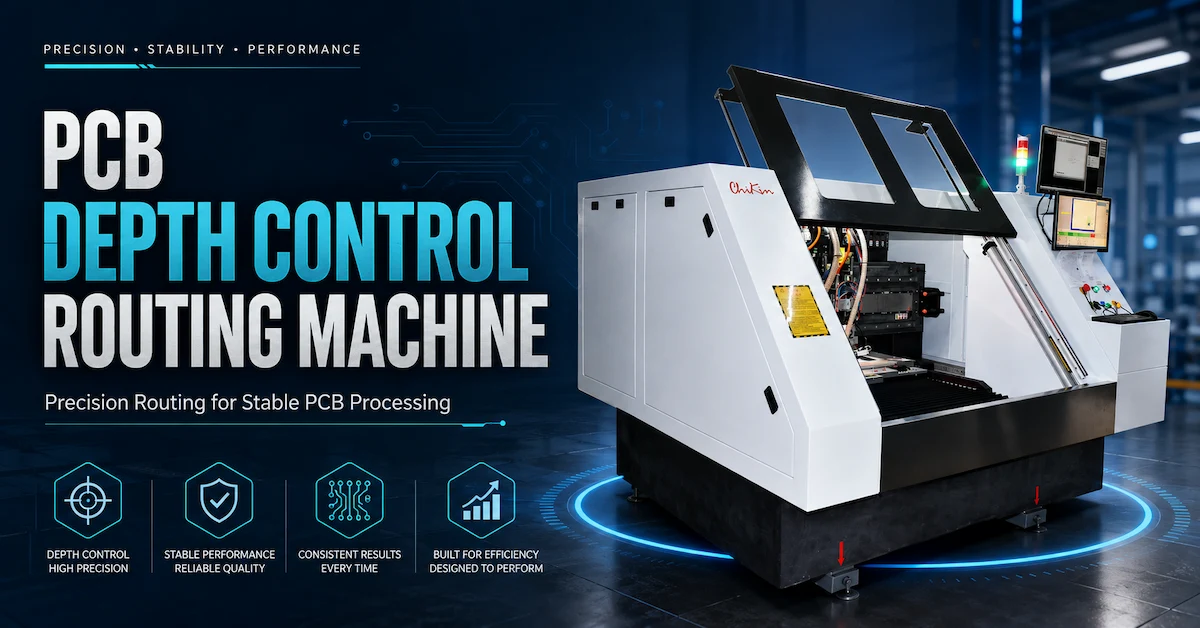
A routing machine for PCB production is CNC equipment used to cut, trim, or shape printed circuit boards according to programmed paths. It usually uses a high-speed routing spindle and specialized router bits to process board outlines, slots, internal cutouts, edge contours, and panel separation paths.
In PCB manufacturing, a routing machine may be used for:
- PCB outline cutting
- Board contour routing
- Slot processing
- Internal opening cutting
- Panel depaneling
- Edge trimming
- Custom board shape processing
- FR4 board routing
- Rigid-flex board routing
- Aluminum PCB profile processing
A PCB routing machine is different from a general router because PCB materials require tighter dimensional control, better dust handling, stable fixturing, and smaller tool compatibility.
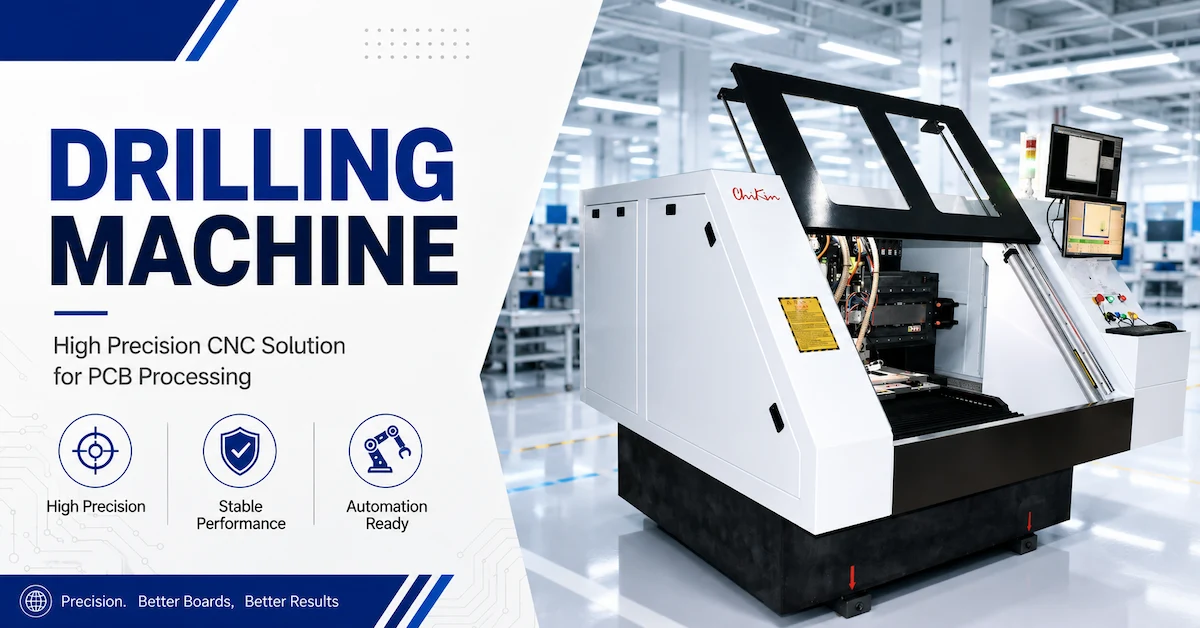
Routing Machine vs Drilling Machine
PCB buyers often compare routing machines and drilling machines, but the two solve different production problems.
| Comparison Point | PCB Drilling Machine | PCB Routing Machine |
|---|---|---|
| Main Function | Makes holes in PCB panels | Cuts outlines, slots, and contours |
| Typical Tool | Drill bit | Router bit or milling cutter |
| Key Concern | Hole position accuracy | Edge quality and profile accuracy |
| Common Use | Vias, through-holes, mounting holes | Board shaping, depaneling, custom slots |
| Buyer Focus | Drill diameter, hole accuracy, tool breakage | Routing path, spindle stability, dust control |
| Best For | Hole-making workflows | Board outline and profile processing |
If your factory needs only hole drilling, a drilling machine may be enough. If your factory needs finished board shapes, edge trimming, or slot cutting, a routing machine is necessary. If you need both processes, a PCB drilling and routing machine can reduce handling between separate machines.
When Should Buyers Choose a PCB Routing Machine?
A routing machine is suitable when PCB dimensions, edges, and profiles must be controlled accurately.
1. When Board Shape Is Not Simple
Many PCB designs are not simple rectangles. They may include curved edges, internal cutouts, mounting slots, or special outlines. CNC routing helps process these shapes more consistently than manual trimming.
2. When Edge Quality Affects Final Assembly
Rough edges, burrs, or inaccurate profiles can affect enclosure fitting, connector alignment, or product assembly. A stable routing machine helps improve final board quality.
3. When Panel Separation Needs Better Control
PCB panels often contain multiple boards. Routing helps separate individual boards while maintaining consistent dimensions.
4. When Production Volume Increases
Manual routing may work for samples, but it becomes slow and inconsistent in batch production. CNC routing improves repeatability and reduces operator dependence.
5. When Drilling and Routing Need One Workflow
Some factories need hole drilling and outline routing in the same production process. A combined PCB drilling and routing machine can reduce setup time and improve workflow efficiency.
Common Applications of a Routing Machine
A routing machine can support many PCB manufacturing tasks.
Typical applications include:
- FR4 PCB contour routing
- PCB outline cutting
- PCB slot cutting
- Internal window cutting
- Irregular board profile processing
- Panel depaneling
- Prototype board shaping
- Rigid-flex PCB routing
- Aluminum PCB edge processing
- High-mix small-batch PCB production
For factories processing different board designs, routing flexibility is one of the strongest reasons to choose CNC equipment.
Key Benefits of a PCB Routing Machine
1. Cleaner Board Edges
A professional routing machine can improve board edge quality when the spindle, tool, feed speed, and fixture are properly matched. This reduces the need for manual trimming and improves product appearance.
2. More Accurate Board Dimensions
PCB assembly often depends on accurate board size. CNC routing helps control outlines and cutouts according to programmed paths, making repeated production more stable.
3. Better Support for Custom Shapes
Routing machines are useful for boards with special outlines, slots, or openings. This is important for electronics products with compact housings or non-standard mechanical requirements.
4. Reduced Manual Labor
CNC routing reduces manual cutting and trimming. This helps lower operator variation and improve process consistency.
5. Integration With Drilling Workflows
For some buyers, the best solution is not a routing-only machine but a PCB drilling and routing machine. This can complete both hole processing and contour routing in one equipment platform.
Routing Machine for Different PCB Materials
Different materials require different routing conditions. Buyers should confirm whether the machine can process their actual boards.
| PCB Material | Routing Consideration |
| FR4 PCB | Needs stable spindle, sharp tools, dust control |
| Multilayer PCB | Requires dimensional accuracy and low edge damage |
| Rigid-flex PCB | Needs careful fixturing and process control |
| Flex PCB | May require special holding or alternative cutting methods |
| Aluminum PCB | Requires suitable tooling and stronger processing stability |
| Prototype PCB | Needs flexible setup and easy program changes |
Before choosing a routing machine, buyers should send board material, thickness, shape, routing path, and tolerance requirements to the supplier.
Key Technical Factors Buyers Should Check
1. Spindle Performance
The routing spindle affects edge quality, speed, tool life, and processing stability.
Buyers should check:
- Spindle speed
- Spindle runout
- Routing bit compatibility
- Cooling method
- Tool holding method
- Maintenance requirements
A stable spindle helps reduce vibration, rough edges, and tool wear.
2. Machine Structure and Motion Stability
Routing creates lateral cutting force. If the machine structure is weak, the board edge may become rough or inaccurate.
Important structure points include:
- Rigid machine base
- Stable gantry or motion system
- Precision linear guides
- Reliable ballscrews or drive system
- Flat worktable
- Enclosed processing area
Stable machine structure is essential for repeatable routing quality.
3. Fixture and Board Holding
PCB panels must stay flat and fixed during routing. If the board moves, the routing path may shift and the edge may be damaged.
Ask the supplier:
- How is the PCB fixed?
- Does the machine support vacuum clamping?
- Can custom fixtures be used?
- Can it handle warped or thin boards?
- Is repeated positioning supported?
Good fixturing improves both accuracy and edge quality.
4. Tool Management
Routing bits wear over time. Tool wear can affect edge finish, routing accuracy, and production consistency.
Useful functions include:
- Automatic tool change
- Tool length detection
- Tool diameter detection
- Broken tool detection
- Tool life management
- Easy tool replacement
For factories running batch production, tool management is important for reducing downtime and scrap.
5. Software and Program Control
A routing machine should be easy for operators to use. Software affects setup time, repeat production, and operator training.
Buyers should ask:
- What file formats are supported?
- Can routing paths be saved?
- Can parameters be stored for repeat jobs?
- Is the interface available in English?
- Can remote support help with setup?
- Can the supplier provide operation training?
A machine with good hardware but poor software may still slow down daily production.
6. Dust and Debris Control
Routing FR4 and similar materials can create dust and chips. Good dust control helps protect operators, machine parts, tools, and board quality.
Check:
- Enclosed work chamber
- Dust extraction compatibility
- Easy cleaning access
- Chip collection design
- Maintenance plan
For long-term production, dust management should not be ignored.
Product Match: CHIKIN CNC 1 Drill 1 Route PCB Machine with CCD
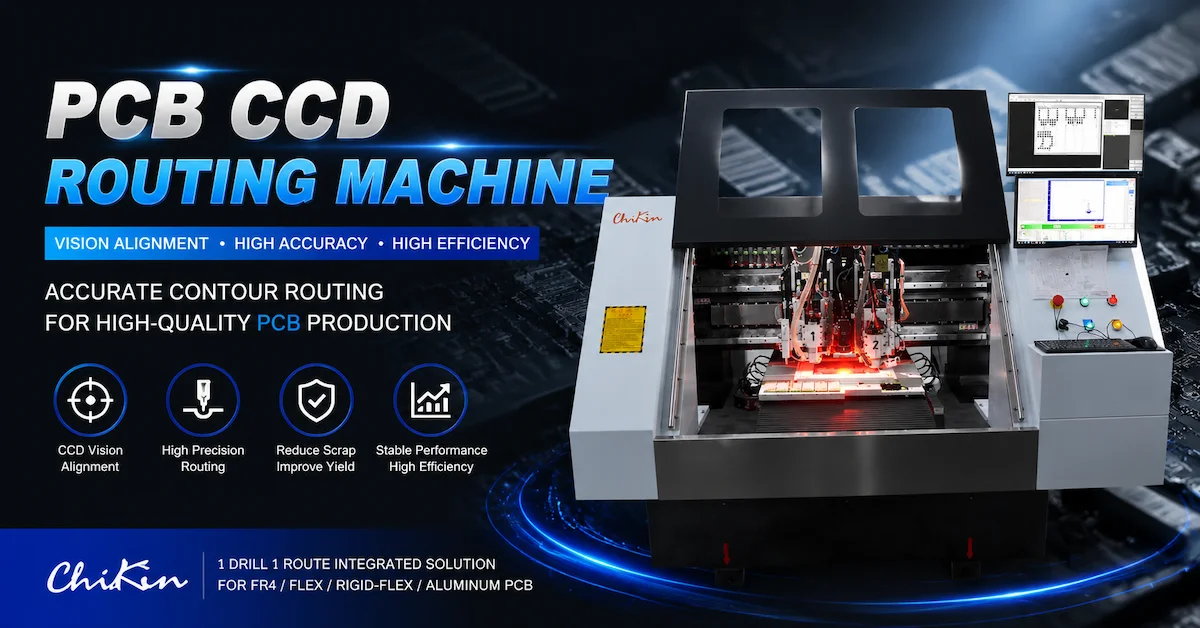
For this topic, the most relevant CHIKIN CNC product is the 1 Drill 1 Route PCB Machine with CCD.
This product is suitable because it combines one high-speed drilling spindle and one routing spindle in one machine. It is designed for PCB factories that need both drilling and contour routing without moving boards between separate equipment.
It is especially suitable for buyers who need:
- PCB drilling and routing in one workflow
- Contour routing after drilling
- CCD fiducial alignment
- Better board registration
- Reduced setup and handling time
- FR4, flex, rigid-flex, and aluminum PCB processing
- Automatic tool change and tool detection support
Recommended product page:
Recommended anchor text:
1 Drill 1 Route PCB Machine with CCD
You can also link to:
https://www.chikincnc.com/products
https://www.chikincnc.com/about-us
https://www.chikincnc.com/service/faq
Routing Machine Buyer Checklist
Before requesting a quotation, prepare the following details:
| Information | Example |
| Board material | FR4, rigid-flex, aluminum PCB |
| Board thickness | 0.8mm, 1.6mm, 2.0mm |
| Board size | Length × width |
| Routing task | Outline, slot, internal opening, depaneling |
| Edge quality requirement | Standard or high-clean edge |
| Accuracy requirement | Routing tolerance |
| Production volume | Prototype, small batch, mid-volume |
| Drilling requirement | Yes or no |
| Alignment need | CCD, fixture, manual reference |
| Automation need | Tool change, tool detection, program storage |
This information helps the supplier recommend a suitable routing machine instead of offering a generic model.
Common Buying Mistakes to Avoid
Mistake 1: Buying Routing-Only Equipment When Drilling Is Also Needed
If your production needs both holes and contours, a drilling and routing machine may be more efficient than separate machines.
Mistake 2: Ignoring Fixture Design
Routing quality depends heavily on board holding. Poor fixture design can cause vibration, edge damage, or routing path deviation.
Mistake 3: Only Comparing Machine Price
Low-cost equipment may not provide stable spindle performance, good software, tool detection, or dust control. Poor routing quality can increase rework cost.
Mistake 4: Forgetting Dust Control
Routing FR4 and similar materials can create debris. Buyers should confirm dust extraction and cleaning access before purchase.
Mistake 5: Not Sending Routing Drawings
The supplier needs your board shape, slot design, tolerance, and material details to recommend the correct machine and tooling.
FAQ: Routing Machine for PCB Production
1. What is a routing machine used for in PCB production?
A routing machine is used to cut PCB outlines, slots, contours, openings, and panel separation paths.
2. What is the difference between drilling and routing?
Drilling makes holes in the PCB, while routing cuts board edges, profiles, internal shapes, and slots.
3. Can one machine support both drilling and routing?
Yes. A PCB drilling and routing machine can support both processes if it has suitable spindles, tools, fixtures, and software.
4. What materials can a PCB routing machine process?
Depending on configuration, it can process FR4, rigid-flex, aluminum PCB, prototype boards, and other PCB-related materials.
5. What affects routing edge quality?
Edge quality depends on spindle stability, tool sharpness, feed speed, board fixation, dust control, and material type.
6. Is CCD alignment useful for routing?
Yes. CCD alignment helps improve board registration, especially when routing must follow existing hole positions or copper patterns.
7. Should I choose routing-only or drilling-routing equipment?
Choose routing-only equipment if you only need profile cutting. Choose drilling-routing equipment if your workflow includes both holes and outlines.
8. What should I send before asking for a quote?
Send board material, thickness, size, routing path, slot design, tolerance, production volume, and whether drilling is also required.
Conclusion: Choose a Routing Machine Based on Board Shape, Edge Quality, and Workflow
A routing machine is essential for PCB factories that need clean board outlines, accurate slots, and stable contour processing. The right machine can reduce manual trimming, improve board consistency, and support higher production reliability.
For many buyers, a PCB drilling and routing machine offers stronger value because it can combine hole drilling and contour routing in one workflow. This is especially useful for mid-volume PCB production, high-mix board designs, and factories that want to reduce handling between processes.
CHIKIN CNC provides PCB routing and drilling-routing equipment for manufacturers that need stable, accurate, and efficient board processing.
If you are comparing routing machine options, send your board material, thickness, routing drawing, accuracy requirement, production volume, and whether drilling is also needed. CHIKIN CNC can help recommend a suitable PCB routing solution.
Contact CHIKIN CNC to request a routing machine recommendation and quotation: