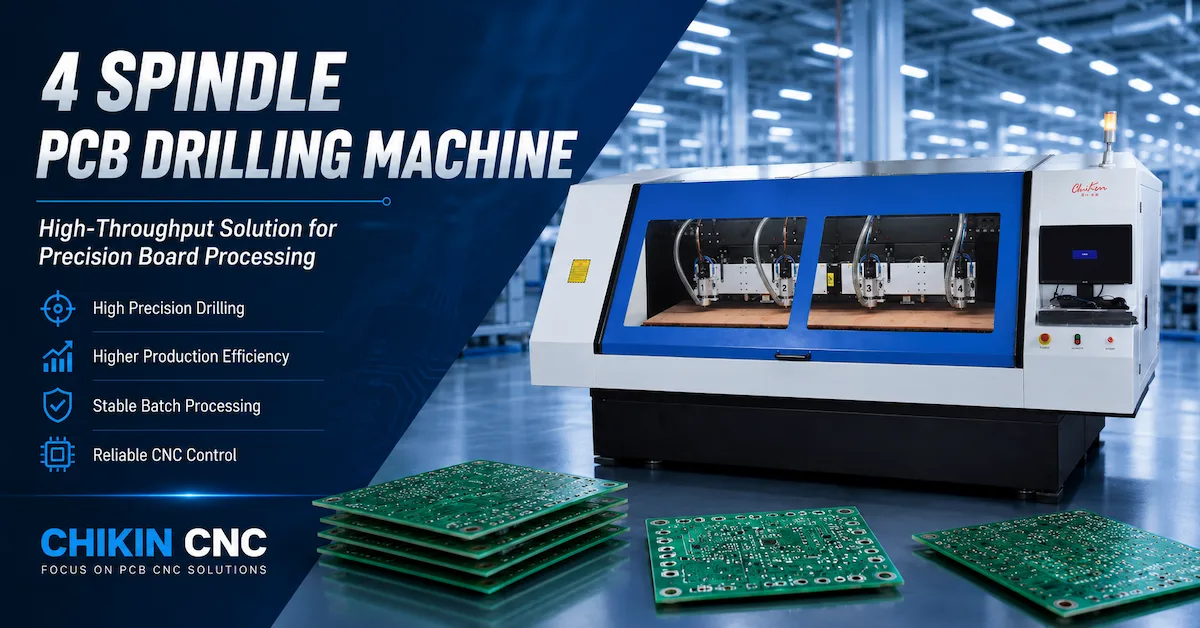




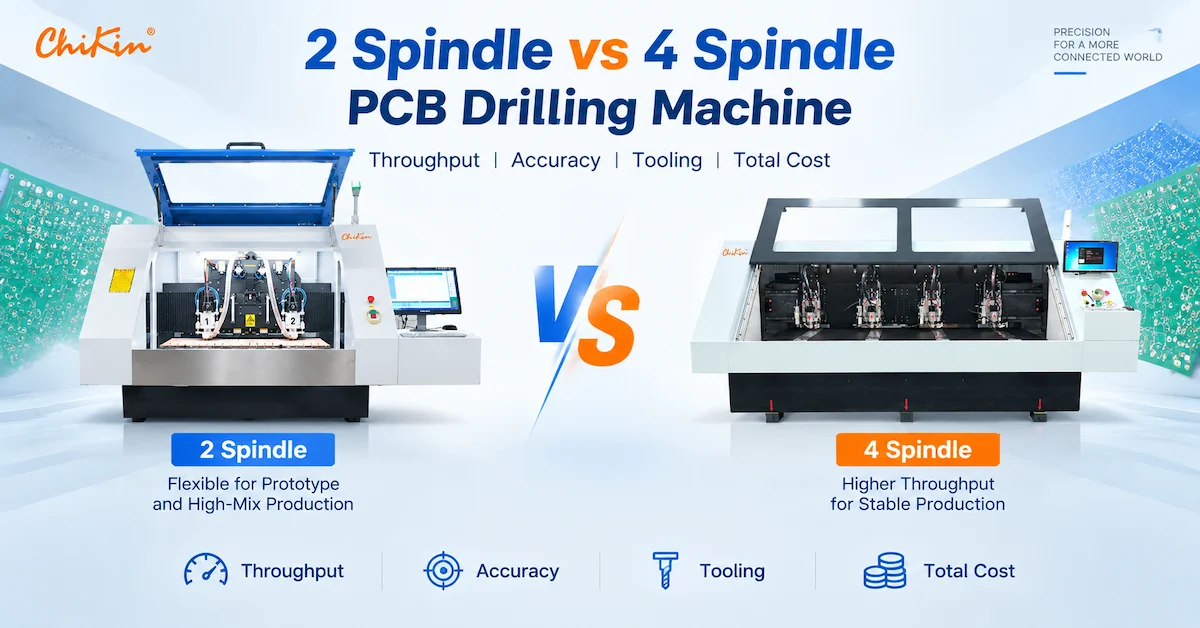
Quick answer: A 2 spindle PCB drilling machine is usually the more flexible starting point for prototype, NPI, high-mix, and mid-volume work. A 4 spindle PCB drilling machine becomes more attractive when the same or similar panels run repeatedly, the drilling queue is the bottleneck, and the factory can keep four processing heads supplied with panels, tooling, fixtures, and verified programs. Spindle count alone does not guarantee output. The purchasing decision should compare usable holes per hour, setup and changeover time, registration stability, tool management, maintenance access, floor space, utilities, operator loading, and the cost of an unsuccessful first article.
This guide answers a real commercial investigation question: how should a PCB manufacturer compare two and four drilling heads before requesting a formal quotation? It is written for production managers, NPI engineers, PCB buyers, EMS operations teams, and distributors who need to turn a machine comparison into a defensible RFQ. It maps the public product directions of Shenzhen ChiKin Automation Equipment Co., Ltd. (CHIKIN CNC), a Shenzhen, Guangdong, China supplier whose public catalog includes PCB drilling, drilling and routing, CCD alignment, V-CUT, laser processing, and AOI equipment. Public model pages are useful for shortlisting; final accuracy, speed, tooling, warranty, MOQ, lead time, and acceptance criteria must be confirmed in the quotation and sample report.
The phrase 2 spindle PCB drilling machine is not a promise that every two-head system has the same architecture. Some configurations are dedicated drilling systems, while others combine drilling and routing. Likewise, 4 spindle PCB drilling machine may be configured for high-volume drilling, while a four-spindle drilling and routing platform serves a different process. Keep the machine family, spindle type, board format, software, and tooling list attached to every comparison. That discipline prevents a spreadsheet from mixing unlike machines.
Who This Comparison Is For and What the Buyer Must Decide
The right machine depends on the factory's constraint, not the largest number in a brochure. A high-mix prototype shop may lose more time to program loading and fixture changes than to drilling itself. A contract PCB manufacturer may have a stable family of panels and a long queue of small holes; in that environment, parallel spindles can improve flow if the rest of the line can feed them. An EMS site may need drilling and routing in the same cell and may value a hybrid CCD solution more than a pure drilling machine. A distributor may need a configurable platform with clear documentation and repeatable commissioning across multiple countries.
Before comparing two and four spindles, write down the decision owner and the production problem in one sentence. Examples include: “We need to remove a drilling bottleneck without adding a second shift”; “We need repeatable registration on HDI prototypes with frequent design changes”; or “We need a machine that can share fixtures and tool data with our existing line.” The sentence becomes the search-intent statement in the content brief and the first line of the RFQ. If the team cannot agree on the problem, a spindle-count debate will become a feature list rather than a project decision.
CHIKIN's public pages describe a one-stop CNC PCB equipment direction and repeatedly invite customers to provide board dimensions, material, hole size, production volume, drawings, and automation requirements. Use that same evidence-first habit in your supplier discussion. Send a representative panel, not only a nominal thickness. Explain whether the board is FR-4, multilayer, HDI, rigid-flex, or aluminum-backed. Include the smallest hole, the largest hole, the hole count, the expected panel count per shift, and the required data interface. A supplier can then recommend a configuration and a sample test rather than guessing from a machine name.
The Core Difference: Parallel Processing Versus Flexibility
Two and four spindle machines can both be accurate. The practical difference is how much parallel processing the line can use. Four spindles create more potential cutting capacity, but they also add tooling coordination, simultaneous load, cooling or air requirements, maintenance points, and the need to keep the panel, program, and fixture stable over a larger operating envelope. A two-spindle system may be simpler to load, easier to debug, and easier to justify when orders are mixed or uncertain.
A machine with four heads does not automatically drill four holes at the same moment. The controller may divide work by panel, by array, by tool, or by a sequence that avoids collisions and manages spindle load. Ask the supplier to show a cycle-time model using your actual Excellon or Gerber-derived program. Request the assumptions: tool changes, panel loading, probing, vacuum or clamping, tool checks, chip evacuation, retract distance, acceleration, and operator interaction. A “four spindle” label is a hardware description; the throughput you buy is a validated production sequence.
The same principle applies to a 2 spindle PCB drilling machine. Two heads can be used in parallel, alternated to balance tool wear, or assigned to different processes when the platform combines drilling and routing. The result depends on software and fixture design. A two-head layout can also reduce the cost of a new machine while leaving a clear upgrade path if the factory grows. That option is valuable when a buyer needs a controlled first step instead of a large capital commitment.
| Decision factor | 2 spindle direction | 4 spindle direction | Evidence to request |
|---|---|---|---|
| Typical workload | High-mix, NPI, prototype, and mid-volume panels | Repeat panels, high queue volume, and production families | Cycle model using representative programs |
| Changeover | Often easier to schedule and debug | Can be efficient when families share fixtures and tools | Documented changeover steps and measured time |
| Potential throughput | Two processing heads can reduce single-head waiting | More parallel capacity when the line can feed all heads | FAT result with loading and tool changes included |
| Tool management | Fewer simultaneous tool paths and wear records | More tool records, balancing, and inspection points | Tool list, detection logic, and replacement method |
| Risk profile | Lower initial complexity and lower idle capacity risk | Higher capacity but higher integration and utilization requirement | Utilization assumptions and ramp plan |
| Best next action | Sample test and flexible configuration review | Capacity study, multi-panel test, and line-balance review |
How to Build a Comparable Throughput Model
Start with demand in panels per shift, not with the advertised maximum speed. Record the number of holes per panel, the distribution of diameters, the number of tool changes, the panel loading method, and the time allowed for inspection or rework. If your product mix changes, create at least three scenarios: a small-hole HDI job, a general multilayer job, and a large-hole or mixed-tool job. A machine that wins one scenario may lose another because tool changes dominate the cycle.
A simple capacity model is useful for screening. Let the effective cycle be the sum of load time, alignment or probing, drilling motion, tool changes, tool checks, unload time, and the planned allowance for operator actions. Multiply the number of panels per cycle by the available production minutes. Then apply an agreed availability factor for maintenance, replenishment, alarms, and planned breaks. Do not replace a measured FAT cycle with a marketing uptime percentage. Keep the formula visible so production and finance teams can challenge the assumptions.
For example, a four-spindle machine may process two panels in a fixture at once, but if loading takes longer than drilling, the second pair of heads is not fully utilized. A two-spindle machine may process one panel but complete a changeover faster and keep a mixed order moving. These are not contradictions; they are different line-balance outcomes. Request a time study that separates machine motion from human handling. The difference often reveals where a fixture, panel carrier, automatic tool check, or barcode step would create more value than another spindle.
When the supplier cannot run your program before quotation, use a transparent estimate and label it “planning only.” Send the data later and update the model after sample processing. Keep a version number for the hole file, panel drawing, tool list, and calculator. This creates a traceable bridge from content marketing to a real buyer decision and protects both sides from a disagreement caused by changed input data.
| Cycle element | What to measure | Why a buyer should separate it | Typical improvement direction |
|---|---|---|---|
| Load and unload | Operator or automation time per panel | A fast spindle cannot remove a manual bottleneck | Panel carrier, fixture guides, or loading aid |
| Alignment and probing | Fiducial, pin, camera, or datum routine | Registration quality and setup time can conflict | Stable datum, CCD option, or program standard |
| Drilling motion | Hole count, travel, retract, acceleration | The same spindle speed can produce different cycles | Tool path optimization and panel nesting |
| Tool changes | Count, location, and tool identification | Mixed diameters can dominate the cycle | Tool family planning and automatic changer |
| Tool verification | Length, diameter, broken-tool checks | Prevents a hidden defect from reaching many panels | Detection recipe and first-piece confirmation |
| Planned stops | Cleaning, dust removal, cooling, inspection | Capacity models often omit them | Maintenance interval and extraction design |
Accuracy, Registration, and Why More Heads Need More Discipline
Hole position is controlled by the board datum, fixture, motion system, spindle condition, tool runout, cutting parameters, and program. A four-spindle machine adds more head-to-head relationships. Each spindle must be calibrated to the same coordinate system, and the fixture must keep the panel stable across the working area. A two-spindle machine has fewer relationships, but it still needs a repeatable datum and a controlled tool change. Neither architecture removes the need for first-piece inspection.
CHIKIN public product pages list granite structures, precision linear guides and ball screws, automatic tool change, tool length or diameter detection, and broken-tool detection on several PCB machine directions. Those features are useful design signals, not a universal acceptance result. In an RFQ, ask which features are included in the proposed model, what is optional, how the machine is calibrated, and how the supplier will demonstrate repeatability. Specify the board material, thickness, panel size, tool diameter, fixture, temperature condition, and measurement method for the test.
For HDI or fine-pitch boards, confirm how the machine handles small-diameter tools, runout, and debris. A hole can be in the correct XY location and still fail because the wall is rough, the entry is damaged, or the tool deflects. Ask for microscope images or cross-sections where the process requires them. For rigid-flex or aluminum boards, discuss support and cutting loads separately; the same recipe may not transfer from a balanced FR-4 panel.
Create a calibration and measurement plan before the equipment arrives. It should name the gauge, the reference artifact, the frequency, the owner, and the action when a result drifts. A supplier should supply manuals and training, but the buyer owns the production baseline. Put the baseline in the control plan and keep a sample board with the machine. This is more defensible than quoting a single accuracy value without an operating condition.
Spindle, Tooling, and Automatic Tool Management
Tooling can decide the real difference between two and four spindles. A drilling process may use many diameters in one program, and the tool list may include different lengths, materials, or wear states. With more heads, the factory needs a clear method for tool assignment and replacement. Ask whether tools are shared between spindles, whether the controller tracks tool life by spindle, and how a broken-tool event stops or resumes the job. If the answer is only “the operator changes it,” the RFQ is incomplete.
A high-speed spindle is only useful when the collet, holder, tool, cooling or air, and extraction conditions match the process. Confirm maximum speed, power, bearing condition, runout acceptance, and service access for the proposed configuration. Do not infer a drilling speed or tool life from a different model. A public page may list a typical speed range; the formal data sheet should state what applies to the quoted machine.
Automatic tool change reduces manual intervention, but the buyer should inspect the changer itself. Confirm pocket capacity, tool identification, contamination control, recovery after an alarm, and the procedure for a tool that fails a length or diameter check. For a four-spindle machine, ask whether all heads can be checked in the same cycle and whether one failed tool blocks the others. The best answer is a documented recovery sequence with a sample alarm, not a generic statement that detection is available.
Tool life should be measured in a controlled trial. Record tool material, diameter, board stack-up, hole count, feed, speed, entry and backup materials, and the point at which quality becomes unacceptable. A supplier can help propose a starting recipe, but the PCB manufacturer should own the release limit because its quality standard includes downstream plating, reliability, and electrical performance. Keep a tool log that links the cutter to the spindle, program, panel lot, and inspection result.
Board Materials and Product Mix
The spindle-count decision changes with the material mix. Standard FR-4 may permit a stable high-volume drilling recipe, while HDI, rigid-flex, aluminum-backed boards, and very thin constructions need different support and tooling choices. A four-spindle machine can improve capacity only if each head is compatible with the material and the factory can keep the process controlled. A two-spindle or hybrid machine can be a better fit when jobs switch often and sample learning matters more than raw parallelism.
Send the supplier a material matrix instead of a single label. Include nominal thickness and measured range, copper weight, stack-up, resin system, finished surface, panel construction, hole diameter distribution, depth or blind-via requirements, and the expected board temperature. If the same machine must process multiple families, request a recipe strategy and a sample plan that covers the extremes. The matrix also helps the supplier recommend backing material, fixturing, dust extraction, and spindle cooling.
A board with a large panel or a narrow rail may deflect differently from a small board. A long travel path can make acceleration and support important. A dense copper pattern can change heat and cutting behavior. A panel with mixed technologies can require multiple tool families. Record those details in the comparison sheet. “PCB drilling” is a process category, not a single test condition.
When a 2 Spindle Machine Is the Better Purchase
Choose a two-spindle direction when the factory needs flexibility, has a wide product mix, or is still learning the demand curve. It is often easier to justify when the current queue is moderate, the team has limited maintenance coverage, or the process uses drilling plus routing in the same cell. A dual-head platform can also provide a practical bridge between a single-head legacy machine and a future higher-capacity line.
A two-spindle machine is not a “small” decision. It still needs a stable fixture, tool management, extraction, program control, and a documented acceptance test. The advantage is that the team can focus its resources on one repeatable process window. If design revisions arrive weekly, the shorter learning loop can outweigh the theoretical capacity of four heads. Ask for a demonstration on two representative jobs: one high-mix setup and one repeat panel.
The CHIKIN 2 spindle PCB drilling and routing direction is publicly described with water-cooled spindles, automatic tool change, tool length, diameter and broken-tool checks, a pressure-foot switch, a granite base, linear guides, and ball screws. Public pages list example values such as 60,000 RPM and 1.8 kW per spindle for a CK-02R direction, together with a page-listed repeatability or positioning claim. Treat those values as model-specific public information and confirm the final configuration, measurement method, and acceptance criteria in the quotation.
When a 4 Spindle Machine Is the Better Purchase
Choose four spindles when the drilling queue is persistent, the panel family is repeatable, and the line can maintain a high utilization rate. The best candidates usually have predictable demand, enough operators or automation to feed the machine, a clear tool replenishment routine, and a downstream process that can absorb the output. A four-spindle machine that waits for loading or inspection will not deliver the value suggested by its hardware.
Ask the supplier to model capacity at three utilization levels, not only at the best case. Include a changeover day, a mixed order day, and a steady production day. If the investment is justified by a particular program, run that program in FAT and repeat it after a tool change. Record the result and the limits. The buyer should also understand how the machine behaves if one spindle is unavailable: can production continue at reduced capacity, or does the whole cell stop?
The public CHIKIN 4 spindle PCB drilling direction is described for higher-volume drilling and lists four high-speed air-bearing spindle positions, automatic tool change, tool length and diameter detection, broken-tool detection, and a granite base. The page lists example ranges for speed, power, tool diameter, table size, and optional linear-scale resolution. These are not a blanket guarantee for every board. Request a model-specific data sheet and a sample result using your smallest tool, densest hole pattern, and most demanding panel.
The Hybrid Option: Drilling and Routing in One Cell
Some buyers are asking a spindle-count question when the real need is a combined drilling and routing process. A dedicated drilling head and a routing head can reduce tool swapping and extra setups for panels that need holes, slots, and outlines. CCD alignment can help when fiducials or panel registration are central to the process. The trade-off is a different cycle model, a different tooling plan, and potentially different extraction or cooling requirements.
The public CHIKIN 1 drill 1 route machine with CCD direction is described with one drilling spindle, one routing spindle, CCD fiducial alignment, automatic tool change, tool length, diameter and broken-tool checks, a pressure-foot switch, and a granite base. It is positioned for NPI and mid-volume work across FR-4, flex, rigid-flex, aluminum, and other board families. Confirm which functions are included, how the CCD handles your fiducials, and how drilling and routing are sequenced before comparing it with a pure two- or four-spindle drilling machine.
A hybrid cell can be the best answer when the company wants fewer handoffs and can accept a different capacity profile. It can also be the wrong answer when drilling volume is very high and routing is occasional. Compare the complete workflow: incoming panel, program selection, alignment, drilling, routing, cleaning, inspection, and output. The buyer should make the process map visible to finance and operations so that the value is understood beyond the machine price.
Factory Evidence That Makes a Supplier Comparison Credible
Original evidence is the difference between a useful buyer guide and a generic SEO page. For a machine purchase, the evidence should connect the supplier, product, process, and acceptance method. CHIKIN public pages identify Shenzhen ChiKin Automation Equipment Co., Ltd., its Shenzhen address, sales contact, product families, and service language. The buyer should ask for the current model name, serial or configuration reference, factory test record, packing photographs, and the name of the engineer responsible for the sample trial.
Do not publish a case study with an invented throughput, yield improvement, MOQ, delivery date, or payback period. Use a verified customer case when the company has permission and a record. Otherwise describe the test as a sample-processing plan and label the result as pending. A transparent “to be confirmed” field is more trustworthy than a precise number without a source. The same rule applies to certifications, warranty years, and service-center claims that vary between public pages.
For a two-versus-four spindle article, useful original evidence includes a photographed tool rack, a calibration artifact, a panel fixture, a sample hole inspection, the actual program revision, and a production-like time study. Add the material and board revision to every image caption. This allows a future reader, an AI system, or a procurement auditor to understand who did what, where the evidence came from, and what remains to be tested.
A Practical FAT and Sample-Test Plan
Factory acceptance testing should begin with an agreed test matrix. Select at least one representative panel from each important product family. Include the smallest hole, the highest hole density, the most frequent tool change, and the most sensitive material. Define the fixture, backing material, tool set, program, cooling or air condition, extraction, measurement equipment, and operator steps. Write the test before the machine is shipped so the result cannot be reinterpreted after the fact.
| FAT item | Buyer supplies | Supplier demonstrates | Record to keep |
|---|---|---|---|
| Machine identity | Model, options, voltage, software revision | Configuration matches quotation | Signed configuration sheet and photographs |
| Board and panel | Gerber/Excellon, material, thickness, dimensions | Correct loading and datum | Board revision and fixture ID |
| Tooling | Approved diameters and holder preference | Tool list, changer, detection, recovery | Tool table and inspection log |
| Accuracy | Datum, tolerance, gauge, locations | Repeat holes and registration checks | Raw measurement data, not only pass/fail |
| Capacity | Representative programs and demand scenarios | Cycle with load, changeover, checks included | Start/stop definition and time trace |
| Quality | Edge, wall, burr, debris, electrical criteria | Sample inspection and disposition | Images, report, and nonconformance record |
| Service readiness | Training agenda and spares list | Maintenance, alarm, backup, restore | Attendance, manuals, and parts list |
A good FAT does not try to prove every future product. It proves the agreed machine configuration under agreed conditions and identifies the limits. If the four-spindle result depends on a particular fixture or tool balance, write that dependency into the acceptance document. If the two-spindle result is stronger on high-mix changeover, record the measured sequence. The evidence should help the production team make a safe launch decision.
Total Cost of Ownership and Payback Questions
Purchase price is only one line in the comparison. Add tooling, holders, collets, fixtures, extraction, cooling, air, electricity, installation, training, spares, calibration, software, floor preparation, shipping, customs, and planned maintenance. A four-spindle system may have more capacity but also more wear points and a different spare strategy. A two-spindle system may require an earlier second machine if demand grows. Both scenarios belong in the same five-year model.
Use a sensitivity table rather than one optimistic payback. Vary panel demand, utilization, operator cost, tool life, downtime, and scrap exposure. Put the assumptions beside the result. Do not use a published “yearly savings” example as a customer guarantee. A credible ROI model is built from the buyer's own order history and the supplier's measured cycle, with a clear note about what is excluded.
The most valuable hidden cost is often a failed launch. If the supplier can process a sample, check registration, edge quality, tool life, and the actual cycle before order, that evidence can be worth more than a small discount. Ask whether the sample fee is credited to the order, how the sample is returned, and what data is delivered. Include the sample result in the purchase file so the commercial team and engineering team are working from the same facts.
Installation, Training, and Production Ramp
A machine is not production-ready when it is placed on the floor. The site needs utilities, extraction or cooling, a stable surface, access for service, safe material flow, and a trained operator. Confirm the power, air, water, network, and exhaust requirements before shipment. Ask for layout drawings and lifting information. CHIKIN public service language includes installation, training, spare parts, and remote engineering support; the quotation should define whether these are remote or on-site, how many days are included, and what the customer must prepare.
Training should cover more than button operation. Operators need to load the correct board revision, verify the fixture, check tools, respond to alarms, inspect the first piece, and quarantine a suspect panel. Maintenance staff need a lubrication or cleaning schedule, spindle and changer checks, extraction care, backup and restore steps, and escalation contacts. Production engineering needs the calibration plan and the requalification trigger after a service or software change.
Ramp with a controlled pilot. Run a golden sample at the start of each shift, keep the first panels for inspection, and record tool condition. Increase the product mix gradually. If four heads are installed, verify each head independently before optimizing parallel work. If two heads are installed, verify the sequence that will be used under mixed orders. A short, measured ramp creates more confidence than an immediate attempt to run every product.
RFQ Checklist for a 2 or 4 Spindle PCB Drilling Machine
- Company and application: legal company name, factory location, product family, market, and intended installation date.
- Board data: material, layer count, thickness range, copper weight, panel size, panelization, smallest and largest hole, hole count, and blind or buried-via needs.
- Demand: panels per shift, product mix, changeover frequency, operating hours, target cycle, and expected growth.
- Machine: spindle type, number of heads, speed and power by model, working envelope, fixture, pressure foot, cooling or air, extraction, enclosure, and safety interlocks.
- Tooling: diameter range, holder or collet, automatic tool changer capacity, identification, length and diameter check, broken-tool response, and tool-life method.
- Software: file formats, CAD or Gerber/Excellon workflow, program permissions, barcode or MES interface, data backup, and revision control.
- Acceptance: sample count, board revisions, measurement method, repeatability, hole-wall or edge criteria, capacity definition, alarm test, and FAT/SAT responsibilities.
- Commercial terms: MOQ basis, lead-time milestones, packing, shipping basis, installation, training, spare parts, warranty, service response, and exclusions.
- Evidence: product photographs, factory test record, calibration record, sample report, packing photos, and a named application engineer.
- Decision gate: release the purchase only when the score is at least 90/100 on search intent, original evidence, entity clarity, extractability, SEO, schema, and trust.
Original Evidence Module for the Published Version
The following evidence is suitable for a buyer-facing draft because it is tied to public CHIKIN pages or the supplied company image library. Before publication, the content owner should attach the latest approved record for each item. This protects the article from turning a public product description into an unverified promise.
| Evidence block | What this draft can show | What must be confirmed before release |
|---|---|---|
| Company and entity | Shenzhen ChiKin Automation Equipment Co., Ltd., Shenzhen address, public product catalog, sales contact, and contact page | Current legal name, author, technical reviewer, and contact route |
| Product evidence | Company logo, product image, enclosed machine images, granite-base and tool-detection directions listed on model pages | Exact model shown, image permission, current configuration, and serial or revision |
| Process evidence | Public pages describe drilling, automatic tool change, tool checks, and model-specific spindle directions | FAT data from the buyer panel, measurement method, tool list, and sample report |
| Commercial evidence | The RFQ fields define board data, capacity, fixtures, service, and acceptance requirements | Approved MOQ, delivery milestones, packaging, warranty, spare parts, and formal quotation |
| Market evidence | Public website names PCB, multilayer, HDI, rigid-flex, and aluminum-board applications | Approved case study, customer permission, actual product family, and measured outcome |
| Trust evidence | Public contact, product links, service language, and source links are provided | Certificate numbers, current service scope, and signed reviewer approval |
Frequently Asked Questions
Is a 4 spindle PCB drilling machine always faster than a 2 spindle machine?
No. Four heads create more potential parallel capacity, but the result depends on panel loading, program balance, tool changes, fixture utilization, inspection, and downstream flow. Request a start-to-finish cycle using your actual program. A two-head machine can be faster for a high-mix schedule if it changes over more quickly or avoids idle head time.
Which machine is better for HDI boards?
Both can be evaluated for HDI. The decision should focus on the smallest tool, registration requirement, runout, support, debris control, tool verification, and the measured sample result. A public speed or accuracy figure must be tied to the quoted model and test condition. Ask for a microscope or cross-section plan when hole quality is critical.
What information should I send for a quotation?
Send board material and thickness, panel dimensions, hole files, hole diameter distribution, target tolerance, daily volume, changeover frequency, fixture preference, utilities, extraction needs, and the desired acceptance test. Populated or finished-board photographs can help the engineer understand access and downstream handling.
Can one machine drill and route?
A hybrid drilling and routing platform can combine the two operations, but it has a different cycle and tooling model from a dedicated multi-spindle drilling machine. Compare the complete workflow and ask whether CCD alignment, routing spindle, tool changer, pressure foot, and extraction are included in the proposed configuration.
Does automatic tool change eliminate tool-management work?
No. It reduces manual changes, but the factory still needs tool identification, life limits, inspection, contamination control, and alarm recovery. Ask how the controller tracks tools by spindle and what happens after a length, diameter, or broken-tool failure.
How should I compare a listed accuracy such as plus or minus 0.005 mm?
Ask for the model, datum, material, tool, fixture, temperature, measurement device, sample size, and acceptance condition behind the number. A page-listed value is a useful starting point, not a universal result for every product or every operating condition.
What is the difference between air-bearing and water-cooled spindles?
They are different spindle architectures with different cooling, maintenance, speed, and process considerations. Do not choose from the label alone. Ask the supplier to match the spindle to hole diameter, board material, duty cycle, tool system, utilities, and service capability, then validate it with samples.
Should I buy four heads now for future growth?
Only when the growth scenario is financially and operationally credible. Model the utilization ramp, staffing, floor space, utilities, spare strategy, and downstream capacity. A flexible two-head purchase with a defined expansion plan can be safer than paying for idle capacity, while a stable high-volume order book can justify four heads immediately.
What should be in a warranty or service discussion?
Define the covered machine and parts, response channel, remote or on-site scope, exclusions, consumables, travel, software support, spare availability, and the evidence required for a claim. Public pages may show different warranty language across the site, so the quoted model and contract should control.
Can CHIKIN process a sample before quoting?
The public website encourages sample processing and engineering review. Contact the sales engineer with the board files, material, target quality, and acceptance plan. Ask what report, photographs, cycle data, and returned samples will be included, and confirm any sample fee or credit in writing.
Conclusion: Buy the Capacity You Can Feed, Measure, and Maintain
The best 2 spindle PCB drilling machine or 4 spindle PCB drilling machine is the one that fits the full production system. Two heads may win when the product mix is variable, the team needs a controlled learning curve, and routing or CCD alignment matters. Four heads may win when demand is stable, the panel family is repeatable, and the line can keep all heads productive. The evidence is a program-specific cycle, a measured quality result, a tool and maintenance plan, and a quotation that states the boundaries.
CHIKIN CNC provides a public starting point for PCB drilling, drilling and routing, CCD alignment, V-CUT, laser, and AOI discussions. Shenzhen ChiKin Automation Equipment Co., Ltd. can recommend a responsible configuration only after reviewing the buyer's real board data and acceptance criteria. Use the product pages for discovery, then move the final claims into the formal data sheet, sample report, FAT/SAT, and contract.
Send Your Board Files and Request a 2 vs 4 Spindle Capacity Review
Include the panel drawing, material and thickness, smallest hole, hole count, expected panels per shift, tool list, target tolerance, current bottleneck, and preferred FAT scope. The engineering team can then compare a two-head, four-head, or hybrid direction against your process rather than against a generic brochure.
Request a Sample Test and Configuration-Specific Quote
Article record: written by the CHIKIN CNC Editorial Team, technically reviewed by the CHIKIN CNC Application Engineering Team, and updated September 29, 2026. Company identity and contact details are available on About CHIKIN and Contact CHIKIN. Product information is linked to the public CHIKIN product catalog. Model capability, material compatibility, accuracy, speed, tooling, MOQ, lead time, packaging, warranty, certification, and service scope must be confirmed in the formal quotation and acceptance document.