



Selecting a reliable PCB AOI machine supplier is a critical decision for PCB factories and electronics manufacturers that need consistent defect detection, stable production quality, and traceable inspection data.
An AOI machine is not simply a camera placed above a circuit board. Its practical performance depends on the full inspection system:
- Camera resolution
- Optical design
- Lighting configuration
- Motion stability
- Image-processing software
- Defect-library programming
- Board handling
- Fiducial alignment
- Data management
- Operator training
Two machines may appear similar in product photos but perform very differently once they are placed in a production environment.
A poorly matched AOI system may create:
- Excessive false calls
- Missed defects
- Slow program creation
- Difficult product changeover
- Unstable inspection results
- Additional manual review
- Poor MES integration
- Production bottlenecks
A professional PCB AOI machine supplier should therefore do more than provide a quotation. The supplier should understand the buyer’s inspection stage, board type, defect requirements, line speed, traceability needs, and factory environment before recommending a configuration.
First Confirm What the AOI Machine Must Inspect
Before comparing suppliers, buyers must define the inspection application.
AOI requirements differ significantly between bare-board inspection and assembled PCB inspection.
Bare-Board AOI
Bare-board inspection may focus on:
- Inner-layer patterns
- Outer-layer patterns
- Open circuits
- Short circuits
- Line-width variation
- Missing copper
- Excess copper
- Pinholes
- Pattern deformation
- Photoresist defects
SMT and PCBA AOI
SMT inspection may focus on:
- Missing components
- Incorrect components
- Component offset
- Polarity errors
- Tombstoning
- Solder bridges
- Insufficient solder
- Excess solder
- Open joints
Why This Distinction Matters
The camera arrangement, illumination, software algorithms, data input, conveyor structure, board handling, and defect library may differ between these applications.
Before contacting a PCB AOI machine supplier, buyers should clearly state:
- Whether the machine will inspect bare boards or assembled boards
- Whether inspection is pre-reflow or post-reflow
- Whether the machine must inspect inner or outer PCB layers
- Whether 2D inspection is enough
- Whether 3D solder-height or volume measurement is required
- Whether the equipment must operate inline or offline
This prevents the supplier from offering a general AOI platform that does not match the real quality-control process.
1. Evaluate the Supplier’s AOI Application Experience
A reliable supplier should understand the buyer’s manufacturing process rather than only the equipment specifications.
Ask whether the supplier has experience with:
- Bare copper boards
- Photoresist layers
- FR4 boards
- HDI boards
- Flexible circuits
- Multilayer PCBs
- SMT assemblies
- Automotive electronics
- Medical electronics
- LED boards
- High-mix production
The supplier should be able to explain which defects the machine can detect and which defects require another inspection or electrical-testing method.
A supplier that cannot clearly distinguish AOI applications may recommend the wrong optical or software configuration.
2. Check the Camera, Lighting, and Optical Platform
The optical system determines what the machine can see.
Camera Resolution
Higher resolution can support smaller-feature inspection, but resolution alone does not guarantee reliable results.
Buyers should also evaluate:
- Field of view
- Scan speed
- Lens quality
- Image distortion
- Camera stability
- Pixel calibration
Lighting Configuration
PCB surfaces reflect light differently depending on material, solder, copper, coating, and component geometry.
Useful lighting options may include:
- Multi-angle LED lighting
- Programmable lighting
- Coaxial lighting
- Side lighting
- Color lighting
- Shadow-control settings
A professional supplier should test the customer’s actual PCB samples and adjust lighting based on the defect type.
Mechanical Stability
The camera and inspection head must move consistently.
A rigid machine base, stable linear motion, calibrated worktable, and controlled vibration help maintain repeatable imaging across large panels.
3. Confirm Defect Coverage and False-Call Performance
AOI value depends on finding real defects without overwhelming operators with unnecessary alarms.
Buyers should ask the supplier to demonstrate:
- Which defects can be detected
- Minimum detectable feature size
- Detection repeatability
- False-call rate
- Escape rate
- Review-station workflow
- Defect-classification method
A machine that identifies every unusual image as a defect may create too much manual review.
A machine with overly loose inspection settings may miss important production problems.
The supplier should help buyers balance:
- Detection sensitivity
- Production speed
- False calls
- Inspection coverage
- Operator workload
These results should be verified using the buyer’s real boards rather than only supplier-prepared demonstration samples.
4. Review Programming and File Compatibility
AOI programming time affects production efficiency, especially in high-mix factories.
Buyers should confirm whether the software supports:
- Gerber data
- ODB++ data
- CAD import
- Recipe storage
- Automatic component or pattern extraction
- Quick program teach-in
- Golden-board comparison
- Defect-library management
- Product revision control
The CK-E3 reference specification supplied for this project lists Gerber RS274X and ODB++ as data-input options.
This type of compatibility can reduce manual setup, but buyers should still request a live demonstration using their own files.
Questions to Ask
- How long does a new inspection program take?
- Can an existing program be copied and edited?
- How are engineering revisions managed?
- Can inspection parameters be exported?
- Can multiple operators use standardized recipes?
- Is the software available in English?
5. Verify Board Size, Thickness, and Handling
The AOI platform must physically support the customer’s boards.
Buyers should provide:
- Maximum panel dimensions
- Minimum panel dimensions
- Board thickness range
- Board weight
- Board warpage
- Panel edge condition
- Flexible-board handling requirements
According to the supplied CK-E3 reference sheet, the listed maximum inspection area is approximately 762 × 698 mm, with a board-thickness range of 1–300 mil.
The reference configuration also lists:
- Automatic vacuum table
- Servo-controlled table movement
- Panel-edge alignment
- Pinless registration
These specifications should be confirmed in the final quotation because board handling may need adjustment for thin, flexible, warped, or unusually heavy panels.
6. Check Inline, Offline, and MES Integration
AOI equipment can operate as a standalone inspection station or as part of an automated line.
Offline AOI
Offline equipment may suit:
- Prototype production
- Sample validation
- Quality laboratories
- Small-batch inspection
- Manual loading workflows
Inline AOI
Inline systems may suit:
- High-volume production
- Conveyorized lines
- Automated board transfer
- Production traceability
- Automatic PASS/FAIL handling
Data and MES Requirements
Buyers should ask whether the machine supports:
- MES communication
- SPC data output
- Inspection-result storage
- Barcode or QR-code tracking
- Defect images
- Operator records
- Production statistics
- Remote data review
A reliable PCB AOI machine supplier should clarify the communication protocol and integration scope before the equipment is ordered.
7. Evaluate the Supplier’s Manufacturing and R&D Capability
AOI equipment combines optics, mechanical motion, electrical control, software, and inspection algorithms.
A supplier should have access to engineers who can support:
- Optical configuration
- Software programming
- Motion calibration
- Fixture design
- Data integration
- Process optimization
- Custom inspection requirements
Buyers should verify whether the company is:
- A direct manufacturer
- A system integrator
- A distributor
- A trading company
A direct PCB AOI machine manufacturer can normally provide more direct engineering communication and better customization control.
Factory capability should include:
- Equipment assembly
- Optical calibration
- Electrical testing
- Motion testing
- Software validation
- Factory acceptance testing
8. Require Sample Testing and Clear Acceptance Criteria
Sample testing is one of the most important steps before purchasing AOI equipment.
The buyer should send:
- Good boards
- Defective boards
- Different board colors
- Representative production panels
- Gerber or ODB++ data
- Defect definitions
- Inspection-cycle requirements
Recommended Acceptance Criteria
The test report should include:
- Detected defect types
- Missed defects
- False calls
- Inspection time
- Programming time
- Image quality
- Repeat-test consistency
- Board-handling performance
Do not accept only a short demonstration video.
Where possible, conduct:
- Live remote testing
- On-site factory acceptance testing
- Repeated inspection of the same board
- Testing across several board types
9. Confirm Installation, Training, and Spare-Parts Support
AOI performance depends heavily on installation and operator knowledge.
A reliable supplier should provide training for:
- Machine operation
- Program creation
- Lighting adjustment
- Defect-library setup
- Calibration
- Daily maintenance
- Data export
- Troubleshooting
Spare Parts
Ask about the availability of:
- Cameras
- Lighting modules
- Motion components
- Vacuum-table components
- Industrial computers
- Control cards
- Sensors
- Power supplies
The supplier should identify which parts are recommended for local stock and provide expected replacement lead times.
10. Compare Total Cost Instead of Machine Price Alone
The lowest purchase price may not deliver the lowest operating cost.
Buyers should compare:
- Machine price
- Software license
- Optional 3D modules
- Conveyor integration
- MES connection
- Installation
- Training
- Fixtures
- Spare parts
- Maintenance
- Program-development time
- False-call review time
- Production downtime
A higher-quality AOI system may create more value if it reduces manual inspection, rework, scrap, and customer complaints.
PCB AOI Supplier Evaluation Table
| Evaluation Factor | Questions Global Buyers Should Ask |
|---|---|
| Inspection application | Is the machine for bare boards, SMT, or both? |
| Defect coverage | Which defects can be reliably detected? |
| Optical system | What cameras, lenses, and lighting are used? |
| False calls | How is false-call performance verified? |
| Software | Does it support Gerber, ODB++, CAD, and recipe storage? |
| Board capability | What sizes, thicknesses, and materials are supported? |
| Automation | Is inline/offline operation available? |
| Data integration | Can it connect to MES and output SPC data? |
| Sample testing | Can the supplier test actual customer boards? |
| Customization | Can optics, software, fixtures, and handling be modified? |
| Installation | Is operator and programming training included? |
| Support | Are spare parts and remote engineering services available? |
Why Consider CHIKIN CNC as a PCB AOI Machine Supplier?
CHIKIN CNC provides PCB automation and inspection equipment through its Testing & Inspection product category.
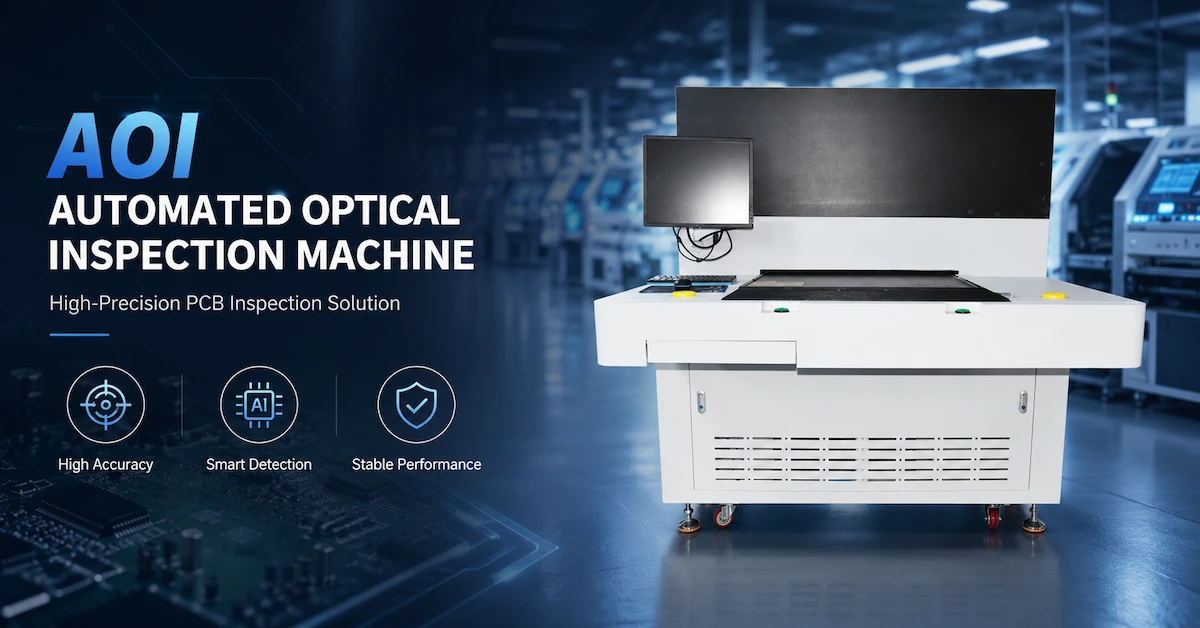
The AOI Automated Optical Inspection Machine is positioned for high-precision PCB quality control and can be configured with:
- Industrial CCD imaging
- Programmable multi-angle lighting
- Automatic fiducial alignment
- Gerber or CAD data import
- Defect classification
- SPC data output
- Inline or offline operation
- MES integration
- English and Chinese software interfaces
The supplied CK-E3 reference specification also lists:
| Reference Item | Listed Configuration |
| Model | CK-E3 |
| Maximum board size | 762 × 698 mm |
| Board thickness | 1–300 mil |
| Data input | Gerber RS274X, ODB++ |
| Alignment | Pinless registration and panel-edge alignment |
| Scanning source | LED lighting |
| Image system | Linear CCD |
| Table | Automatic vacuum table with servo control |
| Operating system | CentOS-based system |
| Air requirement | Approximately 6–7 atm |
Final performance and configuration should be confirmed according to the customer’s inspection stage, board type, defect requirements, and line conditions.
CHIKIN CNC also provides PCB drilling, routing, laser processing, and testing equipment, which can help buyers plan a more connected PCB production and quality-control workflow.
Explore the CHIKIN CNC AOI Automated Optical Inspection Machine.
View more PCB testing and inspection equipment.
Learn more about CHIKIN CNC’s manufacturing and R&D background.
Information to Send Before Requesting a Quote
To receive an accurate AOI proposal, buyers should prepare:
| Buyer Information | Example |
| Inspection stage | Bare board, solder paste, pre-reflow, post-reflow |
| PCB material | FR4, HDI, flex, rigid-flex |
| Board size | Minimum and maximum dimensions |
| Board thickness | Complete production range |
| Minimum feature | Line width, spacing, solder joint, component size |
| Defect list | Opens, shorts, offset, missing parts, bridges |
| Production volume | Panels or boards per hour |
| Line type | Inline or offline |
| Data format | Gerber, ODB++, CAD |
| Traceability | MES, barcode, SPC requirements |
| Product mix | Stable batch or high-mix production |
| Factory utilities | Power, air, network, conveyor height |
| Current problem | High false calls, manual inspection, escaped defects |
FAQ: PCB AOI Machine Supplier
What is a PCB AOI machine supplier?
A PCB AOI machine supplier provides automated optical inspection equipment, technical configuration, software, installation, training, and after-sales services for PCB or PCBA quality-control applications.
Should buyers choose an AOI manufacturer or trading company?
A direct manufacturer is generally better for projects requiring customized optics, software, board handling, MES integration, and direct engineering support.
Can one AOI machine inspect bare PCBs and assembled boards?
Some platforms may be configurable for different applications, but bare-board and SMT inspection have different optical, software, and defect requirements. Buyers should confirm the exact inspection scope before ordering.
What defects can a PCB AOI machine detect?
Depending on the configuration, AOI may detect opens, shorts, missing copper, line defects, missing components, misalignment, polarity errors, solder bridges, insufficient solder, and tombstoning.
Why is the false-call rate important?
Too many false calls increase manual review time and reduce line efficiency. Buyers should evaluate false calls together with escaped-defect performance.
Should buyers request AOI sample testing?
Yes. Testing actual boards is the best way to evaluate defect detection, inspection speed, programming time, and repeatability.
Is MES integration necessary?
MES integration is useful when factories require traceability, production statistics, defect history, barcode tracking, and centralized quality data.
What data should be sent to an AOI supplier?
Send board samples, defect samples, Gerber or ODB++ files, inspection requirements, board dimensions, line speed, and traceability needs.
Can an AOI machine be customized?
A direct supplier may customize cameras, lighting, software, fixtures, board handling, conveyor interfaces, and data integration according to the project.
What after-sales services should be included?
Buyers should confirm installation, operator training, programming support, calibration guidance, remote troubleshooting, software updates, and spare-parts availability.
Conclusion: Choose an AOI Supplier as a Quality-Control Partner
Choosing a PCB AOI machine supplier should not be based only on camera resolution or equipment price.
The right supplier should understand:
- The inspection stage
- The PCB material
- The required defect coverage
- False-call expectations
- Programming workflow
- Production speed
- Traceability requirements
- Factory integration
- Long-term technical support
AOI equipment becomes valuable when it consistently finds meaningful defects without creating unnecessary production delays.
A supplier with direct engineering, sample-testing capability, customization experience, and reliable after-sales support can help buyers turn AOI from a standalone inspection machine into an effective quality-control system.
Request a PCB AOI Equipment Consultation from CHIKIN CNC
If your factory is planning to replace manual inspection, reduce escaped defects, introduce production traceability, or add AOI to a new PCB line, CHIKIN CNC can help evaluate your application.
Prepare your board samples, defect list, inspection stage, production target, and software-integration requirements. The CHIKIN CNC team can then discuss:
- Suitable AOI configuration
- Camera and lighting requirements
- Bare-board or SMT inspection scope
- Sample inspection testing
- Board-handling options
- Inline or offline integration
- MES and data requirements
- Installation and training
- Customized quotation
Contact CHIKIN CNC to request an AOI demonstration, sample defect analysis, and customized PCB inspection equipment proposal.