



A reliable mini PCB drilling machine supplier should provide more than a compact CNC machine and a basic quotation.
Prototype laboratories, electronics R&D departments, fixture workshops, technical schools, and small-batch PCB manufacturers usually need equipment that combines accurate positioning with flexible operation and a manageable footprint.
Their main concerns often include:
- Whether the machine fits the available workshop space
- Whether it can drill and route the required materials
- Whether hole positions remain repeatable
- Whether the spindle suits the required tools
- Whether fixtures can hold small boards securely
- Whether operators can learn the control system quickly
- Whether spare parts and technical service are available
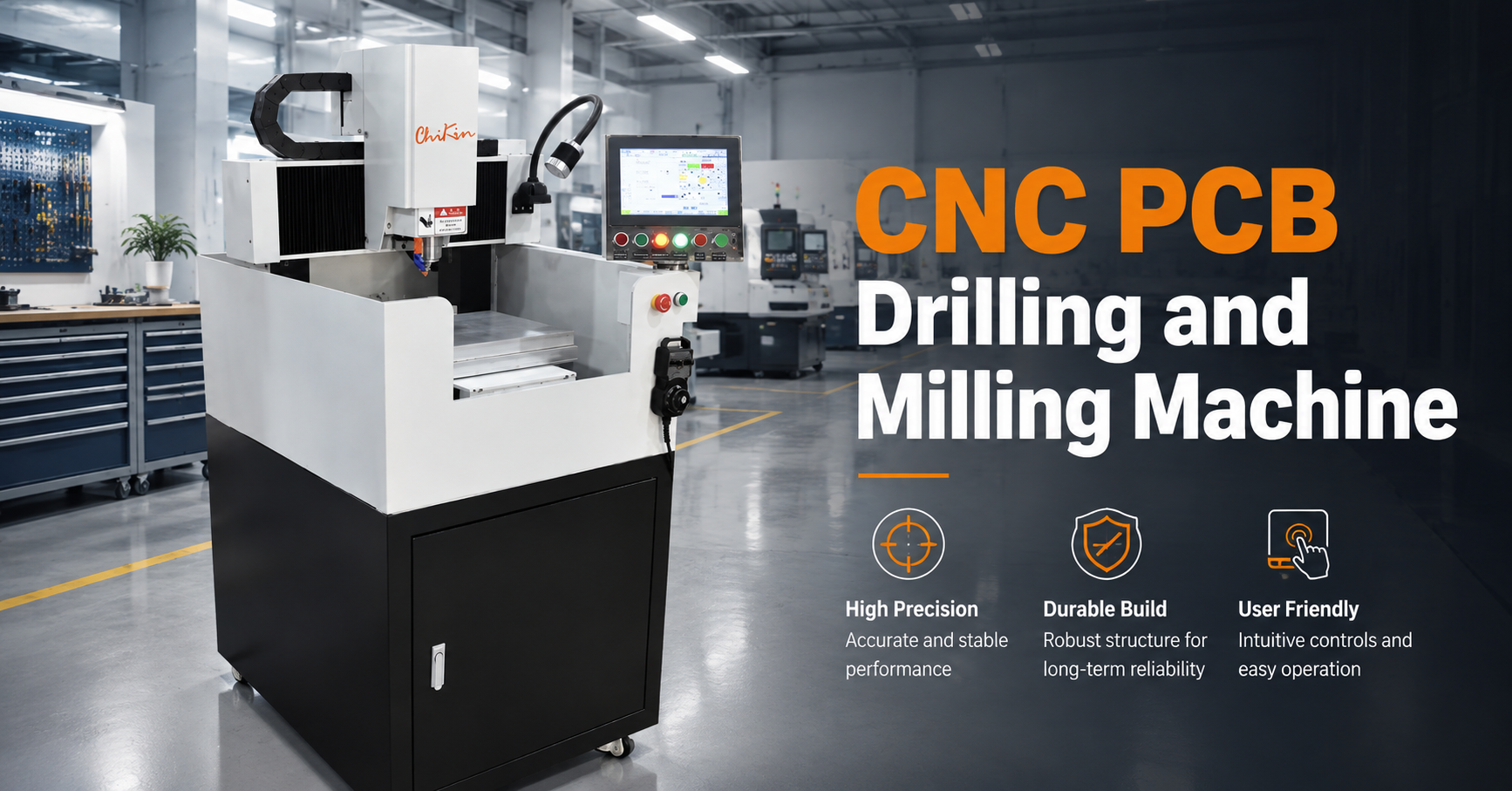
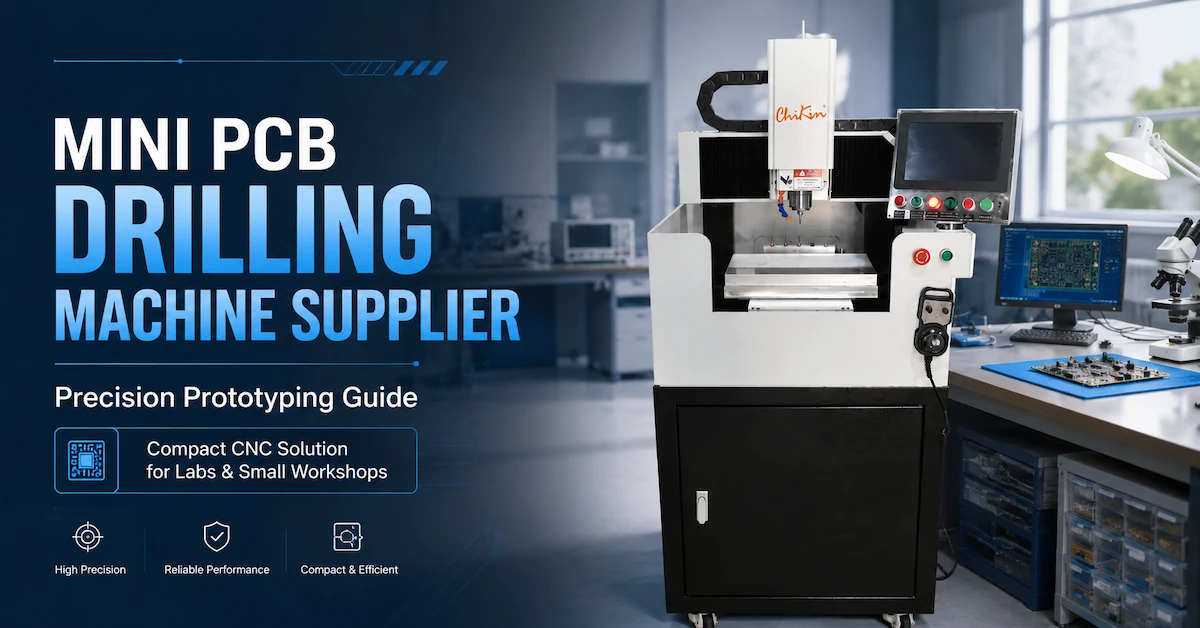
The Mini 1 Spindle PCB Routing and Drilling Machine for Precision Prototyping is presented as a compact enclosed CNC platform for precision prototyping, drilling, engraving, routing, and light milling tasks. Its enclosed structure, vertical spindle, integrated controls, and mobile base make it relevant to laboratories, toolrooms, and compact production environments.
The right supplier should help determine whether this machine format actually matches the buyer’s boards, materials, tolerances, output targets, and daily workflow.
Buyers comparing additional equipment configurations can also review the complete CHIKIN CNC product range.
What Is a Mini PCB Routing and Drilling Machine?
A mini PCB routing and drilling machine is a compact CNC platform that removes material according to programmed toolpaths.
Depending on the installed tooling, fixture, spindle parameters, and software configuration, it may support:
- PCB hole drilling
- Board contour routing
- Slot processing
- Engraving
- Pocket machining
- Fixture-plate processing
- Light milling
- Small precision-part machining
The featured CHIKIN product is listed as a Mini 1 Spindle PCB Routing and Drilling Machine for Precision Prototyping.
Unlike an open desktop router, the machine uses an enclosed cabinet-style structure. The enclosure helps separate the operator from the machining area and provides a more contained environment for routine drilling, routing, and light milling work.
Its compact design is particularly relevant to buyers who need industrial-style controls without installing a large production cell.
Who Should Buy a Mini PCB Drilling Machine?
PCB Prototype Laboratories
Prototype laboratories frequently change board designs, machining files, and tooling arrangements.
Their priorities are usually:
- Flexible setup
- Easy program changes
- Accurate sample processing
- Small production quantities
- Controlled workshop space
- Fast transition between different projects
A compact single-spindle system may provide more practical value than a large multi-spindle production machine when maximum output is not the main requirement.
The Mini 1 Spindle PCB machine is positioned for prototyping and compact shop-floor applications rather than high-volume mass production.
Electronics R&D Departments
Engineering teams may need to produce:
- PCB samples
- Test fixtures
- Mounting plates
- Engineering modifications
- Small mechanical components
- Prototype enclosures or tooling pieces
An internal compact CNC system can reduce dependence on external machining suppliers and shorten the development cycle for selected tasks.
Small-Batch PCB Manufacturers
Small-batch manufacturers need repeatability but may not have enough daily volume to justify a large multi-spindle system.
A mini machine may support:
- Short production runs
- Mixed board designs
- Replacement jobs
- Customer samples
- NPI projects
- Specialized low-volume orders
Fixture and Tooling Workshops
The machine may also be considered for:
- Fixture plates
- Custom tooling
- Engraving plates
- Nameplates
- Mold inserts
- Small precision parts
Final material compatibility should always be confirmed through technical evaluation and sample processing.
Technical Schools and Training Centers
A compact enclosed machine can provide students and operators with practical experience in:
- CNC programming
- Tool setup
- Coordinate control
- Drilling
- Routing
- Machine inspection
- Routine maintenance
What Specifications Should Buyers Verify?
The product information supplied for the Mini CK-01R lists a compact single-spindle configuration with a 60,000 rpm maximum spindle speed, 1.8 kW spindle power, a 350 × 350 mm table, and ±0.01 mm positioning accuracy.
Reference Specification Table
| Specification | Listed Reference |
|---|---|
| Model | Mini CK-01R |
| Spindle quantity | 1 |
| Maximum spindle speed | 60,000 rpm |
| Spindle power | 1.8 kW |
| X/Y maximum speed | 12 m/min |
| Table dimensions | 350 × 350 mm |
| Positioning accuracy | ±0.01 mm |
| Routing-tool diameter | 0.8–3.175 mm |
| Drilling-tool diameter | 0.5–6.35 mm |
| Machine material | Cast iron |
| NC system | CHIKIN CNC |
| Machine dimensions | 780 × 900 × 1700 mm |
| Listed weight | 500 kg |
| Listed warranty | 1 year |
These figures should be reconfirmed in the final quotation because the available controller, fixture, extraction system, voltage, accessories, and software options may depend on the buyer’s project.
How to Evaluate a Mini PCB Drilling Machine Supplier
1. Confirm Direct Manufacturing Capability
A professional supplier should clearly explain:
- Where the machine is assembled
- Who designs the mechanical structure
- Who develops or configures the control system
- How the axes and spindle are calibrated
- How equipment is tested before shipment
- Who handles customization
- Who provides technical service
CHIKIN CNC describes itself as an enterprise integrating research and development, manufacturing, and sales. Its About page also lists software copyrights related to PCB routing, automatic PCB drilling, CNC cutting, target drilling, and CNC drilling-and-milling control systems.
Buyers can review the company’s manufacturing and R&D background before deciding whether it has the engineering capability required for the project.
Direct factory communication is particularly important when the machine needs customized fixtures, software settings, tooling, voltage, or packaging.
2. Check Whether the Machine Fits the Actual Job
Do not choose a machine only because it is compact.
The supplier should first review:
- Workpiece material
- Board dimensions
- Board thickness
- Minimum hole diameter
- Routing profile
- Required tolerance
- Daily production quantity
- Tooling requirements
- Workshop utilities
- Available floor space
A mini machine is most suitable when flexibility, manageable investment, and workshop efficiency matter more than high-volume throughput.
It may not be the correct solution for continuous mass production, large panel processing, or extremely demanding micro-drilling applications.
3. Evaluate Spindle Performance
Spindle speed is only one purchasing consideration.
Buyers should also ask about:
- Spindle runout
- Tool-holder compatibility
- Cooling method
- Continuous operating time
- Tool-changing method
- Maintenance intervals
- Replacement spindle availability
- Suitable feed rates for intended materials
For PCB drilling and routing, spindle stability can affect:
- Hole quality
- Tool life
- Routing edges
- Burr formation
- Surface finish
- Dimensional consistency
Request actual processing samples rather than relying only on the maximum rpm value.
4. Inspect the Motion System and Machine Structure
A compact machine still requires stable mechanical construction.
Important checks include:
- Table flatness
- Axis repeatability
- Guide and screw quality
- Frame rigidity
- Spindle mounting
- Backlash control
- Vibration during machining
- Ease of calibration
The product is presented with an enclosed cabinet, central spindle, flat worktable, integrated HMI, and mobile base. These features distinguish it from a basic open desktop CNC platform.
5. Review the Fixture System
PCB drilling accuracy depends heavily on board holding.
Ask the mini PCB drilling machine supplier whether it can provide:
- Standard clamps
- Vacuum fixtures
- Pin fixtures
- Custom fixture plates
- Repeated-positioning references
- Thin-board support
- Warped-board support
- Fixture drawings and replacement parts
A precise CNC system cannot produce consistent results if the workpiece moves during drilling or routing.
For prototype work, fixture flexibility may be more valuable than maximum processing speed.
6. Test the Control Interface
The machine is shown with an integrated control panel, physical operation buttons, emergency stop, and handheld controller.
Buyers should request a demonstration covering:
- Program loading
- Coordinate setup
- Tool-offset entry
- Spindle control
- Feed adjustment
- Alarm handling
- Emergency stopping
- Program storage
- Repeat-job operation
- Data backup
Also confirm:
- Interface language
- Supported file formats
- Software updates
- Remote troubleshooting
- Recovery procedures
- User-management permissions
A suitable control system should reduce operator training time while still providing enough control for accurate prototyping.
7. Ask for Sample Processing
Sample processing is one of the most reliable ways to compare suppliers.
Send the supplier:
- Actual PCB samples
- Gerber, CAD, or machining files
- Material information
- Board thickness
- Hole sizes
- Routing drawings
- Accuracy requirements
- Required cycle time
Evaluate:
- Hole position
- Hole-wall quality
- Routing edges
- Burrs
- Cycle time
- Tool wear
- Repeatability
- Fixture stability
The same sample should be processed more than once. A single successful sample does not prove consistent production performance.
8. Evaluate Customization Capability
A suitable compact PCB CNC supplier should be able to discuss customization such as:
- Fixture design
- Worktable setup
- Tooling packages
- Interface language
- Voltage and plug type
- Dust extraction
- Work lighting
- Software functions
- Machine branding
- Packaging requirements
Customization should be confirmed through approved drawings, specifications, and a written configuration list before production begins.
9. Review Quality-Control Procedures
Ask how the supplier verifies:
- Table flatness
- Spindle runout
- Axis movement
- Positioning accuracy
- Electrical safety
- Emergency-stop function
- Control-system stability
- Trial processing
- Final appearance
- Export packaging
Request inspection records, test videos, remote factory acceptance, or on-site testing when practical.
CHIKIN CNC states that it operates under a quality-management system and has obtained software copyrights and utility-model patents related to automation and PCB equipment.
10. Confirm Installation and After-Sales Support
A compact machine is easier to install than a large automated production cell, but it still requires correct setup.
The supplier should clarify:
- Installation responsibilities
- Machine leveling
- Power requirements
- Extraction requirements
- Operator training
- Software guidance
- Maintenance schedule
- Spare-parts recommendations
- Remote-support procedures
- Warranty scope
Buyers can review common service topics through the CHIKIN CNC FAQ.
International buyers should also confirm service response times, documentation language, delivery terms, and recommended spare parts in the final contract.
Manufacturer vs General Trading Supplier
| Evaluation Area | Direct Manufacturer | General Trading Supplier |
|---|---|---|
| Machine configuration | Direct engineering communication | Information passed through another party |
| Custom fixtures | Easier to discuss | May be limited |
| Software support | Direct technical channel | Often indirect |
| Accuracy testing | Controlled by the factory | Depends on the original factory |
| Spare parts | Direct source | Additional coordination required |
| After-sales | Manufacturer engineers | May rely on third parties |
A trading company is not automatically unsuitable, but buyers should know who manufactures the equipment and who will provide technical service after delivery.
Why Consider CHIKIN CNC?
CHIKIN CNC’s mini single-spindle machine is positioned for precision prototyping, compact shop floors, fixture plates, engraving, and light machining rather than high-volume production.
Potential advantages for qualified buyers include:
- Compact 350 × 350 mm working table
- Enclosed machining area
- Integrated HMI
- Single-spindle configuration
- Cast-iron machine construction
- Mobile cabinet design
- Drilling and routing capability
- Prototype and small-batch workflow support
The company also presents itself as a direct automation-equipment developer and manufacturer with PCB-specific software and control-system experience.
Buyers can review the Mini 1 Spindle PCB Routing and Drilling Machine, explore the wider CHIKIN CNC equipment portfolio, or learn more about CHIKIN CNC as a PCB equipment manufacturer.
Buyer Checklist Before Requesting a Quote
| Information | What to Provide |
|---|---|
| Application | PCB drilling, routing, engraving, fixture machining |
| Material | FR4, aluminum, plastic, copper-clad board |
| Workpiece dimensions | Maximum length, width, and thickness |
| Hole requirements | Minimum diameter and quantity |
| Routing requirements | Outline, slot, pocket, or engraving |
| Accuracy | Positioning and finished-part tolerance |
| Output | Parts or boards per shift |
| Tooling | Drill and router diameter range |
| Fixture | Clamp, vacuum, pin, or custom plate |
| Software | File format and interface language |
| Factory utilities | Power, extraction, available floor space |
| Service | Installation, training, spare parts |
Common Buying Mistakes
Choosing Only by Machine Size
A compact machine is not automatically suitable for every prototype job. Verify the working envelope, spindle configuration, tooling, fixtures, and accuracy.
Comparing Only Spindle Speed
Maximum rpm does not explain runout, torque, cooling, continuous-duty stability, or material compatibility.
Ignoring Fixtures
Poor workpiece holding can create more accuracy problems than the motion system itself.
Assuming All Materials Use the Same Parameters
FR4, aluminum, plastic, copper-clad boards, and metals require different tools, feeds, speeds, and extraction methods.
Skipping Repeated Sample Tests
One successful sample does not prove stable performance. Request repeated processing and measurement.
Forgetting Spare Parts
Confirm the availability of spindle parts, control components, sensors, switches, and motion-system components before purchase.
FAQ: Mini PCB Drilling Machine Supplier
What does a mini PCB drilling machine supplier provide?
A professional supplier should provide the machine, technical configuration, tooling guidance, fixture support, installation instructions, operator training, spare parts, and after-sales service.
Is a mini PCB machine suitable for production?
It is generally better suited to prototyping, R&D, samples, fixtures, and small-batch production than high-volume PCB manufacturing.
Can the machine perform both drilling and routing?
The featured product is presented as a compact drilling, routing, engraving, and light-milling platform. Final process compatibility should be verified using the buyer’s actual materials and drawings.
What is the listed table size?
The supplied product specification lists a 350 × 350 mm worktable.
What is the listed spindle speed?
The supplied specification lists a maximum spindle speed of 60,000 rpm and spindle power of 1.8 kW.
What materials can the machine process?
Material suitability depends on tooling, spindle behavior, fixture design, cutting parameters, and dust or chip management. Buyers should request testing for their intended materials.
Should buyers choose a manufacturer or a trading company?
A direct manufacturer is normally preferable when the project requires custom fixtures, configuration changes, direct technical support, and long-term spare-parts coordination.
What information is needed for a quotation?
Provide the application, material, workpiece dimensions, hole sizes, routing drawings, accuracy requirements, target output, tooling, power conditions, and service expectations.
Conclusion: Choose a Supplier Based on the Real Prototype Workflow
Selecting a mini PCB drilling machine supplier should begin with the actual application rather than machine appearance or maximum spindle speed.
The buyer should verify:
- Workpiece compatibility
- Working area
- Spindle stability
- Motion repeatability
- Fixture design
- Software usability
- Sample performance
- Quality-control procedures
- Spare-parts support
- After-sales service
For prototype laboratories and compact workshops, a properly configured mini single-spindle machine can provide a useful balance of precision, flexibility, enclosure, and floor-space efficiency.
The CHIKIN mini PCB machine is positioned for prototype drilling, routing, engraving, fixture processing, and related light-machining tasks. Final suitability should be confirmed through technical evaluation and sample processing.
Request a Mini PCB Machine Consultation from CHIKIN CNC
Buyers planning a prototype laboratory, R&D workshop, educational CNC facility, or small-batch PCB operation can request a technical review from CHIKIN CNC.
Prepare:
- PCB or part drawings
- Material details
- Maximum dimensions
- Minimum hole diameter
- Routing or engraving paths
- Accuracy requirements
- Daily output
- Available workshop space
- Power requirements
- Required fixtures and accessories
CHIKIN CNC can use this information to review the machine configuration, recommend tooling and fixtures, arrange sample processing, and clarify installation, training, warranty, and spare-parts support.
Contact CHIKIN CNC to request a consultation and customized quotation for the Mini 1 Spindle PCB Routing and Drilling Machine.