



Why Stable PCB Imaging Starts with the Right UV LED Pattern Exposure Machine
In PCB manufacturing, imaging quality is not something that can be corrected casually at the end of the process. Once a circuit pattern is transferred poorly, the error can move into developing, etching, inspection, and downstream production. A small exposure variation may affect line definition. A positioning issue may create registration problems. An unstable exposure time may make one board acceptable while the next board needs rework. For a factory, that is not only a technical issue. It becomes a yield, cost, and delivery issue.
That is why many PCB factories pay close attention to the PCB UV LED pattern exposure machine used in their imaging process. Chikin CNC describes this equipment as a machine used to transfer a circuit pattern onto photoresist-coated boards with controlled ultraviolet exposure. The product page also explains the main production problem clearly: when pattern alignment, light output, and exposure time vary from board to board, downstream etching and imaging results become unstable. An enclosed exposure system helps standardize the process, reduce ambient light interference, and provide operators with a more controlled working environment.
For buyers searching for a PCB exposure machine, UV LED exposure system for PCB, PCB photoresist exposure machine, or automatic PCB exposure machine, the buying decision should not begin with machine appearance alone. A more practical question is this: can the machine help the factory keep exposure conditions stable from board to board, shift to shift, and batch to batch?
Why PCB Pattern Exposure Deserves Serious Attention
Pattern exposure is the stage where ultraviolet energy transfers or activates a circuit image on photoresist-coated PCB material. Chikin’s product page describes this stage as the process where UV energy hardens or activates photoresist in selected areas defined by a mask or digital pattern. A PCB photoresist exposure machine helps manufacturers keep line widths, pad shapes, and image registration stable before developing and etching.
This is why exposure equipment should not be treated as a simple light box. For a PCB factory, the exposure step connects design intent with physical board production. If exposure is inconsistent, the factory may see unstable image definition, edge variation, developing problems, or downstream etching uncertainty. Even when the issue is small, it can still create inspection pressure later.
In practical production, stable imaging depends on several factors:
- exposure time control
- light output consistency
- illumination uniformity
- board loading stability
- chamber cleanliness
- operator process discipline
- mask or pattern alignment
- control system repeatability
- machine structure and service access
A PCB pattern exposure machine should therefore be evaluated as a process-control platform, not only as a cabinet with a UV source.
What Does Chikin’s PCB UV LED Pattern Exposure Machine Do?
Chikin CNC’s product page positions this machine as equipment for controlled PCB pattern exposure. It is most relevant to electronics manufacturing environments that use photoresist imaging or controlled UV processing. The page mentions typical scenarios such as PCB prototyping lines, small-batch board production, and factory workflows where repeatable exposure is needed before development and etching.
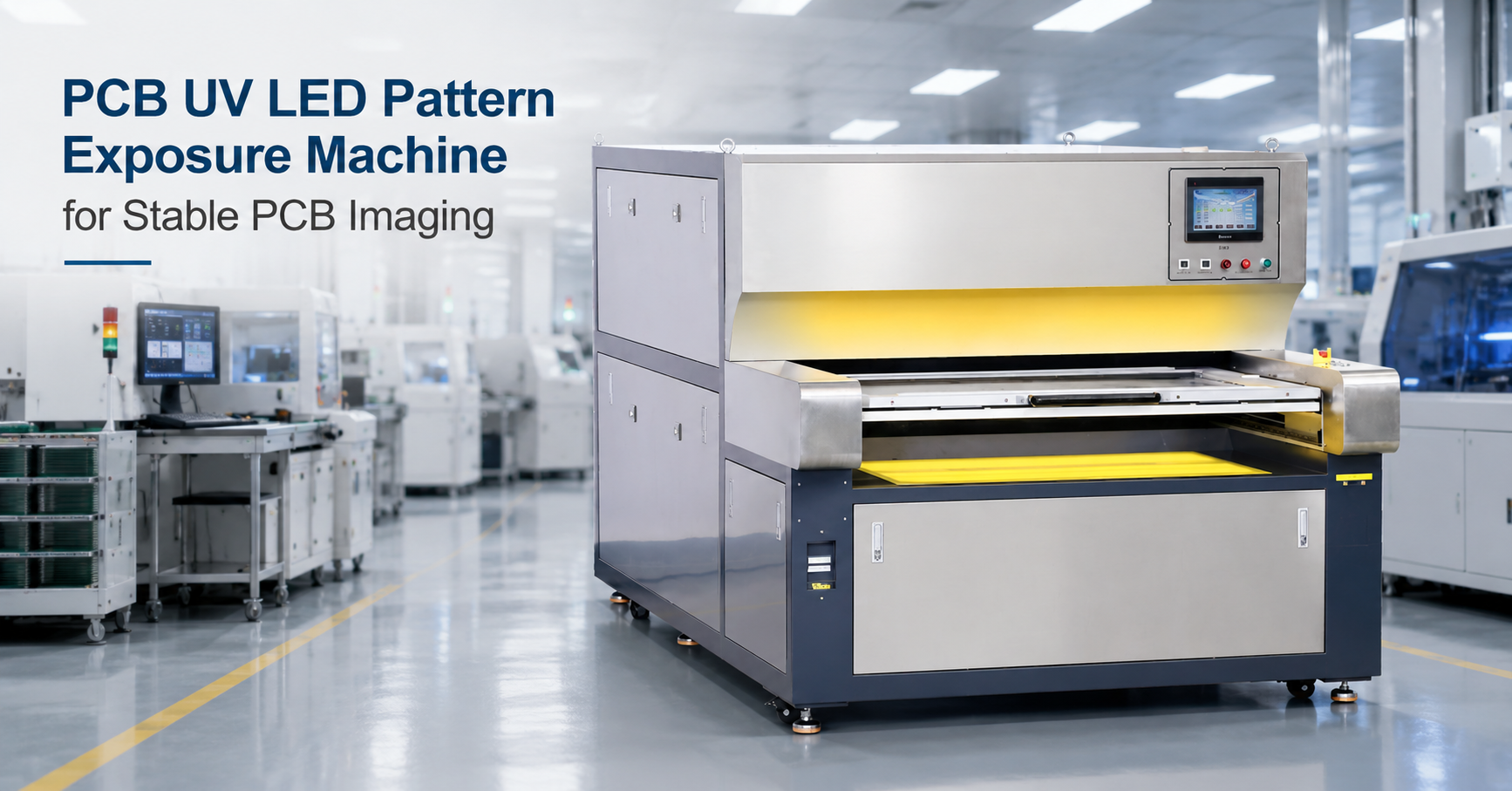
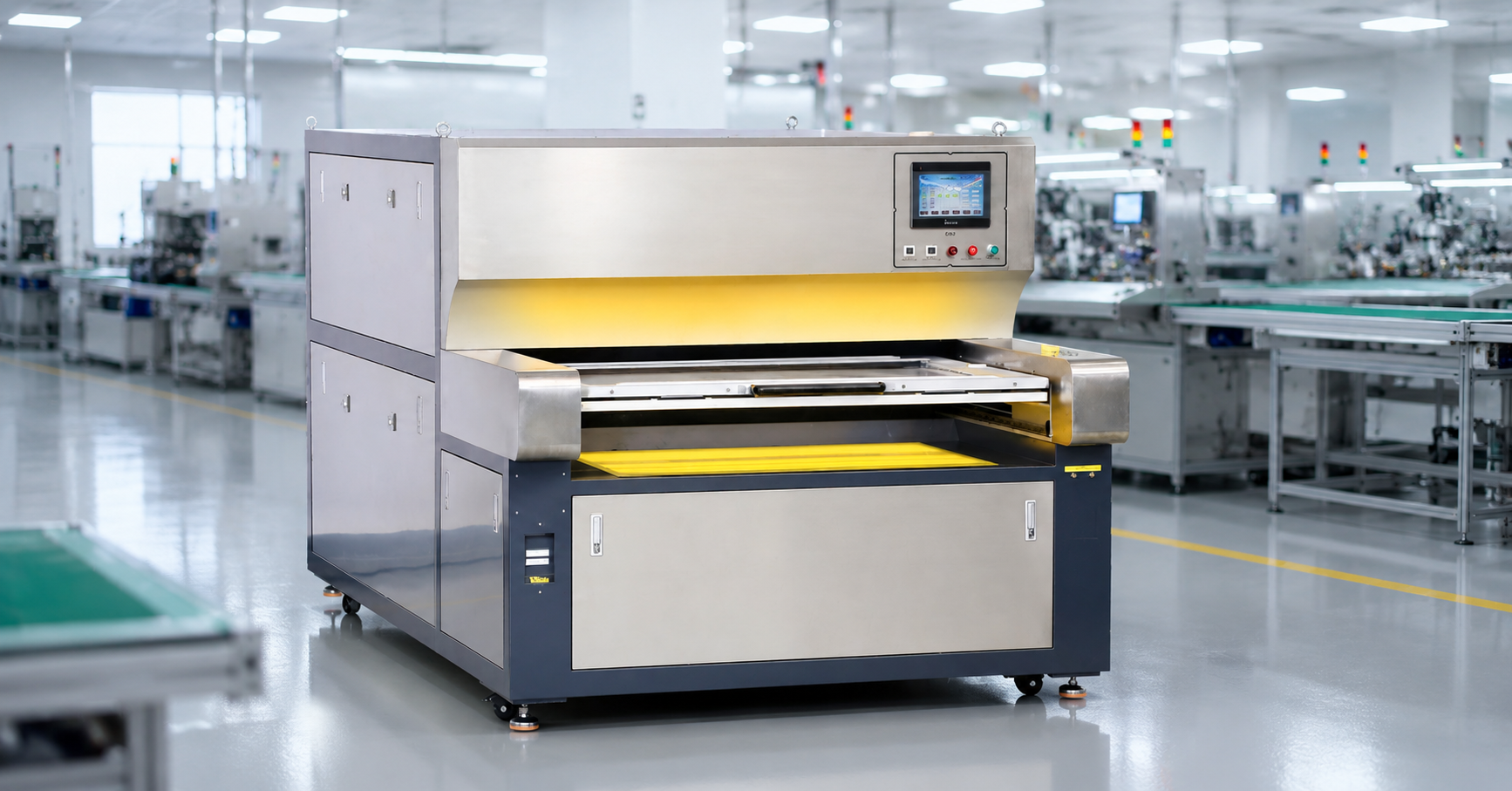
The visible machine structure is described as an industrial enclosed cabinet with a wide front-access chamber, touchscreen HMI, and service panels for maintenance. The page also states that the exact internal process cannot be confirmed from the image alone, so buyers should request the process layout, optical arrangement, and board-loading method before assuming automation level or throughput.
That statement is important. A buyer should not judge a UV exposure machine only from the exterior. The enclosure, HMI, and access doors are useful visible features, but the final imaging result depends on light uniformity, exposure repeatability, board positioning, chamber flatness, calibration method, and control logic.
Main Product Features and Buyer Meaning
| Product Feature | Information from Product Page | Why It Matters for PCB Factories |
|---|---|---|
| UV LED pattern exposure | Transfers circuit patterns onto photoresist-coated boards with controlled UV exposure | Supports stable image creation before developing and etching |
| Enclosed processing chamber | Closed metal housing with front-access working area | Helps block stray light, protect operators, and stabilize the process zone |
| Touchscreen HMI | Interface supports parameter setting, monitoring, and operator guidance | Helps manage exposure routines, alarms, and status checks |
| Wide front opening | Visible front aperture supports loading and unloading | Important for line flow and operator handling |
| Service panels | Multiple side panels indicate maintenance access | Helps reduce downtime when the machine needs inspection or service |
| Leveling feet | Adjustable feet help cabinet sit correctly on factory floors | Supports stable installation and repeatable positioning |
| Top lifting points | Lifting points simplify handling during installation | Useful for plant-level equipment deployment |
| Sheet-metal cabinet | Exterior appears to use painted steel or brushed metal panels with darker base frame | Provides protection, rigidity, and serviceability for industrial use |
| Customization guidance | Working size, loading method, control logic, chamber layout, HMI language, interlocks, lighting arrangement, and integration should be discussed | Helps match the machine to the actual PCB workflow |
| Buyer confirmation needed | Exact dimensions and internal specifications are not supplied in the page text | Buyers should confirm optical layout, automation level, throughput, and process configuration before purchase |
This table shows the main point clearly: the product’s value is not one isolated feature. It is the combination of controlled exposure, enclosed operation, operator interface, service access, and production matching.
Why Enclosed Exposure Is Valuable
The enclosed chamber is one of the most practical visible features of the machine. Chikin’s product page states that the closed metal housing and front-access working area are useful for blocking stray light, protecting operators, and keeping the process zone more stable during exposure.
For PCB imaging, this matters because uncontrolled light and inconsistent handling can affect repeatability. A bench-type or poorly controlled setup may be acceptable for basic experiments, but production factories usually need a more disciplined environment. An enclosed chamber helps create a defined exposure area. Operators know where loading happens. The process is less exposed to ambient interference. The machine becomes easier to manage as part of a production route.
A good enclosed design should also support daily usability. Buyers should check whether the chamber is easy to clean, whether operators can load boards comfortably, whether the front opening matches panel size, whether maintenance panels are accessible, and whether safety interlocks are included. The enclosure should improve process discipline without making operation inconvenient.
Why UV LED Technology Is Often Considered
The page states that when UV LED technology is used, the light source is typically chosen for fast response, compact control, and long service life compared with older lamp-based systems, while also noting that exact performance depends on the final machine design.
That final qualification matters. UV LED is an advantage only when the machine design supports uniform exposure, repeatable timing, stable cooling, suitable optical arrangement, and proper control logic. A buyer should not assume that any UV LED exposure machine will automatically deliver the same imaging quality.
For factories, the useful questions are:
- What wavelength is used?
- Is it suitable for the photoresist in production?
- How is light uniformity measured?
- How is exposure time controlled?
- How is LED output monitored or calibrated?
- How is heat managed inside the system?
- What maintenance is required for the exposure module?
- Can the supplier provide sample exposure testing?
A serious UV LED mask exposure equipment supplier should be able to discuss these points clearly.
HMI Control: More Than a Screen
A touchscreen HMI may look like a simple modern feature, but in production it can affect daily consistency. Chikin’s product page states that the touchscreen interface supports parameter setting, process monitoring, and operator guidance. It also notes that this helps manage exposure routines, alarms, and status checks without relying only on mechanical controls.
In PCB factories, operators may run different board types, exposure recipes, and production batches. If settings are not clear, repeated exposure becomes harder to manage. A well-designed HMI can help standardize operator actions. It can make the machine easier to train, easier to monitor, and easier to integrate into routine production.
Buyers should ask:
- Can exposure programs be saved?
- Can different recipes be stored for different board types?
- Does the system show exposure status clearly?
- Are alarms easy to understand?
- Is the HMI language configurable?
- Can operator access levels be managed?
- Does the control system store process records?
- Can exposure time and related parameters be locked to avoid accidental changes?
If a factory needs production traceability, the control system becomes even more important. Chikin’s page specifically says buyers should ask whether the control system can store settings or support process records if production traceability is required.
What Should Buyers Check for Imaging Quality?
A PCB exposure machine should be judged by imaging results, not only by machine appearance. Chikin’s product page says the most important quality questions include light uniformity, exposure repeatability, chamber flatness, board positioning accuracy, and control consistency across shifts. If the machine is intended for photoresist work, buyers should ask how exposure time is set, how the light source is calibrated, and whether the system supports documentation of process parameters.
These are the real selection points.
Light uniformity affects whether different parts of the board receive consistent exposure. Exposure repeatability affects whether one board matches the next. Chamber flatness affects board support and image consistency. Positioning accuracy affects alignment. Control consistency affects whether operators can repeat the same process over time.
A buyer should request sample testing when possible. A supplier can expose a sample board, but the buyer should inspect the actual result after developing and etching. The most useful test is not only whether the machine turns on. It is whether the exposure result supports the factory’s line width, pad shape, and registration needs.
Quality Evaluation Checklist
| Quality Point | What Buyers Should Confirm | Why It Matters |
| Light uniformity | How evenly UV energy reaches the working area | Helps avoid inconsistent imaging across the board |
| Exposure repeatability | Whether the same settings produce the same result across batches | Supports stable production and less rework |
| Exposure time control | How time is set, stored, and repeated | Prevents operator-dependent variation |
| Board positioning | How boards are loaded, supported, and aligned | Affects pattern registration and image placement |
| Chamber flatness | Whether the support area keeps boards stable | Helps maintain consistent exposure distance |
| Calibration method | How light source output is checked and maintained | Supports long-term process stability |
| HMI records | Whether settings or process records can be stored | Useful for traceability and repeat jobs |
| Maintenance access | Whether panels, light modules, and chamber areas are easy to inspect | Reduces downtime and supports stable output |
| Safety design | Whether enclosure, interlocks, and light shielding are included | Protects operators and supports controlled workflow |
| Supplier sample testing | Whether the supplier can test real board material and resist | Confirms process fit before purchase |
How Does This Machine Fit PCB Production?
Chikin’s product page says this machine is relevant to electronics manufacturing environments that use photoresist imaging or controlled UV processing. It lists PCB prototyping lines, small-batch board production, and factory workflows requiring repeatable exposure before development and etching as typical scenarios.
This means the machine may fit several factory situations.
A prototype line may need controlled exposure but not extremely high-volume automation. A small-batch PCB factory may need repeatability across many product types. A production line may need a stable enclosed chamber to reduce operator variation. A factory upgrading from manual or older exposure methods may need better HMI control and a more organized cabinet layout.
The machine may also be considered for adjacent controlled UV processing tasks, but Chikin’s page notes that those uses should be confirmed against the actual machine configuration. This is an objective point. Buyers should avoid assuming unsupported applications just because the machine has a UV source.
How Is This Different from Manual Bench Exposure?
Manual bench exposure or simple exposure boxes can be useful for learning, very small prototypes, or low-risk experimental work. However, they often depend heavily on operator habits, room conditions, mask placement, exposure timing, and manual handling. This can become unstable when a factory needs repeatable output.
The Chikin machine is presented as an enclosed production-style system with a wide working chamber, HMI, service panels, leveling base, and industrial cabinet structure. These features make it more suitable for controlled factory use than a simple manual exposure setup.
The difference is process discipline.
A manual setup may expose boards.
An enclosed UV LED exposure machine can help standardize exposure.
A manual setup may rely on operator timing.
An HMI-based system can support controlled parameter setting.
A manual setup may be affected more easily by ambient light.
An enclosed chamber helps reduce interference.
A basic exposure box may be hard to integrate into workflow.
A cabinet-style machine can be placed as part of a production route.
For B2B buyers, this difference is often more important than the initial machine price.
How Should Buyers Select the Right PCB UV LED Exposure Machine?
A good selection process should start with the board and resist, not the machine shell. Buyers should define the real imaging requirement before comparing quotations.
Chikin’s page recommends that buyers share board size, resist type, target output, and handling method so the machine can be matched more accurately to the process. It also invites buyers to discuss chamber layout, control options, and integration requirements for the PCB workflow.
A practical buying process should include:
- Define board size and panel format.
- Confirm photoresist type.
- Identify exposure wavelength requirement.
- Confirm target line width and image quality need.
- Confirm whether mask exposure or digital pattern workflow is used.
- Define loading and unloading method.
- Estimate target output per shift.
- Check floor space and service clearance.
- Confirm HMI language and control logic.
- Ask about light uniformity and calibration.
- Ask whether process records are needed.
- Confirm maintenance access and spare parts.
- Request sample exposure if possible.
This process prevents one of the most common mistakes: choosing by cabinet appearance without confirming imaging performance.
What Customization Should Buyers Discuss?
The product page states that customization usually starts with working size, loading method, control logic, and chamber layout. Some buyers need compact units for shorter boards, while others need wider openings for panel production. It also mentions HMI language, safety interlocks, internal lighting arrangement, and integration with upstream or downstream handling equipment as common specification points.
That is important because PCB factories differ widely. One factory may process small prototype boards. Another may process larger production panels. One may need manual loading. Another may need integration with a handling line. Some may require language localization. Others may require process records for quality management.
Buyers should discuss customization early, especially if:
- panel size is unusual
- working width is critical
- loading direction must match the line
- operators require a specific HMI language
- interlocks are required by factory safety policy
- exposure programs must be stored
- maintenance clearance is limited
- upstream or downstream handling must connect to the machine
A good supplier should not force every buyer into the same configuration if the production requirements are different.
What Should Buyers Ask a Supplier?
Choosing a PCB exposure equipment supplier is as important as choosing the machine. The supplier should help the buyer match exposure technology to the actual PCB process.
Useful supplier questions include:
- What board size and resist type can the machine support?
- What is the exposure wavelength?
- How is light uniformity measured?
- How is exposure repeatability verified?
- How is exposure time controlled and stored?
- What is the chamber layout?
- Is the board loaded manually or automatically?
- What safety interlocks are included?
- How is the light source calibrated?
- What maintenance is required for the UV LED system?
- Can the HMI language be customized?
- Can process records be stored?
- What spare parts should be kept in stock?
- Can sample exposure be arranged?
- Can the machine integrate with upstream or downstream handling equipment?
The supplier’s response will show whether it understands PCB imaging as a production process or only as a machine sale.
Practical Case: Small-Batch PCB Factory Upgrading Exposure Control
Consider a small-batch PCB factory that produces prototypes and low-volume industrial control boards. The factory previously used a simpler exposure setup. For basic jobs, it was acceptable. But as board density increased and customers required more stable quality, the imaging process became harder to manage.
The factory noticed several recurring issues:
- one operator’s exposure result was slightly different from another’s
- exposure time settings were not always recorded consistently
- manual loading created small alignment differences
- some boards needed extra inspection after developing
- production staff had difficulty repeating the same condition across batches
The engineering team began evaluating a PCB UV LED pattern exposure machine. They needed a more enclosed chamber, better parameter control, clear HMI operation, and a process that could be repeated more reliably.
Chikin’s product would be relevant in this case because the page positions it as a UV LED exposure system for transferring patterns onto photoresist-coated boards with controlled exposure. The page also highlights an enclosed processing chamber, touchscreen HMI, front access, service panels, leveling feet, and buyer focus points such as light uniformity, exposure repeatability, chamber flatness, board positioning accuracy, and control consistency.
Before purchasing, the factory should send the supplier:
- board size
- resist type
- exposure workflow
- target output
- line width requirement
- mask or pattern method
- current imaging problem
- expected loading method
- floor space limitation
- HMI language requirement
If sample exposure confirms stable results after developing and etching, the machine may help the factory reduce operator variation and improve repeatability.
This case shows the real value of the equipment: it does not only “shine UV light.” It helps standardize one of the most sensitive process steps in PCB production.
How Does Exposure Equipment Affect Downstream Processes?
Exposure quality affects what happens next. Chikin’s page states that unstable pattern alignment, light output, and exposure time can make downstream etching and imaging results unstable. That means buyers should evaluate exposure as part of the full PCB process, not as an isolated station.
If exposure is stable, developing and etching become easier to control. If exposure is inconsistent, the downstream team may need to compensate with inspection, rework, or process adjustment. In a busy factory, that creates hidden cost.
This is why procurement teams should involve process engineers before choosing the machine. The people responsible for developing, etching, and inspection should help define exposure requirements. Otherwise, the machine may meet a purchasing checklist but fail to solve the actual production issue.
Common Buying Mistakes
The first mistake is choosing only by machine appearance. A clean cabinet and HMI are useful, but imaging quality depends on light uniformity, exposure repeatability, chamber flatness, positioning, and control consistency.
The second mistake is ignoring resist compatibility. The machine must match the photoresist and exposure wavelength used in the process.
The third mistake is not asking about calibration. UV LED systems still need output control and maintenance planning.
The fourth mistake is assuming automation level from a product image. Chikin’s page says buyers should request the process layout, optical arrangement, and board-loading method before assuming automation level or throughput.
The fifth mistake is not confirming working size. A machine that cannot comfortably load the buyer’s board format will slow production.
The sixth mistake is ignoring maintenance access. Exposure systems need access for cleaning, inspection, and service.
The seventh mistake is choosing by price before sample testing. The cheapest system may not be cost-effective if imaging results are unstable.
When Is This Machine a Good Fit?
This machine may be a good fit when the factory needs:
- controlled UV exposure for PCB imaging
- better repeatability than manual exposure methods
- an enclosed chamber to reduce ambient light interference
- HMI-based parameter setting
- stable exposure before developing and etching
- small-batch PCB production
- PCB prototyping line support
- factory workflow with repeatable exposure needs
- easier maintenance access than sealed compact boxes
- potential customization for chamber layout and loading method
It may not be the best fit when the factory only needs occasional hobby-level exposure, when resist compatibility is unknown, or when the buyer has not defined board size, imaging target, and exposure workflow.
FAQ
What is a PCB UV LED pattern exposure machine used for?
A PCB UV LED pattern exposure machine is used to transfer a circuit pattern onto photoresist-coated boards with controlled ultraviolet exposure. It helps stabilize pattern transfer before downstream developing and etching.
Why is an enclosed chamber useful?
An enclosed chamber helps block stray light, protect operators, and keep the exposure zone more stable during processing. It also supports a more controlled production environment than open exposure methods.
What visible structure does Chikin’s product page describe?
The page describes an industrial enclosed cabinet with a wide front-access chamber, touchscreen HMI, service panels, adjustable feet, top lifting points, and sheet-metal construction suitable for plant-level deployment.
What should buyers confirm before ordering?
Buyers should confirm light uniformity, exposure repeatability, chamber flatness, board positioning accuracy, exposure time setting, light source calibration, process documentation, working size, loading method, control logic, and integration needs.
Is the exact internal exposure mechanism shown on the page?
No. The product page states that the exact internal process cannot be confirmed from the image alone, so buyers should request the process layout, optical arrangement, and board-loading method before assuming automation level or throughput.
What information should buyers send to the supplier?
Buyers should share board size, resist type, target output, and handling method so the machine can be matched more accurately to the process.
Conclusion
A PCB UV LED pattern exposure machine plays an important role in stable PCB imaging. Its value is not only in using ultraviolet light. Its value is in creating a controlled exposure environment where pattern transfer, exposure time, board loading, operator control, and process repeatability can be managed more consistently.
Chikin CNC’s product page presents this machine as an enclosed UV LED exposure system for transferring circuit patterns onto photoresist-coated boards. The page highlights the importance of controlled ultraviolet exposure, enclosed processing, touchscreen HMI control, wide access, service panels, leveling feet, cabinet rigidity, and customization around working size, loading method, control logic, chamber layout, HMI language, safety interlocks, internal lighting, and process integration.
For B2B buyers, the best purchasing process is objective: define the board size, resist type, exposure requirement, output target, loading method, and downstream quality needs first. Then ask the supplier to confirm light uniformity, exposure repeatability, calibration method, chamber layout, maintenance access, and sample exposure results.
A well-matched PCB exposure machine should help the factory reduce exposure variation, improve imaging stability, and make downstream developing and etching easier to control. In PCB production, stable imaging does not happen by accident. It starts with choosing the right exposure system for the real process.