



How Can Buyers Choose a PCB Registration Hole Drilling Machine for Precise Board Alignment?
For PCB manufacturers, alignment is not a small detail. A board may pass through lamination, drilling, routing, inspection, assembly, and fixture-based handling. If the locating hole is not accurate enough, the problem can travel through several later steps. The result may appear as poor fixture fit, unstable repeat positioning, downstream alignment errors, extra adjustment time, or rejected panels.
That is why factories often evaluate a PCB registration hole drilling machine when they need accurate locating holes for alignment, tooling, or repeatable downstream processing. Chikin CNC describes this machine type as equipment used when a board needs precise registration points on a stable work platform, making it easier to position each panel the same way every time. The product page also notes that even a small shift in hole position may affect lamination alignment, fixture placement, or assembly consistency.
For B2B buyers searching for a PCB hole drilling machine, PCB locating hole machine, PCB alignment hole drill, or PCB tooling hole drilling machine, the key question is not only whether the machine can drill a hole. A more practical question is whether it can support stable board placement, repeatable hole positioning, safe operation, and a clean production workflow.
This article explains how buyers should choose this type of machine, what product details from Chikin’s registration hole drilling machine are worth noting, and what a realistic factory application case may look like.
What Is a PCB Registration Hole Drilling Machine?
A PCB registration hole drilling machine is used to create locating holes or registration holes on PCB panels, board sections, or related flat workpieces. These holes help later processes align the board correctly. In a PCB factory, registration holes may support lamination alignment, fixture positioning, tooling setup, template matching, inspection positioning, or repeatable batch handling.
Chikin’s product page explains that this type of machine is valuable when panels must be indexed for multilayer processing, template matching, or fixture-based handling. It also states that the main value for buyers comparing a target drilling machine, PCB hole drilling machine, or PCB locating hole machine is repeatable hole placement and a cleaner production workflow.
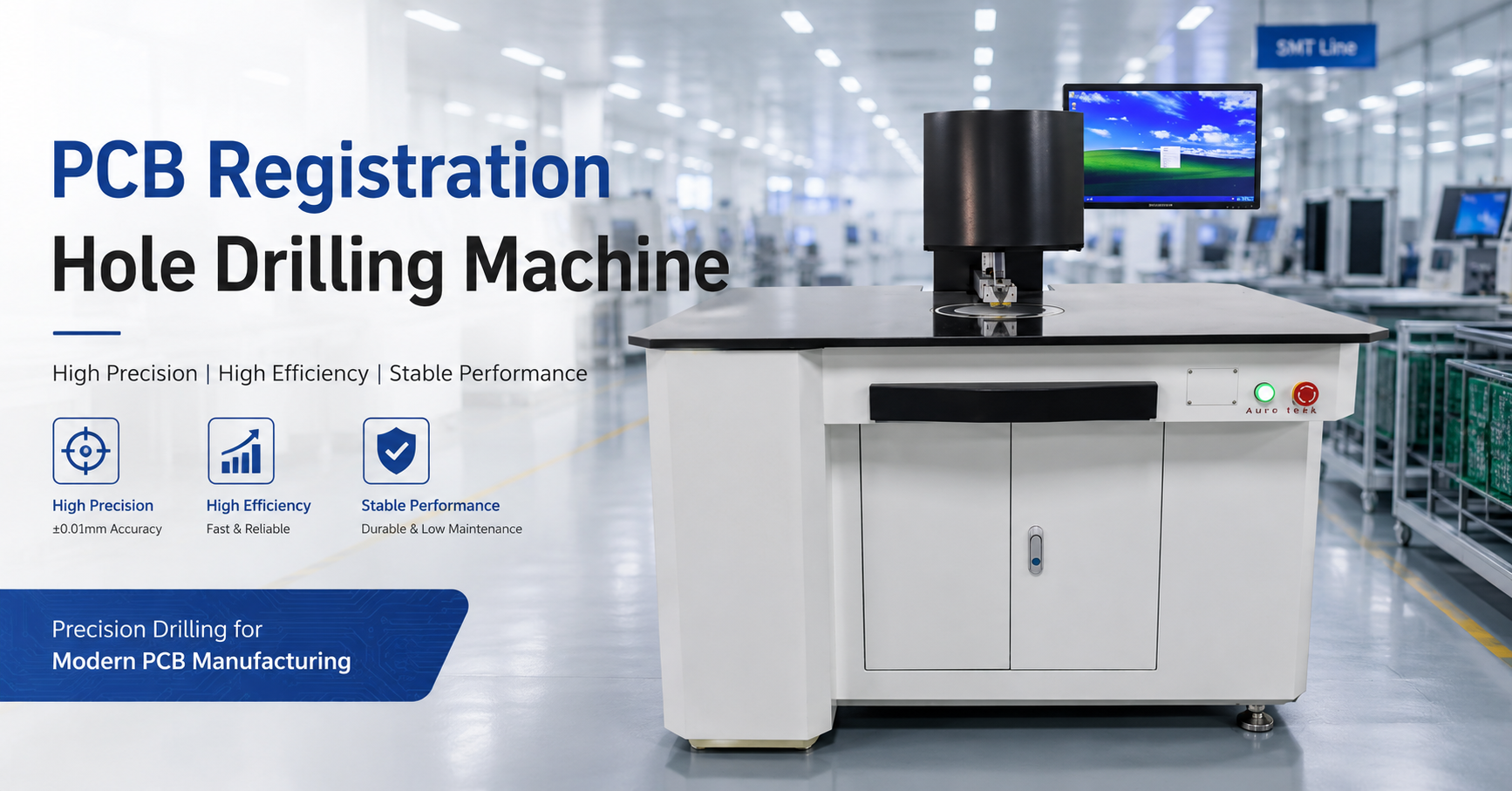
The machine shown on the page appears as an enclosed industrial workstation with a rigid cabinet base, a flat table, and a controlled processing head above the work area. Chikin notes that this layout is suited to small-part or board-level operations where positioning stability matters more than speed alone.
That point is important for buyers. Registration hole drilling is not mainly about high-speed material removal. It is about stable positioning. A fast machine is not useful if the board shifts during drilling or if operators need too much time to correct alignment manually.
Why Does Registration Hole Accuracy Matter?
A registration hole is often used as a physical reference point. If that point is wrong, the next process may begin from the wrong location. In PCB production, this can create several problems.
The panel may not sit properly in a fixture.
The tooling position may need repeated adjustment.
Downstream equipment may need extra setup correction.
Repeat batches may become less consistent.
Operators may spend more time checking placement.
Assembly or inspection flow may become less predictable.
Chikin’s page states that a small shift in hole position can affect lamination alignment, fixture placement, or assembly consistency. This is a concise way to describe the production risk.
For a factory, the cost of poor registration may not appear at the drilling machine alone. It can show up later in slower setup, more frequent rechecking, poor fixture fit, or inconsistent handling. That is why a PCB hole positioning machine should be evaluated as part of the full production flow.
What Product Features Should Buyers Notice from Chikin’s Machine?
The product page does not provide a full numerical specification table in the visible text, so buyers should not assume board size range, spindle details, speed, hole diameter, or exact control logic. However, the page does describe visible structure and practical working concepts that are useful for selection.
| Product / Process Point | Information from Chikin Product Page | Why It Matters for Buyers |
|---|---|---|
| Main application | Accurate locating holes for alignment, tooling, and repeatable downstream processing | Supports stable positioning across PCB production steps |
| Machine structure | Enclosed industrial workstation with rigid cabinet base, flat table, and controlled head above the work area | Helps create a defined, stable processing station |
| Visible body design | Box-style body with side access doors, ventilation openings, leveling feet, and dark work surface | Suggests industrial use, service access, and installation stability |
| Operator controls | Front control area includes green start button and red emergency stop button | Supports straightforward operator interaction and quick stop capability |
| Workholding area | Tabletop includes a circular fixture or rotary-style holder near the working zone | May help keep small parts, round components, or board sections aligned |
| Main process value | Repeatable hole placement and cleaner production workflow | Reduces reliance on manual positioning |
| Buyer confirmation needed | Exact function, supported board size, fixture compatibility, software/control interface, and manual vs automatic operation | Prevents wrong equipment selection when details are not fully visible |
| Customization input | Board material, thickness range, hole diameter target, throughput, fixture format, panel dimensions, and downstream equipment should be shared | Helps supplier match table size, clamping style, control logic, and access arrangement |
These points show that the machine should be discussed as a positioning and registration tool, not only as a drilling device.
How Should Buyers Evaluate Machine Structure?
A registration hole machine must keep the board stable during processing. The Chikin page describes a rigid cabinet base, flat table, controlled processing head, side access doors, ventilation openings, leveling feet, and dark work surface. It also notes that the rigid base and enclosed cabinet can help reduce vibration and protect internal components from dust and incidental contact if the machine is used as a PCB hole positioning machine or precision processing station.
For buyers, this leads to several practical evaluation questions:
Is the work surface rigid enough for our board size?
Can the table keep thin boards flat?
Can the machine be leveled properly on our shop floor?
Are access doors convenient for service?
Is the work zone protected from casual contact?
Does the machine reduce vibration during drilling or positioning?
Can operators see and access the board comfortably?
A machine with a stable body and simple worktable layout may be more valuable than a visually complex machine if the main factory problem is repeatable alignment. The structure should support the process, not distract from it.
Why Is Workholding a Critical Selection Point?
A PCB registration drilling equipment solution depends heavily on how the board is held. Even if the machine head moves accurately, the final hole position may drift if the panel slips, tilts, flexes, or is clamped inconsistently.
Chikin’s page states that the tabletop includes a circular fixture or rotary-style holder near the working zone. It says this feature indicates controlled positioning and may help keep small parts, round components, or board sections aligned during processing. The page also advises buyers to verify the working principle because the exact internal process cannot be confirmed from the image alone.
For factory buyers, this means workholding should be reviewed before price. Ask the supplier:
How is the PCB panel positioned?
How is the panel held flat?
Does the fixture support our board thickness range?
Can the holder be customized for our panel format?
Can the machine handle small boards, compact parts, or repeated batches?
How quickly can operators change fixtures?
Does the fixture prevent slipping during tool contact?
Is a rotary or circular holder necessary for our application?
A supplier that understands registration drilling should discuss fixture design in detail. If a supplier only talks about drilling power or exterior appearance, the buyer should ask more process-specific questions.
What Should Buyers Confirm Before Ordering?
Because the product page focuses mainly on overview, structure, visible build features, and selection guidance, buyers should confirm several technical details directly with the supplier before purchasing.
The page itself recommends confirming exact function, supported board size, fixture compatibility, software or control interface, and manual versus automatic operation. If the application requires production use, it also recommends asking how alignment is achieved and what holding method is used to prevent slip.
Before ordering, buyers should confirm:
Board length, width, and thickness range.
Board material, such as FR-4, multilayer PCB, rigid PCB, or other flat panel type.
Target hole diameter.
Hole position tolerance requirement.
Expected throughput.
Fixture format.
Manual, semi-automatic, or automatic operation.
Alignment method.
Control interface.
Software or job storage ability.
Maintenance access.
Service and spare parts support.
Whether the machine can support repeat jobs with minimal changeover.
Whether sample testing is available.
These details are not optional. They define whether the machine fits the factory’s real process.
How Should Buyers Choose the Right Machine Type?
A buyer may compare several options when looking for registration hole equipment. Some may look at a target drilling machine, some at a PCB hole drilling machine, and others at a PCB locating hole machine. These names can overlap, but the practical focus may differ.
A target drilling machine may emphasize target or reference mark alignment.
A PCB hole drilling machine may emphasize drilling capability.
A PCB locating hole machine may emphasize repeatable panel positioning.
A registration hole drilling machine should combine drilling, positioning, and repeatability.
The Chikin product page uses all of these related terms and explains that buyers comparing these equipment types should focus on repeatable hole placement and a cleaner production workflow.
The right machine should be selected according to the process. If the factory needs simple guide holes for a repeated fixture, workholding and operator workflow may be the main concerns. If the factory needs alignment holes for multilayer processing, positional consistency and verification become more important. If the machine must match downstream equipment, table size and fixture layout must be checked early.
Practical Application Case: Multilayer PCB Fixture Alignment
The product page does not provide a named customer case. The following case is a realistic application scenario based on common PCB production needs and the product functions described on the page.
A PCB factory produces medium-volume multilayer boards for industrial control products. The panels must be positioned repeatedly in a downstream fixture for inspection and assembly preparation. Operators previously drilled locating holes using a more manual setup. The process worked for small batches, but as order volume increased, variation became more visible.
The factory noticed three issues.
First, operators needed extra time to align each panel before drilling.
Second, some panels did not sit smoothly in downstream fixtures.
Third, repeated jobs required frequent manual correction because locating holes were not consistent enough.
The engineering team began evaluating a PCB registration hole drilling machine. Their main selection criteria were not only machine price. They needed stable workholding, repeatable hole placement, easy operator control, and a machine layout that could fit into their existing production area.
Chikin’s machine would be relevant to this case because the page positions it for accurate locating holes, alignment, tooling, and repeatable downstream processing. The visible structure includes a rigid cabinet base, flat table, controlled processing head, operator controls, and fixture-style workholding area.
During supplier discussion, the factory should send:
Panel dimensions.
Board thickness.
Target hole diameter.
Fixture drawing.
Required hole position tolerance.
Current defect examples.
Expected daily output.
Downstream fixture requirements.
Available floor space.
Preferred operator workflow.
The supplier should then confirm whether the machine’s table, fixture style, alignment method, and control logic can support the job. If the setup is suitable, the factory may reduce manual adjustment time and improve repeatability in the downstream fixture process.
This case shows the real value of the machine: not only drilling a hole, but making the next production step easier to control.
Product Selection Checklist for Factory Buyers
| Selection Area | What to Ask | Why It Matters |
| Process definition | Are we drilling registration holes, tooling holes, target holes, or locating holes? | Avoids choosing the wrong machine type |
| Board compatibility | What board size, thickness, and material can the machine handle? | Ensures the platform fits real production panels |
| Workholding | How does the fixture keep the board flat and prevent slip? | Directly affects hole position consistency |
| Alignment method | How is the drilling position confirmed? | Determines whether results remain repeatable across batches |
| Hole requirement | What hole diameter and location tolerance are required? | Helps supplier match head, tooling, and fixture |
| Operator workflow | Is the system manual, semi-automatic, or automatic? | Affects labor planning and training |
| Control interface | What software, buttons, or job settings are available? | Impacts repeat jobs and setup time |
| Maintenance access | Are side doors, ventilation openings, and work areas easy to service? | Reduces downtime |
| Safety | Are emergency stop and safe access points included? | Supports factory operation standards |
| Supplier support | Can the supplier review drawings, test samples, and support customization? | Reduces purchase risk |
How Does Chikin’s Product Differ from Ordinary Manual Drilling?
Ordinary manual drilling may be acceptable for small samples or low-risk internal work. However, manual drilling depends heavily on operator skill. The board may be placed slightly differently each time. A fixture may not be stable enough. Hole consistency may vary from batch to batch.
Chikin’s machine is presented as a dedicated industrial workstation for registration, alignment, and repeatable board handling. The visible structure includes a rigid cabinet base, flat table, controlled processing head, side access doors, ventilation openings, leveling feet, front control area, and circular fixture or rotary-style holder.
These features give it several advantages over rough manual methods:
It creates a defined processing station.
It supports more repeatable board placement.
It reduces dependence on hand positioning.
It provides operator controls in a fixed location.
It offers a more serviceable industrial structure.
It can support fixture-based production rather than temporary setup work.
The difference is not simply machine appearance. The difference is process discipline.
How Should Buyers Evaluate a Supplier?
A good PCB drilling machine supplier should not only sell the machine. It should help the buyer define the application and match the configuration to the production need.
Chikin’s page recommends that buyers provide board material, thickness range, hole diameter target, expected throughput, fixture format, panel dimensions, and downstream equipment information. These details help define table size, clamping style, control logic, and access arrangement.
Supplier evaluation should include:
Does the supplier ask for sample drawings?
Can the supplier explain the machine’s exact working principle?
Can it confirm supported board sizes?
Can it recommend a suitable fixture?
Can it explain how alignment is achieved?
Can it show how the machine prevents slip?
Can it support sample testing?
Can it customize table size or clamping style if needed?
Can it provide training and maintenance guidance?
Can it support spare parts and service after delivery?
A supplier that cannot answer these questions may not be suitable for production-level registration drilling.
What Common Buying Mistakes Should Be Avoided?
The first mistake is choosing by price only. A low-cost machine may not reduce alignment variation if the fixture is weak or if the control workflow is unclear.
The second mistake is assuming the machine’s exact process from a product image. Chikin’s page clearly states that the exact internal process is not confirmed from the image alone and buyers should verify the working principle before placing an order.
The third mistake is ignoring board holding. If the PCB panel slips during processing, drilling accuracy will not stay stable.
The fourth mistake is not confirming downstream equipment requirements. Registration holes often exist to support the next process, so the machine should be matched to that downstream fixture or machine.
The fifth mistake is not defining manual versus automatic needs. Some factories may need simple operator-controlled processing. Others may need higher automation or job memory.
The sixth mistake is skipping sample validation. A sample test with real boards can reveal whether hole location, clamping, and workflow are suitable.
How Can Buyers Prepare a Better Inquiry?
A clear inquiry helps the supplier provide a useful response. Instead of asking only for “best price,” buyers should provide a short technical brief.
Example inquiry:
“We need a PCB registration hole drilling machine for repeatable board alignment before downstream fixture processing. Our board material is [material], thickness range is [value], maximum panel size is [L × W], target hole diameter is [value], and expected output is [quantity] panels per shift. The holes must match [fixture/downstream equipment]. Please confirm suitable table size, clamping method, alignment process, control interface, maintenance access, and whether sample testing is available.”
This type of inquiry helps the supplier recommend a configuration based on real production needs.
FAQ
What is a PCB registration hole drilling machine used for?
A PCB registration hole drilling machine is used to create accurate locating holes for alignment, tooling, and repeatable downstream processing. It helps position each panel the same way every time.
Why is repeatable hole placement important?
Repeatable hole placement helps support lamination alignment, fixture placement, and assembly consistency. Chikin’s product page notes that even a small shift in hole position can affect these later processes.
What visible structure does Chikin’s machine have?
The product page describes the machine as having an enclosed industrial workstation layout with a rigid cabinet base, flat table, controlled processing head, side access doors, ventilation openings, leveling feet, dark work surface, front controls, and a circular fixture or rotary-style holder.
What should buyers confirm before ordering?
Buyers should confirm exact function, supported board size, fixture compatibility, software or control interface, manual versus automatic operation, alignment method, holding method, maintenance requirements, and service access.
Can the machine be customized?
The product page advises buyers to provide board material, thickness range, hole diameter target, throughput, fixture format, panel dimensions, and downstream equipment details. These details help define table size, clamping style, control logic, and access arrangement.
Does the product page provide full numerical specifications?
The visible page includes a “Machine Specification” heading but does not provide a complete readable numerical specification table in the crawled text. Buyers should request confirmed specifications directly from the supplier before purchase.
Conclusion
A PCB registration hole drilling machine should be selected as a positioning and repeatability solution, not just as a drilling device. For PCB factories, the goal is to create accurate locating holes that support alignment, tooling, fixture placement, and repeatable downstream processing.
Chikin CNC’s machine is positioned for accurate locating holes, alignment, tooling, and repeatable board handling. The product page highlights an enclosed industrial workstation structure, rigid cabinet base, flat table, controlled processing head, side access doors, ventilation openings, leveling feet, operator controls, dark work surface, and circular fixture or rotary-style holder. It also advises buyers to confirm exact function, board size, fixture compatibility, software or control interface, and manual versus automatic operation before ordering.
For buyers, the best purchasing process is objective: define the registration purpose, send real board data, clarify downstream equipment requirements, review workholding, confirm alignment method, and request supplier support before comparing price.