



What Should PCB Manufacturers Look for in a Reliable HASL Machine?
For a PCB manufacturer, surface finishing is not simply the last step before a board leaves the factory.
It can influence solderability, exposed copper protection, downstream assembly performance, production consistency, and the amount of rework required after fabrication. When a factory is evaluating a PCB HASL machine, therefore, the purchasing decision should go well beyond machine price, cabinet appearance, or a short list of headline specifications.
The more useful question is:
Can the machine provide a stable and repeatable hot air solder leveling process for the actual PCB sizes, materials, solder systems, and production volumes that the factory needs to handle?
That question becomes particularly important when manufacturers are comparing different PCB HASL machine suppliers.
Two machines may both be marketed as hot air solder leveling equipment, yet their internal process arrangements, temperature-control methods, board-handling systems, maintenance access, automation levels, and final configurations may be different. A machine that works well for one production environment may not automatically be the right choice for another.
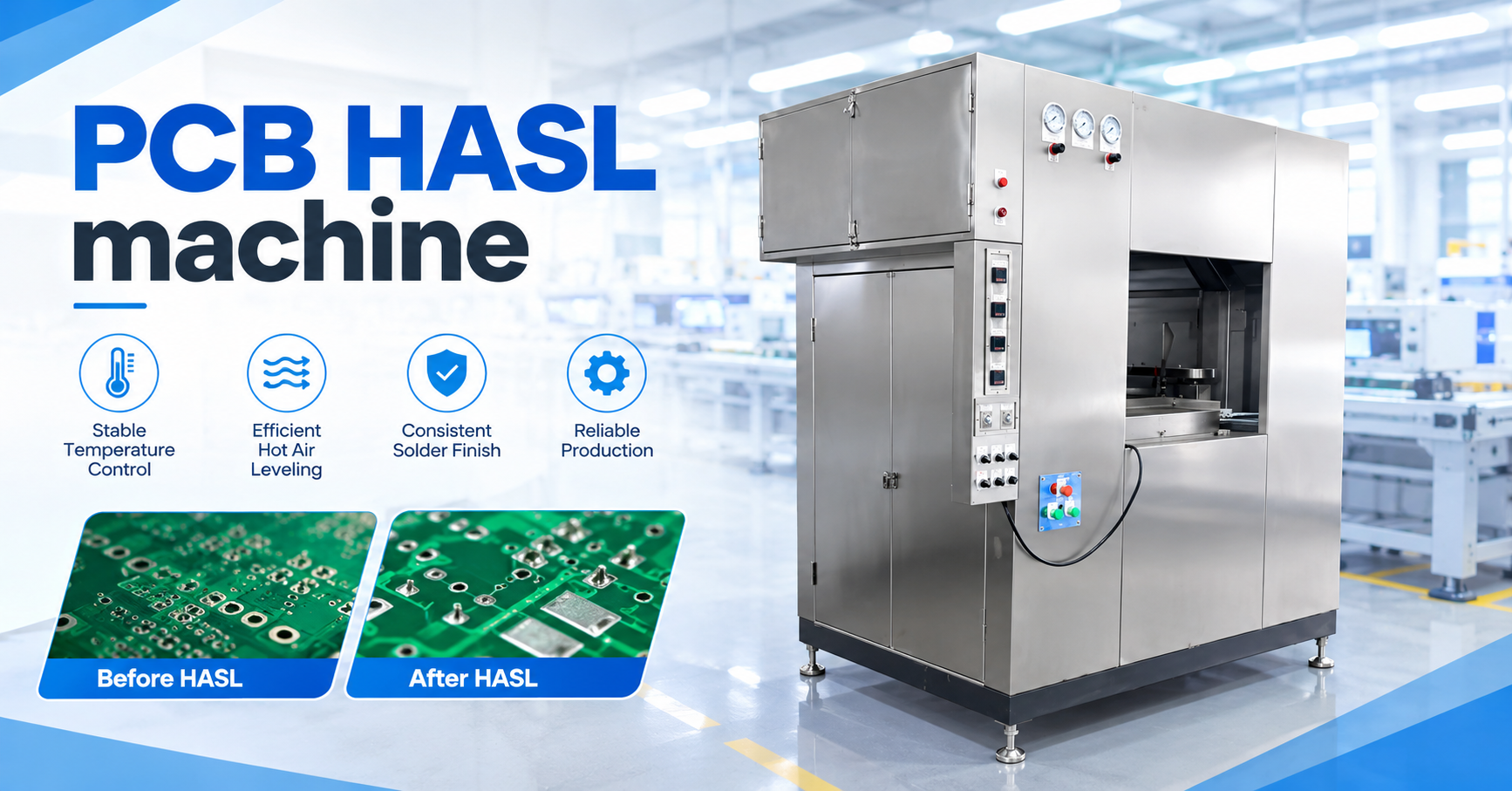
The CHIKIN CNC PCB HASL Machine for Stable Hot Air Leveling is positioned as an industrial PCB surface-finishing system intended to help manufacturers create a more uniform solderable surface while reducing unnecessary process variation. The product is presented as a floor-standing stainless-steel industrial machine with an enclosed processing area, gauges, indicators, controls, access doors, and leveling feet.
The supplier's related technical guide identifies a reference configuration covering PCB sizes up to 610 × 610 mm, PCB thickness from 0.8–3.2 mm, solder temperature of approximately 230–280°C depending on configuration, hot-air temperature of approximately 300–420°C depending on configuration, and a reference working speed of 4–7 pieces/minute. The same source identifies the reference models as CK-2426-A / CK-2426-B and lists a stainless-steel enclosure using SUS 304 / 1.5 mm material. These figures should be treated as reference specifications rather than universal specifications for every final machine configuration.
For purchasing teams, that distinction matters.
The right machine is not necessarily the one with the highest advertised speed or the lowest quotation.
It is the one that fits the production process.
What Is a PCB HASL Machine?
A PCB HASL machine is industrial equipment used for Hot Air Solder Leveling, commonly abbreviated as HASL.
The basic purpose of the process is to apply solder to exposed copper areas on a printed circuit board and then use controlled hot air to remove excess solder and produce a more usable solderable surface.
In a typical PCB manufacturing workflow, the board surface is prepared before soldering treatment. Flux is applied, the board is exposed to molten solder, excess solder is removed through the leveling stage, and the finished board is subsequently cooled and inspected.
The exact process sequence and machine configuration can vary.
The key objective remains the same:
to produce a consistent solderable finish on exposed copper areas.
CHIKIN CNC describes its product as equipment for controlled hot air leveling and solder-coating operations on printed circuit boards. The product page also explains that the purpose of the equipment is to help create a uniform solderable surface while reducing unnecessary variability in the finishing process.
For PCB manufacturers, this is important because surface finishing cannot be considered independently from the assembly process that follows.
A board may pass visual inspection and still create downstream problems if the surface finish is inconsistent or poorly matched to the customer's assembly requirements.
That is why a PCB hot air solder leveling machine should be evaluated as part of the complete PCB manufacturing workflow.
Why Is HASL Still Important for PCB Manufacturing?
PCB manufacturers have access to several surface-finishing technologies.
HASL remains an established process because it provides a solder-coated surface and is familiar to many PCB production environments. It can be used for a wide range of general PCB applications, depending on the board design, customer requirements, solder system, and applicable production standards.
A factory may consider HASL for:
- General electronic PCBs
- Industrial control boards
- Consumer electronic boards
- Power-related electronic boards
- Prototype production
- Small and medium production batches
- Conventional rigid PCB applications
The choice should still be based on the product.
A manufacturer producing fine-pitch boards with particularly demanding surface-finish requirements may evaluate other finishing technologies alongside HASL. Another manufacturer may find HASL practical for a large part of its product portfolio.
There is no universal surface finish that is correct for every PCB.
The purchasing decision should therefore begin with:
What does the customer require from the finished board?
Only after that question is answered should the factory determine whether HASL, lead-free HASL, or another finishing method is appropriate.
What Problems Should a Good PCB HASL Machine Help Control?
A surface-finishing machine is valuable because it can help control production variables.
For PCB HASL processing, important variables may include:
- solder temperature
- hot-air temperature
- board handling
- solder coverage
- excess solder removal
- process timing
- board support
- machine stability
- operator workflow
- maintenance condition
If these variables fluctuate excessively, production can become difficult to manage.
One batch may look acceptable while another requires additional inspection. Operators may spend more time adjusting the equipment. Rework can increase. Production planning becomes less predictable.
This is why the product page describes the CHIKIN CNC machine in terms of stable and repeatable surface finishing, rather than simply focusing on the existence of a soldering function.
A good PCB solder leveling machine should therefore be judged according to repeatability.
Not just whether it can complete one cycle.
Temperature Control Is One of the First Things Buyers Should Evaluate
Temperature is fundamental to HASL.
Solder must be processed within an appropriate temperature range for the selected solder material and board process. Hot-air conditions also influence how excess solder is leveled.
However, buyers should be careful when comparing temperature specifications.
A machine specification stating a maximum temperature does not automatically tell you whether the equipment can maintain the desired process condition consistently.
Ask the supplier:
- What is the normal operating temperature range?
- How is solder temperature controlled?
- How is hot-air temperature controlled?
- How quickly does the system reach operating temperature?
- How stable is the temperature during continuous operation?
- How is temperature monitored?
- What happens if the temperature moves outside the set range?
- Can the system support the solder material required by the factory?
The CHIKIN CNC supplier guide gives a reference solder-temperature range of 230–280°C depending on configuration and a hot-air temperature range of 300–420°C depending on configuration. These values should be confirmed against the final machine configuration and the solder material selected by the customer.
This is an important point for buyers considering a lead free HASL machine.
Lead-free solder systems can require different thermal conditions from traditional tin-lead systems. The machine must therefore be evaluated according to the actual solder alloy and process.
What Is the Difference Between Traditional HASL and Lead-Free HASL?
One of the most important questions for PCB factories is whether the machine needs to support lead-free production.
Traditional HASL commonly uses tin-lead solder systems, while lead-free HASL uses lead-free solder alloys.
The processing conditions are not necessarily identical.
A factory should therefore tell its PCB HASL machine manufacturer exactly which solder system it intends to use.
The buyer should confirm:
- solder alloy
- required operating temperature
- board material
- board thickness
- surface requirements
- production volume
- customer or market requirements
The supplier's technical guide specifically recommends confirming lead-free HASL capability, traditional HASL capability, temperature range, process compatibility, and material requirements before purchasing.
A common procurement mistake is to ask:
“Can this machine do HASL?”
That question is too broad.
A better question is:
“Can this machine process our PCB material and solder alloy at our required board dimensions and production rate, and can you demonstrate the result using our samples?”
That question gives the supplier something concrete to evaluate.
PCB Size Should Be Confirmed Before Price Comparison
Board dimensions directly affect machine selection.
The reference CHIKIN CNC configuration identifies a maximum PCB size of 610 × 610 mm and a board-thickness range of 0.8–3.2 mm.
However, a buyer should not assume that these figures apply to every possible configuration.
Before requesting a final quotation, provide:
- maximum PCB length
- maximum PCB width
- minimum PCB size
- minimum and maximum thickness
- board material
- panel format
- expected production mix
This information allows the supplier to determine whether the standard machine is suitable or whether a customized configuration is required.
A factory producing mostly small boards may not need equipment designed around the largest possible panel.
Conversely, a manufacturer processing large-format panels should not select equipment simply because one small sample board works well.
The equipment needs to support the actual production range.
Table 1: Key Specifications Buyers Should Confirm for a PCB HASL Machine
| Parameter | Reference / Consideration | Why It Matters |
|---|---|---|
| PCB size | Reference configuration up to 610 × 610 mm | Determines whether production panels fit |
| PCB thickness | Reference 0.8–3.2 mm | Affects handling and process compatibility |
| Solder temperature | Approx. 230–280°C depending on configuration | Must match solder material and process |
| Hot-air temperature | Approx. 300–420°C depending on configuration | Affects excess-solder leveling |
| Working speed | Reference 4–7 pcs/min | Should match actual production demand |
| Enclosure | Reference SUS 304 / 1.5 mm | Important for industrial durability and maintenance |
| Machine model | CK-2426-A / CK-2426-B reference | Final configuration should be confirmed |
| Solder type | Traditional or lead-free | Determines process requirements |
| Control system | Confirm with supplier | Determines monitoring and operator workflow |
| Board handling | Confirm final configuration | Influences consistency and production efficiency |
The above figures are reference information from CHIKIN CNC's published supplier guide. Final machine specifications should be confirmed according to the customer's production requirements.
Why Does Machine Construction Matter in a Hot-Air Leveling System?
HASL equipment operates in an industrial thermal environment.
The machine structure therefore needs to be considered carefully.
The CHIKIN CNC product page shows a floor-standing stainless-steel cabinet with an enclosed processing area, access doors, visible gauges, indicator lights, controls, and adjustable leveling feet.
Stainless-steel construction can be useful in manufacturing environments because it is practical to clean and can provide a durable surface around industrial processing areas.
The related technical guide identifies SUS 304 / 1.5 mm as the enclosure material for the reference machine configuration.
However, buyers should distinguish between the external cabinet and the internal process system.
A stainless-steel cabinet alone does not prove process performance.
The buyer should also ask about:
- internal chamber construction
- thermal insulation
- airflow arrangement
- solder handling
- heating system
- exhaust requirements
- access for maintenance
- electrical protection
- operator safety
This is particularly important when comparing different suppliers.
A similar-looking cabinet can contain a very different process design.
Why Is the Hot-Air System Important?
Hot-air leveling is not simply a matter of blowing air across a PCB.
The objective is to remove excess solder while leaving a usable solder coating on the exposed copper.
The air system therefore needs to work consistently with the board handling and soldering process.
Buyers should ask:
- How is airflow generated?
- How is hot-air temperature controlled?
- How is airflow directed?
- Is the air distribution adjustable?
- How is the board positioned during leveling?
- What process parameters can the operator adjust?
The exact internal mechanism of the CHIKIN CNC product is not fully disclosed on the public product page. The page specifically advises buyers to request process drawings, chamber details, and a function description before purchase.
That is a useful procurement principle in general.
Do not infer internal process performance from the external appearance of a machine.
Ask the manufacturer to explain it.
Why Does Board Handling Affect HASL Quality?
The PCB has to move through the process in a controlled manner.
If the board is not supported correctly, several issues can become more difficult to control.
Large boards may behave differently from small boards.
Thin boards may also behave differently from thicker boards.
The machine therefore needs to match the board dimensions and thickness range.
For procurement purposes, ask the supplier:
- How are boards loaded?
- How are they supported?
- How are different sizes handled?
- Can different thicknesses be processed?
- How long does setup take?
- Is the handling sequence manual or automated?
- What operator adjustments are required?
These questions are often more useful than asking whether the machine is “fully automatic.”
Automation should always be defined by function.
For example, automatic board transfer is different from automatic temperature control. Automatic process sequencing is different from automatic loading.
The buyer needs to know exactly what is included.
Is a PCB HASL Machine Suitable for High-Volume Production?
Potentially, but capacity needs to be calculated from the actual production process.
The reference CHIKIN CNC specification gives a working speed of approximately 4–7 pieces per minute.
That figure can be useful as a starting point, but it should not be treated as a guaranteed output for every PCB.
Actual throughput can depend on:
- PCB dimensions
- board thickness
- solder material
- process temperature
- loading method
- operator workflow
- cooling requirements
- inspection
- product changeover
For example, a factory processing one standardized board continuously may achieve a different effective output from a factory that changes PCB formats frequently.
Therefore, buyers should calculate effective production capacity, not only nominal machine speed.
A useful discussion with the supplier should include:
boards per minute + setup time + changeover time + inspection + loading/unloading.
This gives a more realistic view of production capacity.
What About Small-Batch PCB Production?
HASL equipment can also be relevant to prototype and small-batch PCB production, provided the machine configuration matches the required board sizes and process.
Small-batch production often has a different priority from mass production.
Instead of maximum speed, the factory may care more about:
- flexibility
- easy setup
- quick product changeover
- straightforward controls
- easy cleaning
- accessible maintenance
- stable results across different board sizes
The supplier's technical guide specifically identifies PCB prototype and small-batch facilities as one potential customer group for HASL equipment.
For these buyers, a highly complicated production system may not necessarily be the best choice.
The goal should be an appropriate balance between process control and operational simplicity.
How Should Buyers Evaluate a PCB HASL Machine Supplier?
Selecting the machine is only half of the decision.
The supplier matters.
A PCB HASL machine supplier should ideally be able to discuss the process rather than only quote a cabinet.
A good technical conversation should cover:
PCB material
What type of PCB are you processing?
Board dimensions
What is the largest and smallest board?
Thickness
What is the full thickness range?
Solder system
Are you using lead-free or traditional solder?
Production volume
How many boards need to be processed per shift?
Surface-finish requirements
What finish consistency does the customer require?
Factory conditions
What power, ventilation, floor space, and environmental conditions are available?
Automation requirements
Which operations should be automated?
These questions help determine whether the supplier actually understands the application.
CHIKIN CNC's own supplier guide recommends evaluating manufacturing capability, process knowledge, customization ability, sample testing, quality control, and technical support rather than selecting a supplier based only on price.
Direct PCB HASL Manufacturer or Trading Company?
For industrial PCB equipment, buyers often encounter both direct manufacturers and trading companies.
Neither category should automatically be considered good or bad.
The important issue is technical capability.
A direct PCB HASL machine manufacturer may provide more direct communication with engineering and production teams. This can become particularly useful when the project requires:
- customized board dimensions
- special process requirements
- modified controls
- integration with other equipment
- customized chamber arrangements
- non-standard production requirements
A trading company may still be suitable when it provides strong technical resources and has an established relationship with a qualified manufacturer.
The buyer should therefore ask:
Who actually designs the machine?
Then:
Who actually builds it?
And finally:
Who will provide technical support after delivery?
The CHIKIN CNC supplier guide provides a similar manufacturer-versus-trading-company comparison, emphasizing direct engineering communication, customization, machine modification, spare-parts coordination, and long-term service.
Why Should Buyers Request Sample Testing?
Sample testing is one of the most useful steps before purchasing a PCB hot air solder leveling machine.
A brochure can tell you:
- machine dimensions
- nominal temperature
- board size
- nominal speed
- electrical requirements
But it cannot completely demonstrate how your actual PCB behaves during the process.
A sample test can help evaluate:
- solder coverage
- surface appearance
- leveling consistency
- board handling
- edge condition
- solder thickness
- cycle time
- process stability
CHIKIN CNC's supplier guide specifically recommends providing PCB samples, board materials, thickness information, surface requirements, and production targets for sample processing. It also recommends evaluating solder coverage, surface uniformity, edge quality, solder thickness, process stability, and cycle time.
This approach reduces purchasing risk.
It also gives both the buyer and supplier a clearer understanding of the final machine configuration.
What Should Be Included in a HASL Machine Acceptance Test?
Before placing an order, buyers should consider defining acceptance criteria.
A simple statement such as “machine works normally” is not enough for industrial equipment.
Depending on the project, the acceptance criteria may include:
- maximum PCB size
- minimum PCB size
- supported PCB thickness
- solder material
- temperature range
- hot-air temperature
- production speed
- operating sequence
- control functions
- safety functions
- sample-processing results
- documentation
- spare parts
- installation requirements
If the project includes lead-free production, lead-free process performance should be included in the acceptance discussion.
If the project includes multiple PCB sizes, samples from different size ranges should ideally be considered.
The goal is to establish a measurable connection between the machine quotation and the actual production requirement.
Maintenance Should Be Discussed Before the Purchase
A machine that performs well on day one can still become expensive if maintenance is difficult.
For a PCB HASL machine, buyers should consider access to:
- heating components
- airflow-related components
- electrical controls
- gauges
- filters or exhaust components
- solder-related components
- access doors
- wear parts
The product page highlights access doors and a floor-standing structure, while the supplier guide recommends evaluating maintenance requirements and technical support as part of supplier selection.
Ask the supplier:
- Which parts require regular inspection?
- Which components are consumables?
- How often should maintenance be performed?
- Can operators perform routine maintenance?
- Which spare parts should be stocked locally?
- Is remote troubleshooting available?
- What happens if a critical component fails?
These questions should be answered before the machine arrives at the factory.
Why Is Operator Safety Important for HASL Equipment?
HASL involves heat and soldering processes.
Therefore, safety should be part of the equipment specification.
Buyers should review:
- enclosed processing areas
- access doors
- warning indicators
- emergency controls
- thermal protection
- electrical protection
- ventilation requirements
- operator access points
- maintenance procedures
The CHIKIN CNC product is presented as an enclosed floor-standing industrial cabinet with access doors and visible control/monitoring components.
However, buyers should request the complete safety specification for the final configuration.
The visible machine structure alone cannot establish compliance with every local safety requirement.
Factories should also confirm the applicable electrical, environmental, occupational-safety, and process requirements in their destination market.
What Does a Good PCB Surface Finishing Workflow Look Like?
A well-organized PCB surface-finishing process is more than one machine.
A typical workflow may involve:
PCB preparation → flux application → soldering / immersion → hot-air leveling → cooling → inspection
The exact sequence depends on the equipment architecture and factory process.
The important point is that the HASL machine should integrate logically into the overall manufacturing workflow.
A buyer should therefore ask:
- What equipment is installed before the HASL system?
- What happens immediately afterward?
- How are boards transferred?
- Is cooling integrated?
- Is inspection manual or automated?
- How are finished boards stored?
- What is the required production-line footprint?
This broader view can prevent a common purchasing mistake: buying a technically suitable machine that does not fit the factory's actual workflow.
Table 2: PCB HASL Machine Procurement Checklist
| Procurement Question | What the Buyer Should Prepare | Why It Matters |
|---|---|---|
| What PCB materials are processed? | FR-4, multilayer PCB, special materials, etc. | Determines process compatibility |
| What is the largest board? | Maximum length × width | Determines machine capacity |
| What is the thickness range? | Minimum and maximum thickness | Affects board handling |
| What solder is required? | Lead-free or traditional HASL | Determines thermal requirements |
| What output is required? | Boards/hour or boards/shift | Helps size production capacity |
| What finish is required? | Customer surface-finish requirements | Defines process target |
| Is customization needed? | Board handling, chamber, controls, etc. | Prevents later modification costs |
| What utilities are available? | Power, ventilation, factory space | Ensures installation compatibility |
| What support is required? | Installation, training, spare parts | Reduces future downtime |
| Can samples be tested? | PCB samples and process data | Verifies actual application suitability |
Common Mistakes When Buying a PCB HASL Machine
Mistake 1: Choosing Based Only on Price
The lowest quotation is not necessarily the lowest total cost.
Maintenance, downtime, spare parts, energy use, operator requirements, and process consistency can all influence the actual cost of ownership.
Mistake 2: Looking Only at Maximum Temperature
A higher temperature rating does not automatically mean better HASL performance.
What matters is whether the system can maintain the required process conditions consistently.
Mistake 3: Ignoring Board Thickness
A machine that handles one PCB thickness well may not automatically perform the same way across a wider thickness range.
Always provide the full production range.
Mistake 4: Assuming Lead-Free Capability
Do not assume that a standard HASL machine automatically meets your lead-free production requirements.
Confirm the solder alloy, temperature range, thermal system, and sample results.
Mistake 5: Buying Before Sample Testing
This creates unnecessary risk.
Whenever practical, test actual customer boards before finalizing the machine configuration.
Mistake 6: Treating Nominal Speed as Real Production Capacity
Machine speed does not always equal effective factory throughput.
Changeovers, loading, inspection, cooling, and operator handling all influence real output.
Mistake 7: Ignoring Maintenance Access
A machine can become expensive when routine maintenance requires excessive downtime.
Ask to see maintenance-access points before purchasing.
Mistake 8: Comparing Suppliers Only by Their Website
A professional website is useful, but it does not replace technical evaluation.
Ask for:
- sample testing
- technical drawings
- machine videos
- process explanations
- acceptance criteria
- references where appropriate
- after-sales support information
What Makes the CHIKIN CNC PCB HASL Machine Worth Evaluating?
The CHIKIN CNC product is specifically positioned as a PCB HASL machine for stable, repeatable surface finishing.
The public product page presents a floor-standing industrial cabinet with stainless-steel construction, an enclosed processing area, gauges, indicator lights, manual controls, access doors, and adjustable leveling feet.
The related technical guide provides the reference configuration:
- Model: CK-2426-A / CK-2426-B
- Maximum PCB size: 610 × 610 mm
- PCB thickness: 0.8–3.2 mm
- Solder temperature: 230–280°C, depending on configuration
- Hot-air temperature: 300–420°C, depending on configuration
- Working speed: 4–7 pcs/min
- Enclosure: SUS 304 / 1.5 mm
- Total power: 66 kW
These figures provide a useful starting point for procurement discussions.
They should not, however, be copied into every quotation as universal specifications.
The final configuration needs to be confirmed according to:
- PCB dimensions
- PCB thickness
- solder alloy
- required surface finish
- production volume
- factory utilities
- automation requirements
That is the more reliable approach to equipment purchasing.
How Can Buyers Request a More Accurate HASL Machine Quotation?
A useful RFQ should contain more than:
“Please send price for PCB HASL machine.”
Instead, provide a structured specification.
PCB Information
- Board material
- Maximum size
- Minimum size
- Thickness range
- Panel format
- Copper condition
Surface Finish
- HASL
- Lead-free HASL
- Required solder alloy
- Surface requirements
Production
- Boards per hour
- Boards per shift
- Working days per month
- Product mix
- Changeover frequency
Factory Conditions
- Available power
- Factory floor space
- Ventilation
- Cooling
- Installation environment
Automation
- Manual loading
- Automatic handling
- Temperature monitoring
- Process sequencing
- Integration with other equipment
Service
- Installation
- Training
- Spare parts
- Warranty
- Remote support
The more complete the RFQ, the less likely the buyer is to receive a quotation that looks attractive but does not match the actual application.
5 Procurement FAQs About PCB HASL Machines
1. What should I provide when asking for a PCB HASL machine quotation?
Provide your PCB material, maximum and minimum board size, thickness range, solder type, expected production volume, surface-finish requirements, factory power conditions, and automation expectations.
If possible, provide actual PCB samples.
This allows the PCB HASL machine supplier to evaluate the application instead of quoting a generic configuration.
2. Can a PCB HASL machine process lead-free solder?
It can be configured for lead-free HASL applications, but buyers should confirm this with the manufacturer rather than assume it.
The solder alloy, temperature requirements, board material, process parameters, and machine configuration should all be reviewed before purchase. CHIKIN CNC's supplier guide specifically recommends confirming lead-free capability and process compatibility.
3. What PCB size can the CHIKIN CNC HASL machine handle?
The published reference configuration lists a maximum PCB size of 610 × 610 mm and a thickness range of 0.8–3.2 mm. The referenced models are CK-2426-A / CK-2426-B.
However, buyers should confirm the final specification because the required machine configuration may vary according to the actual production application.
4. How do I compare two PCB HASL machine manufacturers?
Compare more than price.
Evaluate:
- PCB size capability
- thickness range
- solder compatibility
- temperature control
- hot-air leveling
- working speed
- machine structure
- maintenance access
- customization
- sample testing
- spare parts
- technical support
A supplier that can demonstrate actual processing capability with your PCB samples can generally provide more useful evidence than a supplier offering specifications alone.
5. Why is sample testing important before buying HASL equipment?
Sample testing allows the buyer to evaluate the actual process on the PCB that will be manufactured.
It can help verify solder coverage, surface consistency, edge condition, solder thickness, process stability, and cycle time.
CHIKIN CNC recommends sample processing as part of the evaluation process for PCB HASL equipment.
Final Buyer Checklist for Selecting a PCB HASL Machine
Before contacting a PCB HASL machine manufacturer, make sure you can answer these questions:
About the PCB
- What material is being processed?
- What is the maximum board size?
- What is the minimum board size?
- What is the thickness range?
- Is the board rigid, multilayer, or another structure?
About the Surface Finish
- Do you require traditional HASL?
- Do you require lead-free HASL?
- What solder alloy will be used?
- What surface-finish requirements must be met?
About Production
- How many boards are required per hour?
- What is the daily output?
- How frequently do board sizes change?
- Is the production continuous or batch-based?
About the Machine
- What is the usable board range?
- What temperature range is available?
- How is hot-air leveling controlled?
- What automation functions are included?
- How is the machine maintained?
About the Supplier
- Is the supplier a manufacturer or trader?
- Can the supplier perform sample testing?
- Can the supplier customize the system?
- Who provides installation support?
- Are spare parts available?
- How is after-sales service handled?
Answering these questions before requesting quotations will make supplier comparisons much more meaningful.
Conclusion: The Right PCB HASL Machine Is About Process Stability, Not Just Machine Price
Selecting a PCB HASL machine is ultimately a production decision.
The equipment must fit the PCB.
It must fit the solder system.
It must fit the production volume.
And it must fit the factory's maintenance and service capabilities.
For buyers, the most important evaluation points include:
- PCB size
- PCB thickness
- solder type
- temperature control
- hot-air leveling
- board handling
- working speed
- machine structure
- maintenance access
- automation
- sample testing
- customization
- supplier engineering capability
- after-sales support
The CHIKIN CNC PCB HASL machine is positioned for stable and repeatable PCB surface finishing, with a stainless-steel industrial enclosure and a reference configuration covering boards up to 610 × 610 mm and 0.8–3.2 mm thickness. The published reference configuration also provides temperature and production-speed information that can be used as a starting point for technical discussion.
But the most important point for a professional buyer is this:
Do not purchase a HASL machine based only on a specification sheet.
Provide your actual PCB samples, board dimensions, thickness range, solder requirements, production target, and factory conditions.
Then ask the supplier to demonstrate that the proposed configuration can meet the process.
That approach makes it easier to compare suppliers objectively, reduce equipment-matching risk, and select a PCB HASL machine supplier that can support the factory beyond the initial sale.
For manufacturers evaluating a new surface-finishing line, replacing older equipment, or adding lead-free HASL capability, a detailed technical discussion with the equipment manufacturer is the logical next step.