



 Why Enclosed Engraving and Milling Machines Are Becoming a Smarter Choice for Precision Workshops
In many workshops, the hardest production problem is not always large-scale output. Sometimes the real issue is much smaller, but more stubborn: how to machine detailed parts in a controlled space, how to keep chips and dust away from operators, how to repeat the same finishing quality across small batches, and how to give operators enough visibility without leaving the machining process too exposed.
That is where an engraving and milling machine with an enclosed cabinet structure becomes useful. Chikin CNC describes this type of machine as equipment for workshops that need controlled material removal, repeatable part finishing, and a safer way to observe the process in a contained space. The product page also states that this floor-standing enclosed unit includes a viewing door, HMI screen, physical controls, and pendant operation, making it suitable for supervised production in a factory or workshop setting.
For B2B buyers searching for a CNC engraving machine, CNC milling machine, precision engraving and milling machine, or compact CNC machine for workshop, the buying decision should not begin with the machine name alone. A more practical question is: does the machine match the real material, toolpath, operator workflow, cleanliness requirement, and production volume in the factory?
This is especially important because engraving and milling applications can vary widely. Some buyers may need acrylic panel processing. Others may need light metal engraving, prototype trimming, nameplate work, tooling marks, or controlled small-part machining. The machine may look similar from the outside, but the final result depends on tooling, spindle setup, fixturing, material behavior, and control configuration.
What Problem Does an Enclosed Engraving and Milling Machine Solve?
A traditional open machine may be easy to observe, but it can also expose the surrounding workspace to chips, dust, noise, and accidental contact risks. In a small workshop, prototype room, jewelry processing area, acrylic fabrication space, or precision parts cell, that becomes a daily management issue. Operators need access, but they also need separation from the active machining zone.
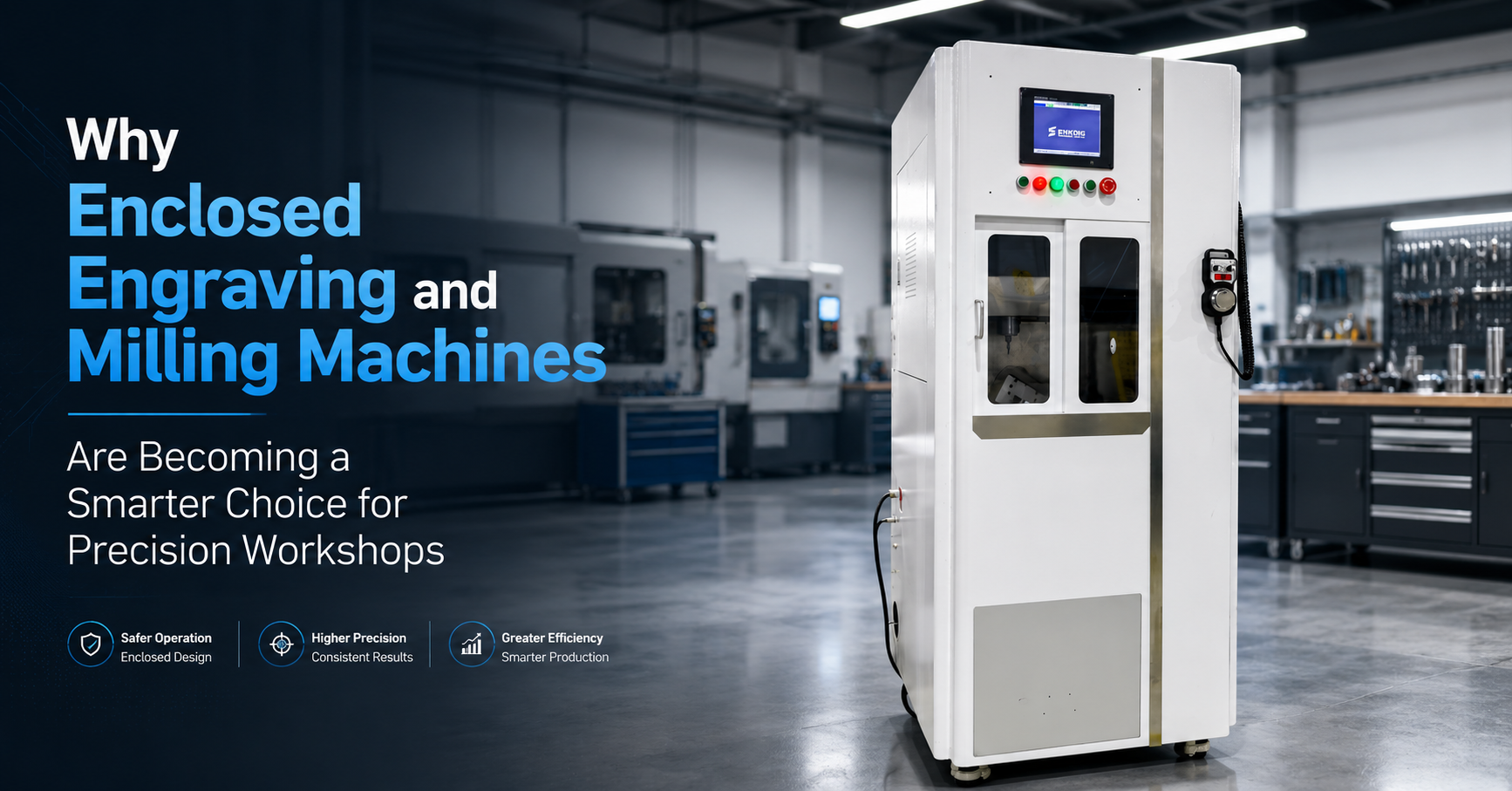
Chikin’s product page explains that the main buyer problem is often the same: achieving clean and consistent results without exposing operators to chips, dust, or accidental contact during machining. The visible machine is described as an industrial cabinet-style system on casters, with dual viewing windows that allow operators to check the internal process without opening the door.
That makes the machine more than a cutting platform. It becomes a supervised processing station. The enclosure defines the working area. The windows allow observation. The HMI and physical controls support operation. The side pendant helps operators make adjustments close to the machine. The cabinet layout supports a more organized shop-floor workflow.
For factories, this can help in several ways:
It keeps the machining process more contained.
It gives operators a clearer boundary between setup and cutting.
It reduces dependence on fully open manual observation.
It helps production managers standardize small-batch machining.
It can improve daily cleanliness when compared with unmanaged open cutting.
It supports a more professional workshop layout for precision tasks.
The machine should still be selected carefully. An enclosure alone does not prove cutting capability. Buyers need to confirm the actual spindle, tool system, working range, material compatibility, dust extraction, chip handling, accuracy, and maintenance access before ordering.
What Does the Chikin Product Page Show About This Machine?
The product page presents the machine as a tall rectangular enclosed industrial unit in a light gray or white painted metal finish. It has two vertically aligned transparent windows at the front, a touchscreen HMI, a row of push buttons and indicator lights, a prominent red emergency-stop style button, and a handheld pendant mounted on the side with a coiled cable. The page also mentions side ventilation openings and a utility connection on the lower side, suggesting a powered industrial cabinet with internal air management.
These visible details are important because they show the product’s likely positioning. It is not presented like a simple open desktop engraver. It is shown as a floor-standing enclosed machining platform for supervised workshop use.
The product page also states that, because the exact processing function is not confirmed from the image alone, the machine should be evaluated as an enclosed industrial platform rather than a fixed-process tool. If configured for a CNC engraving or CNC milling role, the outcome depends on tooling, spindle setup, fixturing, and processed material.
That point is worth emphasizing. The URL and product wording include metal, acrylic, jewelry, and tooth carving language, but buyers should not assume one fixed capability from the title alone. For acrylic, metal, jewelry, dental, or other fine engraving work, the supplier should confirm the actual configuration and test requirements before purchase.
Product Features and Buyer Meaning
| Product Feature | Product Page Information | Why It Matters for B2B Buyers |
|---|---|---|
| Enclosed cabinet structure | The machine is described as a floor-standing enclosed unit with viewing door and cabinet-style body | Helps contain machining activity and creates a defined production workspace |
| Dual viewing windows | Front windows allow operators to check the internal process without opening the door | Supports safer observation during setup checks and machining supervision |
| HMI screen | The machine includes a visible HMI screen | Helps operators interact with the machine and monitor process conditions |
| Physical controls | Push buttons, indicator lights, and emergency-stop style button are visible | Supports direct shop-floor operation and quick intervention |
| Side pendant | A handheld pendant with coiled cable is mounted on the side | Useful when operators need to jog, adjust, or control motion near the machine |
| Side ventilation openings | Ventilation openings and lower utility connection are visible | Suggests internal air management, but exact dust or chip handling must be confirmed |
| Casters | The cabinet-style machine is described as being on casters | Useful for positioning the machine inside a workshop or factory cell |
| Flexible process role | The page advises evaluating it as an enclosed industrial platform rather than assuming one fixed process | Buyers must confirm spindle, tooling, material range, and actual application fit |
| Possible material scope | The page mentions plastics, acrylic, aluminum, copper, soft steel, and other machinable substrates depending on final configuration | Material compatibility must be confirmed with the supplier before purchase |
Why Is the Enclosed Format Important for Factory Buyers?
The enclosure is one of the machine’s most practical advantages. Chikin’s page states that an enclosed format helps contain chips, mist, or debris during machining operations. For engraving, trimming, or light milling applications, this can improve workplace cleanliness and support safer observation.
For B2B buyers, this matters because workshop conditions affect productivity. A machine that throws chips into the surrounding area creates more cleanup. A process that requires operators to stand close to an exposed cutting zone may create safety and training concerns. A toolpath that must be watched closely becomes easier to manage if there are viewing windows and protected access.
An enclosed machine can be useful in several workshop environments:
Acrylic fabrication rooms that need cleaner processing.
Small metal engraving cells where chips should be contained.
Jewelry or fine part workshops where operators need visual control.
Prototype rooms where many small jobs are tested.
Toolrooms that need controlled light milling or marking.
Factories that prefer enclosed workstations for operator safety and process discipline.
However, buyers should still confirm whether the enclosure includes dust extraction, mist control, chip trays, coolant handling, lighting, or interlock functions. The page confirms visible enclosure and ventilation features, but it also notes that exact electrical or process specifications are not visible and should be confirmed before purchase.
Why Does Operator Visibility Matter?
Visibility is not a cosmetic feature. When engraving or milling small details, operators often need to observe setup alignment, toolpath behavior, workpiece condition, and possible abnormalities. If the operator must open the door frequently to check the process, the cycle may become slower and less consistent.
Chikin’s product page states that the front-door windows give the operator a direct view of the process zone. This matters when buyers want to monitor toolpath behavior, setup alignment, or workpiece status without interrupting the cycle.
For precision engraving, visibility may help operators detect:
Poor workpiece clamping.
Unexpected vibration.
Toolpath mismatch.
Chip buildup near the cut.
Tool contact problems.
Surface finish issues.
Incorrect setup before full-cycle operation.
In small-batch production, this can reduce waste. Operators can monitor early cutting behavior and intervene before an entire batch is affected. The combination of viewing windows and local controls makes the machine more practical for supervised production rather than unattended mass production.
Why Are HMI, Buttons, and Pendant Control Useful Together?
A good factory machine should not force operators to choose between screen operation and physical control. In daily use, operators often need both. A screen is helpful for setting and checking information. Physical buttons are useful for quick actions. A pendant helps during setup and jogging.
Chikin’s product page highlights the combination of touchscreen HMI, push buttons, and side pendant. It states that this mix supports practical shop-floor operation and makes it easier to start, stop, adjust, or jog the machine during setup.
This matters for engraving and milling because setup quality strongly affects final results. A part may need careful alignment. A fixture may need small adjustments. A tool may need to be positioned accurately before starting the program. The pendant can make those steps more manageable when the operator is standing near the work area.
Buyers should ask the supplier:
What functions are available on the HMI?
Can operators store or recall job settings?
What functions are available on the pendant?
Can the pendant jog each axis?
How is emergency stop handled?
Are indicator lights linked to machine status?
Can the control language be changed?
Can operators easily switch between engraving and milling jobs?
What training is provided for the interface?
The answer to these questions will show whether the machine is practical for the buyer’s daily production routine.
What Materials Can This Machine Process?
Material compatibility is one of the most important buying points. The product page states that material compatibility is often the real decision point. It mentions that equipment of this kind may be paired with plastics, acrylic, aluminum, copper, soft steel, or other machinable substrates depending on final configuration. It also notes that acrylic engraving may be more relevant for sign making or panel work, while metal engraving may be a better reference when jobs involve tooling marks, pockets, or surface shaping on metals.
This means buyers should not assume universal performance. Acrylic, aluminum, copper, soft steel, jewelry metals, and dental materials may require different spindle speeds, tool materials, clamping methods, chip control, dust extraction, coolant strategies, and surface-finish expectations.
For acrylic, buyers should ask about edge quality, heat buildup, chip evacuation, and whether the machine supports clean cutting or engraving without melting or whitening the edge.
For aluminum, buyers should ask about spindle speed, tool rigidity, chip evacuation, possible lubrication, and surface finish.
For copper, buyers should ask about cutting parameters, tool wear, burr control, and fixture stability.
For soft steel, buyers should confirm whether the machine configuration is truly suitable, because steel places higher demands on rigidity, spindle power, tooling, and cutting strategy.
For jewelry or dental-related fine carving, buyers should be especially careful. The product page does not provide detailed jewelry or dental machining specifications in the visible text. If those are the intended applications, the buyer should request sample machining and configuration confirmation before ordering.
How Should Buyers Select the Right Configuration?
An engraving and milling machine should be selected according to the job type. The wrong approach is to buy based only on the product title. The better approach is to define the real work first.
Chikin’s page states that buyers should clarify the process they want the machine to perform, the workpiece size, the control method, and any floor-space limits before ordering. It also recommends asking about customization early if the enclosure, pendant layout, window placement, or control panel position needs to match the shop routine.
A practical selection process should include:
Define the main material.
Define the main process: engraving, trimming, pocketing, light milling, marking, or surface shaping.
Confirm the maximum workpiece size.
Confirm the expected tolerance and finish.
Check whether the machine frame is suitable for the cutting load.
Ask about spindle type, speed range, and tool holder.
Review workholding and fixture options.
Confirm dust, chip, or coolant handling.
Review control system usability.
Check operator visibility and access.
Confirm maintenance points and spare parts.
Request sample machining if the application is important.
This process helps buyers avoid overbuying or underbuying. A machine that is excellent for acrylic sign engraving may not be suitable for heavier metal milling. A machine that can mark metal surfaces may not automatically handle deep pocketing. A machine that supports fine jewelry-style engraving may need a different spindle and tooling package from a panel-cutting setup.
Buyer Selection Checklist
| Selection Area | What Buyers Should Confirm | Why It Matters |
| Main application | Is the machine mainly for engraving, milling, trimming, marking, or prototype finishing? | Different tasks require different spindle, tooling, and fixture choices |
| Material type | Acrylic, plastic, aluminum, copper, soft steel, jewelry material, or other substrate | Material determines cutting force, tool wear, chip control, and finish |
| Workpiece size | Maximum part size and fixture requirements | Prevents buying a machine with an unsuitable work envelope |
| Enclosure needs | Chip containment, dust control, visibility, and operator access | Affects cleanliness and safety in the workshop |
| Spindle setup | Speed range, tool holder, rigidity, and tool compatibility | Determines whether the machine fits the actual cutting task |
| Workholding | Clamps, vises, fixtures, vacuum options, or custom tooling | Repeatable results depend on stable part holding |
| Control method | HMI usability, pendant control, physical buttons, language, and job setup | Affects daily operator efficiency |
| Ventilation and debris | Dust extraction, chip collection, mist control, or air management | Important for acrylic, plastics, metals, and fine engraving work |
| Mobility | Whether casters are useful or fixed installation is preferred | Helps match the machine to floor layout |
| Supplier support | Application review, sample testing, training, spare parts, and customization | Reduces purchase risk |
How Does This Machine Differ from an Open Engraving Router?
Open engraving routers can be useful for simple work. They may be lower in cost, easy to access, and suitable for non-critical cutting or occasional use. But they are not always ideal for factory environments where process containment, operator separation, and repeatable small-batch production matter.
Chikin’s machine is presented as a floor-standing enclosed industrial platform with viewing door, HMI screen, physical controls, side pendant, side ventilation, and cabinet-style body.
That gives it several differences from a basic open machine:
The machining area is more contained.
The operator can observe through windows.
The process has a more defined boundary.
The control layout is more production-oriented.
The pendant supports setup adjustment.
The cabinet body appears more suitable for workshop positioning.
The machine can be integrated into a more organized workflow.
For buyers running repeated jobs, those differences may matter more than the initial price difference. Open equipment can be acceptable for light, occasional work. Enclosed equipment is more suitable when the factory needs a cleaner, safer, and more standardized process.
How Does This Machine Differ from a Heavy CNC Machining Center?
A heavy CNC machining center is designed for stronger cutting, larger parts, higher rigidity, and more demanding machining cycles. It may be the right choice for industrial metal components, complex molds, and higher material removal rates. But it may be excessive for engraving, light milling, marking, acrylic processing, prototype finishing, or small workpieces.
The Chikin product page positions this machine as an enclosed engraving and milling platform for controlled material removal and repeatable part finishing. It is better understood as a supervised workshop machine rather than a heavy production machining center.
For buyers, this distinction matters. A compact enclosed engraving and milling machine may be the better choice when the workshop needs:
Smaller footprint.
Operator supervision.
Cleaner contained processing.
Short-run flexibility.
Detailed engraving.
Light milling or trimming.
Prototype finishing.
Panel or sign work.
Small batch repeatability.
A heavy machining center may be better when the factory needs:
High cutting force.
Deep metal removal.
Large workpieces.
Long unmanned cycles.
Automatic tool changing.
Heavy fixturing.
Industrial mold or structural part machining.
The right choice depends on the real process, not the most impressive machine category.
Practical Factory Case: Acrylic Panel and Aluminum Nameplate Workshop
Consider a workshop that produces acrylic display panels and aluminum nameplates for equipment manufacturers. The team uses several manual tools and a small open router. For simple work, this setup is acceptable. But as order volume increases, the workshop faces three recurring problems.
First, acrylic chips and dust spread around the work area.
Second, operators need to watch the cutting process closely, but open-machine operation creates more exposure.
Third, small aluminum nameplates require repeatable engraving, but setup varies between operators.
The workshop begins looking for an enclosed CNC engraving machine that can provide better observation, cleaner containment, and more consistent operation. Chikin’s machine would be relevant because the product page describes a floor-standing enclosed unit with viewing windows, HMI screen, physical controls, pendant operation, and cabinet-style structure on casters. It also states that equipment of this kind may be paired with plastics, acrylic, aluminum, copper, soft steel, or other machinable substrates depending on configuration.
Before purchasing, the buyer should send material samples and drawings to the supplier. The supplier should confirm whether the machine configuration fits acrylic panel processing and aluminum engraving. The buyer should also ask about chip extraction, spindle setup, fixture options, and sample machining.
If properly configured, the machine could help the workshop create a cleaner and more controlled production cell for acrylic and aluminum parts. If not properly configured, the same machine shell may not deliver the desired finish. This case shows why process confirmation is more important than product title alone.
Practical Factory Case: Fine Detail Workshop for Jewelry or Dental-Like Parts
Some buyers may read the product URL and notice words related to jewelry or tooth carving. These applications can involve small details, fine contours, and tight visual standards. However, the product page does not provide a detailed jewelry or dental machining specification table in the visible text. That means buyers should treat those applications carefully and request technical confirmation.
For example, a workshop making small wax, resin, soft metal, or dental-style models may need fine detail, smooth surfaces, and precise tool control. The buyer should ask the supplier:
What materials are supported?
What spindle speed and tool holder are used?
What tool diameters can be used reliably?
What surface finish is realistic?
What fixture method is recommended for small parts?
Is dust extraction or coolant required?
Can the supplier provide sample machining?
Can the machine repeat fine details across multiple parts?
The enclosed structure, windows, HMI, and pendant may support supervised fine work. But material and accuracy must be confirmed. This is the objective way to evaluate the machine for specialized applications.
What Should Buyers Ask the Supplier Before Ordering?
Because the product page does not publish full numerical specifications in the visible text, buyers should request confirmed data from the supplier. The page itself says that exact electrical or process specifications are not visible and should be confirmed before purchase. It also states that performance depends on tooling, spindle setup, fixturing, and material.
A useful inquiry should include:
Main material.
Workpiece size.
Required process: engraving, milling, trimming, marking, or carving.
Drawing files or sample photos.
Target surface finish.
Tolerance requirement.
Expected batch size.
Tool diameter range.
Fixture method.
Need for dust extraction or chip collection.
Need for coolant or dry cutting.
Floor-space limit.
Control language requirement.
Maintenance expectations.
Whether sample machining is available.
A supplier that can answer these questions clearly is more valuable than one that only sends a quotation.
What Supplier Qualities Matter?
A good industrial engraving machine supplier should understand application matching. It should not simply claim that one machine can process everything. It should ask what material the buyer uses, what part quality is required, what toolpath is planned, and what workshop conditions apply.
Buyers should evaluate a supplier based on:
Ability to review material and drawings.
Willingness to explain configuration limits.
Experience with acrylic, plastics, metals, or fine engraving applications.
Ability to recommend spindle and tooling options.
Support for fixturing and workholding.
Clarity about dust, chip, and coolant handling.
Training and operating guidance.
Spare parts availability.
Customization ability for enclosure, pendant, window, or control layout.
Sample machining support before order.
Chikin’s page recommends sending application details and workpiece requirements to compare configuration options and emphasizes that a well-matched engraving and milling platform starts with the right process definition, not just the machine shell.
That is the right supplier-selection mindset.
Common Buying Mistakes
The first mistake is buying by product title alone. The title may include several application words, but buyers must confirm the actual configuration.
The second mistake is assuming that all engraving and milling machines process the same materials. Acrylic, aluminum, copper, soft steel, jewelry materials, and dental-like materials may require different setups.
The third mistake is ignoring chip or dust management. Enclosure helps, but the actual extraction or collection system must be confirmed.
The fourth mistake is not checking workholding. Detailed engraving and light milling require stable fixtures.
The fifth mistake is overestimating milling ability. A compact enclosed engraving machine may not be suitable for heavy metal removal unless configured and verified for that work.
The sixth mistake is ignoring operator workflow. Window visibility, pendant location, control layout, and emergency-stop access all affect daily use.
The seventh mistake is skipping sample testing. For acrylic, metal, jewelry, or dental-style fine work, real samples are the safest way to confirm quality.
When Is This Machine a Good Fit?
This machine may be a good fit when the buyer needs:
Controlled engraving in an enclosed workspace.
Light milling or trimming in a supervised shop setting.
Acrylic panel processing, if the configuration is confirmed.
Metal marking or light shaping, if tooling and spindle setup are suitable.
Small-batch prototype finishing.
Operator observation through viewing windows.
A combination of HMI, physical controls, and pendant control.
A compact cabinet-style machine for workshop use.
Cleaner machining compared with fully open equipment.
It may not be the best fit when the buyer needs:
Heavy-duty metal milling.
Large-part machining.
High-volume unmanned production.
A guaranteed acrylic, jewelry, or dental process without sample testing.
A machine selected only by low price.
A process where material compatibility has not been confirmed.
FAQ
What is an engraving and milling machine used for?
An engraving and milling machine is used for controlled material removal, repeatable part finishing, engraving, trimming, light milling, panel processing, prototype work, and other internal manufacturing tasks that need a guarded workspace. Chikin’s product page describes this machine as suitable for workshop environments where repeatability, operator control, and process containment matter.
What are the main visible features of Chikin’s machine?
The machine is shown and described as a floor-standing enclosed unit with viewing windows, HMI screen, push buttons, indicator lights, emergency-stop style button, side pendant, side ventilation openings, lower utility connection, cabinet-style body, and casters.
Can this machine process acrylic?
The product page says equipment of this kind may be paired with plastics and acrylic depending on final configuration. Buyers should confirm spindle, tooling, dust handling, edge quality, and sample results before ordering.
Can it process metal?
The product page mentions aluminum, copper, soft steel, and other machinable substrates depending on final configuration. Buyers should confirm cutting depth, tool system, rigidity, chip handling, and sample machining results before selecting it for metal work.
Why is the enclosure useful?
The enclosed format helps contain chips, mist, or debris during machining operations. It also supports safer observation through the front windows and creates a more controlled production workspace.
What should buyers confirm before purchase?
Buyers should confirm working range, spindle or tool system, power requirements, accuracy, supported materials, maintenance access, dust or chip handling, control method, fixture options, and whether customization is available.
Is the exact machining performance visible from the product image?
No. The page states that the exact processing function is not confirmed from the image alone and that machining outcome depends on tooling, spindle setup, fixturing, and material. Buyers should request confirmed specifications and sample machining before purchase.
Conclusion
An enclosed engraving and milling machine can be a smart choice for workshops that need controlled material removal, repeatable part finishing, cleaner machining, and safer operator observation. It is especially useful when the factory wants a compact industrial platform rather than a fully open engraving router or a heavy machining center.
Chikin CNC’s product page presents this machine as a floor-standing enclosed industrial unit with viewing windows, HMI screen, push-button controls, emergency-stop style button, pendant operation, cabinet-style body, casters, ventilation openings, and a supervised production layout. The page also states that possible material use may include plastics, acrylic, aluminum, copper, soft steel, and other machinable substrates depending on final configuration.
For B2B buyers, the most important lesson is simple: choose by process fit, not by product title alone. Define the material, workpiece size, engraving or milling goal, surface finish, tolerance, chip control, operator workflow, and floor-space requirements first. Then ask the supplier to confirm the spindle, tooling, fixturing, control method, maintenance access, and sample results.