



What Should You Check Before Choosing a PCB Equipment Supplier?
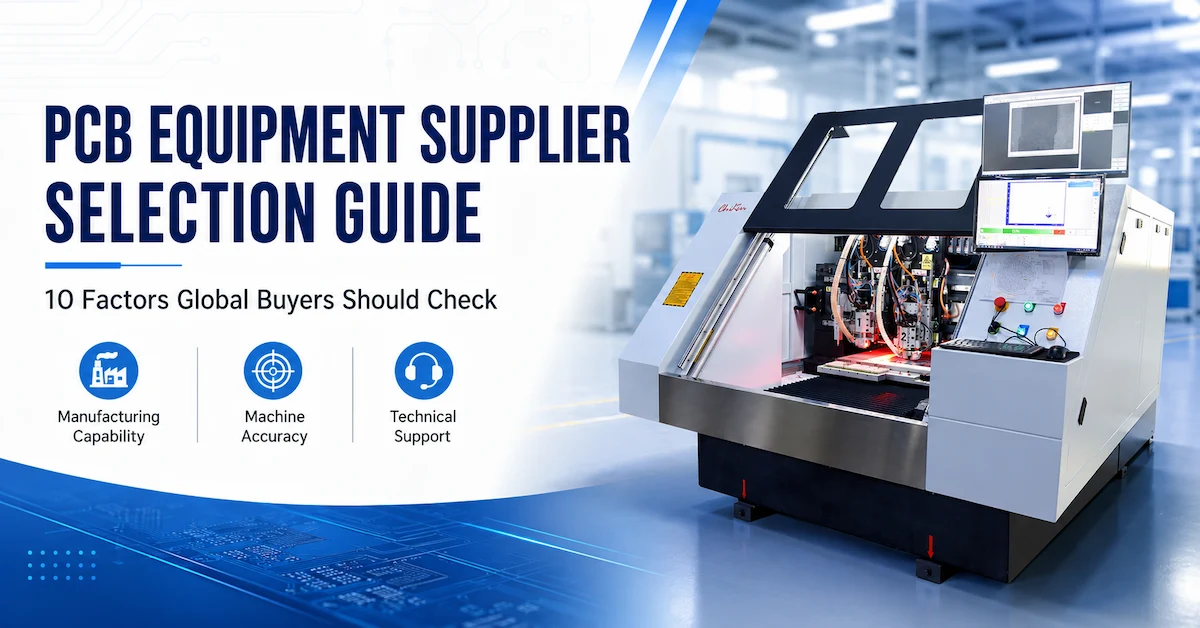 Choosing a PCB equipment supplier is a decision that can affect factory production for years. A machine may look good in photos. The quotation may look attractive. The supplier may also promise fast delivery, stable accuracy, and complete after-sales service. But once the equipment enters a real PCB factory, the questions become more practical.
Can the machine keep stable accuracy after long hours of use?
Can the supplier provide spare parts when production stops?
Can the machine match your board size, material, hole diameter, and production volume?
Will the supplier still respond after the machine has been delivered?
For PCB manufacturers, equipment selection is never just a purchasing task. It is a production decision. A reliable PCB equipment manufacturer should help buyers reduce risk before the order is placed, not only solve problems after the machine arrives.
Start with Real Factory Requirements
Before comparing different suppliers, a factory should first understand its own production needs. This sounds basic, but many buying mistakes begin here.
Some factories need a single-spindle PCB CNC drilling and routing machine for prototypes and small-batch work. Some need a 2-spindle PCB drilling and routing machine for mid-volume production. Others need a 4-spindle PCB drilling machine or 4-spindle drilling and routing machine because drilling and routing have already become production bottlenecks.
A good PCB CNC machine supplier should ask about your actual production situation before recommending a model. If the supplier only sends a price list without asking about board material, panel size, hole diameter, routing needs, and daily output, the recommendation may not be accurate.
For factory buyers, the first key point is simple: do not choose equipment before clarifying the production problem you want to solve.
Check Whether the Supplier Is a Real Manufacturer
The second key point is supplier identity. Is the company a direct manufacturer, a trading company, a distributor, or only a sourcing agent?
A direct PCB equipment manufacturer for factories usually has stronger control over machine production, configuration, testing, spare parts, and technical service. A trading company may still provide good communication, but it may not directly control engineering changes, production inspection, or after-sales response.
This difference becomes important when the buyer needs customization or technical support. If a factory needs a special worktable size, a specific spindle configuration, English operation interface, tool detection function, or sample testing, a direct manufacturer can usually respond more clearly.
A reliable supplier should be able to show factory capability, machine assembly process, testing records, product range, and technical team support. If the supplier cannot explain where the machine is produced or who handles after-sales service, the buyer should be careful.
Compare Technical Capability, Not Only Product Photos
PCB equipment is highly technical. Product photos can show the machine appearance, but they cannot prove long-term accuracy or production stability.
When choosing a PCB drilling machine manufacturer or PCB drilling and routing machine supplier, buyers should check technical details such as spindle speed, spindle power, cooling method, machine base structure, guide rails, ballscrews, CNC system, tool magazine, detection system, positioning accuracy, and repeatability.
The machine body also matters. For high-speed drilling and routing, vibration control affects hole quality, tool life, and edge consistency. A weak machine structure may work during a short demonstration, but problems can appear during continuous production.
A serious supplier should be able to explain why a certain configuration is suitable for your factory. It should not only say “high precision” or “good quality.” It should explain how the machine achieves stable precision.
Supplier Selection Checklist
| Key Point | What Buyers Should Check | Why It Matters |
|---|---|---|
| Factory Capability | Whether the supplier is a real manufacturer with assembly and testing ability | Reduces risk in quality control and after-sales responsibility |
| Product Match | Machine type, spindle number, worktable size, drilling/routing range | Ensures the equipment fits real production needs |
| Technical Configuration | Spindle, guide rail, ballscrew, CNC system, machine base, servo drive | Affects accuracy, stability, and long-term use |
| Automation Level | Automatic tool change, tool length detection, tool diameter detection, broken tool detection | Reduces downtime and operator error |
| Sample Testing | Whether the supplier can test real buyer samples before order | Verifies actual machine performance |
| Customization Support | Work area, fixture, interface language, optional functions | Helps the machine fit factory workflow |
| After-Sales Service | Warranty, spare parts, remote support, training, response time | Protects production after delivery |
| Industry Experience | PCB equipment cases, export experience, application knowledge | Shows whether the supplier understands PCB factory needs |
Ask for Sample Testing Before Ordering
Sample testing is one of the most useful ways to judge a PCB production equipment supplier. A catalog can say many things, but a real sample shows how the machine performs with your actual material, hole size, routing path, and tolerance requirements.
Before ordering, buyers can send sample drawings, board materials, panel size, drilling diameter, routing diameter, and required accuracy. The supplier should process a test sample or provide a clear demonstration.
During sample testing, do not only check whether the machine can finish the job. Check whether the hole position is stable, whether the routed edge is clean, whether the tool changes smoothly, and whether the operation process is practical.
For overseas buyers, this step is even more important. Once the machine is shipped, solving a mismatch becomes more expensive and time-consuming.
Look at Automation and Tool Management
In PCB production, tool change and tool protection are often ignored during purchasing. But in daily operation, they affect efficiency directly.
If operators need to stop frequently for manual tool changes, the machine’s real output will be lower than expected. If a broken tool is not detected quickly, one small problem can damage several panels. If tool length or diameter is not checked properly, drilling depth and routing quality may become unstable.
That is why an automatic PCB drilling machine manufacturer should provide clear information about tool magazine capacity, automatic tool change, tool length detection, tool diameter detection, and broken tool detection.
For factories with repeated orders, mixed board types, or multiple tool sizes, good tool management can reduce downtime and improve production confidence.
Evaluate After-Sales Service Before Payment
After-sales service should not be discussed only after a problem happens. It should be confirmed before the order.
PCB equipment needs installation, training, maintenance, parameter adjustment, spare parts, and sometimes remote troubleshooting. If the supplier responds slowly, even a small issue can stop production.
Buyers should ask clear questions:
Who provides technical support after delivery?
Is remote training available?
Are English manuals and operation videos provided?
How long is the warranty?
Which parts are covered?
How quickly can spare parts be shipped?
Can the supplier support future machine upgrades?
A reliable PCB equipment supplier should answer these questions directly. Vague promises such as “we provide good service” are not enough.
Check Whether the Supplier Can Support Future Growth
A factory should not only buy equipment for today’s order. It should also consider future production direction.
Maybe the factory now produces simple FR4 boards. But in the future, customers may ask for multilayer boards, aluminum substrates, smaller holes, tighter tolerance, or higher delivery speed. If the supplier only provides one basic machine, future upgrades may become difficult.
A stronger PCB CNC machine supplier usually has a wider product range, such as single-spindle machines, 2-spindle machines, 4-spindle drilling machines, drilling and routing machines, laser cutting equipment, AOI inspection machines, and other PCB production equipment.
This does not mean the buyer must purchase many machines at once. It means the supplier understands the broader PCB production process and can support the factory as it grows.
Do Not Choose Only by the Lowest Price
Price matters. Every factory has a budget. But choosing only by the lowest price can create hidden costs.
A low-cost machine may have weaker structure, unstable accuracy, limited service, poor spare parts support, or unclear warranty terms. At the beginning, the buyer may save money. Later, the factory may lose more through downtime, scrap, delayed delivery, and repair problems.
A better purchasing decision should compare total value:
Machine quality
Production efficiency
Accuracy stability
Tooling cost
Maintenance cost
Service response
Spare parts availability
Operator training
Long-term upgrade potential
For B2B buyers, the best supplier is not always the cheapest one. It is the one that can support stable production.
Common Mistakes When Choosing a PCB Equipment Supplier
Many factories make similar mistakes during equipment purchasing. They compare only price. They do not test samples. They ignore after-sales service. They choose a machine based on photos instead of production requirements. Sometimes they buy a high-capacity machine they do not need. Other times, they buy a small machine and soon discover it cannot support growing orders.
The safer way is to slow down before placing the order. Ask more technical questions. Compare supplier capability. Request sample testing. Confirm spare parts and service. Make sure the machine matches real factory needs.
A careful purchasing process may take more time in the beginning, but it can save much more time later.
FAQ
What is the most important factor when choosing a PCB equipment supplier?
The most important factor is whether the supplier can match your real production needs. Buyers should check machine configuration, accuracy, sample testing, after-sales support, and manufacturer capability.
Is it better to buy from a direct PCB equipment manufacturer?
For production equipment, a direct manufacturer is usually safer because it has stronger control over machine assembly, testing, customization, spare parts, and technical support.
Why is sample testing important?
Sample testing shows whether the machine can process your real board material, hole size, routing path, and accuracy requirement. It is more reliable than only checking photos or quotations.
Should a small factory choose a multi-spindle machine?
Not always. A small factory or prototype lab may only need a single-spindle machine. A multi-spindle machine is more suitable when production volume is higher and drilling or routing has become a bottleneck.
What B2B keywords fit this topic?
Suitable keywords include PCB equipment supplier, PCB equipment manufacturer, PCB drilling machine manufacturer, PCB CNC machine supplier, PCB drilling and routing machine supplier, and PCB production equipment supplier.
Conclusion
Choosing a PCB equipment supplier is not simply about finding a machine at a good price. For PCB factories, the right supplier should provide real manufacturing capability, suitable equipment configuration, stable technical performance, sample testing, customization support, and dependable after-sales service.
A good supplier helps the buyer make the right decision before production problems appear. It understands that PCB equipment affects more than one workstation. It affects accuracy, output, delivery, labor efficiency, and future factory growth.
Before placing an order, buyers should ask one practical question: can this supplier support our production after the machine arrives? If the answer is clear, technical, and supported by real capability, the supplier is worth serious consideration.