



How Should Buyers Choose a PCB Deburring Equipment Supplier for Factory Production?
For PCB factories, choosing a PCB deburring equipment supplier is not simply about buying a machine that can remove rough edges. The supplier must understand how the board enters the finishing step, what type of burr or particle needs to be removed, how operators will monitor the machine, and how the equipment will be cleaned and maintained after repeated production.
Chikin CNC describes its PCB circuit board deburring machine as a solution for removing burrs, rough edges, and loose particles after cutting or routing printed circuit boards. The product page explains that unfinished edges can interfere with assembly, cause handling issues, and create contamination risks in downstream processes. It also states that the right machine can improve edge consistency, reduce manual rework, and support cleaner production flow.
For B2B buyers searching for PCB circuit board deburring machine supplier, automatic PCB deburring machine supplier, PCB edge finishing machine supplier, or PCB finishing equipment manufacturer, the right supplier should provide more than a product image and a price. It should help the factory confirm application fit.
Why Does Supplier Evaluation Matter for PCB Deburring?
A deburring machine can look simple from the outside, but the real process depends on many details. How does the board move through the machine? What happens inside the enclosed processing chamber? How are burrs, particles, or waste removed? How are operators protected? How is the machine cleaned? How easy is it to access internal components? Can conveyor width or chamber length be modified?
Chikin’s product page notes that the machine may be described as a PCB edge deburring machine or PCB edge finishing machine, but the exact operating principle is not confirmed from the image alone. The page also states that buyers should confirm the real deburring method, board support style, dust or waste handling, and available electrical specifications.
That statement should guide the purchasing process. A responsible supplier should not ask buyers to guess from a photo. It should explain the machine configuration, application limits, and customization options clearly.
What Product Advantages Should the Supplier Explain?
A good supplier should be able to explain the machine’s practical advantages in factory language.
The first advantage is edge consistency. The machine is designed to remove burrs, rough edges, and loose particles after PCB cutting or routing. This supports more stable downstream processing.
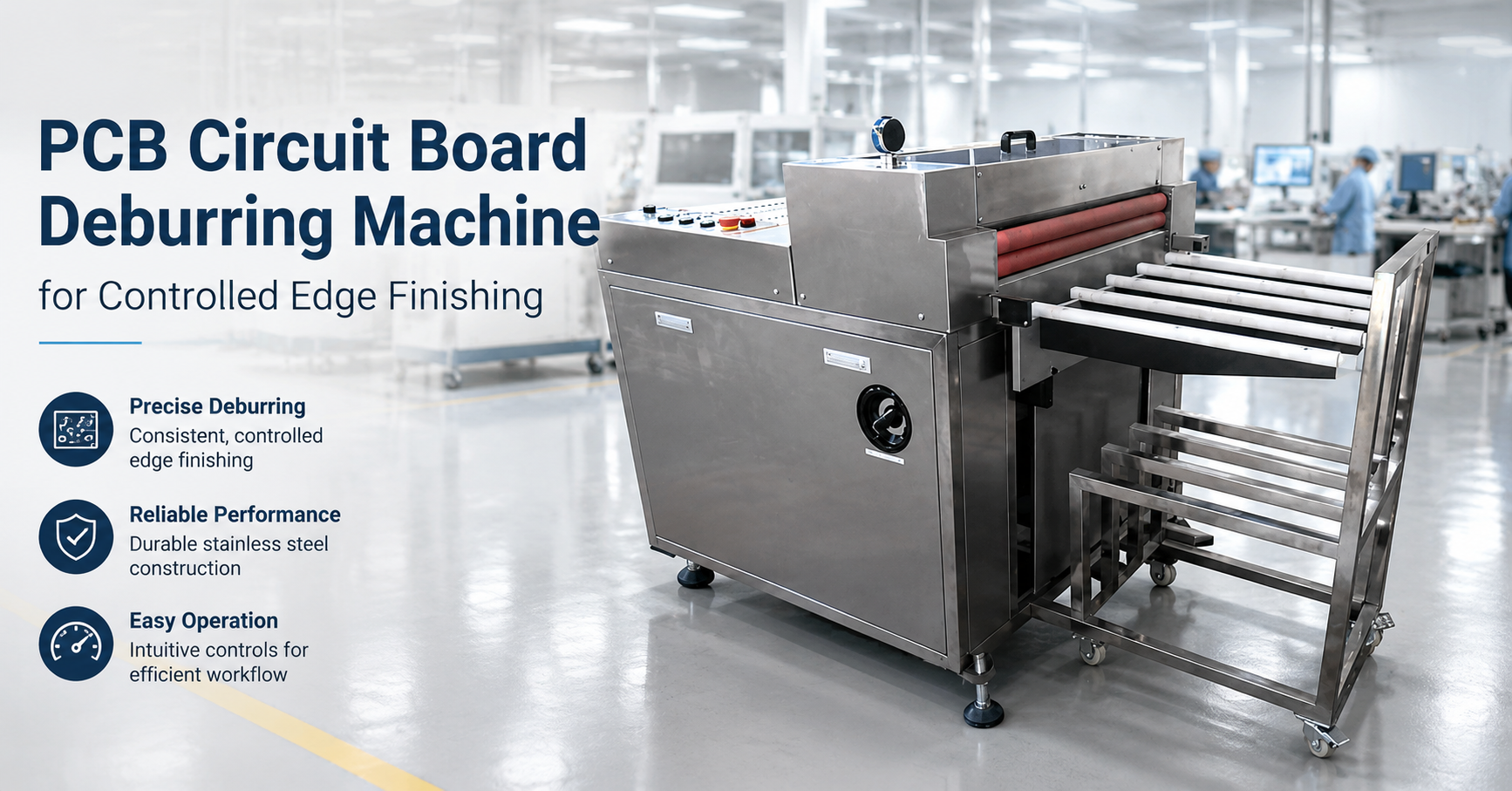
The second advantage is conveyor-style handling. Chikin’s page describes a front feed area with roller- or chain-like components that indicate a continuous handling setup. For a PCB edge deburring machine, this can help boards move at a steady rate and maintain alignment during processing.
The third advantage is stainless-steel industrial construction. The product page says the machine body appears mainly stainless steel, a material commonly used in industrial equipment because it resists corrosion better than painted mild steel in many environments and is easier to wipe down.
The fourth advantage is enclosed processing. The machine has an enclosed processing chamber and enclosed lower base, which can help isolate the process and support maintenance access.
The fifth advantage is customization potential. Chikin states that buyers can ask about conveyor width, chamber length, guarding, control logic, material options, access panel layouts, feet, gauge placement, and control interface.
These advantages are useful only when they match the factory’s real board size, edge condition, output, and line layout.
Supplier Selection Checklist
| Supplier Evaluation Area | What Buyers Should Ask | Why It Matters |
|---|---|---|
| Application review | Can the supplier review board size, process step, and burr type? | Prevents mismatch between machine and real production needs |
| Deburring method | What exact internal process removes burrs or particles? | The visible image alone does not confirm the operating principle |
| Board support | How does the machine support and align boards during feeding? | Affects edge consistency and handling stability |
| Conveyor design | What conveyor width, feed path, and speed control are available? | Determines whether the machine fits board size and output |
| Stainless material | What stainless grade or contact material is used? | Affects cleaning, wear, and corrosion resistance |
| Waste handling | How are dust, particles, water, or debris handled? | Important for cleanliness and maintenance |
| Controls | What does the gauge measure, and what settings can operators adjust? | Helps production teams monitor the process |
| Maintenance access | How do front doors and panels support cleaning or service? | Reduces downtime |
| Customization | Can chamber length, guarding, conveyor width, or control logic be modified? | Helps match factory layout |
| After-sales support | Are manuals, training, spare parts, and troubleshooting support available? | Protects long-term equipment use |
How Should Buyers Define Their Deburring Requirement?
Before contacting a supplier, buyers should identify where the burr problem occurs. This is often the missing step in purchasing. A factory may say it needs a deburring machine, but the supplier needs to know what type of burr needs to be removed.
The burr may come from routing.
It may come from panel cutting.
It may come from drilling or mechanical trimming.
It may appear on single-side PCB, double-side PCB, or multilayer PCB.
It may be an edge burr, loose particle, surface residue, or rough laminate area.
Chikin’s product title itself refers to a cost-effective scrubbing device for single-side PCB, double-side PCB, multilayer PCB, and circuit board deburring. The page description focuses on burrs, rough edges, and loose particles after cutting or routing. Buyers should use that product positioning as the starting point, then confirm their exact application with the supplier.
A strong inquiry should include:
Board type.
Board thickness.
Board width and length.
Whether boards are single-side, double-side, or multilayer.
Source of burrs or particles.
Required edge condition after processing.
Whether boards are dry or wet before entering the machine.
Current manual rework time.
Expected output per shift.
Line direction and floor space.
Cleaning and maintenance expectations.
Electrical and utility requirements.
The clearer the application, the more accurate the supplier’s recommendation.
How Is This Machine Different from Ordinary Edge-Cleaning Methods?
Ordinary edge cleaning may involve handheld tools, manual scraping, brush cleaning, or open workbench finishing. These methods can work for limited production. But they can become slow and inconsistent in a factory line.
Chikin’s machine is presented as a compact in-line system with conveyor-style feeding, enclosed processing, stainless-steel construction, side-mounted controls, and maintenance access. This makes it more suitable for repeated production than a purely manual method.
The difference is not only equipment appearance. It affects process stability.
Manual edge cleaning depends on operator skill.
A conveyor-based machine guides board movement.
Manual work is harder to repeat across shifts.
Machine-based processing is easier to standardize.
Open cleaning may release more debris into the work area.
Enclosed processing can help isolate the working step.
Manual rework becomes harder to measure.
A machine station can be included in production planning.
For buyers, the goal is not to eliminate operators. The goal is to reduce unnecessary operator variation and make deburring easier to manage.
What Should Buyers Ask About Conveyor and Board Handling?
The conveyor or feed path is a central part of this type of machine. Chikin’s page describes a visible front feed area with roller- or chain-like components, which can help boards move through the machine steadily and maintain alignment during processing.
Buyers should ask:
What is the usable conveyor width?
What board length range can be handled?
What board thickness range can pass through?
Can small boards feed smoothly?
Can thin boards stay flat during processing?
Is the feed speed adjustable?
Can the conveyor direction match the existing line?
What contact materials touch the PCB surface?
How are rollers, chains, or belts cleaned?
What wear parts are used?
These questions are practical. A machine can have a strong deburring process inside, but if the feed path does not fit the board, production will still be unstable.
What Should Buyers Ask About Cleaning and Maintenance?
Cleaning and maintenance are critical for a deburring machine. The machine removes burrs and particles, so those particles must go somewhere. If debris accumulates inside the chamber, around rollers, or near access points, the process may become unstable.
Chikin’s page states that buyers should focus on how easy the machine is to clean, what materials are used in contact areas, whether access doors provide safe maintenance access, and how controls are laid out for operators.
Ask the supplier:
How often should the chamber be cleaned?
Where does removed debris collect?
Are front access doors enough for cleaning?
Can operators clean the feed section safely?
What parts require regular inspection?
Does the machine require water, air, or filtration?
How are stainless-steel surfaces maintained?
Are spare rollers, belts, brushes, or contact parts available?
What happens if debris builds up inside the chamber?
A supplier that cannot explain maintenance clearly may not be suitable for long-term factory use.
How Should Buyers Evaluate Controls and Operator Workflow?
The machine includes visible side-mounted controls, an emergency-stop style red button, switches, and an analog gauge. Chikin notes that the gauge function is not identifiable from the image alone and should be confirmed with the supplier.
This is exactly the kind of detail buyers should not overlook. Operator workflow affects daily production more than many procurement teams expect. A machine may process boards correctly, but if controls are unclear, alarms are confusing, or access points are awkward, operators may lose time.
Buyers should ask:
What does each control do?
What does the gauge measure?
Are process settings saved or adjusted manually?
Is operator training provided?
Can the interface language be customized?
What alarms are shown?
Can the machine be stopped quickly?
Can operators monitor board movement easily?
Is the machine designed for standalone use or in-line use?
The supplier’s answers will reveal whether the machine fits the buyer’s production culture.
How Should Buyers Compare Suppliers?
| Supplier Type | Potential Advantage | Possible Risk | Best-Fit Buyer |
| Direct PCB deburring machine manufacturer | Better configuration matching, technical communication, and spare parts support | Buyer still needs to verify process details | PCB factories needing stable edge finishing |
| General equipment trader | Fast quotation and broad sourcing options | May not understand PCB-specific deburring needs | Simple, low-risk applications |
| Low-cost unknown supplier | Lower initial price | Higher risk in feed stability, cleaning access, and service | Occasional use only |
| Local distributor | Easier communication and nearby service | Limited customization options may apply | Buyers prioritizing local support |
| PCB-focused equipment supplier | Better understanding of board handling, edge quality, and factory workflow | Requires detailed buyer input | Factories seeking long-term process stability |
The best supplier is not always the one with the lowest price. For PCB deburring, the supplier must help match the machine to the board, burr type, feed method, cleaning requirement, and line layout.
What Customization Options Should Buyers Discuss?
Chikin’s page states that buyers needing a PCB edge finishing machine adapted to a specific line should ask about conveyor width, chamber length, guarding, control logic, and material options for parts exposed to wear. It also notes that custom stainless-steel fabrication may allow changes to access doors, feet, gauge placement, and the control interface.
This is important because PCB factories differ widely. One factory may need a compact standalone station. Another may need a conveyor-based machine aligned with existing production flow. One plant may require a wider feed path. Another may need easier access for cleaning. Some buyers may need different guarding, material finish, or control layout.
Customization discussions should happen early, before price comparison becomes too narrow.
What Mistakes Should Buyers Avoid?
The first mistake is asking only for a quotation without sharing board data. Without board size, process step, and line layout, the supplier cannot confirm whether the machine fits.
The second mistake is assuming the image explains the internal process. Chikin states that the exact operating principle is not confirmed from the image alone. Buyers should ask for a full process explanation.
The third mistake is ignoring cleaning access. A deburring machine will handle particles and residue, so cleaning should be built into the workflow.
The fourth mistake is not confirming conveyor details. Feed width, speed, alignment, and board support determine whether production remains stable.
The fifth mistake is comparing only initial price. A low purchase price may not be cost-effective if the machine creates rework, downtime, cleaning problems, or spare-parts issues.
The sixth mistake is not discussing customization. Conveyor width, chamber length, guarding, control logic, and contact materials can affect whether the machine fits the factory.
FAQ
What should buyers check first when choosing a PCB deburring equipment supplier?
Buyers should first confirm the board size, process step, burr type, deburring method, conveyor handling, cleaning access, waste handling, electrical requirements, and customization scope.
What is the main function of Chikin’s PCB circuit board deburring machine?
The machine helps remove burrs, rough edges, and loose particles after cutting or routing printed circuit boards, improving edge consistency, reducing manual rework, and supporting cleaner production flow.
Is the exact internal deburring process shown on the page?
No. The product page states that the exact operating principle is not confirmed from the image alone, so buyers should confirm the real deburring method with the supplier.
Why does stainless-steel construction matter?
The product page notes that stainless steel resists corrosion better than painted mild steel in many environments and is easier to wipe down, making it suitable for industrial equipment exposed to moisture, dust, coolant, or cleaning cycles.
What customization should buyers discuss?
Buyers can ask about conveyor width, chamber length, guarding, control logic, material options, access doors, feet, gauge placement, and control interface changes.
Conclusion
Choosing a PCB deburring equipment supplier should be treated as a technical purchasing decision. The buyer should not only compare product photos, machine size, or price. The right supplier should help confirm the deburring method, board support style, conveyor design, cleaning access, waste handling, operator controls, electrical requirements, and customization options.
Chikin CNC’s product page positions the PCB circuit board deburring machine as an industrial stainless-steel unit with conveyor-style feeding, enclosed processing, side-mounted controls, and serviceable structure for controlled PCB edge finishing. It is designed to remove burrs, rough edges, and loose particles after PCB cutting or routing, supporting edge consistency, reduced manual rework, and cleaner production flow.
For factories processing single-side PCB, double-side PCB, multilayer PCB, and circuit boards after cutting or routing, the safest buying path is clear: define the board, define the burr, define the line layout, then ask the supplier to match the equipment to the real process. A good PCB edge finishing machine supplier should help the factory build a stable finishing step, not simply deliver a machine.
Please Send Your Requirements for Quoting