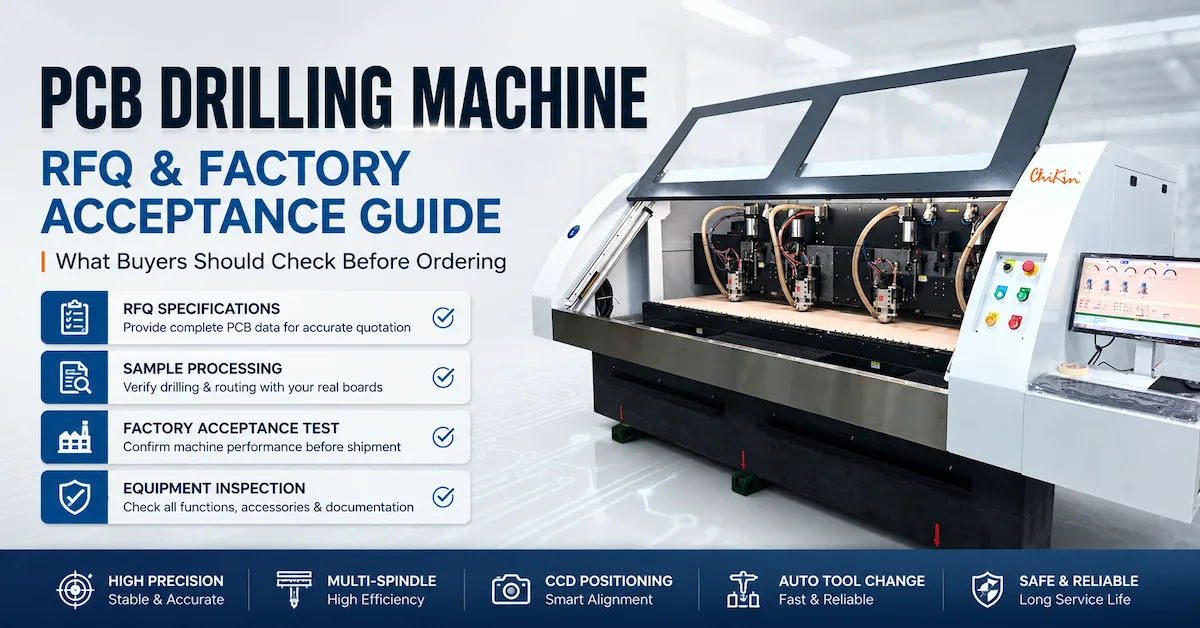




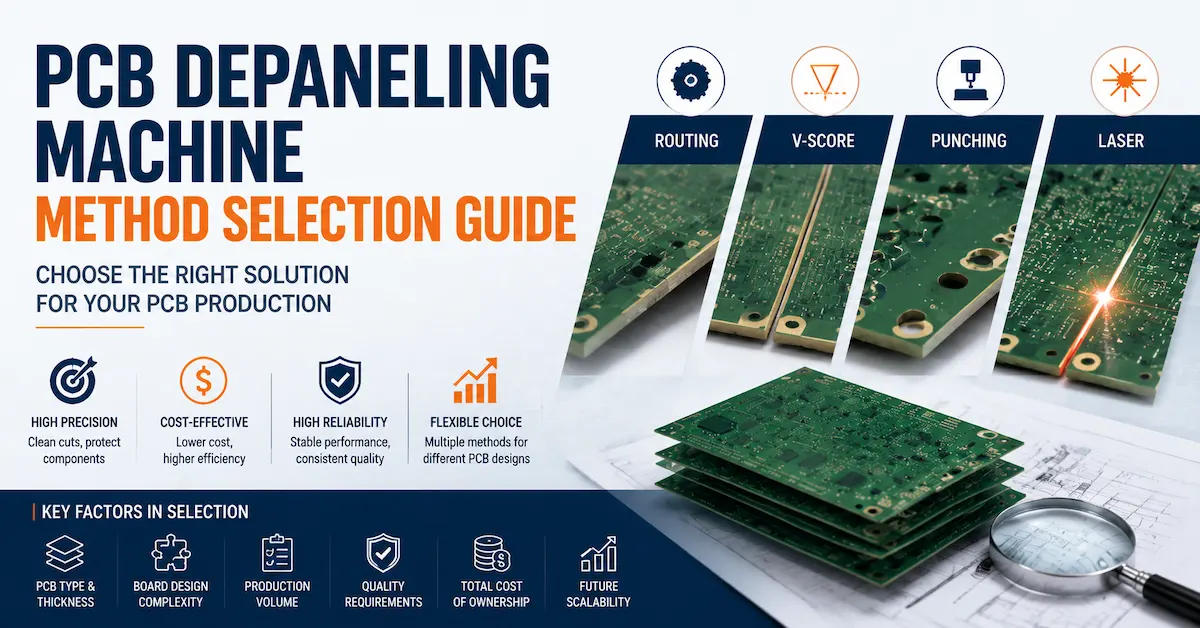
A PCB depaneling machine should be selected from the board design outward. The right solution depends on how the panel is joined, the shape of the finished board, the edge quality required, the expected output, and the amount of operator handling your line can support. A router may be the best answer for complex outlines, while V-CUT, punching, shearing, or laser can be better for other panel designs.
This guide compares the main separation methods in practical purchasing terms. It explains when an automatic PCB depaneling machine makes sense, how a pcb separator machine differs from a routing cell, what buyers should confirm before ordering a pcb router depaneling machine, and how to prepare an RFQ that leads to a useful recommendation rather than a generic catalog price.
What does a PCB depaneling machine do?
On the production floor, depaneling is the point where a fabricated or assembled panel becomes saleable individual boards. A poor cut can crack solder joints, mark components, expose copper, or leave chipped edges. Shops should therefore treat separation as a controlled quality operation, not merely a cutting step.
Put these five items on the table before speaking with suppliers:
- How the panel is held together: V-scores, routed tabs, perforations, punched features, or a mixture.
- The actual outline: straight runs, curves, slots, tight inside corners, tabs, and component keep-out zones.
- What you are cutting: FR-4, aluminum-backed material, flex, or another approved substrate.
- What an acceptable board looks like: measurable limits for burr, dust, chipping, stress, and cosmetic marks.
- How the line runs: required boards per hour, shift pattern, changeover frequency, traceability, and operator skill.
When is routing the best depaneling method?
Routing follows a programmed contour with a rotating bit. It earns its place when the outline bends, includes slots or inside corners, or relies on breakaway tabs. Because programs and fixtures can change from part to part, a pcb router depaneling machine is often the practical choice for factories that run a changing mix.
Routing is commonly considered when:
- The board outline is complex or changes between product families.
- The panel uses routed tabs instead of continuous V-scores.
- Slots and internal features must be completed in the same operation.
- Edge quality and dimensional control matter more than the shortest cycle.
- Dust extraction and a supported fixture can be integrated into the cell.
The trade-off is that routing requires a cutter, a stable fixture, a defined tool path, and dust management. Tool wear can change edge condition and cycle cost, so the RFQ should include the board material, cutter diameter, expected tool life, and sample acceptance criteria. Chikin's PCB drilling and routing machine range is a useful starting point when your panel needs programmed contours or combined machining.
When does V-CUT make more sense?
V-CUT separation is designed for panels that already have continuous V-shaped score lines. A blade or multi-cutter setup follows the score and separates the boards with a short, repeatable movement. It is often attractive for high-volume products with straight or mostly straight panel edges and a stable panel design.
V-CUT can be a good fit when:
- Score lines run continuously through the panel.
- The finished board outline is straight enough for the cutting path.
- Fast, repeatable separation is more important than contour flexibility.
- The design team controls score depth and remaining web thickness.
- The factory wants a compact cell with predictable operator steps.
Buyers should not judge V-CUT only by the number of cutters. Confirm the score depth, panel support, blade condition, board thickness range, changeover method, and the amount of stress transferred to components. Chikin offers single-cutter and multi-cutter V-CUT directions, including the 4 Cutter Auto PCB V Cut Machine and 6 Cutter Auto PCB V Cut Machine. Select the configuration from your panel mix and output target, not from cutter count alone.
Should you choose punching for repeat shapes?
Punching separates boards with a dedicated die or punch tool. It can deliver a fast and repeatable cycle when the product shape is stable and the investment in tooling is justified. Punching is often considered for large quantities of the same or closely related panel design.
The main questions are tooling life, changeover cost, part support, burr control, and the consequences of a design revision. A punch can be highly productive, but it is less forgiving when the outline changes. Include the expected annual volume, tool maintenance plan, spare die strategy, and engineering change frequency in the purchasing review. Chikin's automatic CNC punching machine can be reviewed when your process needs controlled, repeatable punching operations.
When is shearing the simplest solution?
Shearing uses a straight blade to cut along a straight path. It can be a practical solution for rectangular boards, strip panels, or designs where the separation line is accessible and the edge specification is straightforward. The equipment is generally easier to understand than a programmed router, but its geometry is limited.
Check whether the board is supported on both sides of the cut, whether components overhang the line, and whether the blade action creates unacceptable stress. A vertical shearing machine for PCB panel separation may fit a line that values simple handling and straight cuts. It is not a substitute for routing when the outline contains slots, internal corners, or irregular tabs.
Where can laser separation add value?
A laser traces the profile without a blade touching the board. That can help with intricate shapes or assemblies that tolerate little mechanical loading. The catch is process validation: substrate chemistry, copper distribution, fumes, heat-affected zones, and edge color can all change the result.
Put laser on the shortlist when force is the larger risk or physical tooling would be awkward across many variants. Ask the supplier to cut actual panels and return microscope photographs, thermal notes, extraction data, and a written acceptance result. The method only wins if those samples and its running cost fit the job.
Automatic PCB depaneling machine or semi-automatic cell?
An automatic PCB depaneling machine should solve a measurable handling or consistency problem. Automation can include automatic loading, board locating, cutting, unloading, conveyors, barcode checks, and part collection. It can reduce operator variation, but it also adds interfaces, sensors, maintenance points, and integration work.
| Production condition | Likely priority | What to validate |
|---|---|---|
| Prototype or many changeovers | Flexible router or simple fixture cell | Program setup, fixture change, sample approval |
| Stable mid-volume mix | V-CUT, router, or multi-cutter cell | Cycle time, edge quality, queue balance |
| High-volume repeated panel | Automatic V-CUT or dedicated punch | Tool life, uptime, changeover, spare parts |
| Fine or force-sensitive design | Laser or low-contact process | Heat, dust, stress, extraction, inspection |
What features should buyers compare?
Compare the complete process, not only the machine frame. The following features usually affect purchasing risk:
- Locating and support: datum strategy, fixture rigidity, component clearance, and changeover repeatability.
- Cutting control: programmed path, score depth, blade alignment, punch guidance, or laser parameter control.
- Edge protection: burr, chipping, dust, heat, stress, and the protection of populated components.
- Tool management: cutter or blade life, tool measurement, spare parts, sharpening, and storage.
- Handling: loading, unloading, board collection, part orientation, buffers, and traceability.
- Safety and utilities: guarding, extraction, vacuum, compressed air, electrical supply, noise, and floor space.
- Service: installation, training, software support, acceptance testing, response time, and critical spares.
How should you compare a PCB separator machine quotation?
A pcb separator machine quotation is only comparable when the scope is consistent. Ask each supplier to use the same panel drawing, output definition, shift pattern, and quality limits. The quote should separate the base machine from tooling, fixtures, extraction, software, freight, installation, training, validation, and support.
Request these items in writing:
- Recommended method and the reason it fits the panel.
- Working area, board thickness range, and locating method.
- Cycle time including loading, cutting, inspection, and unloading.
- Consumables, tool life, spare parts, and maintenance interval.
- Dust, smoke, noise, guarding, and factory utility requirements.
- Sample test plan, measurements, defect limits, and acceptance procedure.
- Commercial scope: delivery term, installation tasks, training hours, warranty boundaries, and promised service response.
Common depaneling selection mistakes
Choosing by speed alone
A short cutting stroke does not guarantee higher accepted output. Include setup, loading, inspection, tool changes, and rework in the cycle-time model.
Ignoring panel design changes
A dedicated punch or fixed V-CUT arrangement can be efficient for a stable product, but frequent engineering changes may make a programmable router more economical over the project life.
Leaving edge quality undefined
Use photographs, measurements, burr limits, and stress observations in the sample acceptance plan. “Clean edge” is not precise enough for a supplier quote.
Underestimating dust and extraction
Routing and some laser processes need a clear extraction and filter plan. Confirm what is included and what must be prepared at the site.
Buying automation before finding the bottleneck
Measure operator handling, queue time, and downstream inspection first. Automation should remove a defined constraint and fit the layout.
Which depaneling method is right for your factory?
Choose routing when outlines, slots, tabs, or product variety demand flexibility. Choose V-CUT when score lines are continuous and fast repeatability is the priority. Choose punching when volumes justify dedicated tooling and the product shape is stable. Choose shearing for accessible straight cuts. Evaluate laser when low mechanical contact or fine features justify process validation and extraction planning.
Ready to compare your options? Send Chikin your board material, panel dimensions, thickness, outline or score drawing, component clearance, target output, edge-quality requirements, and available files. The team can review the process scope and suggest a suitable separation path, fixture approach, sample test, and quotation structure. Start with the PCB manufacturing equipment category or contact Chikin for a project review.
Frequently asked questions
What is a PCB depaneling machine?
It is equipment used to separate individual printed circuit boards from a production panel by routing, V-CUT, punching, shearing, laser, or another controlled method.
Is an automatic PCB depaneling machine always the best choice?
No. Automation is useful when handling, consistency, or traceability is a measurable constraint. For prototypes or frequent changes, a flexible semi-automatic cell may be easier to justify.
What is the difference between a pcb separator machine and a router?
“PCB separator machine” is a broad term for panel separation equipment. A router is one specific method that removes material along a programmed contour with a cutter and fixture.
When should I buy a pcb router depaneling machine?
Consider it when your boards have irregular outlines, slots, tabs, or mixed profiles and you need programmable flexibility with controlled edge quality.
How do I reduce stress during depaneling?
Match the method to the panel design, support the board correctly, control score depth or tool path, protect component clearance, and validate stress and edge quality on representative samples.
What should I send with a depaneling RFQ?
Provide material, thickness, panel size, drawings or files, output target, changeover frequency, edge criteria, component constraints, utilities, installation location, and acceptance-test expectations.