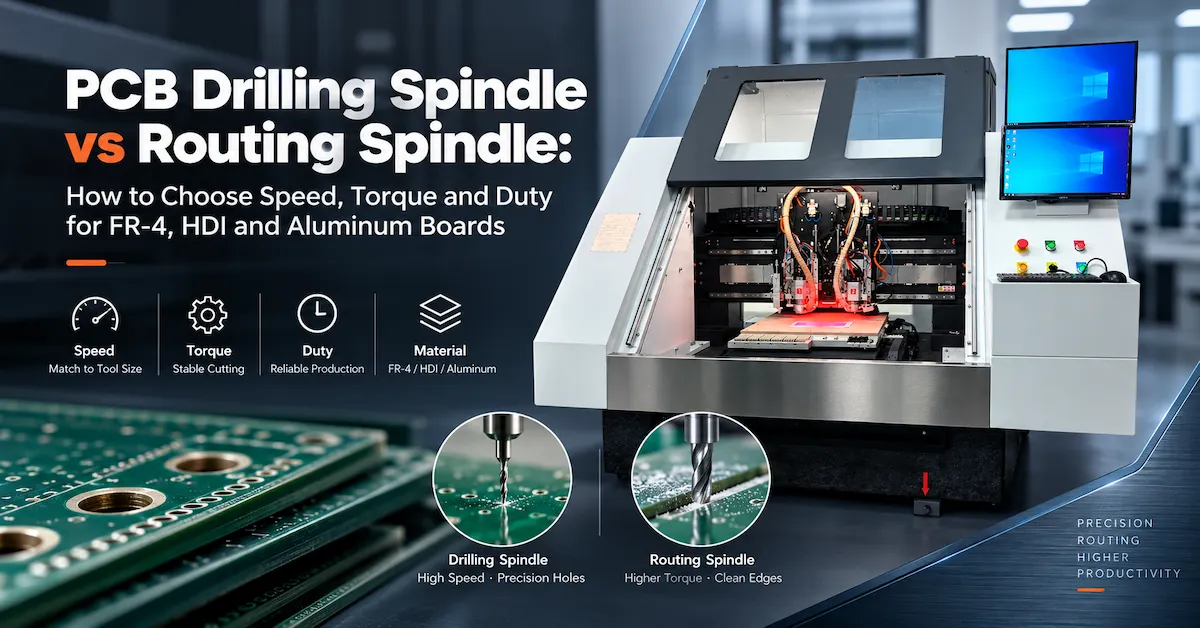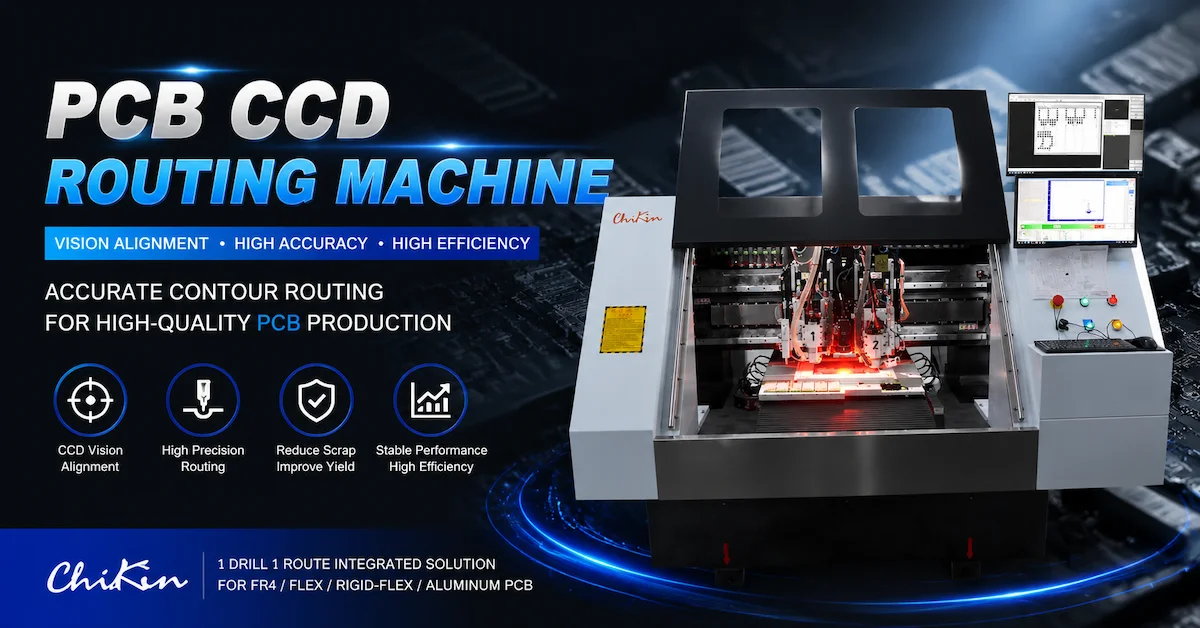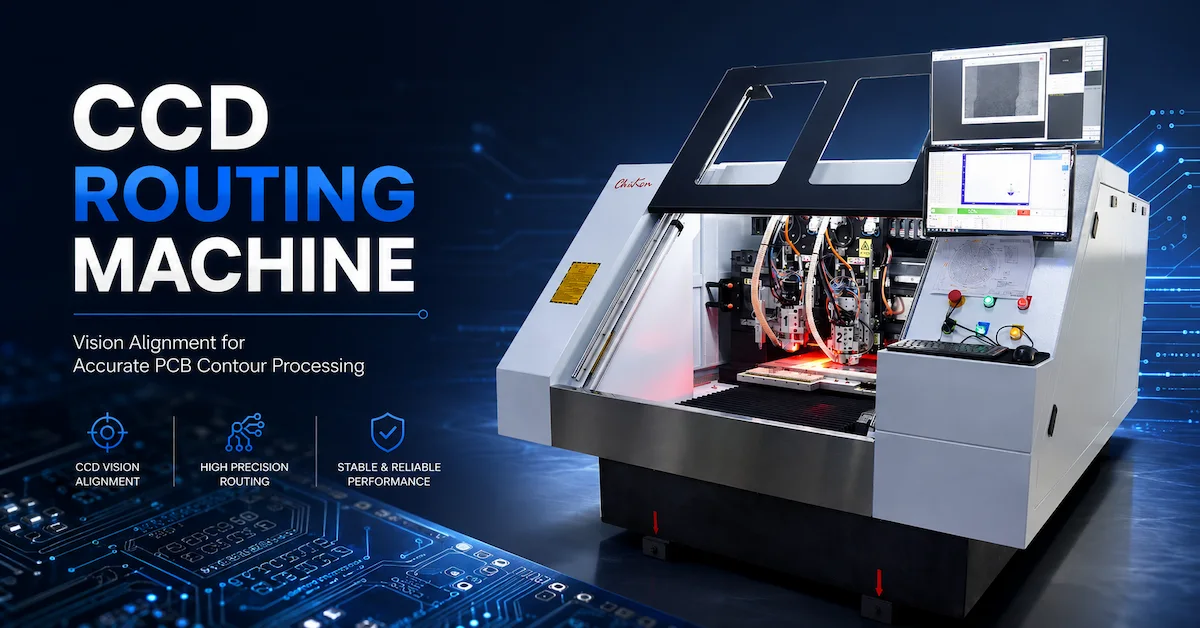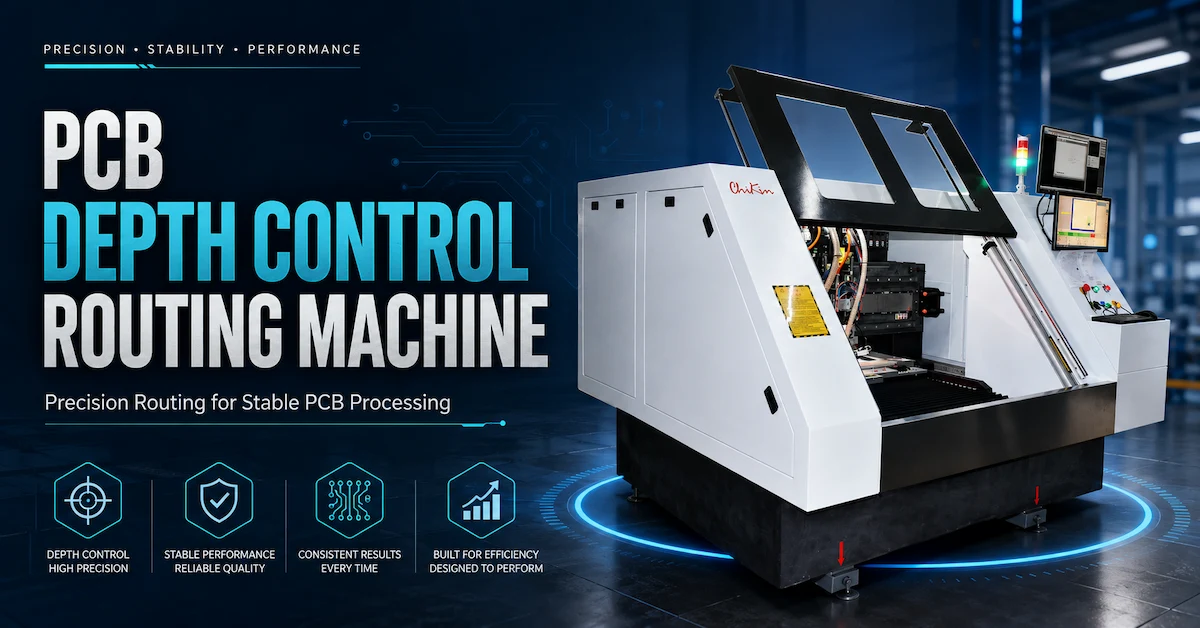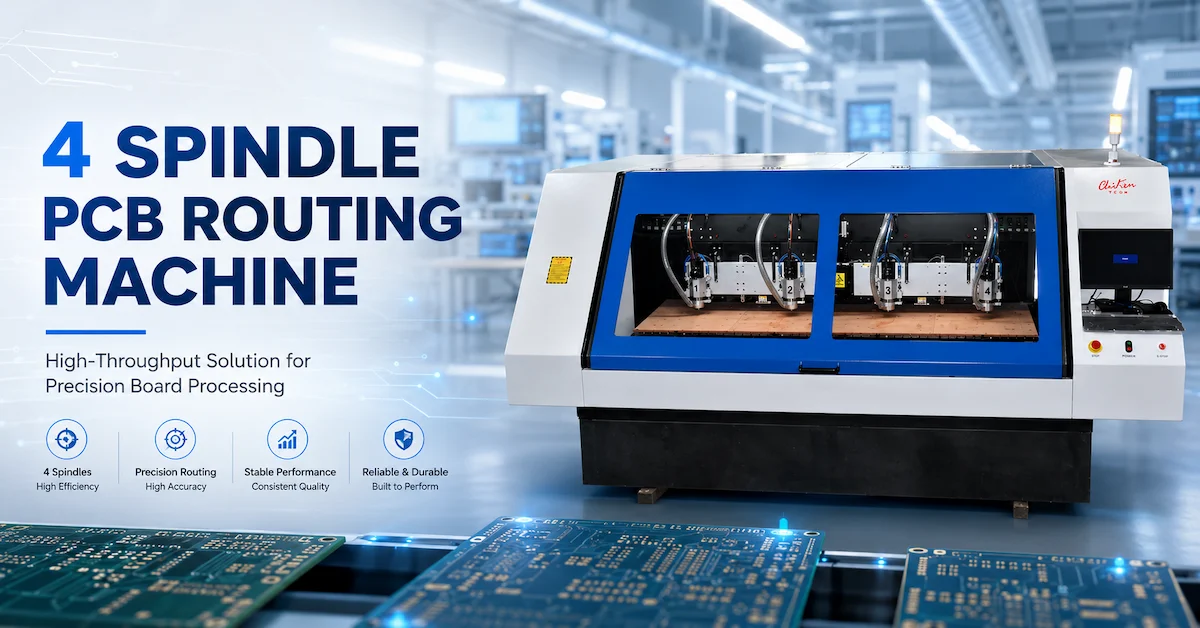




A 6 spindle PCB Routing machine is designed for PCB manufacturers that need faster contour routing, stable edge quality, and higher batch production efficiency. When a factory grows from small-batch production to repeated volume orders, routing often becomes one of the main bottlenecks.
PCB routing is not only a cutting process. It defines the final board outline, slot accuracy, edge smoothness, panel separation quality, and mechanical fit during assembly. If the routing process is slow or unstable, the whole production line may suffer from delayed delivery, extra manual trimming, higher tool cost, and inconsistent finished board quality.
A six-spindle routing solution is built for factories that already have enough order volume to fully use a multi-spindle system. Compared with 2-spindle and 4-spindle equipment, a 6 spindle PCB Routing machine can provide stronger output capacity when board layout, fixture design, tool management, and production planning are properly matched.
For large PCB manufacturers, electronics production suppliers, equipment distributors, and production line upgrade projects, this machine can become a high-value solution for mass PCB contour processing.

What Is a 6 Spindle PCB Routing Machine?
A 6 spindle PCB Routing machine is CNC-controlled PCB processing equipment equipped with six spindle positions or processing heads. Depending on the final configuration, it may support contour routing, milling, drilling, slot processing, depaneling, or combined drilling and routing workflows.
This type of machine is also searched as:
- 6 spindle PCB routing machine
- Six spindle PCB routing machine
- Multi spindle PCB routing machine
- 6 spindle PCB drilling and routing machine
- PCB contour routing machine
- High-capacity PCB routing equipment
- PCB CNC routing machine for mass production
The main value is throughput. When one or two routing heads cannot meet production demand, a six-spindle system can reduce cycle time and improve daily output.
However, more spindles do not automatically mean better results. The machine must also have strong structure, accurate motion control, proper tool management, stable fixturing, good dust control, and practical software support.
Who Should Choose a 6 Spindle PCB Routing Machine?
A 6 spindle PCB Routing machine is not usually the first choice for a small prototype workshop. It is more suitable for factories with stable production demand and repeated PCB orders.
| Buyer Type | Main Need | Why 6 Spindles Fit |
|---|---|---|
| Large PCB manufacturers | High daily routing output | Multiple spindles reduce cycle time |
| Batch PCB production lines | Repeated board profiles | Supports efficient repeat processing |
| FR4 PCB factories | Cleaner edge processing at scale | Improves routing consistency |
| Multilayer PCB producers | Stable contour accuracy | Supports repeatable board dimensions |
| Aluminum PCB processors | Stronger production planning | Helps manage harder board materials |
| Equipment distributors | High-value industrial solution | Suitable for professional PCB factory buyers |
If your factory mainly produces samples, a single-spindle or dual-spindle system may be more flexible. If your factory already has high-volume routing demand and routing slows down delivery, a six-spindle system becomes more practical.
Main Applications of a 6 Spindle PCB Routing Machine
A 6 spindle PCB Routing machine can be used for many high-capacity board-processing tasks.
Typical applications include:
- PCB contour routing
- FR4 board outline cutting
- Multilayer PCB profile processing
- Aluminum PCB routing
- Slot cutting
- Internal opening cutting
- Panel depaneling
- Board edge trimming
- Batch PCB panel routing
- Mass PCB production
- Drilling and routing integration
- Production capacity upgrade
For factories handling repeated board profiles, six-spindle routing can reduce the routing bottleneck and improve line balance.
Why Routing Quality Matters in Mass PCB Production
In mass PCB production, routing quality affects more than the final board shape. It can affect assembly fit, enclosure matching, connector alignment, product appearance, and customer inspection results.
Common routing issues include:
- Rough board edges
- Edge chipping
- Routing path deviation
- Inconsistent board size
- Slot width variation
- Excessive tool wear
- Broken routing bits
- Dust buildup
- Extra manual trimming
- Higher scrap rate
When production volume is high, even a small routing problem can create large total losses. That is why a 6 spindle PCB Routing machine must be evaluated for both output and consistency.
6 Spindle PCB Routing Machine vs 4 Spindle PCB Routing Machine
| Comparison Point | 4 Spindle PCB Routing Machine | 6 Spindle PCB Routing Machine |
| Output Capacity | High | Higher |
| Best For | Medium-to-high volume production | Mass PCB routing production |
| Investment Level | Lower than six-spindle | Higher |
| Workflow Planning | Moderate | More advanced |
| Tool Management | Important | Critical |
| Factory Space | Smaller | Larger |
| Operator Training | Easier | Requires stronger process control |
| Buyer Priority | Capacity upgrade | Maximum throughput and line balance |
A 4 spindle machine is suitable when the factory needs higher output than 2 spindles but still wants manageable operation. A 6 spindle PCB Routing machine is better when production targets are higher and the factory can fully use the machine capacity.
The better question is not simply “Do I need six spindles?” The better question is:
Can my board layout, production volume, fixture system, tooling plan, and operator team support six-spindle routing efficiently?
Key Advantages of a 6 Spindle PCB Routing Machine
1. Higher Routing Throughput
The biggest advantage is production speed. With six spindles, the machine can process more routing paths or more panels in the same production window.
For factories with repeat orders, this can shorten delivery time and increase daily production capacity.
2. Better Line Balance
If routing is slower than drilling, inspection, or assembly, the entire production line may wait. A six-spindle routing system helps reduce routing bottlenecks and supports smoother production flow.
3. Suitable for Repeated Batch Production
Six-spindle equipment performs best when the factory has repeated board designs or stable production batches. This allows the machine, fixture, tool plan, and programs to be optimized for efficiency.
4. Reduced Manual Handling
When a machine can process more boards or more routing paths in one workflow, operators spend less time moving panels between stations. This can reduce handling error and improve consistency.
5. Stronger Long-Term Capacity Upgrade
For factories planning future growth, a 6 spindle PCB Routing machine can support higher production targets than smaller equipment.
Key Technical Factors Buyers Should Check
1. Spindle Configuration
Before buying, confirm exactly how the six spindles are configured. Not every six-spindle machine is the same.
Ask the supplier:
- Are all six spindles used for routing?
- Can the machine support drilling and routing?
- Can spindles work simultaneously?
- What is the spindle speed?
- What routing tool sizes are supported?
- How is spindle calibration handled?
A clear spindle configuration prevents wrong machine selection.
2. Machine Rigidity and Vibration Control
Routing creates lateral cutting force. With six spindles, the machine structure must be strong enough to maintain stable cutting.
Important structure points include:
- High-rigidity machine base
- Stable gantry structure
- Precision linear guides
- Reliable ballscrews or drive system
- Flat worktable
- Enclosed processing chamber
- Good vibration control
If the structure is weak, more spindles may only create more vibration and lower edge quality.
3. Routing Accuracy and Repeatability
A 6 spindle PCB Routing machine must keep board dimensions stable across repeated batches.
Buyers should confirm:
- Routing accuracy
- Positioning repeatability
- Calibration method
- Sample routing capability
- Board size compatibility
- Long-run stability
Fast routing has no value if the final board outline is inconsistent.
4. Fixture and Board Holding
PCB panels must stay flat and stable during routing. Poor holding can cause vibration, path deviation, or broken tools.
Ask:
- Does the machine support vacuum holding?
- Can custom fixtures be used?
- How is panel flatness controlled?
- Can it handle thin boards?
- Can it process warped panels?
- Is repeated positioning supported?
Fixture design is one of the most important success factors in PCB routing.
5. Tool Management and Detection
Tool management is critical in six-spindle routing because more spindles mean more tools, more wear points, and more calibration requirements.
Useful functions include:
- Automatic tool change
- Tool length detection
- Tool diameter detection
- Broken tool detection
- Tool life management
- Tool replacement workflow
- Calibration support
If tool wear is not controlled, different spindles may produce different edge quality. That can create hidden batch inconsistency.
6. Dust and Debris Control
PCB routing can generate dust and chips, especially when processing FR4 boards. With six spindles, dust control becomes even more important.
Buyers should confirm:
- Enclosed work chamber
- Dust extraction ports
- Chip collection design
- Easy cleaning access
- Compatibility with workshop dust collection
- Maintenance schedule
Good dust control helps protect the machine, tools, operators, and finished boards.
7. Software and Control System
A six-spindle machine needs clear software for program management, spindle control, tool status, alarm handling, and repeat production.
Check whether the control system supports:
- English interface
- Program storage
- Routing path management
- Multi-head control
- Tool status monitoring
- Parameter saving
- Remote troubleshooting
- Operator training
A machine with strong hardware but difficult software can still slow down the production line.
Product Match: CHIKIN CNC 6 Spindle PCB Drilling and Routing Machine CK-06R
For this topic, the most suitable product direction is:
6 Spindle PCB Drilling and Routing Machine CK-06R
This product direction fits the article because it focuses on high-capacity PCB drilling and routing workflows, multi-spindle processing, contour routing, tool management, and batch PCB production.
If the English website backend does not currently have a separate public product page for CK-06R, this article can be linked to the broader product category:
PCB Drilling & Routing Equipment
Recommended anchor text:
6 Spindle PCB Drilling and Routing Machine CK-06R
or:
multi spindle PCB routing machine
Recommended internal links:
- https://www.chikincnc.com/products
- https://www.chikincnc.com/about-us
- https://www.chikincnc.com/service/faq
- https://www.chikincnc.com/contact-us
Specification Checklist for 6 Spindle PCB Routing Machine Buyers
| Item | What to Confirm | Why It Matters |
| Spindle Quantity | 6 spindle configuration | Determines routing capacity |
| Spindle Function | Routing, drilling, milling, or mixed | Matches process needs |
| Routing Tool Range | Tool diameter and holder type | Matches board outline requirements |
| Working Area | Maximum PCB panel size | Ensures panel compatibility |
| Machine Base | Rigidity and vibration control | Protects edge quality |
| Motion System | Linear guides and drive system | Controls accuracy and repeatability |
| Fixture Method | Vacuum, clamp, or custom fixture | Prevents board movement |
| Tool Detection | Length, diameter, broken tool detection | Reduces scrap risk |
| Dust Control | Enclosure and extraction ports | Protects production environment |
| Service Support | Training, spare parts, remote help | Reduces downtime |
Common Buying Mistakes to Avoid
Mistake 1: Choosing Six Spindles Without Enough Production Volume
A six-spindle machine only creates value when the factory has enough repeat production. If order volume is low, a smaller machine may be more practical.
Mistake 2: Ignoring Spindle Function
Some machines may use mixed spindle configurations. Confirm whether the heads are used for routing, drilling, milling, or combined processing.
Mistake 3: Underestimating Tool Management
With six spindles, tool wear and tool detection become critical. Buyers should confirm tool life control and replacement workflow.
Mistake 4: Not Planning Dust Extraction
More routing output means more dust and debris. Dust control should be confirmed before the machine is installed.
Mistake 5: Comparing Only Price
A low-cost machine may not provide strong structure, tool detection, software support, or service response. For mass production, downtime and scrap can cost more than the machine price difference.
Buyer Checklist Before Requesting a Quote
Before asking for a 6 spindle PCB Routing machine quotation, prepare:
| Information | Example |
| Board material | FR4, multilayer PCB, aluminum PCB |
| Board thickness | 0.8mm, 1.6mm, 2.0mm |
| Board size | Length × width |
| Routing path | Outline, slots, internal openings |
| Drilling requirement | Yes or no |
| Head configuration | Six routing heads or mixed heads |
| Routing tolerance | Required contour accuracy |
| Production volume | Boards per shift or per day |
| Current bottleneck | Slow routing, rough edges, tool wear |
| Dust control need | Existing extraction system or machine port |
This information helps CHIKIN CNC review whether a six-spindle routing solution is the right configuration for your factory.
FAQ: 6 Spindle PCB Routing Machine
1. What is a 6 spindle PCB Routing machine?
A 6 spindle PCB Routing machine is CNC equipment with six spindle positions for PCB contour routing, drilling, milling, or combined board processing, depending on configuration.
2. Who should choose a six-spindle routing machine?
It is suitable for PCB factories with stable batch production, high daily output requirements, and routing bottlenecks that smaller machines cannot solve.
3. Is a 6 spindle routing machine better than a 4 spindle machine?
It depends on production volume. A 6 spindle machine offers higher capacity, while a 4 spindle machine may be more practical for medium-to-high volume factories.
4. Can this machine support both drilling and routing?
Yes, if configured as a drilling and routing machine. Buyers should confirm head function, tool type, and software capability before ordering.
5. What affects PCB routing edge quality?
Edge quality depends on spindle stability, tool sharpness, feed speed, fixture design, machine rigidity, dust control, and board material.
6. Why is tool detection important?
Tool detection helps identify broken or worn tools, reducing rough edges, dimensional errors, and hidden scrap during batch production.
7. Is this machine suitable for prototype labs?
Usually not as the first choice. Prototype labs often need flexibility more than high output, so one- or two-spindle machines may be better.
8. What should I send before requesting a quote?
Send board material, thickness, size, routing drawing, drilling requirement, daily output target, routing tolerance, and current production bottleneck.
Conclusion: A 6 Spindle PCB Routing Machine Is Built for High-Volume PCB Contour Processing
A 6 spindle PCB Routing machine is a high-capacity solution for PCB factories that need faster contour routing, stable board dimensions, and stronger batch production efficiency. It is most suitable for manufacturers with enough order volume to fully use multi-spindle equipment.
However, buyers should not choose the machine only because it has more spindles. The real value depends on machine rigidity, routing accuracy, fixture design, tool detection, dust control, software, and after-sales support.
CHIKIN CNC provides PCB drilling and routing equipment for factories that need efficient board processing and practical production configuration support.
If you are comparing 6 spindle PCB Routing machine options, send your board material, board size, routing drawing, drilling requirement, production volume, and accuracy target. CHIKIN CNC can help review the right machine configuration for your production line.
Contact CHIKIN CNC to request a 6 spindle PCB routing machine solution and quotation: