



How to Choose a Gold and Silver Fiber Laser Cutting Machine Supplier for Jewelry Production
 A jewelry factory does not buy a laser cutting machine only to add another piece of equipment to the shop floor. It buys the machine to solve specific production problems: cutting fine metal details, controlling part geometry, reducing manual rework, protecting valuable materials, improving repeatability, and giving operators a safer and more organized process. That is why choosing a gold and silver fiber laser cutting machine supplier should be handled as a technical procurement decision, not a quick price comparison.
Gold and silver are high-value materials. When a factory cuts thin precious metal sheets or decorative components, each error has a direct cost. A poor machine configuration may waste material. A weak enclosure may create safety concerns. A supplier without process knowledge may leave the buyer to solve cutting problems alone. In B2B purchasing, the lowest quotation can become expensive if the machine cannot support stable production after delivery.
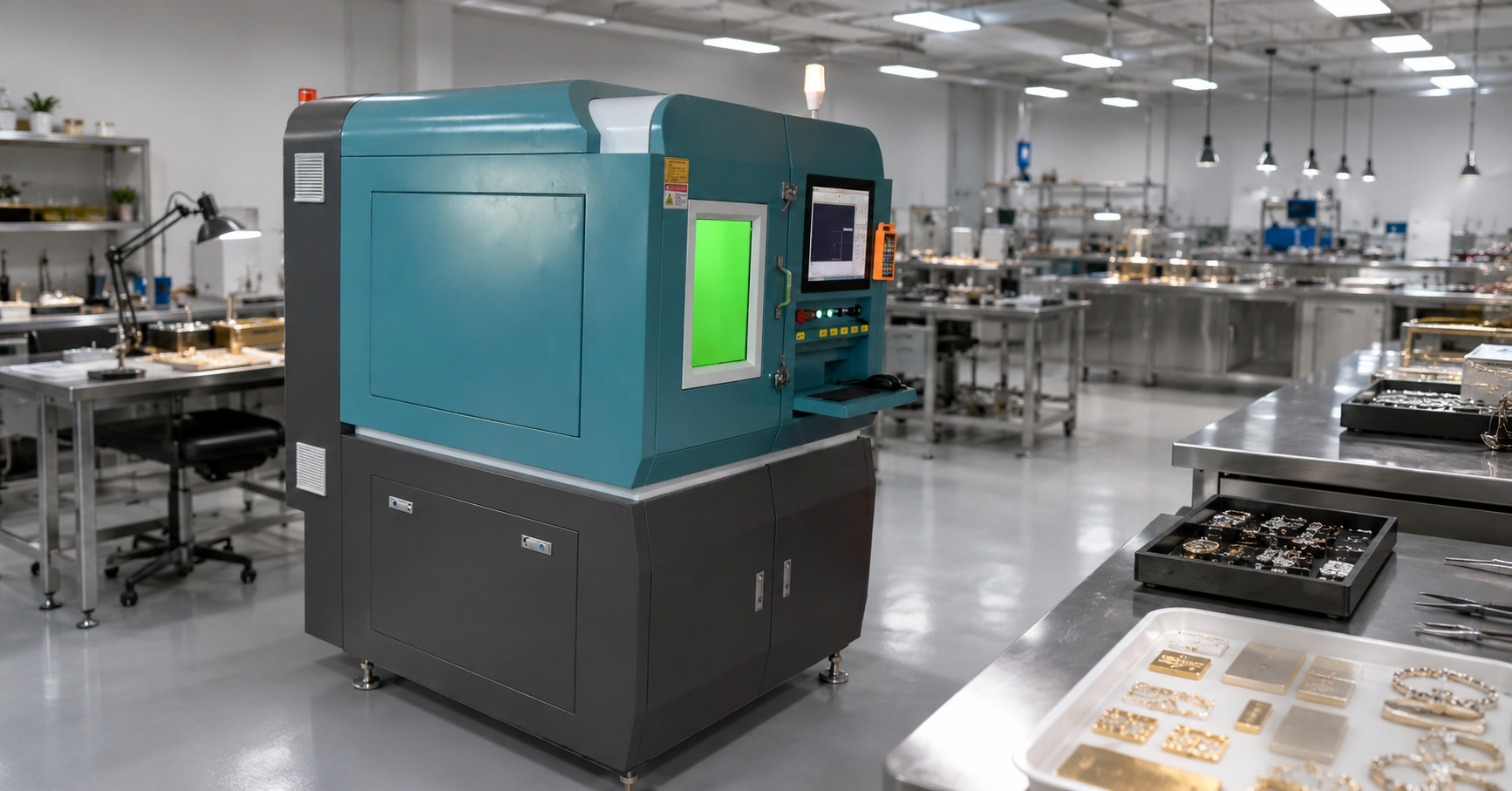
Chikin’s product page describes this equipment as an enclosed industrial jewelry cutting system used to create fine jewelry parts with cleaner edges, tighter control, and less manual rework than traditional cutting methods. It is presented for delicate designs, thin metal sheets, repeatable geometry, and controlled operation with integrated control access and visibility during the process.
For buyers searching for a gold laser cutting machine supplier, silver laser cutting machine manufacturer, precious metal laser cutting machine supplier, or jewelry laser cutting machine manufacturer, this guide explains what to check before choosing a supplier.
Start with the Supplier’s Understanding of Jewelry Production
A supplier selling machines for jewelry production should understand more than basic laser cutting. Jewelry factories work with small parts, expensive materials, changing designs, and fine decorative features. The cutting process must balance detail, heat control, workholding, edge quality, operator access, and material recovery.
A reliable fiber laser cutting machine for jewelry factory should ask detailed questions before recommending a machine. What metal will be processed? Is it gold, silver, platinum, brass, stainless decorative sheet, or another alloy? What thickness range is common? What is the smallest feature size? Is the buyer cutting blanks, engraving decorative patterns, or producing repeated components? How much post-polishing is acceptable?
If a supplier answers every question with “no problem” without asking for sample drawings or material details, that is not a good sign. In precision jewelry production, confidence must be supported by testing.
Check Machine Parameters Against Real Production Needs
The CK-L3020 specification table gives buyers useful starting data. It lists an approximate 1070nm laser center wavelength, 1500W peak power, 300×200mm effective cutting range, thickness range ≤3.0mm, 30m/min maximum movement speed, positioning accuracy ≤0.05mm, repetitive positioning accuracy ≤±0.01mm, AC220V/60A or 380V/40A power supply options, ≤11KW power consumption, overall dimensions of 1200×1500×1850mm, machine weight around 1000kg, and a three-stage dust filtration system.
These specifications are valuable, but they should be connected to actual products. A 300×200mm working range may be practical for small sheets, jewelry blanks, decorative metal patterns, and compact production batches. A ≤3.0mm thickness range may fit many thin precious metal applications, but performance still depends on material type, alloy, surface condition, and required finish.
A serious precious jewelry laser cutter supplier should help the buyer interpret the specification table, not only send it as a sales document.
Supplier Evaluation Checklist
| Evaluation Point | What a Jewelry Factory Should Check | Why It Matters |
|---|---|---|
| Material Testing | Can the supplier test gold, silver, or the buyer’s actual alloy? | Confirms real cutting quality before shipment |
| Working Range | Does the 300×200mm effective cutting area fit the buyer’s sheet and part size? | Avoids mismatch between machine size and product format |
| Thickness Capability | Can the machine cut the buyer’s required thickness with acceptable edge quality? | Prevents overpromising based only on nominal thickness |
| Repeatability | How is ≤±0.01mm repetitive positioning accuracy verified? | Supports repeat orders and small-part consistency |
| Enclosure Safety | Are doors, viewing window, labels, and access controls suitable for laser operation? | Helps protect operators and support compliance planning |
| Filtration System | How does the three-stage dust filtration system work? | Affects workshop cleanliness and maintenance planning |
| Operator Interface | Is the control screen and HMI easy for operators to use? | Reduces training time and operating mistakes |
| Electrical Planning | Does the facility support AC220V/60A or 380V/40A? | Prevents installation delays |
| After-Sales Support | Are training, spare parts, remote service, and maintenance guidance available? | Protects long-term production stability |
| Supplier Experience | Has the supplier worked with jewelry, precious metals, or precision small-part cutting? | Shows whether the supplier understands the application |
Ask for Sample Cutting Before Purchase
For jewelry factories, sample cutting is one of the most important steps in supplier selection. Gold and silver are not generic materials. Even within the same metal category, alloy composition and surface finish can change laser response. A design with wide shapes may cut easily, while a thin decorative pattern may reveal heat, burr, distortion, or micro-feature problems.
Before placing an order, send the supplier actual drawings and material samples. Ask for a test using the expected thickness and geometry. Review the result under the same quality standard your factory uses for production.
During sample review, check:
Edge cleanliness.
Heat-affected appearance.
Dimensional consistency.
Fine feature stability.
Part deformation.
Cutting speed.
Need for polishing or rework.
Material waste.
Ease of part removal.
Repeatability across several samples.
A reliable gold silver laser cutter factory should be willing to discuss the result honestly. If a supplier refuses sample testing or cannot explain the cutting outcome, the buyer should slow down.
Confirm Laser Safety Before Discussing Price
Industrial laser equipment requires careful safety planning. OSHA notes that laser hazards can include eye and skin hazards, reflected beam hazards, fire hazards, and laser-generated airborne contaminants depending on the system and conditions. IEC 60825-1:2014 applies to laser products emitting radiation in the wavelength range from 180nm to 1mm, so a system with an approximately 1070nm laser wavelength falls within the scope of this laser product safety standard.
This does not mean the buyer should guess the machine’s laser class. Instead, the buyer should ask the supplier for exact safety information: classification, enclosure design, interlock status, warning labels, viewing window rating, PPE recommendation, emergency stop design, maintenance access procedure, and operator training documents.
For a jewelry production laser cutting equipment buyer, laser safety should be part of the quotation discussion. A supplier that treats safety as an afterthought may not be suitable for long-term factory cooperation.
Why Enclosure and Visibility Matter
Chikin’s page describes the equipment as an enclosed industrial processing unit with a front access door, viewing window, control screen, push-button controls, and service tray area. The page also states that the observation window allows supervised operation, making it useful for checking alignment, process status, or part handling without opening the enclosure unnecessarily.
This is important for jewelry production because operators often need to supervise delicate parts. They may need to confirm whether a sheet is positioned correctly, whether the process is running as expected, or whether a small component has shifted. A good enclosure should allow monitoring without unnecessary exposure.
At the same time, enclosure design must support maintenance. Buyers should check whether filters, lenses, fixtures, worktable surfaces, doors, and service panels can be accessed safely. A machine that is safe but difficult to maintain may create downtime later.
Review Filtration and Dust Management
The CK-L3020 specification table lists a three-stage dust filtration system. For buyers, this feature should trigger a deeper discussion. Cutting precious metals may produce fine particles or process residue, and factories need to understand how the machine manages them.
Ask the supplier:
What are the three filtration stages?
What filter materials are used?
How often should filters be replaced?
How does the machine indicate filter maintenance?
Is additional external ventilation needed?
Can the filtration system handle the buyer’s actual materials?
Are replacement filters available long term?
How should operators clean the work chamber?
Filtration affects more than cleanliness. It affects operator environment, machine maintenance, lens life, and workshop planning. It can also influence how the buyer positions the machine in the factory.
Compare Direct Manufacturer and General Supplier
Not every seller has the same level of control over the machine. Some companies are direct manufacturers. Others are trading companies or agents. Either type can be useful, but jewelry factories should understand the difference before buying.
| Supplier Type | Potential Advantage | Possible Risk | Best-Fit Buyer |
|---|---|---|---|
| Direct Jewelry Laser Cutting Machine Manufacturer | Better technical communication, factory control, customization, sample testing, spare parts matching | Buyer still needs to verify service quality and real experience | Factories needing long-term production support |
| General Equipment Supplier | May offer fast sourcing and multiple product categories | May depend on another factory for engineering and service | Buyers with simple standard requirements |
| Local Distributor | Easier local communication and installation help | Machine options may be limited and price may be higher | Buyers who need nearby support |
| Low-Price Unknown Seller | Lower initial quote | Higher risk in safety, service, accuracy, and spare parts | Only suitable for low-risk applications |
| Specialized Precious Metal Laser Supplier | Better understanding of gold, silver, small parts, and cutting tests | Needs verification through samples and customer cases | Jewelry factories and OEM production buyers |
For B2B jewelry production, a supplier’s ability to support sample testing, parameter adjustment, spare parts, and after-sales service is often more important than a small price difference.
Evaluate Control Interface and Operator Training
The product page highlights integrated HMI and control access, with front-mounted screen and buttons for job setup, parameter input, and monitoring. This is relevant because jewelry laser cutting often involves frequent job changes.
A factory may cut one pendant design in the morning and a different silver component in the afternoon. Operators need a control interface they can understand. Supervisors need clear process visibility. Maintenance teams need clear alarms and service procedures.
Before ordering, ask whether the supplier provides:
English interface.
Operator manual.
Training video.
Parameter setup guidance.
Maintenance checklist.
Error code explanation.
Remote support.
Sample file preparation help.
A silver laser cutting machine manufacturer that provides good documentation can reduce training pressure after installation.
Consider the Real Cost of Scrap
When cutting gold or silver, scrap is not a minor issue. A small cut error can waste expensive material. A distorted edge may require extra finishing. A missed feature may require remaking the part. This changes the ROI calculation.
A gold and silver fiber laser cutting machine supplier should help buyers evaluate not only machine price but also process loss. Better repeatability, stable positioning, enclosed workflow, and sample-tested parameters may reduce waste. The CK-L3020’s listed ≤±0.01mm repetitive positioning accuracy is valuable because repeatability helps production remain consistent across multiple parts.
Buyers should calculate:
Material value per sheet.
Average scrap cost per mistake.
Manual rework time.
Outsourcing cost for laser cutting.
Expected daily production volume.
Operator training time.
Maintenance cost.
Filter replacement cost.
Potential customer delay cost.
A lower-cost machine that increases scrap may not be cheaper in real factory use.
Check Installation Requirements Early
The CK-L3020 specification table lists overall dimensions of 1200×1500×1850mm and machine weight of approximately 1000kg. Power requirements are listed as AC220V/60A or 380V/40A, with machine power consumption ≤11KW. These are not small details. They affect workshop preparation.
Before purchase, buyers should confirm:
Doorway and forklift access.
Floor load capacity.
Machine placement area.
Service clearance around the machine.
Electrical supply.
Grounding requirements.
Ventilation needs.
Filter replacement space.
Operator standing area.
Material storage nearby.
A supplier should provide installation drawings, packing information, and preparation requirements before shipment. Poor installation planning can delay production even if the machine itself is correct.
Supplier Questions Before Placing an Order
A buyer should ask direct questions before paying a deposit.
Can you test our gold or silver samples?
Can you provide cutting videos using our design?
What is the recommended thickness range for each material?
What edge quality should we expect?
What safety devices are included as standard?
What laser class applies to the final machine configuration?
What is the viewing window specification?
How does the three-stage filtration system work?
What consumables need regular replacement?
What spare parts are shipped with the machine?
What training is included?
Can you provide remote parameter support?
What warranty terms apply?
How fast can you provide replacement parts?
The answers reveal whether the supplier is prepared for real B2B cooperation.
FAQ
What should buyers check first when choosing a gold and silver fiber laser cutting machine supplier?
Buyers should first confirm material compatibility, sample cutting ability, working range, thickness range, safety configuration, filtration system, operator interface, installation requirements, and after-sales service.
Is sample cutting necessary before buying?
Yes. Gold, silver, and jewelry alloys may respond differently to laser cutting. Sample testing helps confirm edge quality, heat effect, dimensional accuracy, and repeatability before purchase.
What is the listed working range of the CK-L3020?
The listed effective cutting range is 300×200mm, which is suitable for many small jewelry parts, decorative components, and compact precious metal sheets.
What is the listed thickness range?
The listed thickness range is ≤3.0mm. Actual performance should be confirmed through material-specific testing.
Why is laser safety important for jewelry factories?
Laser systems can present hazards depending on beam access, reflected radiation, fire risk, and airborne contaminants. Buyers should confirm classification, enclosure, interlocks, PPE, labeling, and operator training before installation.
What filtration system is listed for this machine?
The specification table lists a three-stage dust filtration system. Buyers should ask the supplier how it works, what consumables are required, and how often maintenance is needed.
Is the lowest-price supplier usually the best choice?
Not necessarily. For gold and silver processing, scrap, downtime, poor safety configuration, weak service, and unstable cutting can cost more than the initial machine price difference.
Conclusion
Choosing a gold and silver fiber laser cutting machine supplier requires careful technical evaluation. Jewelry factories should not rely only on machine photos, basic power numbers, or the lowest quotation. The right supplier should help buyers confirm material compatibility, sample results, safety configuration, filtration, installation requirements, operator training, and long-term service.
The Chikin CK-L3020 product information provides a useful starting point: approximately 1070nm wavelength, 1500W peak power, 300×200mm effective cutting range, ≤3.0mm thickness range, 30m/min maximum movement speed, ≤0.05mm positioning accuracy, ≤±0.01mm repetitive positioning accuracy, and a three-stage dust filtration system.
For B2B buyers comparing a gold laser cutting machine supplier, silver laser cutting machine manufacturer, precious metal laser cutting machine supplier, or jewelry laser cutting machine manufacturer, the safest path is practical: send samples, confirm safety, check installation conditions, review after-sales support, and calculate total production value rather than only purchase price. A careful technical discussion before ordering can prevent a costly correction after the machine reaches the factory.