
Three Key Principles of PCB Stackup Design: Balancing Signal Integrity and Manufacturing Costs
Jun 26, 2025
Three Key Principles of PCB Stackup Design: Balancing Signal Integrity and Manufacturing Costs
$$$$$$$
As electronic products evolve toward high performance, miniaturization, and multifunctionality, printed circuit board (PCB) stackup design has become a critical aspect of ensuring both electrical performance and manufacturability. A well-structured PCB stackup not only maintains signal integrity and reduces electromagnetic interference (EMI), but also controls impedance, improves mechanical strength, and lowers manufacturing costs.
$$$$$$$
This article focuses on three key stackup design principles: stackup symmetry, power/ground plane integrity, and signal layer-reference plane pairing. Common layer structures and practical application cases are included to illustrate effective strategies in modern PCB design.
$$$$$$$
1. Principle One: Stackup Symmetry
In multilayer PCBs, stackup symmetry is vital for suppressing warping and deformation. Stackup symmetry means that copper layers and dielectric materials should be evenly distributed above and below the board’s centerline. For example, in an 8-layer board, a recommended structure would be:
Signal1 - GND - Signal2 - Power - Power - Signal3 - GND - Signal4,
which ensures balanced thermal stress distribution.
$$$$$$$
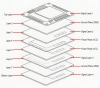
Diagram Description: Typical 8-Layer Stackup
Top Layer - Signal Layer 1
Layer 2 - Ground Plane (GND)
Layer 3 - Signal Layer 2
Layer 4 - Power Plane (VCC)
Layer 5 - Power Plane (VCC)
Layer 6 - Signal Layer 3
Layer 7 - Ground Plane (GND)
Bottom Layer - Signal Layer 4
$$$$$$$
Why Is This Important?
1.Prevents PCB warping during reflow soldering or thermal cycling;
2.Ensures balanced interlayer stress and improves mechanical reliability;
3.Maintains impedance stability for high-frequency signals by avoiding board shape deformation.
$$$$$$$
2. Principle Two: Power/Ground Plane Integrity
A solid ground plane (GND) is the cornerstone of high-speed PCB design. It provides a low-impedance return path for signals, reduces noise, and ensures impedance continuity by forming a stable reference plane.
$$$$$$$
Design Recommendations:
1.High-speed signal layers should be adjacent to continuous ground planes;
2.The dielectric between power and ground layers should be thin for strong coupling;
3.Avoid splitting the GND plane in high-frequency chip areas;
4.Ensure continuity of the ground layer and avoid creating “island” or floating ground regions.
$$$$$$$
Common Mistake Example:
If a signal trace runs above a cut ground plane, the return current will take an alternative longer path, increasing the loop area and EMI risk. For example, USB or HDMI high-speed differential pairs without an adjacent GND reference may fail EMC tests due to excessive emissions.
$$$$$$$
3. Principle Three: Signal Layer and Reference Plane Pairing
High-speed signals must propagate with a clear reference plane to maintain constant characteristic impedance. The reference plane is typically GND or a stable power plane (VCC). During stackup design, signal layers should be paired with corresponding reference planes and avoid uncontrolled layer transitions.
$$$$$$$
Diagram Description: Typical 6-Layer Signal/Reference Pairing
L1 - Signal Layer (routing)
L2 - Ground Plane (GND) ← Reference for L1
L3 - Signal Layer (routing)
L4 - Power Plane (VCC) ← Reference for L3
L5 - Ground Plane (GND)
L6 - Signal Layer (routing)
$$$$$$$
Key Points:
1.Differential pairs (e.g., USB, CAN) should be routed on the same layer with the same reference;
2.If a layer change is unavoidable, place decoupling capacitors (0.1μF to 0.01μF) near the vias to bridge the reference planes;
3.A broken reference plane can cause return current detours, forming large EMI loops.
$$$$$$$
Application Case Studies
Case 1: High-Speed DDR4 Memory Board
A high-performance embedded board uses an 8-layer PCB to connect a SoC with DDR4 RAM at 2400 MHz. Engineers adopted the following stackup:
L1: Signal (SoC to DDR4)
L2: Ground Plane
L3: Signal (Address/Control)
L4: Power Plane
L5: Power Plane
L6: Signal
L7: Ground Plane
L8: Signal
$$$$$$$
Advantages:
1.All high-speed signal layers are adjacent to GND;
2.Tight coupling between power and ground enhances power integrity;
3.Symmetrical stackup improves board stability;
4.Stripline routing enables impedance control within ±10%.
$$$$$$$
Case 2: EMI Issues in USB 3.0 Peripheral Board
A client designed a USB 3.0 expansion board using a 6-layer PCB. However, the ground plane was discontinuous under the TX+/TX− differential pair. As a result, the board repeatedly failed EMI testing. After restructuring the ground plane and adding reference plane bypass capacitors, the EMI issue was resolved.
$$$$$$$
Conclusion: Engineering Meets Practicality
PCB stackup design is not just about stacking layers — it is a comprehensive engineering discipline integrating electromagnetics, thermal dynamics, mechanical balance, cost, and manufacturability. Mastering the principles of symmetry, reference continuity, and layer pairing lays a solid foundation for signal integrity, EMC compliance, and long-term reliability.
$$$$$$$
By applying these strategies, designers can streamline prototyping, reduce debugging iterations, and ultimately deliver high-performance, production-ready electronic systems.


Recent Posts

October 26, 2016
The Most Successful Engineering Contractor

May 12, 2025
China PCB Drilling Routing machine Development
May 06, 2025
PCB Design Process and Key Points
CONTACT US
Contact US
Product Information
Quantity
Unit
Piece
Support order samples, customization, wholesale direct, and complete payment. If the product you look for does not have corresponding customized content, pls fill out the form below to contact us, and we will reply ASAP.