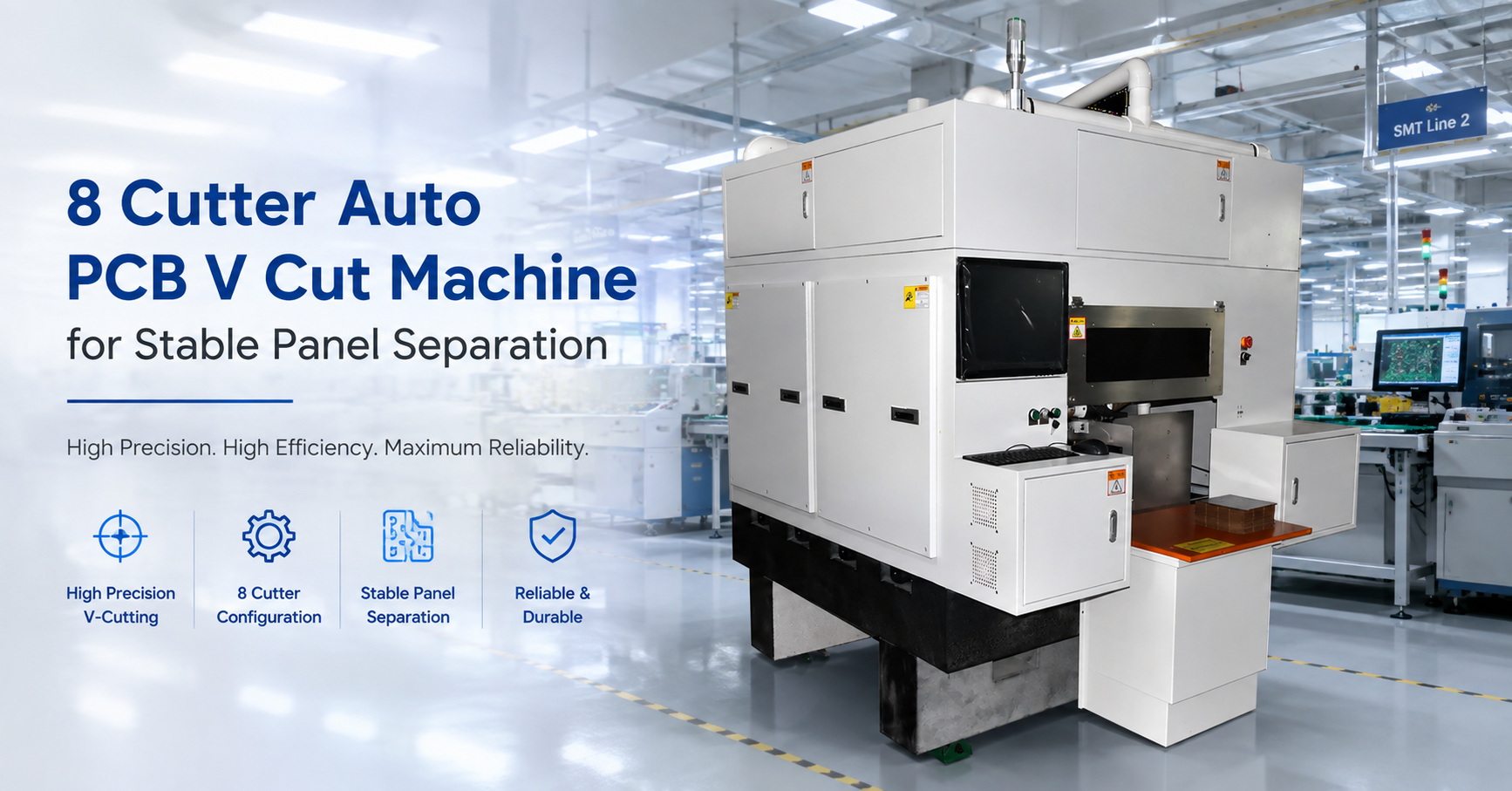




How Should Buyers Choose a 6 Cutter Auto PCB V Cut Machine Supplier for Factory Production?
For PCB factories, buying a 6 cutter auto PCB V cut machine is not only an equipment purchase. It is a decision about process control, operator workflow, production consistency, and long-term support. A machine may look professional in a product image, but factory buyers need more than appearance. They need to know whether the machine matches their panels, whether the cutter configuration supports their production rhythm, whether operators can use it safely, and whether the supplier can provide support after installation.
Chikin CNC describes the 6 Cutter Auto PCB V Cut Machine as equipment for cleaner, safer, and more consistent PCB panel separation. The page says the machine addresses problems caused by manual breaking or unstable cutting, including edge stress, dust, uneven break lines, reduced production quality, and rising rework.
For B2B buyers searching for a PCB V cut machine supplier, automatic PCB V cut machine manufacturer, multi blade PCB cutting machine supplier, or PCB depaneling equipment supplier, the main question is not “Which supplier has the lowest price?” The better question is: which supplier can help the factory build a stable and repeatable panel separation process?
Why Supplier Selection Matters for PCB V-Cut Equipment
A PCB V-cut machine is not a generic cutting tool. It must match the board’s panel design, scoring line, thickness, loading method, and production target. If the supplier does not understand these details, the buyer may receive a machine that looks suitable but does not fit the factory process.
Chikin’s product page clearly warns that the exact internal mechanism cannot be fully confirmed from image alone, and buyers should review the tool configuration, alignment method, serviceability, working range, supported PCB thickness, and actual application directly with the supplier.
This is exactly why supplier selection matters. A responsible supplier should not only send a catalog. It should ask for panel drawings, confirm board dimensions, discuss fixture compatibility, review production rhythm, and recommend a configuration based on real use.
What Product Advantages Should Buyers Discuss with the Supplier?
The product page highlights several advantages that buyers should turn into technical questions during supplier communication.
The first advantage is controlled panel separation. The page describes the machine as a PCB V Scoring Machine or PCB V Groove Machine whose main value is consistent V-cut formation for later board breakaway. This helps reduce operator variability and makes panel processing easier to standardize across shifts.
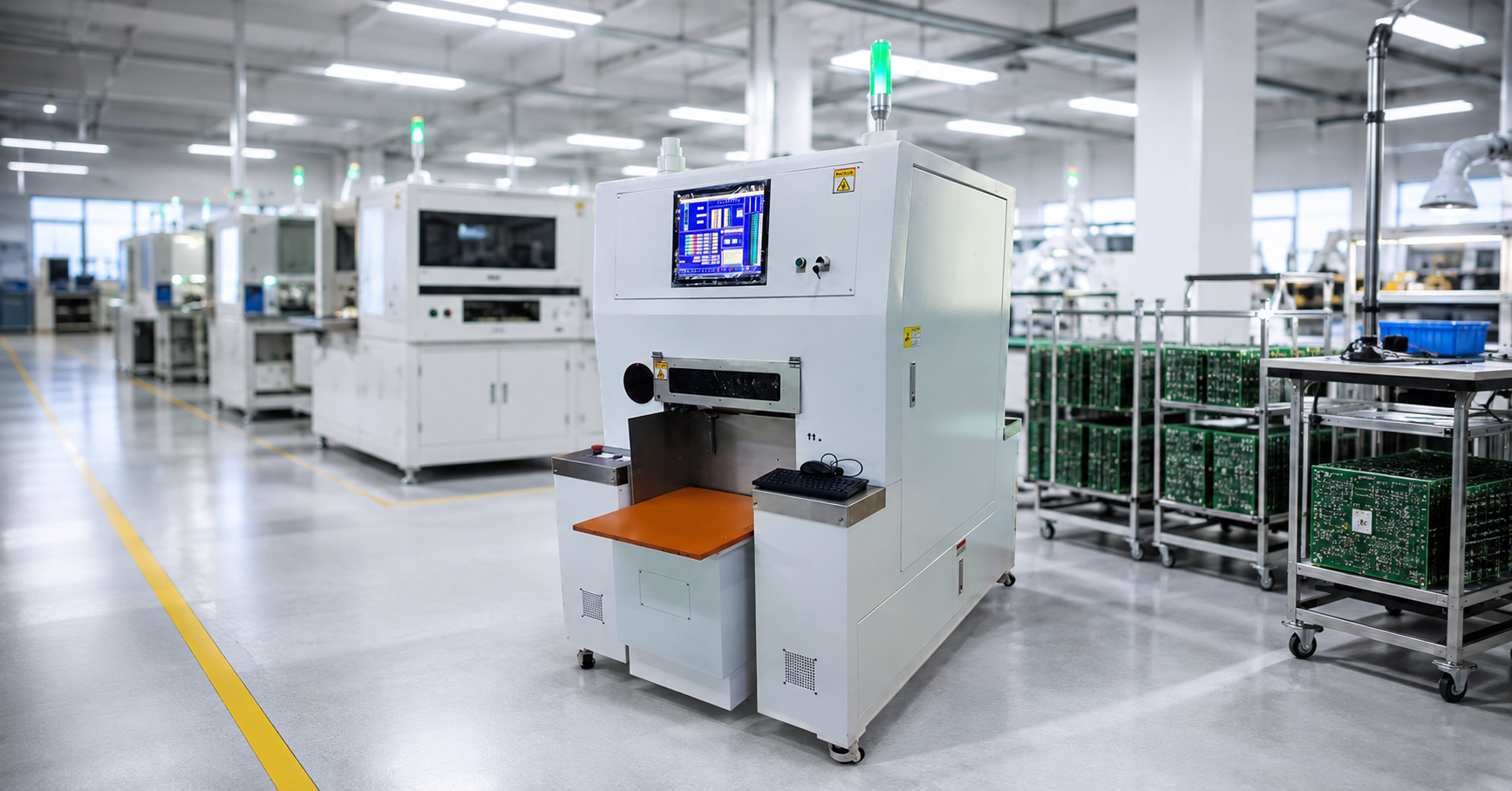
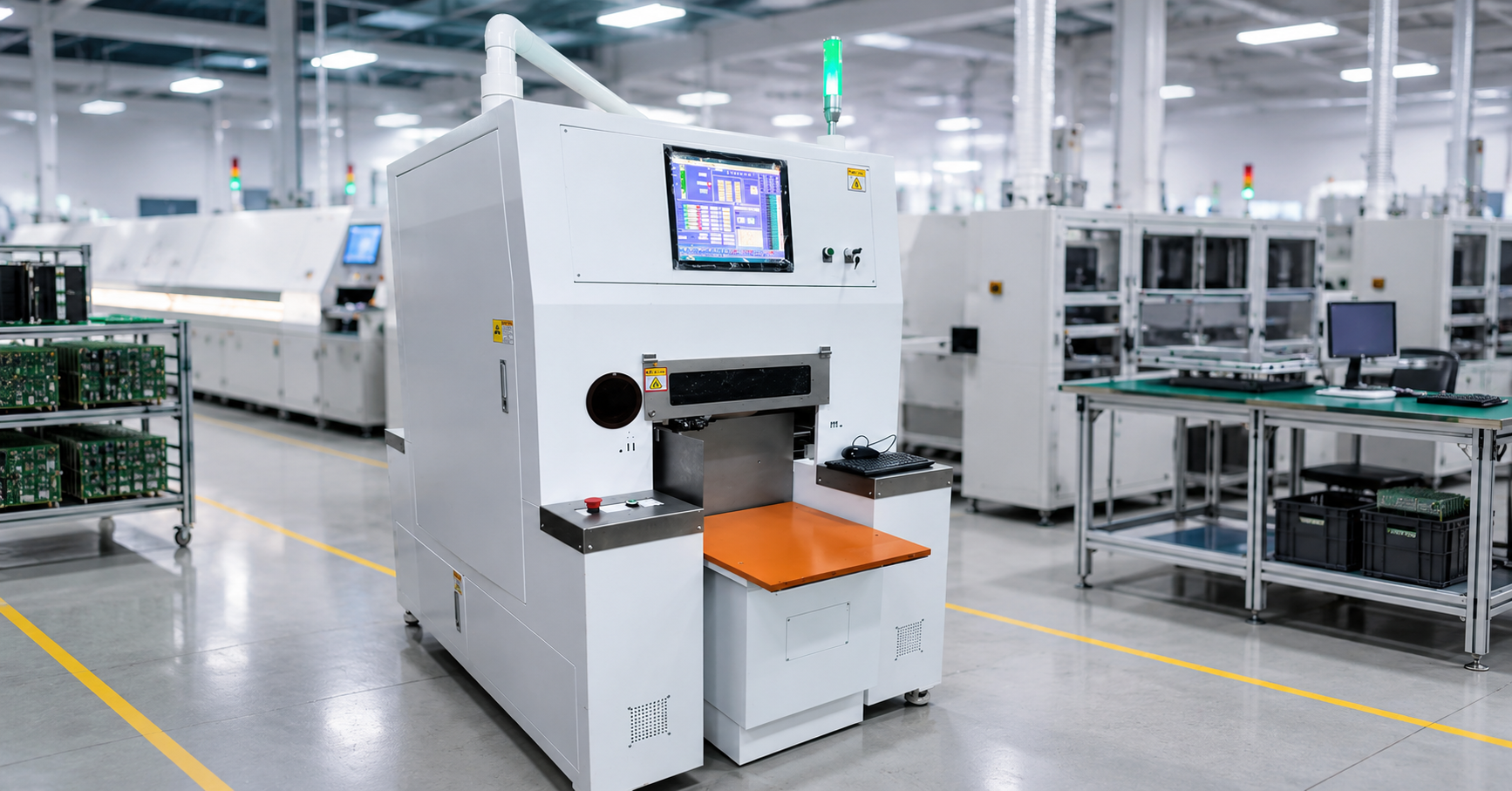
The second advantage is enclosed operation. The visible cabinet structure creates a guarded working environment, which matters when production safety, contamination control, or operator discipline are part of the decision.
The third advantage is touchscreen operation. The integrated screen suggests easier machine interaction for setting jobs, monitoring status, and guiding daily operation. In a factory environment, this helps simplify training and reduce setup confusion.
The fourth advantage is status indication and utility management. The tower light, front buttons, and vent or exhaust connection show that the machine is designed for production use, supporting visibility, machine awareness, and stable operation in busy workshops.
These selling points are useful only when they match the factory’s needs. A buyer should ask the supplier how each feature works in practice.
Supplier Evaluation Checklist
| Evaluation Point | What Buyers Should Ask the Supplier | Why It Matters |
|---|---|---|
| Panel compatibility | Can the machine handle our PCB size, panel layout, and board thickness? | Prevents mismatch between machine and actual production boards |
| Cutter configuration | How are the six cutters arranged and adjusted? | Determines whether the machine fits repeated board sets |
| Alignment method | How does the machine keep the V-cut path consistent? | Affects edge quality and process repeatability |
| Enclosed safety | What guarding, warning labels, access controls, and emergency functions are included? | Supports safer factory use |
| HMI operation | Can operators set jobs, monitor status, and understand alarms easily? | Reduces training pressure and setup mistakes |
| Utility connection | What vent, exhaust, dust, or auxiliary connection is required? | Helps plan installation and cleanliness control |
| Maintenance access | How are cutters, guides, fixtures, and internal work areas serviced? | Affects long-term uptime |
| Customization support | Can cutter layout, worktable, loading direction, interlocks, control language, exhaust, or cabinet layout be customized? | Helps match the machine to the factory line |
| Sample testing | Can the supplier test real buyer panels before order? | Confirms separation quality before shipment |
| After-sales service | Are spare parts, training, remote support, and documentation available? | Protects production after installation |
How Should Buyers Compare This Machine with Ordinary Suppliers’ Products?
Many ordinary suppliers may offer basic PCB cutting or depaneling machines. Some may focus on low price. Others may focus on machine appearance. But for factory production, buyers need to compare practical capability.
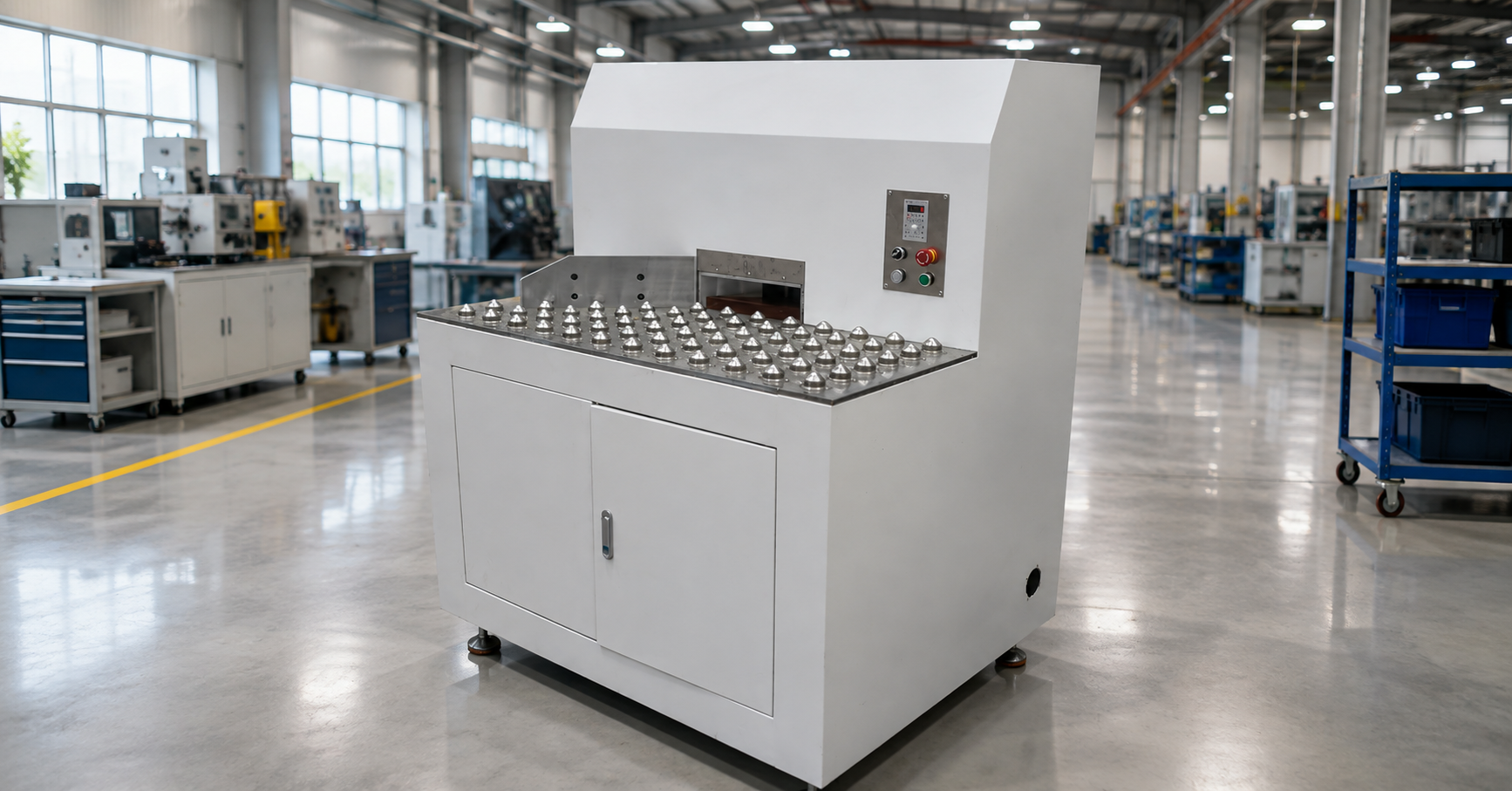
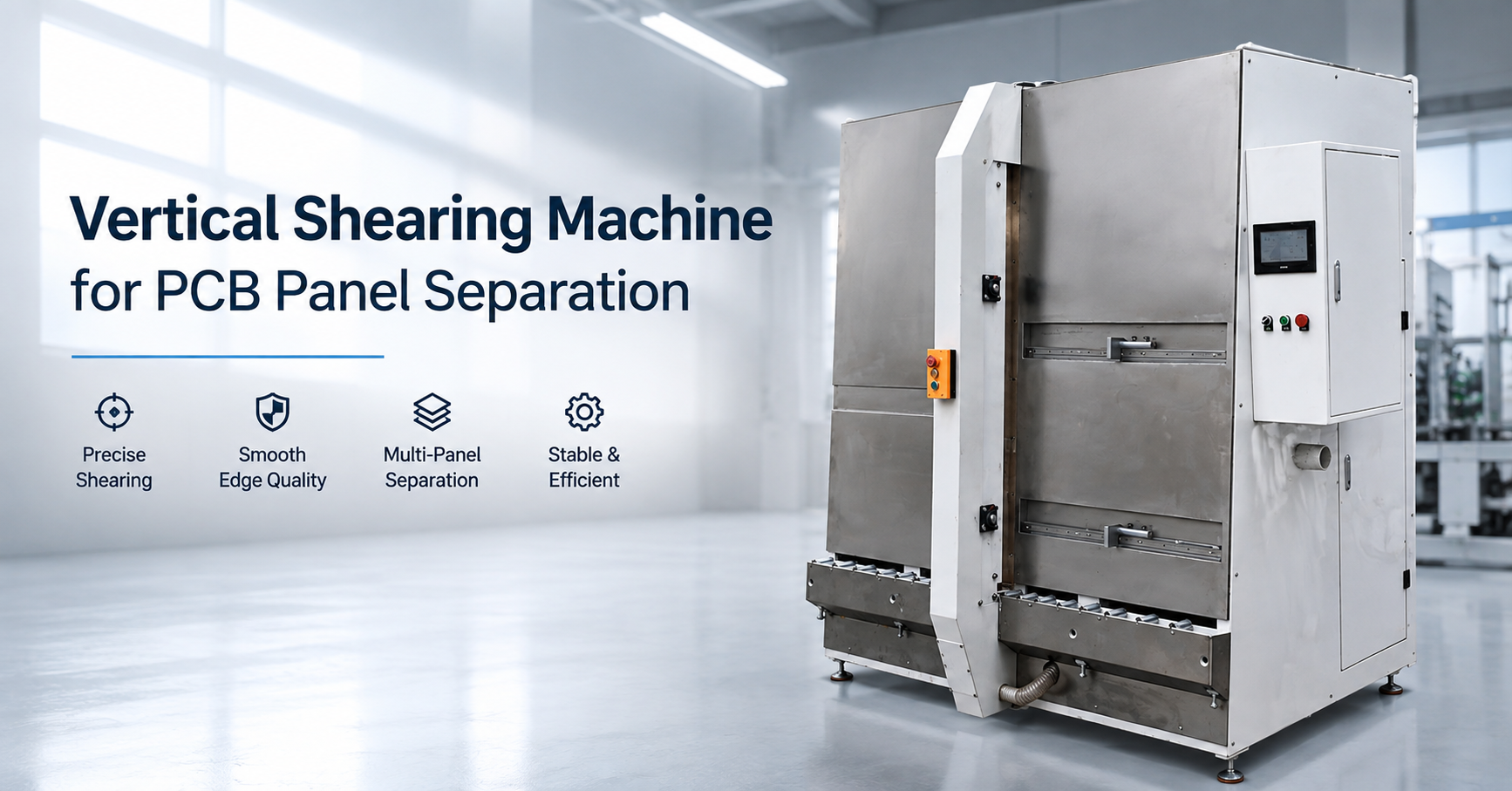
Chikin’s product page positions this 6 cutter auto PCB V cut machine as an enclosed industrial workstation rather than a bench-top hobby tool. The page mentions the floor-standing structure, touchscreen HMI, status tower light, front loading area, protected internal work chamber, cabinet-style body, warning labels, and industrial layout.
These features create a different category from simple open cutting tools. The difference is not only visual. It affects process discipline.
A basic supplier may sell a machine that cuts.
A stronger supplier should help standardize panel separation.
A basic supplier may quote without drawings.
A stronger supplier should request panel data.
A basic supplier may focus only on price.
A stronger supplier should discuss tool configuration, alignment, serviceability, and workflow.
A basic supplier may offer fixed equipment.
A stronger supplier should discuss customization when the line requires it.
For B2B buyers, this difference matters because the real cost of depaneling includes rework, operator variation, dust, edge damage, downtime, and service delays.
Why Should Buyers Focus on Board Data Before Asking for Price?
A buyer who only asks for price may receive a quick quotation, but not necessarily the right machine. PCB V-cut equipment depends heavily on panel design. Before asking for the final price, the factory should prepare technical data.
Useful information includes:
PCB panel length and width.
Board thickness.
Number of boards per panel.
V-groove or V-score layout.
Distance from components to separation lines.
Panel material.
Required edge quality.
Expected output per shift.
Current depaneling problems.
Loading direction.
Available machine space.
Need for exhaust or dust management.
Preferred control language.
Need for sample testing.
The product page also encourages buyers to share PCB size, panel layout, and production target, and to request a configuration matched to the workflow.
This is a good purchasing habit. It helps the supplier recommend a machine based on facts rather than assumptions.
What Should Buyers Ask About Customization?
Customization is one of the most important B2B topics for this product. Chikin’s page says customization may involve cutter layout, worktable style, loading direction, safety interlocks, control language, exhaust connection, and cabinet layout. It also advises buyers to ask about board dimensions, fixture compatibility, and operator access when a specific PCB V cut separator configuration is needed.
This is important because not every PCB factory has the same workflow. Some factories run repeated board families. Some handle high-mix production. Some need manual loading. Others may need better compatibility with upstream or downstream inspection equipment.
Buyers should ask:
Can the cutter layout be adjusted for our board family?
Can the worktable style match our panel loading method?
Can the loading direction fit our line layout?
Can safety interlocks be configured according to factory requirements?
Can the HMI language be changed?
Can exhaust or vent connections be arranged for our facility?
Can cabinet access doors be placed for easier service?
Can the machine fit alongside inspection, marking, or conveyor equipment?
A supplier that can answer these questions clearly is more likely to support real production.
Why Is Sample Testing Important?
Sample testing is one of the safest ways to evaluate a 6 cutter auto PCB V cut machine supplier. A product page can show structure and capabilities, but only real panels can confirm actual fit.
A sample test should use the buyer’s own PCB panels whenever possible. It should include real thickness, real V-score design, real panel size, and typical production conditions.
During testing, buyers should check:
Whether loading is easy.
Whether the panel aligns correctly.
Whether the separation path is stable.
Whether the edge is clean enough.
Whether dust is acceptable.
Whether the panel shows bending or stress.
Whether repeated panels produce consistent results.
Whether operators can understand the workflow.
Whether maintenance points appear accessible.
Chikin’s page notes that the machine should be evaluated carefully against actual PCB format, panel size, and production rhythm because the exact internal process is not fully confirmed from image alone.
That statement supports sample validation. It is better to identify a process mismatch before shipment than after installation.
What After-Sales Support Should a Supplier Provide?
A PCB V-cut machine will need support after delivery. Cutters may need inspection or replacement. Guides and fixtures may need cleaning. HMI settings may need adjustment. Operators may need training. Spare parts may be required.
A strong PCB V groove machine factory or PCB depaneling equipment supplier should provide:
Operation manual.
Maintenance guide.
Recommended spare parts list.
Training videos or remote training.
HMI operation support.
Troubleshooting support.
Cutter replacement guidance.
Electrical or utility connection guidance.
Service response plan.
Buyers should ask these questions before ordering, not after a machine problem appears. A low-cost supplier with weak support may become expensive when production stops.
How Does This Product Fit Different Factory Scenarios?
Chikin’s product page states that this type of multi blade PCB cutting machine is a good fit for PCB production lines, electronics assembly workshops, and factory environments handling repeated board depaneling. It may also suit small component processing or other controlled industrial tasks where an enclosed workstation is preferred.
For a PCB production line, the machine can help create a stable separation step between fabrication and downstream assembly. For an electronics assembly workshop, it can reduce manual strain and improve process control. For a smaller workshop, it may provide better separation discipline than manual methods. For a factory with repeated panels, the six-cutter configuration can support more efficient batch work.
This range of applications makes the machine useful, but buyers still need to match it to real process needs. A high-mix, low-volume factory may care more about adjustment flexibility. A repeat-production factory may care more about throughput and consistency.
Common Supplier Selection Mistakes
One common mistake is choosing the supplier with the lowest quote before sending panel drawings. Without board data, the quote may not reflect the real configuration needed.
Another mistake is trusting machine appearance alone. Enclosed structure, HMI, and tower light are useful, but buyers still need to confirm cutter layout, alignment method, and serviceability.
A third mistake is ignoring customization. Standard equipment may be enough for some factories, but others need different loading direction, worktable design, language, exhaust, or cabinet layout.
A fourth mistake is not discussing spare parts. Cutters and machine components must be available over the long term.
A fifth mistake is skipping training questions. Operators need clear instructions, especially when the machine becomes part of a busy production line.
FAQ
What makes a 6 cutter auto PCB V cut machine suitable for factory production?
It combines a six-cutter configuration with an enclosed industrial layout, touchscreen HMI, status tower light, front loading area, and protected internal work chamber. These features support repeatable V-cut processing and controlled daily operation.
What should buyers check before choosing a supplier?
Buyers should check whether the supplier can review panel drawings, confirm board thickness and layout, explain cutter configuration, provide sample testing, discuss customization, and support after-sales service.
Why is customization important?
Customization may involve cutter layout, worktable style, loading direction, safety interlocks, control language, exhaust connection, and cabinet layout. These details help the machine fit the factory’s actual workflow.
Is a six-cutter machine always better than a single-cutter machine?
Not always. A six-cutter machine is more useful when the factory has repeated board sets and throughput-oriented panel processing needs. A single-cutter system may still fit simpler or lower-volume production.
Why should buyers provide panel drawings?
Panel drawings help the supplier confirm PCB size, panel layout, V-groove design, fixture compatibility, cutter layout, and whether the machine can match the buyer’s workflow.
Conclusion
Choosing a 6 cutter auto PCB V cut machine supplier should be a technical decision, not only a price comparison. The machine must match the factory’s PCB panel size, V-score design, production rhythm, operator workflow, safety needs, and maintenance expectations.
Chikin’s product page shows several important product advantages: six-cutter configuration, controlled panel separation, enclosed industrial body, touchscreen HMI, status indication, front loading area, utility management, and customization guidance.
For B2B buyers, the safest process is practical: send panel drawings, explain production targets, confirm machine configuration, request sample testing, discuss customization, and review after-sales service before placing an order. A reliable PCB V cut machine manufacturer should not only deliver a machine. It should help the factory build a cleaner, safer, and more consistent PCB panel separation process.