



How Does an 8 Cutter Auto PCB V Cut Machine Improve Stable Panel Separation?
For PCB manufacturers, panel separation is not a small finishing step. It is one of the last production stages where a finished or semi-finished board can still be damaged by poor handling, uneven scoring, excessive stress, or unstable cutting behavior. A panel may have already passed drilling, routing, soldering, inspection, cleaning, and electrical testing. If separation creates cracks, rough edges, dust contamination, or inconsistent board geometry, the factory loses value near the end of the process.
That is why a dedicated 8 cutter auto PCB V cut machine can be important for factories that process scored PCB panels in batches. Compared with manual handling or simpler separation methods, an automatic multi-cutter V-cut system is designed to create a more structured, repeatable, and production-oriented workflow. Chikin CNC describes this machine as being built for manufacturers that need cleaner and more controlled board separation without adding extra stress to finished panels. The product page also points out several common production concerns: edge damage, inconsistent scoring depth, dust, operator fatigue, and the need to keep line output steady.
For B2B buyers searching for a PCB V cut machine, automatic PCB depaneling machine, PCB scoring machine, or multiple cutter PCB separator, the key question is not simply whether the machine can cut. The more practical question is whether it can keep panel separation stable across shifts, board batches, and repeated production runs.
Why Stable Panel Separation Matters in PCB Production
PCB panels are used because they improve handling efficiency. Instead of processing many small individual boards separately, factories can move panelized boards through production as larger, more manageable units. This improves efficiency in many upstream processes. But at some point, the boards must be separated.
That final separation stage needs control. If the V-groove process is inconsistent, boards may separate with uneven edges. If operators rely too much on hand force, separation results may vary from person to person. If dust or debris is not managed, the surrounding production cell may become harder to keep clean. If the process is slow, depaneling becomes a bottleneck even when upstream machines are running well.
Chikin’s product page explains that a well-built PCB scoring machine helps reduce these risks by guiding the V-groove process with repeatable motion and fixed tooling. This is especially valuable when the same board size or panel family runs again and again.
In real factory language, stable panel separation means:
The board follows a predictable separation path.
Operators do not need to rely on uncontrolled hand pressure.
Edge quality becomes easier to inspect and maintain.
Batch output becomes easier to schedule.
The process can be organized as a repeatable production station.
Maintenance, safety, and dust control become easier to manage.
A PCB panel separation machine should therefore be judged by workflow stability, not just cutting capacity.
What Is an 8 Cutter Auto PCB V Cut Machine?
An 8 cutter auto PCB V cut machine is a production machine designed for V-score or V-groove PCB panel processing. Its multi-cutter layout is intended to improve throughput and process continuity when compared with simpler single-tool approaches, especially for repetitive panel jobs.
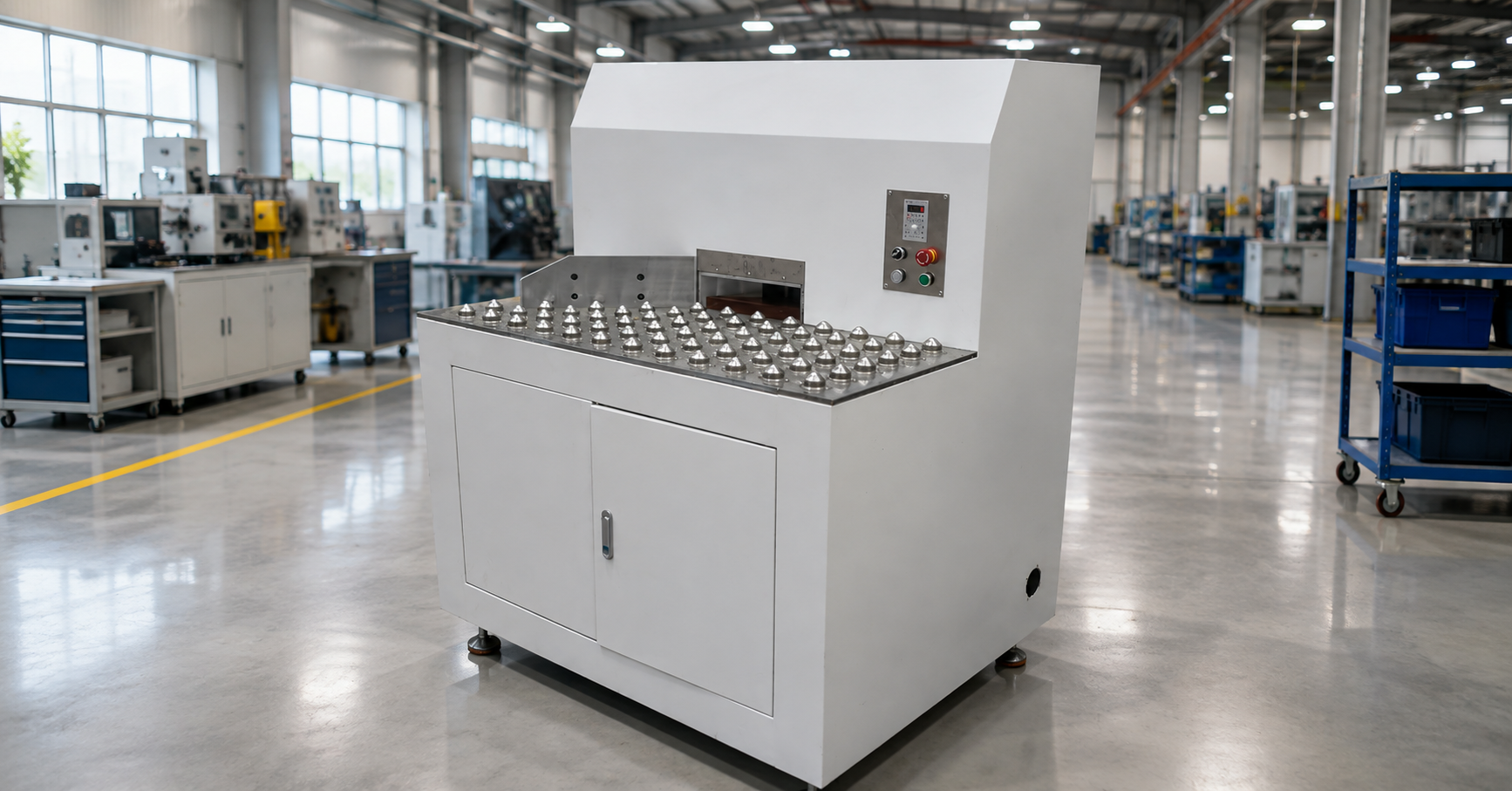
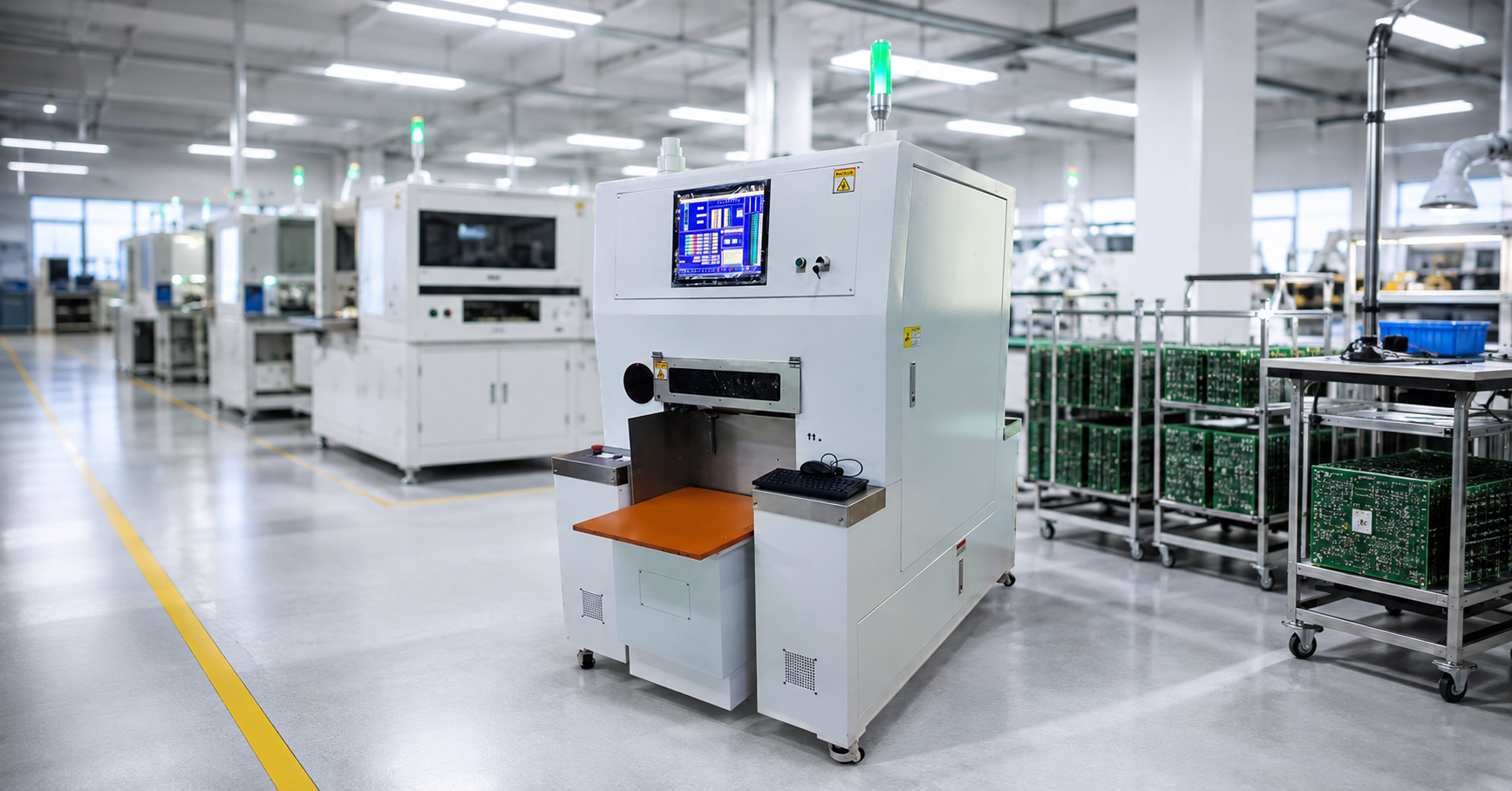
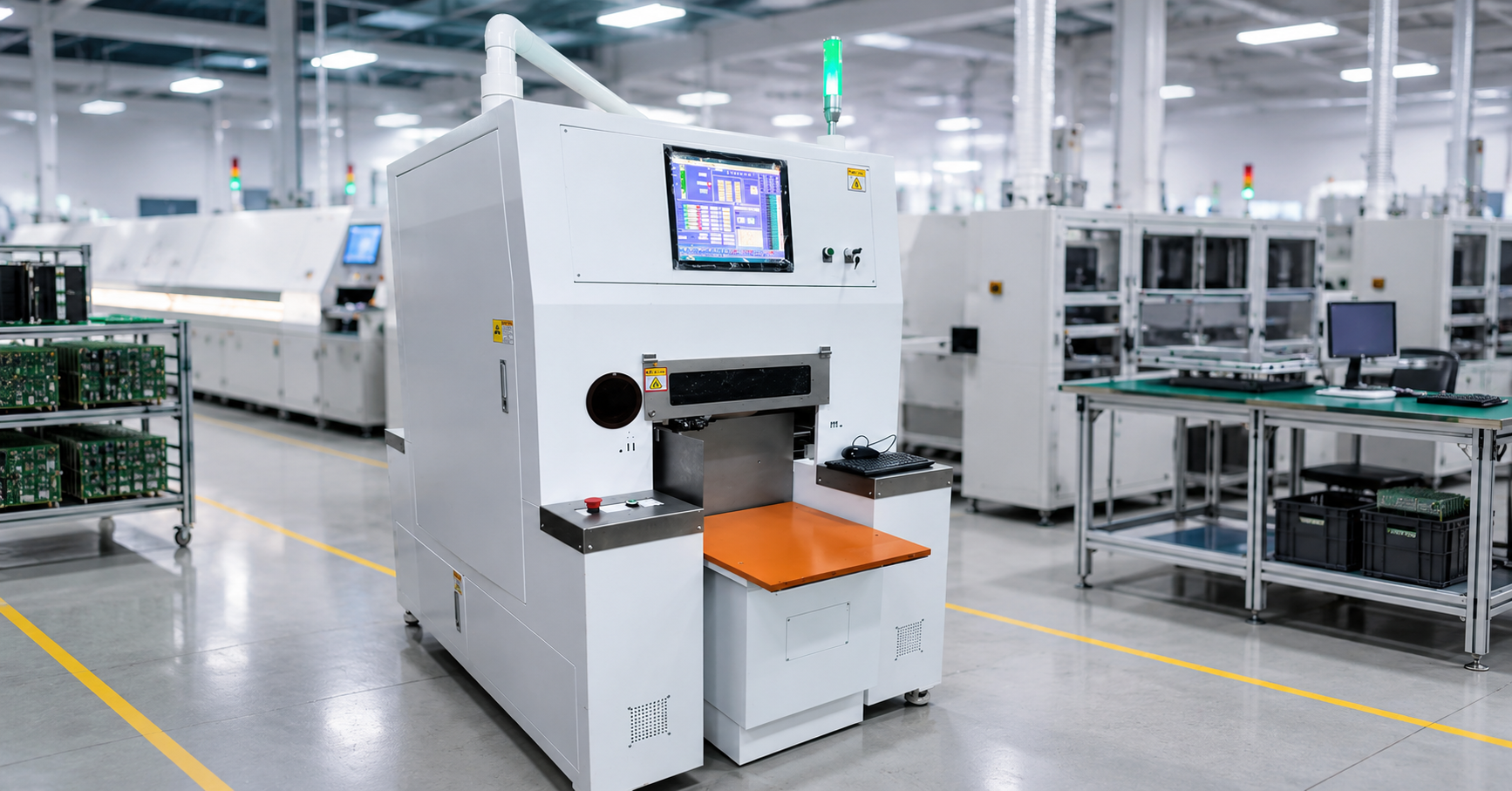
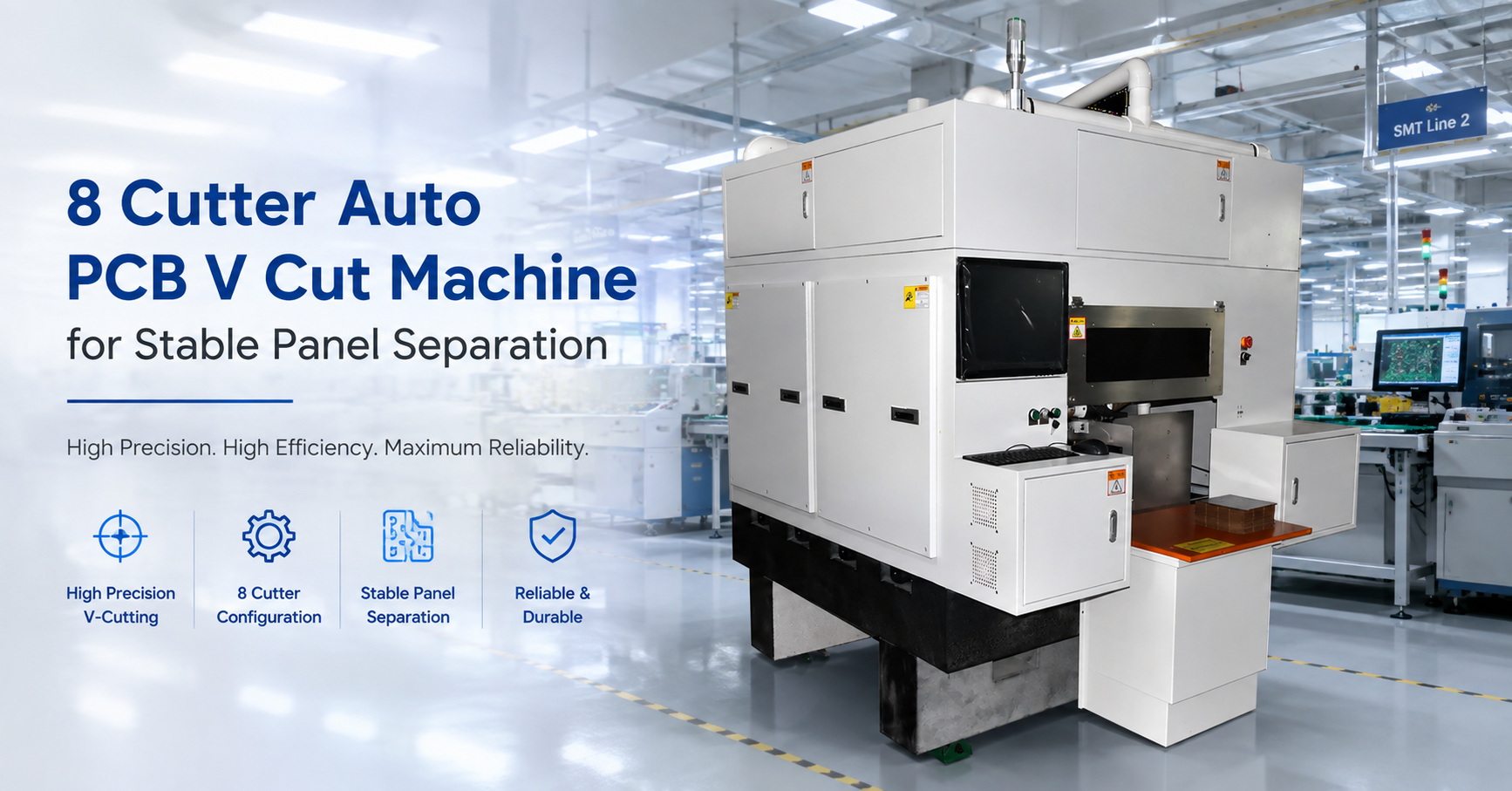
The Chikin CNC product page positions the 8 cutter layout as a practical solution for faster throughput and more efficient board processing, while keeping operation organized inside an enclosed machine structure. It describes the machine as an industrial PCB panel separation solution for controlled V-score operations, with a front work zone, viewing windows, control area, and utility routing for ventilation or extraction.
The phrase “8 cutter” matters because cutter configuration affects production rhythm. A single cutter may be useful for simple or lower-volume V-groove separation. A multiple cutter design is more relevant when a factory needs higher efficiency on suitable panel formats. More cutters can support more continuous processing, provided that the machine is correctly matched to board format, groove specification, panel rigidity, and production layout.
For factories handling rigid PCBs, higher panel volumes, or assembly lines that depend on predictable depaneling, this type of equipment is not just a convenience. It becomes a production control tool.
Technical Overview for B2B Buyers
| Evaluation Area | Product Page Information | Technical Meaning for PCB Factories |
|---|---|---|
| Machine Type | 8 cutter auto PCB V cut machine | Designed for stable V-groove PCB panel separation |
| Main Purpose | Cleaner, more controlled board separation | Helps reduce edge damage, unstable scoring results, and operator fatigue |
| Cutter Configuration | 8 cutter layout | Aimed at faster throughput and more efficient repetitive board processing |
| Machine Category | Enclosed automated process equipment | Provides a more protected workflow than open bench-type separators |
| Work Zone | Front loading and centralized work area | Helps operators load panels from a defined position each cycle |
| Observation | Viewing windows | Allows process observation without opening the full enclosure |
| Utility Support | Top-mounted ducting and side utility cabinet visible | Suggests organized routing for extraction, electrical, or auxiliary process support |
| Suitable Use Cases | Rigid PCBs, higher panel volumes, repetitive board formats, enclosed processing stations | Fits factories that need repeatable depaneling behavior and cleaner production flow |
| Buyer Confirmation Needed | Board size, V-groove specification, cutter layout, worktable size, extraction routing, automation level | The page does not publish full numerical specifications, so these must be confirmed before ordering |
Why the 8 Cutter Layout Can Improve Production Flow
The value of an 8 cutter auto PCB V cut machine is not only that it has more cutting tools. The value appears when the machine configuration matches the panel format and production volume.
In repetitive PCB production, many panels share the same scoring layout. If the machine can process those panels through a fixed, repeatable cutter arrangement, the factory can reduce handling variation and improve cycle consistency. Chikin’s product page notes that multiple cutters are often chosen to improve process continuity and handle repetitive panel jobs more efficiently.
This is why buyers often compare a multiple cutter PCB separator with a single-tool setup. A single-tool machine may be easier to understand and may fit lower-volume or mixed work. A multi-blade machine can be more attractive when the same panel family runs in batches and throughput matters.
However, more cutters do not automatically mean better results. The machine must be configured properly. The buyer should confirm:
How the cutters are arranged.
Whether cutter spacing matches the PCB panel design.
How different board sizes are adjusted.
Whether all cutters are used at once or selectively.
How cutter condition is inspected.
How alignment is maintained during operation.
Whether changeover is simple enough for production staff.
A multi blade PCB cutter works best when the production team has stable panel families and clear process requirements. It should not be selected only because the machine name sounds more powerful.
Enclosed Structure and Controlled Operation
The product page describes the machine as having an enclosed cabinet-style body with guarded working bay and visible inspection windows. This design helps isolate the process area and creates a clearer separation between the operator zone and the machining zone.
For PCB factories, this is useful for several reasons. First, it supports safer daily operation by reducing direct exposure to the working area. Second, it helps organize the depaneling process as a defined production cell. Third, it can support cleaner manufacturing when dust, chips, or fumes need to be managed. Fourth, it gives supervisors and operators a more controlled visual workflow.
Compared with open bench-style equipment, enclosed systems usually require more planning around access, service doors, internal cleaning, extraction, and maintenance clearance. That is not a weakness; it is part of the engineering trade-off. A production factory should want both safety and serviceability.
Buyers should ask:
Can operators see the work area clearly?
Are the inspection windows positioned well?
How are boards loaded and unloaded?
How are cutters accessed for inspection or replacement?
How is dust or debris removed from the working bay?
Does the enclosure fit the factory’s line layout?
Is emergency access easy and clearly marked?
A good PCB depaneling equipment supplier should discuss enclosure design in practical terms, not only describe it as “safe” or “industrial.”
Front Loading and Centralized Work Zone
Chikin’s product page describes the front access opening and central platform as signs of a fixed loading position. This arrangement is useful in line production because boards can be presented to the same station each cycle, reducing handling variation.
This matters more than it may seem. In depaneling, how the board enters the machine affects alignment. If the operator loads the panel differently each time, the cutter path may not remain consistent. If the work surface does not support the board properly, the panel can flex. If the V-groove is not aligned with the cutter path, edge damage or uneven separation may appear.
A centralized work zone helps create a standard operating method:
The operator approaches the same loading point.
The panel is positioned against the same reference.
The machine follows the same working path.
Finished boards or separated panels leave through a planned unloading step.
Inspection can be performed consistently after each cycle.
For factories with multiple operators or shift changes, this consistency is valuable. It reduces dependence on individual operator habits and makes training easier.
Utility Routing, Extraction, and Factory Cleanliness
The product page notes top-mounted ducting and a separate side cabinet on casters, suggesting utility support for extraction, electrical routing, or process connections. It also explains that this layout keeps service elements organized and easier to access during maintenance.
In PCB depaneling, dust and debris control should not be ignored. V-cut processing may generate particles depending on material, board design, cutter condition, and process setup. If those particles are not managed, they can affect the work area, nearby equipment, and cleaning workload.
A factory should ask the supplier:
Is extraction included or optional?
What type of dust or debris collection is supported?
Where does the ducting connect?
Does the side cabinet contain extraction, electrical, or control utilities?
How often should filters or collection areas be cleaned?
Can the utility layout be adjusted for the buyer’s production line?
How much clearance is needed around the machine for service?
A rigid PCB V scoring machine should fit the factory’s production environment, not only the board design. Utility routing and extraction planning can reduce headaches after installation.
Quality Control in V-Groove Separation
Quality control for V-cut depaneling usually depends on alignment, cutter condition, feed behavior, board support, cabinet integrity, and operator interface clarity. Chikin’s product page makes a similar point: buyers should focus on cutter configuration, board format compatibility, ease of setup, enclosure safety, maintenance access, and line fit instead of headline claims alone. It also notes that scoring path stability becomes a key purchasing criterion when edge quality is sensitive.
For a factory, quality control should include both machine-side checks and board-side checks.
Machine-side checks may include cutter wear, cutter alignment, guide cleanliness, worktable condition, extraction function, emergency stop condition, and control interface operation.
Board-side checks may include edge smoothness, cracks, delamination, burrs, board flex, separation consistency, and whether any components near the separation line show stress or displacement.
The inspection method should match product risk. A simple low-cost PCB may need basic visual inspection. A more sensitive assembly may require magnification, functional testing, or additional checks around components near the V-groove.
The machine reduces process variation, but it does not remove the need for inspection discipline.
Key Technical Checks Before Purchase
| Technical Check | What Buyers Should Confirm | Why It Matters |
|---|---|---|
| Panel Compatibility | Panel length, width, thickness, V-groove position, number of boards per panel | Ensures the machine matches actual production boards |
| Cutter Layout | Cutter quantity, spacing, adjustment method, cutter use logic | Determines whether the 8 cutter design fits the panel family |
| V-Groove Specification | Groove depth, remaining web thickness, scoring consistency | Affects separation force and edge quality |
| Board Support | Worktable structure, guide method, support points, fixture options | Reduces panel flex and loading variation |
| Throughput Target | Panels per hour, batch size, shift output, changeover frequency | Helps determine whether multi-cutter equipment is justified |
| Extraction / Utility | Ducting, dust collection, auxiliary cabinet, service routing | Supports cleaner operation and easier maintenance |
| Safety Design | Enclosure, viewing windows, emergency stop, access control | Protects operators and supports controlled workflow |
| Maintenance Access | Cutter replacement, cabinet cleaning, service door layout, spare parts | Affects uptime and long-term performance |
| Customization | Worktable size, cutter layout, extraction routing, access door placement, control panel arrangement | Helps the machine fit real line requirements |
| Supplier Support | Sample testing, training, documentation, spare parts, remote service | Reduces risk after installation |
Board Design Still Matters
A machine can only perform well if the board design supports the depaneling method. A PCB V cut machine is intended for V-scored panels. If the PCB panel design is not suitable for V-cut separation, a different method such as routing, punching, or laser depaneling may be more appropriate.
Before selecting an automatic PCB board separator, the engineering team should review:
Board material.
Panel thickness.
V-groove depth.
Remaining web thickness.
Distance from components to V-cut line.
Location of large or fragile components.
Straightness of the separation path.
Panel warpage before depaneling.
Whether board edges need extra finishing after separation.
A common purchasing mistake is treating depaneling as only an equipment problem. In reality, it is a process match between panel design, machine layout, cutter system, fixture method, and operator workflow.
Application Scenarios for the 8 Cutter Auto PCB V Cut Machine
Chikin’s product page lists typical buyer use cases such as batch V-scoring of rigid boards, front-loaded production cells with controlled access, factory lines that need repeatable depaneling behavior, and enclosed processing stations where extraction and safety access are important.
This makes the machine especially relevant for:
Rigid PCB manufacturers with repeated panel formats.
SMT factories that want internal board separation control.
Contract manufacturers handling medium-to-high panel volume.
OEM production lines with stable board families.
Factories replacing manual or open depaneling methods.
Production cells that need dust containment and better operator shielding.
Plants that want a cleaner, more organized V-score workflow.
It may be less suitable when the product mix changes constantly and cutter adjustment becomes too frequent, or when board outlines are irregular and not designed for V-groove separation. In those cases, buyers may need a routing depaneling machine, laser cutting system, or a different separation method.
How to Decide Between Single Cutter and 8 Cutter V-Cut Equipment
A single cutter machine and an 8 cutter machine serve different production conditions. A single cutter may be practical for lower-volume, flexible, or simpler panel separation. An 8 cutter layout becomes more relevant when repeatability and throughput are stronger priorities.
The buyer should evaluate:
How many panel families are repeated monthly.
How often cutter spacing or setup must change.
Whether current depaneling output is a bottleneck.
Whether operators experience fatigue during manual separation.
Whether edge quality varies across shifts.
Whether the factory needs a more enclosed and organized process cell.
Whether extraction and utility routing are important.
Chikin describes the 8 cutter layout as aimed at faster throughput and more efficient board processing. That makes the machine a better fit for production lines where the same board size or similar board families run frequently.
Customization Should Be Discussed Early
PCB factories rarely operate in exactly the same way. Different plants may have different panel sizes, loading directions, extraction requirements, cutter layout needs, service access preferences, and line integration constraints.
The product page recommends discussing customization early, including worktable size, cutter layout, extraction routing, access door placement, and control panel arrangement. It also advises buyers with multiple board families to ask whether the machine can be adapted for different panel sizes or changeover needs.
This is important for B2B buyers. A standard machine may work well for one panel but become awkward when the product mix changes. If the line is already built around upstream or downstream automation, machine footprint and utility points should be coordinated before final purchase.
Before ordering, send the supplier:
Panel drawings.
Panel dimensions.
V-groove layout.
Expected board families.
Current depaneling process.
Production volume.
Line layout drawing if available.
Required extraction direction.
Operator loading preference.
Maintenance clearance limits.
This information helps the supplier recommend a configuration that fits the factory instead of only matching a catalog name.
Why Operator Fatigue Should Be Treated as a Production Issue
Operator fatigue is often underestimated in depaneling. Manual separation or poorly guided processes can become tiring when the same motion is repeated hundreds of times per shift. Fatigue increases variation. Variation increases defects.
Chikin’s product page directly identifies operator fatigue as one of the problems the 8 cutter auto PCB V cut machine is designed to address, together with edge damage, inconsistent scoring depth, dust, and output stability.
A machine with front loading, fixed tooling, repeatable motion, and an organized work zone can help reduce dependence on manual force. Operators still need training, and they still need to inspect boards, but the process becomes less dependent on hand pressure and personal habit.
For production managers, reducing fatigue is not only about comfort. It is about yield, consistency, training time, and shift-to-shift performance.
What to Ask a PCB Depaneling Equipment Supplier
Before buying a PCB depaneling equipment supplier’s machine, buyers should ask detailed questions:
Can the machine process our panel size and board thickness?
What V-groove specifications are recommended?
How is cutter spacing adjusted?
How long does changeover take between board families?
Can all cutters be used independently or only together?
What cutter material and service life should we expect?
How is cutter wear inspected?
What extraction or dust collection system is included?
What utility connections are required?
What safety guarding and emergency controls are standard?
Can you run a sample test using our actual panels?
What spare parts should be kept in stock?
Can the worktable size or control position be customized?
What training and after-sales support are provided?
The answers will reveal whether the supplier understands PCB depaneling as a production process, not just a machine sale.
Common Buying Mistakes
One common mistake is choosing only by cutter quantity. More cutters are useful only when they match the panel layout and output need.
Another mistake is ignoring V-groove quality. If scoring depth is inconsistent before the board reaches the separator, the machine cannot fully correct the upstream issue.
A third mistake is failing to plan extraction. Dust and debris can affect cleanliness, maintenance, and operator comfort.
Some buyers also overlook changeover. If many board families are processed in small batches, adjustment speed may matter more than maximum cutter count.
Another mistake is accepting vague promises about stability without testing real panels. Sample testing remains one of the most reliable ways to confirm machine fit.
Finally, buyers may focus on price and ignore service. A machine that cannot be maintained, adjusted, or supported quickly can become expensive after delivery.
FAQ
What is an 8 cutter auto PCB V cut machine used for?
An 8 cutter auto PCB V cut machine is used for stable separation or V-score processing of rigid PCB panels. It is designed for manufacturers that need cleaner, more controlled board separation, better throughput, and a more organized enclosed workflow.
Why choose an 8 cutter layout instead of a single cutter machine?
An 8 cutter layout is more suitable when the factory processes repetitive panel jobs and needs faster throughput. Multiple cutters can improve process continuity when the machine is properly configured for the board structure and groove specification.
Is this machine suitable for all PCB panels?
No. It is most relevant for rigid boards and V-score or V-groove panel formats. Buyers should confirm panel size, board thickness, groove layout, cutter configuration, and changeover needs before ordering.
Why is the enclosed structure useful?
The enclosed structure provides a guarded working bay, supports process observation through viewing windows, and helps isolate dust, chips, or fumes from the surrounding production area.
What should buyers confirm before purchasing?
Buyers should confirm cutter layout, board format compatibility, V-groove specification, worktable size, extraction routing, access door placement, control panel arrangement, safety design, maintenance access, and after-sales support.
Can the machine be customized?
The product page recommends discussing customization early, including worktable size, cutter layout, extraction routing, access door placement, and control panel arrangement.
What type of factory is this machine best suited for?
It is best suited for electronics factories processing rigid PCBs, assembly houses needing internal panel separation, OEM lines with repetitive board formats, and production sites that prefer enclosed stations with extraction and safety access.
Conclusion
An 8 cutter auto PCB V cut machine is a practical choice for PCB factories that need stable, repeatable, and organized panel separation. Its value is not only in cutting. It helps factories reduce manual variation, improve throughput on suitable panel families, manage dust or debris more effectively, reduce operator fatigue, and create a cleaner depaneling station.
Chikin CNC’s product page positions this machine for manufacturers that need controlled board separation without extra stress on finished panels. It highlights the 8 cutter layout, enclosed machine structure, repeatable motion, fixed tooling, front loading area, inspection windows, utility routing, and relevance for rigid PCB production lines with predictable depaneling needs.
For B2B buyers comparing a PCB scoring machine, multiple cutter PCB separator, multi blade PCB cutter, or automatic PCB depaneling machine, the best decision should start with real production data: board format, V-groove design, panel volume, edge quality target, operator workflow, extraction requirement, and changeover frequency.
A well-matched machine can help the factory move from manual or unstable panel handling to a more reliable production rhythm. For manufacturers that process repetitive rigid PCB panels, that improvement can protect yield, reduce rework, and make depaneling easier to manage across shifts.