



How Can a 6 Cutter Auto PCB V Cut Machine Improve Cleaner Panel Separation?
For PCB manufacturers, panel separation is not just a final cutting step. It is part of the quality-control chain. A PCB panel may already pass drilling, routing, soldering, inspection, and handling before it reaches depaneling. If the final separation process creates edge stress, dust, uneven break lines, or operator-dependent results, the factory may lose value close to the end of production.
That is why many factories evaluate a 6 cutter auto PCB V cut machine when manual breaking or unstable cutting begins to affect consistency. Chikin CNC describes this machine as being built for factories that need cleaner, safer, and more consistent separation of PCB panels. The product page also states that when manual breaking or unstable cutting creates edge stress, dust, or uneven break lines, production quality suffers and rework rises.
For B2B buyers searching for a PCB V cut machine, automatic PCB V cut machine, PCB V scoring machine, or PCB V cut separator, the important question is not only whether a machine can cut. A better question is whether it can help the factory create a repeatable, guarded, and easier-to-manage panel separation process.
What Is the Core Value of a 6 Cutter Auto PCB V Cut Machine?
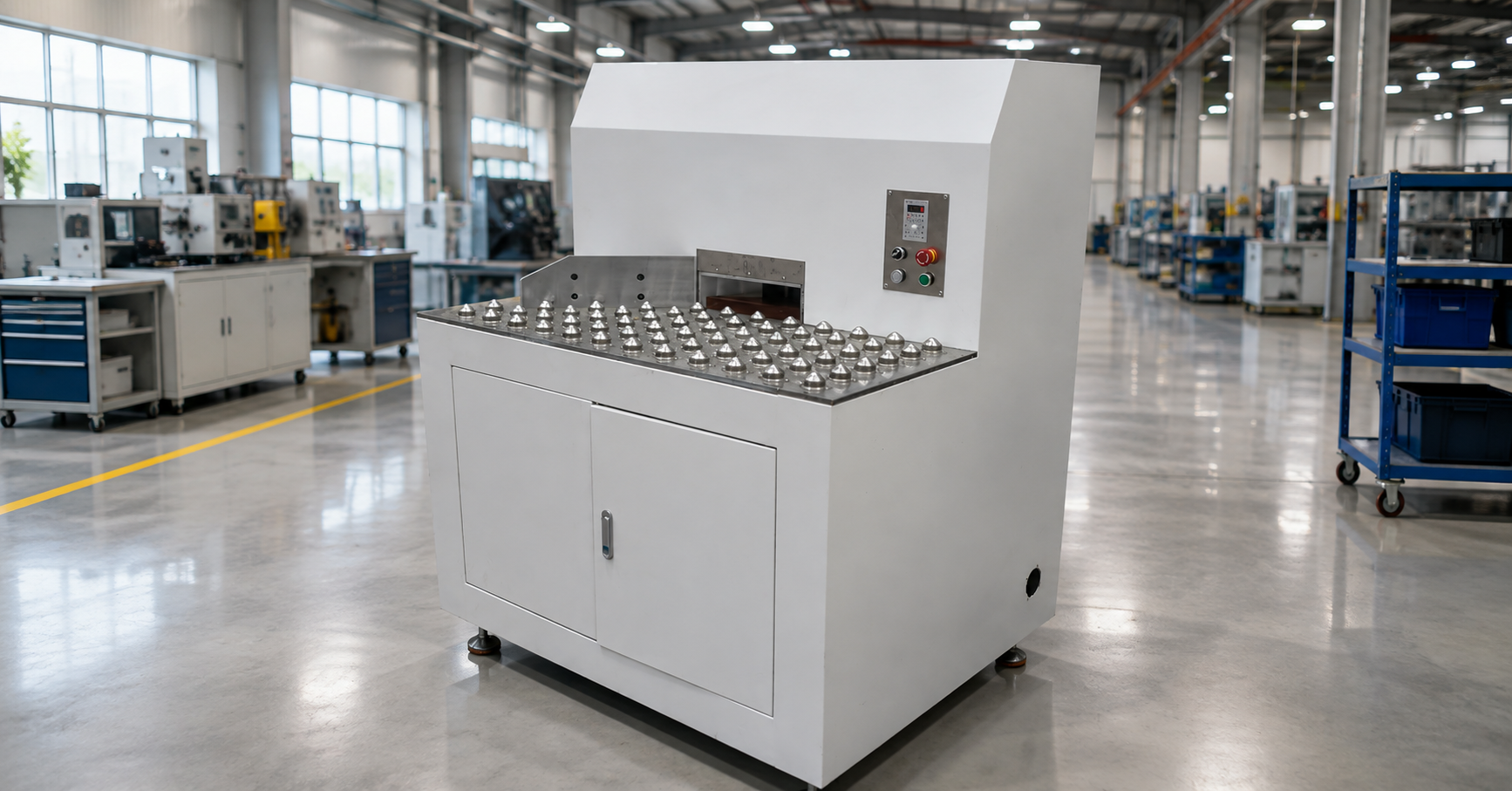
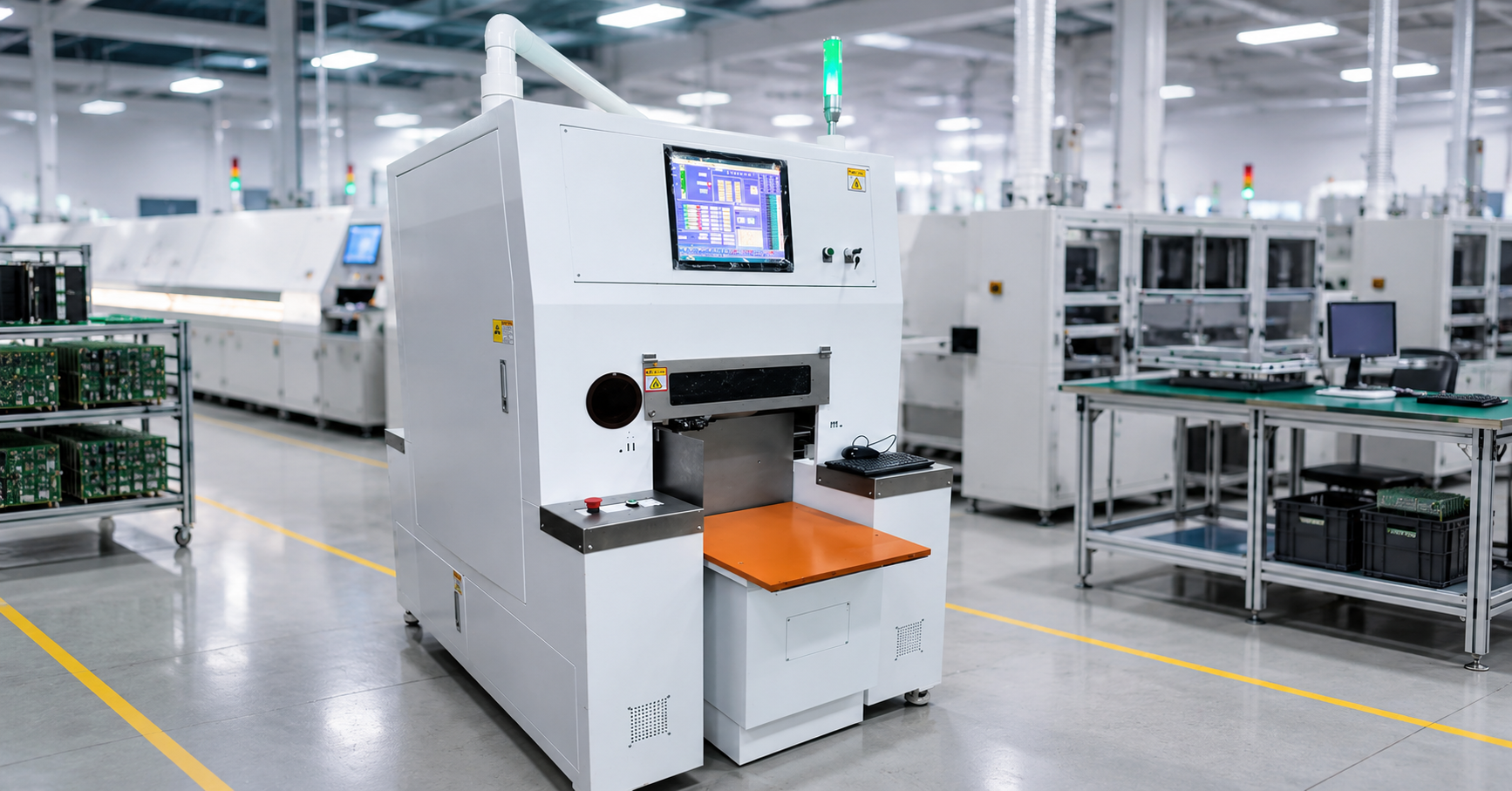
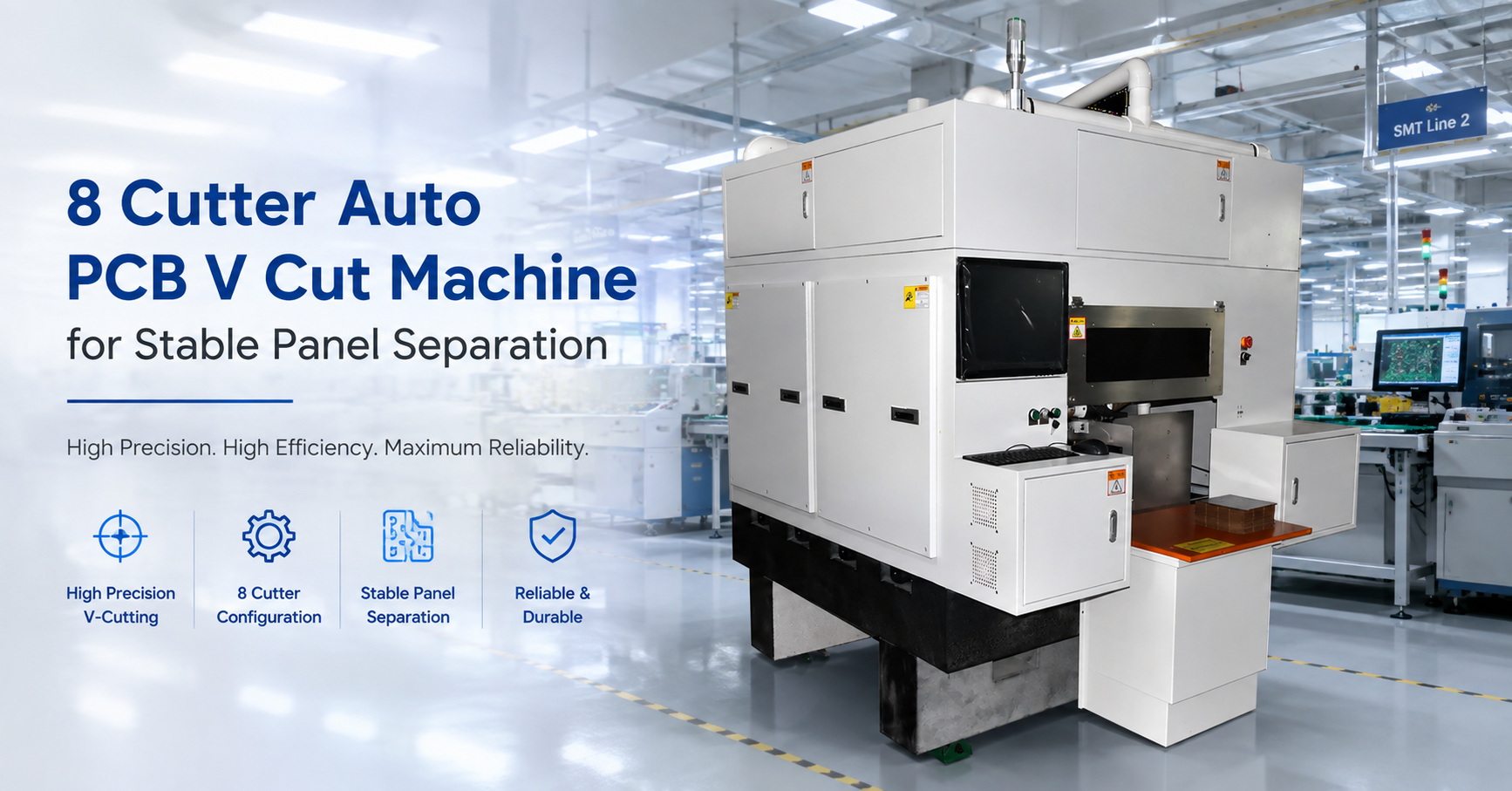
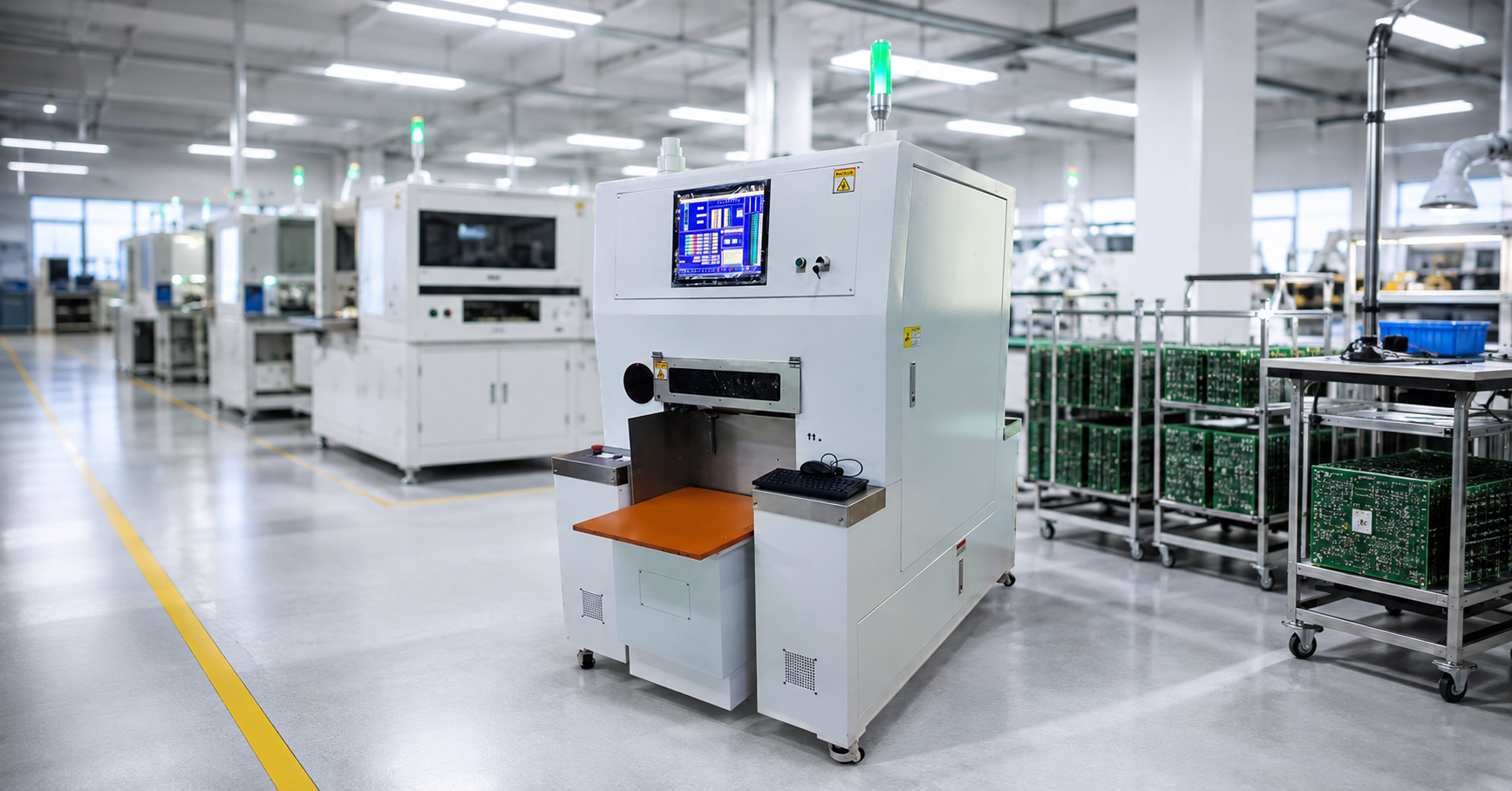
The core value of a 6 cutter auto PCB V cut machine is process control. Instead of relying mainly on manual force or a simple open cutting method, this type of equipment gives operators a controlled workstation for repeated V-cut processing. Chikin’s product page describes the machine as a floor-standing enclosed industrial unit with a touchscreen HMI, status tower light, front loading area, and protected internal work chamber. The page also notes that the cabinet-style body and warning labels indicate a safety-focused design for controlled production environments.
For factories, this means the equipment is not only a cutting tool. It is a production station. It helps define where the operator loads the panel, how the cutting operation is managed, how machine status is monitored, and how the process is separated from surrounding activity on the shop floor.
The model name points to a six-cutter configuration. According to the product page, this is valuable for buyers who are looking at throughput-oriented panel processing, because a multiple blade setup can support faster scoring or cutting cycles than a single-tool approach, especially when production involves repeated board sets.
Why Does the Six-Cutter Configuration Matter?
A single-tool V-cut method may be practical for lower-volume production or simple panel separation. But when a PCB factory handles repeated board families, larger order quantities, or a more stable panel format, a multi-blade structure can help improve production rhythm.
The six-cutter layout gives the machine a stronger production identity. It is not simply a bench-top separator for occasional use. It belongs to the industrial class of PCB separation equipment, as Chikin’s product page notes.
For B2B factories, the six-cutter concept matters in several ways:
It can support more efficient repeated panel processing.
It can reduce reliance on one single tool path.
It can make batch V-cut processing easier to standardize.
It can help reduce operator fatigue when the same panel family runs repeatedly.
It can make the separation station more suitable for production-line use.
However, buyers should not choose this machine only because it has six cutters. The cutter configuration must match the factory’s actual PCB panel design, board size, scoring layout, production volume, and changeover needs. A strong PCB V cut machine manufacturer should review those details before recommending a configuration.
Key Capabilities Buyers Should Understand
| Capability | What the Product Page Indicates | Why It Matters for PCB Factories |
|---|---|---|
| Six-cutter configuration | The model name points to a six-cutter setup for throughput-oriented panel processing | Useful for repeated board sets and batch production |
| Controlled panel separation | Designed for cleaner and more consistent PCB panel separation | Helps reduce edge stress, dust, and uneven break lines |
| Enclosed industrial layout | Floor-standing enclosed unit with protected internal work chamber | Supports safer operation and better process discipline |
| Touchscreen HMI | Integrated screen for machine interaction | Helps operators set jobs, monitor status, and reduce setup confusion |
| Status tower light | Tower light, front buttons, and utility features are visible | Supports machine awareness in busy workshops |
| Front loading area | Visible front work area for operator access | Helps create a more orderly loading and unloading process |
| Utility management | Vent or exhaust connection shown on the machine | Relevant for production environments where dust or process cleanliness matters |
| Customization potential | Cutter layout, worktable style, loading direction, interlocks, control language, exhaust connection, and cabinet layout may be discussed | Helps match the machine to different factory workflows |
How Does Enclosed Operation Improve Daily Production?
The enclosed structure is one of the most important visible advantages of this machine. Chikin’s page states that the cabinet structure gives the machine a guarded working environment, which matters when production safety, contamination control, or operator discipline are part of the purchasing decision.
In a real PCB factory, this can make a difference. Open cutting stations may be easy to access, but they depend more heavily on operator discipline. If several operators use the same station across different shifts, small handling differences can create inconsistent results. An enclosed workstation gives the process a clearer boundary.
The operator knows where the panel should enter.
The machine status can be seen through the tower light.
The control interface is placed in a defined position.
The internal work chamber is more protected than an open cutting area.
The production area looks more organized and easier to manage.
This does not mean an enclosed machine automatically solves every problem. The buyer still needs to check access doors, service space, cleaning method, cutter replacement, exhaust routing, and maintenance requirements. But for factories that want a more professional production environment, enclosed operation is a clear advantage over simple open-frame equipment.
Why Touchscreen Operation and Status Indication Matter
A touchscreen HMI may look like a simple feature, but in factory use it affects training, job setup, and production communication. Chikin’s page notes that the integrated screen suggests straightforward machine interaction for setting jobs, monitoring status, and guiding daily operation. The page also mentions the tower light, front buttons, and vent or exhaust connection as details that support visibility, machine awareness, and stable operation in a busy workshop.
For a PCB assembly or manufacturing line, these details help supervisors and operators understand what the machine is doing. If the machine is ready, paused, alarming, or waiting for operator action, the status should be visible. This is especially useful in production cells where one operator may manage more than one process station.
A factory buyer should ask the supplier:
What information does the HMI display?
Can different jobs or panel programs be saved?
Is the control language suitable for local operators?
How are alarms shown?
Can operating parameters be protected by access level?
Is the tower light linked to machine status or alarms?
What training materials are provided?
These questions turn a visible feature into a real production evaluation.
What Materials and Finish Details Suggest About Factory Use
The product page describes the enclosure as painted sheet metal with a light gray or white industrial finish, darker trim panels, and an orange working platform or tray. It notes that this combination is typical of factory equipment designed for durability and easier maintenance.
This matters because PCB factories often care about clean presentation, wipe-down convenience, and long-term equipment appearance. A controlled electronics production area usually benefits from machines that are easy to identify, clean, inspect, and maintain.
Still, appearance should not replace technical confirmation. Chikin’s page also advises buyers to ask about blade material, guide rail construction, and durability of fixture surfaces, because those details affect long-term consistency more than appearance alone.
That is a useful reminder. A professional-looking machine is a good starting point, but the buyer must still confirm the internal tool structure, cutter service life, guide method, alignment design, fixture options, and maintenance routine.
How Should Buyers Choose This Product?
Choosing a 6 cutter auto PCB V cut machine should begin with the PCB panel, not the machine photo. A good buying process starts with real production data.
Buyers should prepare:
PCB panel size.
Board thickness.
V-groove or scoring design.
Number of boards per panel.
Component clearance near the cut line.
Required edge quality.
Expected output per shift.
Current separation method.
Current quality problems.
Need for manual loading, semi-automatic operation, or line integration.
Factory space and exhaust requirements.
The product page recommends that buyers confirm the exact application, working range, and supported PCB thickness directly with the supplier. It also states that tool configuration, alignment method, and serviceability should be reviewed before purchase if the machine is intended as a PCB V cut separator.
This is important because the page does not publish complete numerical specifications. Buyers should not assume working range, board thickness support, cutter dimensions, or process speed. These details should be confirmed through technical communication and, if possible, sample testing.
How Is This Product Different from Simpler Market Options?
Compared with simpler market options, this machine stands out in four areas.
First, it uses a six-cutter concept rather than a basic single-tool setup. This makes it more relevant for repeated board sets and throughput-oriented production.
Second, it uses an enclosed industrial layout instead of a casual bench-top format. The page describes a guarded workstation with cabinet-style body, warning labels, and protected internal chamber.
Third, it provides operator-focused features such as touchscreen HMI, tower light, front buttons, and front loading area. These details support daily operation, training, and machine awareness.
Fourth, it allows buyers to discuss customization. The product page mentions cutter layout, worktable style, loading direction, safety interlocks, control language, exhaust connection, cabinet layout, board dimensions, fixture compatibility, and operator access as customization or confirmation points.
A simple cutter may only answer the question “Can it separate the panel?” This machine is better positioned to answer a broader factory question: “Can the separation process become safer, more consistent, and easier to manage?”
How Should Buyers Evaluate a Supplier?
A good PCB depaneling machine supplier should not only sell equipment. It should help the buyer determine whether the machine fits the panel design and production rhythm.
When evaluating a supplier, buyers should check:
Does the supplier ask for panel drawings?
Does the supplier confirm board thickness and scoring layout?
Can the supplier explain the cutter configuration?
Can the machine be tested with real sample panels?
Does the supplier provide HMI language support?
Are spare cutters and key components available?
Is remote support available after installation?
Can customization be discussed before production?
Does the supplier understand SMT or PCB production workflow?
Chikin’s product page invites buyers to share PCB size, panel layout, and production target, then request a configuration matched to their workflow. It also asks buyers to contact the company with panel drawings and process needs to discuss the right automatic PCB V cut machine configuration.
That is the correct B2B approach. A supplier should match the equipment to the factory’s real process, not only quote based on a product name.
Common Buying Mistakes
One common mistake is choosing only by cutter number. A six-cutter machine is useful when the cutter layout matches the board family. If the factory changes panel designs constantly, changeover and adjustability may be more important than cutter count.
Another mistake is ignoring board thickness and V-groove design. Even a stable machine cannot compensate for unsuitable panel design or inconsistent upstream scoring.
A third mistake is comparing only purchase price. Lower-cost machines may appear attractive, but the total cost includes edge defects, dust, operator fatigue, machine downtime, service problems, and spare parts.
A fourth mistake is overlooking maintenance access. The cutter system, guide structure, worktable, exhaust path, and control elements must be easy enough to inspect and maintain.
The final mistake is skipping sample validation. Before placing a bulk order, buyers should test real panels whenever possible. This helps confirm separation quality, edge appearance, operator workflow, and fixture suitability.
FAQ
What is a 6 cutter auto PCB V cut machine used for?
A 6 cutter auto PCB V cut machine is used for cleaner, safer, and more consistent separation or V-cut processing of PCB panels. Chikin describes it as an enclosed industrial workstation for repeatable V-cut processing and controlled production use.
Why is the six-cutter configuration useful?
The product page states that the six-cutter configuration is valuable for throughput-oriented panel processing and can support faster scoring or cutting cycles than a single-tool approach, especially for repeated board sets.
Is this machine suitable for every PCB panel?
Not necessarily. Buyers should confirm PCB size, panel layout, board thickness, scoring design, alignment method, and actual working range with the supplier before purchase.
Why is the enclosed structure important?
The enclosed cabinet-style structure provides a guarded work environment. This supports safer daily use, better process control, and more disciplined production compared with open cutting stations.
What should buyers send before requesting a quote?
Buyers should send panel drawings, PCB size, panel layout, board thickness, production target, current process problem, and any requirements for fixture compatibility, operator access, exhaust connection, or machine language.
Conclusion
A 6 cutter auto PCB V cut machine is worth considering when a PCB factory wants cleaner panel separation, safer enclosed operation, and more consistent V-cut processing. Its value is not only in the number of cutters. It is in the full production structure: six-cutter configuration, enclosed cabinet, touchscreen HMI, tower light, front loading area, protected internal chamber, utility management, and customization potential.
For B2B buyers, the best decision starts with real panel data. Before comparing price, confirm board size, panel layout, V-groove design, board thickness, output requirement, alignment method, maintenance access, and supplier support. A machine that matches these details can help reduce operator variability, improve separation consistency, and create a more reliable depaneling station for factory production.