



How Can Manufacturers Choose an Automatic Net Drawing Machine for Stable Large-Format Material Handling?
Large-format material handling often looks simple from a distance.
A sheet is placed on a table. The edges are fixed. The material is stretched or held in position. Processing begins.
Inside a real factory, however, the situation is usually more complicated.
A wide mesh may develop uneven tension from one side to the other. A flexible film can shift slightly during setup. A large textile or sheet material may remain flat near the clamps while developing wrinkles closer to the center. When these variations continue into printing, coating, inspection, assembly, or another downstream process, the problem is no longer limited to material handling.It can affect registration, repeatability, waste, labor requirements, and overall production stability.
That is why buyers searching for an automatic net drawing machine should avoid treating it as simply a large table with clamps.
The actual purchasing question is more specific:
Can the machine hold, tension, and position the customer's material in a repeatable way that matches the real production process?
This distinction matters. Two machines can have similar external dimensions and still perform very differently if their frame rigidity, clamping distribution, tensioning method, control logic, material compatibility, and serviceability are not comparable.
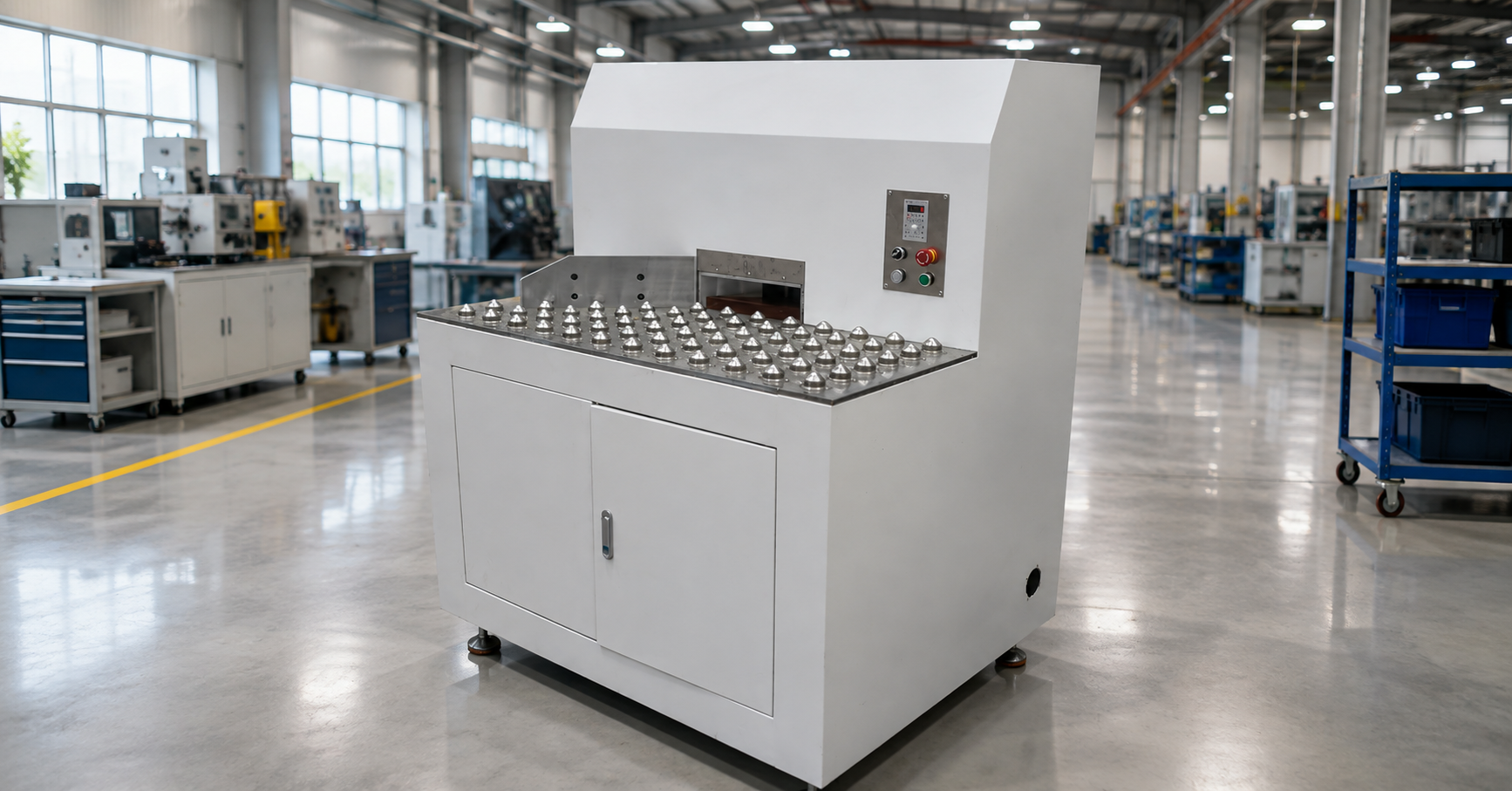
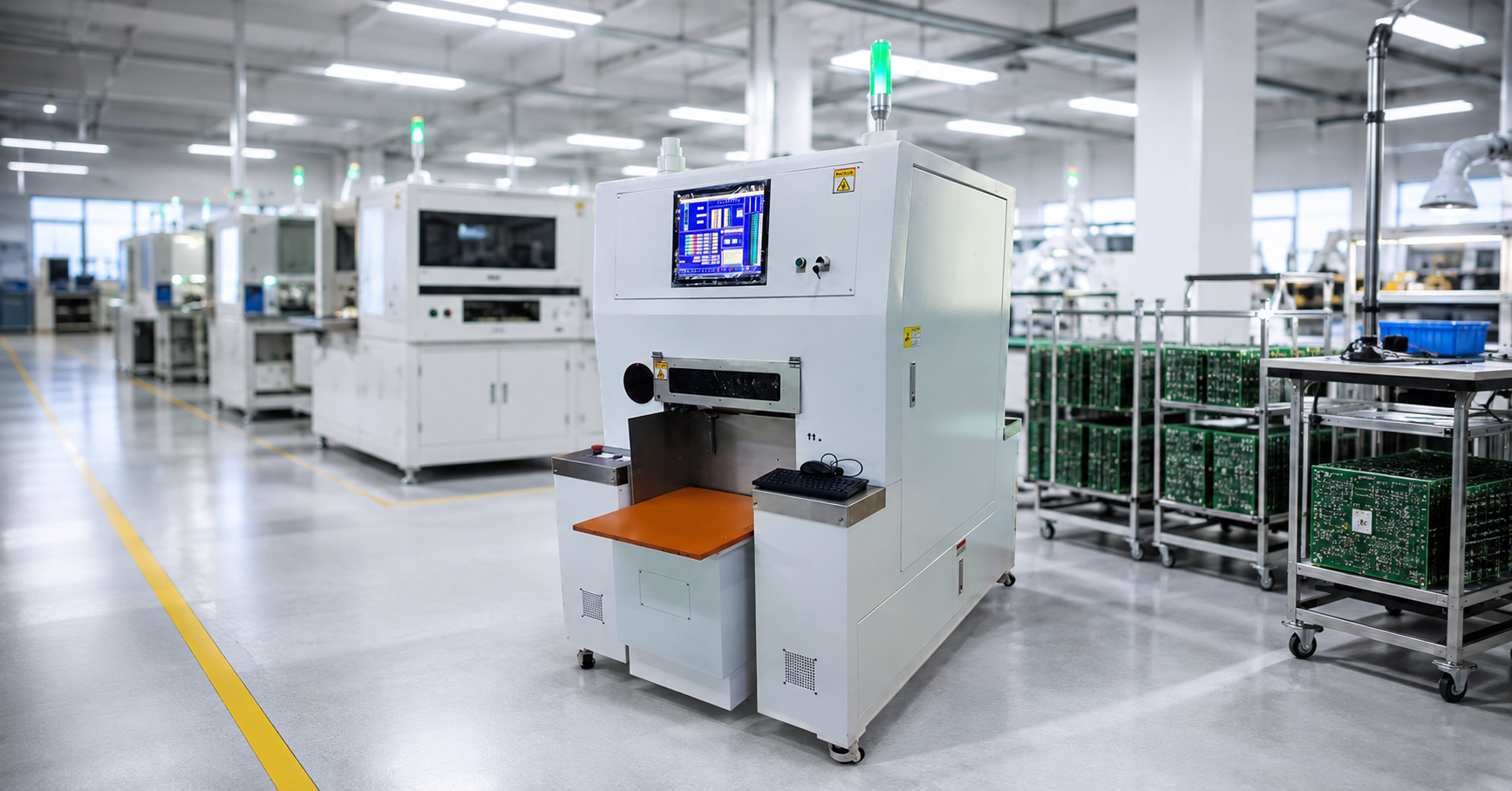
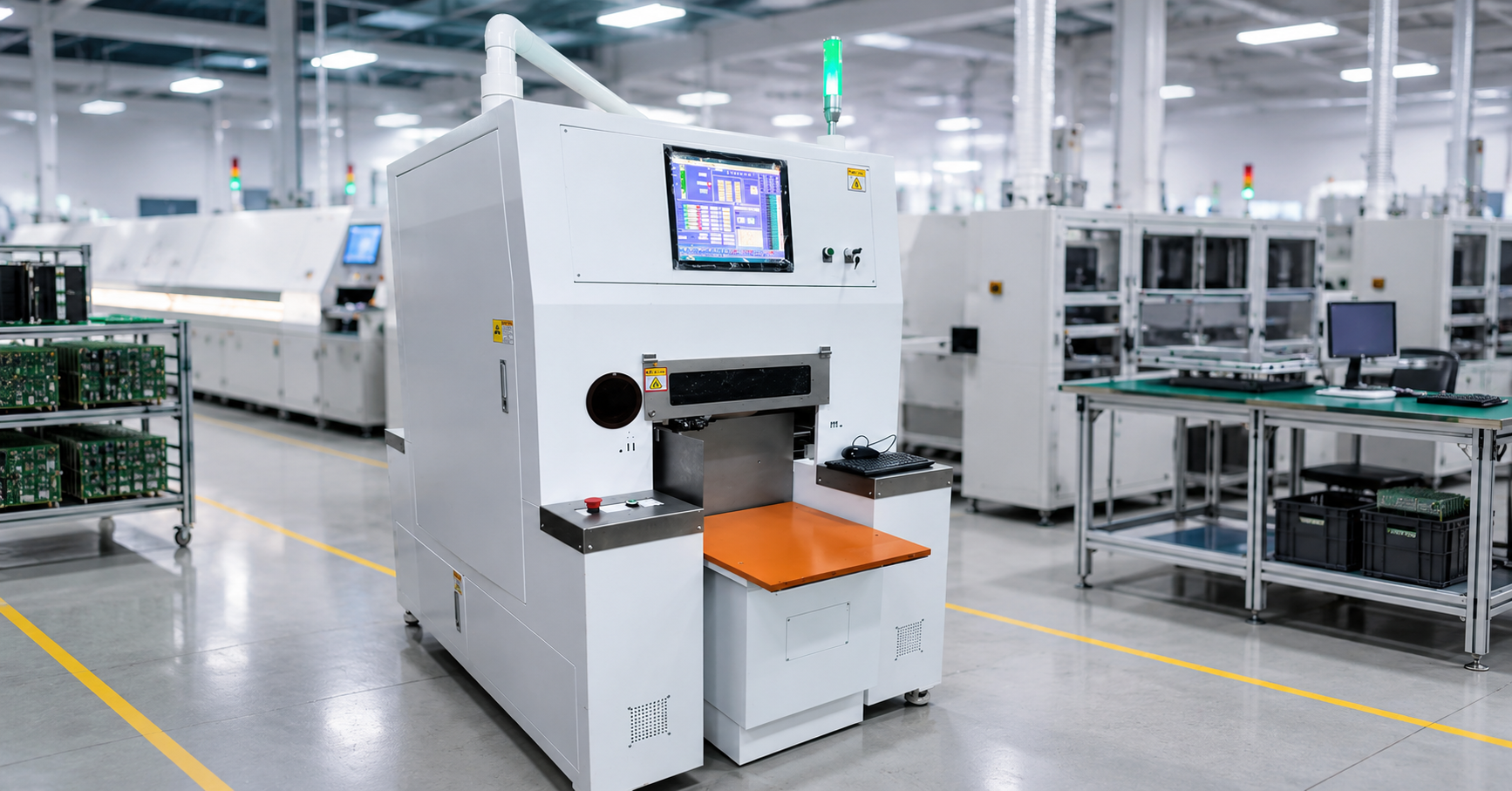
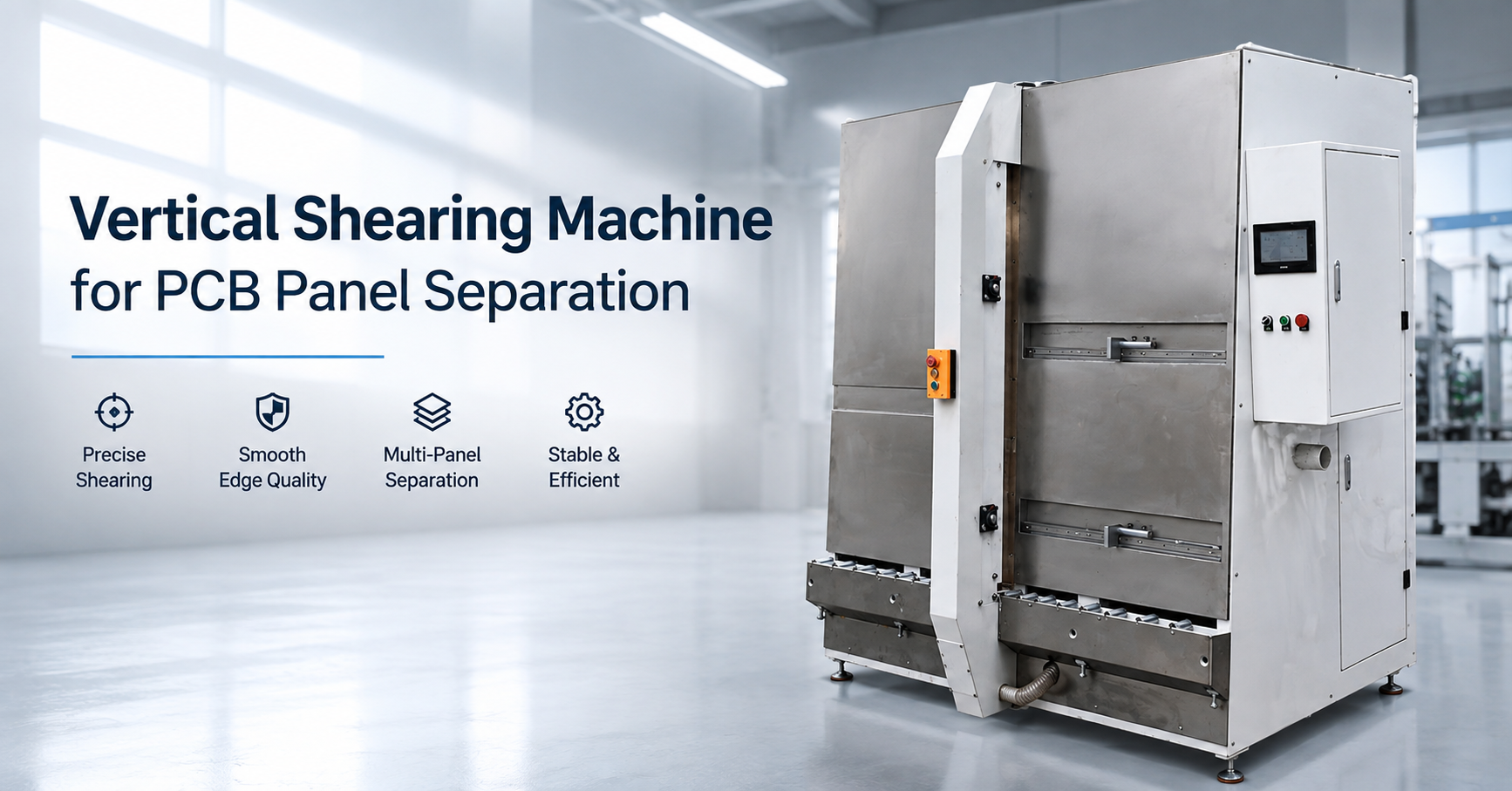
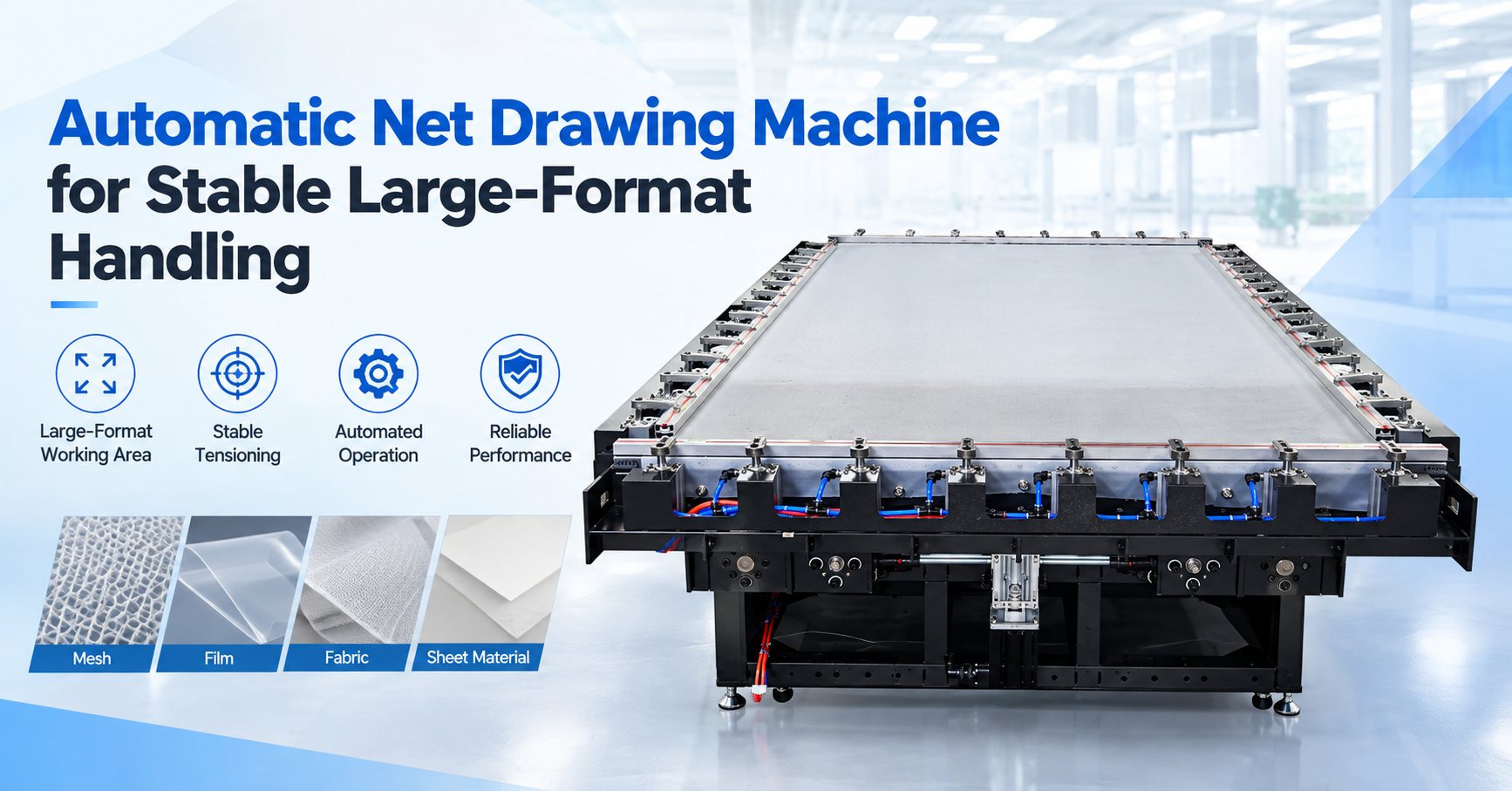
The CHIKIN CNC product, Automatic Net Drawing Machine for Stable, Large-Format Material Handling, is presented as an industrial platform designed to help keep wide, flexible materials flat, aligned, and controlled across a large working surface. Its visible structure includes a broad rectangular working bed, repeated perimeter clamping or module positions, industrial structural supports, and pneumatic/control hardware. According to the product page, the machine may be considered for mesh, film, fabric, and other sheet-like substrates where stable positioning and controlled handling are important.
For a factory buyer, that creates several important areas to evaluate before sending an RFQ.
This article explains what they are.
Why Is Large-Format Material Handling More Difficult Than It First Appears?
Small materials are relatively easy to control.
An operator can often position a small sheet manually, inspect its edges, make a minor adjustment, and restart the operation. The material itself has less area in which to deform, sag, shift, or develop uneven tension.
Large-format materials behave differently.
As the working width increases, several variables become more important at the same time:
- material flexibility
- edge condition
- weight distribution
- tension requirements
- clamp spacing
- surface flatness
- frame rigidity
- setup consistency
- operator handling
- downstream process accuracy
A large sheet does not necessarily fail because the machine lacks enough power. In many cases, the problem is inconsistency.
One production cycle may appear acceptable. The next may show slight edge movement. A third may develop localized wrinkles. The material can be physically inside the correct working area while still not being held consistently enough for the process that follows.
This is particularly relevant where the material is used as a reference surface for another operation.
For example, screen-related processing may require stable material positioning before downstream printing. Coating operations may be affected by wrinkles or inconsistent flatness. Inspection can become less reliable if the material position changes. A flexible sheet may also require a different clamping strategy from a relatively stiff substrate.
The purpose of an industrial large format tensioning system is therefore not simply to make the material tight.
It is to create a controlled and repeatable condition.
That is a much higher requirement.
What Is an Automatic Net Drawing Machine?
An automatic net drawing machine is industrial equipment used to stretch, tension, position, or securely hold large-format flexible materials during a manufacturing process.
Depending on the machine configuration and the customer's actual application, the equipment may support workflows involving:
- mesh materials
- screen-related processing
- flexible films
- fabric and textile materials
- sheet-like industrial substrates
- printing preparation
- coating preparation
- inspection
- alignment
- assembly
- finishing processes
The product page for the CHIKIN CNC machine describes the basic production problem clearly: wide and flexible materials need to remain flat, aligned, and controlled during processing. Uneven tension can contribute to wrinkles, registration drift, waste, and rework. The machine is therefore built around a rigid bed, distributed perimeter holding points, and an industrial automation-oriented layout.
It is important, however, not to assume that every automatic mesh drawing machine is identical.
The exact machine should be selected according to the material and process.
A system suitable for one mesh size may not automatically suit another. Film thickness, edge strength, required tension, production dimensions, and downstream processing conditions can all change the preferred configuration.
For this reason, an experienced buyer should begin with the application rather than the catalog.
Start with the Material, Not the Machine
One of the most common purchasing mistakes is choosing the equipment first and defining the process later.
The better sequence is the opposite.
Before comparing suppliers, the buyer should document the material being handled.
At a minimum, the supplier should understand:
- Material type
Is the material mesh, fabric, film, or another flexible substrate? - Maximum length and width
The usable processing dimensions are more important than the machine's outside dimensions. - Material thickness
Thin and highly flexible materials may behave differently from heavier substrates. - Edge condition
Can the material tolerate direct mechanical clamping? Does it require protective contact surfaces? - Required tension or holding condition
Some processes require a defined tension range. Others primarily require stable flat positioning. - Production frequency
Is the machine being used occasionally, several times per shift, or continuously? - Changeover frequency
Does the factory repeatedly process one format, or change materials and sizes often? - Downstream process
Is the machine supporting printing, coating, inspection, assembly, or another operation?
These answers directly affect machine selection.
A buyer who only asks, “What is your price for an automatic net drawing machine?” is not yet providing enough information for a technically meaningful quotation.
A more useful question is:
“We process this material, at this size, with this required tension or flatness condition, and the next process is this. How should the machine be configured?”
That conversation gives both the manufacturer and the buyer a clearer technical starting point.
Why Does the Working Area Matter?
Working area is one of the first specifications buyers notice.
It is also one of the easiest specifications to misunderstand.
A machine may have a large physical footprint, but the usable processing area can be smaller after accounting for clamps, edge restraint, safety clearance, or structural components.
The buyer should therefore ask specifically for:
- effective working area
- minimum usable material size
- maximum usable material size
- edge gripping area
- clamp interference zones
- loading direction
- clearance around the machine
- maintenance access requirements
The CHIKIN CNC product is described as having a broad horizontal working platform for large-format materials.The repeated perimeter holding positions are intended to support distributed material restraint rather than relying on only a few isolated fixing points. This design approach can be valuable where a large sheet needs to remain stable across a wide surface.
A larger bed can also reduce the need to divide one production job into multiple smaller handling steps.
That may improve workflow efficiency.
But larger is not automatically better.
An oversized machine can consume unnecessary floor space, increase installation complexity, and cost more than the process requires. The correct working area is the one that provides sufficient processing capacity with practical access around the equipment.
How Important Is Distributed Clamping?
Very important—but only if the clamping system matches the material.
A large-format flexible material is rarely controlled equally well by one or two strong holding points.
Imagine pulling a wide sheet from only two edges. The central area may behave differently from the outer sections. Localized force can create distortion, while insufficient restraint can allow movement.
This is why distributed perimeter control is an important design consideration.
The visible CHIKIN CNC machine structure includes repeated clamp or module assemblies around the work zone. The product description states that this layout suggests distributed control over the sheet or mesh being processed and is intended to support more even handling across the working surface.
When evaluating this type of design, buyers should ask:
- How many effective clamping points are used?
- Can clamp positions be adjusted?
- Is clamping force independently controlled?
- What protects the material at the contact point?
- Can damaged or worn clamp components be replaced individually?
- Does the layout change for different material widths?
- How is tension distributed across the edges?
These questions are more useful than simply asking whether the machine is “automatic.”
Automation does not automatically guarantee even material handling.
The mechanical system still matters.
Table 1: Key Factors to Compare Before Buying an Automatic Net Drawing Machine
| Evaluation Factor | Why It Matters | Questions for the Supplier |
|---|---|---|
| Effective working area | Determines whether the material can be processed without excessive handling | What is the actual usable area after clamping? |
| Frame rigidity | Helps maintain stable positioning across large dimensions | How is the frame designed to support the working load? |
| Clamping layout | Affects edge holding and tension distribution | How many clamping zones are used? |
| Material compatibility | Prevents damage and poor process matching | What materials and thickness ranges can be evaluated? |
| Tension control | Important for flatness and repeatability | How is tension adjusted and verified? |
| Automation method | Influences labor and setup consistency | Which operations are automatic and which remain manual? |
| Changeover | Affects production flexibility | How long does it take to change material formats? |
| Maintenance | Influences long-term uptime | Which parts require routine inspection or replacement? |
| Customization | Important for non-standard production | Can the bed, clamps, and controls be adapted? |
| Technical support | Important during installation and troubleshooting | Who provides engineering and after-sales support? |
Manual Adjustment vs Automated Material Handling
Manual fixtures can still be appropriate for some factories.
A low-volume operation with frequent experimental work may prefer a simpler setup because operators can make direct adjustments quickly. A manual fixture may also have a lower initial investment.
The disadvantages appear when consistency becomes more important.
Manual stretching or positioning can depend on:
- operator skill
- adjustment sequence
- applied force
- visual judgment
- individual working habits
- fatigue
- production pressure
Two experienced operators may still set the same material differently.
That does not mean manual work is poor. It means manual work has more process variables.
An automatic net drawing machine can reduce some of these variables by creating a more structured sequence for clamping, positioning, and material handling.
The CHIKIN CNC product page describes visible pneumatic tubing and control hardware associated with an industrial automation layout. Pneumatic actuation may support clamping, positioning, or other handling functions depending on final configuration. The exact operating arrangement should be confirmed for the customer's application.
This last point is important.
Buyers should not accept vague descriptions such as “fully automatic” without asking what the machine actually automates.
Does automatic mean:
- automatic clamping?
- automatic tension adjustment?
- automatic position control?
- automatic cycle sequencing?
- automatic material loading?
- automatic unloading?
These functions are not interchangeable.
What Should Buyers Check in the Tension Control System?
Tension control is often one of the most critical parts of the machine selection process.
Too little control can allow:
- wrinkles
- edge movement
- local slack areas
- poor registration
- unstable downstream processing
Excessive or uneven tension can create another set of problems.
The material may distort, the edges may become damaged, or the applied force may not match the substrate's mechanical properties.
The correct goal is not “maximum tension.”
The goal is appropriate and repeatable tension.
Buyers should therefore discuss the actual process requirement with the supplier.
Useful questions include:
- What tension range is required?
- Does every material require the same setting?
- How is tension adjusted?
- How repeatable is the setting?
- Can the process be tested with customer samples?
- Is tension measured directly or controlled indirectly through the machine mechanism?
- How does the machine prevent one area from receiving substantially different restraint from another?
A supplier should be able to explain the difference between a machine that merely pulls material and one designed to support controlled production handling.
Why Frame Rigidity Should Not Be Ignored
Large-format equipment works across long distances.
That makes structural stability important.
A small fixture can sometimes tolerate a relatively light structure because the distances between support points are short.A large-format platform faces different mechanical conditions.
Potential influences include:
- machine loading
- material tension
- repeated cycles
- floor condition
- structural deflection
- vibration from nearby equipment
- uneven installation
The CHIKIN CNC machine is described as having a heavy-duty industrial frame and broad rectangular working structure intended to provide stable support for the material across the working surface.
When comparing an industrial net drawing equipment manufacturer, the buyer should not judge rigidity only by the thickness of visible sheet metal.
A good technical discussion should cover:
- main structural members
- support points
- load path
- bed flatness requirements
- installation and leveling
- repeated-cycle stability
The factory does not necessarily need the heaviest machine available.
It needs a structure appropriate to the process.
Overbuilding adds cost. Underbuilding can create stability problems that are difficult to correct later.
What Applications Can This Type of Machine Support?
The CHIKIN CNC product page identifies several application scenarios where stable large-format handling may be useful, including textile and fabric handling, screen or wide-format printing support, mesh, film and sheet tensioning, specialty substrate processing, electronics or precision assembly support, and inspection, coating, and finishing workflows. Final suitability depends on the actual machine configuration and process requirements.
This range of applications demonstrates why buyers must clearly define their process.
The same basic machine architecture may need different details depending on the job.
Screen and Printing-Related Applications
Stable mesh positioning can influence consistency before downstream operations.
The machine selection should focus on:
- tension uniformity
- frame compatibility
- material positioning
- repeatability
- changeover requirements
Film Processing
Films can be sensitive to wrinkles and surface damage.
The buyer should confirm:
- clamp contact design
- material protection
- required tension
- static or environmental considerations
- loading method
Textile and Fabric Handling
Fabric behavior can change with weave, thickness, elasticity, and humidity.
A supplier should not assume that all fabrics can use identical settings.
Coating and Inspection
These processes may require the material to remain flat and consistently positioned.
Here, the key question is often not only tension but also whether the complete system maintains stable positioning during the downstream operation.
Should Buyers Choose a Standard Machine or Request Customization?
That depends on how standardized the production is.
A standard machine can offer advantages:
- shorter engineering discussion
- simpler specification process
- easier initial comparison
- potentially lower cost
- proven standard architecture
Customization becomes more relevant when the buyer has unusual requirements involving:
- non-standard material dimensions
- special clamp spacing
- unusual material edges
- specific factory layout
- integration with existing equipment
- special control interfaces
- customized automation sequence
The CHIKIN CNC product page specifically identifies potential customization areas such as working area size, clamp spacing, control style, frame height,tubing layout, and integration with upstream or downstream automation. It also recommends sharing sample dimensions, tension requirements, and line-layout information before configuration is finalized.
For B2B procurement, customization should not be viewed as automatically positive.
Too much customization can create unnecessary complexity.
The better objective is:
Standardize what can be standardized. Customize only what the process genuinely requires.
That usually produces a more manageable machine specification.
How Should a Factory Evaluate an Automatic Net Drawing Machine Supplier?
A machine is only one part of the purchasing decision.
Industrial equipment requires communication before delivery and support after installation.
For that reason, the automatic net drawing machine supplier should be evaluated as carefully as the machine itself.
1. Does the Supplier Understand the Application?
The supplier should ask technical questions.
That is generally a positive sign.
A serious industrial project may require information about:
- material
- dimensions
- tension requirement
- production process
- output
- changeover
- automation level
- available installation space
A supplier that quotes immediately without understanding the process may be quoting a generic product rather than an appropriate solution.
2.Can the Supplier Explain the Machine Clearly?
Technical explanations should distinguish between:
- standard equipment
- optional equipment
- custom functions
- application-dependent functions
Buyers should be cautious when a supplier describes every possible feature as if it were included in the quoted configuration.
3. Can the Supplier Support Custom Engineering?
For non-standard production, engineering communication matters.
The buyer should ask who is responsible for:
- mechanical design changes
- electrical modifications
- control integration
- installation requirements
- acceptance testing
Direct technical communication can be especially valuable for customized equipment.
4. Is Sample Testing Available?
Whenever practical, testing the customer's actual material is one of the best ways to reduce uncertainty.
A brochure cannot reveal everything.
Sample testing can help evaluate:
- material flatness
- clamp interaction
- tension behavior
- setup sequence
- repeatability
- handling practicality
The CHIKIN CNC product page also recommends sharing material specifications and production requirements to confirm application fit before selecting a final configuration.
5.What Happens After Installation?
Ask about:
- installation guidance
- commissioning
- operator training
- spare parts
- remote support
- troubleshooting procedures
The purchase price is only one part of equipment cost.
Downtime can be far more expensive.
Table 2: Automatic Net Drawing Machine Manufacturer vs Trading Company
| Procurement Factor | Direct Equipment Manufacturer | Trading Company |
|---|---|---|
| Technical communication | May communicate directly with engineering and production teams | May require coordination with another factory |
| Customization | Can potentially coordinate design changes directly | Depends on the underlying manufacturer |
| Production knowledge | Usually closer to assembly and manufacturing processes | Depends on technical resources |
| Design modification | May be easier to discuss at the source | Can involve additional communication layers |
| Spare parts coordination | Potentially more direct | May require third-party coordination |
| Factory testing | Buyers may have more opportunity to discuss acceptance requirements | Depends on supplier arrangement |
| Best choice | Useful for technically customized projects | May be suitable when trading support and sourcing convenience are priorities |
This comparison does not mean every manufacturer is automatically better or every trading company is unsuitable.
The buyer should evaluate the actual supplier.
A technically capable trading company with strong engineering support may be preferable to a poorly organized factory. Conversely, a direct automatic net drawing machine manufacturer can provide advantages when the project requires detailed customization and direct technical communication.
The important issue is not the label.
It is the supplier's actual capability.
A Practical Factory Scenario
Consider a manufacturer processing wide flexible mesh for a downstream production stage.
Initially, the factory uses manual handling.
Operators secure the material at several positions, adjust it visually, and begin processing. The system works reasonably well for occasional production.
As volume increases, several issues begin to appear.
One shift produces acceptable results. Another requires more adjustment. Setup time varies. Some operators pull the material more tightly than others.The factory cannot easily determine whether downstream variation is caused by the next process or by inconsistent material preparation.
The production manager then evaluates an automatic mesh drawing machine.
The correct purchasing process would not begin by choosing the largest machine.
Instead, the factory should measure:
- maximum material dimensions
- minimum dimensions
- material behavior under tension
- edge strength
- required production rate
- changeover frequency
- required consistency
- available floor space
- downstream process requirements
The supplier can then evaluate whether a large-format platform with distributed perimeter restraint is suitable.
If the proposed machine supports the material correctly, the factory may gain a more repeatable setup condition.
The key word is may.
The machine does not automatically solve every downstream problem. It solves the material handling problem only when correctly matched to the process.
That is why application testing and clear acceptance criteria are important.
What Acceptance Criteria Should Buyers Define Before Ordering?
“Machine runs normally” is not a sufficient industrial acceptance standard.
A better FAT or pre-delivery discussion should define measurable expectations where possible.
Depending on the application, these may include:
- machine operating sequence
- effective working dimensions
- clamp operation
- material loading procedure
- control functions
- emergency stop operation
- pneumatic system operation
- repeatability of the handling cycle
- compatibility with sample material
- changeover procedure
- safety features
- documentation
If tension is a critical requirement, the buyer and supplier should also define how it will be evaluated.
The method matters.
A number written in a quotation is useful only when both sides understand what it represents and how it is measured.
Common Mistakes Buyers Make When Selecting Large-Format Tensioning Equipment
Mistake 1: Buying by Outside Dimensions
The usable area matters more.
Always confirm the actual processing zone.
Mistake 2: Assuming “Automatic” Means Fully Hands-Free
Automation can refer to many different functions.
Ask exactly what the machine automates.
Mistake 3: Ignoring Material Samples
A machine may appear technically suitable while interacting poorly with the actual material.
Test where possible.
Mistake 4: Comparing Only Initial Price
Consider installation, maintenance, spare parts, setup time, and expected downtime.
Mistake 5: Overlooking Changeover
A machine optimized for one material may not be efficient when formats change frequently.
Mistake 6: Choosing Maximum Tension Instead of Suitable Tension
More force is not automatically better.
Material stability must be matched to the process.
Mistake 7: Treating Customization as a Substitute for Process Definition
Customization cannot correct an unclear production requirement.
Define the process first.
Mistake 8: Not Reviewing Supplier Support
Industrial equipment remains a long-term operating asset after delivery.
Technical support matters.
How Does the CHIKIN CNC Automatic Net Drawing Machine Fit into This Decision?
The product, Automatic Net Drawing Machine for Stable, Large-Format Material Handling, is positioned around controlled handling of wide and flexible materials. Its visible design includes a large rectangular working area, distributed perimeter restraint points, industrial structural supports, and pneumatic/control hardware associated with repeatable production handling.The product page identifies potential applications involving mesh, film, fabric, sheet materials, printing support, coating, inspection, assembly, and finishing, while emphasizing that final process suitability should be confirmed for the customer's specific application.
From a B2B buyer's perspective, several characteristics deserve attention.
Large-Format Layout
The broad working surface is relevant where smaller fixtures would require additional material handling.
Distributed Perimeter Control
Repeated edge-mounted assemblies can support more structured restraint across a large material area.
Industrial Automation-Oriented Design
Visible control and pneumatic components suggest a design intended for factory use rather than occasional manual fixture work.
Customization Potential
The product page identifies possible adjustment areas involving working dimensions, clamp spacing, control method, machine height, pneumatic layout, and production-line integration.
Application-First Selection
Perhaps the most important advantage is not a single component.It is the opportunity to configure the machine around the actual material and workflow rather than assuming every flexible substrate requires the same solution.
For procurement teams, that is the correct approach.
The buyer should still confirm final specifications during the RFQ process.
5 Procurement FAQs About Automatic Net Drawing Machines
1. What information should I provide before requesting an automatic net drawing machine quotation?
Provide the material type, maximum and minimum dimensions, thickness, required tension or holding condition, production process, expected output, changeover frequency, automation requirements, and available installation space.
The more clearly the application is defined, the easier it is for the supplier to recommend an appropriate configuration.
2. Can one automatic net drawing machine handle different materials?
Possibly, but it depends on the material properties and machine configuration.
Different materials may require different clamping methods, contact surfaces, tension settings, and handling procedures.Buyers should provide samples or detailed material information before assuming one configuration is suitable for every product.
3. Is a larger working area always better?
No.
A larger platform can support bigger materials, but it also requires more floor space and may increase equipment cost. Buyers should select an effective working area based on the actual production dimensions plus practical handling and clearance requirements.
4. How can I compare different automatic net drawing machine suppliers?
Compare application understanding, engineering communication, machine structure, usable working area, clamping method, tension control, customization capability, sample testing, documentation, installation support, spare-parts access, and after-sales service.
Do not compare only quotation prices.
5. Should I choose a standard model or a customized machine?
Choose a standard machine when it already fits the production process.
Request customization when material dimensions, clamp requirements, automation needs, or production-line integration cannot be handled effectively by the standard configuration.
The best solution is usually not the most customized one. It is the simplest configuration that reliably meets the process requirement.
Final Buyer Checklist Before Contacting an Automatic Net Drawing Machine Manufacturer
Before contacting a supplier, prepare the following:
Material
- What exactly is being handled?
- What are its mechanical characteristics?
- Can you provide samples?
Dimensions
- Maximum width
- Maximum length
- Minimum working size
Process
- What happens before the material enters the machine?
- What happens after it leaves?
- Is tension, flatness, positioning,or all three critical?
Production
- Daily or shift output
- Batch size
- Changeover frequency
Automation
- Which operations must be automated?
- Which can remain operator-controlled?
Factory Layout
- Available floor space
- Loading direction
- Maintenance access
- Utility requirements
Acceptance
- What performance must the machine demonstrate before delivery?
This information turns a general inquiry into a technical discussion.
And that is usually where better equipment decisions begin.
Conclusion: Choose the Machine Around the Process, Not the Other Way Around
An automatic net drawing machine should not be selected simply because it has a large platform or an automated control system.
For manufacturers handling wide mesh, film, fabric, or other flexible materials, the real objective is more practical:
Can the machine keep the material stable, appropriately restrained, consistently positioned, and ready for the next production stage?
To answer that question,buyers should evaluate:
- effective working area
- frame rigidity
- distributed clamping
- material compatibility
- tension control
- automation functions
- changeover requirements
- maintenance access
- customization needs
- sample testing
- supplier engineering capability
- after-sales support
The CHIKIN CNC Automatic Net Drawing Machine for Stable, Large-Format Material Handling provides a large-format industrial platform with perimeter restraint points and an automation-oriented design for controlled handling of flexible materials. Buyers should confirm the exact material compatibility, process configuration, control functions, and final specifications with the supplier before purchase.
For factories, the best investment is rarely the machine with the longest feature list.
It is the machine that fits the material, fits the production workflow, and can continue delivering a repeatable handling condition as production requirements change.