



What Is a Precious Metal Laser Cutting Machine, and How Do You Choose the Right One?
A Precious Metal Laser Cutting Machine is industrial equipment designed to cut valuable metal materials into controlled shapes using focused laser energy and a programmed processing path. It is commonly evaluated for jewelry components, thin precious-metal sheets, decorative patterns, custom accessories, and other precision metal parts.
For jewelry manufacturers, the main advantage is not simply the ability to cut complicated designs. It is the potential to manufacture repeatable components without the physical cutting forces associated with mechanical tools.
However, laser cutting introduces challenges that are especially important when processing high-value materials.
Gold and silver can exhibit high optical reflectivity at certain laser wavelengths. Their thermal conductivity, alloy composition, thickness, and surface condition also affect how energy enters the material and how the cut develops.
An unsuitable process may produce excessive kerf width, melting, edge burrs, discoloration, incomplete separation, or unnecessary material loss.
For this reason, the best precious metal laser cutting machine is not necessarily the machine with the highest laser power or lowest purchase price.
It is the system that can produce acceptable components repeatedly while controlling material consumption, processing time, operator safety, and total manufacturing cost.
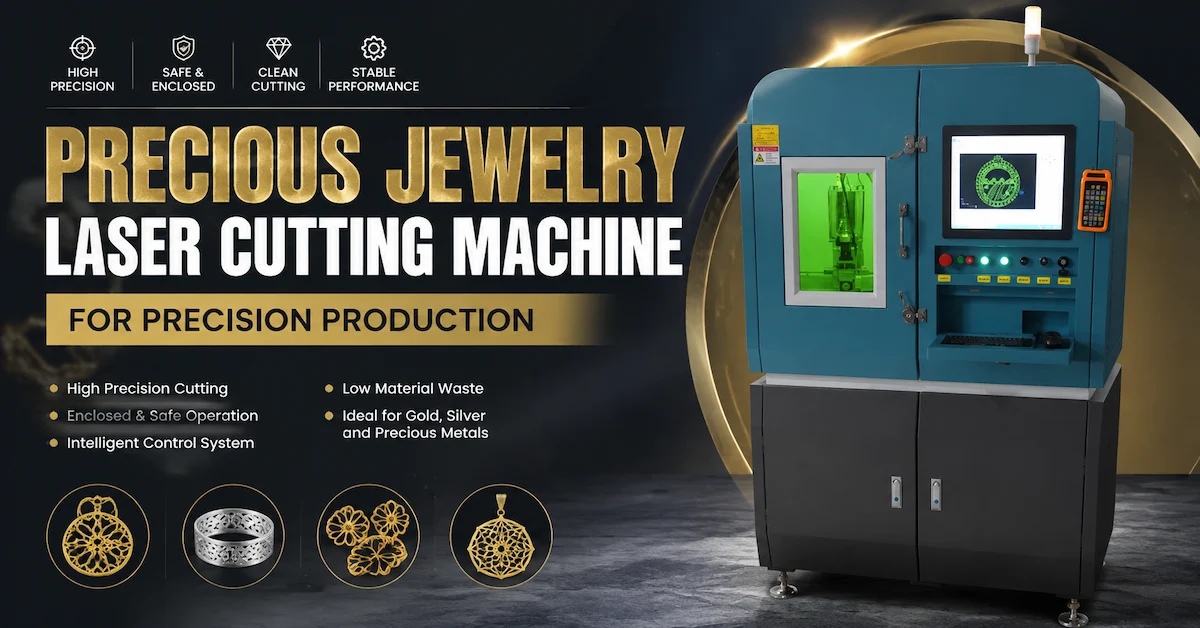
CHIKIN CNC provides a dedicated Precious Jewelry Laser Cutting Machine for buyers evaluating precision jewelry and precious-metal processing equipment.
This guide explains how to assess the technical requirements before investing in a machine, including what to test, which specifications matter, and how to compare suppliers.

Quick Answer: What Matters Most When Buying a Precious Metal Laser Cutting Machine?
For manufacturers processing gold, silver, platinum alloys, or other valuable metals, six factors should dominate the equipment selection process.
-
Material compatibility: Verify the machine's capability on the specific metal grade, alloy composition, and thickness.
-
Cut quality: Evaluate kerf width, dimensional accuracy, edge burrs, melting, oxidation, and heat-affected zones.
-
Material utilization: Calculate nesting efficiency, reusable offcuts, recoverable residues, and unaccounted metal losses.
-
Production capability: Measure actual conforming parts per hour rather than relying on maximum cutting speed.
-
Safety and containment: Examine the enclosure, laser interlocks, extraction, particulate collection, and recovery procedures.
-
Supplier verification: Require representative sample cutting, a documented technical configuration, and agreed acceptance criteria.
A jewelry manufacturer that purchases equipment without evaluating these factors may achieve acceptable cutting speed while losing money through poor material utilization, excessive polishing, or inconsistent quality.
The most useful purchasing process begins with a real production drawing and a representative sample of the metal to be processed.
Why Is Precious Metal Laser Cutting Different From Ordinary Sheet Metal Cutting?
Gold, silver, platinum, palladium, and their alloys are not interchangeable materials.
Their physical and optical properties affect laser processing, while their economic value makes material accounting unusually important.
Optical Reflectivity
Some precious metals reflect a substantial portion of incident laser energy at commonly used industrial wavelengths.
This can make initial energy coupling more difficult, particularly on polished surfaces.
Absorption is also influenced by temperature, surface condition, wavelength, and the state of the material during processing.
A parameter set that cuts stainless steel efficiently should not be assumed suitable for polished silver.
Thermal Conductivity
Gold and silver conduct heat efficiently.
When laser energy enters the metal, heat can spread away from the cutting zone.
This affects the energy needed to initiate and sustain material removal.
The resulting process behavior depends on the balance between energy absorption, thermal conduction, melting, vaporization, and material ejection.
Material Value
For ordinary structural materials, small differences in cutting waste may have limited financial significance.
For precious metals, the value of the removed material can become an important production cost.
This changes how a factory should evaluate nesting, cutting paths, pierce positions, scrap collection, and extraction.
Surface Quality Requirements
Jewelry components are often visible in the finished product.
Cutting defects that might be acceptable in a hidden industrial component may require expensive polishing or rework in jewelry production.
The laser process should therefore be judged against the required finished appearance, not only whether the metal separates.
Small and Complex Geometry
Decorative jewelry frequently incorporates narrow bridges, intricate patterns, tiny openings, and closely spaced features.
These geometries require careful coordination between cutting path, laser beam characteristics, material support, and thermal effects.
The smallest theoretical laser spot does not automatically determine the smallest reliable production feature.
Which Precious Metals Can Be Laser Cut?
Material selection should be based on the actual grade and alloy, not simply the commercial name of the metal.
A machine described as suitable for gold or silver still requires testing across the intended production thickness and composition range.
Gold and Gold Alloys
Gold is widely used in rings, pendants, earrings, decorative components, and luxury accessories.
However, 24K gold, 18K yellow gold, 14K gold, white gold, and rose gold can behave differently during cutting.
Different alloying elements influence melting behavior, thermal properties, and edge appearance.
For example, a process qualified on one yellow-gold alloy should not automatically be approved for a white-gold composition.
Buyers should identify the exact alloy specification and request sample testing on that material.
Silver and Sterling Silver
Silver is common in jewelry and decorative metal products.
Its high reflectivity at certain wavelengths and high thermal conductivity can create demanding cutting conditions.
Sterling silver contains alloying elements that change its behavior compared with high-purity silver.
The equipment supplier should evaluate the actual grade and surface condition.
Cut quality inspection should include edge melting, burr formation, discoloration, and distortion.
Platinum
Platinum jewelry is associated with premium products and specialized manufacturing requirements.
Its material properties differ significantly from gold and silver.
A process optimized for thin gold sheet should not be applied to platinum without independent verification.
Depending on the alloy and workpiece geometry, a different laser configuration or cutting strategy may be required.
Palladium and Other Precious-Metal Alloys
Palladium and selected precious-metal alloys appear in jewelry and specialized manufacturing applications.
Their suitability for a particular laser machine must be established through material-specific testing.
Commercially valuable alloys may also contain elements that affect fume hazards, oxidation behavior, or cutting quality.
The supplier should review the complete material composition rather than assume that all precious-metal alloys behave similarly.
Precious Metal Processing Comparison
| Material | Typical application | Main cutting concern | Buyer verification priority |
|---|---|---|---|
| Gold | Pendants, rings, earrings, decorative parts | Reflectivity, edge quality, material loss | Alloy-specific cutting test |
| Sterling silver | Jewelry and decorative components | Reflectivity, melting, burrs | Edge inspection and repeatability |
| Platinum alloys | Premium jewelry components | Process compatibility and thermal behavior | Dedicated feasibility study |
| Palladium alloys | Jewelry and specialized components | Alloy-specific laser interaction | Sample validation |
| White and rose gold | Fashion and premium jewelry | Alloy variation and finished appearance | Separate process qualification |
| Precious-metal-coated parts | Decorative components | Coating and substrate interaction | Layer-specific processing review |
Material compatibility must be confirmed for the delivered machine configuration. A manufacturer's broad material description should not be treated as a universal cutting guarantee.
What Jewelry Products Can Be Manufactured With Laser Cutting?
A suitable laser system may support several jewelry manufacturing operations.
Its commercial value depends on whether those operations match the buyer's product designs and production volumes.
Pendants and Decorative Plates
Pendant production frequently involves intricate outlines, internal openings, and decorative patterns.
Laser cutting can be attractive because the programmed path can be changed without producing a new mechanical cutting die.
For manufacturers offering customized collections, this flexibility may reduce the cost and delay associated with frequent design changes.
Earrings and Small Jewelry Components
Small earrings and decorative components may require repeated cutting of fine shapes.
The process must maintain consistent dimensions across multiple pieces.
Part retention and recovery are important because small finished components can be difficult to handle after separation.
Ring Components and Flat Blanks
Laser cutting can be evaluated for certain flat ring components, decorative inserts, and blanks that undergo subsequent forming or assembly.
However, a conventional flatbed cutting machine should not be assumed capable of cutting completed three-dimensional rings.
Curved surfaces may require different workholding, motion axes, focus control, or dedicated equipment.
Filigree and Intricate Designs
Filigree-style components contain narrow metal features and closely spaced openings.
These designs may be difficult to manufacture consistently using conventional cutting tools.
Laser processing may offer flexibility, but engineers must confirm that narrow bridges remain stable during cutting.
Thermal distortion, local melting, and unsupported feature movement can affect the finished result.
Custom Jewelry and Prototype Production
Jewelry designers often test several versions of a component before approving the final design.
Programmable laser processing can be valuable when drawings change frequently.
This is especially relevant to OEM/ODM jewelry factories handling multiple brands or small-batch collections.
Precision Decorative Metal Parts
Some applications extend beyond conventional jewelry.
Examples may include luxury accessories, small decorative metal inserts, watch-related components, and precision ornamental parts.
The supplier must still confirm whether the proposed equipment supports the metal, geometry, and tolerances involved.
Which Jewelry Manufacturers Benefit Most From Laser Cutting?
The strongest potential buyers are manufacturers whose products require a combination of fine geometry, repeatable quality, and design flexibility.
| Buyer segment | Main production problem | Potential laser-processing value |
|---|---|---|
| Gold jewelry factory | Complex components and costly scrap | Programmable cutting with material accounting |
| Silver jewelry manufacturer | Edge consistency and repeated patterns | Controlled batch processing |
| Jewelry OEM/ODM factory | Frequent customer design changes | Reduced dependence on dedicated dies |
| Custom jewelry workshop | Low-volume complex designs | Flexible CAD-based processing |
| Luxury accessory manufacturer | Visible edge quality | Repeatable precision processing |
| Jewelry prototyping studio | Fast product iteration | Reduced tooling preparation |
| Precious metal fabrication company | Material yield and traceability | Integrated cutting and recovery workflow |
Not every jewelry manufacturer needs a laser cutter.
A workshop primarily performing casting, polishing, or stone setting may have little use for precision flat-sheet cutting equipment.
Similarly, a factory producing one simple shape in extremely high quantities may find stamping or die cutting more economical.
The correct investment depends on the manufacturing operation that the machine will replace or improve.
Fiber Laser, Green Laser, or Other Laser Sources: Which Is Better for Precious Metals?
Laser wavelength and beam delivery strongly influence how different metals absorb energy.
No laser source is universally superior for every precious-metal application.
Fiber Laser Cutting Systems
Fiber laser equipment is commonly evaluated for metal processing because it can provide controllable beam delivery and a compact industrial source architecture.
However, gold and silver may present difficult absorption conditions at common near-infrared fiber laser wavelengths, particularly when polished.
The appropriate source configuration depends on the metal, thickness, pulse behavior, focus conditions, and required cutting quality.
A buyer should not assume that increasing laser power automatically improves processing economics.
Higher energy delivery can also increase melting, kerf width, and material removal if the process is not optimized.
Green Laser Processing
Green wavelengths may offer different absorption behavior on selected metals compared with near-infrared light.
This can be relevant to certain precision metal-processing tasks.
Nevertheless, a green laser system is not automatically the best choice for every gold or silver cutting application.
The supplier should compare the actual cutting results, throughput, maintenance requirements, and cost.
Pulsed Laser Systems
Pulsed laser operation can provide additional control over energy delivery.
Relevant variables include pulse duration, frequency, pulse energy, average power, and peak power.
These characteristics influence how material is heated and removed.
A shorter pulse does not automatically guarantee a cleaner finished part.
The entire process must be optimized for the specific material and geometry.
Source Selection Table
| Laser configuration | Potential strength | Important limitation | Main selection evidence |
|---|---|---|---|
| Near-infrared fiber laser | Industrial metal-processing capability | Reflective-metal coupling may be demanding | Material-specific sample results |
| Green laser | Different absorption characteristics on selected metals | Cost and application suitability vary | Quality and throughput comparison |
| Short-pulse laser | Controlled energy delivery | Processing rate and system cost | Edge quality under production conditions |
| Other specialized laser sources | Application-specific capability | Requires dedicated qualification | Full process feasibility study |
The most reliable purchasing comparison is based on the same metal alloy, thickness, geometry, and acceptance criteria.
For a wider discussion of laser technology selection, CHIKIN also provides a Laser Cutting Machine Buying Guide.
What Technical Specifications Matter Most?
Precious-metal equipment buyers often focus on advertised laser power.
In reality, many other specifications have a direct effect on production capability.
Laser Source and Wavelength
Confirm the exact source manufacturer, model, wavelength, power characteristics, and operating range.
The specification should describe the machine being supplied rather than a general product family.
Effective Working Area
The machine must accommodate the actual production sheet, including fixture margins and locating features.
A nominal working area may not represent the maximum usable area for every process.
Positioning Accuracy
Positioning accuracy describes how closely the motion system reaches its commanded location.
It is not the same as finished-part cutting accuracy.
Thermal behavior, focus, material movement, and process compensation can all influence the final dimensions.
Repeatability
Repeatability indicates how consistently a motion system returns to a position under defined conditions.
However, the factory also needs process repeatability.
A machine can repeat the same movement accurately while producing inconsistent edges if the cutting parameters are unstable.
Kerf Width
Kerf is the width of material removed by the cut.
In jewelry manufacturing, kerf directly affects feature dimensions, nesting clearances, and material consumption.
The buyer should request actual kerf measurements on representative samples.
Cutting Thickness
Maximum cutting thickness should always be interpreted in relation to the specific material and required edge quality.
A machine may separate a particular thickness under favorable conditions without meeting the finish or cycle-time requirements of a jewelry production line.
Machine Structure and Workholding
The motion system, frame, fixture, and material support influence stability and repeatability.
Small, high-value parts require secure handling to prevent movement or loss during processing.
Dust Collection and Filtration
Fine particles and process residues may contain valuable material.
The filtration and collection arrangement should be evaluated for both safety and material-accounting requirements.
Technical Specification Checklist
| Technical item | What the supplier should provide | Why it matters |
|---|---|---|
| Laser source | Manufacturer and exact model | Confirms delivered configuration |
| Wavelength | Actual operating wavelength | Influences material interaction |
| Power characteristics | Rated and relevant operating parameters | Supports process evaluation |
| Working area | Effective cutting dimensions | Determines sheet compatibility |
| Material capability | Qualified alloy and thickness range | Prevents application mismatch |
| Positioning accuracy | Test conditions and measurement method | Supports dimensional evaluation |
| Repeatability | Documented test method | Supports production consistency |
| Kerf width | Actual results by material and thickness | Affects material utilization |
| Cooling system | Type and utility requirements | Affects factory integration |
| Extraction system | Filtration and collection arrangement | Supports safety and recovery |
| Software | File formats and nesting functions | Affects workflow efficiency |
| Safety system | Enclosure and protective functions | Supports safe operation |
The product quotation should clearly distinguish standard equipment from optional functions.
Why Kerf Width Is Especially Important When Cutting Gold and Silver
Kerf width is one of the most commercially significant parameters in precious-metal processing.
A narrow kerf may allow closely spaced features and improved material utilization when all quality and spacing requirements are met.
A wide kerf removes more material and may prevent certain fine designs from being manufactured accurately.
However, the narrowest possible kerf is not necessarily the best production setting.
It must remain consistent through the required material thickness and across the full cutting path.
Kerf and Finished Dimensions
A laser follows a programmed centerline or compensated path.
The final component dimensions depend on the relationship between this path and the actual width of material removed.
If the CAM program does not apply suitable kerf compensation, the finished component may be smaller or larger than intended.
For fine jewelry details, even a small dimensional error can affect assembly or finished appearance.
Kerf and Nesting
Nesting software arranges multiple parts on a sheet to improve utilization.
The minimum safe distance between neighboring parts depends on kerf width, thermal effects, geometry, and handling requirements.
An overly aggressive nesting layout may save theoretical sheet area while causing parts to deform or become difficult to separate.
Kerf and Valuable Metal Loss
The material removed along the cut has economic value.
A simple geometric estimate of removed volume is:
Approximate cut volume = kerf width × cutting path length × sheet thickness
The corresponding material mass depends on alloy density.
This is only an approximation.
Real cutting may involve variable kerf, piercing losses, molten material, redeposition, and process residue.
For purchasing decisions, actual material weighing and recovery records are more reliable than a theoretical calculation alone.
Precious Metal Recovery: The Most Overlooked Part of Laser Cutting ROI
Material recovery deserves a separate purchasing evaluation because jewelry factories process materials with substantial financial value.
The term “material loss” is often used too loosely.
Not all metal removed from the original sheet is permanently lost.
Some becomes finished product, some remains in a reusable skeleton, and some may be collected as process residue.
Only part of the original material may be unrecovered or unaccounted for.
Separate Four Material Categories
A responsible material accounting system should distinguish:
-
Finished acceptable components.
-
Reusable offcuts and sheet skeletons.
-
Collected process residues that require evaluation or refining.
-
Unaccounted material differences.
These categories should not be combined into a single scrap percentage.
Illustrative Material Balance
Consider a hypothetical batch starting with 1,000 grams of precious-metal alloy.
After processing, the factory records:
| Material category | Illustrative mass |
|---|---|
| Starting sheet material | 1,000 g |
| Acceptable finished components | 650 g |
| Reusable skeleton and offcuts | 320 g |
| Collected residues awaiting evaluation | 25 g |
| Unaccounted difference | 5 g |
These numbers are illustrative and do not represent CHIKIN equipment performance.
The 320 grams of reusable material should not automatically be counted as a permanent loss.
Likewise, the 25 grams of collected residue should not automatically be treated as fully recoverable precious metal.
Recovery value depends on composition, contamination, processing losses, and refining arrangements.
The five-gram difference should trigger an investigation under the factory's material-accounting procedures.
Material Recovery Requires More Than a Filter
A filtration system may help collect some airborne process particles.
However, not every form of removed material is captured in the same way.
Residue may be found in collection trays, filters, ducts, fixtures, and other machine areas.
The recovery system must be designed and operated according to applicable safety and environmental requirements.
Buyers should ask how collected material is handled, identified, stored, measured, and transferred for approved recovery or disposal.
A supplier should never promise 100% precious-metal recovery without a validated mass-balance method.
Why Recovery Changes the Purchasing Decision
Two machines may have similar cutting speed and purchase price but different material utilization and collection performance.
In a high-value manufacturing environment, the difference can influence total operating cost.
This is why a precious metal laser cutter should be evaluated as a complete production system rather than only a laser source and motion platform.
How Can Jewelry Manufacturers Improve Material Utilization?
Several manufacturing decisions influence how efficiently precious-metal sheets are converted into saleable parts.
Optimize the Nesting Layout
CAD/CAM nesting can reduce unused sheet areas.
However, minimum spacing must still account for kerf, thermal effects, fixture constraints, and part strength.
Review Part Orientation
Some geometries nest more efficiently when rotated or paired.
The best orientation may depend on the downstream manufacturing process and the material's required surface condition.
Minimize Unnecessary Piercing and Travel
Poorly planned cutting paths can increase processing time and material removal.
The program should use an approved strategy for piercing, lead-ins, and contour sequencing.
Protect Narrow Features
A design with delicate bridges can fail if surrounding material is removed in an unsuitable sequence.
Feature retention should be considered during path planning.
Reduce Rework
Excessive edge melting or burr formation can create additional finishing labor.
A slightly slower cutting process may be commercially preferable if it produces more consistently acceptable components.
Improve Scrap Segregation
Different alloys should not be mixed indiscriminately.
Factories processing several gold grades or other precious-metal alloys need a controlled approach to identifying and recovering material.
Material utilization is therefore a combination of design, programming, processing, handling, inspection, and accounting.
What Cutting Defects Should Buyers Check During Sample Testing?
A professional sample evaluation should identify defects that influence finished quality or downstream manufacturing.
| Defect | Possible contributing factors | What to inspect |
|---|---|---|
| Incomplete cutting | Insufficient effective energy or unsuitable parameters | Full material separation |
| Excessive burr | Melt ejection or process instability | Edge condition and finishing requirement |
| Wide kerf | Beam/process characteristics | Finished feature dimensions |
| Edge discoloration | Thermal effects or surface reactions | Visual acceptance |
| Distortion | Heat input or poor support | Flatness and geometry |
| Narrow feature damage | Local heating or unsupported geometry | Fine-detail integrity |
| Variable dimensions | Workpiece movement or motion error | Measurement across the sheet |
| Excessive spatter | Process and material interaction | Surface contamination |
| Inconsistent cut depth | Focus or material variation | Through-thickness consistency |
| Part loss | Inadequate retention or handling | Fixture and recovery workflow |
These are potential causes, not automatic diagnoses.
The supplier should use controlled testing to identify the actual cause of a defect.
For example, increasing laser power may resolve incomplete separation while increasing thermal damage.
The correct solution may instead involve focus, speed, pulse behavior, assist gas, or cutting strategy.
What Is the Difference Between Laser Cutting, Laser Welding, and Laser Engraving?
These processes are related but have different objectives.
A jewelry business may require more than one of them.
Laser Cutting
Laser cutting removes material to create an outline, opening, or separation.
The process is evaluated through kerf, dimensional accuracy, edge quality, and material utilization.
Laser Welding
Laser welding joins metal components.
Its main concerns include joint design, penetration, metallurgical compatibility, strength, and distortion.
A jewelry laser welding machine should not automatically be assumed capable of precision contour cutting.
Laser Engraving and Marking
Laser marking creates identification or decorative surface effects.
Engraving removes or modifies material to form a design.
These operations do not necessarily require full material penetration.
Buyers should identify which processes are actually needed before purchasing multifunction equipment.
A machine advertised for laser marking may not provide the cutting capability required for gold or silver sheet production.
Precious Metal Laser Cutting vs CNC Milling, Stamping, and Wire EDM
Laser cutting is not always the lowest-cost or most appropriate manufacturing method.
The correct process depends on product geometry, material, thickness, surface requirements, production volume, and tooling economics.
| Manufacturing process | Main advantage | Main limitation | Typical decision factor |
|---|---|---|---|
| Laser cutting | Programmable non-contact contour processing | Thermal effects and material loss must be controlled | Complex shapes and design flexibility |
| CNC milling | Mechanical material removal with toolpath flexibility | Tool wear and mechanical loads | Three-dimensional features and machining needs |
| Stamping or die cutting | Fast repeated production | Tooling investment and design inflexibility | Stable high-volume shapes |
| Wire EDM | Precision cutting of suitable conductive materials | Different processing speed and wire/fluid requirements | Specialized precision contours |
| Mechanical sawing | Simple cutting for suitable shapes | Tool access, kerf, and mechanical forces | Straightforward cuts |
| Chemical etching | Fine sheet patterns for compatible materials | Chemistry, masking, and environmental management | Batch sheet processing |
For example, stamping may be economically attractive for a very high-volume pendant with unchanged geometry.
Laser cutting may be preferable for frequently changing decorative designs.
Wire EDM may be considered for selected conductive materials and geometries where its process characteristics are advantageous.
A good equipment supplier should help buyers understand when another technology is a better fit.
How Do You Calculate Real Jewelry Laser Cutting Production Capacity?
Maximum laser travel speed is not the same as finished-part output.
A complete production cycle may include:
-
material loading
-
positioning
-
cutting-program preparation
-
focus verification
-
laser cutting
-
part retention
-
unloading
-
inspection
-
scrap collection
-
cleaning and maintenance
The actual cycle depends on the number of components, total cutting path, material thickness, and process parameters.
Use Conforming Parts as the Output Measure
A useful starting calculation is:
Gross parts per hour = 3,600 ÷ complete batch cycle time in seconds × parts per batch
If the batch contains multiple components, this calculation gives nominal production output.
To estimate usable output, account for normal equipment availability and acceptable-product yield.
Include Product Mix
A jewelry factory may process a mixture of pendants, earrings, components, and custom designs.
A machine that performs well on one simple outline may not achieve the same productivity on complicated filigree patterns.
Production planning should use representative product families rather than one idealized demonstration.
Include Changeover Time
Small-batch manufacturing may require frequent changes to materials, fixtures, and programs.
A system that minimizes setup time can be valuable even if its maximum cutting speed is not the highest available.
Consider Inspection and Finishing
The real production result depends on how many parts pass inspection and how much finishing work remains.
An apparently faster process may be less economical if it produces excessive rework.
Precious Metal Laser Cutting Machine Price: What Determines the Investment?
A buyer searching for a precious metal laser cutting machine price is usually trying to establish whether the process can be justified economically.
The quotation should therefore distinguish equipment cost from full installation and operating cost.
Machine Configuration
Major price variables may include:
-
laser source and operating characteristics
-
working area
-
motion system
-
positioning capability
-
optics and focus control
-
CNC controller and software
-
enclosure
-
cooling
-
extraction and collection equipment
-
fixtures
-
automation
-
installation and training
-
spare-parts package
Precision Requirements
Tighter finished-part tolerances may require improved motion control, calibration, fixturing, and inspection.
The buyer should avoid paying for specifications that do not improve the final product.
At the same time, purchasing an inadequate precision system can create expensive scrap.
Automation Level
Manual loading may be appropriate for prototype workshops.
Higher-volume factories may require additional handling or process integration.
The economic value of automation depends on the actual workflow and product geometry.
Precious Metal Recovery Arrangement
An extraction or collection system may have significant operational value when processing gold and silver.
Its purchase cost should be considered alongside material accounting and maintenance.
Installation and Support
International buyers should clarify freight, packaging, commissioning, documentation, training, spare parts, and service arrangements.
These costs can differ substantially between quotations.
Total Cost of Ownership: The More Useful Purchasing Metric
Total cost of ownership includes the original equipment investment and the costs associated with using the machine throughout its service life.
For precious-metal processing, the model should include material accounting as well as conventional factory expenses.
Equipment Costs
Include machine purchase, accessories, shipping, installation, fixtures, and any required factory modifications.
Operating Costs
Include electricity, cooling, extraction, maintenance, labor, optics, and relevant consumables.
Quality Costs
Include rejected components, rework, additional polishing, and inspection requirements.
Material Costs
Account separately for material incorporated into finished parts, reusable skeletons, residues sent for approved recovery, and unrecovered differences.
Avoid counting reusable scrap as a permanent loss.
Downtime Costs
Unplanned downtime can delay jewelry orders and increase production costs.
Supplier support and spare-parts availability should be part of the economic evaluation.
Cost Per Conforming Component
A practical production comparison should ultimately consider:
Cost per conforming component = relevant net production cost ÷ number of acceptable finished components
Net production cost should use a consistent accounting treatment for recovered material and inventories.
For serious purchasing decisions, compare several candidate processes using the same assumptions and production requirements.
How Should You Test a Precious Metal Laser Cutting Machine Before Buying?
Sample testing should be a formal part of supplier evaluation.
A demonstration on generic stainless steel or unrelated metal does not establish performance on jewelry-grade gold or silver.
Step 1: Provide Representative Materials
Send samples of the actual alloy and thickness.
If your factory processes several grades, identify which material represents the most demanding application.
Step 2: Provide Production Drawings
Include the real component geometry.
Complex internal contours and narrow features are more informative than a simple rectangular demonstration.
Step 3: Define Acceptance Criteria
Agree on dimensional tolerances, kerf width, edge condition, distortion, and any post-processing requirements.
Step 4: Record Cutting Conditions
The supplier should document the relevant process settings and machine configuration.
This supports future repeatability and troubleshooting.
Step 5: Measure Multiple Samples
One successful component is not enough to establish production stability.
Evaluate an agreed number of consecutive parts.
Step 6: Review Material Utilization
Record the starting material mass, finished components, reusable offcuts, and collected residues where practical.
Step 7: Calculate Actual Output
Measure the full process cycle rather than beam-on time alone.
Sample Acceptance Table
| Test | Required evidence | Purchasing value |
|---|---|---|
| Material compatibility | Successful processing of the actual alloy | Confirms application feasibility |
| Thickness capability | Accepted edge and complete separation | Confirms practical range |
| Dimensional accuracy | Finished-part measurement | Confirms precision |
| Kerf | Measured cutting width | Supports nesting and yield analysis |
| Edge quality | Inspection photographs and agreed criteria | Estimates finishing requirements |
| Repeatability | Consecutive sample results | Evaluates stability |
| Material accounting | Recorded mass balance | Supports recovery and cost analysis |
| Cycle time | Complete production-cycle measurement | Supports capacity planning |
| Safety | Relevant system documentation | Supports factory integration |
This test process gives buyers stronger evidence than a generic equipment demonstration.
What Should Be Included in Factory Acceptance Testing?
Factory Acceptance Testing, or FAT, verifies that the supplied machine meets the agreed configuration and performance requirements before shipment.
For a precious metal laser cutter, the FAT should include both equipment functions and actual process results.
Equipment Verification
Confirm the source, control system, working area, software, fixture, enclosure, and extraction arrangement.
Process Verification
Run the approved sample material using documented parameters.
Measure the agreed dimensional and quality requirements.
Safety Verification
Check the documented safety functions and confirm the relevant machine safety information is supplied.
Material Collection Verification
Review how process residues are collected, accessed, and handled.
The recovery arrangement should match the quotation.
Documentation Verification
Confirm manuals, maintenance instructions, recommended spare parts, software information, and training scope.
Commercial Verification
Confirm the equipment and accessories included in the purchase contract.
The FAT should be supported by a written acceptance record signed or otherwise approved according to the agreed procedure.
Laser Safety and Precious Metal Dust Management
Laser processing equipment presents hazards that must be addressed through engineering design and appropriate operating procedures.
High-value materials also introduce additional inventory-control considerations.
Enclosure and Laser Protection
A suitable enclosure can help control access to the laser-processing area.
However, enclosure appearance alone does not establish compliance with applicable safety requirements.
Buyers should review the supplied safety documentation.
ISO 11553-1:2020 addresses laser-processing machine safety requirements relating to laser radiation hazards.
IEC 60825-1 concerns laser-product classification and safety requirements.
These standards provide relevant references, but mentioning them does not prove that a particular CHIKIN machine has been certified under them.
Ventilation and Extraction
Laser cutting can produce airborne particles and fumes.
The composition depends on the metal, alloy, coatings, and process conditions.
A suitable extraction system should be selected through a documented hazard assessment.
Valuable Residue Handling
Dust or residue that may contain precious metal should be collected and handled according to the facility's recovery and inventory procedures.
Special attention may be required to prevent cross-contamination between different alloy batches.
Operator Training
Operators should understand safe machine operation, process setup, emergency procedures, maintenance boundaries, and approved material handling.
Laser cutting equipment should not be operated outside the supplier's documented safety conditions.
Maintenance
Optics, cooling, extraction, motion systems, and fixtures may require preventive maintenance.
A maintenance schedule should be agreed before production begins.
How Does CHIKIN CNC Support Precious Metal Laser Cutting Applications?
CHIKIN CNC offers a Precious Jewelry Laser Cutting Machine for Precision Production.
Its current product presentation focuses on an enclosed industrial workstation for fine-detail jewelry manufacturing.
Visible and described equipment features include:
-
enclosed cabinet construction
-
integrated operator controls
-
front observation window
-
accessible machine interface
-
industrial service access
-
suitability for evaluating small precision manufacturing operations
These features are relevant to factories that need an organized equipment workstation for valuable components.
However, the exact machine configuration must be confirmed for the intended application.
Buyers should request written clarification of the laser source, qualified materials, effective working area, cutting thickness, accuracy, filtration, and software before making a purchase decision.
CHIKIN's broader Laser Cutting Machine portfolio also includes equipment for other processing applications.
That broader experience provides context for discussing laser equipment selection, but each application still requires independent verification.
Why Application-Based Configuration Matters
A factory producing thin gold pendants may need different equipment characteristics from a business manufacturing thicker silver components.
The correct proposal should consider the alloy, finished geometry, volume, material accounting, and downstream finishing process.
A machine should be configured around those requirements rather than selected only by nominal power.
How to Evaluate a Precious Metal Laser Cutting Machine Manufacturer
A professional purchasing evaluation should examine the supplier's technical capability, manufacturing support, and willingness to document limitations.
Application Engineering
Ask whether the supplier can evaluate the actual alloy and geometry.
The engineering discussion should include laser-material interaction, kerf, edge quality, thermal effects, and production yield.
Sample Processing
Request a sample test using representative material.
The supplier should provide clear inspection results.
Technical Documentation
A complete proposal should identify the supplied configuration and measurable acceptance requirements.
Material Recovery
Review the collection arrangement and how it fits your factory's material-accounting procedures.
Installation Support
For overseas buyers, confirm utility requirements, commissioning responsibilities, and training.
Spare Parts and Maintenance
Ask which components require routine service and what spare-parts support is available.
Factory Background
CHIKIN provides company information through its About Us page and service information through its Service Advantages page.
For a broader supplier-selection perspective, buyers can also review the Jewelry Laser Cutting Machine Supplier Guide.
What Information Should You Send When Requesting a Quotation?
A well-prepared Request for Quotation helps the supplier understand the actual process and recommend a suitable machine.
For precious-metal manufacturing, the RFQ should be more detailed than a general request for laser power and machine price.
Recommended RFQ Checklist
| Information | What to provide |
|---|---|
| Material | Gold, silver, platinum, palladium, or identified alloy |
| Material grade | Alloy specification or purity |
| Thickness | Minimum, maximum, and typical |
| Sheet dimensions | Maximum length and width |
| Product type | Pendant, earring, ring blank, decorative component |
| Design files | CAD, DXF, or relevant manufacturing drawing |
| Tolerance | Critical finished dimensions |
| Kerf requirements | Maximum acceptable cutting width |
| Edge requirements | Burr, discoloration, and finish criteria |
| Production quantity | Parts per day or shift |
| Product mix | Number of designs and changeover frequency |
| Recovery requirements | Scrap and process-residue handling expectations |
| Automation | Manual or integrated loading |
| Installation | Country and factory utilities |
| Acceptance | Sample test and FAT requirements |
If your current cutting process produces excessive waste or rework, describe the problem explicitly.
For example, tell the supplier whether the main issue is poor nesting, wide kerf, melted fine details, inconsistent dimensions, or difficult recovery.
This gives the engineering team a more useful starting point.
Request a Material-Specific Evaluation
CHIKIN CNC can be contacted through its Contact Us page to discuss precious-metal laser-processing requirements.
Provide the actual alloy, thickness, drawing, target quantity, and desired finished quality.
Ask for an application-based equipment recommendation and a sample-testing proposal before finalizing the purchasing specification.
Frequently Asked Questions About Precious Metal Laser Cutting Machines
1. What is a Precious Metal Laser Cutting Machine used for?
A Precious Metal Laser Cutting Machine is used to create controlled shapes, openings, and contours in suitable valuable metal materials.
Typical applications include jewelry components, decorative parts, custom designs, and selected precision metal products.
Its suitability depends on the metal grade, thickness, geometry, and required finished quality.
For jewelry manufacturers, it can provide programmable production without a contacting cutting tool.
2. Can a laser cutting machine cut gold?
Yes, appropriately configured laser systems can process certain gold materials and alloys.
However, cutting performance depends on the alloy composition, thickness, surface condition, wavelength, beam delivery, and operating parameters.
Gold should not be treated as having the same processing characteristics as stainless steel.
A manufacturer should demonstrate cutting on the actual gold grade before the machine is approved.
3. Can the same machine cut gold and silver?
Possibly, but compatibility should be verified separately.
Gold and silver have different processing characteristics, and alloy composition can further change the required parameters.
A machine that produces acceptable parts from one gold alloy may require different settings for sterling silver.
Buyers should request sample testing for every important production material.
4. Is fiber laser cutting suitable for jewelry manufacturing?
Fiber laser systems are used for many industrial metal-processing applications and may be suitable for selected jewelry operations.
The result depends on the source configuration, material, thickness, geometry, and cutting requirements.
A fiber laser marking system should not automatically be treated as a sheet-cutting system.
Buyers should verify the intended processing function and actual sample quality.
5. How does kerf width affect gold jewelry production?
Kerf width is the width of material removed along the cutting path.
It influences finished dimensions, nesting clearance, fine-feature capability, and material consumption.
In precious-metal production, kerf can have a direct financial impact.
Buyers should measure kerf under the approved process conditions and include its effect in material-utilization calculations.
6. Does laser cutting eliminate precious-metal waste?
No.
Laser cutting still removes material.
Some remains as reusable sheet skeletons or offcuts, while other portions may become process residue.
The amount recovered depends on the collection, handling, and refining arrangement.
A responsible purchasing evaluation should measure material balance rather than assume zero waste or complete recovery.
7. What causes poor edge quality when laser cutting silver?
Poor edge quality may be related to material characteristics, energy delivery, focus, process speed, assist conditions, or workholding.
Potential defects include burrs, melting, discoloration, incomplete separation, and dimensional variation.
The correct solution requires a controlled process investigation.
Simply increasing laser power may introduce additional thermal effects.
8. What determines the price of a precious metal laser cutter?
Machine price depends on the laser source, motion system, working area, optics, controls, enclosure, filtration, cooling, software, fixtures, automation, and service package.
Buyers should request a complete itemized quotation.
For expensive metals, material utilization, scrap recovery, edge quality, and downtime can be more important to long-term economics than the initial machine price difference.
9. How should I test a jewelry laser cutting machine before buying?
Use the actual precious-metal alloy and production drawing.
Define acceptance requirements for dimensional accuracy, kerf, edge quality, repeatability, and complete cycle time.
Inspect multiple consecutive components rather than relying on one sample.
Where practical, record the starting material mass, finished products, reusable offcuts, and collected residues.
The results should form part of the agreed purchasing specification.
10. How can I request a Precious Metal Laser Cutting Machine quotation from CHIKIN CNC?
Prepare your material grade, thickness, drawings, product dimensions, target production quantity, and quality requirements.
Include any special concerns involving fine-detail cutting or material recovery.
Then review the CHIKIN Precious Jewelry Laser Cutting Machine and contact the CHIKIN CNC team for an application-specific discussion and quotation.
Conclusion
Choosing a Precious Metal Laser Cutting Machine requires balancing cutting precision, alloy compatibility, kerf width, edge quality, material recovery, and production economics. For gold and silver jewelry manufacturers, the most reliable investment decision comes from representative sample testing, measurable acceptance criteria, and a realistic cost-per-conforming-part calculation.
CHIKIN CNC offers precision laser equipment for jewelry manufacturing applications. Explore its Precious Jewelry Laser Cutting Machine and request a technical quotation with your metal grade, thickness, design files, and production requirements to evaluate a suitable processing solution.