



Why Choosing the Right Jewelry Laser Cutting Machine Supplier Matters
In modern jewelry manufacturing, precision and consistency are critical factors that influence product quality, material utilization, and production efficiency.
A reliable Jewelry Laser Cutting Machine Supplier provides more than a laser system. The supplier should understand:
- Precious metal characteristics
- Jewelry design requirements
- Cutting accuracy expectations
- Production volume
- Material thickness
- Operator safety
- Long-term maintenance
Traditional cutting methods may struggle with:
- Complex jewelry patterns
- Small detailed components
- Thin metal sheets
- Repeated production requirements
A professional laser cutting system helps manufacturers achieve:
- Cleaner cutting edges
- Higher dimensional accuracy
- Reduced material waste
- Improved production repeatability
However, selecting the right supplier requires evaluating more than machine appearance or laser power.
Buyers should consider:
- Laser source capability
- Motion accuracy
- Machine structure
- Dust management
- Customization ability
- Quality control
- Technical support
What Is a Jewelry Laser Cutting Machine?
A jewelry laser cutting machine is precision equipment designed to cut, engrave, or process valuable metal materials using controlled laser energy.
Typical applications include:
- Ring components
- Pendant parts
- Earrings
- Decorative elements
- Precious metal sheets
- Custom jewelry designs
Compared with mechanical cutting methods, laser processing provides advantages such as:
- Non-contact processing
- Fine detail capability
- Reduced mechanical stress
- Flexible design processing
- Better repeatability
For jewelry manufacturers, the main goal is not only cutting speed but maintaining consistent quality across valuable materials.
Who Needs a Jewelry Laser Cutting Machine Supplier?
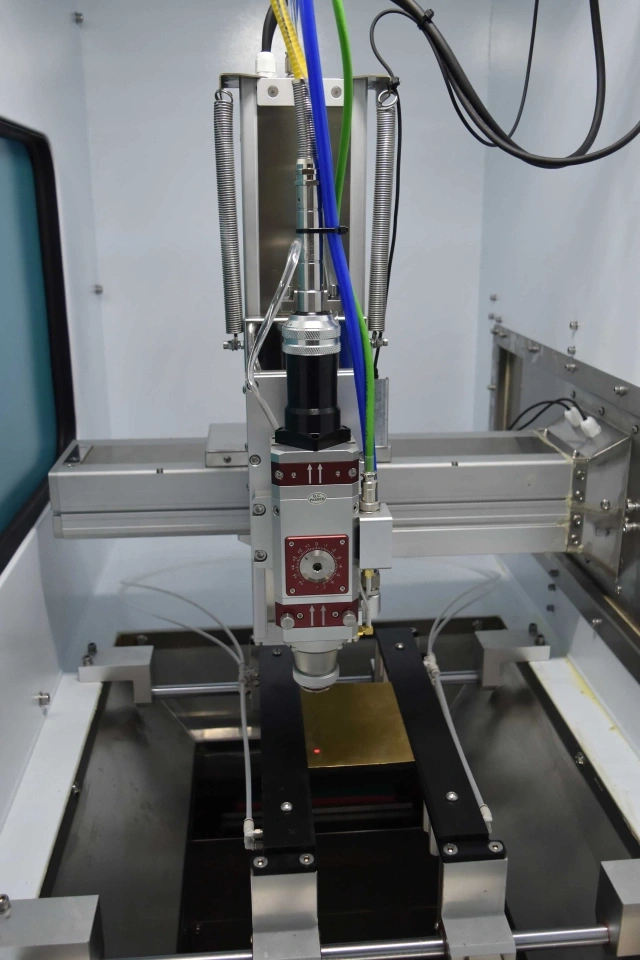
Jewelry Manufacturers
Jewelry factories use laser cutting equipment for:
- Custom jewelry production
- Small-batch manufacturing
- Complex patterns
- High-value material processing
Their priorities include:
- Precision
- Repeatability
- Surface quality
- Production stability
Jewelry OEM and ODM Companies
OEM/ODM manufacturers often handle multiple customer designs.
They need equipment that supports:
- Fast product changes
- Custom designs
- Flexible processing
- Stable quality control
A suitable supplier can help match the machine with different production requirements.
Precious Metal Processing Workshops
Small and medium workshops may use laser equipment for:
- Gold processing
- Silver components
- Fine metal cutting
- Prototype development
A compact enclosed system can provide safer and cleaner operation compared with open processing equipment.
Jewelry Equipment Integrators
Equipment distributors and integrators may require:
- OEM cooperation
- Stable supply
- Technical documents
- Custom configurations
- Long-term cooperation
Direct jewelry laser cutting machine manufacturers are usually better suited for these projects.
How to Evaluate a Jewelry Laser Cutting Machine Manufacturer
1. Confirm Manufacturing Capability
The first step is checking whether the supplier has real equipment manufacturing capability.
A professional jewelry laser cutting machine manufacturer should have:
- Engineering team
- Machine assembly capability
- Laser application experience
- Quality inspection procedures
- Technical support resources
Buyers should ask:
- Is the machine manufactured internally?
- Who develops the control system?
- How is accuracy tested?
- What inspection is performed before shipment?
Direct manufacturers usually provide better technical communication than general trading companies.
2. Evaluate Laser Cutting Performance
Laser performance directly affects jewelry processing quality.
Important factors include:
- Laser wavelength
- Peak power
- Cutting thickness range
- Beam stability
- Cutting speed
- Heat affected area control
The supplied product specification lists:
| Item | Specification |
|---|---|
| Laser center wavelength | ≈1070nm |
| Peak power | 1500W |
| Effective cutting range | 300 × 200 mm |
| Thickness range | ≤3.0 mm |
| Maximum movement speed | 30m/min |
| Positioning accuracy | ≤0.05mm |
| Repetitive positioning accuracy | ≤±0.01mm |
These specifications should be confirmed according to the final machine configuration and material requirements.
3. Check Cutting Accuracy and Repeatability
Jewelry production requires high precision because many components are small and valuable.
Buyers should evaluate:
- Positioning accuracy
- Repeat positioning accuracy
- Motion system stability
- Cutting consistency
- Design repeatability
The reference specification lists repetitive positioning accuracy of ≤±0.01mm.
Stable repeatability helps reduce:
- Material waste
- Manual correction
- Production variation
4. Evaluate Machine Structure and Safety Design
Jewelry materials are valuable, so machine protection and operator safety are important.
Buyers should evaluate:
- Enclosed working chamber
- Observation window
- Safety protection
- Dust filtration
- Maintenance access
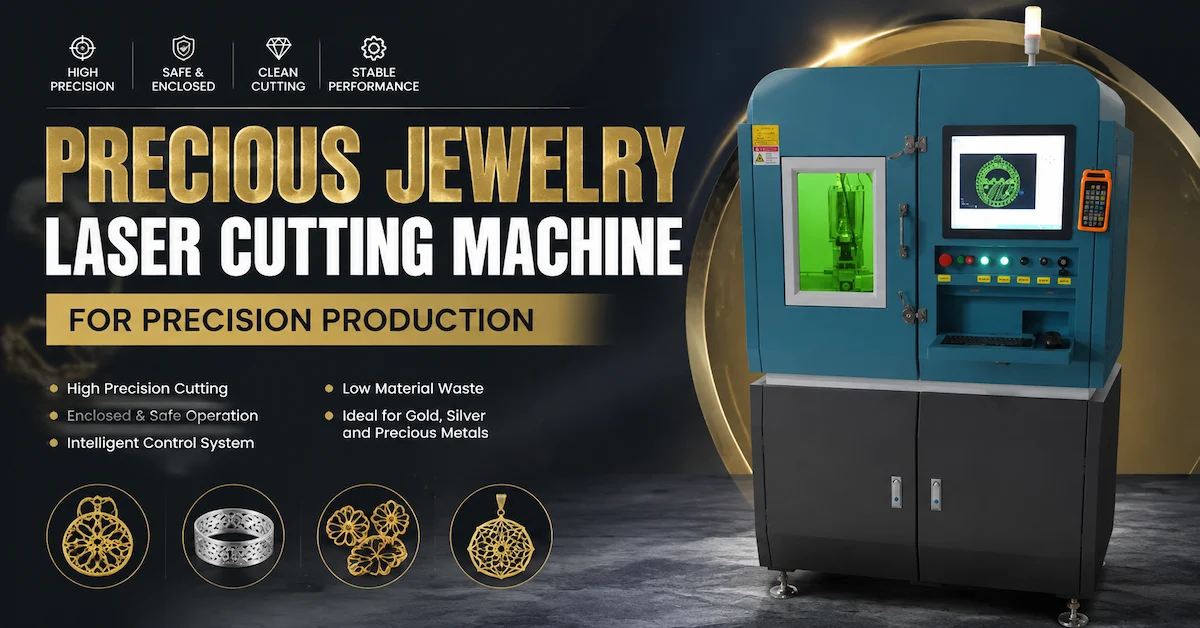
The visible machine structure includes:
- Enclosed cabinet design
- Front observation window
- Integrated control interface
- Service access panels
An enclosed design helps create a controlled processing environment.
5. Review Dust and Waste Management
Laser processing precious metals can generate particles and fumes.
Buyers should check:
- Filtration system
- Extraction design
- Waste collection
- Maintenance requirements
The product specification references a three-stage dust filtration system.
A suitable filtration system helps maintain:
- Cleaner operation
- Safer working conditions
- Better equipment maintenance
6. Confirm Material Compatibility
Different jewelry materials require different processing parameters.
Buyers should provide:
- Metal type
- Material thickness
- Design complexity
- Surface requirements
Common considerations include:
- Gold
- Silver
- Precious alloys
- Decorative metal components
The supplier should recommend parameters based on actual samples.
7. Request Sample Cutting Tests
Sample testing is one of the most important purchasing steps.
Provide:
- Jewelry design files
- Material samples
- Thickness information
- Quality requirements
Evaluate:
- Cutting edge quality
- Detail accuracy
- Surface condition
- Production time
- Repeatability
A professional supplier should demonstrate real processing results.
8. Evaluate Customization Capability
Different jewelry factories may require different configurations.
Customization may include:
- Fixture design
- Software functions
- Worktable configuration
- Automation options
- Production integration
A capable supplier should understand the customer's workflow before finalizing equipment.
9. Review Quality Control Procedures
A reliable jewelry laser cutting machine supplier should have quality control covering:
- Mechanical assembly
- Laser system inspection
- Motion testing
- Electrical safety
- Final processing verification
Buyers should request:
- Testing reports
- Machine videos
- Acceptance standards
- Maintenance documentation
10. Confirm Technical Support and After-Sales Service
Laser equipment requires long-term support.
Important services include:
- Installation guidance
- Operator training
- Parameter support
- Maintenance advice
- Spare parts
- Remote troubleshooting
For international buyers, supplier response capability is especially important.
Jewelry Laser Cutting Machine Supplier vs Trading Company
| Factor | Direct Manufacturer | Trading Company |
|---|---|---|
| Technical knowledge | Direct | Depends on supplier |
| Customization | Stronger | Limited |
| Laser support | Direct engineers | Indirect |
| Spare parts | Direct supply | Additional coordination |
| Process optimization | Better | Limited |
| Long-term service | More reliable | Depends on factory |
For precision jewelry equipment, direct communication with the manufacturer usually provides better technical support.
Product Match: CHIKIN CNC Precious Jewelry Laser Cutting Machine
The matching product for this article is:
Precious Jewelry Laser Cutting Machine for Precision Production
This equipment supports:
- Jewelry component cutting
- Precious metal processing
- Fine-detail production
- Controlled laser manufacturing
Reference specifications:
| Item | Specification |
|---|---|
| Model | CK-3020 |
| Laser wavelength | ≈1070nm |
| Peak power | 1500W |
| Cutting range | 300 × 200mm |
| Thickness | ≤3.0mm |
| Positioning accuracy | ≤0.05mm |
| Repeat positioning accuracy | ≤±0.01mm |
| Filtration system | Three-stage dust filtration |
Why Consider CHIKIN CNC as a Jewelry Laser Cutting Machine Supplier?
CHIKIN CNC provides precision laser equipment solutions for manufacturers requiring controlled processing and stable production.
The company supports customers with:
- Equipment selection
- Technical consultation
- Application evaluation
- Customized solutions
- Production support
For buyers evaluating laser processing equipment, review the complete CHIKIN CNC equipment portfolio.
Related product:
Precious Jewelry Laser Cutting Machine
Buyer Checklist Before Requesting a Quote
| Information | Details |
|---|---|
| Material | Gold, silver, alloy, precious metals |
| Thickness | Material thickness range |
| Design type | Rings, pendants, decorative parts |
| Accuracy | Required tolerance |
| Production volume | Daily output |
| Cutting size | Required working area |
| Automation | Manual or integrated system |
| Filtration | Dust and fume requirements |
| Service | Installation and training |
FAQ: Jewelry Laser Cutting Machine Supplier
What does a jewelry laser cutting machine supplier provide?
A professional supplier provides laser equipment, technical consultation, installation, training, spare parts, and after-sales support.
Why use laser cutting for jewelry production?
Laser cutting provides high precision, flexible design processing, and reduced mechanical stress on valuable materials.
What materials can jewelry laser machines process?
Depending on configuration, they may process gold, silver, alloys, and other precious metal materials.
Should I choose a manufacturer or trading company?
Direct manufacturers usually provide better customization and technical communication.
What affects jewelry laser cutting quality?
Important factors include laser stability, positioning accuracy, material parameters, and machine structure.
Why is sample testing important?
Sample testing verifies cutting quality, detail accuracy, and process compatibility.
Can jewelry laser cutting machines be customized?
Yes. Manufacturers can customize fixtures, software, automation features, and processing configurations.
How important is after-sales service?
Reliable service helps maintain production stability and reduce downtime.
Conclusion: Choose a Jewelry Laser Cutting Machine Supplier as a Long-Term Partner
Choosing a Jewelry Laser Cutting Machine Supplier requires evaluating more than laser power or machine price.
Jewelry manufacturers should consider:
- Laser performance
- Cutting accuracy
- Machine structure
- Safety design
- Dust management
- Customization ability
- Sample testing
- Technical support
A reliable supplier helps manufacturers improve production quality, reduce material waste, and create more consistent jewelry products.
CHIKIN CNC provides precision laser processing solutions for manufacturers looking for reliable jewelry production equipment.
Request a Jewelry Laser Cutting Machine Consultation from CHIKIN CNC
If you are evaluating laser cutting equipment for jewelry production, prepare:
- Material type
- Thickness range
- Product drawings
- Production volume
- Accuracy requirements
- Processing expectations
The CHIKIN CNC team can help evaluate your application, recommend a suitable machine configuration, arrange sample testing, and provide a customized quotation.
Contact CHIKIN CNC for a jewelry laser cutting machine consultation: