



A PCB CCD drilling machine is designed for manufacturers that need more accurate hole positioning, cleaner routing results, and more stable board alignment during production. In PCB manufacturing, even a small shift between the board and the drilling path can cause quality problems, especially on multilayer boards, HDI boards, rigid-flex boards, and high-density circuit layouts.
Traditional PCB drilling depends heavily on mechanical positioning, fixtures, and operator experience. This may work for simple boards, but it becomes less reliable when a factory handles frequent model changes, small-batch orders, different board sizes, or panels with slight deformation.
CCD vision alignment solves this problem by helping the machine “see” the real position of the PCB before drilling or routing. The system detects fiducial marks or reference points, compares the actual board position with the program, and corrects offset or rotation before processing.
For PCB manufacturers, prototype labs, and overseas equipment buyers, a PCB CCD drilling machine can improve drilling accuracy, reduce rework, and support more efficient production.
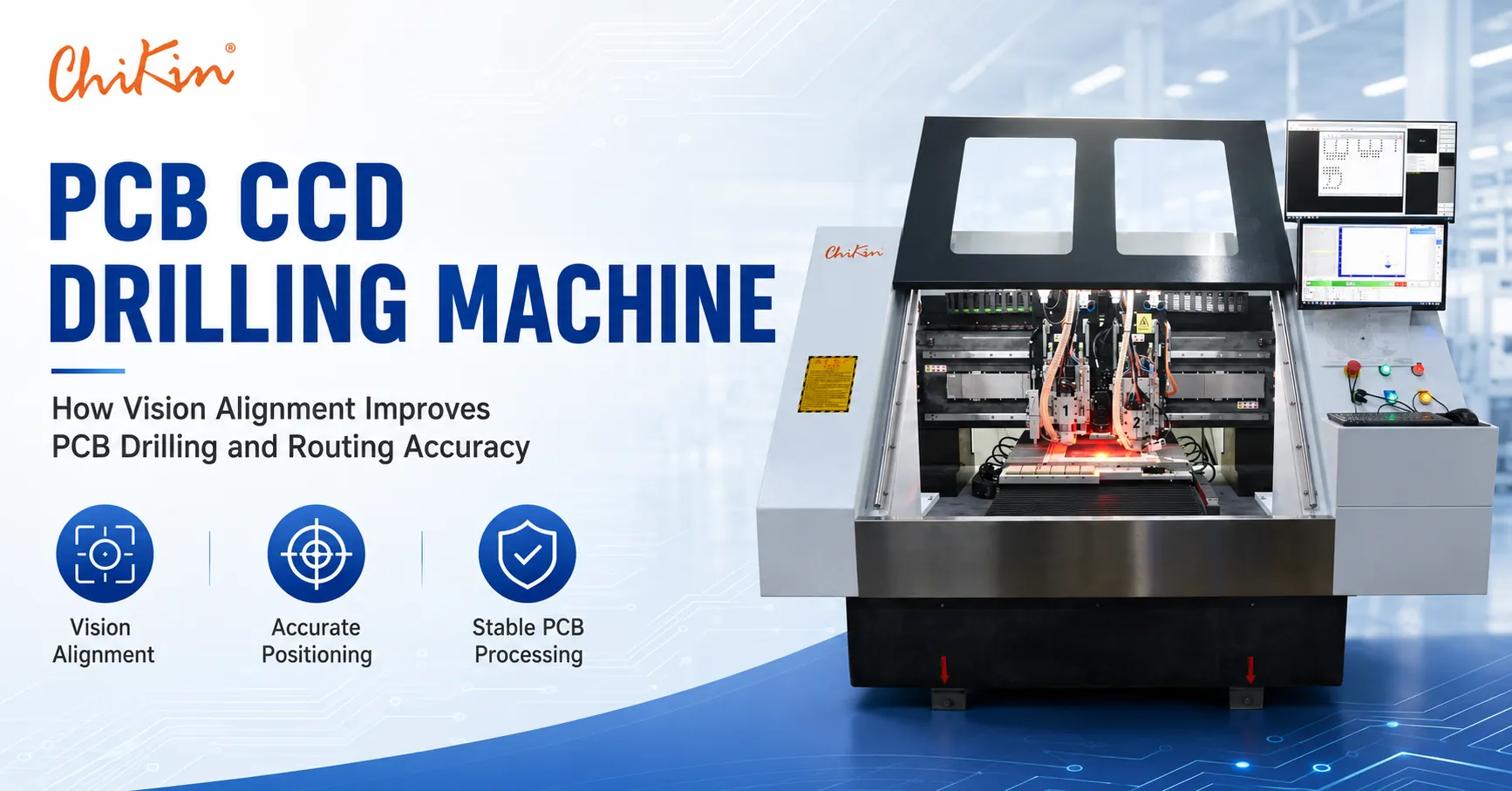
What Is a PCB CCD Drilling Machine?
A PCB CCD drilling machine is a CNC PCB processing machine equipped with a CCD camera vision alignment system. The CCD system detects board reference points and helps the control system correct positioning before drilling.
In many PCB production workflows, CCD drilling equipment may also be integrated with routing. For example, a PCB drilling and routing machine with CCD can complete drilling and contour routing in one clamping, reducing manual transfer between machines.
A PCB CCD drilling machine is commonly used for:
- PCB guide hole drilling
- Fiducial hole drilling
- Through-hole drilling
- Multilayer PCB drilling
- PCB positioning hole processing
- PCB drilling and routing integration
- Small-batch and mid-volume production
- High-mix PCB manufacturing
The key value is simple: the machine does not rely only on where the operator places the board. It uses vision alignment to locate the actual board position before processing.
How CCD Vision Alignment Works
The working process usually includes these steps:
- The operator loads the PCB panel onto the machine table.
- The board is fixed by vacuum, clamp, pin, or fixture.
- The CCD camera scans fiducial marks or reference points.
- The control system compares the real board position with program coordinates.
- The machine corrects offset, rotation, or small placement deviation.
- The drilling spindle processes the required holes.
- If routing is included, the routing spindle cuts outlines or slots based on the same alignment reference.
- The finished board is checked for hole position and routing consistency.
This workflow helps reduce human error and improves repeatability between batches.
For factories that frequently switch product models, CCD alignment can also reduce setup time because operators do not need to rely only on manual adjustment.
Why CCD Alignment Matters for PCB Drilling
1. More Accurate Hole Positioning
PCB holes must match pads, vias, copper layers, and assembly positions. If the hole shifts, the board may fail inspection or create downstream assembly issues.
CCD alignment improves hole-to-pattern registration by detecting the real board position before drilling.
2. Lower Scrap From Misalignment
Misalignment is one of the most expensive problems in PCB production because one wrong drilling process may damage an entire panel. CCD positioning helps reduce this risk by correcting board placement deviation before cutting starts.
3. Better Support for Multilayer and High-Density Boards
Multilayer PCBs require accurate registration between layers. CCD drilling is useful when boards have dense layouts, small holes, or strict tolerance requirements.
4. More Efficient Drilling and Routing Workflow
When drilling and routing are completed in one clamping, the board does not need to be moved between different machines. This helps maintain alignment and reduce handling time.
5. Faster Setup for High-Mix Production
Many PCB factories handle multiple small or medium orders. CCD alignment helps operators switch between different board designs more efficiently, improving production flexibility.
Who Should Use a PCB CCD Drilling Machine?
A PCB CCD drilling machine is suitable for buyers who care about alignment accuracy, repeatability, and production flexibility.
| Buyer Type | Main Requirement | Why CCD Helps |
|---|---|---|
| PCB manufacturers | Stable drilling accuracy | Reduces hole position deviation |
| Prototype PCB labs | Fast product changeover | Improves setup efficiency |
| Multilayer PCB factories | Layer registration | Helps improve hole-to-pattern matching |
| Rigid-flex board producers | Material variation control | Compensates for slight board deviation |
| Mid-volume PCB factories | Efficient drilling + routing | Reduces handling between processes |
| Equipment distributors | Higher-value machine solution | Easier to sell as precision PCB equipment |
If your factory only processes simple boards with loose tolerances, standard drilling equipment may be enough. But if your orders require accurate fiducial alignment, frequent changeover, or combined drilling and routing, CCD equipment is worth considering.
PCB CCD Drilling Machine vs Standard PCB Drilling Machine
| Comparison Point | Standard PCB Drilling Machine | PCB CCD Drilling Machine |
| Alignment Method | Manual or fixture-based | CCD vision-assisted alignment |
| Setup Accuracy | Depends more on operator skill | More repeatable and controllable |
| Offset Correction | Limited | Supports position and rotation correction |
| Best For | Simple PCB drilling | High-mix, precision, multilayer PCB work |
| Process Integration | Usually drilling only | Can support drilling + routing workflows |
| Cost Level | Lower | Higher |
| Long-Term Value | Basic production | Better for accuracy and future growth |
The value of CCD is not only the camera itself. A good PCB CCD drilling machine should combine CCD vision, stable machine structure, precision motion control, reliable spindle performance, and practical software.
Key Technical Factors to Check Before Buying
1. CCD Camera and Recognition Ability
The camera must clearly recognize fiducial marks or reference points. If the image is unstable, the alignment result may also become unstable.
Buyers should ask:
- What type of CCD system is used?
- Can it detect small fiducials?
- Is the lighting adjustable?
- Can it recognize different board colors or surface finishes?
- Does the system support multi-point alignment?
2. Alignment Software
CCD hardware must work with reliable software. The software should convert camera data into accurate machine correction.
Important software functions include:
- Offset correction
- Rotation compensation
- Multi-point alignment
- Parameter storage
- Repeat job settings
- Easy operator interface
3. Spindle Configuration
For PCB drilling and routing, spindle design is critical. A good machine may use a dedicated drilling spindle for micro-drilling and a separate routing spindle for contour cutting.
Buyers should check:
- Drilling spindle speed
- Routing spindle torque
- Tool change method
- Drill bit range
- Tool length detection
- Tool diameter detection
- Broken tool detection
4. Machine Structure
Even with CCD vision, the mechanical structure must remain stable. If the base or motion system vibrates, final accuracy will suffer.
Important points include:
- Granite or high-rigidity base
- Precision linear guides
- Quality ballscrews
- Stable worktable
- Vibration damping
- Enclosed protection design
5. Board Material Compatibility
A PCB CCD drilling machine should be matched to your actual materials.
Common materials include:
- FR4 PCB
- Multilayer PCB
- HDI board
- Rigid-flex board
- FPC
- Aluminum PCB
- Copper substrate
- Prototype PCB panels
Different materials may require different clamping, drill bits, routing tools, spindle parameters, and alignment methods.
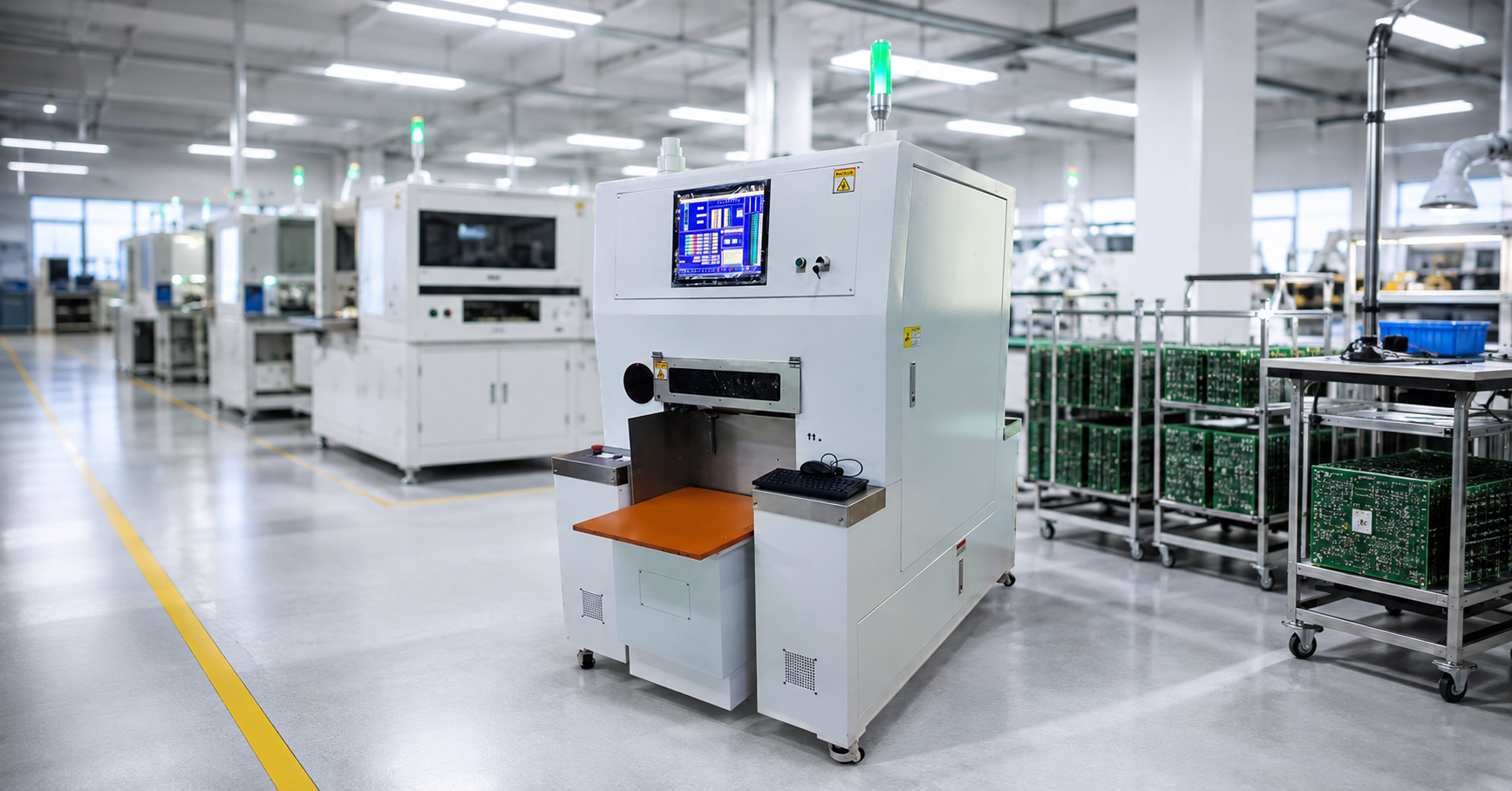
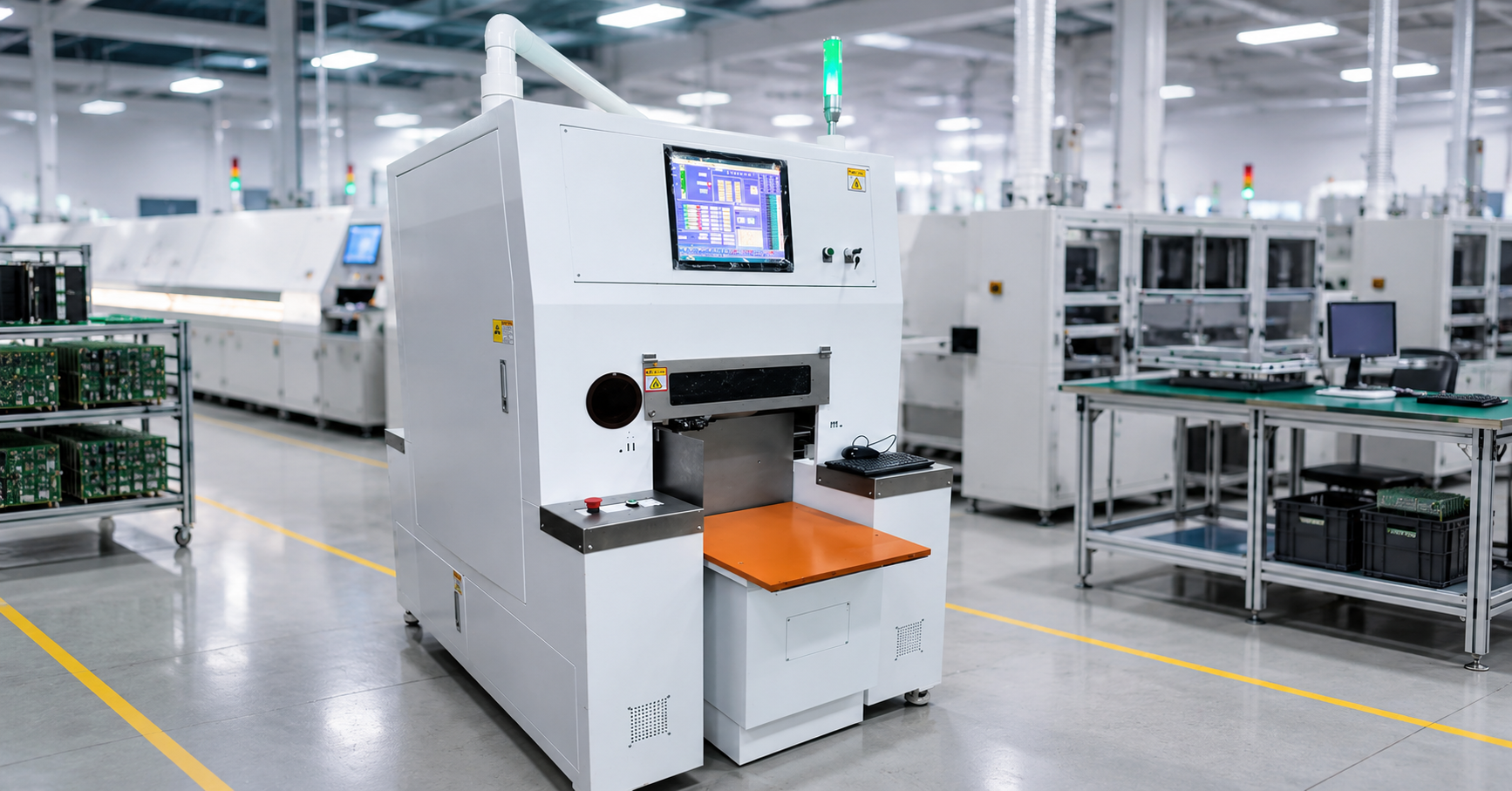
Product Match: CHIKIN CNC 1 Drill 1 Route PCB Machine with CCD
For this topic, the most relevant CHIKIN CNC product is the 1 Drill 1 Route PCB Machine with CCD.
This machine is designed for manufacturers that need drilling and routing in the same workflow. It uses one dedicated drilling spindle and one routing spindle, supported by CCD vision alignment for fiducial detection and more accurate board registration.
It is suitable for buyers who want:
- Drilling and routing in one machine
- CCD fiducial alignment
- Reduced manual setup error
- Better panel registration
- Mid-volume PCB production
- FR4, flex, rigid-flex, and aluminum PCB processing
- More efficient production than single-process equipment
Product link:
https://www.chikincnc.com/product/1-drilling-spindle-1-routing-spindle-machine-with-ccd-yi-zuan-yi-luo-ji-qi-e
Specification Checklist for PCB CCD Drilling Machine Buyers
| Item | What to Confirm | Why It Matters |
| CCD System | Camera resolution and lighting | Affects fiducial recognition |
| Alignment Function | Offset and rotation correction | Improves board registration |
| Working Area | Maximum PCB panel size | Ensures board compatibility |
| Drilling Range | Minimum and maximum drill diameter | Matches hole requirements |
| Routing Range | Routing tool compatibility | Supports contour cutting |
| Machine Base | Granite or high-rigidity structure | Reduces vibration |
| Motion System | Linear guides and ballscrews | Supports repeatability |
| Tool Detection | Tool length, diameter, broken tool detection | Reduces production risk |
| Control Software | English interface and program storage | Improves operation efficiency |
| Service Support | Training, spare parts, remote support | Reduces downtime |
Common Buying Mistakes to Avoid
Mistake 1: Choosing CCD Only by Camera Specs
A high-resolution camera is useful, but it is not enough. The full system must include stable software, reliable lighting, accurate motion control, and a rigid machine structure.
Mistake 2: Ignoring Routing Requirements
Many buyers need both drilling and routing. If you buy a drilling-only machine but later need contour routing, you may increase handling time and equipment cost.
Mistake 3: Not Providing Fiducial Information
Before requesting a quote, share your fiducial type, board size, hole diameter, and accuracy target. This helps the supplier recommend the correct configuration.
Mistake 4: Only Comparing Initial Price
A cheaper machine may have weaker alignment, less stable motion, poor support, or limited automation. For PCB production, long-term yield and uptime are often more important than the lowest price.
Buyer Checklist Before Requesting a Quote
Before asking for a PCB CCD drilling machine quotation, prepare:
| Information | Example |
| Board material | FR4, HDI, rigid-flex, aluminum PCB |
| Board size | Length × width × thickness |
| Fiducial mark type | Round mark, copper mark, tooling point |
| Hole diameter | Minimum and common hole sizes |
| Routing requirement | Outline cutting, slots, contour routing |
| Accuracy requirement | Hole position tolerance |
| Production volume | Prototype, small batch, mid-volume |
| Current issue | Misalignment, rework, slow setup |
| Automation needs | CCD, tool change, tool detection |
| Purchase goal | New line, upgrade, replacement |
FAQ: PCB CCD Drilling Machine
1. What is a PCB CCD drilling machine?
A PCB CCD drilling machine is a CNC drilling system with camera vision alignment. It detects PCB reference points before drilling to improve hole positioning accuracy.
2. Why is CCD alignment important in PCB drilling?
CCD alignment reduces board placement errors and improves hole-to-pattern registration, especially for multilayer, high-density, and high-mix PCB production.
3. Can a PCB CCD drilling machine also do routing?
Yes. Some machines, such as a 1 drill 1 route PCB machine with CCD, combine drilling and routing in one equipment platform.
4. What boards are suitable for PCB CCD drilling equipment?
It can be suitable for FR4, multilayer PCB, HDI boards, rigid-flex boards, aluminum PCB, and prototype PCB panels.
5. Does CCD alignment reduce scrap?
Yes. By correcting board offset and rotation before processing, CCD alignment can reduce scrap caused by misalignment.
6. Is a PCB CCD drilling machine suitable for small-batch production?
Yes. CCD alignment is useful for small-batch and high-mix production because it reduces manual setup time and improves repeatability.
7. What should I check before buying a PCB CCD drilling machine?
Check CCD recognition ability, alignment software, machine structure, spindle configuration, tool detection, board compatibility, and after-sales support.
8. What information should I send for a quotation?
Send your board material, size, fiducial type, hole diameter, routing requirement, production volume, accuracy target, and current process problems.
Conclusion: PCB CCD Drilling Machines Improve Accuracy, Setup Efficiency, and Production Stability
A PCB CCD drilling machine is a practical solution for PCB manufacturers that need better alignment accuracy, lower rework, and more stable drilling performance. For factories that require both drilling and routing, a CCD-based drilling and routing machine can reduce handling and keep both processes aligned to the same board reference.
CHIKIN CNC’s 1 Drill 1 Route PCB Machine with CCD is especially suitable for buyers who need one drilling spindle, one routing spindle, CCD fiducial alignment, automatic tool detection, and efficient mid-volume PCB production.
If you are comparing PCB CCD drilling machine options, send your board material, fiducial type, hole diameter, routing requirement, production volume, and accuracy target. CHIKIN CNC can help recommend a suitable machine configuration for your PCB production line.
Contact CHIKIN CNC to request a PCB CCD drilling machine solution and quotation:
https://www.chikincnc.com/contact-us