




What Does a Flying Probe Tester Price Actually Include?
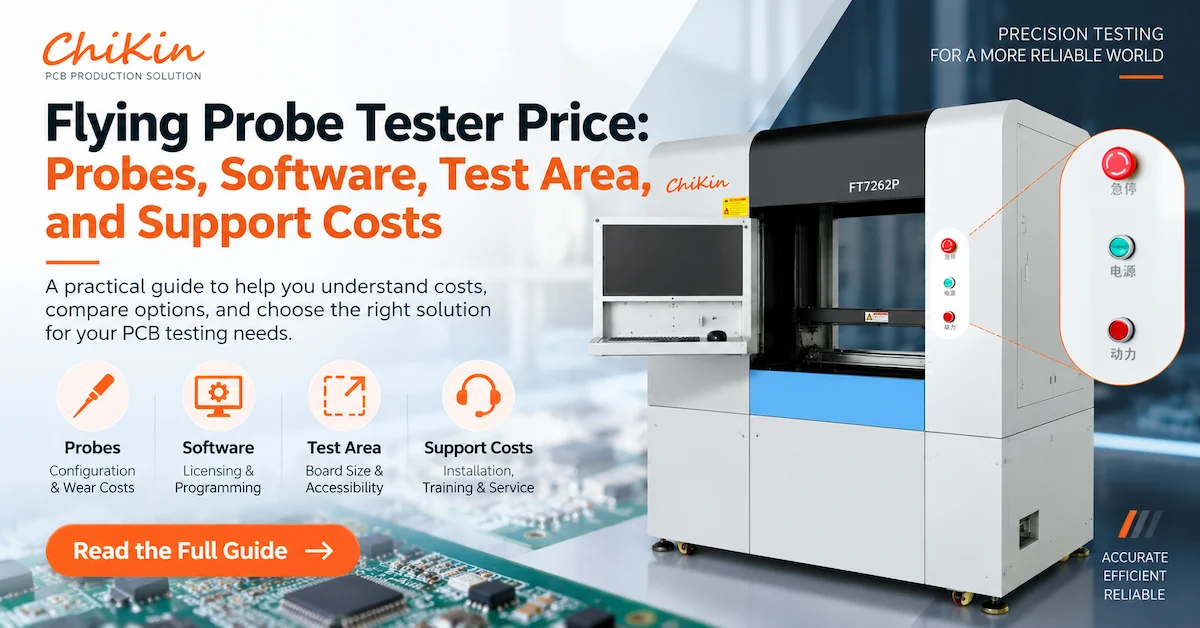
A useful flying probe tester price is the price of a defined testing package, not simply the machine cabinet. Compare the probe arrangement, electrical measurement functions, software rights, usable test area, installation, and support within the same quotation. CHIKIN’s published product information provides reference specifications rather than a fixed purchase price, so an exact equipment budget requires a configuration-specific offer. Start with the CHIKIN flying probe tester and request a breakdown of standard equipment, options, one-time services, and recurring charges. A lower flying probe machine price is not necessarily a comparable offer when programming software, commissioning, or required accessories are excluded. Keep equipment purchasing separate from a flying probe test price quoted for outsourced testing: one buys production capability, while the other pays for an agreed testing service.
Confirm the Application Before Comparing Equipment Prices
Flying probe systems use movable probes rather than a dedicated bed-of-nails fixture for every board design. CHIKIN positions its listed equipment around prototype validation, engineering changes, and small-to-medium batches with changing layouts. For procurement, first distinguish bare-board electrical testing from populated PCB assembly testing; do not assume one quotation covers both. Define the required measurements and accessible contact locations, then request a demonstration on representative boards. PCB fabricators should prioritize their actual panel and test requirements, while an electronics laboratory or contract manufacturer should document assembly clearance and measurement needs separately. For a stable, high-volume product, include an appropriate fixture-based alternative in the evaluation rather than assuming flying probe equipment is always the economical choice. The relevant comparison belongs within the wider testing and inspection equipment category, not across machines performing different quality-control tasks.
Probes: Compare Access, Demonstrated Throughput, and Wear Costs
Probe count should be a line item, not the entire purchasing argument. Ask how many probes are independently controlled, which board surfaces they can access, and which measurements the quoted configuration can perform simultaneously. An offer with more probes has not, by itself, demonstrated proportionally higher output. Require the same board revision, test coverage, electrical limits, and reporting conditions when comparing cycle times. Also request the probe-tip material and geometry, holder specifications, replacement prices, calibration procedure, and recommended spare quantities. Include the board finish and acceptable contact-mark criteria in sample evaluation. These checks connect the flying probe tester price to a measurable production requirement: completing the agreed test plan repeatedly, without buying unnecessary mechanisms or accepting an unverified speed claim.
Software: Separate Machine Operation from Programming and Data Costs
Ask for a software schedule alongside the hardware quotation. It should identify the machine-control license, any offline programming seats, required data-import modules, reporting functions, and interfaces to your production records. CHIKIN’s flying probe tester supplier guide identifies programming, result analysis, and data handling as evaluation topics; it does not establish that every software function is included in every offer. Have the supplier demonstrate your actual input files, generate a test program, process an engineering revision, and export the report your customer requires. Then ask whether the license is perpetual or subscription-based, which updates are included, and what happens after the support period expires. Confirm program ownership, backup and restore procedures, and license recovery after a computer replacement. A software option should earn its place in the flying probe tester price through demonstrated capability or reduced work, not a vague description such as “advanced intelligent software.”
Test Area: Verify Reachable Test Points, Not Only Panel Dimensions
Separate the quoted test area from maximum loadable board dimensions and the area actually reachable after clamping. Request a drawing that shows supports, edge exclusions, accessible surfaces, and any limits created by the proposed probe arrangement. For thin or flexible boards, ask whether a carrier is needed and whether its design and supply are included. For assembled boards, submit component-height and keep-out information before accepting compatibility. Use your largest current panel and a justified future requirement for evaluation, then demonstrate access to the required test locations with the proposed holding arrangement. Paying for extra area is defensible when it solves a documented access problem, not merely because a larger number looks safer on a purchasing spreadsheet.
CHIKIN CK-FT7262P: Reference Specifications for Quotation Review
The following values appear in CHIKIN’s published product specification image. Use them to start the technical discussion, then confirm the current configuration and acceptance conditions in the quotation. They are reference specifications, not customer-specific test results.
| Specification | Published reference | What to confirm before ordering |
|---|---|---|
| Model | CK-FT7262P | Exact model, configuration, and software revision |
| Test area | 720 × 620 mm | Reachable area with the proposed clamping arrangement |
| Test speed | 1,500–1,800 points/min | Complete cycle time on your board and test plan |
| Minimum pad size | 4 mil | Contact performance on representative samples |
| Minimum pad distance | 4 mil | Definition of “distance”; do not automatically interpret it as pitch |
| Repetition accuracy | 5 μm | Verification method and conditions; not an electrical measurement-accuracy specification |
| Test voltage | 30–300 V | Required range and suitability for the application |
| Test method | Capacitance and resistance testing | Included measurements, coverage, and limitations |
| Probe count and sidedness | Not established in the published reference | Quantity, surface access, and simultaneous measurement capability |
| Software and support package | Not itemized in the published reference | Licenses, training, updates, service scope, and charges |
Treat points per minute as a specified rate, not a promised number of finished boards per hour. Ask the demonstration report to include loading, alignment, electrical testing, result handling, and retesting. Likewise, a 720 × 620 mm test-area specification does not establish compatibility with every panel of those dimensions, and the published voltage range should not be interpreted as permission to apply those settings to a populated assembly.
Compare Quoted Models Through Their Included Packages
A model number does not describe everything delivered with a machine. Use the following matrix to compare purchasing scopes for the CK-FT7262P or an alternative proposed after board review. These are quotation categories, not published CHIKIN product packages. For every proposed model, request separate equipment, option, and service subtotals so the reason for a price difference remains visible.
| Quotation scope | What it should identify | Potential purchasing value | Question before paying more |
|---|---|---|---|
| Defined base configuration | Probe arrangement, measurement functions, board limits, standard software | Establishes the minimum compliant offer | Does it complete the required test plan? |
| Expanded programming package | Offline seats, import modules, revision tools, reporting | May reduce engineering work | What improvement was demonstrated on your files? |
| Different access or handling configuration | Test envelope, board supports, sidedness, loading arrangement | May resolve panel-access or workflow constraints | Which current requirement cannot the base configuration meet? |
| Extended service package | Installation, training, calibration, response commitments, spares | Makes support responsibilities and budgets clearer | Which costs remain outside the package? |
An attractive flying probe machine price becomes meaningful only after the offers have equivalent acceptance criteria. Do not pay for a claimed throughput improvement that removes required measurements, or compare a machine-only offer with an installed and commissioned package without adjusting the totals.
Support Costs: Warranty, Calibration, Spares, and Site Work
The product reference sheet lists a one-year warranty, but buyers should obtain the applicable coverage, exclusions, and start date in writing. Separate warranty repair from routine calibration, probe replacement, software assistance, refresher training, and on-site engineering. Ask whether remote support has stated service hours, whether response means initial contact or resolution, and who pays for replacement-part shipping and travel. For installation, request the required floor space, access route, electrical supply, grounding, environmental conditions, and any utilities specific to the offered configuration. Do not copy installation values from an unrelated PCB machine. CHIKIN’s packaging and transportation information describes general packing arrangements; the order should still specify the actual package, shipment responsibilities, unloading requirements, and installation scope. Include confirmed destination and commissioning costs in the budget rather than treating shipment as the point when the machine becomes productive.
Quality Checks, Customization, and Delivery Milestones
Make acceptance work a priced deliverable. Request factory acceptance testing on customer-approved data and representative boards, with agreed criteria for repeatability, known-defect detection, false failures, reports, and cycle time. Ask for documented assembly checks and completed calibration records, keeping electrical measurement checks distinct from motion-positioning results. Review the relevant CHIKIN company information, but request documentation for the actual machine and destination requirements rather than assuming a company credential covers every product. For OEM/ODM, reporting, interface, or handling changes, separate engineering charges, software work, hardware supply, documentation, and revalidation. Define who approves each change and how additional work is priced. Finally, distinguish production completion, factory acceptance, dispatch, arrival, installation, and site acceptance. A delivery estimate is more useful when it names a milestone and states dependencies such as approved data, samples, drawings, and final configuration.
Calculate Ownership Cost Separately from Flying Probe Test Price
For a three-year budget, add the machine and required options, deployment costs, recurring software and service charges, internal programming and operating labor, consumables, and utilities. Record estimated interruption costs separately, with visible assumptions. Do not add an included item twice, or combine the full purchase price with depreciation of the same asset in one cost comparison. When evaluating an outsourced flying probe test price, request separate setup, programming, per-board testing, minimum-batch, reporting, and retest charges. Compare the same board revision and test coverage, then account for your own handling and coordination costs. A service price and an equipment price answer different questions; the useful comparison is the cost of completing the same testing workload over the same period.
Illustrative Calculation: When Could a Software Upgrade Pay Back?
Suppose an optional programming package costs an additional $6,000 and adds $1,000 in annual fees. Assume your own trial shows a saving of 45 minutes on each of five new programs per week, across 48 working weeks, with engineering time valued at $25 per hour. The annual time value is 5 × 0.75 × 48 × $25 = $4,500. After the additional annual fee, the net annual value is $3,500; $6,000 ÷ $3,500 gives approximately 1.7 years. These are illustrative assumptions, not CHIKIN prices or performance data. The result represents cash payback only when the saved time produces an actual cost reduction; otherwise it represents available engineering capacity. Use measured programming time and your own cost rates before accepting a higher flying probe tester price.
Evaluating a Flying Probe Tester for Sale: Prepare a Complete RFQ
A useful request for quotation combines a purchasing brief with a technical acceptance brief. Provide board type, minimum and maximum dimensions, thickness, panel drawings, accessible test locations, required measurements, input-file formats, product-change frequency, daily workload, and the destination site. Add software-seat requirements, reporting needs, installation expectations, and the desired support scope. Where board data is confidential, establish the agreed confidentiality and transfer arrangements before sharing it. Ask each supplier to return the same breakdown: base machine, required options, software, deployment, recurring charges, exclusions, and acceptance milestones. CHIKIN’s published supplier guide describes application evaluation and configuration discussions as part of its offering; use the CHIKIN quotation contact to request a current proposal tied to those requirements. This produces a comparable flying probe tester price rather than an isolated headline figure.
FAQs About Flying Probe Tester Price
1. Is There a Fixed Flying Probe Tester Price for the CK-FT7262P?
No fixed purchase price is displayed in the referenced product information. Request a quotation identifying the current configuration, software, services, commercial terms, and validity period. The specification sheet alone is not a priced offer.
2. Does the Flying Probe Machine Price Include Software?
Do not assume it does. Ask the quotation to distinguish machine-control software from programming seats, import modules, reporting, updates, and optional integrations. Confirm which rights continue if a subscription or support agreement ends.
3. Does a Higher Probe Count Guarantee Faster Production?
No proportional output increase should be accepted without a comparable trial. Use the same board, measurements, coverage, and reporting requirements, and compare complete cycles rather than isolated motion demonstrations.
4. Does “Fixture-Free” Mean There Are No Setup Costs?
Not necessarily. Budget review should still ask about programming, board supports, carriers where required, sample validation, and operator setup. Avoiding a design-specific bed-of-nails fixture does not establish that every preparation task is included at no charge.
5. Can a Bare-Board Tester Be Assumed to Test Populated Assemblies?
No. Request separate confirmation of component clearance, probe access, included measurements, and electrical suitability. Demonstrate the actual assembly and test plan; do not infer powered functional-test capability from a resistance or capacitance specification.
6. How Is Flying Probe Test Price Different from Equipment Price?
A testing-service quotation may charge for programming, setup, batches, or individual boards. An equipment quotation purchases a defined machine package. Compare them using the same workload, coverage, reporting obligations, and evaluation period.
7. What Should Be Checked on a Used Flying Probe Tester for Sale?
Request serial-number and configuration records, a live sample test, calibration and service history, available replacement parts, and written software-license transfer confirmation. Include recommissioning and any unsupported components in the purchasing evaluation.
8. Which Software Demonstration Is Most Useful?
Ask the supplier to start with your actual files, create a program, process a revised board, and export the required report. Record engineering time and identify every module used, including any module absent from the quotation.
9. What Should a Support Agreement Specify?
It should identify the covered machine and software, service hours, escalation route, remote and on-site responsibilities, calibration scope, parts exclusions, and renewal charges. Require clear distinctions between response commitments and repair completion.
10. How Can Buyers Avoid Overpaying for Test Area?
Evaluate the largest required panel with its proposed supports and probe access. Add future capacity only against a documented product plan. Maximum panel dimensions, published test area, and reachable test locations should be confirmed separately.
Conclusion
The right flying probe tester price is the cost of a configuration that completes your required test plan, fits your boards, and comes with clearly defined software and support. Compare probe arrangements through representative trials, confirm the usable test area, separate one-time and recurring charges, and judge upgrades using your own workload rather than headline specifications. For a CHIKIN project, use the CK-FT7262P reference data as a starting point—not a substitute for an agreed technical and commercial offer. Submit your board information and purchasing requirements to CHIKIN CNC to request a configuration-specific quotation with itemized options, acceptance conditions, and support responsibilities.