



Precious Jewelry Laser Cutting Machine: A Practical Guide for Gold and Silver Production Buyers
For jewelry manufacturers, cutting small metal parts is rarely just a matter of speed. The real concern is whether the process can protect fine details, reduce manual rework, keep part geometry repeatable, and control operator risk when working with high-value materials. A precious jewelry laser cutting machine is designed for this type of production environment, especially when buyers need cleaner edges, tighter control, and more consistent processing than many traditional manual cutting methods can offer. Chikin’s product page positions this enclosed jewelry laser cutting system for delicate designs, thin metal sheets, repeatable part geometry, and controlled shop-floor operation.
In B2B purchasing, this machine should not be evaluated only by its exterior or the word “laser.” A sourcing manager, jewelry factory owner, or production engineer needs to understand what the machine can do in daily production: what metals it can process, what part sizes it can handle, how the enclosure supports safety, how operators control the machine, how dust or fumes are managed, and whether the supplier can support training and service after installation.
For buyers searching for a jewelry laser cutting machine manufacturer, gold laser cutting machine supplier, silver laser cutting machine, or fiber laser cutting machine for jewelry, the core question is not “Which machine looks more advanced?” The better question is: which machine fits the factory’s actual production flow, material value, operator skill level, and quality expectations?
Why Jewelry Factories Use a Precious Jewelry Laser Cutting Machine
Jewelry production often deals with small parts, thin material, decorative patterns, and valuable metals. Gold, silver, and related precious metal alloys do not leave much room for trial-and-error. A small mistake can create material waste, delay a custom order, or require time-consuming hand finishing. For manufacturers producing rings, pendants, earrings, decorative components, or small metal parts, repeatable cutting becomes part of the business model.
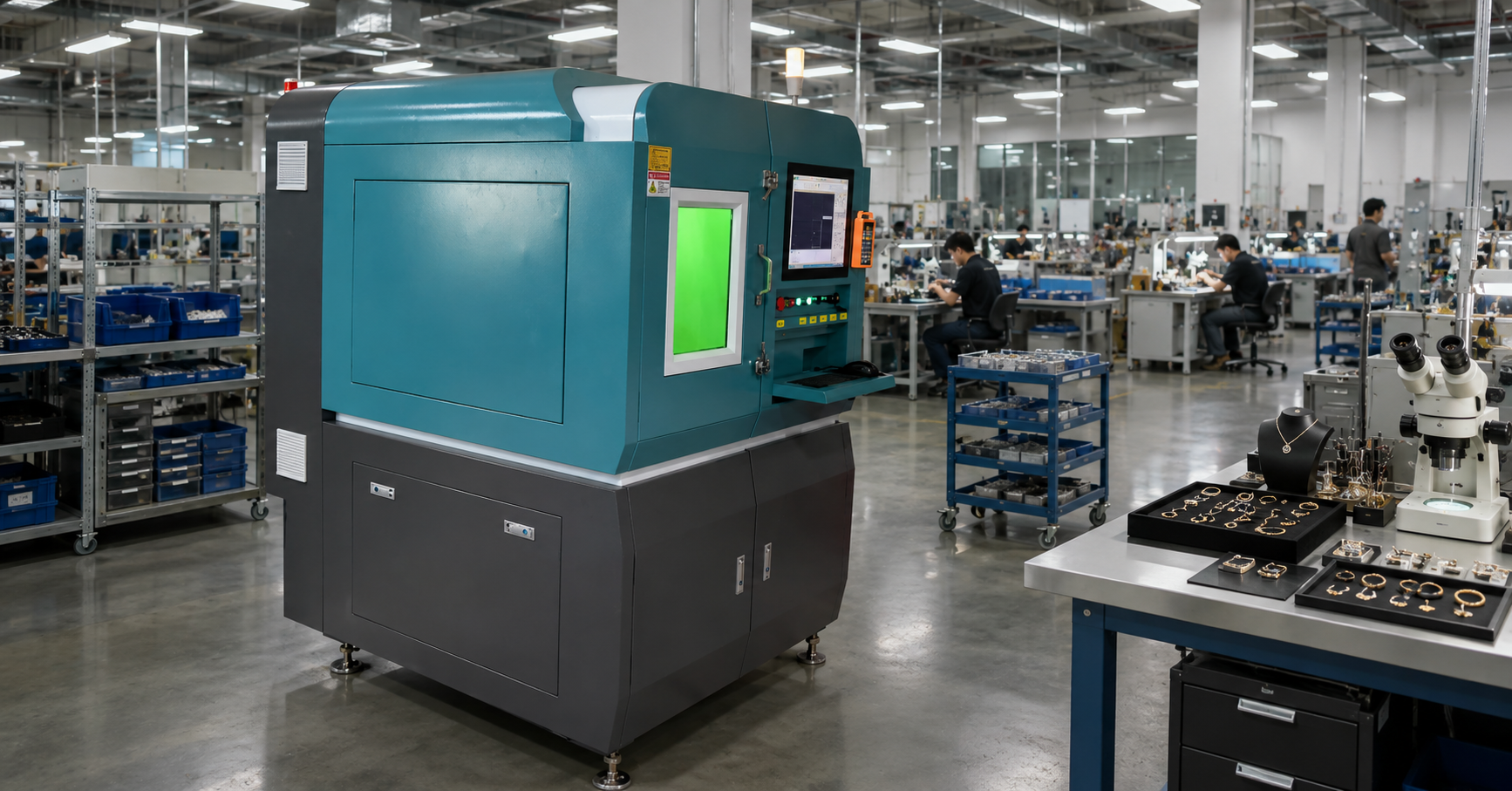
A precious metal laser cutting machine can help by using a controlled cutting process inside an enclosed workspace. Chikin’s page describes the equipment as an enclosed industrial processing unit with a two-tone metal cabinet, front access door with viewing window, control screen, push-button controls, and service tray area. The page also notes that the enclosed format separates the operator from the cutting zone and supports cleaner workflow management for small, valuable workpieces.
This matters because jewelry production is not only about cutting one good sample. A factory needs the same result across repeated orders. If a pendant pattern, ring insert, or decorative sheet component changes slightly from one piece to the next, the difference may affect assembly, finishing, polishing, or customer acceptance. A controlled CNC or laser-based process reduces dependence on hand cutting and gives the factory a more predictable production method.
What the CK-L3020 Product Configuration Suggests
According to the specification image on the product page, the CK-L3020 is listed as a precious metal engraving machine with a laser center wavelength of approximately 1070nm, 1500W peak power, 300×200mm effective cutting range, thickness range up to 3.0mm, maximum movement speed of 30m/min, positioning accuracy of ≤0.05mm, and repetitive positioning accuracy of ≤±0.01mm. The same specification table lists AC220V/60A or 380V/40A power supply requirements, machine power consumption ≤11KW, overall dimensions of 1200×1500×1850mm, machine weight around 1000kg, and a three-stage dust filtration system.
| Item | CK-L3020 Specification / Feature | Practical Meaning for Jewelry Manufacturers |
|---|---|---|
| Laser Center Wavelength | Approx. 1070nm | Typical near-infrared fiber-laser range; buyers should confirm material response and safety configuration |
| Peak Power | 1500W | Suitable for evaluating cutting capacity on precious metal sheets within confirmed process limits |
| Effective Cutting Range | 300×200mm | Fits small jewelry parts, decorative components, samples, and compact precious metal sheets |
| Thickness Range | ≤3.0mm | Buyers should verify performance by metal type, alloy, finish, and required edge quality |
| Maximum Movement Speed | 30m/min | Supports efficient toolpath movement for small-part production |
| Positioning Accuracy | ≤0.05mm | Helps support fine jewelry geometry and controlled cutting paths |
| Repetitive Positioning Accuracy | ≤±0.01mm | Important for repeat orders and batch consistency |
| Power Supply | AC220V/60A; 380V/40A | Buyers need to confirm workshop electrical compatibility before installation |
| Machine Power Consumption | ≤11KW | Useful for production cost and electrical planning |
| Overall Dimensions | 1200×1500×1850mm | Helps buyers check factory floor space and service clearance |
| Machine Weight | Approx. 1000kg | Indicates an industrial floor-standing system rather than a light desktop tool |
| Filtration System | Three-stage dust filtration system | Important for managing cutting residue and workshop cleanliness |
These parameters should be treated as a starting point for technical discussion. A B2B buyer still needs to confirm actual cutting results through sample testing, because gold, silver, and jewelry alloys may behave differently depending on thickness, reflectivity, surface finish, alloy composition, and required edge quality.
Why Enclosure Design Matters in Jewelry Laser Cutting
An enclosed machine format is not only about appearance. For jewelry factories, it affects process control, operator safety, and workshop organization.
Laser cutting involves light energy, heat, motion, and material interaction. OSHA notes that laser hazards may involve direct beam exposure, reflected beam exposure, skin hazards, eye hazards, fire hazards, and laser-generated airborne contaminants depending on the system and use conditions. IEC 60825-1:2014 applies to laser product safety for laser radiation in the wavelength range from 180nm to 1mm, which covers a 1070nm system; buyers should therefore ask suppliers about laser classification, enclosure design, labeling, interlocks, viewing protection, and operating procedures.
For a laser cutting machine for jewelry factory, enclosure design can help create a defined processing zone. Operators know where the cutting takes place. Supervisors can monitor through the viewing window. The control interface stays outside the main cutting area. Access doors and panels help separate routine operation from maintenance work.
The product page highlights an enclosed working chamber, integrated HMI and control access, observation window, and front access panels. These features support controlled production, supervised operation, and shop-floor installation planning.
Still, buyers should not assume that every enclosed machine provides the same safety level. They should ask for details: Is the viewing window rated for the laser wavelength? Are door interlocks included? What warning labels are provided? What protective eyewear is required? How is smoke or particulate handled? What maintenance steps are needed for filters?
Why Repeatability Is More Important Than One-Time Cutting Speed
Jewelry production often includes repeat patterns. A factory may cut many small decorative parts from sheet material. A custom jewelry workshop may reproduce the same pendant shape in different metals. A small production line may need consistent openings, curves, slots, or fine contours across multiple batches.
In this environment, one-time cutting speed is not enough. The machine must return to the same position again and again. That is why repetitive positioning accuracy matters. The CK-L3020 specification table lists repetitive positioning accuracy of ≤±0.01mm and positioning accuracy of ≤0.05mm.
For buyers, these figures should be discussed with the supplier in relation to real product geometry. A thin gold decorative plate may need a different edge expectation from a thicker silver component. A highly detailed pendant may require careful heat control, while a simple blank shape may focus more on output speed. The machine specification provides a technical foundation, but sample testing confirms whether the result matches actual product needs.
Material Compatibility Needs Direct Confirmation
The product page mentions common application materials such as gold, silver, and related jewelry alloys, while also stating that exact compatibility depends on the internal laser source, motion system, and process parameters. This point is important. In B2B purchasing, material compatibility should never be assumed only from the product name.
Gold and silver have different thermal and reflective behavior. Alloy composition may change cutting performance. Surface polishing, plating, thickness, sheet flatness, and workholding method can all affect the final result. A supplier should be able to discuss these variables with the buyer before quoting the machine as a complete production solution.
For example, a factory should provide:
Material type and alloy information.
Sheet thickness range.
Part drawing or DXF file.
Required edge quality.
Expected batch size.
Tolerance requirement.
Need for engraving, marking, or only cutting.
Whether the material is flat sheet, small plate, or pre-formed jewelry blank.
Any post-processing requirement such as polishing or soldering.
A serious gold silver laser cutting machine supplier should ask for these details instead of simply saying that the machine can cut all precious metals.
Process Control for High-Value Materials
Gold and silver are expensive. That changes the buying logic. In many ordinary metalworking applications, buyers may tolerate trial runs and scrap during process setup. In jewelry production, wasted material has a much higher direct cost. Even a small error can be frustrating when the material itself is valuable.
A precious jewelry laser cutting machine should therefore support process control from several directions:
The enclosure should protect the work zone.
The motion system should support repeatable cutting.
The control interface should make setup manageable.
The working range should match jewelry part size.
The filtration system should manage process residue.
The supplier should help buyers confirm parameters before production.
The machine should allow supervised operation without unnecessary access to the cutting area.
Chikin’s page describes the machine as an enclosed industrial unit for controlled, high-detail production, with integrated control access and visibility during operation. Those points fit the production reality of small, valuable components.
Buyer Checklist for Choosing a Jewelry Laser Cutting Machine Supplier
| Evaluation Point | What Buyers Should Ask | Why It Matters |
|---|---|---|
| Material Compatibility | Can the machine cut our gold, silver, or alloy thickness range? | Prevents mismatch between machine capability and real products |
| Sample Testing | Can the supplier cut our sample design before purchase? | Confirms edge quality, heat impact, accuracy, and part geometry |
| Laser Safety | What enclosure, labels, window protection, interlocks, and PPE guidance are provided? | Supports safer shop-floor operation and compliance planning |
| Filtration | How does the three-stage dust filtration system work and how often is maintenance required? | Affects cleanliness, operator environment, and maintenance planning |
| Working Area | Does the 300×200mm effective cutting range fit our parts and sheet formats? | Ensures the machine matches production layout |
| Accuracy | How are ≤0.05mm positioning and ≤±0.01mm repeatability tested? | Helps buyers judge production consistency |
| Electrical Requirement | Does our workshop support AC220V/60A or 380V/40A? | Avoids installation delays |
| Control Interface | Is the HMI easy for operators to learn? | Reduces training time and operation errors |
| After-Sales Support | Are training, spare parts, remote support, and filter replacement guidance available? | Protects long-term production use |
| Supplier Experience | Has the supplier supported jewelry, metal sheet, or precision small-part factories? | Shows whether the supplier understands B2B use cases |
How This Machine Fits Different Jewelry Production Scenarios
A precious jewelry laser cutting machine is most relevant when a buyer needs controlled processing of small, detailed metal parts. It may fit jewelry factories producing pendant blanks, earring components, decorative panels, small logo plates, ring components, custom design pieces, prototype samples, or short-run precious metal parts.
For a large factory, the machine may be used as part of a dedicated jewelry production cell. For a smaller workshop, it may help bring laser cutting in-house instead of outsourcing every new design. For an OEM jewelry manufacturer, it may support faster design changes and lower dependence on manual cutting.
The 300×200mm effective cutting range suggests that the machine is more suitable for compact workpieces and small sheets rather than large industrial metal plates. The ≤3.0mm thickness range also points toward precision sheet and jewelry-style work rather than heavy metal fabrication.
Why B2B Buyers Should Ask About Dust and Fume Management
Laser cutting can produce residue, fumes, or fine particles depending on the material and process. The CK-L3020 specification table lists a three-stage dust filtration system. For a jewelry factory, this is worth discussing in detail.
Buyers should ask what each filtration stage does, which consumables are used, how filters are replaced, whether extraction is built into the machine, and what maintenance interval is recommended. They should also ask whether local ventilation or additional extraction is needed based on material type and workshop regulation.
This is not only a maintenance question. It affects operator comfort, machine cleanliness, and long-term use. A supplier that can explain filtration clearly is usually more prepared to support real factory operation.
How to Compare Laser Cutting with Traditional Jewelry Cutting
Traditional cutting, sawing, punching, wire cutting, or manual finishing can still be useful in jewelry production. The best process depends on the design, material, volume, and finish requirement. A fiber laser cutting machine for jewelry is not automatically better for every job. Its advantage appears when the buyer needs fine detail, repeatable geometry, lower manual rework, and controlled cutting paths.
For complex decorative patterns, laser cutting may reduce manual layout work. For repeat orders, CNC-controlled cutting can reduce operator variation. For thin metal sheet, laser processing may support cleaner contour control when parameters are correct. For very thick or heat-sensitive pieces, buyers should test carefully before committing.
A practical B2B decision should compare process fit, not only machine appearance.
Questions to Ask Before Sending an Inquiry
Before contacting a jewelry cutting machine supplier, buyers should prepare clear information. This short preparation makes supplier communication much more accurate.
What metals will be processed?
What is the material thickness range?
What is the smallest feature size?
What edge quality is required?
What file format will be used?
How many pieces are expected per day or per batch?
Is the process for cutting only, or also engraving and marking?
Is the workshop ready for AC220V/60A or 380V/40A?
What safety requirements must the factory meet?
Is sample cutting required before purchase?
These questions help the supplier recommend the right configuration and avoid overpromising.
FAQ
What is a precious jewelry laser cutting machine used for?
A precious jewelry laser cutting machine is used for controlled cutting of small jewelry components, precious metal sheets, decorative patterns, and repeatable part geometries. It is especially useful when manufacturers need cleaner edges, tighter process control, and less manual rework.
Can this machine process gold and silver?
The product page mentions gold, silver, and related jewelry alloys as common application materials, but it also states that exact compatibility depends on the laser source, motion system, and process parameters. Buyers should confirm material thickness and cutting behavior through sample testing.
What is the effective cutting range of the CK-L3020?
The specification table lists an effective cutting range of 300×200mm. This is suitable for small jewelry parts, decorative components, and compact precious metal sheets.
What thickness can the machine cut?
The listed thickness range is ≤3.0mm. Actual cutting performance should be verified based on metal type, alloy, surface condition, edge requirement, and laser parameters.
Why is enclosure important for a jewelry laser cutting machine?
An enclosed design helps separate the operator from the processing area, supports cleaner workflow management, and allows supervised operation through the viewing window. Buyers should still confirm laser safety details such as interlocks, window protection, labeling, and PPE requirements.
What should a buyer check before choosing a jewelry laser cutting machine manufacturer?
Buyers should check material compatibility, sample testing ability, laser safety design, filtration system, working area, positioning accuracy, electrical requirements, operator interface, after-sales support, and spare parts availability.
Conclusion
A precious jewelry laser cutting machine is not just a cutting device. For B2B jewelry manufacturers, it is a production control tool. It helps factories handle small, valuable parts with more repeatability, clearer operator supervision, and a more organized process than many manual methods.
The Chikin CK-L3020 product information shows an enclosed industrial machine with integrated control access, observation window, a 300×200mm effective cutting range, 1500W peak power, ≤3.0mm thickness range, ≤0.05mm positioning accuracy, ≤±0.01mm repetitive positioning accuracy, and a three-stage dust filtration system.
For buyers comparing a gold laser cutting machine supplier, silver laser cutting machine, or fiber laser cutting machine for jewelry, the better decision should be based on sample results, safety configuration, material behavior, service support, and workflow fit. Price matters, but repeatability, support, and scrap reduction often decide whether the investment works in real production.