



A pneumatic marking machine provides a practical method for applying serial numbers, vehicle identification numbers (VINs), batch codes, and permanent identification marks to industrial metal components.
For automotive manufacturers, machinery suppliers, metal fabrication workshops, and quality-control departments, reliable marking is essential for connecting physical parts with production records, inspection results, and maintenance histories.
The right pneumatic marking machine should produce readable, consistently positioned marks on the intended material while meeting the required marking depth, cycle time, and traceability specifications.
Unlike adhesive labels or ink-based identification, dot-peen marking physically alters the surface through controlled mechanical impacts. This can provide durable identification without inks or labels, although the marking process must be compatible with the part's material and structural requirements.
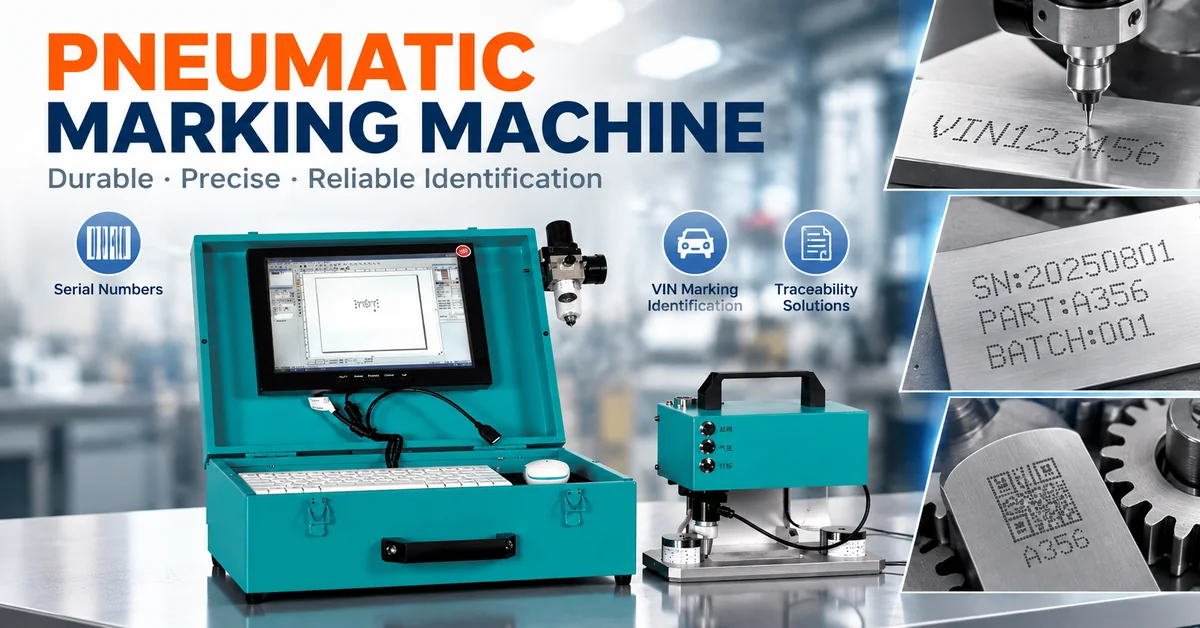
CHIKIN CNC lists a pneumatic marking machine featuring a compact computer-based control cabinet and separate marking head. This configuration is relevant to workshops and industrial production environments requiring flexible part positioning and repeatable marking operations.
This guide explains how pneumatic marking works, which applications it suits, how to compare equipment, and what industrial buyers should verify before requesting a quotation.
1. What Is a Pneumatic Marking Machine?
A pneumatic marking machine is an industrial identification system that uses a compressed-air-driven marking mechanism to create marks on a workpiece.
In a typical pneumatic dot-peen configuration, a hardened marking pin repeatedly impacts the surface, producing a controlled sequence of indentations.
These indentations form characters, numbers, symbols, or other programmed patterns.
The marking process is commonly used for industrial traceability because it creates physical surface deformation rather than applying a removable label.
How Does Pneumatic Dot-Peen Marking Work?
A typical marking cycle includes five stages:
-
The operator enters or imports the required marking content.
-
The workpiece is positioned and secured.
-
The marking head moves according to the programmed pattern.
-
A pneumatic mechanism drives the marking pin against the material.
-
The completed mark is inspected for readability and accuracy.
The exact marking technology, air-pressure requirements, and supported marking patterns must be confirmed for the selected machine configuration.
Pneumatic Marking vs Manual Stamping
Manual stamping can be suitable for occasional identification tasks, but it depends heavily on operator positioning and impact consistency.
A programmable marking system can improve control over character layout and marking location when properly configured.
For factories processing repeated serial numbers or production batches, a standardized marking workflow may also reduce identification errors.
2. Who Needs a Pneumatic Marking Machine?
Pneumatic marking equipment is relevant to manufacturers requiring durable, repeatable identification on suitable components.
| Buyer Segment | Typical Application | Main Purchasing Requirement |
|---|---|---|
| Automotive manufacturers | VIN and chassis identification | Character accuracy and regulatory compliance |
| Automotive parts suppliers | Serial numbers on mechanical components | Permanent part traceability |
| Metal fabrication workshops | Plates, brackets and fabricated components | Consistent and readable marking |
| Machinery manufacturers | Equipment identification and serial plates | Durable product identification |
| Industrial maintenance teams | Equipment and replacement-part marking | Traceability through service life |
| Tool and fixture manufacturers | Tool numbers and asset identification | Mark durability and positioning |
| Quality-control departments | Batch and inspection identification | Accurate connection to production records |
| Industrial equipment distributors | Customer-specific marking applications | Configuration and technical support |
For automotive identification, purchasing teams should distinguish between marking a legally regulated vehicle VIN and marking an ordinary internal part number.
Different requirements may apply to character layout, marking location, permanence, and documentation.
3. CHIKIN CNC Pneumatic Marking Machine: Product Overview
The CHIKIN Pneumatic Marking Machine is presented as an industrial digital marking system for serial-number identification, metal components, nameplates, and related traceability applications.
The supplied product photographs show a teal-colored control cabinet with a hinged enclosure, integrated display, keyboard, mouse, and a separate marking head.
The separate-head layout may be useful where the marking position is difficult to access with a fully integrated workstation.
Visible Product Features
| Product Feature | Supplied Product Information | Potential Buyer Benefit |
|---|---|---|
| Equipment category | Pneumatic marking machine | Industrial identification applications |
| Product variant | VIN marking machine | Vehicle and metal-part identification |
| Controller arrangement | Separate control cabinet | Flexible workstation layout |
| Operator interface | Monitor, keyboard and mouse | Computer-based job preparation |
| Marking assembly | Separate marking head | More flexible part positioning |
| Cabinet structure | Hinged metal enclosure | Organized storage and handling |
| Transport feature | Carry handle on cabinet | Movement between workstations |
| Installation arrangement | Compact head mounting base | Workbench or dedicated marking station |
| Marking applications | Serial numbers, part numbers and nameplates | Production traceability |
These visible features support an initial equipment evaluation.
However, machine photographs cannot independently establish exact marking depth, positioning accuracy, cycle time, or pneumatic performance.
Which Specifications Require Confirmation?
The uploaded specification image combines dot-peen equipment identification with laser-specific parameters.
Consequently, figures such as laser wavelength, laser power, laser frequency, and laser marking speed should not be treated as verified specifications for the pneumatic system.
Before purchase, request a revised machine-specific datasheet confirming the actual marking mechanism, working area, marking-pin configuration, compressed-air requirements, electrical supply, and supported materials.
4. What Materials Can a Pneumatic Marking Machine Process?
Material compatibility is one of the most important factors in pneumatic marking.
Because dot-peen marking creates indentations, the material must tolerate localized mechanical impact without unacceptable cracking, distortion, or damage.
Material Compatibility Guide
| Material | Typical Marking Application | Main Consideration |
|---|---|---|
| Carbon steel | Machinery and automotive parts | Hardness and required indentation |
| Stainless steel | Industrial components and plates | Surface finish and marking force |
| Aluminum | Housings and nameplates | Distortion and indentation depth |
| Brass | Identification plates and fittings | Surface deformation |
| Cast iron | Industrial machinery components | Surface texture and brittleness |
| Coated metal | Finished components | Coating damage and mark readability |
| Hardened steel | Specialized industrial parts | Tool capability and material hardness |
The suitability of each material depends on the actual alloy, heat treatment, thickness, geometry, and marking parameters.
Can Pneumatic Marking Damage a Metal Part?
Yes, if the marking force or location is unsuitable.
Pneumatic marking intentionally deforms the surface. Excessive indentation can create local stress concentration, distort thin components, or affect coatings.
For safety-critical parts, pressure-containing components, or highly stressed mechanical structures, the approved marking location and depth should be established by the responsible engineering team.
The best marking result is not necessarily the deepest mark. It is the shallowest qualified mark that satisfies the required readability and durability criteria.
5. How to Evaluate VIN Marking Quality and Readability
Vehicle identification marking requires more than creating a sequence of visible characters.
Manufacturers must ensure that the correct identification information is applied to the correct vehicle or component.
ISO 3779:2009, Road Vehicles — Vehicle Identification Number (VIN) — Content and Structure, provides an international reference for VIN identification structure.
However, compliance with the VIN format does not automatically establish compliance with country-specific requirements for marking location, dimensions, permanence, or application methods.
Important VIN Marking Quality Factors
| Quality Factor | What Buyers Should Check |
|---|---|
| Character accuracy | Correct identification sequence |
| Character size | Conformity with drawing or applicable requirements |
| Character spacing | Uniform and readable arrangement |
| Marking depth | Sufficient durability without excessive damage |
| Position | Correct location on the vehicle or component |
| Surface condition | No unacceptable cracking or deformation |
| Readability | Consistent recognition under specified inspection conditions |
| Repeatability | Similar results across production samples |
| Traceability | Correct correspondence between mark and production record |
Should VIN Marking Depth Be Maximized?
No.
Marking depth should be established from the applicable engineering and legal requirements.
A deeper mark may provide durability in certain environments, but excessive surface deformation can compromise sensitive components.
For chassis identification, manufacturers should verify local regulatory requirements and approved marking locations before production.
6. Pneumatic Marking Machine vs Laser Marking Machine
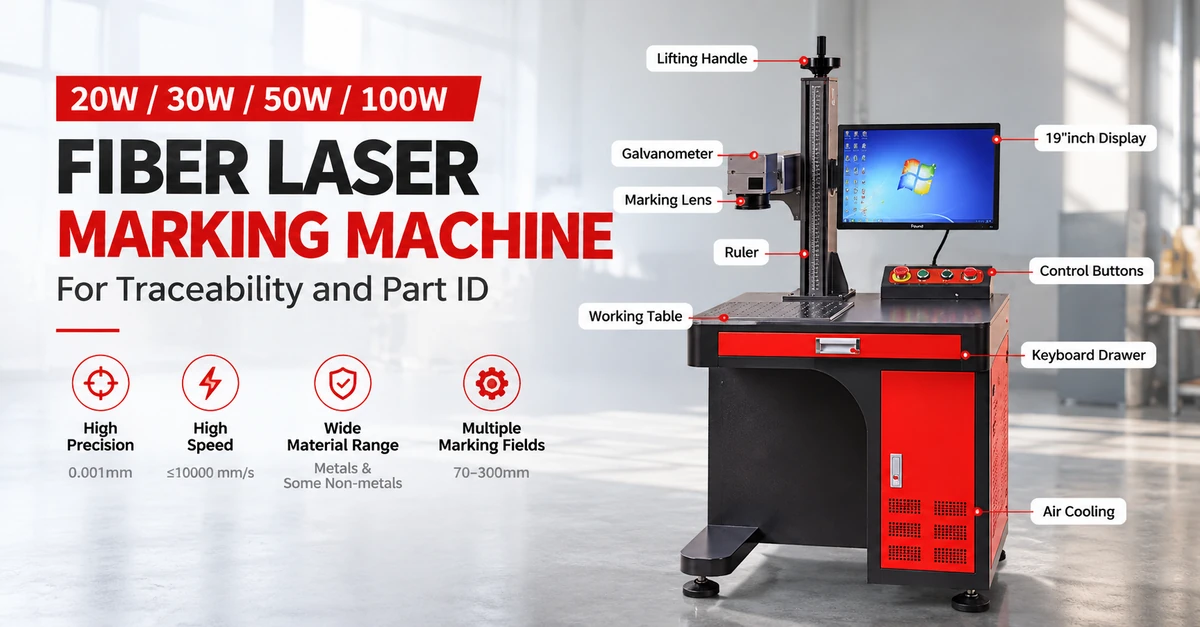
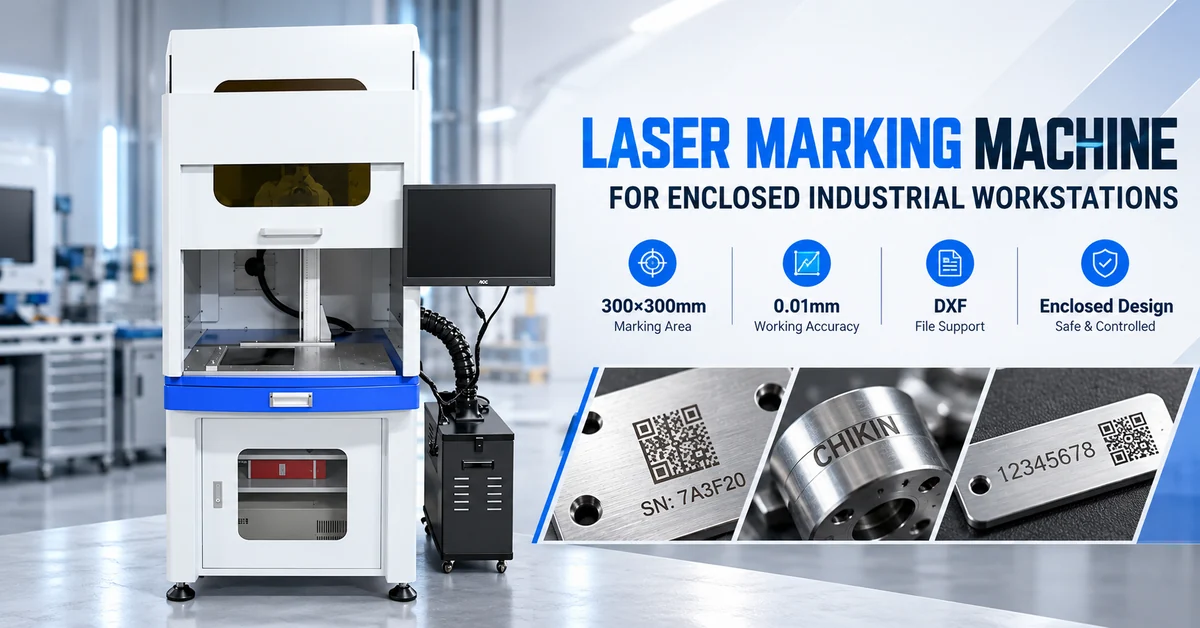
Industrial buyers often compare pneumatic dot-peen marking with fiber laser marking.
Both technologies can provide durable part identification, but they operate differently.
Technology Comparison
| Evaluation Factor | Pneumatic Dot-Peen Marking | Fiber Laser Marking |
|---|---|---|
| Marking principle | Mechanical indentation | Focused laser energy |
| Direct contact | Marking pin contacts surface | Non-contact beam processing |
| Main process requirements | Appropriate marking mechanism and compressed air | Laser source, optics and safety controls |
| Marking depth | Depends on impact and material | Depends on laser and material parameters |
| Fine graphics | Limited by stylus and process geometry | Often suitable for fine details |
| Tool wear | Marking pin requires maintenance | Optical components require maintenance |
| Thin components | Impact may cause deformation | Thermal effects require evaluation |
| Deep physical identification | Can be suitable when qualified | Depends on laser power and process |
| Main safety considerations | Mechanical impact, guarding and noise | Laser exposure, fumes and guarding |
Which Technology Is Better for VIN Marking?
Pneumatic dot-peen marking is worth evaluating when the application requires physical indentation on a suitable metal surface.
Laser marking may be advantageous where fine detail, non-contact operation, or specific code formats are important.
However, neither technology should be selected solely on equipment price.
Buyers should compare the finished mark, part integrity, production cycle time, maintenance requirements, and applicable identification standards.
CHIKIN CNC also lists fiber laser marking equipment for industrial part identification, allowing buyers to investigate an alternative marking method when appropriate.
7. Marking Head, Controller, and Fixture Requirements
The marking head and workpiece fixture have a major influence on production consistency.
Even a capable marking system may produce unacceptable results when the part moves during the marking cycle.
Marking Head Configuration
The supplied CHIKIN product shows a separate marking head connected to a control cabinet.
This configuration may help operators position the head near larger parts or operate from a compact workbench.
Before purchase, confirm:
-
The effective marking area.
-
Marking head mounting dimensions.
-
Cable and hose requirements.
-
Marking-pin specifications.
-
Supported workpiece height.
-
Access around the intended marking location.
Part Fixturing
A suitable fixture should locate the component consistently without damaging its functional surfaces.
For curved components, irregular castings, or heavy metal parts, buyers may need application-specific positioning arrangements.
Controller and Software
The photographed system includes a display, keyboard, and mouse.
These features support computer-based operation, but the exact software capabilities require verification.
For serial-number production, request a demonstration of content editing, automatic numbering, job storage, error prevention, and any required communication with production databases.
8. Industrial Traceability: Serial Numbers, Batch Codes, and Direct Part Marking
A permanent mark becomes valuable when it can be linked reliably to manufacturing records.
In a traceability workflow, the identification system may connect a part number or serial number to information such as production date, material batch, inspection results, and manufacturing location.
Example Traceability Workflow
-
Assign or retrieve the correct identification number.
-
Confirm the workpiece and production order.
-
Position the part in the marking fixture.
-
Apply the required identification.
-
Inspect the completed mark.
-
Record the result in the relevant production system.
The marking equipment may perform only part of this workflow. Barcode readers, verification cameras, database interfaces, and production-system integration must be specified separately.
Can Pneumatic Marking Produce Data Matrix Codes?
Some industrial dot-peen systems support direct-part-marked two-dimensional codes, but capability depends on the marking hardware, controller software, dot spacing, and surface properties.
The supplied CHIKIN product information does not establish that Data Matrix marking is supported as standard.
For applications requiring machine-readable direct part marks, ISO/IEC 29158:2025 provides a relevant reference for evaluating direct-part-marked two-dimensional symbol quality.
This is different from ordinary visual inspection of VIN characters.
Buyers should verify scanner compatibility, code format, and acceptance requirements before specifying automated code marking.
9. How to Control Marking Quality Before Production
A marking machine should be qualified using actual components rather than relying entirely on catalog specifications.
A practical inspection plan should cover content accuracy, mark quality, and potential damage to the substrate.
Marking Quality Control Checklist
| Inspection Item | Recommended Evaluation |
|---|---|
| Marking content | Compare with the approved production record |
| Character clarity | Confirm visual readability |
| Character dimensions | Measure against the applicable specification |
| Marking location | Verify position relative to part datums |
| Indentation condition | Inspect uniformity and excessive deformation |
| Surface integrity | Check for cracks or coating damage |
| Repeatability | Inspect multiple marked parts |
| Identification durability | Test under specified handling or environmental conditions |
| Process documentation | Record job settings and inspection results |
For applications involving corrosion resistance, abrasive cleaning, or repeated handling, the mark should be evaluated under relevant service conditions.
No marking method should be assumed to remain readable indefinitely under every environment.
10. What Determines Pneumatic Marking Machine Productivity?
The equipment's practical production capacity depends on the complete marking cycle.
A high-speed marking head may still produce limited output if operators spend significant time locating parts, entering content, or inspecting identification.
A useful production calculation is:
Cycle Time = Loading + Positioning + Marking + Inspection + Unloading
The resulting accepted production output should account for parts that fail inspection.
Main Factors Affecting Output
| Factor | Production Impact |
|---|---|
| Number of characters | More marking content may require longer processing |
| Marking depth | Greater indentation can affect processing conditions |
| Material hardness | Changes marking response |
| Fixture design | Influences positioning and loading time |
| Operator workflow | Affects manual handling |
| Software setup | Determines job-change efficiency |
| Inspection requirements | Adds necessary quality-control time |
For batch manufacturing, request a time study using the real identification format and workpiece.
Avoid estimating hourly output from an unverified maximum marking-speed figure.
11. What Affects Pneumatic Marking Machine Price?
Industrial marking equipment prices can vary according to configuration, marking area, controller, head design, software, and required accessories.
The least expensive machine is not always the lowest-cost production solution.
Cost Comparison Checklist
| Cost Factor | What to Confirm |
|---|---|
| Base equipment | Controller and marking-head scope |
| Marking area | Required dimensions |
| Pneumatic system | Air supply and consumption |
| Marking consumables | Pin type and replacement cost |
| Fixtures | Standard or application-specific |
| Software | Included functions and licensing |
| Integration | Data interfaces and external equipment |
| Installation | Commissioning and training arrangements |
| Maintenance | Spare parts and service requirements |
| Delivery | Packaging, transport and commercial terms |
Production managers should also consider the cost of incorrectly marked parts.
An identification error can require rework, additional inspection, or rejection depending on the product and industry.
A more complete purchasing comparison therefore evaluates total ownership cost and accepted production output instead of initial purchase price alone.
12. Standard vs Customized Pneumatic Marking Machines
A standard marking system may be appropriate when part dimensions, marking location, character format, and production requirements fall within the equipment's supported range.
Customization may deserve evaluation when components have unusual shapes, restricted marking locations, or more demanding traceability requirements.
Potential discussion topics include marking-head mounting, fixtures, control software, communication interfaces, and workstation layout.
These features should not be assumed to be available on every configuration.
Recommended RFQ Information
| Information | Buyer Should Provide |
|---|---|
| Part material | Steel, stainless steel, aluminum or other |
| Material hardness | Grade or hardness information |
| Component dimensions | Overall dimensions and marking position |
| Marking content | VIN, serial number, batch code, text or symbol |
| Character requirements | Height, spacing, depth and readability |
| Production quantity | Expected parts per hour or shift |
| Workpiece handling | Manual loading or automated line |
| Fixture requirements | Part drawings or photographs |
| Utilities | Available electrical supply and compressed air |
| Traceability requirements | Numbering logic and record integration |
| Acceptance criteria | Sample inspection and durability requirements |
| Purchasing requirements | Quantity, destination and requested delivery |
Request a Configuration Review from CHIKIN CNC
CHIKIN CNC supplies industrial CNC and precision manufacturing equipment, including marking systems for part identification applications.
If your factory is evaluating a pneumatic marking machine for VIN numbers, nameplates, or serial-number marking, prepare representative components and the required marking format.
Review the CHIKIN Pneumatic Marking Machine product page.
Product availability and the exact marking configuration should be confirmed before ordering.
Contact CHIKIN CNC to Discuss Marking Requirements and Request Availability
Providing material details, photographs, character requirements, and production targets will support a more useful technical discussion.
13. Frequently Asked Questions About Pneumatic Marking Machines
1. What is a pneumatic marking machine used for?
A pneumatic marking machine is used to apply identification information to suitable industrial components. Common applications include serial numbers, VIN numbers, batch codes, equipment identification, and metal nameplates.
2. Is pneumatic marking permanent?
Dot-peen marking physically deforms the workpiece surface, which can provide durable identification. However, permanence and readability depend on marking depth, material, corrosion, abrasion, and service conditions.
3. Can a pneumatic marking machine mark stainless steel?
Stainless steel is a potential marking material. The appropriate marking force and tool specification depend on its grade, hardness, thickness, and required mark quality.
4. Can pneumatic marking be used for vehicle VIN numbers?
Yes, suitable pneumatic systems can be considered for VIN identification. The manufacturer must still verify applicable legal requirements, approved marking locations, character specifications, and material compatibility.
5. What is the difference between pneumatic marking and laser marking?
Pneumatic dot-peen marking creates physical indentations through mechanical impacts. Laser marking uses focused energy to modify the surface. Each method has different equipment, material, maintenance, and quality considerations.
6. Does pneumatic marking damage metal surfaces?
It deliberately creates localized surface deformation. Excessive indentation or an unsuitable marking location can damage certain parts. Engineering validation is especially important for thin or safety-critical components.
7. Can pneumatic marking machines automatically generate serial numbers?
Some programmable systems support automatic numbering, but this function must be confirmed for the specific controller and software. Buyers should request a demonstration using their actual numbering format.
8. What maintenance does a pneumatic marking machine require?
Maintenance commonly involves inspecting the marking pin, head mechanism, workholding, pneumatic connections, and controller. The exact maintenance schedule depends on the machine configuration and operating conditions.
9. How can I check marking quality before buying?
Request sample marking on your actual material. Evaluate character clarity, dimensions, position, indentation condition, repeatability, and durability according to the intended application.
10. How can I request a quotation from CHIKIN CNC?
Send your part material, dimensions, marking content, required marking area, production quantity, and photographs or drawings. Contact CHIKIN CNC to confirm the marking technology, available configuration, supply status, and commercial terms.
Conclusion
A pneumatic marking machine can provide a practical solution for manufacturers requiring durable identification of metal components, vehicle-related parts, industrial nameplates, and production equipment.
For B2B buyers, the most important selection factors are not simply equipment price or claimed marking speed. They include material compatibility, marking clarity, part integrity, fixture stability, traceability requirements, and consistent production performance.
Pneumatic dot-peen marking is worth considering when physical surface indentation is suitable for the component and identification requirements. Laser marking may be a better alternative for certain fine-detail or non-contact applications.
Before investing, manufacturers should validate the proposed technology on actual components, confirm the machine-specific specifications, and establish clear inspection and acceptance criteria.
CHIKIN CNC provides industrial marking and precision manufacturing equipment solutions for customers evaluating part-identification workflows.
Explore the CHIKIN CNC product portfolio or learn more about the company's service capabilities.
Contact CHIKIN CNC for a Pneumatic Marking Machine Configuration Review and share your metal-part details, marking requirements, and expected production volume.
A well-defined technical inquiry is the first step toward selecting an identification system that fits your manufacturing process and long-term traceability needs.