



How Should Buyers Evaluate a Wire EDM Machine Manufacturer?
Choosing a wire EDM machine manufacturer should start with the parts you need to produce, not simply with the machine price.
For tool-and-die shops, mold manufacturers, precision component suppliers, and industrial metalworking factories, the important questions are whether the machine can handle the required material, geometry, accuracy, working area, production volume, and workflow.
A capable manufacturer should therefore provide more than a standard equipment quotation. Buyers should expect application review, technical configuration, machine testing, sample evaluation, documentation, and after-sales support.
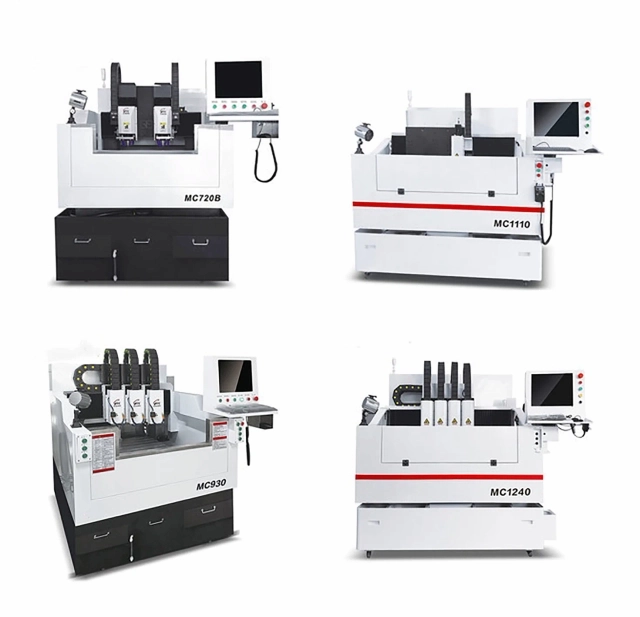
CHIKIN offers a broader range of CNC and precision manufacturing equipment for buyers comparing different machining processes.
What Type of Work Is Wire EDM Designed For?
Wire electrical discharge machining removes conductive material through controlled electrical discharge rather than conventional cutting contact.
This makes Wire EDM particularly useful when a part requires:
- Complex contours
- Narrow slots
- Internal profiles
- Precision punches and dies
- Mold inserts
- Hard conductive materials
- Fine-detail metal components
Mitsubishi Electric describes wire-cut EDM as a precision machining technology used for molds and industrial parts where high accuracy and complex cutting are important.
Unlike a conventional milling cutter, the EDM wire does not remove material through direct mechanical cutting force. Buyers should therefore evaluate Wire EDM and CNC milling as complementary processes rather than assuming one replaces the other in every application.
What Do the Published CK-710-AT Specifications Tell Buyers?
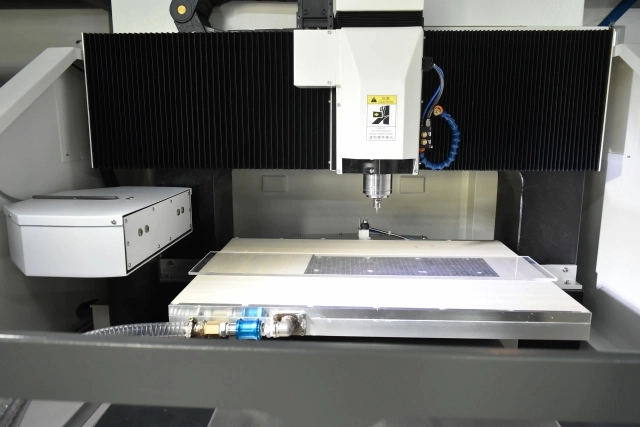
The product information shown identifies the machine as CHIKIN CK-710-AT and provides several useful purchasing parameters.
| Item | Published Information |
|---|---|
| Model | CK-710-AT |
| Table dimension | 700 × 500 mm |
| Z-axis height | 100–200 mm |
| Processing area | 600 × 500 × 100 mm |
| Processing accuracy | ±0.015 mm |
| Repositioning accuracy | 0.005 mm |
| Spindle information | 2.5 kW, 60,000 rpm |
| Tool magazine | 12 tools, automatic tool change |
| Machine weight | 2000 kg |
| Core components | Bearing, motor, spindle |
| Warranty | 1 year |
| MOQ | 1 set |
These specifications help buyers judge machine size, working envelope, positioning capability, and installation requirements.
However, the product information combines Wire EDM positioning with CNC milling-related specifications such as spindle speed and automatic tool change. Buyers should therefore confirm which specifications apply to the Wire EDM process and which belong to the milling or engraving configuration before approving the final machine specification.
That technical clarification is exactly the type of question a qualified supplier should answer before quotation approval.
Manufacturer, Supplier, or Factory: What Should Buyers Actually Compare?
The words manufacturer, supplier, and factory are often used interchangeably in industrial sourcing, but the company behind the quotation may provide very different levels of technical support.
| Evaluation Area | General Supplier | Equipment Trader | Machine Manufacturer |
| Product quotation | Yes | Yes | Yes |
| Application review | Varies | Limited | Should be available |
| Machine configuration | Moderate | Often outsourced | Direct engineering |
| Sample testing | Possible | Source-dependent | Easier to arrange |
| Customization | Limited to moderate | Usually outsourced | Higher potential |
| QC and machine testing | Indirect | Indirect | Factory controlled |
| Spare parts | Available | Source-dependent | More controllable |
| Technical troubleshooting | Varies | Third-party dependent | Direct support preferred |
When evaluating a wire EDM machine manufacturer, focus on who controls the engineering, machine assembly, testing, configuration, and technical response.
A large factory building alone does not prove machining expertise.
Why Does Application Engineering Matter?
Two buyers can purchase machines with similar dimensions but require completely different machining performance.
One factory may produce mold inserts with tight internal profiles. Another may machine precision punches, dies, or conductive metal components in small batches.
Before recommending a configuration, the supplier should understand:
- Workpiece material
- Part dimensions
- Maximum thickness
- Geometry
- Required tolerance
- Surface finish expectations
- Batch quantity
- Current machining method
- Production bottleneck
For combined CNC milling and Wire EDM applications, the supplier should also clarify which operations should be completed by milling and which should be reserved for EDM.
This prevents buyers from selecting equipment based on features that do not solve the actual manufacturing problem.
What Should Buyers Check During Factory Evaluation?
Engineering Capability
A suitable wire EDM machine factory should be able to discuss the machining process rather than only repeat specifications from a catalog.
Ask whether the technical team can review:
- CAD drawings
- Part tolerances
- Material grades
- Machining sequence
- Workholding
- Required accuracy
- Machine configuration
You can review more information about CHIKIN's design and R&D capabilities when evaluating its engineering background.
Machine Assembly and Quality Control
Buyers should ask how the factory checks:
- Mechanical assembly
- Axis movement
- Control operation
- Electrical systems
- Machine alignment
- Safety devices
- Repeated positioning
- Trial machining
For Wire EDM specifically, accuracy verification is an important technical subject. ISO 14137:2015 defines test conditions for evaluating the accuracy of general-purpose Wire EDM machines.
Buyers do not necessarily need every supplier to provide an ISO test certificate, but asking how accuracy is measured is a useful way to evaluate manufacturing discipline.
Sample Machining
Sample testing is one of the most useful steps before purchasing precision equipment.
Instead of asking only:
“Can your machine achieve our accuracy?”
send a real drawing and material specification.
Ask the supplier to demonstrate:
- Machining feasibility
- Dimensional consistency
- Edge condition
- Fine-profile capability
- Repeatability
- Processing time
- Setup requirements
For difficult components, sample machining often provides more purchasing value than another page of marketing specifications.
Which Materials and Parts Are Best Suited to Wire EDM?
Wire EDM requires electrically conductive workpieces.
Typical applications can include:
Tool and Die Components
Wire EDM is commonly considered for:
- Precision punches
- Die inserts
- Cutting profiles
- Narrow slots
- Internal geometries
Mold Components
Mold manufacturers may use the process where conventional tools have difficulty reaching fine internal features or sharp profile transitions.
Precision Metal Parts
Suitable industries can include:
- Industrial machinery
- Automotive components
- Aerospace-related precision parts
- Electronics tooling
- Precision fixtures
Mitsubishi Electric also identifies mold making and high-reliability industrial component production among important EDM applications.
The correct process still depends on material, geometry, tolerance, and productivity requirements.
Wire EDM vs CNC Milling: Which Should a Buyer Choose?
Wire EDM and CNC milling solve different machining problems.
| Requirement | Wire EDM | CNC Milling |
| Conductive material required | Yes | No |
| Mechanical cutter contact | No | Yes |
| Complex internal contours | Strong | Tool-access dependent |
| General 3D machining | Limited | Strong |
| Sharp internal features | Strong | Limited by cutter radius |
| High material removal | Usually slower | Often stronger |
| Tool cutting force | Very low | Present |
| Mold and die detail work | Strong | Strong for complementary operations |
A precision factory may use both technologies.
CNC milling can perform roughing, general profiling, holes, surfaces, and broader 3D machining, while Wire EDM may handle final conductive profiles that are difficult to produce efficiently with a conventional cutting tool.
The decision should be based on the part rather than the machine name.
What Should a Wire EDM Machine Supplier Provide Before Shipment?
A reliable wire EDM machine supplier should provide clear information about what is included with the machine.
Buyers should confirm:
- Final machine configuration
- Working area
- Control system
- Included accessories
- Consumables
- Installation requirements
- Machine documentation
- Testing records
- Recommended spare parts
- Warranty scope
- Operator training
- Remote technical support
The product information shown states that machinery test reports and outgoing inspection are provided. Buyers should request copies or agree on the required documentation before shipment.
For common service questions, CHIKIN's equipment FAQ can also be used as a reference point before contacting the technical team.
What Information Should Buyers Send for a Quotation?
The fastest way to receive a meaningful quotation is to provide engineering information with the inquiry.
Send:
- Part drawing
- Material grade
- Maximum part dimensions
- Workpiece thickness
- Required tolerance
- Surface requirements
- Monthly or daily quantity
- Existing machining process
- Current production problem
- Required automation
- Factory voltage
- Destination country
This allows the manufacturer to evaluate technical suitability rather than giving only a generic equipment price.
Why Does Manufacturer Experience Matter?
CHIKIN CNC operates through Shenzhen ChiKin Automation Equipment Co., Ltd. and focuses on CNC, automation, PCB processing, and related industrial equipment.
For an overseas buyer, the value of manufacturing experience should be evaluated through practical evidence:
- Can the engineering team understand the drawing?
- Can the machine be configured for the application?
- Can the supplier demonstrate the machining process?
- Can the factory test the equipment before shipment?
- Can replacement parts and technical assistance be provided later?
These questions provide more useful purchasing evidence than broad statements such as “high quality” or “advanced technology.”
FAQ
What Is the Most Important Factor When Choosing a Wire EDM Machine Manufacturer?
Application understanding is one of the most important factors. The manufacturer should review the workpiece material, dimensions, tolerance, geometry, and production target before recommending a machine.
Is Wire EDM Suitable for Non-Conductive Materials?
No. Wire EDM depends on electrical discharge, so the workpiece must be electrically conductive.
Should I Compare Wire EDM Machines Only by Accuracy?
No. Accuracy matters, but buyers should also evaluate working area, part thickness, control system, machine stability, sample results, maintenance requirements, support, and total production needs.
Why Should I Request Sample Machining?
Sample machining allows you to verify how the proposed configuration performs on your own material and geometry before purchasing the machine.
What Should I Confirm About the CK-710-AT Configuration?
Because the published information includes both Wire EDM positioning and CNC milling-related specifications, buyers should confirm the exact processing modules, applicable specifications, control configuration, and accessories included in the quoted machine.
Can the Machine Be Customized?
Customization should be discussed according to the application. Possible requirements may involve working area, controls, tooling, fixtures, accessories, software, or production-specific configuration.
What Support Should an Overseas Buyer Request?
Confirm installation guidance, operator training, technical documentation, spare parts, remote troubleshooting, warranty terms, and post-warranty support before placing the order.
Conclusion
Choosing a wire EDM machine manufacturer is ultimately a technical sourcing decision.
The right factory should not only provide a machine with suitable dimensions and specifications. It should understand your material, drawing, tolerance, production volume, and machining challenges, then demonstrate that the proposed equipment can meet those requirements.
For buyers comparing a wire EDM machine supplier, manufacturer, or factory, prioritize application engineering, verified specifications, sample testing, machine QC, documentation, spare parts, and long-term technical support.
To discuss the CK-710-AT or another precision machining configuration, contact CHIKIN CNC with your part drawing, material, required tolerance, workpiece size, and production target. This gives the engineering team enough information to evaluate machine suitability before preparing the final quotation.