



How to Choose a Reliable PCB Drilling Machine Manufacturer for Your Factory
Choosing a PCB drilling machine manufacturer is a serious decision for any PCB factory. The machine you buy will not only affect drilling speed. It can influence hole accuracy, production rhythm, tool cost, scrap rate, operator workload, delivery stability, and even the type of PCB orders your factory can accept in the future.
Many buyers start by asking for a price. That is understandable. But in real production, the cheapest machine is not always the most economical one. A drilling machine that looks affordable at the quotation stage may become expensive later if it causes frequent tool breakage, unstable hole positioning, poor after-sales support, or long downtime.
For factories producing multilayer boards, HDI boards, aluminum substrates, industrial control boards, automotive electronics boards, or high-density circuit layouts, the supplier selection process needs to be more careful. IPC-6012 covers qualification and performance requirements for rigid printed boards, including single-sided, double-sided, plated-through-hole, multilayer, blind/buried via, and metal core boards, so drilling quality is closely connected with the broader reliability expectations of PCB manufacturing.
Why Choosing the Right PCB Drilling Machine Manufacturer Matters
A reliable PCB drilling machine manufacturer should not only sell equipment. It should understand how PCB factories actually use the machine: what board materials they process, what hole sizes they require, what tolerance level they expect, how often tools need to be changed, and how quickly technical support must respond when production stops.
In daily production, the drilling process looks repetitive. A panel is fixed, the program starts, the spindle drills, and the operator moves to the next batch. Yet the details are not simple. Hole position must stay stable. Spindle vibration must be controlled. Tool life must be monitored. The CNC system must execute programs smoothly. Operators need a clear interface. Maintenance needs to be practical, not theoretical.
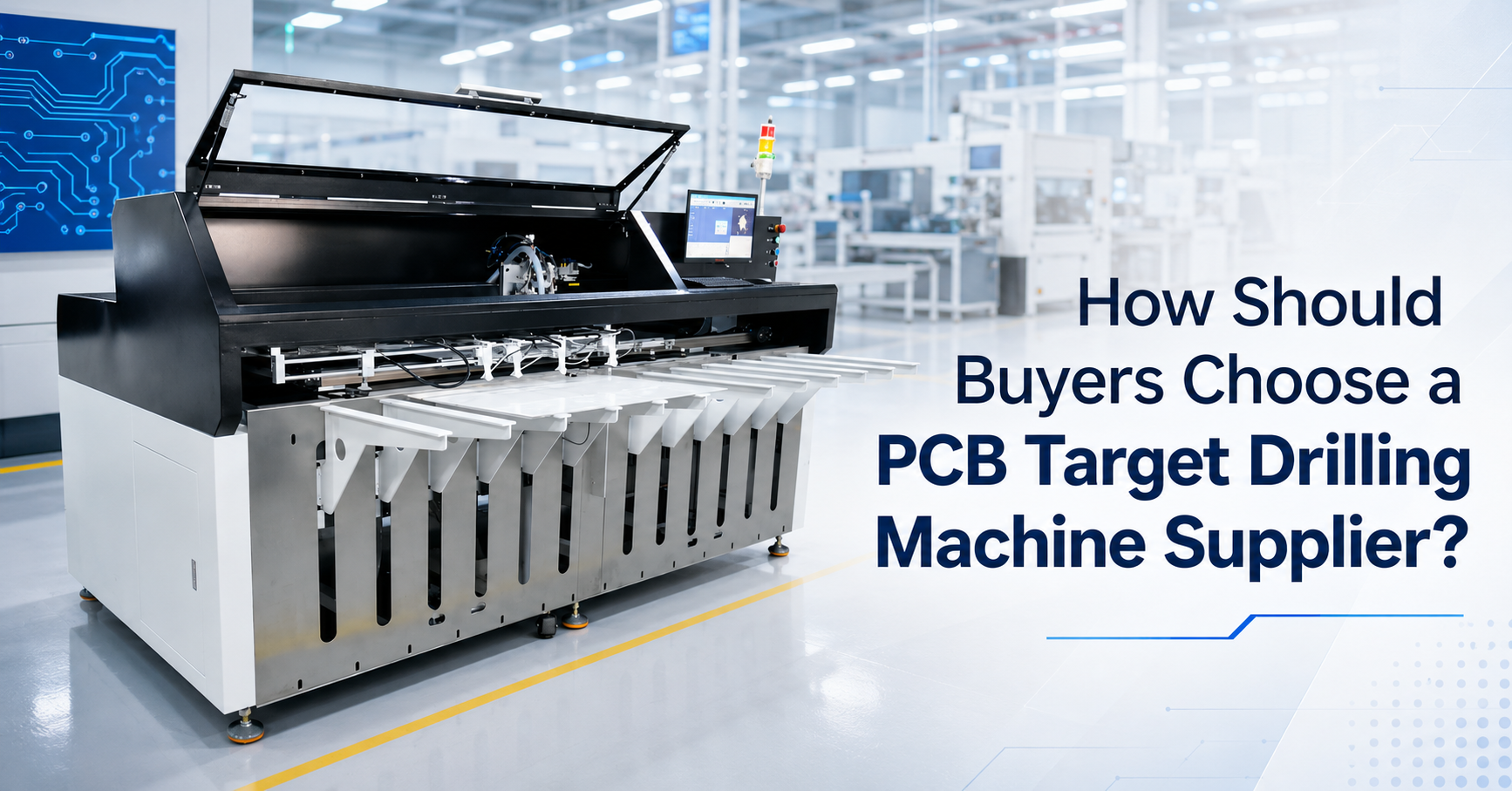
This is why B2B buyers often search for terms such as PCB drilling machine supplier, PCB CNC drilling machine manufacturer, automatic PCB drilling machine supplier, and PCB drilling equipment manufacturer. They are usually not looking for a basic catalog. They want a supplier that can help them reduce production risk.
Start with Your Factory’s Real Production Needs
Before comparing suppliers, a PCB factory should first define its own production requirements. Without this step, every machine may look similar, and every supplier may sound convincing.
A prototype lab may only need a single-spindle PCB CNC drilling and routing machine for small-batch work. A mid-volume factory may need a 2-spindle drilling and routing machine to improve output while keeping flexibility. A high-volume PCB factory may need a 4-spindle PCB drilling machine or a 4-spindle drilling and routing machine to reduce bottlenecks.
Ask these questions before contacting suppliers:
What types of boards do we process most often?
What is our normal panel size?
What is the smallest and largest hole diameter we need?
Do we need drilling only, or drilling plus routing?
Is our main problem accuracy, speed, tool change time, or labor cost?
How many hours does the drilling section run every day?
Do we process prototypes, small batches, or mass production?
What delivery problems are currently caused by drilling capacity?
A good PCB drilling machine manufacturer for factories should be able to recommend equipment based on these answers, not simply push the most expensive machine.
Check Machine Accuracy, Not Just Spindle Speed
Spindle speed is important, but it is only one part of the machine. A high-speed spindle does not guarantee high-quality drilling if the machine base is unstable, the axis movement is inaccurate, or the tool management system is weak.
For PCB drilling, buyers should check positioning accuracy, repeatability, guide rail quality, ballscrew quality, machine base structure, vibration control, and optional feedback systems such as linear encoders. These details affect whether the machine can repeat the same hole position across panels and batches.
This is especially important for multilayer PCBs and high-density designs. A small hole deviation may not look serious at first glance, but it can affect plating, component assembly, or later inspection. For this reason, a high precision PCB drilling machine should be evaluated as a complete mechanical and control system, not only as a fast spindle.
Evaluate the Supplier’s Product Range
A reliable supplier should usually offer more than one machine type. This does not mean a supplier must have every possible model, but it should have enough product coverage to match different production scenarios.
For example, a strong PCB production equipment supplier may provide single-spindle machines for prototype and small-batch work, 2-spindle machines for mid-volume production, 4-spindle drilling machines for higher drilling output, and drilling-routing integrated machines for factories that need both hole processing and board outline machining.
This matters because your factory may grow. A supplier with a broader product range can support future upgrades more easily. It also means the supplier is more likely to understand different buyer situations, rather than forcing one machine into every project.
Supplier Evaluation Checklist
| Evaluation Point | What Buyers Should Check | Why It Matters for PCB Factories |
|---|---|---|
| Machine Type | Single spindle, 2 spindle, 4 spindle, drilling only, or drilling + routing | Ensures the machine matches production volume and process needs |
| Spindle System | RPM, power, cooling method, spindle brand, maintenance needs | Affects drilling quality, tool life, and continuous operation |
| Accuracy | Positioning accuracy, repeatability, guide rails, ballscrews | Determines whether hole positions remain stable |
| Machine Structure | Granite base, frame rigidity, vibration control | Supports long-term precision and smooth operation |
| Tool Management | Automatic tool change, tool detection, broken tool detection | Reduces downtime and prevents scrap caused by tool failure |
| CNC System | Interface language, program compatibility, control stability | Affects operator training and daily production efficiency |
| Sample Testing | Real board drilling test before purchase | Helps verify machine performance under actual conditions |
| After-Sales Support | Warranty, spare parts, remote support, installation guidance | Reduces risk after delivery |
| Factory Experience | PCB industry cases, export experience, technical knowledge | Shows whether the supplier understands real production |
| Upgrade Potential | Related machines, line integration, future model options | Supports long-term factory development |
Ask for Sample Testing Before You Decide
A product brochure can look perfect. A machine video can also be edited to show only the best result. Sample testing is more useful.
Before choosing a PCB drilling machine supplier, send your actual board material, hole diameter requirements, drawing files, panel size, and tolerance expectations. Ask the supplier to process a sample or provide a detailed demonstration based on similar working conditions.
During sample testing, do not only check whether the machine can drill holes. Check whether the hole positions are consistent, whether the edge of the hole is clean, whether the tool breaks easily, whether the fixture method is practical, and whether the operator process is clear.
This step is especially important for overseas buyers. Once the machine is shipped, solving a mismatch becomes more costly. A sample test can reveal problems before purchase.
Do Not Ignore Tool Change and Tool Protection
In PCB drilling production, tool handling can quietly consume a lot of time. If operators must frequently stop the machine to change tools, the real production efficiency will be lower than expected.
For factories that process many hole sizes or mixed orders, automatic tool change becomes valuable. Tool length detection, tool diameter detection, and broken tool detection are also important. These features help reduce operator error and prevent damaged tools from ruining multiple boards.
A professional automatic PCB drilling machine supplier should clearly explain how tool change works, how broken tool detection is handled, and how operators should maintain the tool system.
Compare Supplier Types Carefully
| Supplier Type | Advantage | Possible Risk | Best Fit |
|---|---|---|---|
| Direct PCB drilling machine manufacturer | Better technical communication, factory price, customization support | Requires buyer to evaluate factory strength carefully | B2B buyers needing long-term equipment support |
| Trading company | Easier communication, may offer multiple brands | Technical support may depend on the original factory | Buyers who need quick sourcing but have lower technical complexity |
| Local distributor | Faster local service, easier installation support | Price may be higher, model options may be limited | Buyers who prioritize nearby service |
| Low-cost unknown supplier | Lower initial quotation | Higher risk in accuracy, spare parts, and after-sales service | Only suitable when technical risk is low |
| Professional PCB equipment supplier | Better understanding of PCB process and related machines | Must still verify real cases and sample performance | PCB factories planning production upgrades |
For serious production buyers, the safest choice is usually a supplier that can provide both technical equipment knowledge and practical service support. A PCB drilling machine factory with real manufacturing experience can often answer deeper questions about machine structure, spindle matching, tool life, and production workflow.
Check Quality Management and Documentation
Quality is not only what the supplier says. It should be visible in documentation, process control, inspection records, machine testing, and after-sales workflow.
Ask whether the supplier has a quality management system. ISO 9001 is a globally recognized quality management standard that helps organizations improve performance, meet customer expectations, and demonstrate commitment to quality.
For machinery buyers, ISO-related certification does not automatically prove that every machine is perfect. Still, it shows whether the supplier has a structured approach to process control. In addition, buyers should ask for machine inspection reports, testing videos, packing standards, spare parts lists, user manuals, maintenance instructions, and electrical documentation.
Good documentation makes later operation easier. Poor documentation often creates problems after installation.
Review After-Sales Support Before You Pay
After-sales service should be discussed before the order is placed, not after the machine has a problem.
A PCB drilling machine is not a simple consumable product. It needs installation, commissioning, operator training, maintenance, troubleshooting, spare parts, and sometimes software or parameter support. If the supplier cannot respond quickly, even a small issue may stop production.
Ask these questions clearly:
How long is the warranty?
What parts are covered?
Is remote support available?
Can the supplier provide English manuals and videos?
How quickly can spare parts be shipped?
Does the supplier support online training?
Can engineers guide installation remotely?
What should the buyer prepare before the machine arrives?
For overseas buyers, service clarity is critical. Time zone differences, language issues, and logistics delays can affect production. A reliable PCB drilling machine manufacturer should provide a practical support plan instead of vague promises.
Look at Total Cost, Not Only Machine Price
The lowest machine price may look attractive, but factory buyers should calculate total cost. A cheaper machine may cost more later if it causes higher scrap, longer downtime, more tool breakage, unstable production, or poor support.
Total cost includes:
Machine purchase cost.
Shipping and installation cost.
Training cost.
Tooling cost.
Maintenance cost.
Spare parts cost.
Scrap caused by unstable drilling.
Downtime caused by machine failure.
Lost orders caused by delayed delivery.
For a PCB factory, stable output is often more valuable than saving a small amount on the initial purchase. A better supplier helps reduce long-term uncertainty.
Match Supplier Capability with Your Future Orders
A factory should not only buy for today’s order. It should also consider the next two or three years.
Maybe your current orders are mostly simple FR4 boards. But will your customers ask for multilayer boards, smaller holes, higher density, aluminum substrates, or more complex routing in the future? Will your delivery time become shorter? Will labor cost increase? Will your factory need more automation?
A capable PCB CNC drilling machine manufacturer should help buyers think about future production direction. Sometimes it is better to choose a machine with slightly higher capability if the factory is clearly growing. In other cases, a simple single-spindle model is enough if the production volume is stable and low.
The point is not to buy the biggest machine. The point is to buy the right machine.
Common Mistakes When Choosing a PCB Drilling Machine Supplier
Many equipment problems start from the buying stage. These are common mistakes:
Choosing only by the lowest price.
Ignoring sample testing.
Not checking after-sales service.
Buying a drilling-only machine when routing is also needed.
Choosing a large machine when production volume is too low.
Ignoring tool change time.
Not confirming board size and material compatibility.
Overlooking spare parts availability.
Believing catalog data without asking for real production proof.
A careful buyer can avoid most of these problems by preparing technical requirements early and asking suppliers direct questions.
FAQ
What is the most important factor when choosing a PCB drilling machine manufacturer?
The most important factor is whether the supplier can match your real production needs. Machine accuracy, spindle stability, automation, tool management, sample testing, and after-sales support should all be checked before purchase.
Is a direct PCB drilling machine manufacturer better than a trading company?
A direct manufacturer usually has stronger technical control and better customization ability. However, buyers should still verify production experience, sample results, documentation, and service support before making a decision.
Should I choose a single-spindle or multi-spindle PCB drilling machine?
It depends on production volume. Single-spindle machines are suitable for prototypes and small batches. Multi-spindle machines are better for medium or high-volume PCB factories that need higher throughput.
Why is sample testing important before buying?
Sample testing shows whether the machine can process your real board material, hole size, and accuracy requirements. It is more reliable than only reading a quotation or watching a general machine video.
What B2B keywords are suitable for this topic?
Suitable keywords include PCB drilling machine manufacturer, PCB drilling machine supplier, PCB CNC drilling machine manufacturer, automatic PCB drilling machine supplier, PCB drilling equipment manufacturer, and PCB drilling machine for factories.
Conclusion
Choosing a PCB drilling machine manufacturer is not a quick price comparison. For PCB factories, the right supplier should provide stable equipment, suitable machine configuration, clear technical communication, sample testing, documentation, spare parts, and reliable after-sales support.
A good supplier helps the buyer reduce risk before production problems appear. It understands that drilling quality affects more than holes. It affects output, scrap rate, delivery, customer confidence, and future factory capability.
For B2B buyers, the best approach is practical: define your production needs, compare machine structure and accuracy, ask for sample testing, review service capability, and calculate total long-term cost. When these points are clear, choosing a reliable PCB drilling machine manufacturer becomes much easier—and much safer for your factory.