



Metal Core PCB Laser Cutting Machine: A Practical Guide for PCB Factories
For PCB manufacturers, cutting quality is not a small detail at the end of production. It affects board outline accuracy, edge condition, material waste, downstream assembly, and final product consistency. This becomes even more important when a factory processes metal core PCB materials, aluminum substrates, copper substrates, FPC, or other precision electronics components.
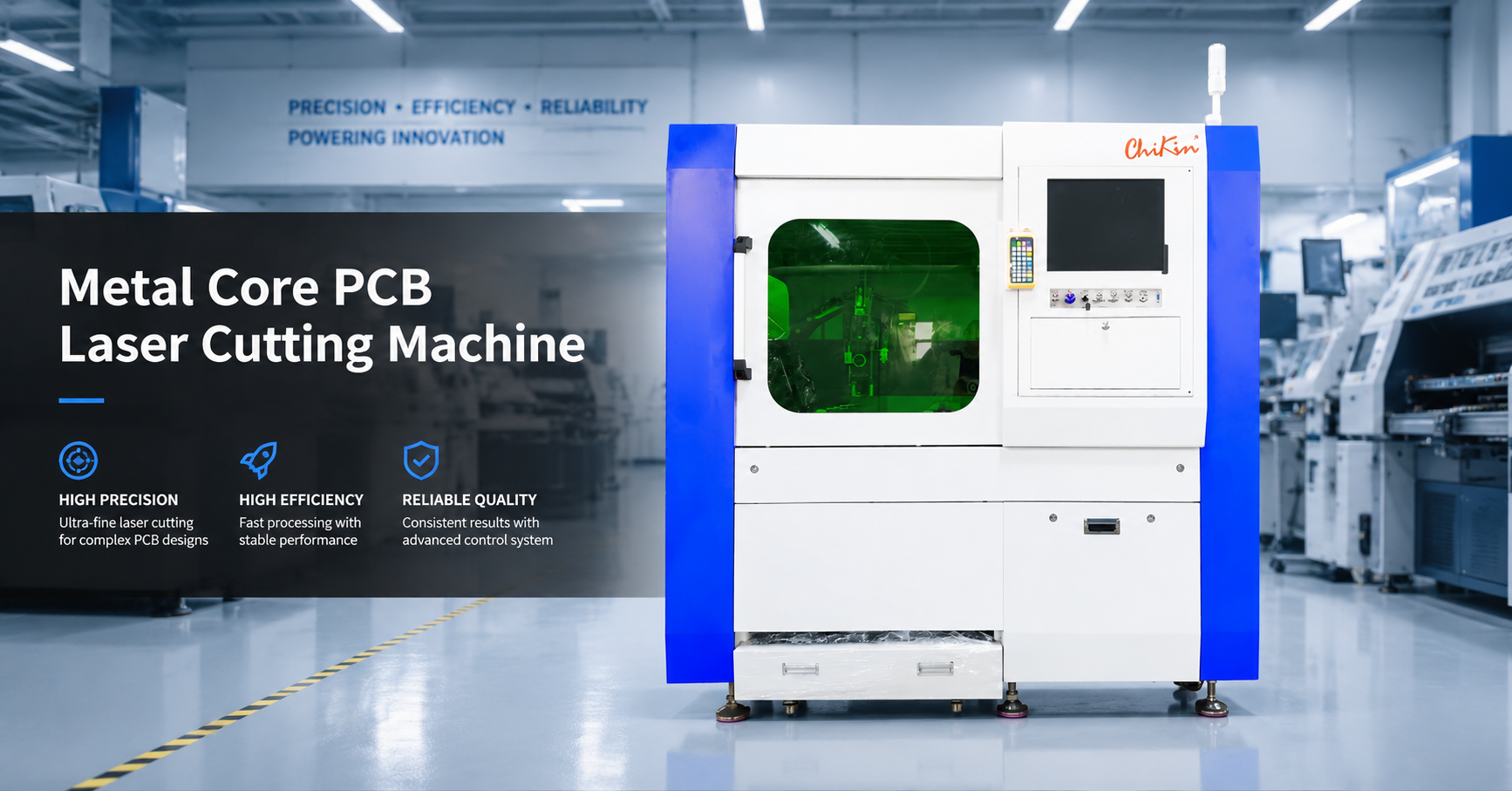
A metal core PCB laser cutting machine is designed for this kind of production need. Compared with conventional mechanical cutting methods, laser cutting can offer non-contact processing, smaller heat-affected zones, reduced burrs, and cleaner edge quality when the process is properly configured. Chikin CNC’s product page describes its metal core PCB laser cutting machine as a high-precision laser cutter using advanced laser control technology and a stable machine structure for fast, precise, non-contact processing in electronics manufacturing.
For B2B buyers searching for a PCB laser cutting machine manufacturer, PCB laser cutting machine supplier, or MCPCB laser cutting machine, the key question is not only whether the machine can cut. A more practical question is whether the equipment can support stable production, reduce rework, handle different substrate types, and fit the factory’s real workflow.
Why Metal Core PCB Cutting Needs Better Process Control
Metal core PCBs are widely used in applications where thermal management matters, such as LED lighting, power electronics, automotive electronics, industrial control systems, and new energy devices. These boards may use aluminum or copper substrates to help transfer heat away from key components. IPC-6012F covers qualification and performance requirements for rigid printed boards, including metal core printed boards, which shows that metal core boards are part of recognized PCB manufacturing categories rather than a niche material type.
The challenge is that metal core materials are usually harder to process than ordinary FR4. A cutting method that works well on standard boards may create burrs, edge deformation, inconsistent outlines, or extra finishing work when applied to aluminum or copper substrates. If the edge is rough or the outline is inaccurate, the problem may appear later during assembly, fitting, heat sink mounting, or final inspection.
This is why many factories evaluate an aluminum PCB laser cutting machine or copper substrate laser cutting equipment when mechanical cutting cannot provide enough consistency. Laser cutting reduces direct tool contact with the material, which helps lower the risk of mechanical stress and tool-wear-related variation. Chikin’s page also states that the machine is suitable for metal core PCB manufacturing, flexible circuits, aluminum/copper substrates, and other precision electronics components.
What a Metal Core PCB Laser Cutting Machine Does
A metal core PCB laser cutting machine is used to cut, shape, trim, or process PCB-related materials with laser energy instead of direct mechanical force. In practical production, it may be used for board outline cutting, precision contour processing, prototype development, small-batch production, or mass-production support.
Chikin CNC’s product page highlights several key features: high-speed and high-precision laser cutting, non-contact processing with minimal material deformation, an intelligent motion control system, a high-performance servo platform, cutting quality for PCB, FPC, metal sheets, and new energy materials, and industrial-grade durability and reliability.
For PCB factories, these features connect directly with common production concerns. Non-contact cutting helps reduce mechanical stress. High-precision motion control supports better outline consistency. Stable servo movement helps reduce variation between panels. Cleaner edges can reduce secondary finishing work. Lower burr formation can also reduce inspection and handling problems.
A machine like this is not only a cutting tool. It is part of a controlled PCB production process.
Main B2B Applications
A high precision PCB laser cutter can be relevant for several factory scenarios.
For MCPCB production, it can support aluminum and copper substrate cutting where edge quality and dimensional stability are important. For FPC and thin electronics materials, it can help reduce mechanical stress compared with traditional tooling. For prototype development, it can support faster design changes without waiting for dedicated mechanical tooling. For mass production, it can help factories improve repeatability and reduce material waste when the cutting path is optimized.
Chikin’s product page specifically states that the machine is suited for metal core PCB manufacturing, flexible circuits, aluminum/copper substrates, and other precision electronics components, and that it can support both prototype development and mass production.
Buyer Checklist for Choosing a PCB Laser Cutting Machine
| Evaluation Point | What PCB Buyers Should Check | Why It Matters |
|---|---|---|
| Material Compatibility | PCB, FPC, aluminum substrate, copper substrate, metal sheets, new energy materials | Ensures the machine fits actual production materials |
| Cutting Edge Quality | Burr level, edge smoothness, heat-affected zone, outline consistency | Affects downstream assembly and inspection |
| Motion Control | Servo platform, path accuracy, repeatability, software workflow | Determines whether cutting remains stable across batches |
| Non-Contact Processing | Laser cutting behavior, fixture method, material deformation control | Helps reduce stress on boards and substrates |
| Production Fit | Prototype, small batch, mixed production, or mass production | Prevents overbuying or underbuying equipment |
| Safety Design | Enclosure, extraction, viewing protection, emergency stop, operator training | Laser processing requires controlled operation |
| Supplier Support | Sample testing, technical specification, quotation, installation, training, after-sales service | Reduces purchase and production risk |
| Long-Term Cost | Material waste, rework, maintenance, downtime, consumables | Helps buyers evaluate total cost, not only purchase price |
Why Non-Contact Cutting Matters
Traditional cutting processes use mechanical force. That can be useful in many cases, but mechanical contact may create tool wear, vibration, burrs, or stress on the substrate. In PCB production, especially when dealing with thin materials or metal-backed substrates, these problems can affect both quality and yield.
Laser cutting works differently. The process does not rely on a physical cutting edge touching the board. Chikin’s product page describes the machine as offering non-contact processing with minimal material deformation. It also lists reduced burrs, better edge quality, higher precision, and improved consistency as key advantages.
For a laser cutting machine for PCB factory, this is important because the factory needs stable results from one panel to the next. If edge quality changes as tools wear, the operator may need more inspection and adjustment. With laser cutting, tool wear is not the same type of production variable. The process still requires parameter control, fixture control, material confirmation, and machine maintenance, but it can reduce certain mechanical cutting risks.
Heat-Affected Zone and Edge Quality
When buyers compare cutting methods, they should not only ask whether a machine can cut through a material. They should ask what happens near the edge.
A rough edge can create handling problems. A large heat-affected zone may affect nearby material behavior. Burrs can increase cleaning or finishing work. Poor outline accuracy can affect fitting, mounting, or assembly. Chikin’s page states that laser cutting offers a smaller heat-affected zone compared with mechanical methods, cleaner edges with significantly reduced burrs, and higher processing precision and consistency.
For B2B buyers, this means sample testing is important. Different materials respond differently to laser cutting. Aluminum substrates, copper substrates, flexible circuits, and metal sheets may require different settings. Before purchase, a buyer should send real material samples, thickness information, drawing files, edge quality requirements, and expected production volume to the supplier.
A reliable PCB laser cutting machine supplier should be able to discuss cutting parameters, edge expectations, fixture method, and production workflow before the buyer places an order.
Why Motion Control and Servo Stability Matter
Laser quality alone does not decide cutting quality. The motion system also matters. If the machine cannot follow the path accurately, even a good laser source cannot deliver consistent outlines. If motion is unstable, small contours, corners, slots, and fine patterns may suffer.
Chikin CNC highlights an advanced intelligent motion control system and a high-performance servo platform on the product page. For factories processing complex PCB shapes or fine electronic components, this is a key part of the machine’s value. Precise laser control must be paired with precise movement.
B2B buyers should ask the supplier about:
Supported file formats.
Path compensation.
Positioning method.
Repeatability testing.
Motion control software.
Fixture and alignment options.
Sample cutting process.
Maintenance requirements for motion components.
These questions help buyers understand whether the machine is suitable for real production rather than only demonstration cutting.
Safety and Factory Operation
Laser cutting equipment should be evaluated carefully for safety and factory operation. OSHA notes that laser hazards can include direct beam exposure, reflected beam exposure, eye hazards, skin hazards, fire hazards, and laser-generated airborne contaminants depending on the laser system and operating conditions.
For a PCB factory, this means buyers should ask about enclosure design, viewing window protection, exhaust or filtration, emergency stop placement, laser warning labels, operator training, and maintenance procedures. A machine used in electronics manufacturing should not only cut accurately; it should also fit safe shop-floor operation.
Before purchasing an electronics manufacturing laser cutting equipment solution, buyers should confirm:
Whether the machine has an enclosed or protected cutting area.
How smoke, dust, or particles are extracted.
What personal protective equipment is recommended.
How operators are trained.
How maintenance staff access the laser area.
What safety documents are provided.
What emergency procedures are included.
A professional PCB laser cutting machine manufacturer should be able to answer these questions clearly.
How This Machine Supports Prototype and Mass Production
One advantage of laser cutting is flexibility. For prototype development, a factory may need to test new outlines, adjust board shapes, or process a small number of panels before final design approval. Traditional tooling may slow this process, especially when each design change requires new fixtures or cutting tools.
Chikin’s product page says the machine supports customers from prototype development to mass production, helping improve product quality, throughput, and competitiveness. This makes the machine relevant for factories handling both engineering samples and repeated production.
For prototype work, flexibility matters. For mass production, repeatability matters. A good PCB CNC laser cutting solution should support both, but the buyer should still define the main use case before selecting configuration. A small R&D lab may prioritize easy operation and fast job changeover. A production factory may prioritize throughput, automation, alignment, and service support.
What Buyers Should Confirm Before Requesting a Quote
Before contacting Chikin CNC or another supplier, buyers should prepare practical information. A clear inquiry helps the supplier recommend the right configuration.
Useful information includes:
Board material type.
Metal core type, such as aluminum or copper substrate.
Material thickness range.
Panel size.
Cutting outline file.
Smallest feature size.
Required edge quality.
Expected daily or monthly output.
Prototype or mass-production use.
Need for automation or manual loading.
Need for alignment or vision support.
Factory voltage and installation environment.
Safety and extraction requirements.
After-sales service expectations.
Chikin’s product page invites buyers to contact the company for customized solutions, technical specifications, and competitive quotations. A buyer who provides detailed process information will usually receive a more accurate technical response.
Common Mistakes When Buying a PCB Laser Cutting Machine
The first mistake is choosing only by price. A low-cost machine may create higher long-term cost if it causes unstable cutting, poor service, or higher scrap.
The second mistake is ignoring material testing. A machine should be tested with the buyer’s actual PCB, FPC, aluminum substrate, or copper substrate before a final decision.
The third mistake is focusing only on laser power. Motion control, fixture design, software workflow, safety, extraction, and supplier support are equally important.
The fourth mistake is not defining edge quality. “Clean cutting” should be confirmed by sample inspection, not assumed from product wording.
The fifth mistake is overlooking after-sales support. Laser equipment needs training, maintenance, spare parts, and parameter support. A supplier that cannot provide technical service may create production risk.
Why Work with Chikin CNC
Chikin CNC positions this machine as a high-precision laser cutting solution for modern electronics manufacturing. The product page emphasizes non-contact processing, smaller heat-affected zones, reduced burrs, edge quality, intelligent motion control, servo stability, and suitability for PCB, FPC, metal sheets, new energy materials, MCPCB, aluminum/copper substrates, and precision electronics components.
For B2B buyers, these points match common factory concerns: cutting quality, material compatibility, automation potential, and production consistency. Chikin also provides contact options for customized solutions, technical specifications, and quotations, which is useful when buyers need configuration details before purchase.
FAQ
What is a metal core PCB laser cutting machine used for?
A metal core PCB laser cutting machine is used for cutting and processing metal core PCB materials, aluminum substrates, copper substrates, FPC, PCB panels, metal sheets, and precision electronics components. Chikin CNC’s product page lists MCPCB, flexible circuits, aluminum/copper substrates, and precision electronics components as suitable applications.
Why choose laser cutting instead of mechanical cutting?
Laser cutting is non-contact and can provide smaller heat-affected zones, reduced burrs, cleaner edges, and better consistency when properly configured. These advantages are especially useful for complex patterns, fine details, and precision electronics materials.
Is this machine suitable for aluminum PCB production?
Yes. The product page states that the machine is suitable for aluminum/copper substrates and metal core PCB manufacturing. Buyers should still test real materials and thicknesses before final purchase.
Can it process FPC materials?
Yes. Chikin lists FPC among the materials suitable for this laser cutting machine. Buyers should confirm stack-up, thickness, edge quality, fixture method, and cutting parameters through sample testing.
What should a PCB factory check before buying?
A PCB factory should check material compatibility, cutting edge quality, motion control, fixture method, safety configuration, extraction or filtration, software workflow, sample testing results, installation requirements, and after-sales support.
Why is sample testing important?
Sample testing confirms whether the machine can meet the buyer’s actual edge quality, dimensional tolerance, material behavior, and production requirements. It is more reliable than judging only by machine photos or general product descriptions.
Conclusion
A metal core PCB laser cutting machine is a practical solution for PCB factories that need clean, controlled, and repeatable cutting for MCPCB, aluminum substrates, copper substrates, FPC, PCB panels, metal sheets, and precision electronics components. It is especially relevant when traditional mechanical cutting creates burrs, deformation, edge inconsistency, or unnecessary material waste.
Chikin CNC’s product page highlights advanced laser control technology, a stable machine structure, non-contact processing, reduced burrs, smaller heat-affected zones, intelligent motion control, servo platform stability, and suitability for prototype development and mass production.
For buyers comparing a PCB laser cutting machine manufacturer, MCPCB laser cutting machine, aluminum PCB laser cutting machine, or PCB laser cutting machine supplier, the best decision should begin with real production needs. Define the material, thickness, panel size, edge quality, output requirement, safety needs, and service expectations first. Then use sample testing and technical discussion to confirm whether the machine fits the factory.
A good laser cutting solution should not only cut the board. It should help the factory reduce process variation, improve edge quality, protect material value, and build a more stable PCB production workflow.