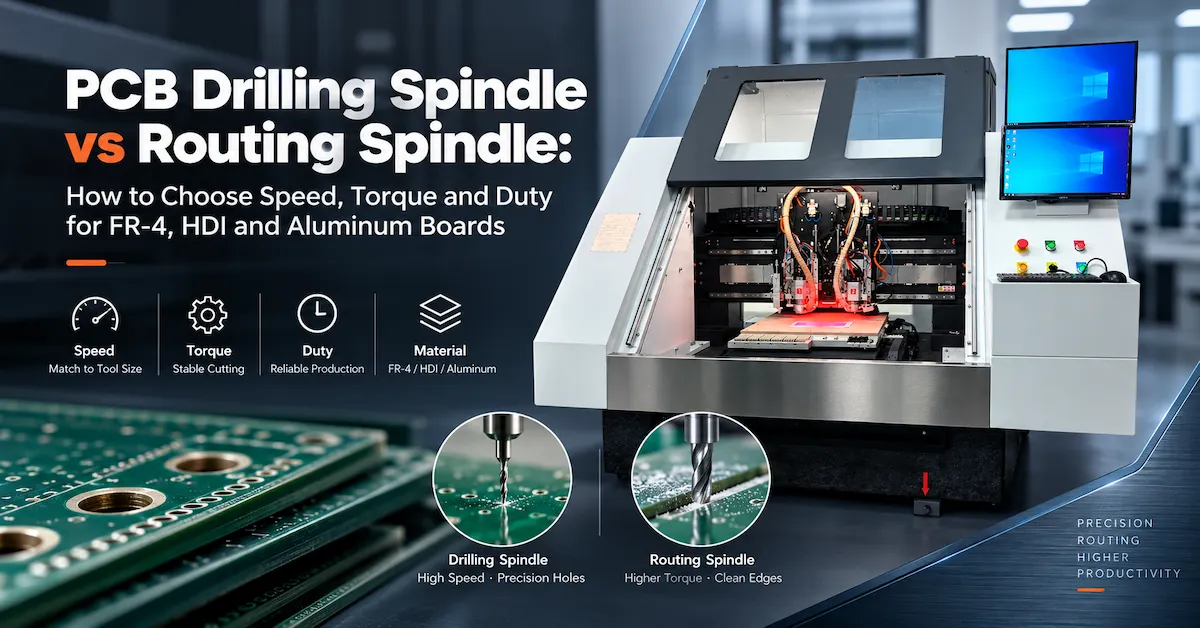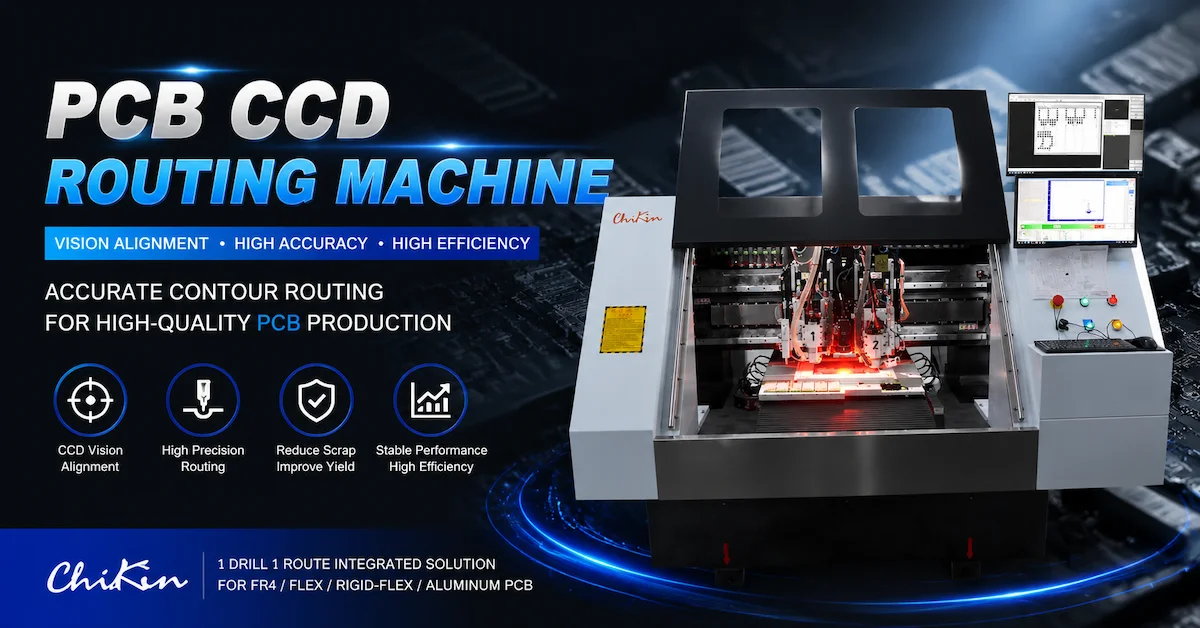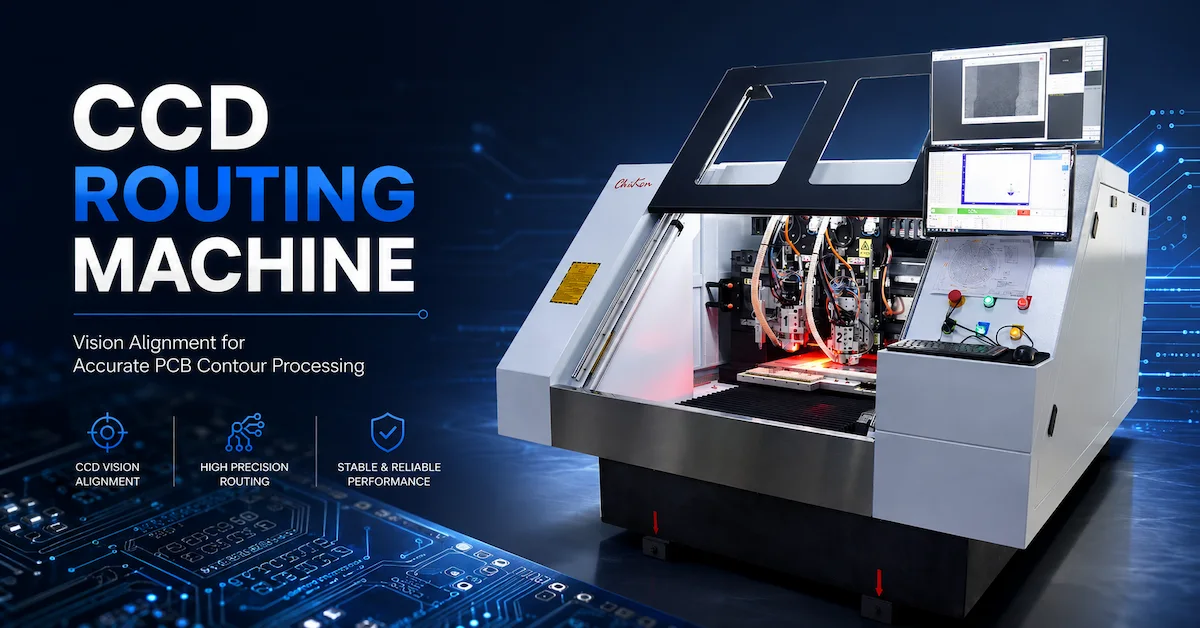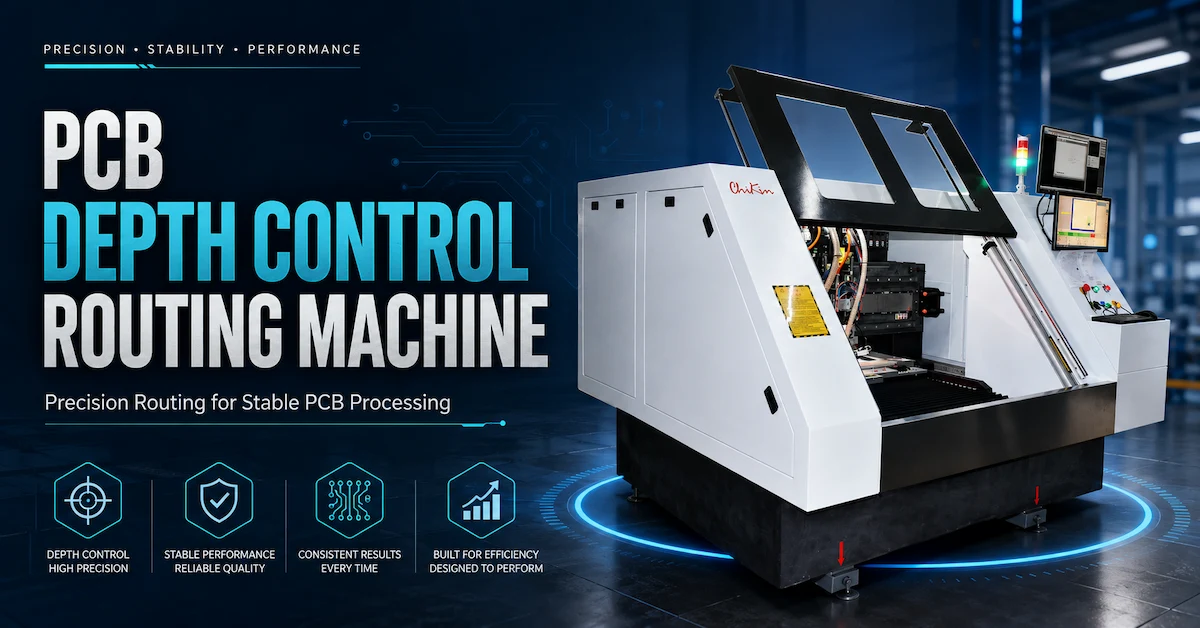




A 4 spindle PCB Routing machine is designed for PCB manufacturers that need higher contour routing efficiency, more stable batch output, and better board-processing consistency than single-spindle or dual-spindle equipment can provide.
In PCB manufacturing, routing is the process that defines the final shape of the board. It is used for board outlines, slots, internal openings, edge trimming, panel separation, and special profile cutting. If routing quality is unstable, the board may still fail assembly even when the electrical circuit is correct.
Common routing problems include rough edges, inaccurate board dimensions, chipped FR4 material, excessive tool wear, slot deviation, dust buildup, and inconsistent output between batches. These problems become more serious when production volume increases.
A four-spindle PCB routing solution helps factories increase throughput while maintaining CNC-controlled routing paths. It is especially useful for batch PCB production, repeated board shapes, and factories where routing has become a bottleneck.
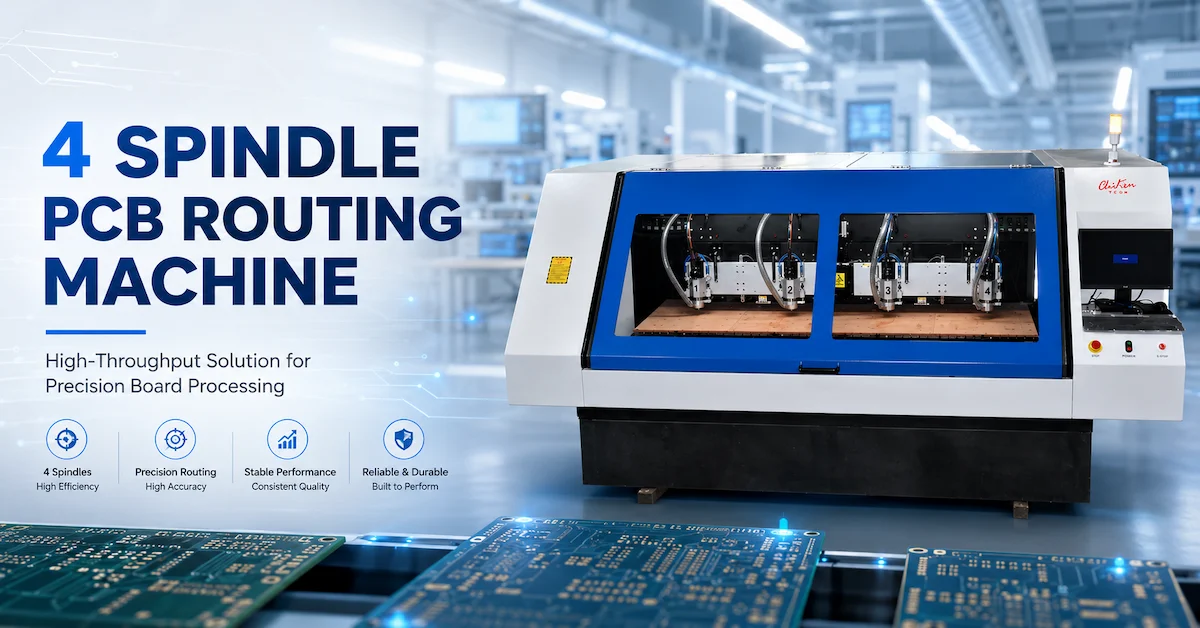
What Is a 4 Spindle PCB Routing Machine?
A 4 spindle PCB Routing machine is a CNC-controlled PCB processing machine equipped with four spindle positions or processing heads. Depending on final configuration, the machine may support PCB routing, drilling, milling, contour cutting, slot processing, or combined board-processing workflows.
This type of machine may also be searched as:
- 4 spindle PCB routing machine
- Multi spindle PCB routing machine
- 4 spindle PCB drilling and routing machine
- PCB routing and milling machine
- PCB contour routing machine
- High-throughput PCB routing equipment
- PCB CNC routing machine with 4 spindles
The main value is output efficiency. A four-spindle machine can support higher production capacity than one- or two-spindle equipment when the factory has enough stable orders and suitable board layouts.
However, buyers should not choose a machine only because it has more spindles. The right decision depends on board size, routing path, material type, fixture design, tool management, machine structure, software, and service support.
Who Should Choose a 4 Spindle PCB Routing Machine?
A 4 spindle PCB Routing machine is suitable for buyers who need stronger production capacity and stable routing output.
| Buyer Type | Main Need | Why 4 Spindles Fit |
|---|---|---|
| Medium-to-large PCB factories | Higher routing throughput | Multiple spindles reduce routing bottlenecks |
| Batch PCB manufacturers | Repeated board shapes | Supports more efficient repeat production |
| FR4 PCB producers | Cleaner contour routing | Stable CNC control improves edge consistency |
| Aluminum PCB processors | Stronger mechanical stability | Helps manage tougher substrate cutting |
| PCB drilling and routing users | Combined board processing | Supports drilling, milling, or routing configurations |
| Equipment distributors | Higher-value machine option | Suitable for professional PCB factory buyers |
If your factory mainly handles prototype or sample boards, a single-spindle routing machine may be enough. If your factory already has stable production demand and contour routing slows down delivery, a four-spindle solution may provide stronger long-term value.
Main Applications of a 4 Spindle PCB Routing Machine
A 4 spindle PCB Routing machine can be used in many PCB board-processing environments, depending on the final configuration.
Typical applications include:
- PCB contour routing
- FR4 board outline cutting
- PCB slot processing
- Internal opening cutting
- Panel depaneling
- PCB edge trimming
- Multilayer PCB profile routing
- Aluminum PCB routing
- PCB drilling and milling support
- Batch PCB production
- Production line capacity upgrades
For factories that need both drilling and routing, a 4 spindle PCB drilling and routing machine can reduce handling between separate equipment and improve workflow efficiency.
Why Routing Quality Matters in PCB Manufacturing
Routing quality affects more than the board edge. It can influence final product assembly, mechanical fit, connector placement, enclosure matching, and customer quality inspection.
Poor routing may cause:
- Rough or chipped edges
- Wrong board outline dimensions
- Incorrect slot width
- Board vibration marks
- Cracked laminate edge
- Extra manual trimming
- Higher scrap rate
- Lower repeatability across batches
For PCB manufacturers serving electronics brands, automotive electronics, industrial control systems, consumer electronics, or power modules, stable routing quality is a key part of production reliability.
A professional multi-spindle routing machine helps improve consistency by using CNC-controlled paths, rigid structure, stable spindle performance, and repeatable fixture positioning.
4 Spindle PCB Routing Machine vs 2 Spindle PCB Routing Machine
| Comparison Point | 2 Spindle PCB Routing Machine | 4 Spindle PCB Routing Machine |
| Output Capacity | Suitable for mid-volume production | Better for higher-throughput production |
| Investment Level | Moderate | Higher |
| Operation Complexity | Easier to manage | Requires stronger workflow planning |
| Best For | Growing PCB factories | Batch production and capacity upgrade |
| Floor Space | Smaller | Larger |
| Tool Management | Important | More critical |
| Production Focus | Balanced efficiency and cost | Throughput and line productivity |
| Buyer Priority | Flexible mid-volume work | Faster routing and repeated batch output |
A 2 spindle system is a practical upgrade for factories moving beyond single-spindle routing. A 4 spindle PCB Routing machine is more suitable when the factory already has stable order volume and needs stronger routing capacity.
The key question is not simply “Do I need more spindles?” The better question is:
Can my board layout, order volume, fixture system, tool management, and production flow fully use four-spindle capacity?
Key Benefits of a 4 Spindle PCB Routing Machine
1. Higher Routing Throughput
The biggest advantage of a 4 spindle PCB Routing machine is higher routing capacity. Multiple spindles can help reduce processing time when the production workflow is suitable.
For repeated PCB outlines, panelized boards, or batch orders, this can help reduce lead time and improve daily output.
2. Better Fit for Batch PCB Production
Four-spindle equipment is most valuable when the factory has repeated jobs and stable board designs. In these cases, the machine can be configured to improve routing efficiency and reduce manual workload.
3. Reduced Production Bottlenecks
If routing is slower than drilling, inspection, or assembly, the whole production line may wait. A four-spindle routing solution can help balance the line and reduce delays before downstream processes.
4. More Stable Board Edge Processing
A good 4 spindle PCB Routing machine should combine a rigid machine base, precision motion system, stable spindle control, and proper fixture design. These factors help maintain board edge quality during repeated production.
5. Stronger Upgrade Value for Growing Factories
For factories that have already used single-spindle or dual-spindle equipment, a four-spindle system can be the next upgrade step when orders increase.
Key Technical Factors Buyers Should Check
1. Spindle Configuration
The first question buyers should ask is what each spindle is configured to do. Some machines may focus on routing, while others may support drilling, milling, or mixed processing.
Ask the supplier:
- Are all four spindles used for routing?
- Can the machine support drilling and routing together?
- What tool sizes are compatible?
- Can the spindle layout match my board size?
- Can spindles work simultaneously or sequentially?
A clear head configuration prevents wrong machine selection.
2. Machine Rigidity and Vibration Control
Routing creates lateral cutting force. With four spindles, vibration control becomes even more important.
Buyers should check:
- Machine base rigidity
- Gantry stability
- Linear guide quality
- Ballscrew or drive system
- Worktable flatness
- Enclosed structure
- Maintenance access
If the machine is not rigid enough, routing quality may become unstable even if the spindle speed is high.
3. Routing Accuracy and Repeatability
A 4 spindle PCB Routing machine should maintain accurate routing paths across repeated batches.
Important questions include:
- What routing accuracy can the machine achieve?
- What repeatability is tested before shipment?
- Can sample routing be provided?
- Can the machine process my board thickness and outline complexity?
- How is calibration handled between multiple spindles?
Fast routing is useful only when the final board dimension remains stable.
4. Fixture and Board Holding
PCB panels must stay flat and stable during routing. If the board moves, the routing path may shift and edges may become rough.
Ask:
- How is the PCB panel fixed?
- Does the machine support vacuum holding?
- Can custom fixtures be used?
- Is repeated positioning supported?
- Can the machine handle thin or warped boards?
Good fixture design is one of the most important parts of successful PCB routing.
5. Tool Management and Detection
Routing tools wear over time. In multi-spindle routing, tool management becomes more important because inconsistent tool condition can create different edge quality between spindles.
Useful functions include:
- Automatic tool change
- Tool length detection
- Tool diameter detection
- Broken tool detection
- Tool life management
- Easy tool replacement
- Tool calibration support
For batch production, tool detection helps reduce downtime and hidden defects.
6. Dust and Debris Control
PCB routing can generate FR4 dust, chips, and debris. Without proper management, dust can affect operator environment, machine components, tool life, and board cleanliness.
Buyers should confirm:
- Enclosed work chamber
- Dust extraction ports
- Cleaning access
- Chip collection design
- Maintenance schedule
- Compatibility with factory dust collection systems
Dust control is especially important for factories running long shifts.
7. Software and Control System
A four-spindle machine requires clear software and operator control. Operators should be able to manage programs, process parameters, spindle status, tool settings, and alarms efficiently.
Check whether the software supports:
- English interface
- Program storage
- Routing path management
- Multi-head control
- Parameter saving
- Remote troubleshooting
- Operator training
A machine with strong hardware but difficult software may slow down production.
Product Match: CHIKIN CNC 4 Spindle PCB Drilling and Milling Routing Machine
For this article, the most relevant CHIKIN CNC product is:
PCB Drilling Machine for Precision Board Processing
For SEO and article anchor text, it can be written as:
4 Spindle PCB Drilling and Milling Routing Machine
This product direction fits the article because it is positioned around PCB drilling, milling, routing, multi-head processing, and precision board processing. It is suitable for buyers who need higher-throughput board processing and want to confirm head configuration based on production flow.
Recommended product page:
Recommended anchor text:
4 Spindle PCB Drilling and Milling Routing Machine
You can also link to:
https://www.chikincnc.com/products
https://www.chikincnc.com/about-us
https://www.chikincnc.com/service/faq
Specification Checklist for 4 Spindle PCB Routing Machine Buyers
| Item | What to Confirm | Why It Matters |
| Spindle Quantity | 4 spindle layout | Determines processing capacity |
| Head Function | Routing, drilling, milling, or mixed | Prevents wrong configuration |
| Working Area | Maximum board size | Ensures panel compatibility |
| Routing Tool Range | Tool diameter and holder type | Matches contour cutting needs |
| Machine Base | Rigidity and vibration control | Supports clean routing quality |
| Motion System | Linear guides, ballscrews, drive system | Controls accuracy and repeatability |
| Fixture Method | Vacuum, clamp, custom fixture | Keeps board stable |
| Tool Detection | Length, diameter, broken tool detection | Reduces scrap and downtime |
| Dust Control | Enclosure and extraction ports | Improves workshop cleanliness |
| Service Support | Training, spare parts, remote help | Reduces after-sales risk |
Common Buying Mistakes to Avoid
Mistake 1: Assuming All Four Spindles Perform the Same Function
Some machines may be configured for drilling, routing, milling, or mixed processing. Always confirm exact head configuration before ordering.
Mistake 2: Buying More Capacity Than the Factory Can Use
More spindles only create value when order volume and workflow can support them. If your factory mainly processes samples, a smaller system may be more practical.
Mistake 3: Ignoring Fixture Design
Routing accuracy depends heavily on board holding. Without proper fixtures, even a high-end machine may produce unstable results.
Mistake 4: Not Confirming Dust Removal
FR4 and other PCB materials generate dust during routing. Buyers should confirm dust extraction and maintenance access before purchase.
Mistake 5: Comparing Only Initial Price
A low-price machine may not include stable structure, tool detection, software support, or responsive after-sales service. For batch routing, downtime and scrap often cost more than the price difference.
Buyer Checklist Before Requesting a Quote
Before asking for a quotation, prepare:
| Information | Example |
| Board material | FR4, multilayer PCB, aluminum PCB |
| Board thickness | 0.8mm, 1.6mm, 2.0mm |
| Board size | Length × width |
| Routing path | Outline, slots, openings, depaneling |
| Drilling requirement | Yes or no |
| Head configuration | Four routing heads or mixed heads |
| Routing tolerance | Required contour accuracy |
| Production volume | Boards per shift or per day |
| Dust removal need | Existing extraction system or machine port |
| Purchase goal | Capacity upgrade, new line, replacement |
This information helps CHIKIN CNC review the correct routing configuration for your production line.
FAQ: 4 Spindle PCB Routing Machine
1. What is a 4 spindle PCB Routing machine?
A 4 spindle PCB Routing machine is CNC equipment with four spindle positions or processing heads used for PCB contour routing, drilling, milling, or combined board processing depending on configuration.
2. Is a 4 spindle routing machine better than a 2 spindle machine?
It depends on production volume. A 4 spindle machine is better for higher-throughput batch production, while a 2 spindle machine is more suitable for mid-volume factories.
3. Can this machine support both drilling and routing?
Yes, if configured as a drilling and routing machine. Buyers should confirm head function, tool type, and software capability before ordering.
4. What materials can a 4 spindle PCB routing machine process?
Depending on tooling and configuration, it can process FR4, multilayer PCB, aluminum PCB, and other board materials.
5. What affects routing edge quality?
Edge quality depends on spindle stability, tool sharpness, feed speed, fixture design, machine rigidity, dust control, and material type.
6. Why is tool detection important?
Tool detection helps reduce broken-tool risk, dimensional errors, rough edges, and hidden scrap during batch production.
7. Is this machine suitable for prototype labs?
Usually not as the first choice. Prototype labs often need flexibility more than high throughput, so one- or two-spindle machines may be more practical.
8. What should I send before requesting a quote?
Send board material, thickness, size, routing drawing, drilling requirement, production volume, head configuration needs, and routing tolerance.
Conclusion: A 4 Spindle PCB Routing Machine Is Built for Higher Routing Efficiency
A 4 spindle PCB Routing machine is a strong solution for PCB factories that need higher routing throughput, stable board outlines, and better batch production efficiency. It is most suitable for manufacturers with stable production demand and routing bottlenecks that cannot be solved by one- or two-spindle equipment.
However, buyers should confirm head configuration, routing tools, fixture design, machine rigidity, software, dust control, and service support before ordering.
CHIKIN CNC provides PCB drilling, milling, and routing equipment for factories that need controlled board processing and practical configuration support.
If you are comparing 4 spindle PCB Routing machine options, send your board material, board size, routing drawing, drilling requirement, production volume, and accuracy target. CHIKIN CNC can help recommend the right configuration for your PCB production line.
Contact CHIKIN CNC to request a 4 spindle PCB routing machine solution and quotation: