



FPC UV Laser Cutting Machine: A Practical Guide for Flexible PCB Manufacturers
 For flexible PCB manufacturers, cutting and routing are not simple finishing steps. They directly affect edge condition, dimensional stability, assembly yield, and downstream handling. Flexible circuits are thin, light, and often more sensitive to mechanical stress than rigid PCB panels. If the cutting process creates burrs, edge fray, deformation, carbonization, or delamination, the cost may appear later during inspection, bonding, assembly, or final product reliability checks.
That is why many factories evaluate an FPC UV laser cutting machine when they need cleaner separation and more controlled contour processing. The Chikin product page describes this machine type as being built for manufacturers that need clean and controlled cutting on flexible circuit materials without the mechanical stress of conventional tooling. It also notes that buyers working with thin and delicate substrates often face edge damage, deformation, and inconsistent cut quality during panelization or routing.
For B2B buyers searching for a flexible PCB laser cutting machine, FPC laser cutting machine supplier, or laser cutting equipment for flexible PCB, the key question is not only whether the machine can cut. The better question is whether the machine can support stable alignment, repeatable edge quality, safe operation, and practical factory workflow.
Why Flexible PCB Cutting Is Different from Rigid PCB Cutting
Flexible PCB materials behave differently from rigid FR4 panels. They can bend, shift, stretch, wrinkle, or deform during handling if the process is not controlled. Mechanical blades or routing tools may still be useful in some applications, but they can introduce contact force. For delicate FPC structures, contact force can become a source of edge defects, local distortion, or material movement.
A UV laser process uses localized laser energy rather than direct mechanical contact. This makes it attractive when the part geometry is intricate, the base material is thin, or the final edge must remain clean for assembly. Chikin’s product page states that a Flexible PCB UV Laser Cutting Machine is typically selected when geometry is detailed, substrates are thin, or the finished edge needs to stay clean for downstream assembly.
This does not mean UV laser cutting automatically solves every problem. Actual performance still depends on material stack-up, fixture design, beam stability, motion control, software path handling, and parameter tuning. A reliable UV laser cutting machine for FPC should therefore be evaluated as a complete process system, not simply as a laser source inside a cabinet.
What an FPC UV Laser Cutting Machine Is Used For
An FPC UV laser cutting machine is generally used for precise and localized processing of flexible circuit materials. The Chikin page lists application scenarios including flexible PCB panelization and depaneling, prototype cutting for new FPC designs, small-batch production with frequent design changes, precision routing for thin sheet-based electronics, sample marking or fine surface processing, and industrial R&D or process validation lines.
These applications have one thing in common: they require controlled geometry. A small deviation in a flexible circuit outline can affect mounting, folding, bonding, connector positioning, or enclosure fit. In many factories, the edge quality is not judged only by appearance. It is judged by whether the part can move through the next process without extra rework.
For example, a wearable electronics manufacturer may need small FPC parts with curves and openings. A camera module supplier may need flexible circuits with precise slots and contours. A medical electronics supplier may need clean separation and traceable process control. A prototyping team may need fast design changes without building new mechanical tooling each time.
In these scenarios, flexible PCB processing equipment must support more than basic cutting. It must help the production team control material, geometry, operator behavior, and process repeatability.
Machine Structure Buyers Should Pay Attention To
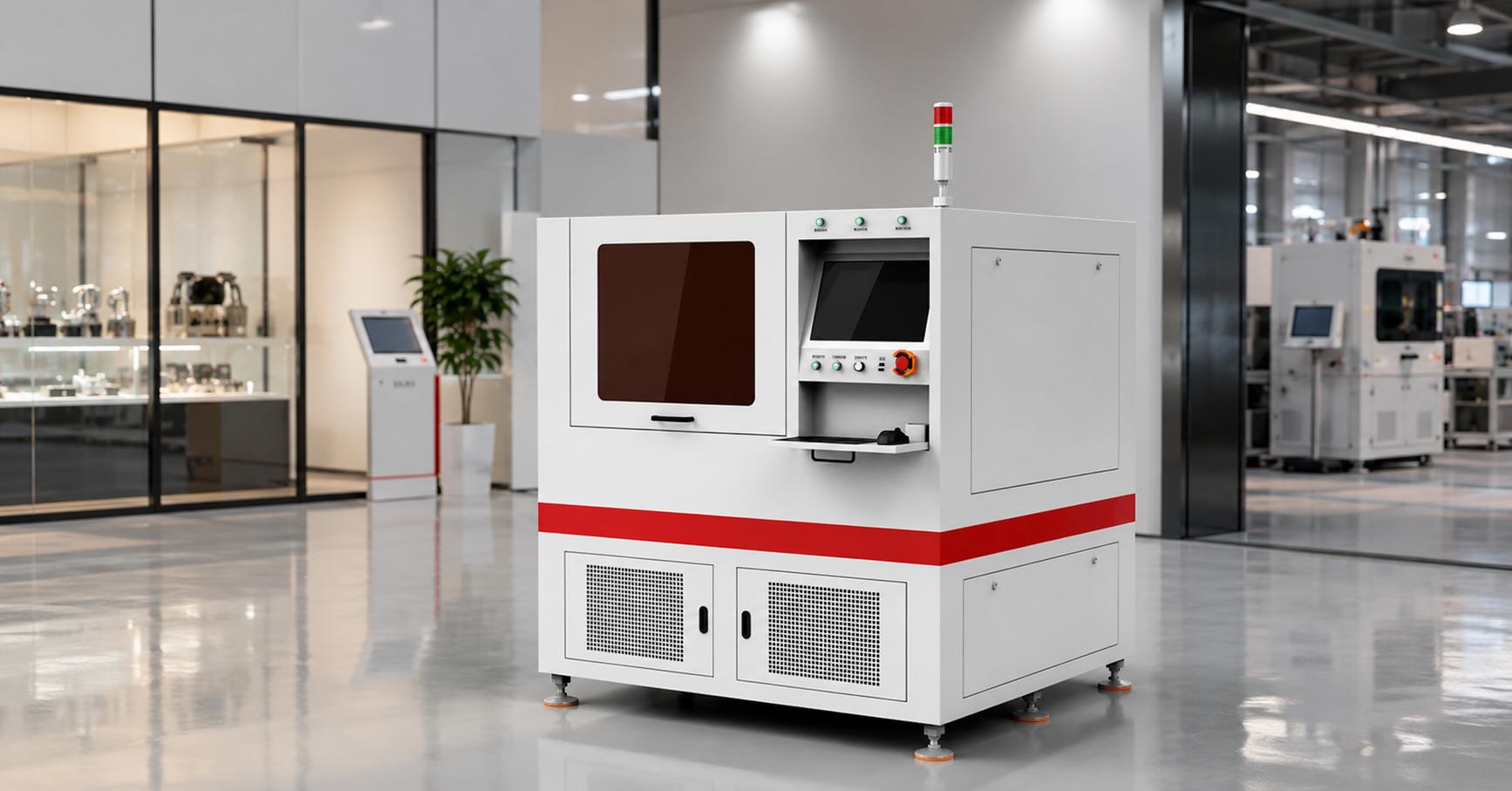
The visible product structure on the Chikin page suggests an enclosed floor-standing platform with an operator interface, viewing window, status tower light, and service access panels. These are practical details for factory use because operators need to monitor production while keeping the work chamber controlled.
The enclosure matters. It helps separate the work zone from the shop floor, supports cleaner production behavior, and creates a clearer boundary between routine operation and maintenance. The page also notes visible components such as a central touchscreen or HMI, control buttons, emergency stop button, and tower light, which indicate a machine designed for routine manufacturing rather than only lab demonstration.
For buyers, these details should lead to deeper questions:
Can operators monitor the process clearly through the viewing window?
Is the interface easy enough for shift operators?
How is material loaded and fixed?
How does the machine handle thin substrates?
Is there enough access for maintenance?
What safety interlocks, exhaust, and filtration options are available?
Can the supplier support vision alignment, special fixtures, or automated loading if needed?
A good FPC routing machine manufacturer should be able to discuss these issues in practical production language.
Key Buyer Evaluation Table
| Evaluation Area | What Buyers Should Check | Why It Matters for FPC Production |
|---|---|---|
| Material Stack-Up | Polyimide, adhesive, copper layer, coverlay, reinforcement, thickness range | Different stack-ups react differently to UV laser cutting |
| Edge Quality | Burrs, charring, edge fray, delamination, heat-affected appearance | Edge quality affects assembly and inspection |
| Alignment Method | Manual alignment, CCD vision, fiducial recognition, fixture repeatability | Thin FPC materials can shift easily if alignment is weak |
| Workholding | Vacuum table, fixture plate, carrier sheet, clamping method | Stable holding reduces deformation and outline error |
| Software Workflow | File format, path compensation, contour data handling, job changeover | Frequent design changes require smooth programming |
| Enclosure and Safety | Viewing window, emergency stop, access control, process chamber design | Protects operators and supports controlled production |
| Maintenance Access | Service panels, optical path cleaning, filter replacement, fixture maintenance | Affects uptime and long-term usability |
| Supplier Support | Sample testing, parameter guidance, installation, training, spare parts | Reduces risk after delivery |
Why UV Laser Cutting Is Often Considered for Fine FPC Features
UV laser systems are often selected for fine-detail processing because shorter wavelengths are commonly associated with more localized energy interaction compared with broader, more aggressive cutting methods. The Chikin page also notes that UV laser systems are often chosen for fine-detail processing and reduced thermal influence, while actual results still depend on material stack-up, motion control, parameter tuning, and fixture quality.
For flexible PCB buyers, this is an important distinction. The keyword FPC UV laser cutting machine should not be understood as a guarantee that every material will be processed perfectly. The machine must be tested with real production materials. FPC stack-ups vary widely. One material may cut cleanly with a certain parameter set, while another may require different speed, power, pulse, focus, or fixture settings.
A careful buyer should request sample cutting before purchase. The sample should use the actual material stack, thickness, outline geometry, and tolerance target. It should also include the smallest openings, sharpest corners, narrowest bridge areas, and any shape that may be difficult in production.
Quality Control in Flexible Circuit Laser Cutting
Flexible circuit manufacturing is closely tied to process discipline. IPC-6013 covers qualification and performance requirements for flexible printed boards, including single-sided, double-sided, multilayer, and rigid-flex multilayer boards. This does not mean a laser cutting machine alone determines full compliance, but it shows why flexible board production must be treated as a controlled manufacturing process.
In FPC cutting, quality control often focuses on edge condition, dimensional consistency, alignment accuracy, traceability, and process repeatability. Chikin’s page states that quality control in flexible circuit manufacturing is often about edge condition, positional consistency, and traceability, and that a properly configured Flexible PCB UV Laser Cutting Machine can support inspection routines by producing repeatable cut lines and clear marking zones.
Factories should define inspection criteria before purchasing equipment. For example, the buyer can define acceptable edge appearance, maximum outline deviation, minimum bridge width, allowable heat mark, fixture method, inspection sampling frequency, and process record requirements.
Without this definition, it becomes difficult to judge whether a machine is “good enough.” A supplier demonstration may look clean, but production requirements may be stricter.
Application Scenarios for FPC UV Laser Cutting
| Application Scenario | Buyer Requirement | Why UV Laser Cutting May Help |
|---|---|---|
| FPC Panelization | Clean separation of flexible circuits from panel format | Reduces mechanical contact and edge deformation risk |
| Prototype FPC Cutting | Frequent design changes and small production lots | Avoids new mechanical tools for each design |
| Fine Contour Routing | Curves, small openings, windows, slots, and intricate shapes | Supports localized cutting paths |
| Thin Sheet Electronics | Fragile sheet-based circuits and layered materials | Non-contact process reduces handling stress |
| R&D Validation | Testing new material stack-ups or process windows | Flexible parameter adjustment helps process trials |
| Small-Batch Production | Low-to-medium volume with changing orders | Shorter setup can support flexible manufacturing |
Supplier Questions Before Sending an Inquiry
Before contacting a PCB laser cutting machine supplier, buyers should prepare enough technical information. This helps the supplier recommend the correct configuration instead of providing a generic quotation.
Send the supplier:
Material stack-up and thickness.
Panel size and effective cutting area requirement.
Target part outline and drawing file.
Smallest feature size.
Required edge quality.
Whether CCD alignment is needed.
Whether automated loading/unloading is required.
Expected output per shift.
Fixture preference or current process method.
Inspection standard and tolerance target.
Dust extraction or filtration requirements.
Operator language and training needs.
Chikin’s page also recommends that buyers define substrate thickness range, panel size, cut path complexity, and desired throughput first, then review whether they need automated loading, vision alignment, special workholding, dust extraction, or a specific software workflow.
Laser Safety and Production Planning
Industrial laser equipment must be evaluated carefully for safety. IEC 60825-1:2014 applies to laser products emitting laser radiation in the wavelength range from 180 nm to 1 mm. OSHA also notes that laser hazards may include beam and non-beam hazards, including eye and skin hazards depending on laser type and operating conditions.
For FPC factories, this means buyers should not only ask about cutting performance. They should ask about enclosure design, viewing window protection, interlocks, labeling, operator training, exhaust, filtration, emergency stop placement, and maintenance procedures.
The machine’s enclosed cabinet is a useful starting point, but safety details must be confirmed with the supplier. Buyers should request documentation before installation and ensure that local regulations and factory safety policies are followed.
How to Compare UV Laser Cutting with Mechanical Routing
Mechanical routing is still useful in many PCB factories. It can be cost-effective, familiar to operators, and suitable for certain rigid or less delicate materials. But for thin flexible circuits, mechanical force can create problems. The Chikin page specifically positions this machine type as a more controlled option for thin substrates, fine geometry, and cleaner separation where mechanical routing may not be the best answer.
A fair comparison should include:
Edge quality after cutting.
Substrate deformation.
Fixture complexity.
Tool wear.
Setup time for design changes.
Burr or dust behavior.
Heat-related marks.
Operator training.
Inspection workload.
Long-term maintenance cost.
A factory should not choose UV laser cutting only because it sounds advanced. It should choose it when the process requirements justify it.
FAQ
What is an FPC UV laser cutting machine used for?
An FPC UV laser cutting machine is used for cutting, routing, trimming, depaneling, and fine contour processing of flexible circuit materials. Chikin’s product page lists use cases such as flexible PCB panelization, depaneling, prototype cutting, precision routing, and R&D validation.
Why is UV laser cutting useful for flexible PCB materials?
UV laser cutting is often selected for fine-detail work and delicate materials because it can process without mechanical contact. Chikin’s page highlights that this machine type is intended to reduce mechanical stress compared with conventional tooling.
Does this machine replace all mechanical routing processes?
Not always. Mechanical routing can still be suitable for some applications. UV laser cutting is more relevant when the factory needs fine geometry, thin substrate handling, clean edges, and reduced contact stress.
What should buyers confirm before ordering?
Buyers should confirm material stack-up, thickness range, panel size, cutting accuracy requirement, fixture method, alignment method, software workflow, safety design, extraction system, and sample test results.
Is sample testing necessary?
Yes. Flexible PCB materials vary by substrate, adhesive, copper, coverlay, and reinforcement structure. Sample testing helps confirm edge quality, heat effect, dimensional consistency, and process repeatability before purchase.
Conclusion
An FPC UV laser cutting machine is valuable when a flexible PCB manufacturer needs cleaner, more controlled, and more repeatable processing for thin circuit materials. It is especially relevant for flexible PCB panelization, depaneling, prototype cutting, fine contour routing, small-batch production, and process validation.
The Chikin FPC UV Laser Cutting Routing Machine is presented as an enclosed industrial cabinet system for clean, controlled cutting on flexible circuit materials without the mechanical stress of conventional tooling. Its visible structure includes an enclosed cabinet, operator interface, viewing window, emergency stop, tower light, service access, and leveling feet, all of which support factory usability.
For B2B buyers comparing a flexible PCB laser cutting machine, FPC laser cutting machine supplier, or laser cutting equipment for flexible PCB, the best decision should be based on process fit rather than marketing claims. Start with material stack-up, edge quality, panel size, alignment method, fixture design, software workflow, safety configuration, and sample testing. A short technical discussion before purchase usually prevents a much longer correction after installation.