



4 Spindle PCB Drilling and Routing Machine: A Practical Guide for High-Volume PCB Manufacturing
For PCB manufacturers, drilling and routing are not simple secondary steps after circuit design. They directly affect hole accuracy, plated-through-hole quality, board outline consistency, edge finish, assembly fit, delivery stability, and long-term production cost. When a factory moves from small-batch work to mid-to-high-volume production, slow drilling, unstable routing, frequent tool changes, and manual intervention can become serious bottlenecks.
This is why many production managers and procurement teams begin to evaluate a 4 spindle PCB drilling and routing machine. Compared with a single-spindle or dual-spindle machine, a four-spindle system is designed to process more panels in less time while still maintaining mechanical accuracy and stable CNC control. For factories that produce multilayer FR4 boards, LED aluminum substrates, automotive PCBs, industrial control boards, or high-mix PCB panels, the machine is not only a piece of equipment. It becomes part of the production capacity strategy.
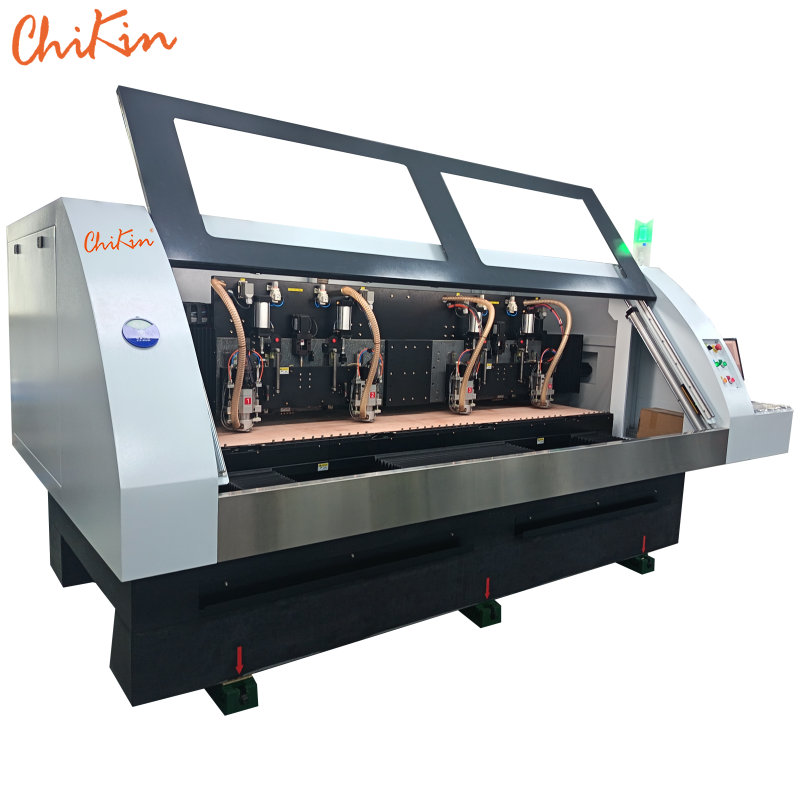
The Chikin CK-04R 4 Spindle PCB Drilling and Routing Machine is engineered for factories that need maximum parallel processing without sacrificing quality. According to the product page, this multi spindle PCB CNC machine combines four independent high-performance spindles, a high-density granite base, premium linear guide and ballscrew options, automatic tool change, intelligent tool detection, and CNC control for high-volume PCB drilling and routing production.
For B2B buyers searching for a PCB drilling and routing machine manufacturer, PCB drilling and routing machine supplier, or PCB CNC machine supplier, the key question is not only “How fast is the machine?” A more practical question is: can the machine improve throughput, keep accuracy stable, reduce tool-related downtime, and support reliable production across repeated orders?
Why PCB Drilling and Routing Become Production Bottlenecks
In PCB manufacturing, mechanical processing often looks straightforward from outside the workshop. A panel is positioned on the table, the CNC program is loaded, the spindle moves, holes are drilled, outlines are routed, and the finished panel continues to the next process. But inside a real production environment, each of these steps contains risk.
A PCB panel may contain hundreds or thousands of holes. Some boards require precise mounting holes, plated-through holes, slots, internal cutouts, or complex outlines. Multilayer PCB panels may require tighter registration. Aluminum substrate boards require stronger routing capability. Automotive electronics boards need stable repeatability. LED boards often require repeat processing across similar panels. High-mix PCB jobs may involve frequent tool changes and program switching.
When drilling and routing are handled by lower-capacity equipment, several problems can appear at the same time. Cycle time becomes too long. Operators need to stop the machine for tool changes. Broken tools may damage panels before they are discovered. Routing edges may become inconsistent. Hole position may drift if vibration or motion accuracy is not well controlled. Delivery time becomes harder to predict.
A 4 spindle PCB drilling and routing machine is designed to address these problems through parallel spindle processing and automation. Instead of relying on one spindle to complete all drilling and routing work, the CK-04R uses four high-speed water-cooled spindles. This allows the machine to support much higher productivity than single-spindle models. Chikin states that the CK-04R offers 3–4 times higher productivity than single-spindle machines, making it suitable for mass production of multilayer boards, LED aluminum substrates, automotive PCBs, and high-mix panels.
For a PCB factory, this improvement can affect the entire production rhythm. Faster drilling and routing can reduce queues, help downstream processes receive panels sooner, and give production managers more control over delivery schedules.
What Is a 4 Spindle PCB Drilling and Routing Machine?
A 4 spindle PCB drilling and routing machine is a CNC processing machine designed to perform PCB hole drilling and board routing with four spindles. It combines the functions of a PCB drilling machine and a PCB routing machine in one platform. The four-spindle structure is especially useful for factories that process repeated board designs, high-volume orders, or mixed panels requiring both hole-making and contour machining.
The Chikin CK-04R is positioned as a high-throughput machine for mid-to-high-volume PCB manufacturing. Its four synchronized high-speed spindles operate at 60,000 RPM with 1.8 kW power each. The machine supports drilling tools from 0.5–6.35 mm and routing tools from 0.5–3.175 mm. For aluminum boards, the drilling diameter range is listed as 0.8–6.0 mm.
The machine also uses a granite base to improve vibration damping and thermal stability. This is important because high-speed drilling and routing require more than spindle speed. The machine frame must remain stable during continuous operation. If vibration increases or thermal drift becomes visible, hole quality and edge consistency can suffer. Chikin highlights the granite base as a structure that helps maintain consistent ±0.005 mm accuracy even during continuous high-speed production.
For B2B procurement teams, the CK-04R should be understood as an automatic PCB drilling and routing machine designed for production efficiency, process repeatability, and reduced operator intervention.
CK-04R Technical Overview
| Item | CK-04R Specification / Feature | Practical Value for PCB Manufacturers |
|---|---|---|
| Machine Type | 4 Spindle PCB Drilling and Routing Machine | Combines PCB drilling and routing for high-volume production |
| Model | CK-04R | Designed for mid-to-high-volume PCB manufacturing |
| Spindle Quantity | 4 high-speed water-cooled spindles | Supports parallel processing and higher throughput |
| Spindle Speed | 60,000 RPM | Suitable for PCB drilling and routing operations |
| Spindle Power | 1.8 kW each | Provides cutting power for drilling and routing stability |
| Drilling Tool Diameter | 0.5–6.35 mm; aluminum 0.8–6.0 mm | Covers common PCB drilling requirements |
| Routing Tool Diameter | 0.5–3.175 mm | Supports board outlines, slots, and profile routing |
| Machine Base | High-density granite base | Improves vibration damping and thermal stability |
| Motion Components | Germany Rexroth or Japan linear rails and ballscrews | Supports smooth, accurate, backlash-free movement |
| Rapid Traverse Speed | Up to 30 m/min in XY/Z | Reduces non-cutting movement time |
| Accuracy | ±0.005 mm repeatability and positioning accuracy | Helps maintain stable drilling and routing precision |
| Optional Linear Encoder | ±0.001 mm resolution | Supports higher precision feedback when required |
| Tool Changer | 9-position automatic tool magazine | Reduces manual tool change and machine downtime |
| Detection Systems | Tool length, tool diameter, broken tool detection, pressure foot switch | Helps protect tools and reduce process risk |
| Control System | CHIKIN CNC or SIEB & MEYER CNC82 | Supports CNC control for drilling and routing |
| Interface | English interface | Useful for international buyers and overseas operators |
| Table Size | 635 × 735 mm effective area | Fits common PCB panel processing needs |
| Drive System | Panasonic / Delta drive system | Supports stable machine movement and control |
| Power | 220V/380V 3PH, 10KVA | Important for factory installation planning |
| Machine Weight | Around 6100 kg | Indicates heavy-duty mechanical structure |
| Machine Dimensions | 3380 × 1850 × 1600 mm | Helps buyers plan workshop layout and logistics |
| Support | 3-year precision warranty and 24-hour global support | Supports long-term equipment use and overseas service |
Why Four Spindles Matter in PCB Production
The number of spindles directly affects how a PCB factory organizes mechanical processing. A single-spindle machine processes one tool path at a time. A dual-spindle machine improves output, but may still become a bottleneck when production volume increases. A four-spindle machine is designed for factories where drilling and routing demand is already significant.
Four spindles allow the machine to process repeated patterns more efficiently. When panel designs are arranged in a way that supports parallel machining, the machine can complete work faster than lower-spindle equipment. This is especially valuable for high-volume orders, repeated customer designs, LED aluminum substrate production, and automotive PCB projects where consistency and output both matter.
For factories comparing PCB routing machine for mass production options, the four-spindle structure offers three practical benefits.
First, it improves capacity. Higher output helps reduce waiting time in the drilling and routing section.
Second, it improves scheduling stability. When cycle time becomes more predictable, the production manager can coordinate downstream processes more confidently.
Third, it improves equipment utilization. Instead of relying on several smaller machines, a factory may use one higher-capacity machine to manage a larger amount of work, depending on production structure.
This does not mean every factory must choose a four-spindle machine. For prototyping or low-volume production, a single-spindle or two-spindle machine may be enough. But for factories with regular mass-production orders, the four-spindle structure can create a clear operational advantage.
Why Drilling and Routing Should Be Considered Together
Drilling and routing are different processes, but they are closely connected in PCB production. Drilling creates holes for vias, through-hole components, mounting points, tooling holes, and other mechanical or electrical needs. Routing shapes the board outline, cuts slots, forms edges, and creates internal profiles.
If drilling is fast but routing is slow, routing becomes the bottleneck. If routing is fast but drilling is unstable, hole quality becomes the risk. If drilling and routing are handled on separate machines, the factory may need more handling, more alignment control, more scheduling coordination, and more operators.
A PCB CNC drilling and routing machine gives factories another option. By combining drilling and routing in one machine platform, the factory can improve flexibility and reduce unnecessary process transfer. This is particularly useful for mid-to-high-volume manufacturers that need both efficiency and process control.
The CK-04R is not only a drilling machine with four spindles. It is a drilling and routing machine, meaning it can handle holes, slots, contours, and board profiles within the supported tool ranges. This makes it suitable for factories that produce complex panels or high-mix PCB orders.
The Importance of Granite Structure
Machine stability is one of the most important but often underestimated factors in PCB drilling and routing. Buyers may focus first on spindle speed, tool range, or machine price. But in long production shifts, the mechanical foundation of the machine has a major influence on accuracy.
The CK-04R uses a high-density granite base. Chikin states that this structure provides vibration damping and thermal stability, helping the machine maintain consistent ±0.005 mm accuracy during continuous high-speed operation.
Vibration can affect PCB production in several ways. During drilling, vibration may reduce hole quality or increase tool wear. During routing, vibration can affect edge finish and profile consistency. In repeated production, even small mechanical instability can create accumulated quality issues.
Thermal stability is also important. A PCB factory may run machines for long hours. If heat affects the structure or motion system, accuracy may drift. A stable granite base helps reduce this risk.
For B2B buyers evaluating a PCB drilling equipment manufacturer, machine structure should be part of the selection checklist. A low-cost machine may look attractive at first, but if it cannot maintain accuracy during continuous operation, the hidden cost may appear later in scrap, rework, delayed orders, and extra maintenance.
Linear Guides, Ballscrews, and Motion Precision
The CK-04R uses premium Germany Rexroth or Japan linear rails and ballscrews. According to Chikin, the machine provides smooth, backlash-free movement with rapid traverse speeds up to 30 m/min in XY/Z movement.
Motion precision is critical because PCB drilling and routing are coordinate-based processes. Every hole and every routed edge depends on the machine’s ability to move according to the CNC program. If motion is unstable, the result may be hole deviation, board outline error, uneven edge finish, or poor repeatability.
For high-volume PCB manufacturing, repeatability is often more important than one-time accuracy. A machine must not only perform well on the first panel. It must continue to perform across repeated panels, long shifts, and changing production batches.
The CK-04R’s stated ±0.005 mm repeatability and positioning accuracy is therefore an important selling point for factories producing multilayer boards, automotive PCBs, and complex panels. The optional ±0.001 mm linear encoder resolution provides another precision option for buyers with stricter process requirements.
Automatic Tool Change and Intelligent Detection
Tool management can quietly consume a large amount of production time. In PCB drilling and routing, different jobs may require different drill diameters and routing tools. If every tool change depends on manual operation, the machine stops frequently, and the operator becomes part of the bottleneck.
The CK-04R includes a 9-position automatic tool magazine. It also integrates tool length detection, tool diameter detection, broken tool detection, and a pressure foot switch.
These features support more reliable production in several ways.
Tool length detection helps ensure that the machine understands the actual cutting tool condition before machining. Tool diameter detection helps reduce the risk of using the wrong tool. Broken tool detection is particularly valuable because a broken tool can cause repeated defects if not detected quickly. A pressure foot switch supports safer and more controlled operation.
For an automatic PCB drilling and routing machine, these systems are not optional decoration. They are part of production risk control. They help reduce operator intervention, protect tools, and support unattended or semi-unattended production.
This matters to factories because manual errors can be expensive. One wrong tool, one unnoticed broken drill, or one unstable tool setting can damage a full panel. If that panel belongs to an urgent customer order, the cost may include not only material loss but also delivery pressure.
CNC Control System and International Operation
The CK-04R supports CHIKIN CNC or SIEB & MEYER CNC82 control with an English interface. For overseas buyers, this is an important detail. A machine may have strong mechanical specifications, but if the control system is difficult to operate, training and adoption become slower.
A CNC control system affects program execution, spindle coordination, axis movement, tool management, and operator interaction. In PCB drilling and routing, the control system must support fast, accurate, repeatable movement. It must also help operators manage jobs efficiently.
For B2B buyers comparing different PCB CNC machine supplier options, the control system should be discussed carefully. Buyers should ask about supported file formats, training, operator interface language, troubleshooting process, and after-sales technical support.
An English interface helps international factories reduce communication barriers. It allows local engineers and operators to work with the machine more directly, especially during setup, production adjustment, and maintenance.
Application Scenarios for the CK-04R
The CK-04R is described as suitable for mass production of multilayer boards, LED aluminum substrates, automotive PCBs, and high-mix panels. It is also compatible with Chikin’s broader equipment line, including laser cutting, V-CUT, AOI, and flying probe testing.
These application areas have different production concerns.
Multilayer boards require stable hole registration and reliable routing accuracy. LED aluminum substrates often require stronger routing and drilling performance because aluminum-backed boards are more demanding than standard FR4. Automotive PCBs require process reliability because the final application may involve stricter quality expectations. High-mix panels require flexible tool handling and reliable program switching.
A 4 spindle PCB drilling and routing machine is especially relevant when the factory faces both volume and variety. If all products are simple, low-volume boards, a four-spindle machine may not be necessary. But when a factory handles repeat production, mixed customer orders, and more complex materials, higher-capacity CNC equipment can improve efficiency.
Quality Control and PCB Reliability
PCB drilling and routing directly affect board reliability. Hole position influences via quality, plated-through-hole performance, component fit, and assembly accuracy. Routing quality affects edge finish, board dimensions, and installation fit. Poor mechanical processing can create downstream issues that are more expensive to fix later.
The IPC-6012 standard covers qualification and performance requirements for rigid printed boards, including single-sided, double-sided, plated-through-hole, multilayer, blind or buried via, and metal core boards. This is relevant because CK-04R application areas include multilayer boards and aluminum substrates. While the drilling and routing machine alone does not determine full IPC compliance, it supports the mechanical accuracy and consistency required by serious PCB production.
In practical terms, a factory should not treat drilling and routing as low-value mechanical steps. These steps shape the board’s physical structure. If the holes or outlines are not consistent, later inspection, plating, assembly, and customer acceptance may be affected.
The CK-04R supports quality control through granite construction, precision motion components, automatic tool change, tool detection, broken tool detection, and stable CNC control. These features work together to reduce process variation.
4 Spindle PCB Drilling and Routing Machine vs Other Machine Types
| Comparison Point | 4 Spindle PCB Drilling and Routing Machine | 2 Spindle PCB Drilling and Routing Machine | 4 Spindle PCB Drilling Machine | Single-Spindle PCB CNC Machine |
|---|---|---|---|---|
| Main Function | Drilling + routing | Drilling + routing | Mainly drilling | Depends on model; usually lower-capacity drilling/routing |
| Spindle Quantity | 4 | 2 | 4 | 1 |
| Best Use | High-volume PCB drilling and routing | Mid-volume mixed production | High-volume drilling bottleneck | Prototyping, small batches, simple jobs |
| Production Capacity | Highest among drilling/routing options in this comparison | Balanced output | High drilling output, less routing flexibility | Lowest output |
| Process Flexibility | High, supports both drilling and routing | High, suitable for flexible jobs | More focused on drilling | Flexible but slower |
| Tool Management | 9-position automatic tool change + detection | Usually similar but lower spindle capacity | Larger drilling-focused tool strategy depending on model | Often more operator-dependent |
| Typical Buyer | PCB factories with strong output demand and mixed machining needs | Factories upgrading from single-spindle equipment | Factories where drilling is the main bottleneck | Labs, sample shops, small workshops |
| Selection Logic | Choose when both high output and drilling/routing integration matter | Choose when flexibility and moderate capacity matter | Choose when drilling speed is the priority | Choose when budget or low-volume work matters |
This comparison helps clarify the CK-04R’s position. It is not the same as a drilling-only machine. It is also not simply a larger version of a basic CNC router. Its value lies in combining four-spindle capacity with drilling and routing flexibility.
Why B2B Buyers Should Evaluate Total Production Cost
For B2B equipment procurement, machine price is only one part of the decision. A lower-priced machine may appear attractive, but if it creates downtime, tool loss, inaccurate routing, frequent maintenance, or unstable production, the total cost may become higher.
A professional PCB factory should evaluate total production cost through several practical questions.
How many panels can the machine process per shift?
How much time is currently lost to tool changes?
How often do operators need to stop production?
How many defects are related to drilling or routing errors?
How much production time is lost due to broken tools?
Can the machine support future product types?
Can the supplier provide service when problems occur?
Will the control interface support local operators?
Does the machine fit the factory’s floor space and power supply?
The CK-04R’s four-spindle design, automatic tool change, tool detection, and granite machine base are all relevant to these cost factors. The machine is designed not only to run fast, but also to reduce interruptions that commonly affect production efficiency.
How the CK-04R Supports High-Mix PCB Production
High-mix PCB production is challenging because the factory cannot rely on one simple, repeated process. Different customers may require different panel sizes, hole diameters, routing paths, material types, and delivery schedules. Operators may need to change tools and programs frequently.
The CK-04R supports high-mix production in several ways.
Its drilling and routing tool ranges cover common PCB machining requirements. Its automatic tool changer reduces manual tool change. Its tool length and diameter detection help control tool setup. Its broken tool detection helps protect panels. Its CNC control system supports programmed machining. Its granite base and precision motion components help keep results consistent across different jobs.
For a factory serving multiple industries, such as LED lighting, automotive electronics, industrial controls, power electronics, and communication products, this flexibility can be valuable. The machine allows the factory to handle different board requirements while maintaining higher output than lower-spindle equipment.
When Should a Factory Choose a 4 Spindle PCB Drilling and Routing Machine?
A factory should consider a 4 spindle PCB drilling and routing machine when drilling and routing have become a visible bottleneck. This may happen when order volume increases, when customers require shorter lead times, when the factory handles more complex panels, or when current machines require too much manual intervention.
The CK-04R may be suitable if the factory has the following conditions:
It processes mid-to-high-volume PCB orders.
It needs both drilling and routing in one machine platform.
It produces multilayer boards, LED aluminum substrates, automotive PCBs, or high-mix panels.
It wants higher output than single-spindle or dual-spindle equipment.
It needs automatic tool change and broken tool detection.
It values mechanical stability and repeatable accuracy.
It serves B2B customers that require reliable delivery and stable quality.
It wants equipment compatible with a broader PCB production line.
It may not be necessary if the factory only handles very small samples, simple boards, or occasional prototype work. In that case, a smaller machine may be more cost-effective. The best machine is not always the largest machine. It is the machine that matches the factory’s real bottleneck.
Practical Buying Checklist for PCB Factories
When choosing a PCB drilling and routing machine supplier, procurement teams should prepare questions before requesting a quote.
Ask about spindle configuration. Confirm spindle speed, power, cooling method, quantity, and long-term maintenance needs.
Ask about tool handling. Check the number of tool positions, automatic tool change logic, and detection systems.
Ask about motion accuracy. Review repeatability, positioning accuracy, guide rails, ballscrews, and optional encoder configuration.
Ask about materials. Confirm whether the machine can process the factory’s common FR4, multilayer, aluminum substrate, or other board types.
Ask about table size. Make sure the effective work area fits the factory’s standard panel sizes.
Ask about CNC control. Confirm the control system, interface language, file compatibility, training process, and operator support.
Ask about installation. Review machine dimensions, weight, power requirements, floor planning, and environmental needs.
Ask about warranty and service. Chikin lists a 3-year precision warranty and 24-hour global support for this product. For overseas buyers, this point should be discussed in detail before purchase.
Ask about sample processing. A sample test can show how the machine performs on real board materials and actual design requirements.
Why Supplier Capability Matters
A PCB drilling and routing machine is a long-term production asset. Buyers should not only compare specifications; they should also evaluate the supplier’s technical capability and service ability.
A reliable PCB drilling and routing machine manufacturer should understand the buyer’s board type, order volume, machining process, quality requirements, and production bottleneck. The supplier should help buyers choose between single-spindle, dual-spindle, four-spindle drilling-only, and four-spindle drilling/routing systems.
For overseas customers, supplier communication is even more important. Installation guidance, spare parts, software support, remote troubleshooting, and operator training can affect the success of the whole equipment project.
Chikin positions the CK-04R as part of a complete PCB equipment line, including laser cutting, V-CUT, AOI, and flying probe testing. For buyers planning a broader production line upgrade, this ecosystem may simplify communication and equipment matching.
Internal Link Suggestions for Publishing
When publishing this blog on the Chikin website, the article can naturally link to related pages.
Suggested internal anchors include:
“4 spindle PCB drilling and routing machine” → CK-04R product page
“2 spindle PCB drilling and routing machine” → CK-02R product page
“4 spindle PCB drilling machine” → CK-04D product page
“PCB laser cutting equipment” → laser cutting product category
“PCB AOI inspection machine” → AOI product page
“request a customized quote” → contact page
“sample processing and throughput demo” → inquiry or service page
These links should be placed naturally in the article. The goal is to guide buyers from technical education to product comparison, then to inquiry.
FAQ
What is a 4 spindle PCB drilling and routing machine?
A 4 spindle PCB drilling and routing machine is a CNC machine that uses four spindles to perform PCB drilling and routing operations. It is designed for factories that need higher throughput, stable accuracy, and integrated hole-making and board-outline processing.
What is the main advantage of the CK-04R?
The main advantage is high-volume drilling and routing productivity. The CK-04R uses four 60,000 RPM, 1.8 kW water-cooled spindles, a granite base, automatic tool change, tool detection, and precision motion components to support mass production.
What materials and applications is the CK-04R suitable for?
The CK-04R is suitable for mass production of multilayer boards, LED aluminum substrates, automotive PCBs, and high-mix panels. These applications often require both processing output and stable mechanical accuracy.
What is the drilling and routing tool diameter range?
The CK-04R supports drilling tools from 0.5–6.35 mm, aluminum drilling from 0.8–6.0 mm, and routing tools from 0.5–3.175 mm.
Does the CK-04R support automatic tool change?
Yes. The machine includes a 9-position automatic tool magazine, tool length detection, tool diameter detection, broken tool detection, and pressure foot switch.
Is a 4 spindle drilling and routing machine better than a 2 spindle machine?
It depends on production needs. A 4 spindle machine is better for higher-volume production and stronger throughput requirements. A 2 spindle machine may be more suitable for mid-volume factories that need balanced flexibility with lower investment.
What should buyers check before choosing a PCB drilling and routing machine manufacturer?
Buyers should check spindle quantity, spindle speed, machine base, motion accuracy, tool changer, detection systems, CNC control, table size, supported materials, warranty, after-sales service, and sample processing ability.
Why does the machine use a granite base?
The granite base helps provide vibration damping and thermal stability. This supports more consistent drilling and routing accuracy during continuous high-speed production.
Is the CK-04R suitable for overseas buyers?
The CK-04R uses an English interface and is backed by 24-hour global support according to the product page. Overseas buyers should still confirm installation, training, spare parts, and remote support details before purchase.
Conclusion
A 4 spindle PCB drilling and routing machine is designed for PCB manufacturers that need higher production output, stable mechanical accuracy, and integrated drilling and routing capability. For factories producing multilayer boards, LED aluminum substrates, automotive PCBs, or high-mix panels, equipment capacity is not just a technical issue. It affects delivery schedules, quality consistency, labor efficiency, and customer confidence.
The Chikin CK-04R combines four high-speed water-cooled spindles, a high-density granite base, premium linear guide and ballscrew options, automatic tool change, tool length detection, tool diameter detection, broken tool detection, and CNC control with English interface. These features make it a practical option for buyers searching for a PCB drilling and routing machine manufacturer, PCB drilling and routing machine supplier, PCB CNC machine supplier, or high-volume PCB manufacturing equipment.
For B2B procurement teams, the best decision should not be based only on price or spindle count. A stronger evaluation should include production volume, board materials, routing complexity, tool-change frequency, accuracy requirements, operator skill, service support, and long-term ROI.
If a PCB factory is facing longer drilling and routing queues, more complex panel designs, or stricter delivery requirements, upgrading to a 4 spindle PCB drilling and routing machine can be a practical step toward more efficient and scalable PCB manufacturing.