



2 Spindle PCB Drilling and Routing Machine: A Practical Guide for Mid-Volume PCB Manufacturers
For many PCB manufacturers, the real production problem is not only whether a machine can drill holes. The harder question is whether the equipment can keep drilling and routing stable across repeated orders, mixed board designs, changing tool sizes, and practical delivery pressure. A factory may receive FR4 boards in the morning, aluminum-based boards after lunch, and a small batch of multilayer panels before the shift ends. In this kind of production environment, flexibility matters just as much as speed.
That is where a 2 spindle PCB drilling and routing machine becomes useful. It sits between basic single-spindle equipment and higher-output multi-spindle systems. Compared with a single-spindle machine, it can improve throughput. Compared with a larger four-spindle drilling system, it may offer a more balanced choice for manufacturers that need both drilling and routing without investing in the highest-capacity setup.
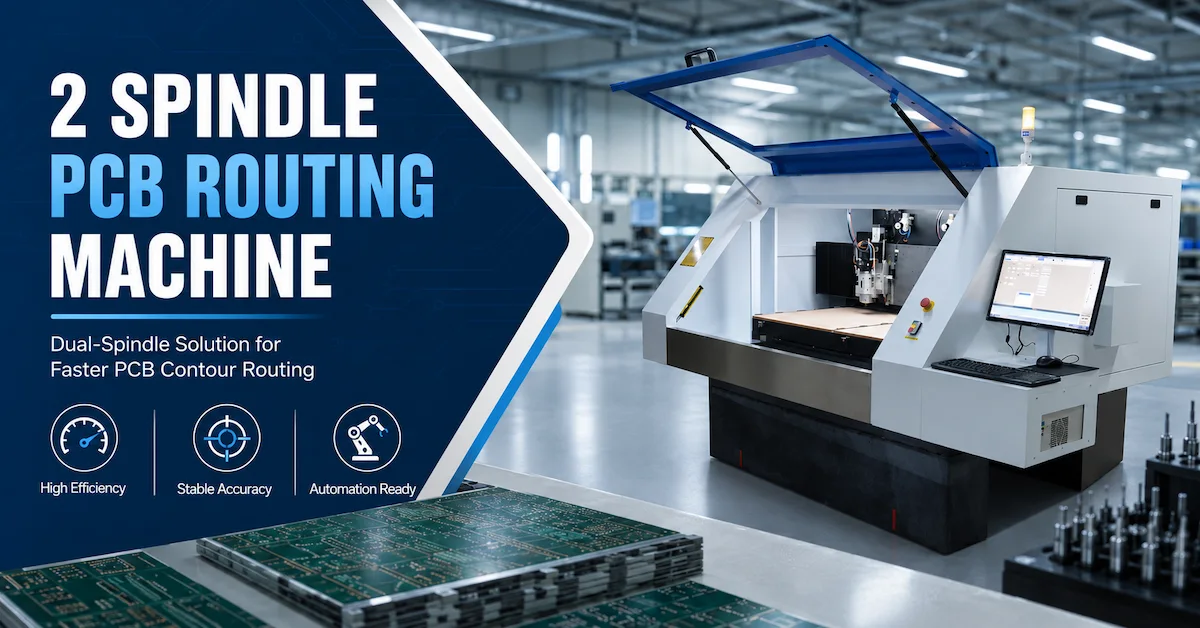
The Chikin CK-02R 2 Spindle PCB Drilling and Routing Machine is designed for mid-volume PCB production. According to the product page, it uses dual spindles with independent Z-axis control, 60,000 RPM spindle speed, 1.8KW spindle power, water cooling, granite construction, high-accuracy linear guides and ballscrews, automatic tool change, tool length detection, tool diameter detection, broken tool detection, and pressure foot switch support. The machine is described as suitable for precise drilling and routing on FR4, multilayer, and aluminum boards.
For B2B buyers searching for a PCB drilling and routing machine manufacturer or a PCB CNC machine supplier, this article looks beyond the product name. It explains what the machine does, why the structure matters, how it fits real PCB production, and what procurement teams should check before sending an inquiry.
 B2B Keyword Strategy for This Blog
| Keyword Type | Keyword | Search Intent | Recommended Use in Article |
|---|---|---|---|
| Main Keyword | 2 spindle PCB drilling and routing machine | Product research / supplier comparison | SEO title, H1, introduction, conclusion |
| Supplier Keyword | PCB drilling and routing machine manufacturer | Find manufacturer | Procurement sections and CTA |
| Supplier Keyword | PCB drilling and routing machine supplier | Compare vendors | Buyer checklist and FAQ |
| Product Keyword | dual spindle PCB drilling machine | Compare spindle configuration | Technical explanation |
| Product Keyword | PCB CNC drilling and routing machine | Understand machine type | Product overview |
| Automation Keyword | automatic PCB drilling and routing machine | Search automated solution | Tool change and detection section |
| Factory Keyword | PCB routing machine for factories | B2B factory equipment | Application section |
| Production Keyword | mid-volume PCB production equipment | Capacity planning | ROI section |
| Application Keyword | PCB drilling equipment for PCB manufacturers | General purchase intent | Introduction and conclusion |
| Commercial Keyword | PCB CNC machine supplier | Supplier inquiry | CTA and procurement guide |
Why Mid-Volume PCB Factories Need a Balanced Drilling and Routing Solution
PCB production does not always grow in a straight line. Some factories move from prototyping to small batches, then to repeat orders. Others already serve industrial electronics, LED boards, control systems, communication equipment, or automotive suppliers, but their product mix changes frequently. In these cases, the bottleneck is not always the largest order. Often, it is the repeated setup, tool change, routing path adjustment, and operator intervention between different jobs.
A single-spindle machine may be enough for low-volume production, sample boards, or simple drilling work. But when order volume increases, the machine can quickly become slow. Every drilling coordinate, every routing path, and every tool change adds time. If operators must manually check tool conditions or stop the machine frequently, production rhythm becomes unstable.
A high-end four-spindle machine can solve throughput pressure, but not every factory needs that capacity. Some buyers need something more balanced: higher efficiency than single-spindle equipment, but still flexible enough to handle both drilling and routing. This is the practical position of a 2 spindle PCB drilling and routing machine.
The CK-02R is described by Chikin as offering 1.8–2.5 times the throughput of single-spindle models while maintaining edge quality, reducing tool wear, and integrating with related PCB line equipment such as laser cutters, V-CUT, and AOI systems. For mid-volume PCB manufacturers, that balance is often more valuable than chasing the largest machine on paper.
What Is a 2 Spindle PCB Drilling and Routing Machine?
A 2 spindle PCB drilling and routing machine is a CNC machine equipped with two spindles for PCB hole drilling and contour routing. Unlike a drilling-only machine, it can process both holes and routing profiles. Unlike a basic single-spindle CNC unit, it uses two spindles to improve production efficiency.
The CK-02R uses dual spindles with independent Z-axis control. This configuration is important because drilling and routing do not always require the same cutting behavior. Different board materials, hole diameters, routing diameters, and tool depths may require careful control. Independent Z-axis movement gives the system more flexibility during processing.
In practical PCB manufacturing, a machine like this may be used for:
| Process | What It Does | Why It Matters |
|---|---|---|
| PCB drilling | Creates holes for vias, through-holes, mounting points, and process holes | Affects plating, assembly, registration, and electrical reliability |
| PCB routing | Cuts board outlines, slots, grooves, and contours | Affects board shape, edge quality, and downstream assembly |
| Mixed drilling and routing | Handles both hole-making and profile machining in one equipment platform | Reduces machine switching and improves production flexibility |
| Repeated batch processing | Runs recurring board designs with stable accuracy | Helps factories protect delivery schedules |
| Mid-volume production | Supports more output than simple single-spindle equipment | Suitable for factories with regular but not extreme-volume orders |
The key advantage is not just “two spindles.” The real value is combining dual-spindle processing, stable mechanical structure, CNC control, automatic tool handling, and detection systems into one production machine.
CK-02R Product Overview
The table below summarizes the main CK-02R information from Chikin’s product page.
| Item | CK-02R Specification / Feature | Practical Value for PCB Manufacturers |
|---|---|---|
| Machine Type | 2 Spindle PCB Drilling and Routing Machine | Suitable for factories needing both drilling and routing |
| Spindle Quantity | 2 spindles | Improves throughput compared with single-spindle machines |
| Z-Axis Design | Independent Z-axis control | Supports more flexible drilling and routing operations |
| Spindle Speed | 60,000 RPM | Suitable for PCB drilling and routing tasks |
| Spindle Power | 1.8KW | Provides cutting power for stable processing |
| Cooling Method | Water cooling | Supports longer spindle life and continuous operation |
| Drilling Tool Diameter | 0.5–6.35mm | Covers common PCB drilling requirements |
| Routing Tool Diameter | 0.5–3.175mm | Supports board contour, slot, and edge processing |
| Accuracy | ±0.005mm repeatability / positioning accuracy | Helps maintain consistent hole and routing precision |
| Tool Magazine | 9-position automatic tool changer | Reduces manual tool change and downtime |
| Detection Systems | Tool length, tool diameter, broken tool detection | Improves process safety and consistency |
| Machine Base | Granite base | Improves vibration damping and thermal stability |
| Drive System | Panasonic / Delta drive system | Supports stable machine motion |
| CNC Control | CHIKIN CNC or SIEB & MEYER CNC82 | Supports industrial CNC operation |
| Interface | English interface | Useful for overseas operators and global buyers |
| Optional Feedback | Linear encoder, ±0.001mm resolution | Supports higher precision control when needed |
| Machine Weight | About 2300KG | Indicates heavy-duty machine structure |
| Machine Size | 2170×1700×1600mm | Helps buyers plan workshop layout |
| Power | 220V/380V 3PH, 5KVA | Important for installation planning |
| Support | 3-year precision warranty and global 24h support | Useful for international B2B buyers |
Product Pain Points the Machine Is Designed to Solve
A PCB drilling and routing machine should solve real factory problems. For procurement teams, the machine should not be evaluated only by spindle speed or price. The more useful question is: which problems does the machine reduce during daily production?
| Factory Pain Point | Common Production Impact | CK-02R Related Feature |
|---|---|---|
| Slow drilling and routing cycle | Delivery pressure, overtime, production bottleneck | Dual-spindle design improves throughput |
| Unstable hole position | Scrap, rework, poor plating quality | ±0.005mm repeatability and positioning accuracy |
| Poor edge quality after routing | Assembly issues and extra finishing work | CNC routing with stable spindle and machine base |
| Tool breakage not detected quickly | Damaged panels and wasted production time | Broken tool detection system |
| Frequent manual tool change | Downtime and operator dependency | 9-position automatic tool changer |
| Vibration during high-speed processing | Tool wear, accuracy drift, rough edge quality | Granite base for vibration damping |
| Mixed production requirements | Need separate machines for drilling and routing | Combined drilling and routing capability |
| Overseas operation difficulty | Training cost and communication issues | English interface and global support |
In many factories, these issues appear together. A machine may drill accurately but require too much manual tool handling. Another may be fast but unstable during routing. A practical automatic PCB drilling and routing machine should reduce several risks at the same time.
Why Drilling and Routing Are Often Linked in PCB Production
Drilling and routing are separate processes, but they are closely connected in PCB production planning. Drilling creates holes. Routing defines the board shape, slots, and cutouts. If both processes are delayed or inconsistent, the whole batch can be affected.
For example, a board may need plated through-holes, mounting holes, and edge routing. If drilling is completed on one machine and routing is moved to another machine, the factory must manage alignment, handling, scheduling, and quality checks between stations. This is not always a problem in large production lines, but for mid-volume factories and mixed-order workshops, process movement can create delays.
A PCB CNC drilling and routing machine helps by combining both capabilities. It does not replace every specialized machine in a large production plant, but it gives the factory more flexibility. This is especially useful when the same production team handles multiple board types, small-to-medium batch sizes, engineering changes, and urgent delivery requests.
The CK-02R’s drilling tool range of 0.5–6.35mm and routing range of 0.5–3.175mm make it suitable for common PCB machining tasks across different board types.
The Role of Dual Spindles in Production Efficiency
The difference between one spindle and two spindles may sound simple, but its production effect can be significant. A single-spindle machine handles one machining path at a time. A dual-spindle configuration can improve output when the job structure and machine setup are suitable.
Chikin states that the CK-02R can achieve 1.8–2.5 times higher throughput than single-spindle models. In factory terms, that may mean shorter drilling queues, faster batch completion, better machine utilization, and less dependence on overtime.
However, dual-spindle value is not only about speed. It also improves production planning. If a factory regularly processes repeated panels, two spindles can make cycle time more predictable. Predictable cycle time helps production managers schedule downstream processes, such as plating, inspection, assembly preparation, or delivery.
| Production Factor | Single-Spindle Machine | 2 Spindle PCB Drilling and Routing Machine |
|---|---|---|
| Processing Output | Lower | Higher for suitable repeated jobs |
| Production Flexibility | Good for samples and simple work | Better for mid-volume mixed production |
| Machine Investment | Lower initial cost | Higher but more productive |
| Operator Dependency | Higher when tool changes are frequent | Lower with automatic tool handling |
| Routing Capability | Depends on machine design | Integrated drilling and routing |
| Best Fit | Prototype, low-volume, simple boards | Mid-volume PCB factories and repeated orders |
For a factory that already has regular PCB orders but is not ready for a larger four-spindle drilling machine, a two-spindle drilling and routing machine can be a reasonable next step.
Why Independent Z-Axis Control Matters
The CK-02R uses dual spindles with independent Z-axis control. This is an important detail for real machining, because the Z-axis controls vertical movement, cutting depth, tool engagement, and process safety.
In PCB drilling, the Z-axis affects entry, drilling depth, and tool withdrawal. In routing, it affects cutting depth, edge finish, and tool load. If the machine handles different tools or different machining operations, independent Z-axis control gives the system more control over how each spindle works.
This can help in several ways:
| Z-Axis Requirement | Why It Matters in PCB Processing |
|---|---|
| Accurate vertical positioning | Helps prevent over-cutting or insufficient cutting |
| Controlled drilling depth | Important for process consistency |
| Tool protection | Reduces risk of overload and breakage |
| Routing quality | Helps maintain clean board edges and stable profiles |
| Process flexibility | Supports different operations within one machine platform |
For B2B buyers, independent Z-axis control is one of the details that separates a production-oriented machine from a basic mechanical platform.
Granite Base and Machine Stability
A machine base may not look as exciting as spindle speed, but it has a direct effect on machining quality. The CK-02R uses a granite base for vibration damping, thermal stability, and long-term precision.
In PCB drilling and routing, vibration can create several problems. It can increase tool wear, reduce hole accuracy, affect routing edge quality, and create inconsistent results across a batch. The issue becomes more visible when processing smaller features, denser boards, or materials that require clean cutting.
Granite is commonly valued in precision equipment because it provides dimensional stability and vibration damping. In the context of the CK-02R, the granite base supports consistent high-speed operation in demanding PCB environments.
| Machine Structure Factor | Impact on PCB Production |
|---|---|
| Vibration damping | Helps improve hole quality and routing edge consistency |
| Thermal stability | Reduces accuracy drift during longer operation |
| Heavy machine body | Supports stable high-speed motion |
| Precision mechanical foundation | Helps maintain repeatability over time |
A lower-cost machine with weak structure may perform acceptably during a short demonstration, but long production shifts expose vibration and thermal issues. That is why serious buyers should ask about the machine base, not only spindle quantity.
Linear Guides, Ballscrews, and Motion Accuracy
The CK-02R is equipped with high-accuracy linear guides and ballscrews. Chikin lists Taiwan components as standard, with Germany Rexroth or Japanese components available as upgraded options. The product page also states that the machine can reach rapid traverse speeds up to 30m/min in XY and maintain ±0.005mm repeatability and positioning accuracy.
Motion accuracy matters because PCB machining is coordinate-based. Every hole and routing path depends on the machine’s ability to move predictably. If there is backlash, vibration, or positioning drift, the result may be hole offset, routing deviation, rough board edges, or scrap.
| Motion System Element | Production Meaning |
|---|---|
| Linear guide | Supports smooth and stable axis movement |
| Ballscrew | Converts motor motion into precise linear movement |
| Rapid traverse speed | Reduces non-cutting movement time |
| Repeatability | Helps the machine return to the same point consistently |
| Positioning accuracy | Helps match programmed coordinates with actual machining |
| Optional linear encoder | Adds higher-resolution position feedback when required |
For a PCB drilling and routing machine supplier, motion accuracy should be a core selling point. For buyers, it should be a core inspection point.
Spindle Performance: 60,000 RPM, 1.8KW, and Water Cooling
The CK-02R uses 60,000 RPM spindles with 1.8KW power and water cooling. This combination is relevant for both drilling and routing.
High spindle speed helps process PCB materials cleanly, especially when using smaller tools. Spindle power helps maintain cutting stability during routing and heavier machining conditions. Water cooling helps control spindle temperature and supports longer service life during extended operation.
| Spindle Feature | Why It Matters |
|---|---|
| 60,000 RPM speed | Supports PCB drilling and routing with smaller tools |
| 1.8KW power | Provides cutting strength for routing and stable machining |
| Water cooling | Helps protect spindle performance during longer operation |
| Dual-spindle setup | Improves throughput compared with single-spindle equipment |
Spindle performance should always be evaluated together with machine structure and motion accuracy. A fast spindle cannot compensate for a weak mechanical base. A strong machine frame cannot reach full value if the spindle lacks stability. The CK-02R positions these elements as a complete system.
Automatic Tool Change and Detection Systems
Manual tool handling is one of the most underestimated sources of downtime in PCB machining. Every time the operator changes tools manually, production stops. Every tool setup error can create quality risk. Every broken tool that goes undetected can damage boards before anyone notices.
The CK-02R includes a fully automatic tool changer with a 9-position magazine. It also includes tool length detection, tool diameter detection, broken tool detection, and pressure foot switch support.
| Tool Management Feature | Practical Benefit |
|---|---|
| 9-position automatic tool changer | Reduces manual tool changes |
| Tool length detection | Helps maintain correct machining depth |
| Tool diameter detection | Helps confirm tool suitability |
| Broken tool detection | Reduces scrap risk from undetected tool breakage |
| Pressure foot switch | Supports safer and more controlled processing |
For a mid-volume PCB factory, these features are not just “automation options.” They help reduce human error, stabilize process timing, and improve production confidence.
CNC Control and Drive System
The CK-02R uses a Panasonic / Delta drive system and supports CHIKIN CNC or SIEB & MEYER CNC82 control, with an English interface. This matters because a CNC machine is only as useful as its control stability and operator usability.
SIEB & MEYER describes its CNC controls and motion controller products as optimized for PCB drilling and mechanical PCB routing, with emphasis on process reliability and efficiency. This aligns with what PCB manufacturers need from drilling and routing equipment: stable motion, reliable spindle coordination, efficient program execution, and manageable operation.
For overseas buyers, the English interface is also important. It reduces training difficulty and allows local operators to work with less translation dependency. In B2B equipment purchases, operation clarity can directly affect how quickly a factory can adopt the new machine.
| Control / Drive Element | Buyer Concern |
|---|---|
| CNC controller | Program execution, machine coordination, operation logic |
| Drive system | Axis response, stability, motion reliability |
| English interface | Operator training and overseas usability |
| Optional encoder | Higher positioning feedback for precision requirements |
| Supplier support | Troubleshooting, parameter adjustment, long-term maintenance |
A PCB CNC machine supplier should be able to explain not only which controller is used, but also how the control system supports real drilling and routing work.
Suitable PCB Materials and Applications
The CK-02R is positioned for precise drilling and routing on FR4, multilayer, and aluminum boards. These are common board categories in industrial electronics, LED lighting, power electronics, control systems, communication equipment, and many other manufacturing sectors.
| PCB Type | Typical Requirement | Why CK-02R Fits |
|---|---|---|
| FR4 PCB | General drilling, routing, mounting holes, edge profiles | Balanced drilling and routing capability |
| Multilayer PCB | Stable hole position and repeatable machining | ±0.005mm accuracy supports consistency |
| Aluminum PCB | Routing and processing for metal-backed boards | 1.8KW spindle power supports tougher cutting conditions |
| Industrial control board | Repeatable production and stable quality | CNC control and detection systems reduce process variation |
| LED PCB | Aluminum substrate processing and repeated panel machining | Suitable for board routing and drilling tasks |
| Small to mid-volume production | Flexible batch processing | Dual-spindle system improves efficiency without oversized investment |
This makes the machine especially relevant for factories that produce more than one PCB type. If a factory only produces one extremely high-volume product, a more specialized line may be preferred. But if the factory manages repeated mixed orders, a dual-spindle drilling and routing platform can be practical.
How This Machine Supports Mid-Volume PCB Production
Mid-volume production is often harder to manage than it appears. The factory must maintain efficiency, but it may not have the luxury of running one product for weeks without changeover. Orders may be repeated, but batch sizes may vary. Product designs may be stable, but customer requirements can change.
A 2 spindle PCB drilling and routing machine supports this environment because it offers:
| Production Need | How CK-02R Supports It |
|---|---|
| Higher output than single-spindle machines | Dual spindles improve production efficiency |
| Flexibility for drilling and routing | One machine platform handles both processes |
| Stable accuracy | Granite base and precision motion components |
| Lower downtime | Automatic tool change and detection systems |
| Mixed board compatibility | FR4, multilayer, and aluminum board applications |
| International operation | English interface and global support |
For many buyers, this combination is the reason to choose a dual-spindle machine instead of a single-spindle unit or a drilling-only system.
2 Spindle Machine vs 4 Spindle Machine
A common procurement question is whether to buy a two-spindle or four-spindle machine. The answer depends on production volume, board type, budget, and the factory’s bottleneck.
| Comparison Point | 2 Spindle PCB Drilling and Routing Machine | 4 Spindle PCB Drilling Machine |
|---|---|---|
| Main Function | Drilling + routing | Mainly high-speed drilling |
| Spindle Quantity | 2 | 4 |
| Best Use | Mid-volume mixed production | Higher-volume drilling production |
| Process Flexibility | Higher because it combines drilling and routing | More focused on drilling throughput |
| Investment Level | Usually more moderate | Usually higher |
| Typical Buyer | Factory needing balanced drilling/routing capacity | Factory with drilling bottleneck and larger volume |
| Selection Logic | Choose when flexibility and mid-volume output matter | Choose when maximum drilling output matters |
A 4-spindle drilling machine may be better for factories with heavy drilling loads and high batch volume. A 2-spindle drilling and routing machine may be better when the factory wants a more flexible system that handles both hole processing and profile machining.
2 Spindle PCB Drilling and Routing Machine vs Single-Spindle Machine
| Factor | Single-Spindle Machine | 2 Spindle PCB Drilling and Routing Machine |
|---|---|---|
| Throughput | Lower | Higher, especially for repeated jobs |
| Initial Cost | Lower | Higher than single-spindle equipment |
| Automation Level | Depends on model | Automatic tool change and detection features |
| Suitable Production | Prototype and low volume | Small-to-mid and mid-volume production |
| Drilling and Routing | May support both, but slower | Better balanced for repeated drilling/routing |
| Operator Intervention | Often higher | Lower due to tool automation |
| Long-Term Value | Good for simple jobs | Better for factories with steady orders |
The decision should not be made only by purchase price. If a single-spindle machine causes delays, overtime, tool-change downtime, or missed delivery dates, its lower price may not mean lower total cost.
2 Spindle Drilling and Routing Machine vs Separate Drilling and Routing Machines
Some factories prefer separate machines for drilling and routing. This can work well when production volume is high enough and the workflow is stable. However, separate equipment also means more handling, more floor space, and more scheduling coordination.
| Evaluation Point | Combined 2 Spindle Drilling & Routing Machine | Separate Drilling and Routing Machines |
|---|---|---|
| Floor Space | More compact | Requires more space |
| Process Flexibility | Good for mixed production | Strong if each process has stable volume |
| Handling Time | Lower between drilling and routing | Higher due to transfer between machines |
| Scheduling | Easier for small/mid batches | More complex but scalable |
| Investment | One integrated machine | Two separate equipment investments |
| Best Fit | Mid-volume factories and mixed orders | Larger production lines with dedicated process stations |
A combined machine is not always better. But for many mid-volume PCB manufacturers, it reduces workflow complexity and gives production managers more flexibility.
Quality Control: Why Drilling and Routing Accuracy Affect Final PCB Reliability
PCB drilling and routing quality affects more than appearance. Hole accuracy affects registration, plating, assembly, and electrical reliability. Routing quality affects board shape, edge smoothness, assembly fit, and handling safety.
IPC-6012 covers qualification and performance requirements for rigid printed boards, including single-sided, double-sided, plated-through-hole, multilayer, blind/buried via, and metal core boards. This is relevant because drilling and routing equipment contributes directly to whether a factory can maintain consistent board quality.
| Quality Issue | Possible Cause | Machine Feature That Helps |
|---|---|---|
| Hole position deviation | Motion error, vibration, poor positioning | ±0.005mm accuracy and granite base |
| Rough routing edge | Tool wear, vibration, weak spindle control | 1.8KW spindle and stable machine structure |
| Tool breakage | Incorrect tool condition, overload, long use | Broken tool detection |
| Inconsistent cutting depth | Z-axis control or tool length error | Independent Z-axis and tool length detection |
| Production scrap | Delayed detection of process problems | Tool diameter and broken tool detection |
A professional PCB drilling and routing machine manufacturer should understand that equipment is part of the quality system. It is not only a mechanical tool.
ROI Factors for B2B Buyers
A buyer should calculate machine value based on production results, not only purchase cost. The CK-02R is positioned as a machine that improves throughput, reduces downtime, and supports stable mid-volume production.
| ROI Factor | How It Affects Production | What Buyers Should Measure |
|---|---|---|
| Throughput improvement | Shortens drilling/routing cycle time | Compare current cycle time with expected dual-spindle output |
| Tool change reduction | Reduces machine idle time | Record daily manual tool-change time |
| Scrap reduction | Saves board material and labor | Review drilling/routing-related scrap records |
| Labor efficiency | Reduces operator intervention | Compare operator workload before and after upgrade |
| Delivery stability | Helps protect lead time | Track delayed orders caused by machining bottlenecks |
| Process flexibility | Handles different PCB types | Review monthly board variety |
| Floor space efficiency | Combines drilling and routing | Compare one integrated machine vs separate equipment |
| Maintenance and support | Reduces long-term downtime risk | Review warranty, spare parts, and supplier response |
A machine with a higher purchase price can still be economical if it reduces downtime, improves delivery, and allows the factory to accept more stable orders.
Practical Buyer Checklist
Before choosing a PCB drilling and routing machine supplier, buyers should prepare a clear checklist. This prevents procurement from becoming a simple price comparison.
| Evaluation Area | Questions to Ask Supplier | Why It Matters |
|---|---|---|
| Spindle System | What is the spindle speed, power, cooling method, and service life? | Determines cutting performance and durability |
| Spindle Quantity | Is two-spindle capacity enough for our order volume? | Prevents underbuying or overbuying |
| Z-Axis Design | Are the spindles independently controlled? | Affects process flexibility |
| Work Area | Does the machine fit our standard PCB panel sizes? | Prevents production mismatch |
| Tool Range | What drilling and routing tool diameters are supported? | Ensures compatibility with product designs |
| Tool Changer | How many tool positions are available? | Affects downtime and job complexity |
| Detection Systems | Does the machine detect broken tools and tool dimensions? | Reduces scrap risk |
| Accuracy | What repeatability and positioning accuracy can the machine maintain? | Affects hole and routing quality |
| CNC System | Which controller is used and what languages are supported? | Affects operation and training |
| Service | What warranty and global support are available? | Important for overseas buyers |
| Sample Test | Can the supplier process buyer samples before order? | Verifies real performance |
| ROI | Can the supplier help compare current and expected production output? | Supports business decision-making |
How to Decide Whether CK-02R Fits Your Factory
The CK-02R is not the only possible machine choice. It is suitable when the factory’s needs match its design.
It may fit your factory if:
| Factory Situation | CK-02R Fit |
|---|---|
| You process FR4, multilayer, or aluminum PCB boards | Strong fit |
| You need both drilling and routing | Strong fit |
| You want higher output than single-spindle machines | Strong fit |
| You handle mid-volume or mixed-batch orders | Strong fit |
| You need automatic tool change and detection | Strong fit |
| You only need very low-volume prototyping | May be more than necessary |
| You need the highest possible drilling throughput | Consider a 4-spindle drilling machine |
| You already have separate high-capacity routing and drilling lines | Compare workflow carefully |
A good machine decision starts with production data. Before sending an inquiry, the buyer should review monthly board volume, average hole count, routing complexity, tool change frequency, scrap causes, and current bottleneck location.
Process Flow: How the Machine Fits into PCB Manufacturing
A PCB CNC drilling and routing machine usually belongs in the mechanical processing stage of PCB manufacturing. Its exact position depends on the factory process, but it often supports hole formation and board profiling.
| Production Step | Role of Drilling / Routing Machine |
|---|---|
| Design preparation | Receives machining coordinates and process requirements |
| Panel setup | PCB panels are positioned and fixed |
| Tool preparation | Required drilling and routing tools are loaded |
| Drilling | Holes are created according to CNC program |
| Routing | Board outline, slots, or contours are machined |
| Detection | Tool condition and machining stability are monitored |
| Inspection | Board holes and edges are checked |
| Downstream process | Boards continue to plating, finishing, inspection, or assembly-related workflow |
The CK-02R’s automatic tool change and detection systems are useful because they reduce interruptions during the drilling and routing stages.
Production Scenarios for the CK-02R
| Scenario | Buyer Need | Why CK-02R Is Relevant |
|---|---|---|
| Mid-volume PCB factory | Increase output without buying oversized equipment | Dual-spindle throughput improvement |
| Prototype-to-batch transition | Move from samples to repeat orders | Balanced flexibility and efficiency |
| Aluminum PCB processing | Handle LED and power boards | Routing capability and spindle power |
| Mixed FR4 and multilayer orders | Process different board types | CNC flexibility and stable accuracy |
| Export-oriented factory | Improve reliability and delivery confidence | English interface and global support |
| Equipment upgrade project | Replace older single-spindle machines | Better automation and detection |
Common Mistakes When Buying PCB Drilling and Routing Equipment
Many equipment problems begin before the machine arrives. Procurement teams sometimes focus on visible specifications while ignoring workflow fit.
| Mistake | Why It Creates Risk | Better Approach |
|---|---|---|
| Buying only by lowest price | May lead to poor stability or weak support | Compare total cost and production impact |
| Ignoring tool change time | Manual changes reduce real output | Evaluate automatic tool changer capacity |
| Focusing only on spindle speed | Speed without stability may reduce quality | Check base, guide rails, ballscrews, and accuracy |
| Not testing real samples | Catalog specs may not reflect actual jobs | Request sample processing |
| Overbuying capacity | Higher investment may not improve ROI | Match machine to order volume |
| Underbuying capacity | Bottleneck remains after purchase | Calculate future order growth |
| Ignoring service support | Downtime becomes expensive | Confirm warranty, response time, and spare parts |
A reliable PCB drilling and routing machine supplier should help the buyer avoid these mistakes during selection.
Internal Linking Suggestions for Website Publishing
| Anchor Text | Suggested Link Target |
|---|---|
| 2 spindle PCB drilling and routing machine | CK-02R product page |
| PCB drilling and routing solutions | Product category page |
| 4 spindle PCB drilling machine | Related product page |
| PCB routing machine for factories | Routing product page |
| PCB laser cutting equipment | Laser cutting machine page |
| PCB AOI inspection machine | AOI product page |
| request a customized quote | Contact / inquiry page |
| sample processing or live demo | Service page |
Internal links should be placed naturally. The article should guide buyers from education to product comparison, then to inquiry.
FAQ
What is a 2 spindle PCB drilling and routing machine?
A 2 spindle PCB drilling and routing machine is a CNC machine designed to process PCB holes and board profiles with two spindles. It improves efficiency compared with a single-spindle machine and offers more flexibility than a drilling-only system.
What is the main advantage of the CK-02R?
The main advantage is balanced production capability. The CK-02R combines dual spindles, drilling and routing functions, granite structure, automatic tool change, tool detection, and ±0.005mm repeatability / positioning accuracy for mid-volume PCB production.
What materials can the CK-02R process?
The product page describes the CK-02R as suitable for precise drilling and routing on FR4, multilayer, and aluminum boards.
What is the spindle speed of the CK-02R?
The CK-02R uses 60,000 RPM spindles with 1.8KW power and water cooling.
What tool sizes does the machine support?
The CK-02R supports drilling tools from 0.5–6.35mm and routing tools from 0.5–3.175mm.
Does the machine include automatic tool change?
Yes. The CK-02R includes a fully automatic tool changer with a 9-position magazine, along with tool length detection, tool diameter detection, broken tool detection, and pressure foot switch support.
Is a 2 spindle machine better than a 4 spindle machine?
Not always. A two-spindle drilling and routing machine is better for mid-volume production and mixed drilling/routing needs. A four-spindle drilling machine is better when the main goal is higher drilling throughput.
Is this machine suitable for overseas buyers?
The CK-02R includes an English interface and is backed by global 24-hour support, according to Chikin’s product page.
How should a factory calculate ROI?
A factory should compare current cycle time, manual tool-change time, scrap caused by drilling/routing issues, operator workload, delivery delays, and expected order growth. The value of the machine comes from higher output, lower downtime, and more stable quality.
Conclusion
A 2 spindle PCB drilling and routing machine is a practical choice for PCB manufacturers that need more than basic drilling capacity but do not necessarily require the largest multi-spindle system. It is especially suitable for mid-volume factories, mixed PCB orders, FR4 boards, multilayer boards, aluminum boards, and production environments where both drilling and routing must remain stable.
The Chikin CK-02R combines dual spindles, independent Z-axis control, 60,000 RPM spindle speed, 1.8KW water-cooled spindle power, granite base construction, high-accuracy linear guides and ballscrews, automatic tool change, tool length detection, tool diameter detection, broken tool detection, and ±0.005mm repeatability / positioning accuracy. These features make it relevant for buyers searching for a PCB drilling and routing machine manufacturer, PCB drilling and routing machine supplier, or PCB CNC machine supplier for mid-volume PCB production.
For B2B procurement teams, the best decision is not simply choosing the lowest price or the highest spindle count. A better approach is to match the machine to real factory conditions: board materials, hole sizes, routing requirements, order volume, tool-change frequency, accuracy expectations, operator skill level, and after-sales support needs.
If the main production challenge is flexible drilling and routing with better throughput than a single-spindle machine, the CK-02R is worth evaluating as a balanced PCB CNC solution for modern PCB manufacturing.