



Leiterplatten-Bohr- und Fräsmaschine mit 2 Spindeln: Ein praktischer Leitfaden für Leiterplattenhersteller mittlerer Stückzahl
Für viele Leiterplattenhersteller besteht das eigentliche Produktionsproblem nicht nur darin, ob eine Maschine Löcher bohren kann. Die schwierigere Frage ist, ob die Ausrüstung das Bohren und Fräsen bei wiederholten Aufträgen, gemischten Platinendesigns, sich ändernden Werkzeuggrößen und praktischem Lieferdruck stabil halten kann. Eine Fabrik erhält möglicherweise morgens FR4-Platten, nach dem Mittagessen Platten auf Aluminiumbasis und vor Schichtende eine kleine Menge Mehrschichtplatten. In einer solchen Produktionsumgebung ist Flexibilität genauso wichtig wie Geschwindigkeit.
Hier kommt eine 2-Spindel-Leiterplatten-Bohr- und Fräsmaschine zum Einsatz. Es liegt zwischen einfachen Einspindelgeräten und Mehrspindelsystemen mit höherer Leistung. Im Vergleich zu einer Einspindelmaschine kann der Durchsatz verbessert werden. Im Vergleich zu einem größeren Bohrsystem mit vier Spindeln bietet es möglicherweise eine ausgewogenere Wahl für Hersteller, die sowohl Bohren als auch Fräsen benötigen, ohne in die Konfiguration mit der höchsten Kapazität zu investieren.
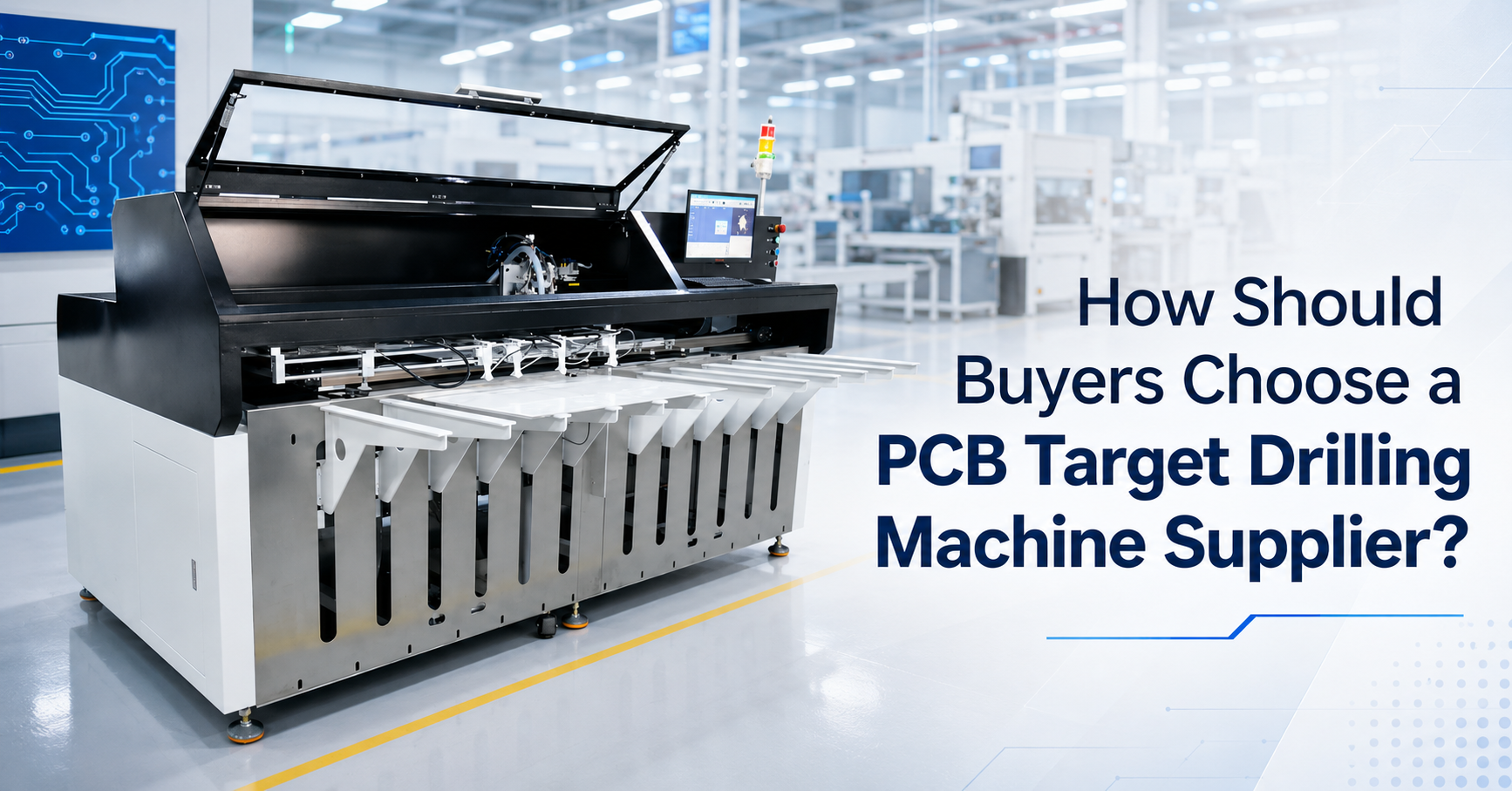
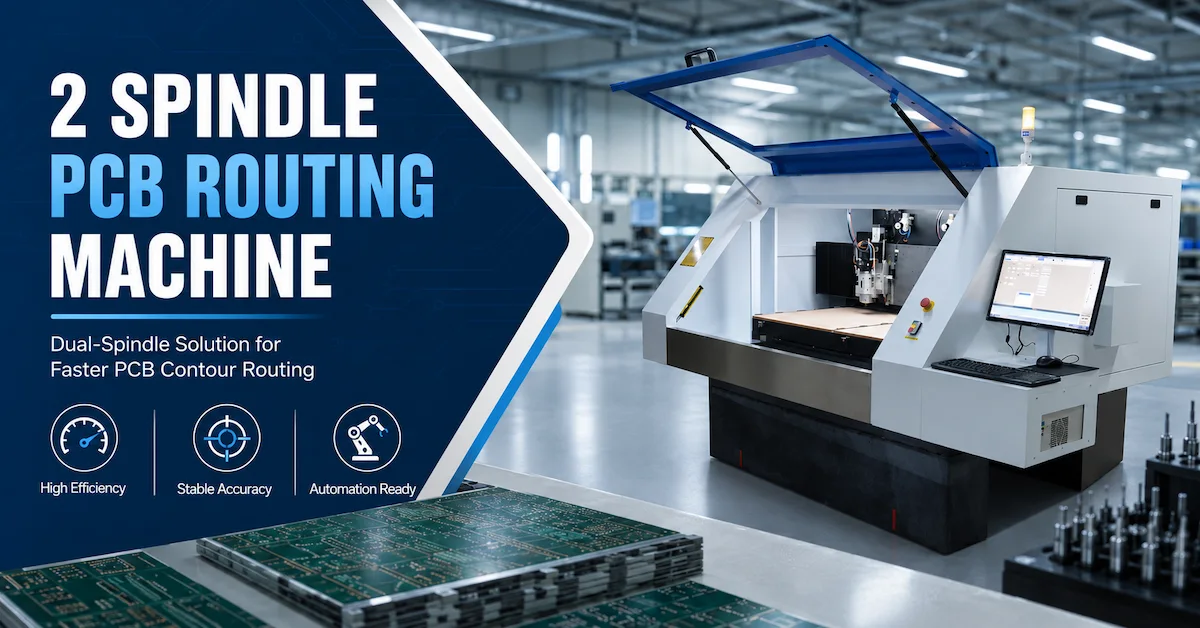
Die Chikin CK-02R 2-Spindel-Leiterplatten-Bohr- und Fräsmaschine ist für die Leiterplattenproduktion mittlerer Stückzahl konzipiert. Laut Produktseite werden Doppelspindeln mit unabhängiger Z-Achsen-Steuerung, 60.000 U/min Spindelgeschwindigkeit, 1,8 kW Spindelleistung, Wasserkühlung, Granitkonstruktion, hochpräzise Linearführungen und Kugelumlaufspindeln, automatischer Werkzeugwechsel, Werkzeuglängenerkennung, Werkzeugdurchmessererkennung, Werkzeugbrucherkennung und Druckfußschalterunterstützung verwendet. Die Maschine wird als geeignet für präzises Bohren und Fräsen auf FR4-, Multilayer- und Aluminiumplatten beschrieben.
Für B2B-Käufer, die nach einem Hersteller von PCB-Bohr- und Fräsmaschinen oder einem Lieferanten von PCB-CNC-Maschinen suchen, geht dieser Artikel über den Produktnamen hinaus. Es erklärt, was die Maschine macht, warum die Struktur wichtig ist, wie sie in die reale Leiterplattenproduktion passt und was Beschaffungsteams prüfen sollten, bevor sie eine Anfrage senden.
 B2B-Keyword-Strategie dafür Blog
| Keyword-Typ | Schlüsselwort | Suchabsicht | Empfohlene Verwendung im Artikel |
|---|---|---|---|
| Hauptschlüsselwort | 2-Spindel-Leiterplatten-Bohr- und Fräsmaschine | Produktrecherche / Lieferantenvergleich | SEO-Titel, H1, Einleitung, Fazit |
| Lieferantenschlüsselwort | Hersteller von PCB-Bohr- und Fräsmaschinen | Hersteller finden | Beschaffungsabschnitte und CTA |
| Lieferantenschlüsselwort | Lieferant von PCB-Bohr- und Fräsmaschinen | Anbieter vergleichen | Checkliste und FAQ für Käufer |
| Produkt-Keyword | Doppelspindel-Leiterplattenbohrmaschine | Spindelkonfiguration vergleichen | Technische Erklärung |
| Produkt-Keyword | PCB CNC Bohr- und Fräsmaschine | Maschinentyp verstehen | Produktübersicht |
| Automatisierungsschlüsselwort | automatische PCB-Bohr- und Fräsmaschine | Automatisierte Suchlösung | Abschnitt für Werkzeugwechsel und -erkennung |
| Factory-Schlüsselwort | PCB-Fräsmaschine für Fabriken | B2B-Fabrikausrüstung | Anwendungsabschnitt |
| Produktionsschlüsselwort | Leiterplattenproduktionsausrüstung für mittlere Stückzahlen | Kapazitätsplanung | ROI-Abschnitt |
| Anwendungsschlüsselwort | Leiterplatten-Bohrausrüstung für Leiterplattenhersteller | Allgemeine Kaufabsicht | Einleitung und Fazit |
| Kommerzielles Schlüsselwort | Lieferant von PCB-CNC-Maschinen | Lieferantenanfrage | CTA und Beschaffungsleitfaden |
Warum Leiterplattenfabriken mit mittlerem Volumen eine ausgewogene Bohr- und Fräslösung benötigen
Die PCB-Produktion wächst nicht immer geradlinig. Einige Fabriken gehen vom Prototypenbau zu Kleinserien und dann zu Nachbestellungen über. Andere bedienen bereits Industrieelektronik, LED-Platinen, Steuerungssysteme, Kommunikationsgeräte oder Automobilzulieferer, ihr Produktmix ändert sich jedoch häufig. In diesen Fällen ist der Engpass nicht immer der größte Auftrag. Oft handelt es sich dabei um das wiederholte Einrichten, den Werkzeugwechsel, die Anpassung des Fräspfads und den Bedienereingriff zwischen verschiedenen Aufträgen.
Eine Einspindelmaschine kann für die Produktion kleiner Stückzahlen, Musterplatinen oder einfache Bohrarbeiten ausreichend sein. Doch wenn das Auftragsvolumen steigt, kann die Maschine schnell langsam werden. Jede Bohrkoordinate, jeder Fräsweg und jeder Werkzeugwechsel kostet Zeit. Wenn Bediener den Werkzeugzustand manuell überprüfen oder die Maschine häufig anhalten müssen, wird der Produktionsrhythmus instabil.
Eine High-End-Vierspindelmaschine kann den Durchsatzdruck bewältigen, aber nicht jede Fabrik benötigt diese Kapazität. Manche Käufer benötigen etwas Ausgewogeneres: höhere Effizienz als Einspindelgeräte, aber dennoch flexibel genug, um sowohl Bohren als auch Fräsen zu bewältigen. Dies ist die praktische Position einer 2-Spindel-Leiterplatten-Bohr- und Fräsmaschine.
Chikin beschreibt, dass der CK-02R den 1,8- bis 2,5-fachen Durchsatz von Einspindelmodellen bietet und gleichzeitig die Kantenqualität beibehält, den Werkzeugverschleiß reduziert und sich in verwandte PCB-Liniengeräte wie Laserschneider, V-CUT und AOI-Systeme integrieren lässt. Für Leiterplattenhersteller mittlerer Stückzahl ist dieses Gleichgewicht oft wertvoller, als auf dem Papier der größten Maschine nachzujagen.
Was ist eine 2-Spindel-PCB-Bohr- und Fräsmaschine?
Eine 2-Spindel-PCB-Bohr- und Fräsmaschine ist eine CNC-Maschine, die mit zwei Spindeln zum PCB-Lochbohren und Konturfräsen ausgestattet ist. Im Gegensatz zu einer reinen Bohrmaschine kann sie sowohl Löcher als auch Fräsprofile bearbeiten. Im Gegensatz zu einer einfachen CNC-Einheit mit einer Spindel werden zwei Spindeln verwendet, um die Produktionseffizienz zu verbessern.
Der CK-02R verwendet Doppelspindeln mit unabhängiger Z-Achsensteuerung. Diese Konfiguration ist wichtig, da Bohren und Fräsen nicht immer das gleiche Schneidverhalten erfordern. Unterschiedliche Plattenmaterialien, Lochdurchmesser, Fräsdurchmesser und Werkzeugtiefen erfordern möglicherweise eine sorgfältige Kontrolle. Die unabhängige Bewegung der Z-Achse verleiht dem System mehr Flexibilität bei der Bearbeitung.
In der praktischen Leiterplattenfertigung kann eine Maschine wie diese verwendet werden für:
| Prozess | Was es tut | Warum es wichtig ist |
|---|---|---|
| PCB-Bohrungen | Erstellt Löcher für Durchkontaktierungen, Durchgangslöcher, Montagepunkte und Prozesslöcher | Beeinflusst Beschichtung, Montage, Registrierung und elektrische Zuverlässigkeit |
| PCB-Routing | Schneidet Platinenumrisse, Schlitze, Rillen und Konturen | Beeinflusst die Platinenform, die Kantenqualität und die nachgelagerte Montage |
| Gemischtes Bohren und Fräsen | Erledigt sowohl das Bohren als auch die Profilbearbeitung auf einer Geräteplattform | Reduziert den Maschinenwechsel und verbessert die Produktionsflexibilität |
| Wiederholte Stapelverarbeitung | Führt wiederkehrende Platinendesigns mit stabiler Genauigkeit aus | Hilft Fabriken, Lieferpläne zu schützen |
| Produktion mit mittlerem Volumen | Unterstützt mehr Ausgabe als einfache Einspindelgeräte | Geeignet für Fabriken mit regelmäßigen, aber nicht extrem großen Bestellungen |
Der entscheidende Vorteil sind nicht nur „zwei Spindeln“. Der wahre Wert liegt in der Kombination von Doppelspindelbearbeitung, stabiler mechanischer Struktur, CNC-Steuerung, automatischer Werkzeughandhabung und Erkennungssystemen in einer Produktionsmaschine.
CK-02R Produktübersicht
Die folgende Tabelle fasst die wichtigsten CK-02R-Informationen von Chikins Produktseite zusammen.
| Element | CK-02R Spezifikation/Funktion | Praktischer Nutzen für Leiterplattenhersteller |
|---|---|---|
| Maschinentyp | 2-Spindel-PCB-Bohr- und Fräsmaschine | Geeignet für Fabriken, die sowohl Bohren als auch Fräsen benötigen |
| Spindelmenge | 2 Spindeln | Verbessert den Durchsatz im Vergleich zu Einspindelmaschinen |
| Z-Achsen-Design | Unabhängige Z-Achsen-Steuerung | Unterstützt flexiblere Bohr- und Routingvorgänge |
| Spindelgeschwindigkeit | 60.000 U/min | Geeignet für Leiterplattenbohr- und Routingaufgaben |
| Spindelleistung | 1,8 kW | Bietet Schnittleistung für eine stabile Verarbeitung |
| Kühlmethode | Wasserkühlung | Unterstützt eine längere Spindellebensdauer und kontinuierlichen Betrieb |
| Bohrwerkzeugdurchmesser | 0,5–6,35 mm | Deckt häufige PCB-Bohranforderungen ab |
| Durchmesser des Fräswerkzeugs | 0,5–3,175 mm | Unterstützt Platinenkontur-, Schlitz- und Kantenbearbeitung |
| Genauigkeit | ±0,005 mm Wiederholgenauigkeit/Positionierungsgenauigkeit | Trägt zur Aufrechterhaltung einer konsistenten Loch- und Routing-Präzision bei |
| Werkzeugmagazin | Automatischer Werkzeugwechsler mit 9 Positionen | Reduziert manuelle Werkzeugwechsel und Ausfallzeiten |
| Erkennungssysteme | Werkzeuglänge, Werkzeugdurchmesser, Werkzeugbrucherkennung | Verbessert die Prozesssicherheit und -konsistenz |
| Maschinenbasis | Granitsockel | Verbessert Vibrationsdämpfung und thermische Stabilität |
| Antriebssystem | Panasonic / Delta-Antriebssystem | Unterstützt stabile Maschinenbewegung |
| CNC-Steuerung | CHIKIN CNC oder SIEB & MEYER CNC82 | Unterstützt den industriellen CNC-Betrieb |
| Schnittstelle | Englische Schnittstelle | Nützlich für ausländische Betreiber und globale Käufer |
| Optionales Feedback | Linear-Encoder, ±0,001 mm Auflösung | Unterstützt bei Bedarf eine präzisere Steuerung |
| Maschinengewicht | Etwa 2300 kg | Zeigt die Struktur einer Hochleistungsmaschine an |
| Maschinengröße | 2170×1700×1600mm | Hilft Käufern bei der Planung des Werkstattlayouts |
| Leistung | 220V/380V 3PH, 5KVA | Wichtig für die Installationsplanung |
| Unterstützung | 3 Jahre Präzisionsgarantie und weltweiter 24-Stunden-Support | Nützlich für internationale B2B-Käufer |
Produktproblempunkte, für deren Lösung die Maschine konzipiert ist
Eine PCB-Bohr- und Fräsmaschine sollte echte Fabrikprobleme lösen. Für Beschaffungsteams sollte die Maschine nicht nur nach Spindelgeschwindigkeit oder Preis bewertet werden. Die sinnvollere Frage ist: Welche Probleme reduziert die Maschine während der täglichen Produktion?
| Factory Pain Point | Allgemeine Auswirkungen auf die Produktion | CK-02R-bezogene Funktion |
|---|---|---|
| Langsamer Bohr- und Fräszyklus | Lieferdruck, Überstunden, Produktionsengpass | Das Design mit zwei Spindeln verbessert den Durchsatz |
| Instabile Lochposition | Ausschuss, Nacharbeit, schlechte Beschichtungsqualität | ±0,005 mm Wiederholgenauigkeit und Positionierungsgenauigkeit |
| Schlechte Kantenqualität nach dem Routing | Montageprobleme und zusätzliche Nacharbeit | CNC-Fräsen mit stabiler Spindel und Maschinenbasis |
| Werkzeugbruch nicht schnell erkannt | Beschädigte Panels und verschwendete Produktionszeit | System zur Erkennung defekter Werkzeuge |
| Häufiger manueller Werkzeugwechsel | Ausfallzeit und Betreiberabhängigkeit | Automatischer Werkzeugwechsler mit 9 Positionen |
| Vibration während der Hochgeschwindigkeitsverarbeitung | Werkzeugverschleiß, Genauigkeitsabweichung, raue Kantenqualität | Granitsockel zur Vibrationsdämpfung |
| Gemischte Produktionsanforderungen | Benötigen Sie separate Maschinen zum Bohren und Fräsen | Kombinierte Bohr- und Routing-Funktion |
| Schwierigkeit bei Übersee-Operationen | Schulungskosten und Kommunikationsprobleme | Englische Benutzeroberfläche und globale Unterstützung |
In vielen Fabriken treten diese Probleme gemeinsam auf. Eine Maschine bohrt zwar präzise, erfordert aber zu viel manuelle Werkzeughandhabung. Ein anderer ist möglicherweise schnell, aber beim Routing instabil. Eine praktische automatische Leiterplatten-Bohr- und Fräsmaschine soll mehrere Risiken gleichzeitig reduzieren.
Warum Bohren und Fräsen in der Leiterplattenproduktion häufig miteinander verbunden sind
Bohren und Fräsen sind separate Prozesse, die jedoch in der PCB-Produktionsplanung eng miteinander verbunden sind. Beim Bohren entstehen Löcher. Durch das Routing werden die Platinenform, die Schlitze und die Ausschnitte definiert. Wenn beide Prozesse verzögert oder inkonsistent sind, kann dies die gesamte Charge beeinträchtigen.
Beispielsweise benötigt eine Platine möglicherweise plattierte Durchgangslöcher, Montagelöcher und eine Kantenführung. Wenn das Bohren auf einer Maschine abgeschlossen ist und die Verlegung auf eine andere Maschine verschoben wird, muss das Werk die Ausrichtung, Handhabung, Planung und Qualitätsprüfungen zwischen den Stationen verwalten. Dies ist in großen Produktionslinien nicht immer ein Problem, aber in Fabriken mit mittlerem Volumen und Werkstätten mit gemischten Aufträgen können Prozessbewegungen zu Verzögerungen führen.
Eine PCB-CNC-Bohr- und Fräsmaschine hilft, indem sie beide Fähigkeiten kombiniert. Es ersetzt nicht jede Spezialmaschine in einer großen Produktionsanlage, verleiht der Fabrik jedoch mehr Flexibilität. Dies ist besonders nützlich, wenn dasselbe Produktionsteam mehrere Leiterplattentypen, kleine bis mittlere Losgrößen, technische Änderungen und dringende Lieferanfragen bearbeitet.
Der Bohrwerkzeugbereich des CK-02R von 0,5–6,35 mm und der Fräsbereich von 0,5–3,175 mm machen ihn für gängige Leiterplattenbearbeitungsaufgaben bei verschiedenen Leiterplattentypen geeignet.
Die Rolle von Doppelspindeln für die Produktionseffizienz
Der Unterschied zwischen einer Spindel und zwei Spindeln mag einfach klingen, seine Auswirkungen auf die Produktion können jedoch erheblich sein. Eine Einspindelmaschine erledigt jeweils einen Bearbeitungspfad. Eine Doppelspindelkonfiguration kann die Leistung verbessern, wenn die Auftragsstruktur und die Maschineneinrichtung geeignet sind.
Chikin gibt an, dass der CK-02R einen 1,8- bis 2,5-mal höheren Durchsatz als Einspindelmodelle erreichen kann. In der Fabrik bedeutet das möglicherweise kürzere Bohrwarteschlangen, schnellere Chargenabwicklung, bessere Maschinenauslastung und weniger Abhängigkeit von Überstunden.
Beim Dual-Spindel-Wert kommt es jedoch nicht nur auf die Geschwindigkeit an. Es verbessert auch die Produktionsplanung. Wenn eine Fabrik regelmäßig wiederholte Platten verarbeitet, können zwei Spindeln die Zykluszeit vorhersehbarer machen. Vorhersehbare Zykluszeiten helfen Produktionsmanagern bei der Planung nachgelagerter Prozesse wie Galvanisierung, Inspektion, Montagevorbereitung oder Lieferung.
| Produktionsfaktor | Einspindelmaschine | 2-Spindel-PCB-Bohr- und Fräsmaschine |
|---|---|---|
| Verarbeitungsausgabe | Unten | Höher für geeignete wiederholte Jobs |
| Produktionsflexibilität | Gut für Proben und einfache Arbeiten | Besser für gemischte Produktion mit mittlerem Volumen |
| Maschineninvestition | Geringere Anschaffungskosten | Höher, aber produktiver |
| Operatorabhängigkeit | Höher, wenn Werkzeugwechsel häufig sind | Unterer mit automatischer Werkzeughandhabung |
| Routing-Fähigkeit | Hängt vom Maschinendesign ab | Integriertes Bohren und Fräsen |
| Best Fit | Prototype, low-volume, simple boards | Mid-volume PCB factories and repeated orders |
For a factory that already has regular PCB orders but is not ready for a larger four-spindle drilling machine, a two-spindle drilling and routing machine can be a reasonable next step.
Why Independent Z-Axis Control Matters
The CK-02R uses dual spindles with independent Z-axis control. This is an important detail for real machining, because the Z-axis controls vertical movement, cutting depth, tool engagement, and process safety.
In PCB drilling, the Z-axis affects entry, drilling depth, and tool withdrawal. In routing, it affects cutting depth, edge finish, and tool load. If the machine handles different tools or different machining operations, independent Z-axis control gives the system more control over how each spindle works.
This can help in several ways:
| Z-Axis Requirement | Why It Matters in PCB Processing |
|---|---|
| Accurate vertical positioning | Helps prevent over-cutting or insufficient cutting |
| Controlled drilling depth | Important for process consistency |
| Tool protection | Reduces risk of overload and breakage |
| Routing quality | Helps maintain clean board edges and stable profiles |
| Process flexibility | Supports different operations within one machine platform |
For B2B buyers, independent Z-axis control is one of the details that separates a production-oriented machine from a basic mechanical platform.
Granite Base and Machine Stability
A machine base may not look as exciting as spindle speed, but it has a direct effect on machining quality. The CK-02R uses a granite base for vibration damping, thermal stability, and long-term precision.
In PCB drilling and routing, vibration can create several problems. It can increase tool wear, reduce hole accuracy, affect routing edge quality, and create inconsistent results across a batch. The issue becomes more visible when processing smaller features, denser boards, or materials that require clean cutting.
Granite is commonly valued in precision equipment because it provides dimensional stability and vibration damping. In the context of the CK-02R, the granite base supports consistent high-speed operation in demanding PCB environments.
| Machine Structure Factor | Impact on PCB Production |
|---|---|
| Vibration damping | Helps improve hole quality and routing edge consistency |
| Thermal stability | Reduces accuracy drift during longer operation |
| Heavy machine body | Supports stable high-speed motion |
| Precision mechanical foundation | Helps maintain repeatability over time |
A lower-cost machine with weak structure may perform acceptably during a short demonstration, but long production shifts expose vibration and thermal issues. That is why serious buyers should ask about the machine base, not only spindle quantity.
Linear Guides, Ballscrews, and Motion Accuracy
The CK-02R is equipped with high-accuracy linear guides and ballscrews. Chikin lists Taiwan components as standard, with Germany Rexroth or Japanese components available as upgraded options. The product page also states that the machine can reach rapid traverse speeds up to 30m/min in XY and maintain ±0.005mm repeatability and positioning accuracy.
Motion accuracy matters because PCB machining is coordinate-based. Every hole and routing path depends on the machine’s ability to move predictably. If there is backlash, vibration, or positioning drift, the result may be hole offset, routing deviation, rough board edges, or scrap.
| Motion System Element | Production Meaning |
|---|---|
| Linear guide | Supports smooth and stable axis movement |
| Ballscrew | Converts motor motion into precise linear movement |
| Rapid traverse speed | Reduces non-cutting movement time |
| Repeatability | Helps the machine return to the same point consistently |
| Positioning accuracy | Helps match programmed coordinates with actual machining |
| Optional linear encoder | Adds higher-resolution position feedback when required |
For a PCB drilling and routing machine supplier, motion accuracy should be a core selling point. For buyers, it should be a core inspection point.
Spindle Performance: 60,000 RPM, 1.8KW, and Water Cooling
The CK-02R uses 60,000 RPM spindles with 1.8KW power and water cooling. This combination is relevant for both drilling and routing.
High spindle speed helps process PCB materials cleanly, especially when using smaller tools. Spindle power helps maintain cutting stability during routing and heavier machining conditions. Water cooling helps control spindle temperature and supports longer service life during extended operation.
| Spindle Feature | Why It Matters |
|---|---|
| 60,000 RPM speed | Supports PCB drilling and routing with smaller tools |
| 1.8KW power | Provides cutting strength for routing and stable machining |
| Water cooling | Helps protect spindle performance during longer operation |
| Dual-spindle setup | Improves throughput compared with single-spindle equipment |
Spindle performance should always be evaluated together with machine structure and motion accuracy. A fast spindle cannot compensate for a weak mechanical base. A strong machine frame cannot reach full value if the spindle lacks stability. The CK-02R positions these elements as a complete system.
Automatic Tool Change and Detection Systems
Manual tool handling is one of the most underestimated sources of downtime in PCB machining. Every time the operator changes tools manually, production stops. Every tool setup error can create quality risk. Every broken tool that goes undetected can damage boards before anyone notices.
The CK-02R includes a fully automatic tool changer with a 9-position magazine. It also includes tool length detection, tool diameter detection, broken tool detection, and pressure foot switch support.
| Tool Management Feature | Practical Benefit |
|---|---|
| 9-position automatic tool changer | Reduces manual tool changes |
| Tool length detection | Helps maintain correct machining depth |
| Tool diameter detection | Helps confirm tool suitability |
| Broken tool detection | Reduces scrap risk from undetected tool breakage |
| Pressure foot switch | Supports safer and more controlled processing |
For a mid-volume PCB factory, these features are not just “automation options.” They help reduce human error, stabilize process timing, and improve production confidence.
CNC Control and Drive System
The CK-02R uses a Panasonic / Delta drive system and supports CHIKIN CNC or SIEB & MEYER CNC82 control, with an English interface. This matters because a CNC machine is only as useful as its control stability and operator usability.
SIEB & MEYER describes its CNC controls and motion controller products as optimized for PCB drilling and mechanical PCB routing, with emphasis on process reliability and efficiency. This aligns with what PCB manufacturers need from drilling and routing equipment: stable motion, reliable spindle coordination, efficient program execution, and manageable operation.
For overseas buyers, the English interface is also important. It reduces training difficulty and allows local operators to work with less translation dependency. In B2B equipment purchases, operation clarity can directly affect how quickly a factory can adopt the new machine.
| Control / Drive Element | Buyer Concern |
|---|---|
| CNC controller | Program execution, machine coordination, operation logic |
| Drive system | Axis response, stability, motion reliability |
| English interface | Operator training and overseas usability |
| Optional encoder | Higher positioning feedback for precision requirements |
| Supplier support | Troubleshooting, parameter adjustment, long-term maintenance |
A PCB CNC machine supplier should be able to explain not only which controller is used, but also how the control system supports real drilling and routing work.
Suitable PCB Materials and Applications
The CK-02R is positioned for precise drilling and routing on FR4, multilayer, and aluminum boards. These are common board categories in industrial electronics, LED lighting, power electronics, control systems, communication equipment, and many other manufacturing sectors.
| PCB Type | Typical Requirement | Why CK-02R Fits |
|---|---|---|
| FR4 PCB | General drilling, routing, mounting holes, edge profiles | Balanced drilling and routing capability |
| Multilayer PCB | Stable hole position and repeatable machining | ±0.005mm accuracy supports consistency |
| Aluminum PCB | Routing and processing for metal-backed boards | 1.8KW spindle power supports tougher cutting conditions |
| Industrial control board | Repeatable production and stable quality | CNC control and detection systems reduce process variation |
| LED PCB | Aluminum substrate processing and repeated panel machining | Suitable for board routing and drilling tasks |
| Small to mid-volume production | Flexible batch processing | Dual-spindle system improves efficiency without oversized investment |
This makes the machine especially relevant for factories that produce more than one PCB type. If a factory only produces one extremely high-volume product, a more specialized line may be preferred. But if the factory manages repeated mixed orders, a dual-spindle drilling and routing platform can be practical.
How This Machine Supports Mid-Volume PCB Production
Mid-volume production is often harder to manage than it appears. The factory must maintain efficiency, but it may not have the luxury of running one product for weeks without changeover. Orders may be repeated, but batch sizes may vary. Product designs may be stable, but customer requirements can change.
A 2 spindle PCB drilling and routing machine supports this environment because it offers:
| Production Need | How CK-02R Supports It |
|---|---|
| Higher output than single-spindle machines | Dual spindles improve production efficiency |
| Flexibility for drilling and routing | One machine platform handles both processes |
| Stable accuracy | Granite base and precision motion components |
| Lower downtime | Automatic tool change and detection systems |
| Mixed board compatibility | FR4, multilayer, and aluminum board applications |
| International operation | English interface and global support |
For many buyers, this combination is the reason to choose a dual-spindle machine instead of a single-spindle unit or a drilling-only system.
2 Spindle Machine vs 4 Spindle Machine
A common procurement question is whether to buy a two-spindle or four-spindle machine. The answer depends on production volume, board type, budget, and the factory’s bottleneck.
| Comparison Point | 2 Spindle PCB Drilling and Routing Machine | 4 Spindle PCB Drilling Machine |
|---|---|---|
| Main Function | Drilling + routing | Mainly high-speed drilling |
| Spindle Quantity | 2 | 4 |
| Best Use | Mid-volume mixed production | Higher-volume drilling production |
| Process Flexibility | Higher because it combines drilling and routing | More focused on drilling throughput |
| Investment Level | Usually more moderate | Usually higher |
| Typical Buyer | Factory needing balanced drilling/routing capacity | Factory with drilling bottleneck and larger volume |
| Selection Logic | Choose when flexibility and mid-volume output matter | Choose when maximum drilling output matters |
A 4-spindle drilling machine may be better for factories with heavy drilling loads and high batch volume. A 2-spindle drilling and routing machine may be better when the factory wants a more flexible system that handles both hole processing and profile machining.
2 Spindle PCB Drilling and Routing Machine vs Single-Spindle Machine
| Factor | Single-Spindle Machine | 2 Spindle PCB Drilling and Routing Machine |
|---|---|---|
| Throughput | Lower | Higher, especially for repeated jobs |
| Initial Cost | Lower | Higher than single-spindle equipment |
| Automation Level | Depends on model | Automatic tool change and detection features |
| Suitable Production | Prototype and low volume | Small-to-mid and mid-volume production |
| Drilling and Routing | May support both, but slower | Better balanced for repeated drilling/routing |
| Operator Intervention | Often higher | Lower due to tool automation |
| Long-Term Value | Good for simple jobs | Better for factories with steady orders |
The decision should not be made only by purchase price. If a single-spindle machine causes delays, overtime, tool-change downtime, or missed delivery dates, its lower price may not mean lower total cost.
2 Spindle Drilling and Routing Machine vs Separate Drilling and Routing Machines
Some factories prefer separate machines for drilling and routing. This can work well when production volume is high enough and the workflow is stable. However, separate equipment also means more handling, more floor space, and more scheduling coordination.
| Evaluation Point | Combined 2 Spindle Drilling & Routing Machine | Separate Drilling and Routing Machines |
|---|---|---|
| Floor Space | More compact | Requires more space |
| Process Flexibility | Good for mixed production | Strong if each process has stable volume |
| Handling Time | Lower between drilling and routing | Higher due to transfer between machines |
| Scheduling | Easier for small/mid batches | More complex but scalable |
| Investment | One integrated machine | Two separate equipment investments |
| Best Fit | Mid-volume factories and mixed orders | Larger production lines with dedicated process stations |
A combined machine is not always better. But for many mid-volume PCB manufacturers, it reduces workflow complexity and gives production managers more flexibility.
Quality Control: Why Drilling and Routing Accuracy Affect Final PCB Reliability
PCB drilling and routing quality affects more than appearance. Hole accuracy affects registration, plating, assembly, and electrical reliability. Routing quality affects board shape, edge smoothness, assembly fit, and handling safety.
IPC-6012 covers qualification and performance requirements for rigid printed boards, including single-sided, double-sided, plated-through-hole, multilayer, blind/buried via, and metal core boards. This is relevant because drilling and routing equipment contributes directly to whether a factory can maintain consistent board quality.
| Quality Issue | Possible Cause | Machine Feature That Helps |
|---|---|---|
| Hole position deviation | Motion error, vibration, poor positioning | ±0.005mm accuracy and granite base |
| Rough routing edge | Tool wear, vibration, weak spindle control | 1.8KW spindle and stable machine structure |
| Tool breakage | Incorrect tool condition, overload, long use | Broken tool detection |
| Inconsistent cutting depth | Z-axis control or tool length error | Independent Z-axis and tool length detection |
| Production scrap | Delayed detection of process problems | Tool diameter and broken tool detection |
A professional PCB drilling and routing machine manufacturer should understand that equipment is part of the quality system. It is not only a mechanical tool.
ROI Factors for B2B Buyers
A buyer should calculate machine value based on production results, not only purchase cost. The CK-02R is positioned as a machine that improves throughput, reduces downtime, and supports stable mid-volume production.
| ROI Factor | How It Affects Production | What Buyers Should Measure |
|---|---|---|
| Throughput improvement | Shortens drilling/routing cycle time | Compare current cycle time with expected dual-spindle output |
| Tool change reduction | Reduces machine idle time | Record daily manual tool-change time |
| Scrap reduction | Saves board material and labor | Review drilling/routing-related scrap records |
| Labor efficiency | Reduces operator intervention | Compare operator workload before and after upgrade |
| Delivery stability | Helps protect lead time | Track delayed orders caused by machining bottlenecks |
| Process flexibility | Handles different PCB types | Review monthly board variety |
| Floor space efficiency | Combines drilling and routing | Compare one integrated machine vs separate equipment |
| Maintenance and support | Reduces long-term downtime risk | Review warranty, spare parts, and supplier response |
A machine with a higher purchase price can still be economical if it reduces downtime, improves delivery, and allows the factory to accept more stable orders.
Practical Buyer Checklist
Before choosing a PCB drilling and routing machine supplier, buyers should prepare a clear checklist. This prevents procurement from becoming a simple price comparison.
| Evaluation Area | Questions to Ask Supplier | Why It Matters |
|---|---|---|
| Spindle System | What is the spindle speed, power, cooling method, and service life? | Determines cutting performance and durability |
| Spindle Quantity | Is two-spindle capacity enough for our order volume? | Prevents underbuying or overbuying |
| Z-Axis Design | Are the spindles independently controlled? | Affects process flexibility |
| Work Area | Does the machine fit our standard PCB panel sizes? | Prevents production mismatch |
| Tool Range | What drilling and routing tool diameters are supported? | Ensures compatibility with product designs |
| Tool Changer | How many tool positions are available? | Affects downtime and job complexity |
| Detection Systems | Does the machine detect broken tools and tool dimensions? | Reduces scrap risk |
| Accuracy | What repeatability and positioning accuracy can the machine maintain? | Affects hole and routing quality |
| CNC System | Which controller is used and what languages are supported? | Affects operation and training |
| Service | What warranty and global support are available? | Important for overseas buyers |
| Sample Test | Can the supplier process buyer samples before order? | Verifies real performance |
| ROI | Can the supplier help compare current and expected production output? | Supports business decision-making |
How to Decide Whether CK-02R Fits Your Factory
The CK-02R is not the only possible machine choice. It is suitable when the factory’s needs match its design.
It may fit your factory if:
| Factory Situation | CK-02R Fit |
|---|---|
| You process FR4, multilayer, or aluminum PCB boards | Strong fit |
| You need both drilling and routing | Strong fit |
| You want higher output than single-spindle machines | Strong fit |
| You handle mid-volume or mixed-batch orders | Strong fit |
| You need automatic tool change and detection | Strong fit |
| You only need very low-volume prototyping | May be more than necessary |
| You need the highest possible drilling throughput | Consider a 4-spindle drilling machine |
| You already have separate high-capacity routing and drilling lines | Compare workflow carefully |
A good machine decision starts with production data. Before sending an inquiry, the buyer should review monthly board volume, average hole count, routing complexity, tool change frequency, scrap causes, and current bottleneck location.
Process Flow: How the Machine Fits into PCB Manufacturing
A PCB CNC drilling and routing machine usually belongs in the mechanical processing stage of PCB manufacturing. Its exact position depends on the factory process, but it often supports hole formation and board profiling.
| Production Step | Role of Drilling / Routing Machine |
|---|---|
| Design preparation | Receives machining coordinates and process requirements |
| Panel setup | PCB panels are positioned and fixed |
| Tool preparation | Required drilling and routing tools are loaded |
| Drilling | Holes are created according to CNC program |
| Routing | Board outline, slots, or contours are machined |
| Detection | Tool condition and machining stability are monitored |
| Inspection | Board holes and edges are checked |
| Downstream process | Boards continue to plating, finishing, inspection, or assembly-related workflow |
The CK-02R’s automatic tool change and detection systems are useful because they reduce interruptions during the drilling and routing stages.
Production Scenarios for the CK-02R
| Scenario | Buyer Need | Why CK-02R Is Relevant |
|---|---|---|
| Mid-volume PCB factory | Increase output without buying oversized equipment | Dual-spindle throughput improvement |
| Prototype-to-batch transition | Move from samples to repeat orders | Balanced flexibility and efficiency |
| Aluminum PCB processing | Handle LED and power boards | Routing capability and spindle power |
| Mixed FR4 and multilayer orders | Process different board types | CNC flexibility and stable accuracy |
| Export-oriented factory | Improve reliability and delivery confidence | English interface and global support |
| Equipment upgrade project | Replace older single-spindle machines | Better automation and detection |
Common Mistakes When Buying PCB Drilling and Routing Equipment
Many equipment problems begin before the machine arrives. Procurement teams sometimes focus on visible specifications while ignoring workflow fit.
| Mistake | Why It Creates Risk | Better Approach |
|---|---|---|
| Buying only by lowest price | May lead to poor stability or weak support | Compare total cost and production impact |
| Ignoring tool change time | Manual changes reduce real output | Evaluate automatic tool changer capacity |
| Focusing only on spindle speed | Speed without stability may reduce quality | Check base, guide rails, ballscrews, and accuracy |
| Not testing real samples | Catalog specs may not reflect actual jobs | Request sample processing |
| Overbuying capacity | Higher investment may not improve ROI | Match machine to order volume |
| Underbuying capacity | Bottleneck remains after purchase | Calculate future order growth |
| Ignoring service support | Downtime becomes expensive | Confirm warranty, response time, and spare parts |
A reliable PCB drilling and routing machine supplier should help the buyer avoid these mistakes during selection.
Internal Linking Suggestions for Website Publishing
| Anchor Text | Suggested Link Target |
|---|---|
| 2 spindle PCB drilling and routing machine | CK-02R product page |
| PCB drilling and routing solutions | Product category page |
| 4 spindle PCB drilling machine | Related product page |
| PCB routing machine for factories | Routing product page |
| PCB laser cutting equipment | Laser cutting machine page |
| PCB AOI inspection machine | AOI product page |
| request a customized quote | Contact / inquiry page |
| sample processing or live demo | Service page |
Internal links should be placed naturally. The article should guide buyers from education to product comparison, then to inquiry.
FAQ
What is a 2 spindle PCB drilling and routing machine?
A 2 spindle PCB drilling and routing machine is a CNC machine designed to process PCB holes and board profiles with two spindles. It improves efficiency compared with a single-spindle machine and offers more flexibility than a drilling-only system.
What is the main advantage of the CK-02R?
The main advantage is balanced production capability. The CK-02R combines dual spindles, drilling and routing functions, granite structure, automatic tool change, tool detection, and ±0.005mm repeatability / positioning accuracy for mid-volume PCB production.
What materials can the CK-02R process?
The product page describes the CK-02R as suitable for precise drilling and routing on FR4, multilayer, and aluminum boards.
What is the spindle speed of the CK-02R?
The CK-02R uses 60,000 RPM spindles with 1.8KW power and water cooling.
What tool sizes does the machine support?
The CK-02R supports drilling tools from 0.5–6.35mm and routing tools from 0.5–3.175mm.
Does the machine include automatic tool change?
Yes. The CK-02R includes a fully automatic tool changer with a 9-position magazine, along with tool length detection, tool diameter detection, broken tool detection, and pressure foot switch support.
Is a 2 spindle machine better than a 4 spindle machine?
Not always. A two-spindle drilling and routing machine is better for mid-volume production and mixed drilling/routing needs. A four-spindle drilling machine is better when the main goal is higher drilling throughput.
Is this machine suitable for overseas buyers?
The CK-02R includes an English interface and is backed by global 24-hour support, according to Chikin’s product page.
How should a factory calculate ROI?
A factory should compare current cycle time, manual tool-change time, scrap caused by drilling/routing issues, operator workload, delivery delays, and expected order growth. The value of the machine comes from higher output, lower downtime, and more stable quality.
Conclusion
A 2 spindle PCB drilling and routing machine is a practical choice for PCB manufacturers that need more than basic drilling capacity but do not necessarily require the largest multi-spindle system. It is especially suitable for mid-volume factories, mixed PCB orders, FR4 boards, multilayer boards, aluminum boards, and production environments where both drilling and routing must remain stable.
The Chikin CK-02R combines dual spindles, independent Z-axis control, 60,000 RPM spindle speed, 1.8KW water-cooled spindle power, granite base construction, high-accuracy linear guides and ballscrews, automatic tool change, tool length detection, tool diameter detection, broken tool detection, and ±0.005mm repeatability / positioning accuracy. These features make it relevant for buyers searching for a PCB drilling and routing machine manufacturer, PCB drilling and routing machine supplier, or PCB CNC machine supplier for mid-volume PCB production.
For B2B procurement teams, the best decision is not simply choosing the lowest price or the highest spindle count. A better approach is to match the machine to real factory conditions: board materials, hole sizes, routing requirements, order volume, tool-change frequency, accuracy expectations, operator skill level, and after-sales support needs.
If the main production challenge is flexible drilling and routing with better throughput than a single-spindle machine, the CK-02R is worth evaluating as a balanced PCB CNC solution for modern PCB manufacturing.