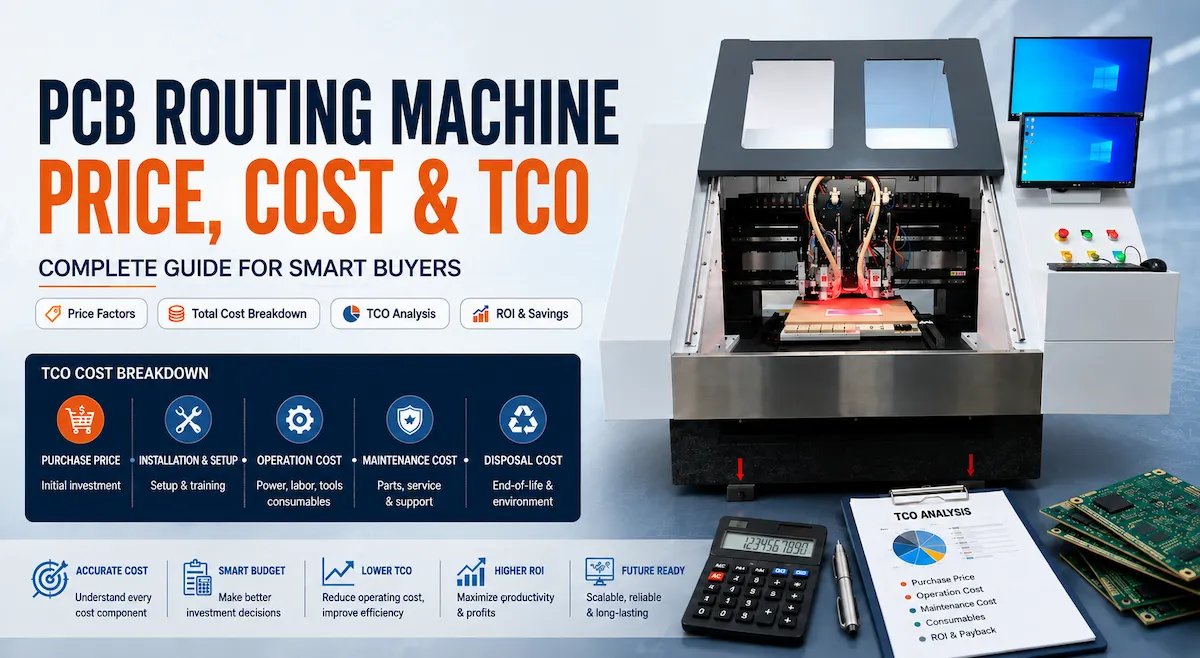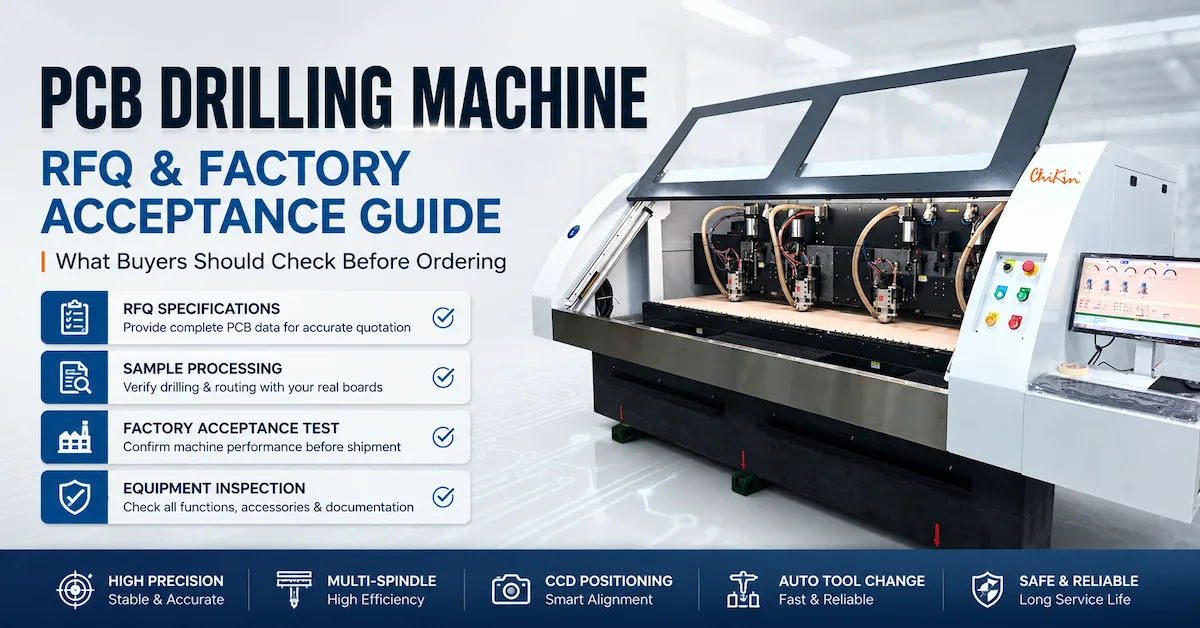




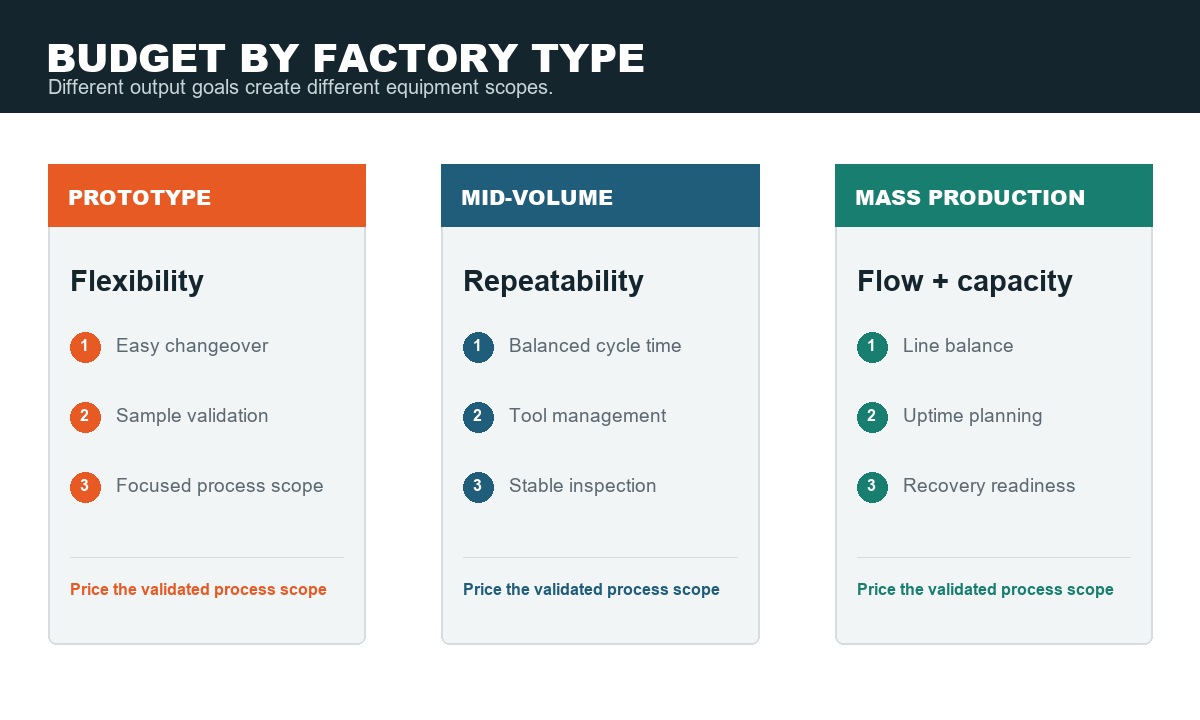
PCB manufacturing equipment cost is a project budget, not a single machine price. A prototype shop may need a focused set of process machines, while a mid-volume factory adds repeatable handling, inspection, and utilities. A mass-production line adds capacity, redundancy, material flow, commissioning, and service coverage. If those three factory types are compared with one headline number, the budget will be misleading before the first quotation is received.
This guide gives purchasing managers, process engineers, and factory owners a practical way to plan the investment. It separates equipment by process step, shows what changes pcb production line cost, explains how to compare a complete line with individual pcb making machine cost, and provides an RFQ checklist that helps suppliers return a usable proposal. The goal is not to publish a fictional price range. The goal is to make the scope, assumptions, and next action clear.
What does PCB manufacturing equipment cost include?
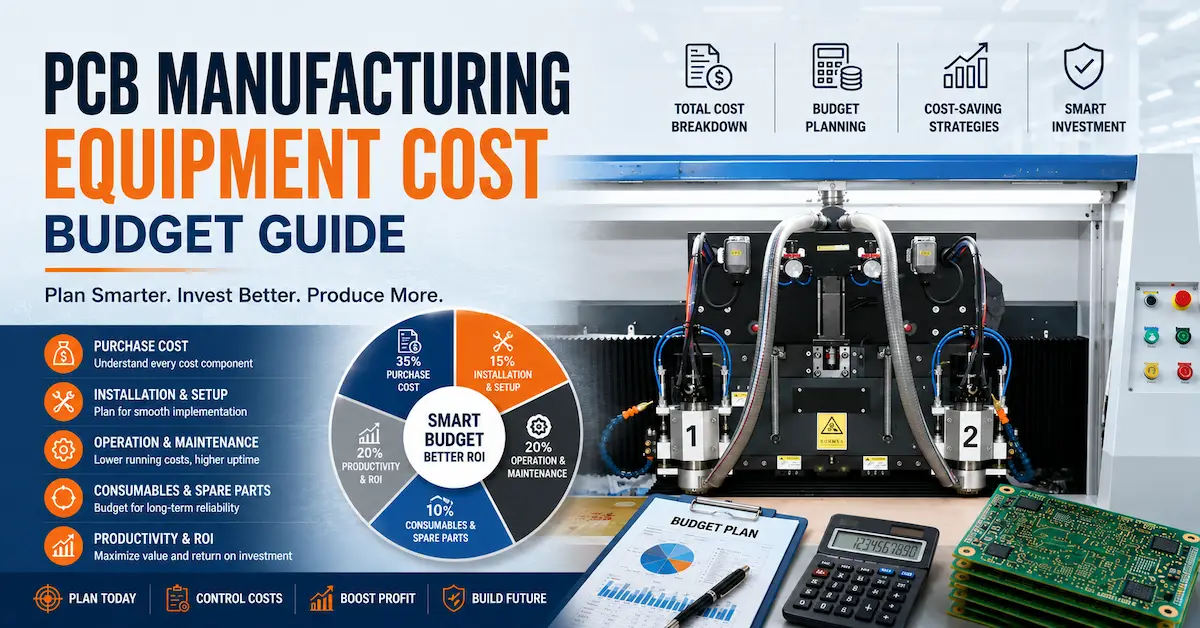
A factory budget should begin with the production route and the output target. The equipment subtotal is only one layer. A realistic plan normally includes the following cost groups:
- Process equipment: machines for drilling, routing, imaging, lamination, surface treatment, inspection, testing, or other steps in the approved flow.
- Fixtures and tooling: drill fixtures, routing fixtures, panels, nests, holders, collets, tooling kits, and initial consumables.
- Utilities: electrical supply, compressed air, extraction, cooling, water, drainage, ventilation, and environmental controls required by the selected process.
- Material handling: loading tables, carts, buffers, conveyors, racks, barcode or traceability interfaces, and safe movement between operations.
- Quality and validation: sample runs, measurement equipment, inspection programs, test coupons, acceptance criteria, and documentation.
- Project delivery: freight, import charges where applicable, installation, training, translation, spare parts, and after-sales support.
These groups should appear as separate lines in the budget. When they are hidden inside a machine total, it becomes difficult to see whether one supplier has quoted a complete production cell while another has quoted a base unit. That is the first reason a low pcb manufacturing equipment cost can later become a high start-up cost.
How should you budget a prototype PCB line?
A prototype line is usually designed around flexibility and learning speed. Product mix changes often, batch sizes are limited, and engineers may need to adjust files, fixtures, and process conditions. The right budget is therefore not the smallest possible list. It is the smallest list that can produce representative samples, measure the result, and support the next design iteration.
For a prototype environment, start by defining the operations that must be performed in-house. A focused route may include drilling, routing or depaneling, manual preparation, and inspection, while imaging, plating, or other chemistry-heavy processes are outsourced. The budget should state those boundaries clearly so that an outsourced step is not accidentally treated as a missing machine.
Prototype buyers commonly prioritize:
- A working area and fixture method that cover the expected board and panel formats.
- Simple changeover and accessible tooling for frequent engineering revisions.
- Stable file transfer and operator controls that make the process repeatable.
- Measurement and sample validation before a machine is accepted.
- Training and remote support that let a small team solve routine issues.
Do not pay for capacity that the prototype schedule cannot use. At the same time, do not remove dust control, safe guarding, or basic tooling support simply to lower the purchase order. Prototype work often exposes process weaknesses earlier than production does, so the budget must leave room for testing and adjustment.
What changes the budget for a mid-volume PCB factory?
Mid-volume production sits between engineering flexibility and dedicated throughput. The factory may run several product families, but it also needs predictable cycle time, controlled changeovers, and a repeatable quality record. At this stage, the question is not only whether a machine can process a board. It is whether the complete cell can keep the planned schedule without creating a new bottleneck downstream.
Key budget decisions include:
- Parallel capacity: compare single-spindle and multi-spindle arrangements against the real board mix, not a theoretical maximum.
- Registration: decide whether fixture-based locating is sufficient or whether camera-assisted alignment is needed for the actual panel.
- Tool management: include tool measurement, tool-life records, spare holders, and a plan for manual or automatic changes.
- Handling: measure loading, unloading, queue time, and changeover rather than using cutting time alone.
- Inspection: reserve budget for first-piece checks, in-process verification, and records that support corrective action.
Chikin's product range includes single-spindle, two-spindle, four-spindle, and combined drilling-and-routing directions. Those product pages are useful starting points for a configuration discussion, but the final selection still depends on board material, thickness, panel size, routing outline, target output, and file review. A mid-volume budget should show the assumptions behind the selected configuration instead of treating a model name as a capacity guarantee.
How does a mass-production line change PCB production line cost?
Mass production adds more than additional machines. The investment must protect material flow, uptime, quality release, and recovery after a stop. A line with high nominal capacity can still miss its output target if loading is slow, a shared utility is undersized, one inspection step becomes a queue, or a single failed machine stops the entire route.
For a mass-production plan, build the budget around a line balance:
- Define the takt or output requirement. State boards, panels, or accepted units per shift and identify the product mix used for the calculation.
- Map every process step. Include internal operations, outsourced operations, buffers, inspection, rework, and finished-goods movement.
- Test the constraint. Use the slowest operation, changeover, tool replacement, inspection queue, or material-handling step as the first capacity question.
- Price resilience. Consider spare tooling, critical spare parts, backup utilities, recovery procedures, and service response requirements.
- Validate with representative work. Agree on sample material, files, quantity, measurements, and acceptance conditions before final approval.
Redundancy should be justified by risk. Two machines may be sensible when one failure would stop a high-value line, but duplicate equipment is not automatically efficient. The decision should compare the cost of the second asset with the cost of downtime, delayed shipments, and recovery labor under the planned production schedule.
Which equipment belongs in a PCB manufacturing equipment list?
There is no universal list for every factory. The right list follows the board type, materials, process ownership, quality requirements, and volume. A useful planning map looks like this:
| Process area | Budget question | Evidence to request |
|---|---|---|
| Drilling | Can the selected platform handle the hole range, stack method, files, and output plan? | Machine configuration, tooling plan, sample drill data, inspection method |
| Routing and depaneling | Will the process meet outline quality, dust control, fixture, and changeover needs? | Routing files, tool strategy, extraction scope, sample acceptance criteria |
| Imaging and lamination | Are film handling, alignment, cleanliness, and material compatibility defined? | Material data, process window, utilities, inspection records |
| Surface and chemical steps | Who owns chemistry, ventilation, water, waste, and environmental compliance? | Utility schedule, safety review, environmental responsibilities |
| Inspection and test | Which defects or electrical conditions must be detected before release? | Inspection coverage, test files, measurement method, traceability needs |
| Handling and utilities | What connects the machines into a stable, safe production route? | Layout, power, air, extraction, cooling, racks, and material-flow plan |
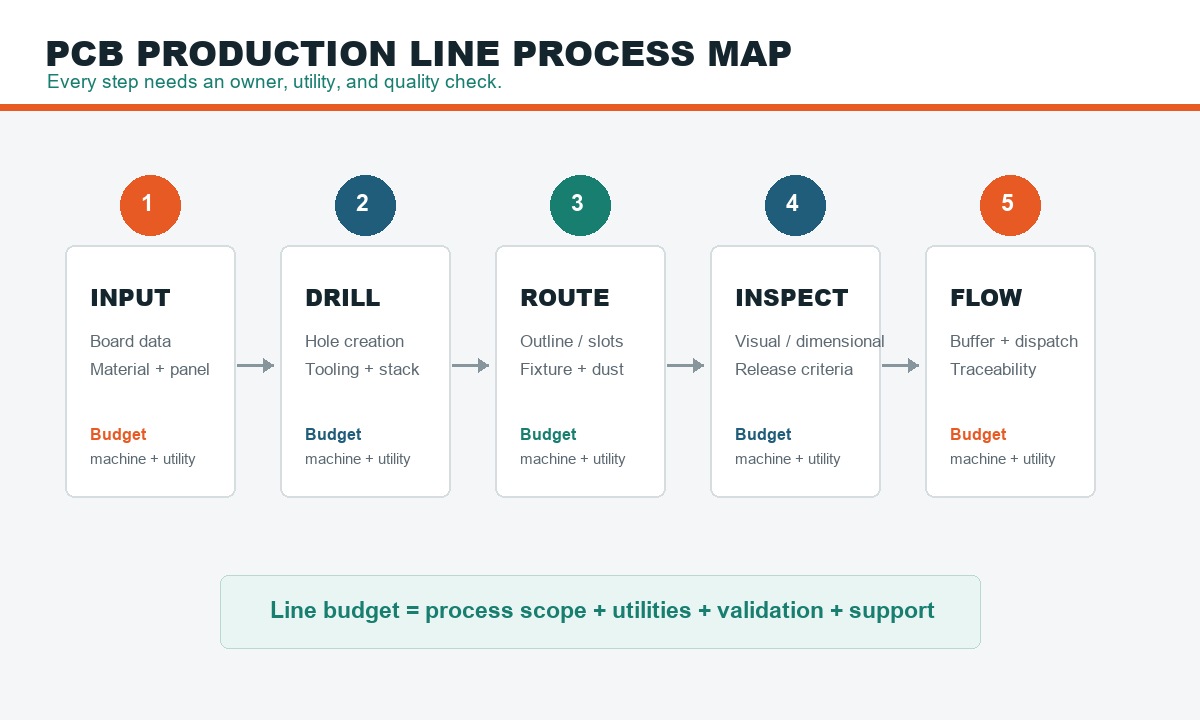
Use this table as a scoping tool, not as a promise that every process is supplied by one vendor. If a step is outsourced, record the supplier, lead time, transport, quality hand-off, and cost assumption. That makes the line budget easier to update when the factory changes its make-or-buy decision.
What makes individual PCB making machine cost difficult to compare?
A machine quotation can contain different levels of completeness. One proposal may include a fixture, starter tooling, software, training, and extraction; another may list only the base machine. One supplier may calculate cycle time from a loaded panel, while another reports cutting time without loading or inspection. These differences can make an apparently low pcb making machine cost look attractive while moving work into the buyer's own budget.
Request an itemized quotation with at least these fields:
- Base machine and included configuration.
- Standard options, custom options, and exclusions.
- Fixtures, holders, collets, starter tooling, and spare parts.
- Software, file formats, training, and documentation.
- Extraction, utilities, electrical requirements, and site preparation.
- Freight, installation, commissioning, sample validation, and acceptance support.
- Warranty period, response method, travel boundaries, and replacement-part responsibility.
When reviewing pcb equipment for sale, ask what is included in the displayed price and what must be confirmed for your factory. A catalog listing is useful for discovering product families, but it is not a production-ready budget until the board data and delivery scope are agreed.
How should total cost of ownership be calculated?
Total cost of ownership should use the same time period and output assumptions for every option. A simple model is:
TCO = capital cost + installation and validation + recurring operating cost + production-risk cost - residual value
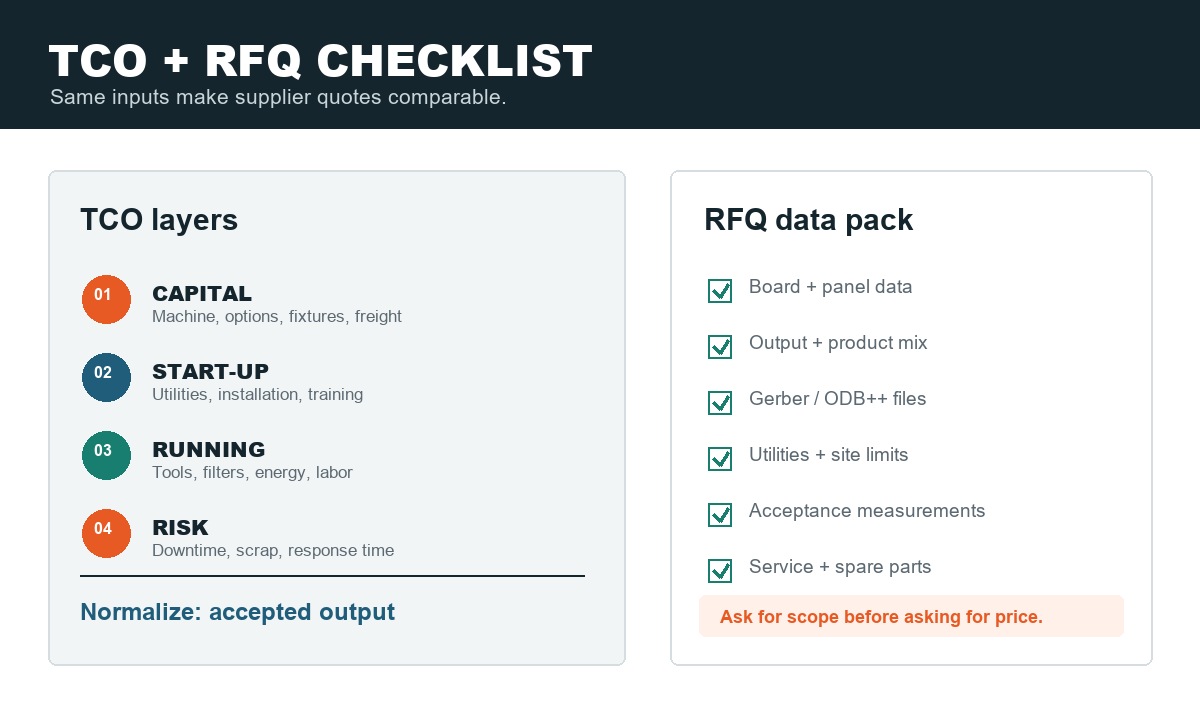
Capital cost may include the machine, options, fixtures, freight, and applicable import charges. Start-up cost can include utilities, installation, training, sample work, and initial consumables. Recurring cost includes tooling, filters, energy, compressed air, labor, maintenance, and calibration. Production-risk cost covers downtime, scrap, rework, slow changeover, and delayed service. The model should show which values are measured, estimated, or waiting for supplier confirmation.
| Cost layer | Questions for the buyer | Useful normalization |
|---|---|---|
| Capital | What assets and options are needed to run the approved process? | Cost per installed line |
| Start-up | What is required before the first accepted panel? | Cost per validated process |
| Recurring | What is consumed or maintained during the evaluation period? | Cost per accepted panel |
| Risk | What happens when a tool breaks, a machine stops, or quality is rejected? | Expected cost per production period |
Use accepted output rather than attempted output when comparing lines. If a machine produces more panels but also creates more rework, the denominator should reveal that difference. Treat the result as a decision model, not a guaranteed ROI statement, and update it after sample testing and commissioning.
What should the RFQ include before you ask for a line budget?
A supplier can make a useful recommendation only when the process inputs are concrete. Send a compact data pack rather than a request for a generic catalog price:
- Board material, construction, thickness, and any special surface or core information.
- Panel length, width, usable working area, outline, slots, holes, and minimum feature size.
- Expected product mix, batch size, shifts, target output, and changeover frequency.
- Gerber, ODB++, DXF, drill, routing, or other files available for engineering review.
- Required locating method, fiducials, fixture constraints, and inspection expectations.
- Factory voltage, frequency, compressed air, extraction, cooling, water, drainage, and site limits.
- Installation country, delivery terms, target production date, training needs, and service expectations.
- Preferred acceptance method, sample quantity, measurements, defect limits, and documentation.
For a first discussion, review Chikin's PCB manufacturing equipment category and the PCB drilling and routing machine range. If your line needs a different process mix, ask for a one-stop project review that connects equipment selection, technical documents, installation guidance, training, and after-sales support.
How can buyers avoid the most common budget mistakes?
Comparing a base machine with an installed cell
Use the same scope on every quote. Separate equipment, tooling, utilities, freight, installation, validation, and support. A price comparison is meaningful only after exclusions are visible.
Using theoretical capacity as the production plan
Ask how the supplier calculated cycle time. Include loading, unloading, tool changes, fixture changes, inspection, and expected utilization. Capacity should be tied to the actual product mix.
Leaving utilities until the machine arrives
Power, air, extraction, cooling, ventilation, drainage, and floor access can alter both cost and schedule. Put site requirements into the RFQ and layout review.
Ignoring service and spare parts
A line budget should state response channels, support hours, warranty boundaries, critical spares, and the buyer's responsibilities. This is especially important for overseas projects.
Choosing automation before measuring the bottleneck
Automation can be valuable when handling is the constraint. It can also add interfaces and maintenance. First measure the manual step, then compare the upgrade against the cost of the problem it solves.
Which factory type is the best fit for your budget?
Prototype: prioritize flexible fixtures, easy changeover, sample validation, and training. Outsource steps that are not yet economical to own, but document the hand-off cost and lead time.
Mid-volume: prioritize repeatable cycle time, registration, tool management, inspection, and balanced material flow. Compare single- and multi-spindle configurations with the real board mix.
Mass production: prioritize line balance, uptime, redundancy where justified, traceability, recovery procedures, and service readiness. Validate the complete route, not only the fastest individual machine.
Ready to build a project budget? Send your board material, panel dimensions, thickness, hole and routing data, target output, available files, factory utilities, and installation country. Chikin can review the process scope and recommend a suitable equipment path, quotation structure, and validation plan instead of returning an unexplained catalog number.
Frequently asked questions
Why is there no universal PCB manufacturing equipment cost?
Because a prototype cell, a mid-volume route, and a mass-production line have different process ownership, capacity, utilities, quality, and service requirements. The same machine can also be quoted with different options and delivery scope.
Is PCB production line cost mainly the price of the machines?
No. Utilities, fixtures, tooling, handling, installation, validation, training, spare parts, freight, and production risk can materially change the installed budget.
How can I compare PCB making machine cost from two suppliers?
Send both suppliers the same board files and output assumptions, request itemized inclusions and exclusions, agree on the same sample test, and normalize the result by accepted output over the same evaluation period.
Should I buy PCB equipment for sale online or request an RFQ?
Online listings help you discover equipment families. An RFQ is needed when the factory requires a defined configuration, utilities, acceptance test, installation scope, and service plan.
When does a multi-spindle drilling or routing platform make sense?
It may make sense when the product mix can use parallel positions and the planned output justifies the added capacity. Frequent changeovers or low utilization can reduce the benefit, so sample and cycle-time review are important.
What is the fastest way to get a useful line budget?
Send the process route, board and panel data, output target, files, utilities, installation location, and acceptance requirements in one pack. This gives the supplier enough context to separate required equipment from optional upgrades.