



Why PCB Equipment Quality Matters Before Purchase
Selecting suitable equipment is a critical decision for PCB manufacturers. Unlike standard products, PCB manufacturing equipment directly affects production efficiency, processing accuracy, product consistency, and long-term operating costs.
A machine with poor quality may cause:
- Unstable production performance
- Increased maintenance requirements
- Lower processing accuracy
- Higher operating costs
- Production delays
Therefore, manufacturers should evaluate PCB Equipment Quality carefully before purchasing.
A reliable PCB equipment supplier should provide not only machines but also stable performance, professional engineering support, and long-term service capability.
CHIKIN CNC provides PCB Manufacturing Equipment solutions designed for manufacturers requiring precision processing, stable operation, and efficient production.
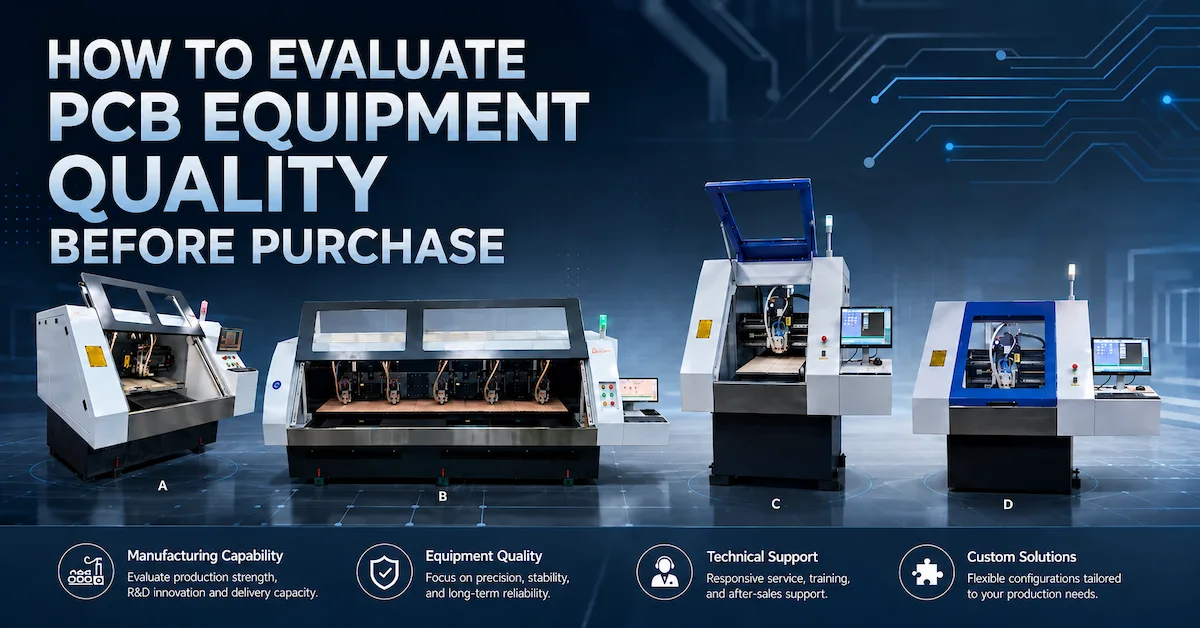
Key Factors to Evaluate PCB Equipment Quality
Processing Accuracy and Repeatability
Processing accuracy is one of the most important indicators of PCB equipment quality.
For PCB manufacturing applications, small errors can affect:
- PCB processing consistency
- Product quality
- Production efficiency
Manufacturers should evaluate:
- Positioning accuracy
- Processing repeatability
- Cutting or drilling precision
- Long-term accuracy stability
High-quality PCB equipment should maintain consistent performance during continuous production.
Machine Structure and Mechanical Stability
A stable machine structure directly affects equipment reliability.
When evaluating PCB equipment quality, buyers should consider:
- Machine frame design
- Mechanical rigidity
- Vibration control
- Component durability
A strong mechanical structure helps maintain processing accuracy and reduces performance fluctuations during long-term operation.
Core Components and Configuration
The quality of core components influences equipment lifespan and production stability.
Manufacturers should evaluate:
- Spindle performance
- Motion control systems
- Electrical components
- Transmission systems
Professional PCB equipment manufacturers usually select suitable components based on application requirements rather than focusing only on reducing initial costs.
Equipment Testing Before Delivery
Before shipment, reliable manufacturers should perform equipment inspections and testing.
Important quality control processes may include:
- Machine operation testing
- Processing accuracy verification
- Functional inspection
- Safety checks
Testing before delivery helps ensure that equipment can operate normally after installation.
Production Efficiency and Reliability
High-quality PCB equipment should provide stable performance during continuous production.
Manufacturers should consider:
- Processing speed
- Automation capability
- Operating stability
- Maintenance requirements
Reliable equipment helps factories improve productivity while reducing unexpected downtime.
How PCB Equipment Manufacturers Ensure Quality
A professional PCB Equipment Manufacturer should have a complete quality management process.
Engineering and Design Capability
Equipment quality starts from product design.
Experienced manufacturers usually have:
- Engineering development capability
- Application experience
- Machine optimization ability
This allows suppliers to develop equipment that matches different PCB production requirements.
Manufacturing and Assembly Process
A reliable factory should control:
- Component assembly
- Machine calibration
- Production procedures
- Final inspection
Strong manufacturing capability helps maintain consistent equipment quality.
Technical Support and After-Sales Service
Equipment quality is not only about the machine itself.
Long-term performance also depends on:
- Installation guidance
- Operator training
- Maintenance support
- Spare parts availability
A supplier with strong technical support helps manufacturers reduce operational risks.
Evaluating Different Types of PCB Equipment
Different PCB manufacturing processes require different equipment quality considerations.
PCB Cutting Equipment
For PCB cutting applications, manufacturers should evaluate:
- Cutting accuracy
- Blade stability
- PCB thickness compatibility
- Production efficiency
CHIKIN CNC provides PCB cutting solutions such as the Single Cutter PCB V Cut Machine and automatic PCB V cut machines for different production requirements.
PCB Drilling and Milling Equipment
For drilling and routing applications, buyers should focus on:
- Spindle performance
- Positioning accuracy
- Processing stability
- Production efficiency
The Dual Spindle PCB Drilling and Milling Machine provides accurate drilling and milling capability for PCB manufacturers requiring stable processing performance.
Precision Processing Equipment
For customized processing requirements, manufacturers may require flexible machining solutions.
The Mini 5-Axis Engraving and Milling Machine supports precision processing applications requiring multi-angle machining capability.
PCB Equipment Quality Checklist for Buyers
| Evaluation Factor | What Buyers Should Check |
|---|---|
| Accuracy | Processing precision and repeatability |
| Structure | Machine rigidity and stability |
| Components | Quality of core parts |
| Testing | Inspection before delivery |
| Support | Technical and after-sales service |
Common Mistakes When Purchasing PCB Equipment
Choosing Equipment Only Based on Price
The lowest price does not always provide the best long-term value.
Lower-cost equipment may result in:
- More maintenance
- Lower efficiency
- Higher operating costs
Ignoring Supplier Technical Capability
A supplier should understand PCB manufacturing requirements and provide suitable recommendations.
Technical capability is especially important during:
- Equipment selection
- Installation
- Production adjustment
Not Considering Future Production Needs
Manufacturers should consider future expansion before purchasing equipment.
Suitable equipment should support:
- Current production requirements
- Increased production capacity
- Different PCB applications
Frequently Asked Questions
How can I evaluate PCB equipment quality before purchase?
Manufacturers should evaluate processing accuracy, machine stability, component quality, testing procedures, and supplier technical capability.
Why is PCB equipment quality important?
High-quality PCB equipment helps maintain stable production, improve processing accuracy, reduce downtime, and lower long-term operating costs.
Should I choose equipment based only on price?
No. Equipment reliability, performance, supplier support, and maintenance requirements are also important factors.
How do PCB equipment manufacturers test machines before delivery?
Professional manufacturers usually perform operation tests, accuracy checks, functional inspections, and safety verification before shipment.
What should I check when selecting a PCB equipment manufacturer?
Buyers should evaluate factory capability, engineering experience, quality control procedures, technical support, and after-sales service.
Conclusion
Evaluating PCB Equipment Quality before purchase helps manufacturers reduce risks and select equipment that delivers reliable long-term performance.
Before investing in PCB manufacturing equipment, buyers should carefully consider:
- Processing accuracy
- Machine stability
- Component quality
- Testing procedures
- Supplier technical support
CHIKIN CNC provides reliable PCB Manufacturing Equipment solutions for manufacturers requiring precision, stability, and efficient production performance.
From PCB V Cut Machine for panel separation to PCB Drilling and Milling Equipment for precision processing, CHIKIN CNC helps manufacturers select suitable equipment solutions based on their production requirements.
Contact CHIKIN CNC to discuss your PCB equipment requirements and find the right solution for your manufacturing process.