



Why a PCB Drilling Machine RFQ Should Include More Than a Price Request
A PCB Drilling Machine RFQ should give the supplier enough technical information to determine whether the machine can actually process your boards at the required accuracy, capacity, and workflow.
Sending only:
“Please quote one PCB drilling machine.”
may produce a quotation, but it does not provide enough information for meaningful machine selection.
Two PCB drilling machines may look similar while differing significantly in:
- Working area
- Spindle configuration
- Drilling and routing capability
- CCD positioning
- Tool management
- Production capacity
- Fixture requirements
- Software workflow
- Dust extraction
- Automation level
For B2B buyers, the objective of an RFQ should therefore be:
Define the application clearly enough that suppliers quote comparable equipment.
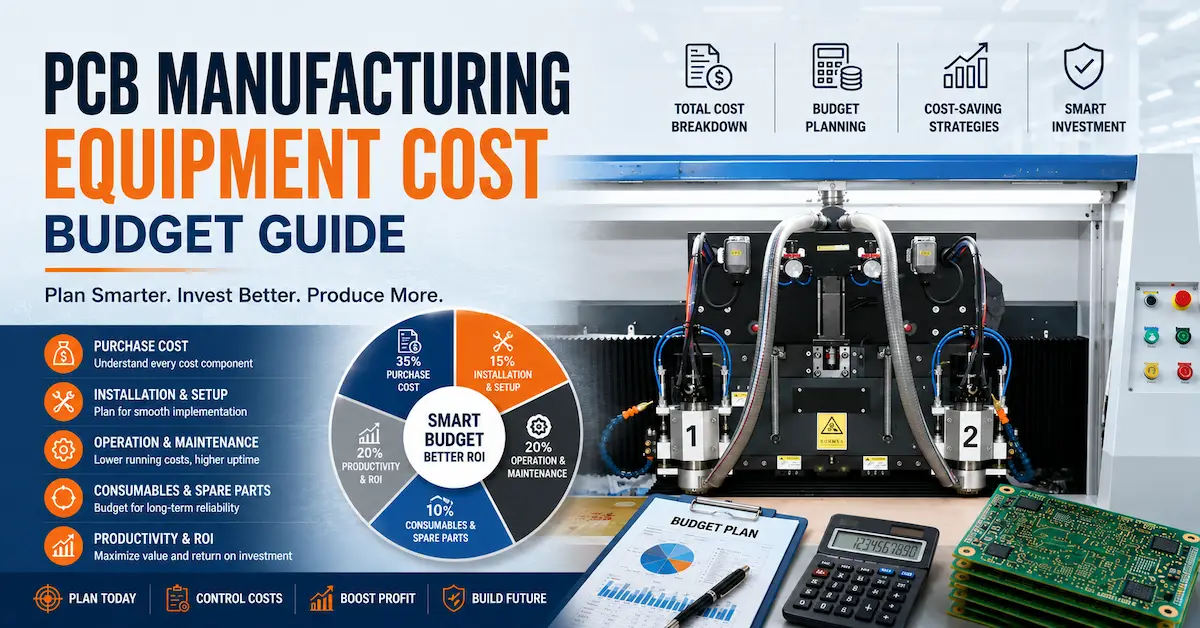
Before requesting a quotation, you can review CHIKIN CNC’s current PCB manufacturing equipment to identify the general machine configuration that fits your production process.
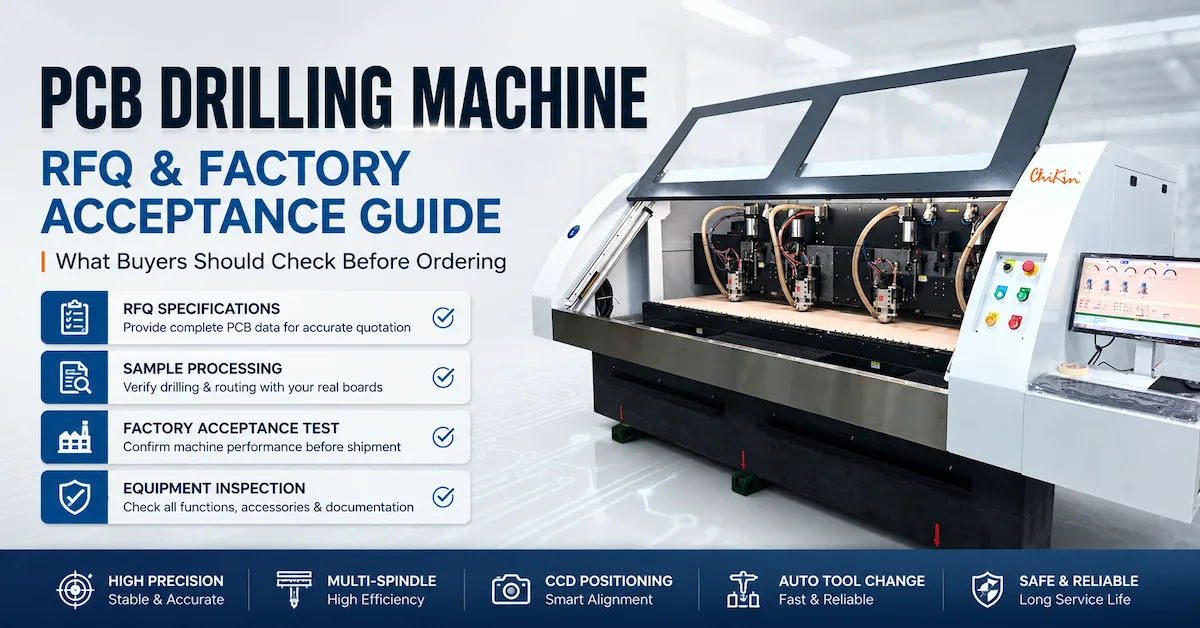
What Information Should a PCB Drilling Machine RFQ Include?
A useful RFQ should answer the supplier’s main engineering questions before quotation.
PCB and Panel Dimensions
Provide:
- Minimum PCB size
- Maximum PCB size
- Panel dimensions
- Usable machining area required
- Fixture or clamping requirements
The maximum board dimension should not be confused with the required machine working area. Fixtures, registration points, edge clearance, and loading space may require additional travel.
PCB Material
Specify the actual materials you intend to process.
Examples may include:
- FR-4
- Aluminum-based PCB
- Copper-clad laminate
- Composite PCB materials
- Other machinable board materials
Material affects tooling, spindle load, dust extraction, and processing parameters.
Board Thickness
Include:
- Minimum thickness
- Maximum thickness
- Most common production thickness
This helps the supplier evaluate fixture design and machining requirements.
Hole Requirements
A professional PCB Drilling Machine Supplier should understand the actual hole pattern before recommending a machine.
Provide:
- Minimum hole diameter
- Maximum hole diameter
- Typical hole diameter
- Number of holes per PCB
- Number of holes per panel
- Hole spacing
- Required registration accuracy
If several PCB products are involved, provide representative drawings or data from the most demanding product.
Drilling Only or Drilling and Routing?
This is one of the most important RFQ questions.
Tell the supplier whether your process requires:
- Drilling only
- Drilling + routing
- Outline routing
- Slot processing
- Engraving or additional machining
If drilling and routing are both common processes, a combined machine may reduce board transfer and repeated setup.
CHIKIN CNC, for example, provides a 1 Drilling Spindle + 1 Routing Spindle Machine with CCD for applications requiring integrated drilling, routing, and visual positioning.
Production Volume
Include realistic production requirements such as:
- Boards per day
- Panels per shift
- Working shifts per day
- Monthly production volume
- Target cycle time, if known
Production volume helps determine whether the application is better suited to:
- Single-spindle equipment
- Dual-function drilling/routing equipment
- Multi-spindle production equipment
For repeated higher-output requirements, buyers can also evaluate a 4 Spindle PCB Drilling and Routing Machine.
PCB Drilling Machine RFQ Checklist
| RFQ Information | What to Provide | Why It Matters |
|---|---|---|
| PCB size | Min/max board dimensions | Determines working area |
| Panel size | Actual production panel | Affects machine travel and fixture |
| Material | FR-4, aluminum PCB, etc. | Affects tooling and processing |
| Thickness | Min/max/common thickness | Affects setup |
| Hole range | Minimum and maximum diameter | Helps evaluate spindle/tooling |
| Hole quantity | Holes per board/panel | Influences cycle time |
| Routing | Yes / No | Determines machine configuration |
| CCD | Required / Not required | Affects positioning solution |
| Production volume | Daily/monthly output | Determines suitable spindle count |
| Accuracy | Required production tolerance | Defines acceptance criteria |
| Electrical supply | Factory voltage/frequency | Avoids installation problems |
| Destination | Country and delivery location | Supports logistics planning |
What Documents Should Buyers Send With the RFQ?
The more application-specific information the supplier receives, the more useful the quotation becomes.
Useful files may include:
- PCB drawing
- Panel drawing
- Sample photos
- Hole map
- Routing path
- CAD/CAM production data
- Existing machine specifications
- Current processing problems
If confidentiality is a concern, buyers can first provide a representative board or simplified drawing and release full production data after technical alignment.
How to Compare PCB Drilling Machine Quotations
Do not compare supplier quotations only by total machine price.
A lower quotation may exclude functions included by another supplier.
Compare the Machine Configuration Line by Line
Check:
- Number of spindles
- Spindle function
- Working area
- Motion system
- CCD system
- Control system
- Tool detection
- Fixture
- Dust extraction
- Software
- Accessories
- Spare parts
The term “dual spindle”, for example, should be clarified.
It may mean:
- Two drilling spindles
- One drilling + one routing spindle
- Independently controlled heads
- Simultaneous processing heads
These configurations do not provide the same production capability.
Compare What Is Included in the Price
Ask suppliers to identify whether the quotation includes:
- Machine
- Fixture
- Dust collector
- Tools
- Computer
- Software
- Training
- Installation
- Export packaging
- Spare parts
- Remote support
This prevents a low initial quotation from becoming more expensive after mandatory accessories are added.
What Technical Questions Should You Ask the Supplier?
A good RFQ should generate technical discussion, not only a price.
Ask About Positioning Accuracy and Repeatability
Request the supplier’s stated values and ask how they are verified.
Do not assume:
Positioning accuracy = repeatability.
For production buyers, both matter.
More importantly, ask whether the supplier can demonstrate acceptable results on your PCB sample.
Ask About Spindle Performance
Confirm:
- Spindle quantity
- Spindle type
- Rated speed
- Tool compatibility
- Drilling/routing function
- Replacement procedure
A high headline RPM alone does not prove higher real-world productivity.
Ask About Tool Management
For small PCB drilling tools, tool handling can significantly affect downtime.
Ask whether the system supports:
- Tool-length checking
- Tool-life management
- Broken-tool detection
- Automatic tool change
- Tool replacement alerts
Only request functions that matter to your production workflow.
Ask About CCD Alignment
If the machine has vision positioning, request a demonstration of:
- Fiducial recognition
- Registration procedure
- Alignment workflow
- Job changeover
CCD can be valuable for positioning-sensitive production, but buyers should verify how it works in the actual machine configuration rather than assuming all vision systems provide the same functionality.
Why Sample Processing Should Come Before the Final Order
One of the strongest ways to reduce procurement risk is to test your actual board.
A supplier brochure shows machine capability in general.
A sample test shows whether the proposed configuration fits your application.
What Should You Send for a Sample Test?
Ideally provide:
- Actual PCB or representative material
- PCB drawing/data
- Hole requirements
- Routing requirements
- Required finished result
- Critical dimensions
What Should the Supplier Return?
Depending on the project, request:
- Processed sample
- Photos or video
- Processing parameters
- Cycle time
- Inspection results
- Comments on tooling or fixture requirements
Do not define acceptance solely from a video.
The finished PCB should be compared with the agreed technical requirements.
What Is a PCB Machine Acceptance Test?
A PCB Machine Acceptance Test is the process of verifying that the ordered machine matches the agreed configuration and performance requirements before final acceptance.
For overseas equipment procurement, buyers often conduct some form of factory acceptance before shipment.
The exact FAT scope should be defined in the purchase contract or technical agreement.
PCB Drilling Machine FAT Checklist
Machine Identity and Configuration
Confirm:
- Model
- Serial number
- Spindle quantity
- Spindle configuration
- Working area
- CCD configuration
- Accessories
The physical machine should match the approved quotation and technical specification.
Visual and Assembly Inspection
Check:
- Cabinet condition
- Wiring organization
- Fasteners
- Covers and guards
- Pneumatic connections
- Cable routing
- Control components
The goal is to identify obvious assembly or transport-risk issues before packing.
Machine Startup
Verify:
- Power-on sequence
- Control initialization
- Emergency stop
- Alarm functions
- Axis movement
Axis Motion Test
Check that each axis:
- Moves smoothly
- Returns correctly
- Does not generate abnormal noise
- Operates across the required travel range
Spindle Test
Run each spindle and verify:
- Startup
- Speed control
- Abnormal vibration
- Abnormal noise
- Tool holding
If multiple spindles are included, test each one rather than checking only the first.
PCB Drilling Test
A useful FAT should process a representative board.
Verify:
- Hole positioning
- Hole consistency
- Pattern alignment
- Repeatability
Acceptance thresholds should come from the buyer’s approved specification or sample requirements rather than generic assumptions.
Routing Test
If routing is included, test:
- Route path
- Board outline
- Corners
- Edge quality
- Toolpath execution
CCD Alignment Test
For machines equipped with CCD, verify:
- Fiducial recognition
- Coordinate correction
- Registration stability
- Repeat job setup
Continuous Running Test
A short demonstration cannot fully represent production conditions.
For important projects, define an agreed continuous operating test appropriate to the actual application.
The goal is to identify:
- Unexpected alarms
- Excessive heating
- Position drift
- Software issues
- Mechanical instability
before shipment.
PCB Drilling Equipment Inspection Checklist
| Inspection Item | What Buyer Should Verify |
|---|---|
| Machine model | Matches PO and approved quotation |
| Working area | Matches required travel |
| Spindles | Correct quantity and function |
| CCD | Installed and functional if ordered |
| Axis movement | Smooth and stable |
| Emergency stop | Functional |
| Drilling sample | Meets agreed requirements |
| Routing sample | Meets requirements if applicable |
| Tool management | Functions included in order |
| Software | Correct version/workflow |
| Accessories | Complete |
| Spare parts | Match agreed list |
| Documentation | Manuals and technical files |
| Packaging | Suitable for export shipment |
How Should Buyers Define Acceptance Criteria?
This is where many equipment purchases become unnecessarily risky.
Do not write:
“Machine quality must be good.”
Instead, define measurable acceptance requirements.
Depending on the application, criteria may include:
- Required board size
- Required hole pattern
- Positioning requirement
- Repeatability requirement
- Accepted sample result
- Routing requirement
- Processing cycle target
- Required software functions
The exact values should be based on your production requirements and the supplier’s confirmed machine specification.
Use the Approved Sample as a Reference
Where practical, buyers can approve a pre-order sample and define it as a reference for FAT.
This provides both parties with a more concrete acceptance benchmark.
Factory Acceptance Test vs Final Site Acceptance
These two stages should not be confused.
Factory Acceptance Test
Conducted before shipment.
Main purpose:
- Verify configuration
- Verify machine functions
- Run sample processing
- Identify issues while the machine remains at the supplier factory
Site Acceptance
Conducted after installation at the buyer’s factory.
Main purpose:
- Confirm transport did not cause damage
- Verify power and utilities
- Reconfirm machine functions
- Train operators
- Start production setup
For international projects, clearly defining responsibility for both stages reduces disputes.
What Spare Parts Should Be Confirmed Before Shipment?
Ask the supplier which parts are:
- Consumable
- Wear items
- Recommended stock
- Long-lead replacement components
For PCB drilling equipment, relevant items depend on the actual configuration.
Ask for a recommended spare-parts list covering the expected operating period rather than purchasing arbitrary parts.
What Should Be Included in the Technical Documentation?
Before shipment, confirm the documentation package.
Depending on the machine, this may include:
- User manual
- Electrical documentation
- Maintenance instructions
- Spare-parts list
- Software instructions
- Machine parameter backup
- Troubleshooting guidance
For customized equipment, document the final configuration rather than relying only on a standard manual.
Questions to Ask About After-Sales Support
A machine can pass FAT and still create problems later if technical support is unclear.
Before ordering, ask:
- Who provides technical support?
- What communication channels are available?
- Is remote troubleshooting available?
- What is the warranty scope?
- Which parts are covered?
- How are spare parts shipped?
- Is installation support available?
- Is operator training included?
These questions should be resolved before payment, not after a machine problem occurs.
PCB Drilling Machine RFQ Template
Buyers can use the following structure when contacting a supplier:
Application
- PCB type:
- PCB material:
- PCB thickness:
- Maximum PCB/panel size:
Hole Requirements
- Minimum hole diameter:
- Maximum hole diameter:
- Typical hole count:
- Required positioning/quality:
Processing
- Drilling required: Yes / No
- Routing required: Yes / No
- CCD required: Yes / No
- Special process requirements:
Production
- Boards/panels per day:
- Shifts per day:
- Target cycle time:
- Expected future capacity:
Factory Information
- Country:
- Voltage:
- Frequency:
- Available utilities:
Commercial Requirements
- Required delivery date:
- Installation requirement:
- Training requirement:
- Spare-parts requirement:
Adding drawings and sample-board information will make the quotation significantly more useful.
Which CHIKIN CNC PCB Drilling Machine Configuration Should You Request?
The correct configuration depends on your actual production process.
Prototype and Flexible Production
For compact and lower-volume PCB processing, buyers can evaluate the Mini 1 Spindle PCB Routing and Drilling Machine.
This direction is more suitable when flexibility is more important than maximum throughput.
Drilling + Routing + CCD Alignment
For processes requiring integrated drilling and routing plus visual alignment, consider the 1 Drilling Spindle + 1 Routing Spindle Machine with CCD.
Before ordering, send your PCB and alignment requirements so the CCD workflow can be evaluated against the actual application.
Higher-Throughput Production
For more repeatable production requiring greater processing capacity, buyers can evaluate the 4 Spindle PCB Drilling and Routing Machine.
The correct choice should still be based on whether your panel design and production volume can effectively utilize the additional spindles.
Frequently Asked Questions
What information should I include in a PCB Drilling Machine RFQ?
Include PCB size, material, thickness, hole requirements, routing requirements, production volume, accuracy requirements, CCD needs, electrical supply, and destination.
Should I send PCB samples before ordering?
For industrial PCB equipment purchases, sample testing is strongly recommended when practical because it helps verify real application compatibility.
What should be checked during a PCB Machine Acceptance Test?
Verify machine configuration, axis motion, spindle operation, safety functions, software, sample drilling, routing if required, CCD alignment, accessories, and documentation.
Who should define the machine acceptance standard?
Acceptance criteria should be agreed between buyer and supplier before the order and should reflect the actual production requirement and confirmed machine specification.
Is FAT necessary before international shipment?
For higher-value or customized equipment, FAT can significantly reduce procurement risk because problems can be identified while the machine is still at the supplier’s factory.
What is the difference between FAT and site acceptance?
FAT is performed before shipment at the supplier factory. Site acceptance is completed after installation at the buyer’s facility.
Should I compare PCB drilling machine quotations only by price?
No. Compare configuration, spindle system, working area, automation, software, accessories, testing, service, spare parts, and total cost of ownership.
What should I ask a PCB Drilling Machine Supplier before payment?
Confirm the final configuration, FAT scope, delivery schedule, warranty, installation support, training, spare parts, technical documentation, and after-sales process.
Conclusion
A well-prepared PCB Drilling Machine RFQ does more than obtain a price—it helps buyers receive a technically appropriate proposal and creates a clear basis for comparing suppliers.
Before placing an order, define:
- PCB specifications
- Hole and routing requirements
- Production volume
- Machine configuration
- Sample-processing expectations
- FAT procedure
- Acceptance criteria
- Spare-parts requirements
- After-sales responsibilities
Then verify those requirements through a structured PCB Machine Acceptance Test before shipment.
CHIKIN CNC provides PCB drilling and routing equipment for prototype, mixed-process, and higher-throughput production requirements. Browse the complete PCB equipment range, or contact CHIKIN CNC with your PCB drawings, panel dimensions, hole requirements, expected output, and routing needs.
The more complete your RFQ is, the more accurately the engineering team can recommend a machine configuration—and the easier it becomes for your purchasing team to compare quotations on a true like-for-like basis.