



An FR4 PCB Drilling machine is used to drill accurate holes in FR4 printed circuit boards, which are among the most widely used circuit board materials in electronics manufacturing. FR4 boards are strong, electrically insulating, and suitable for many standard PCB applications, but they also create specific drilling challenges.
FR4 is made from woven glass fiber and epoxy resin. During drilling, the machine must cut through glass fiber reinforcement, resin material, and copper layers while keeping hole position, hole wall quality, and board stability under control. If the machine is unstable, buyers may face hole deviation, rough hole walls, burrs, delamination, broken drill bits, and inconsistent production quality.
For PCB manufacturers, electronics factories, prototype labs, and equipment buyers, choosing the right FR4 PCB Drilling machine is not only about drilling speed. It is about stable accuracy, suitable spindle speed, proper tooling, board fixation, dust control, software usability, and reliable after-sales support.
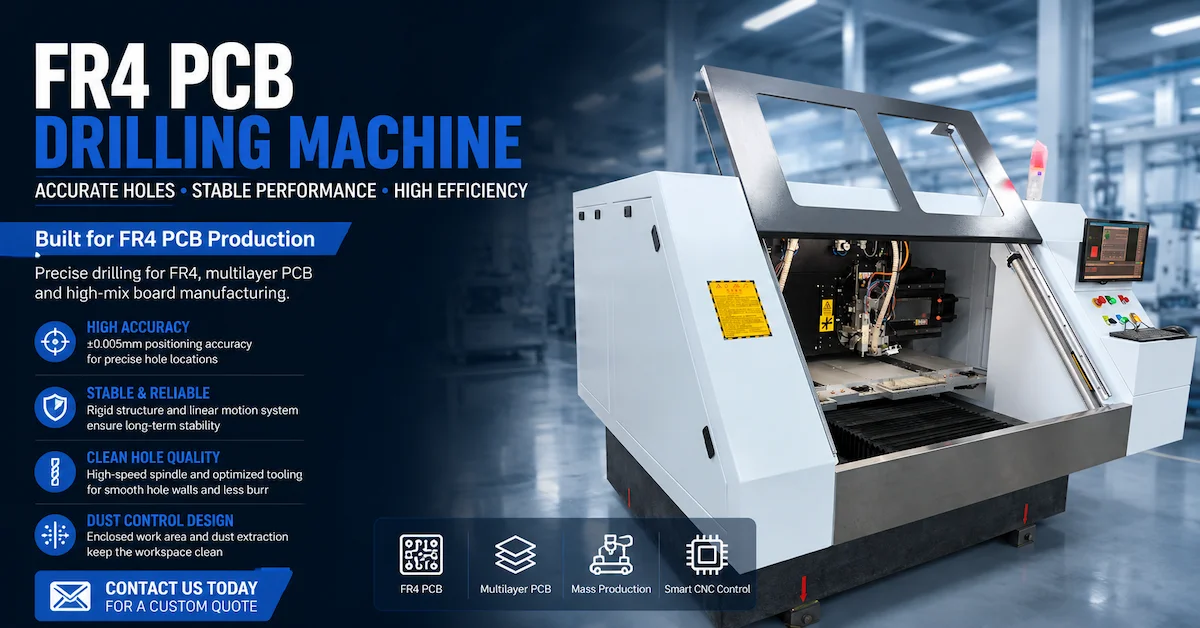
What Is an FR4 PCB Drilling Machine?
An FR4 PCB Drilling machine is CNC-controlled equipment designed to drill holes in FR4 circuit boards. These holes may be used for vias, through-hole components, tooling holes, mounting holes, alignment holes, or later routing and assembly processes.
Compared with general drilling equipment, FR4 PCB drilling equipment needs higher accuracy and better process control because circuit boards are thinner, more layered, and more sensitive to hole-position errors.
This type of machine may also be called:
- FR4 PCB drilling equipment
- PCB CNC drilling machine
- FR4 circuit board drilling machine
- PCB hole drilling machine
- CNC PCB drilling and routing machine
- High-speed PCB drilling machine
The purpose is simple: make clean, accurate, repeatable holes in FR4 boards while reducing scrap and tool-related downtime.
Why FR4 Boards Are Difficult to Drill
FR4 is a practical and widely used PCB material, but it is not soft or simple to process. The glass fiber inside the material can wear tools faster than some other substrates. The epoxy resin can also create heat and dust during drilling if process parameters are not controlled properly.
Common FR4 drilling challenges include:
- Faster micro-drill wear
- Possible burrs around hole edges
- Rough hole wall quality
- Drill bit breakage
- Resin smear or heat-related defects
- Hole position deviation
- Board vibration during drilling
- Dust and debris inside the working area
A good FR4 PCB Drilling machine should reduce these risks through stable spindle control, rigid machine structure, suitable tool path control, reliable clamping, and proper machine maintenance.
Who Needs an FR4 PCB Drilling Machine?
An FR4 PCB Drilling machine is suitable for buyers who process standard circuit boards, prototype boards, multilayer boards, and high-mix electronic products.
| Buyer Type | Main Need | Why FR4 Drilling Equipment Helps |
|---|---|---|
| PCB manufacturers | Stable FR4 board drilling | Improves hole accuracy and repeatability |
| Prototype PCB labs | Flexible sample processing | Supports small-batch board production |
| Electronics factories | In-house board preparation | Reduces outsourcing delays |
| Multilayer PCB producers | Accurate hole registration | Helps protect downstream plating and assembly |
| PCB equipment distributors | Sell practical PCB solutions | FR4 is a common buyer application |
| R&D teams | Test board fabrication | Supports controlled board development |
If your factory processes mainly FR4 boards, the machine should be selected around FR4 thickness, hole diameter, production volume, and accuracy requirements.
Main Applications of an FR4 PCB Drilling Machine
An FR4 PCB Drilling machine can be used for many circuit board production tasks.
Typical applications include:
- FR4 through-hole drilling
- Via hole preparation
- Tooling hole drilling
- Component mounting holes
- Prototype FR4 PCB production
- Multilayer FR4 board drilling
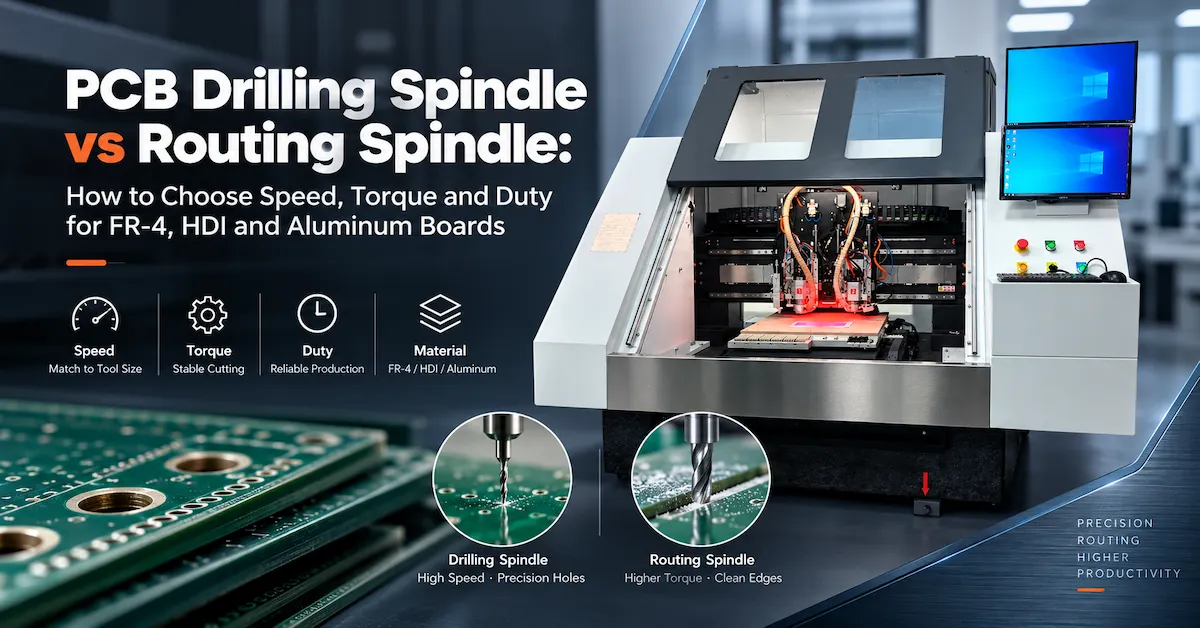
- FR4 PCB drilling and routing
- Small-batch board processing
- Electronics sample development
- Production line capacity upgrade
For factories that also need board outline processing, a PCB drilling and routing machine may be more efficient than a drilling-only solution.
Key Factors When Choosing an FR4 PCB Drilling Machine
1. Spindle Speed and Stability
The spindle is the core of any PCB drilling system. For FR4 boards, stable high-speed spindle performance helps improve hole quality and reduce tool stress.
Buyers should check:
- Spindle speed
- Spindle cooling method
- Tool holding stability
- Drill bit compatibility
- Spindle runout
- Maintenance requirements
A spindle that is fast but unstable can still create poor hole quality. Stability matters as much as speed.
2. Machine Rigidity and Vibration Control
FR4 drilling requires stable machine movement. If the base or gantry vibrates, the hole position may shift and drill bits may wear faster.
Important machine structure points include:
- High-rigidity base
- Stable worktable
- Precision linear guides
- Reliable ballscrews or motion system
- Good vibration damping
- Enclosed processing area
- Easy maintenance access
For repeat production, machine rigidity is one of the main reasons that professional CNC drilling equipment performs better than simple manual drilling methods.
3. Hole Accuracy and Repeatability
Hole position accuracy is critical for FR4 PCB manufacturing. Poor hole alignment can affect copper plating, component placement, testing, and assembly.
Before buying, ask:
- What positioning accuracy can the machine achieve?
- What repeatability is tested before delivery?
- Can the supplier provide sample drilling?
- Does the machine support alignment correction?
- What board thickness and hole size are suitable?
For high-value boards, sample testing is strongly recommended before final machine confirmation.
4. Tool Management and Broken Tool Detection
FR4 can wear small drill bits quickly, especially when the board contains dense hole patterns. Tool management affects both quality and downtime.
Useful features include:
- Automatic tool change
- Tool length detection
- Tool diameter detection
- Broken tool detection
- Tool magazine support
- Easy tool replacement
Broken drill bits can create hidden defects and damage boards. Detection functions help reduce this risk during production.
5. Board Fixing and Flatness Control
Even a good machine cannot drill accurately if the FR4 board moves during processing. Board fixation is important for both hole quality and repeatability.
Buyers should check:
- Fixture method
- Vacuum or clamp support
- Worktable flatness
- Board size compatibility
- Support for custom fixtures
- Handling of thin or warped panels
Stable clamping helps prevent vibration, hole offset, and inconsistent results.
6. Dust and Debris Control
FR4 drilling produces dust and debris because of the glass fiber and resin structure. Good dust control helps protect the machine, operators, tools, and board quality.
Buyers should ask:
- Does the machine support dust extraction?
- Is the working area enclosed?
- Is cleaning easy?
- How is debris removed from the drilling area?
- What maintenance is required?
Dust management is especially important for factories that need cleaner production environments.
FR4 PCB Drilling Machine vs General PCB Drilling Machine
| Comparison Point | General PCB Drilling Machine | FR4 PCB Drilling Machine Focus |
| Main Application | Mixed PCB materials | FR4 board processing |
| Tool Requirement | Depends on material | Must handle glass fiber wear |
| Main Risk | Hole deviation and tool wear | Burrs, rough holes, broken bits, dust |
| Buyer Focus | General drilling capability | FR4 stability, hole quality, repeatability |
| Best For | Broad PCB processing | Standard FR4 circuit board production |
| Recommended Features | CNC control, spindle stability | Tool detection, dust control, rigid structure |
The right machine for FR4 should not only drill holes. It should manage FR4-specific challenges such as tool wear, dust, board fixation, and repeatability.
Product Match: CHIKIN CNC PCB Drilling and Routing Equipment
For this article, the most suitable product direction is:
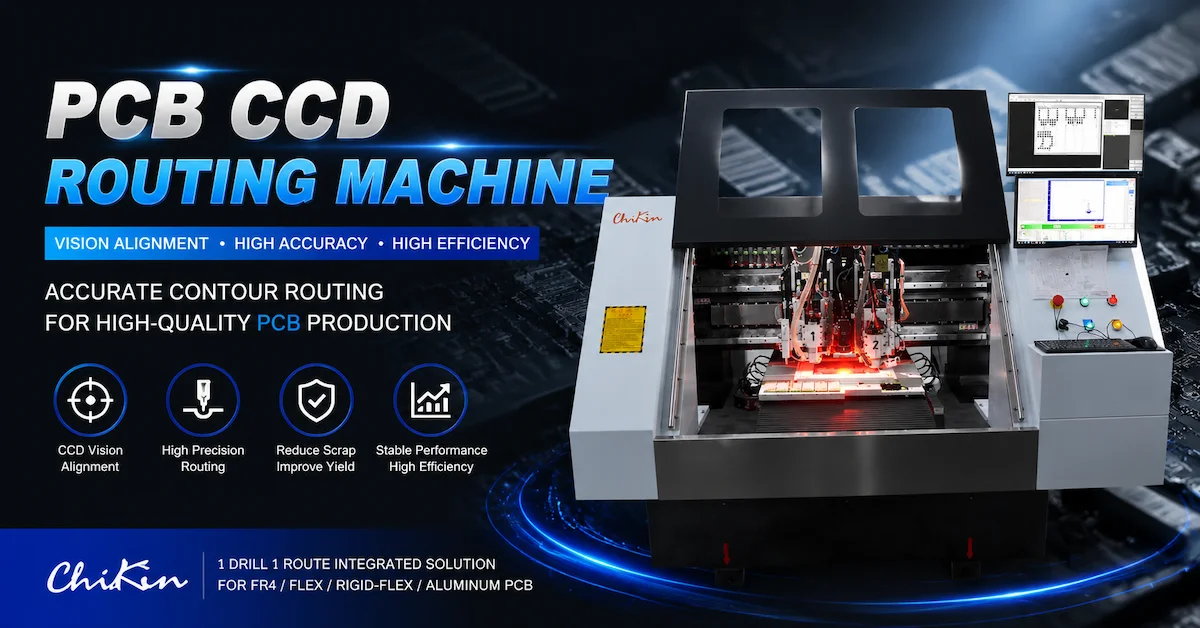
2 Spindle PCB Drilling and Routing Machine
This product direction fits FR4 PCB drilling because it is designed for PCB drilling and routing workflows and is suitable for FR4 board production. It is also a strong option for buyers who need both hole processing and contour routing in one production setup.
Recommended product anchor text:
2 Spindle PCB Drilling and Routing Machine
Recommended product link:
https://www.chikincnc.com/product/2-spindle-pcb-drilling-and-routing-machine
If the buyer needs CCD alignment or drilling plus routing in one clamping, the related product can also be:
1 Drill 1 Route PCB Machine with CCD
Recommended product link:
For general browsing, use:
https://www.chikincnc.com/products
Specification Checklist for FR4 PCB Drilling Machine Buyers
| Item | What to Confirm | Why It Matters |
| Board Material | FR4 grade and thickness | Determines drilling parameters |
| Board Size | Maximum panel size | Ensures machine compatibility |
| Hole Diameter | Minimum and common hole sizes | Affects tool and spindle selection |
| Spindle Speed | High-speed stability | Controls hole quality and tool life |
| Machine Rigidity | Base and frame stability | Reduces vibration and deviation |
| Fixture Method | Clamp, vacuum, or custom fixture | Keeps board stable |
| Tool Detection | Length, diameter, broken tool detection | Reduces scrap risk |
| Dust Control | Enclosure and extraction | Supports clean production |
| Software | Program storage and file handling | Improves repeat jobs |
| Service Support | Training, spare parts, remote help | Reduces downtime |
Common Buying Mistakes to Avoid
Mistake 1: Choosing Only by Price
A low-cost machine may not provide stable spindle performance, reliable tool detection, or enough rigidity for consistent FR4 drilling. This can increase scrap and tool cost.
Mistake 2: Ignoring Drill Bit Wear
FR4 contains glass fiber, so tool wear matters. Buyers should ask about tool compatibility, tool replacement, and broken tool detection.
Mistake 3: Not Checking Dust Management
FR4 drilling creates dust. Without proper enclosure and extraction planning, the machine may require more frequent cleaning and maintenance.
Mistake 4: Buying a Drilling-Only Machine When Routing Is Needed
Many PCB factories also need board outline routing. If routing is part of your workflow, consider a PCB drilling and routing machine instead of separate equipment.
Mistake 5: Skipping Sample Testing
If your board has strict hole quality requirements, sample drilling is one of the safest ways to confirm machine suitability before ordering.
Buyer Checklist Before Requesting a Quote
Before requesting an FR4 PCB Drilling machine quotation, prepare these details:
| Information | Example |
| Board material | FR4 |
| Board thickness | 0.8mm, 1.6mm, 2.0mm |
| Board size | Length × width |
| Minimum hole diameter | 0.2mm, 0.3mm, 0.5mm |
| Hole quantity per board | Dense or standard hole layout |
| Production volume | Prototype, small batch, mid-volume |
| Accuracy requirement | Hole position tolerance |
| Routing requirement | Yes or no |
| Current issue | Broken bits, burrs, slow drilling, hole deviation |
| Automation need | Tool change, tool detection, CCD alignment |
The more complete your information is, the easier it is for CHIKIN CNC to recommend a suitable machine configuration.
FAQ: FR4 PCB Drilling Machine
1. What is an FR4 PCB Drilling machine?
An FR4 PCB Drilling machine is CNC equipment used to drill accurate holes in FR4 printed circuit boards for vias, through-holes, mounting holes, and tooling holes.
2. Why is FR4 difficult to drill?
FR4 contains glass fiber and epoxy resin. The glass fiber can wear tools, while resin and dust may affect hole quality if drilling parameters are not controlled.
3. What affects FR4 hole quality?
Hole quality depends on spindle stability, drill bit condition, feed speed, machine rigidity, board clamping, dust control, and software parameters.
4. Can the same machine drill and route FR4 boards?
Yes. A PCB drilling and routing machine can support both hole drilling and contour routing, depending on configuration.
5. Is broken tool detection important for FR4 drilling?
Yes. FR4 can increase tool wear, and broken drill bits may create hidden defects. Broken tool detection helps reduce scrap risk.
6. What machine is suitable for FR4 small-batch production?
For small-batch work, a single-spindle or 1 drill 1 route machine may be suitable. For higher output, a dual-spindle machine may be better.
7. Should I use CCD alignment for FR4 PCB drilling?
CCD alignment is useful when hole-to-pattern registration is important, especially for high-mix, prototype, multilayer, or accuracy-sensitive boards.
8. What should I send before asking for a quote?
Send board thickness, board size, minimum hole diameter, hole quantity, production volume, accuracy requirement, and whether routing is also needed.
Conclusion: Choose an FR4 PCB Drilling Machine Based on Accuracy, Tool Life, and Production Stability
An FR4 PCB Drilling machine should be selected based on the real requirements of FR4 board production: hole accuracy, spindle stability, tool wear control, board fixation, dust management, and production volume.
For buyers who need only basic hole drilling, a single-spindle system may be enough. For factories that need higher output or both drilling and routing, a dual-spindle PCB drilling and routing machine is often a stronger choice. If alignment accuracy is critical, CCD vision support should also be considered.
CHIKIN CNC provides PCB drilling and routing equipment for FR4, multilayer, rigid-flex, and aluminum board applications. If you are comparing FR4 PCB drilling equipment, send your board size, thickness, hole diameter, production volume, accuracy requirement, and routing needs.
Contact CHIKIN CNC to request an FR4 PCB drilling machine recommendation and quotation: