



A reliable FPC laser cutting machine must do more than follow a programmed cutting path. For flexible printed circuit manufacturers, it must control substrate movement, maintain accurate registration, produce acceptable edges, and support repeatable production without excessive scrap.
Flexible circuits often contain polyimide films, copper conductors, adhesives, and protective layers. These materials can deform under mechanical cutting forces and respond differently to laser energy.
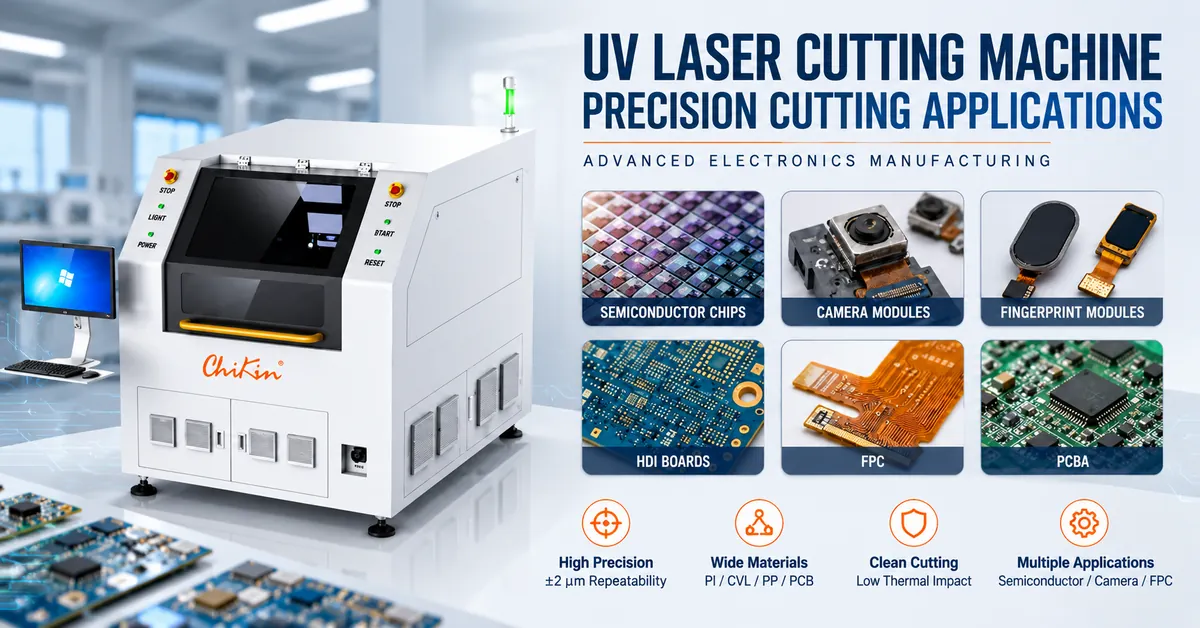
The CHIKIN CNC CK-L5252 is a 35W, 532nm green laser processing machine featuring a 520 × 520mm effective working area, linear motor motion, CCD-assisted positioning, and vacuum workpiece fixation. It is designed for precision processing applications where stable motion, controlled cutting, and flexible production programs are important.
However, machine positioning accuracy alone does not guarantee finished-part tolerance. Buyers should validate their actual material stack, cutting geometry, edge quality, and production cycle time before approving equipment.
This guide explains how to evaluate the CK-L5252, understand its published specifications, compare alternative laser configurations, and prepare a technically complete purchasing inquiry.
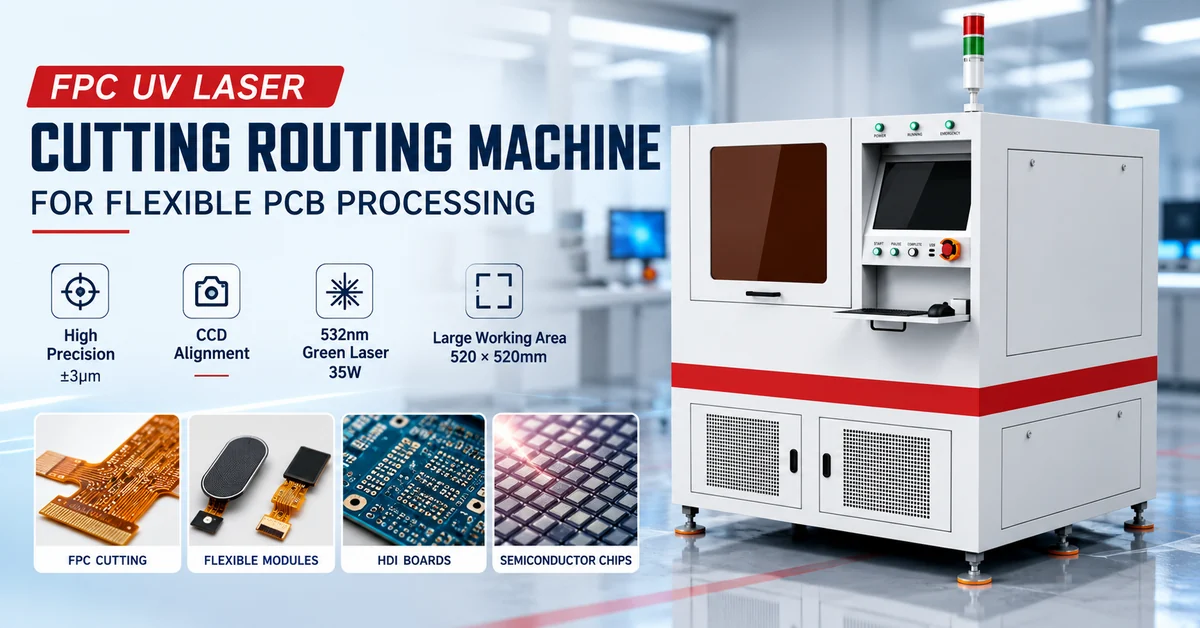
1. What Is a 532nm FPC Laser Cutting Machine?
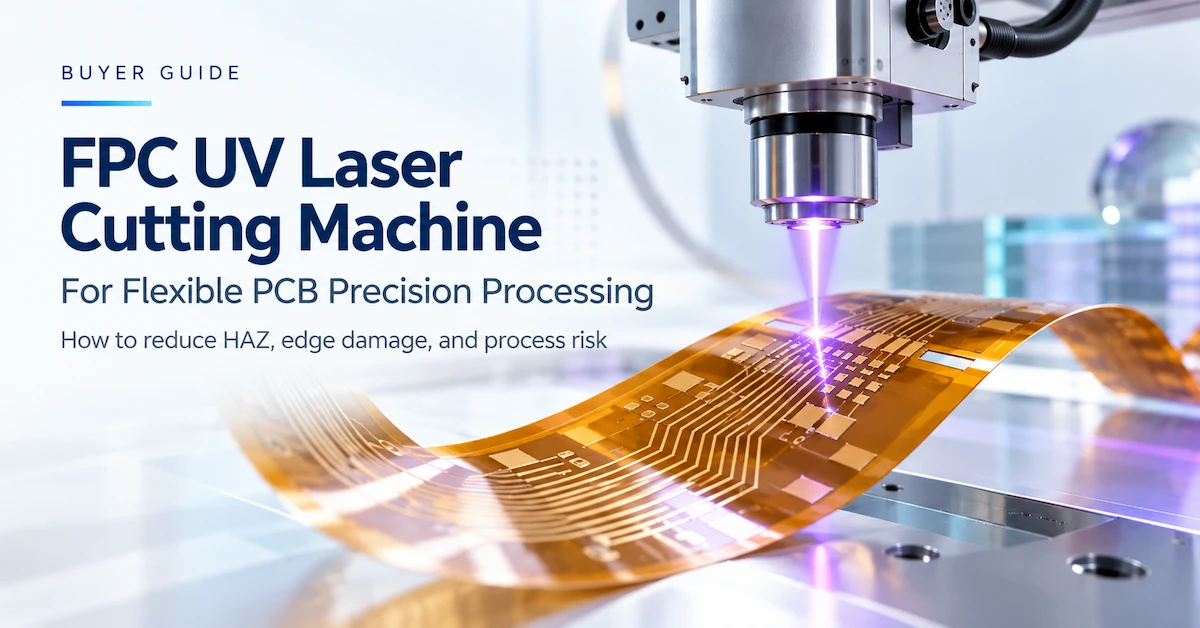
An FPC laser cutting machine uses focused laser energy to process flexible printed circuit materials along programmed paths.
Unlike mechanical routing or punching, laser cutting does not require a physical cutting edge to contact the workpiece. This reduces direct mechanical loading on thin films and flexible circuits.
Typical applications include:
-
Flexible PCB outline cutting and panel separation.
-
Precision contour trimming of thin substrates.
-
Cutting openings in suitable films and circuit structures.
-
Prototype processing for new FPC designs.
-
Small-batch electronic component production.
-
Selected fine-feature processing and marking tasks, subject to machine configuration.
The CK-L5252 uses a 532nm green laser, which belongs to the visible spectrum.
Although some product-category descriptions use the term UV laser cutting, 532nm green light and 355nm ultraviolet light are technically different.
This distinction matters because wavelength influences material absorption and processing behavior. The correct laser must be selected according to actual substrate properties and finished-part requirements.
2. Which Manufacturers Should Consider the CK-L5252?
The CK-L5252 is worth evaluating when production requires programmable cutting of relatively thin, sensitive, or geometrically complex workpieces.
| Target Buyer | Typical Application | Primary Requirement |
|---|---|---|
| FPC manufacturers | Flexible circuit outlines and openings | Dimensional consistency and edge quality |
| Flexible electronics suppliers | Thin electronic substrate processing | Low mechanical loading |
| Camera module suppliers | Flexible interconnect components | Fine contours and accurate registration |
| Fingerprint sensor suppliers | Flexible circuit components | Controlled cutting and repeatability |
| PCB prototyping workshops | Changing FPC designs | Fast program adjustment |
| Precision electronics manufacturers | Small sheets and intricate structures | Fixture stability and clean processing |
| Equipment integrators | Laser cutting production cells | Interface and installation compatibility |
The machine may be particularly relevant for high-mix manufacturing, where product dimensions and cutting paths change frequently.
When Is This Machine Not the Best Choice?
Buyers should consider alternative equipment when processing thick metal plates, large rigid boards outside the machine's effective working area, or materials that cannot meet quality requirements using the specified laser.
Factories requiring extremely high-volume production of a fixed, simple shape may also compare laser cutting with dedicated punching or mechanical tooling.
For these applications, review the wider CHIKIN CNC laser cutting equipment range before selecting a configuration.
3. CK-L5252 FPC Laser Cutting Machine Specifications
The CK-L5252 combines a green laser source, precision motion components, an optical scanning system, CCD imaging, and vacuum workpiece holding.
The following information is taken from the supplied machine specification sheet.
CK-L5252 Technical Specification Table
| Parameter | Published Specification |
|---|---|
| Machine model | CK-L5252 |
| Laser type | Green laser |
| Laser power | 35W |
| Laser wavelength | 532nm |
| Galvanometer scanning range | 50 × 50mm |
| Focusing system | F-Theta |
| Focus spot diameter | 35μm |
| Controller | PC-based CNC AC servo |
| Drive system | Linear motor, linear scale, precision guide rail |
| X/Y positioning accuracy | ±3μm |
| X/Y repeatability | ±1.5μm |
| Positioning test resolution | 0.5μm |
| Published moving speed | Less than 500mm/s |
| Table dimensions | 525 × 520mm |
| Effective working area | 520 × 520mm |
| Vision system | Paraxial CCD |
| Workpiece fixation | Vacuum adsorption table |
| Exhaust system | Air-exhaust purification system |
| Software | JS Mark |
| Supported file format | DXF |
| Operating interface | Chinese / English |
| Operating temperature | 20–24°C |
| Power requirement | AC220V, single-phase, 10kVA with stabilizer |
| Machine power | Rated 3kW; maximum 5kW |
| Dimensions | 1590 × 1750 × 2050mm |
| Machine weight | Approximately 1600kg |
These are manufacturer-published machine specifications. Finished-part accuracy, cutting speed, material compatibility, and production yield must be verified through application-specific testing.
What Do These Specifications Mean for Buyers?
The 35W green laser identifies the published optical output configuration, but power alone does not determine cutting speed or material compatibility.
The 520 × 520mm effective working area defines the nominal usable processing area, which should be checked against the customer's panel dimensions and fixture requirements.
The linear motor system supports precise programmed positioning, while the CCD system provides a basis for alignment-related operations.
Actual processing quality still depends on the laser parameters, material structure, workholding, calibration, and cutting program.
4. 532nm Green Laser vs 355nm UV Laser: Which Is Better for FPC Cutting?
Both green and ultraviolet lasers are used in precision industrial processing, but their application performance is not interchangeable.
A 532nm laser operates in the visible green spectrum, while a 355nm laser operates in the ultraviolet spectrum. Their interaction with copper, polyimide, adhesives, and coatings can differ significantly.
Green Laser vs UV Laser Comparison
| Evaluation Factor | 532nm Green Laser | 355nm UV Laser |
|---|---|---|
| Wavelength region | Visible green | Ultraviolet |
| Photon energy | Lower than 355nm | Higher than 532nm |
| Material interaction | Depends on absorption and optical properties | Depends on absorption and optical properties |
| Fine-feature capability | Depends on beam delivery and process | Depends on beam delivery and process |
| Copper processing | Requires stack-specific testing | Requires stack-specific testing |
| Polyimide processing | Requires parameter qualification | Requires parameter qualification |
| Thermal influence | Depends on pulse duration, fluence and overlap | Depends on pulse duration, fluence and overlap |
| Appropriate selection basis | Actual sample quality and throughput | Actual sample quality and throughput |
Can a 532nm Green Laser Cut Flexible PCBs?
It can be considered for suitable FPC applications, provided the laser energy interacts effectively with the specific material construction.
A flexible board may include copper, polyimide, adhesives, solder mask, and protective layers. These materials do not necessarily respond equally to the same wavelength.
Buyers should therefore test the complete stack rather than assuming that all flexible printed circuits will produce identical results.
Is a 355nm UV Laser Always More Precise?
No.
Shorter wavelength alone does not establish better finished-part accuracy.
Motion control, laser pulse characteristics, beam quality, focus stability, workholding, and alignment all influence the final result.
For applications requiring a UV picosecond source, CHIKIN also lists an FPC UV Laser Cutting Routing Machine for precise flexible circuit processing.
The appropriate choice should be based on actual sample-cutting performance, not wavelength alone.
5. How Do Linear Motors and CCD Alignment Improve Process Control?
Precision laser equipment depends on accurate positioning and stable workpiece registration.
The CK-L5252 lists linear motors, linear scales, precision guide rails, and a paraxial CCD module.
Linear Motor Motion
Linear motors provide controlled axis movement without the same mechanical transmission arrangement used by traditional rotary motor and screw-driven systems.
Combined with position feedback, they can support precise and repeatable programmed motion.
However, motion accuracy is affected by machine calibration, temperature, installation conditions, and process setup.
CCD-Assisted Alignment
CCD imaging can support identification of suitable visual references and help align cutting data to the actual workpiece.
For FPC production, this is especially valuable when thin panels shift slightly during loading or contain registration features that must be located before cutting.
Buyers should confirm which alignment functions are provided by the quoted machine.
The supplied specification identifies a paraxial CCD module but does not state a separate numerical CCD alignment tolerance.
Vacuum Workholding
The vacuum adsorption table is intended to keep the workpiece positioned during processing.
Good vacuum support can help reduce movement and maintain consistent presentation of thin films to the laser beam.
For flexible materials, the fixture should be evaluated for flatness, vacuum distribution, leakage, and the risk of marking delicate surfaces.
6. Does ±1.5μm Repeatability Mean ±1.5μm Cutting Accuracy?
No. Machine repeatability and finished-part cutting accuracy are different measurements.
The CK-L5252 lists:
-
X/Y positioning accuracy: ±3μm.
-
X/Y repeatability: ±1.5μm.
-
Positioning test resolution: 0.5μm.
-
Focus spot diameter: 35μm.
Each number describes a different aspect of system performance.
| Specification | What It Indicates | What It Does Not Guarantee |
|---|---|---|
| ±3μm positioning accuracy | Published axis positioning performance | Final contour tolerance |
| ±1.5μm repeatability | Consistency of repeated positioning | Finished-part accuracy |
| 0.5μm test resolution | Resolution associated with position testing | Ability to cut 0.5μm features |
| 35μm focused spot | Published laser focus size | Finished kerf width or feature tolerance |
The finished cut depends on kerf formation, laser energy distribution, workpiece movement, thermal effects, and compensation within the cutting program.
For production acceptance, request actual measurements of finished FPC components.
The correct purchasing question is not simply "How accurate is the machine?" but "Can the machine repeatedly cut my specified geometry within the agreed tolerance?"
7. Which Materials and Applications Should Be Tested?
The product information identifies flexible PCB processing, precision contour cutting, panel separation, and thin sheet-based electronic applications.
However, the supplied CK-L5252 specification does not establish a universal maximum cutting thickness or a complete material qualification list.
The following are relevant testing candidates rather than guaranteed applications.
Material and Application Evaluation Matrix
| Material / Structure | Potential Application | Main Quality Concern |
|---|---|---|
| Polyimide film | Fine contour cutting | Discoloration and edge condition |
| Flexible copper-clad laminate | FPC outline processing | Copper integrity and delamination |
| Coverlay film | Openings and contour trimming | Adhesive damage and residue |
| Thin flexible PCB | Circuit separation | Positional accuracy and deformation |
| Rigid-flex PCB | Selected thin flexible sections | Damage at material transitions |
| Protective electronic films | Precision sheet processing | Melting, debris and consistency |
| Populated PCBA | Selected separation tasks | Component clearance and thermal exposure |
Why Does Material Stack-Up Matter?
A cutting program developed for a single polyimide film may not perform identically on a complete FPC containing copper and adhesive layers.
Differences in optical absorption, thickness, heat transfer, and mechanical properties affect the process.
To qualify the CK-L5252, provide the full material stack, copper thickness, protective coatings, and required cutting geometry.
If the application involves HDI boards or assembled electronics, confirm suitability through application-specific samples. Their presence in a general application category does not establish that the machine can process every construction.
8. How Does the CK-L5252 Cutting Workflow Operate?
A typical FPC laser cutting workflow combines digital cutting data, workpiece positioning, laser processing, and finished-part inspection.
Step 1: Prepare the Cutting Drawing
The CK-L5252 specification identifies DXF as a supported file format.
Before purchase, verify that the software can correctly import the required geometry, interpret units, and handle closed contours, internal openings, and cutting sequences.
Step 2: Position the Workpiece
Place the panel on the vacuum adsorption table and confirm adequate support.
Thin materials should remain sufficiently flat without excessive stretching or local deformation.
Step 3: Perform Alignment
Use the available CCD positioning functions according to the approved operating procedure.
Verify that the required reference marks are detectable under the actual lighting and surface conditions.
Step 4: Execute Laser Processing
The laser follows the programmed path using the galvanometer and motion platform.
The CK-L5252 lists a 50 × 50mm galvanometer scanning range and a larger 520 × 520mm effective working area.
For patterns extending across multiple scanning fields, request evidence of accurate alignment between processing regions.
Step 5: Inspect and Record Results
After processing, inspect dimensions, edge condition, thermal effects, and electrical features where applicable.
Record the cutting program, material batch, fixture setup, and relevant process parameters for traceability.
9. CK-L5252 vs CK-PP30-6060-DA: Which Machine Should You Evaluate?
CHIKIN CNC's product information includes different laser configurations for flexible electronic processing.
These systems should be compared based on actual capabilities rather than assuming that higher laser power or better published motion repeatability guarantees superior cutting quality.
Machine Configuration Comparison
| Feature | CK-L5252 | CK-PP30-6060-DA |
|---|---|---|
| Laser wavelength | 532nm green | 355nm UV |
| Published laser power | 35W | 30W |
| Laser pulse description | Not specified in supplied sheet | Picosecond, less than 15ps |
| Effective / max processing area | 520 × 520mm | 550 × 550mm |
| Published X/Y positioning accuracy | ±3μm | ±8μm |
| Published X/Y repeatability | ±1.5μm | ±2μm |
| Vision configuration | Paraxial CCD | Single CCD |
| Workpiece fixation | Vacuum adsorption | Vacuum adsorption |
| Main evaluation requirement | Green-laser sample qualification | UV picosecond sample qualification |
The two machines have different wavelength characteristics and published configurations.
Their numerical positioning specifications should not be used to predict a direct difference in finished-part accuracy.
A meaningful comparison requires the same representative material, drawing, inspection requirements, and production targets.
Which Machine Is More Suitable for High-Mix Production?
Either may be suitable for particular high-mix applications when the corresponding processing capability is verified.
Buyers should compare program-change time, fixture requirements, material compatibility, inspection results, and actual accepted production output.
A qualified sample-cutting comparison is more useful than selecting a machine solely from the catalog.
10. How Should FPC Cutting Quality Be Inspected?
Quality control is one of the most important purchasing considerations for an FPC laser cutting machine.
Thin flexible circuits may be sensitive to mechanical deformation, thermal effects, and damage near copper conductors.
Recommended Cutting Quality Checklist
| Quality Parameter | Inspection Requirement |
|---|---|
| Outline dimensions | Measure critical finished-part geometry |
| Cut-edge condition | Check for roughness, charring and irregularities |
| Heat-affected zone | Evaluate discoloration and thermal alteration |
| Copper integrity | Inspect conductors near the cutting path |
| Delamination | Check for separation between material layers |
| Adhesive residue | Inspect processed edges and openings |
| Registration | Measure cut position relative to reference features |
| Repeatability | Compare results across multiple panels |
| Electrical performance | Test continuity and insulation where relevant |
For flexible and rigid-flex printed boards, IPC-6013E, Qualification and Performance Specification for Flexible/Rigid-Flexible Printed Boards, provides an industry reference for relevant board-quality requirements.
Manufacturers should also follow applicable customer drawings and contractual acceptance criteria.
Citing an IPC standard does not mean that a particular laser cutting machine is independently certified to that standard.
How Can Buyers Reduce Production Scrap?
Start by identifying the defect that causes rejection.
If parts fail dimensional inspection, investigate positioning, program compensation, and substrate stability.
If thermal damage is the problem, evaluate laser parameters and material interaction.
If results vary across the working area, examine calibration, focus consistency, registration, and fixture conditions.
A documented inspection plan helps distinguish equipment limitations from process-setup problems.
11. How Fast Can the CK-L5252 Cut Flexible PCBs?
The published CK-L5252 specification lists a maximum moving speed below 500mm/s.
This figure should not be interpreted as a guaranteed cutting speed.
Actual laser cutting throughput depends on the material, thickness, geometry, laser parameters, number of passes, and handling operations.
A realistic cycle-time evaluation should include:
Total Cycle Time = Loading + Alignment + Laser Processing + Unloading + In-Cycle Inspection
The accepted production output is then influenced by the proportion of finished parts meeting the quality requirements.
For example, a process with a fast laser path but frequent alignment adjustments may produce less accepted output than a slower, more stable process.
Buyers should request a production trial using their own panel layout.
Where possible, repeat the trial under representative production conditions rather than relying on a demonstration involving an unusually simple shape.
12. What Should Buyers Verify During Factory Acceptance Testing?
A Factory Acceptance Test (FAT) helps establish whether the supplied equipment meets the agreed functional and processing requirements before shipment.
For the CK-L5252, the FAT should cover both machine operation and finished-sample quality.
CK-L5252 Factory Acceptance Checklist
| FAT Item | Recommended Verification |
|---|---|
| Laser source | Confirm 532nm wavelength and specified configuration |
| Motion accuracy | Review appropriate calibration and test records |
| CCD functions | Demonstrate registration using actual reference marks |
| Effective working area | Verify usable processing across 520 × 520mm |
| DXF compatibility | Import and process the buyer's actual drawing |
| Vacuum fixture | Demonstrate stable holding of production material |
| Cutting quality | Measure geometry, HAZ, copper condition and edges |
| Multi-field consistency | Check processing across relevant scanning regions |
| Production cycle | Record actual complete cycle time |
| Exhaust system | Demonstrate extraction and maintenance arrangements |
| Safety systems | Verify guards, interlocks and emergency stops |
| Documentation | Review electrical, operation and maintenance documents |
Why Laser Safety Verification Matters
The product uses an enclosed industrial cabinet, but enclosure appearance alone does not establish a laser safety classification.
Buyers should request the appropriate classification and safety documentation in accordance with applicable requirements, including IEC 60825-1, Safety of Laser Products — Equipment Classification and Requirements.
Confirm that viewing windows, interlocks, access panels, and operating procedures are suitable for the delivered laser configuration.
13. Installation Requirements, Maintenance, and Long-Term Costs
The CK-L5252 is a floor-standing industrial system, so installation requirements should be reviewed before ordering.
Factory Installation Requirements
| Item | Published Requirement |
|---|---|
| Electrical supply | AC220V, single-phase |
| Supply capacity | 10kVA with stabilizer |
| Rated machine power | 3kW |
| Maximum machine power | 5kW |
| Operating temperature | 20–24°C |
| Machine size | 1590 × 1750 × 2050mm |
| Equipment weight | Approximately 1600kg |
| User interface | Chinese / English |
Buyers should confirm the exact electrical arrangement, protective grounding, facility cooling requirements, ventilation, and floor-loading capacity.
The 10kVA electrical supply requirement and 3–5kW power figures describe different electrical quantities and should not be treated as directly interchangeable.
The equipment's full site preparation requirements should be confirmed before delivery.
What Determines Total Ownership Cost?
Initial machine price is only one part of the investment.
Other potential expenses include installation, operator training, electricity, extraction filters, optical component maintenance, fixtures, spare parts, and unplanned downtime.
For production calculations, evaluate:
Equipment Cost per Accepted Part = Allocated Equipment Operating Cost ÷ Accepted Parts Produced
Actual cost estimates require factory-specific production data.
When requesting a quote, ask whether the offered price includes software, accessories, fixtures, extraction equipment, training, commissioning, and the agreed warranty scope.
14. Customization and RFQ Guidance for Overseas FPC Manufacturers
Different electronics factories have different material stacks, panel sizes, and production requirements.
Before considering additional automation or special fixtures, buyers should first establish that the standard machine configuration can meet the required cutting quality.
Potential engineering discussions may include vacuum fixture design, CCD alignment requirements, production handling, exhaust integration, and software compatibility.
These should be treated as options requiring technical and commercial confirmation.
FPC Laser Cutting Machine RFQ Checklist
| Required Information | Details to Provide |
|---|---|
| Material | Polyimide, copper-clad laminate, coverlay or other |
| Stack structure | Layer materials and thicknesses |
| Panel size | Overall width, length and usable processing area |
| Cutting drawing | DXF file and critical dimensions |
| Quality requirement | Tolerance, edge condition, HAZ and electrical integrity |
| Production volume | Target panels or accepted parts per hour |
| Production type | Prototype, high-mix or high-volume |
| Existing process | Mechanical routing, punching, laser or manual cutting |
| Main problem | Scrap, deformation, burrs, slow setup or unstable quality |
| Factory conditions | Electricity, temperature, ventilation and floor space |
| Acceptance requirements | Sample measurements and proposed FAT criteria |
| Commercial information | Delivery destination, service requirements and quotation scope |
Request an Application-Based Quotation from CHIKIN CNC
CHIKIN CNC supplies PCB manufacturing and precision processing equipment, including laser cutting, drilling, and routing systems.
The CK-L5252 is worth evaluating for factories requiring programmable processing of suitable flexible electronic substrates.
For a more useful technical discussion, provide your material construction, drawing files, target processing quality, and production volume.
Review the FPC Laser Cutting Routing Machine product page for the equipment overview.
Contact CHIKIN CNC to Request a Technical Evaluation and Quotation
A complete application brief allows the proposed equipment configuration to be evaluated against actual production requirements rather than generic catalog descriptions.
15. Frequently Asked Questions About the CK-L5252 FPC Laser Cutting Machine
1. Is the CK-L5252 a UV laser cutting machine?
Its supplied specification identifies a 532nm green laser. This is visible green light, not ultraviolet light. Buyers should use the wavelength in the technical specification rather than relying solely on a product-category name.
2. What is the laser power of the CK-L5252?
The published specification lists a 35W green laser source. This does not establish a universal cutting speed because the result depends on material properties, laser parameters, and cutting geometry.
3. What is the effective working area?
The CK-L5252 lists a 520 × 520mm effective working area and a 525 × 520mm table size. Fixture clearance and usable processing limits should be confirmed before purchase.
4. Can the CK-L5252 cut polyimide flexible circuits?
It is positioned for flexible circuit processing. The buyer should verify the actual polyimide construction, copper layers, adhesives, thickness, and required cut quality through sample testing.
5. What is the machine's positioning accuracy?
The published X/Y positioning accuracy is ±3μm, with repeatability of ±1.5μm. These values do not automatically represent finished-part cutting tolerances.
6. Does the CK-L5252 support CCD alignment?
Yes. The specification lists a paraxial CCD module. The exact supported alignment functions and achievable registration results should be verified using the buyer's fiducial design.
7. Can the machine process DXF drawings?
DXF is listed as a supported file format. Buyers should test their actual files, including contour geometry, dimensions, and required processing sequences.
8. Is green laser cutting better than mechanical routing for FPC?
Green laser cutting eliminates direct cutting-tool contact and may be advantageous for suitable delicate structures. However, mechanical routing may be more economical for other materials and geometries. Sample quality and total production cost should determine the choice.
9. How can I estimate the CK-L5252 production capacity?
Use actual panel drawings and material samples to measure loading, alignment, cutting, unloading, and inspection time. Do not use the published maximum axis movement speed as the guaranteed cutting speed.
10. What information should I provide when requesting a quotation?
Provide the full FPC material stack, panel size, DXF drawings, finished-part tolerance, edge-quality requirements, expected production volume, and factory conditions. Include any required sample-cutting and FAT acceptance criteria.
Conclusion
Selecting the right FPC laser cutting machine requires a complete evaluation of the laser source, material compatibility, machine accuracy, fixture stability, and production requirements.
The CHIKIN CNC CK-L5252 combines a published 35W, 532nm green laser configuration with a 520 × 520mm effective working area, linear motor motion, CCD-assisted positioning, and vacuum workpiece fixation.
These specifications make it a relevant candidate for precision flexible circuit processing and other qualified thin electronic substrate applications.
However, equipment selection should not rely solely on nominal laser power, positioning repeatability, or maximum movement speed.
The most reliable purchasing approach is to test representative material samples, verify finished-part quality, measure realistic production cycle time, and establish clear factory acceptance requirements.
For overseas FPC manufacturers, these steps help reduce procurement uncertainty and create a stronger basis for equipment investment decisions.
Explore CHIKIN CNC's laser processing equipment and learn more about the company's manufacturing and service capabilities.
Contact CHIKIN CNC for an Application-Specific FPC Laser Cutting Machine Quotation and share your material samples, panel drawings, quality requirements, and target production output.
The goal is not simply to purchase a laser cutting machine, but to identify a processing solution that can be validated for your actual flexible PCB manufacturing requirements.