



Choosing the right fiber laser marking machine is an important investment decision for manufacturers that require durable identification, consistent product traceability, and reliable marking quality.
For automotive component suppliers, CNC machining workshops, electronics manufacturers, and industrial equipment producers, laser marking provides a programmable method for applying serial numbers, part IDs, batch codes, logos, and suitable machine-readable symbols.
However, purchasing the highest-powered machine does not automatically produce better marks or lower operating costs.
The best fiber laser marking machine is the configuration that meets your material, marking-quality, cycle-time, and safety requirements at an acceptable total cost. A 20W system may be sufficient for certain surface-identification tasks, while higher-power configurations may be worth evaluating when greater material removal or shorter qualified processing cycles are required.
This guide compares 20W, 30W, 50W, and 100W laser marking configurations, examines CHIKIN CNC's industrial marking workstation, and explains how buyers can verify machine performance before purchasing.
1. What Is a Fiber Laser Marking Machine?
A fiber laser marking machine uses laser energy delivered through a fiber-based optical system to create identification marks on suitable workpiece surfaces.
Depending on the laser source, material, and processing parameters, marking can involve surface coloration, localized oxidation, coating removal, engraving, or other controlled surface modifications.
Unlike traditional mechanical engraving, a laser marking process does not require a conventional cutting tool to contact the workpiece.
Typical industrial applications include:
-
Serial numbers on machined metal components.
-
Product identification and batch tracking.
-
Automotive and mechanical part codes.
-
Industrial equipment nameplates.
-
Logos and technical information.
-
Direct Part Marking (DPM) applications.
-
Identification of suitable electronic component housings.
Why Do Industrial Manufacturers Use Fiber Laser Marking?
The main advantages of a qualified laser marking process include programmable content, limited reliance on inks and labels, and compatibility with automated identification workflows.
Because identification information can be generated electronically, the process can also support production traceability when integrated with appropriate software and verification procedures.
However, permanent identification is not guaranteed under every surface condition. Mark durability must be verified against the actual handling, cleaning, corrosion, and service environment.
2. Who Should Buy a Fiber Laser Marking Machine?
Fiber laser marking equipment is particularly relevant to industrial buyers that require repeatable identification across different components or production batches.
| Buyer Segment | Typical Application | Main Purchasing Priority |
|---|---|---|
| CNC machining factories | Serial numbers on metal parts | Marking accuracy and consistency |
| Automotive parts suppliers | Component identification and traceability | Readability and process control |
| Electronics manufacturers | Metal housings and selected components | Controlled marking and surface protection |
| Machinery manufacturers | Nameplates and equipment identification | Durability and mark quality |
| Hardware manufacturers | Batch codes, logos and product IDs | Production efficiency |
| Tool manufacturers | Tool identification and inventory tracking | Marking flexibility |
| Industrial system integrators | Traceability production cells | Software and fixture compatibility |
| Quality-control departments | Inspection and serialized identification | Code verification and data accuracy |
For high-mix production, the ability to change marking programs and fixture arrangements may be particularly important.
For high-volume production, buyers should prioritize qualified cycle time, stable workpiece positioning, and integration with their identification records.
3. CHIKIN CNC Fiber Laser Marking Machine: Product Overview
CHIKIN CNC offers industrial laser marking equipment for part identification and traceability-related applications.
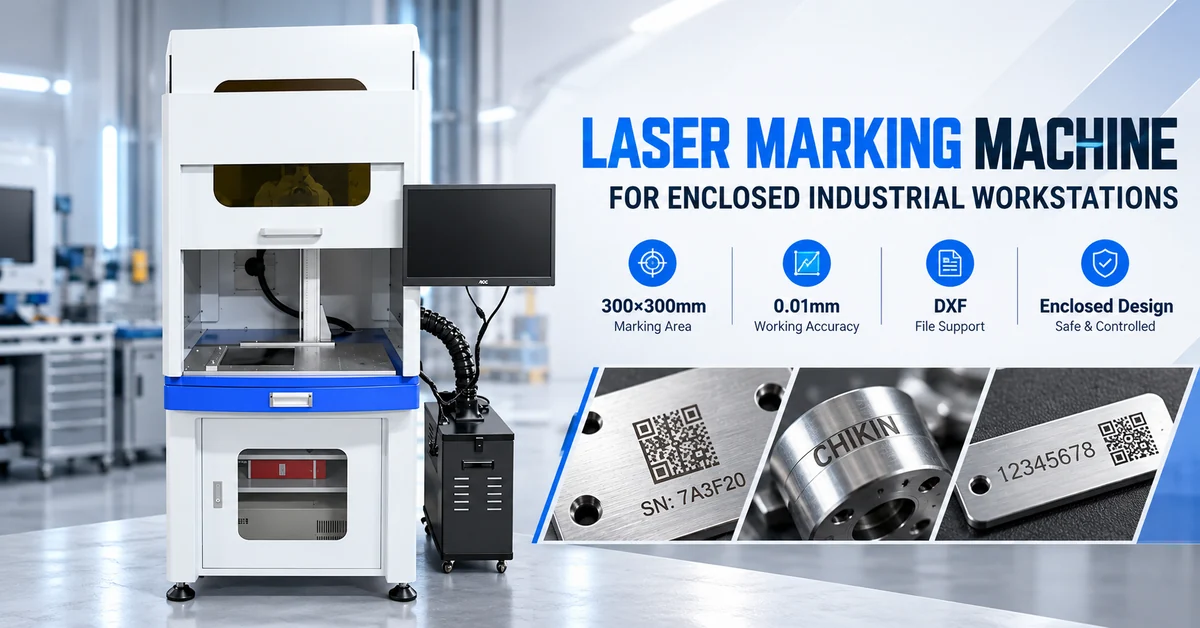
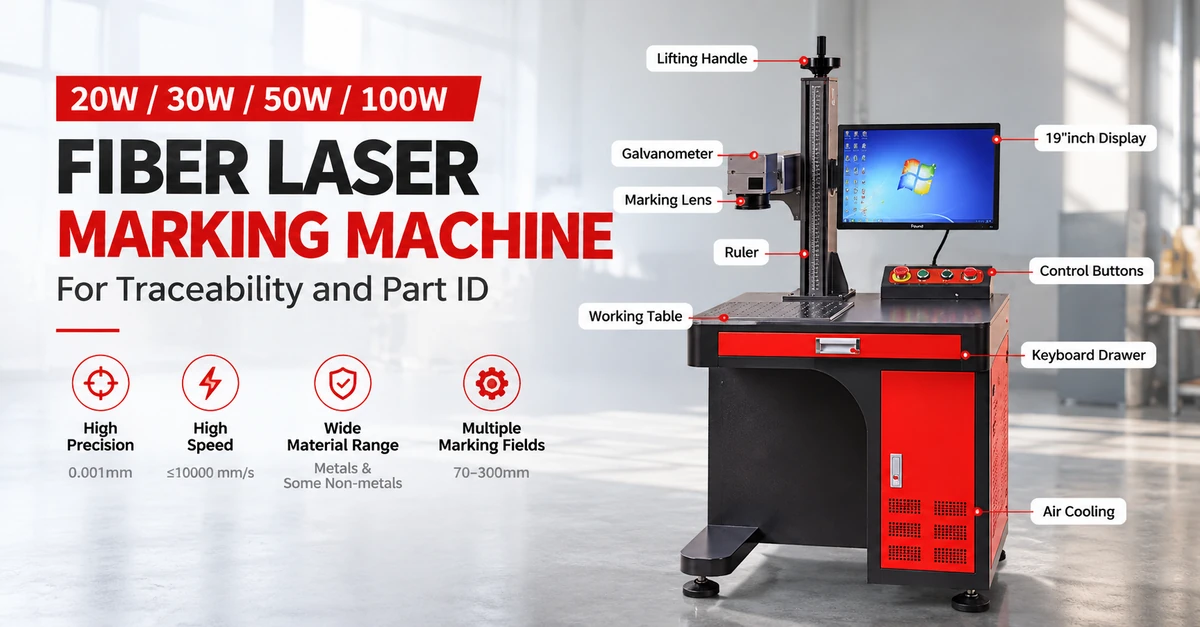
The featured Fiber Laser Marking Machine for Traceability and Part ID is presented as a floor-standing workstation with an adjustable vertical column, a flat working platform, a mounted marking module, an external monitor, and operator controls.
The photographs show a black-and-red cabinet with leveling feet and a perforated worktable suitable for evaluating fixture-based production setups.
This arrangement is relevant to factories handling small metal components, industrial parts, and identification plates.
Published Product Specifications
| Technical Parameter | Supplier-Listed Specification |
|---|---|
| Equipment type | Fiber laser marking machine |
| Listed power options | 20W / 30W / 50W / 100W |
| Laser source | Fiber laser |
| Wavelength | Listed as 1064 μm — requires unit verification |
| Work precision | 0.001mm — measurement basis to be confirmed |
| Repeat accuracy | ±0.003mm |
| Minimum line width | 0.012mm |
| Listed marking speed | ≤10,000mm/s |
| Marking field options | 70 / 120 / 160 / 200 / 250 / 300mm |
| Cooling method | Air cooling |
| Power supply | 220V / 50Hz / 3A |
| Listed service life | ≥100,000 hours |
| Workpiece materials | Metals and selected non-metals |
These figures are taken from the supplied product specification and should be verified against the final quoted machine. They are not independently validated finished-part performance guarantees.
Important Specifications to Confirm
The source table lists the wavelength as 1064 μm. Industrial ytterbium fiber marking lasers commonly operate around 1064nm, but the supplied unit must be corrected or confirmed by the manufacturer before publication as an exact specification.
Similarly, the listed 0.001mm work precision, 0.012mm minimum line width, and ±0.003mm repeat accuracy require defined testing conditions.
The product table also lists a marking-depth limit of 8mm. This should not be interpreted as a guaranteed engraving depth for every material or laser-power configuration.
Buyers should request machine-specific sample results, laser-source documentation, and the actual measurement methods.
4. 20W vs 30W vs 50W vs 100W Fiber Laser Marking Machines
Power selection is one of the most common questions from industrial equipment buyers.
Although higher rated power increases the available optical output, the relationship between power, mark quality, and cycle time is not always linear.
The final result also depends on pulse characteristics, scan strategy, optics, focus, material absorption, and marking requirements.
Laser Power Comparison
| Laser Power | Application Direction to Evaluate | Potential Advantage | Main Verification |
|---|---|---|---|
| 20W | Surface text, logos, and selected part IDs | Lower-power option for suitable marking tasks | Contrast and cycle time |
| 30W | Repeated serial numbers and industrial identification | Additional available output | Material and production stability |
| 50W | Production marking and selected engraving applications | Greater power headroom | Heat effects and surface quality |
| 100W | More demanding material-removal or throughput targets | Higher available optical output | Depth, cycle time and part integrity |
These are application-screening directions, not confirmed performance claims for each CHIKIN configuration.
When Is a 20W Fiber Laser Marker Sufficient?
A 20W system may be suitable when the main requirement is readable surface identification on a compatible material.
Typical candidates include small part numbers, identification text, logos, and selected coated-metal marking tasks.
The buyer should verify that the desired contrast and durability can be achieved within the target production cycle.
When Should You Consider 30W or 50W?
A 30W or 50W system may deserve evaluation when greater output flexibility is useful or when the existing process has difficulty meeting the required cycle time.
However, increasing power without adjusting the process can create unwanted surface changes, excessive material removal, or reduced marking quality.
A controlled comparison should use the same material, marking geometry, and acceptance criteria.
Is a 100W Fiber Laser Marking Machine Always Better?
No.
A 100W configuration may be appropriate for particular high-demand marking or engraving processes, but it may be unnecessary for simple product identification.
Higher rated output can also increase the importance of laser parameter control, thermal management, safety engineering, and cost evaluation.
Procurement recommendation: Select laser power from representative sample results and accepted production throughput, not wattage alone.
5. What Materials Can a Fiber Laser Marking Machine Process?
Fiber laser marking is commonly evaluated for metals, although the suitability of each material depends on its surface condition and the chosen laser configuration.
Material Selection Guide
| Material | Potential Application | Quality Concern |
|---|---|---|
| Stainless steel | Serial numbers and identification | Contrast, oxidation and corrosion performance |
| Carbon steel | Machinery and automotive parts | Mark durability and surface condition |
| Aluminum | Machined housings and fittings | Contrast and surface appearance |
| Anodized aluminum | Equipment panels and product IDs | Coating response and marking consistency |
| Brass | Fittings, nameplates and components | Readability and surface finish |
| Copper | Selected industrial components | Reflectivity and marking response |
| Coated metals | Product identification | Coating removal and durability |
| Engineering plastics | Selected compatible components | Melting, discoloration or substrate damage |
Not all plastics are suitable for a particular fiber laser wavelength.
For applications involving sensitive electronics or safety-critical parts, evaluate whether the marking process could damage protective coatings, electrical insulation, or functional surfaces.
The supplier should qualify the actual material and finish rather than relying only on a generic compatibility list.
6. Why Workstation Design Matters Beyond Laser Power
The featured CHIKIN workstation includes a vertical column, external monitor, operator controls, and a cabinet-style supporting structure.
These features influence daily production usability.
Adjustable Marking Head Position
The vertical column provides an arrangement for setting the working distance between the marking module and the workpiece.
Maintaining the correct focus position is important because an incorrectly focused beam can affect mark geometry and consistency.
Workpiece Fixture Platform
The visible perforated worktable provides a potential mounting surface for fixtures.
Suitable fixtures can help position repeated workpieces consistently and reduce handling variation.
For cylindrical or irregular parts, additional workholding arrangements may be required.
Operator Control and Monitoring
The external monitor and control panel support an operator-guided workstation layout.
For high-mix production, clear job selection and documented parameter settings can help prevent incorrect marking programs.
However, automatic vision recognition, MES connectivity, barcode scanning, and rotary fixtures should not be assumed to be standard equipment.
Their availability must be confirmed for the quoted configuration.
7. How Do Marking Field Size and Focus Affect Quality?
The supplier lists marking field options from 70mm to 300mm.
These figures should be confirmed as the usable dimensions associated with the relevant optical configuration.
A larger field can accommodate more marking positions, but it does not automatically provide the same resolution or spot characteristics as a smaller optical field.
Marking Field Selection
| Application | What to Evaluate |
|---|---|
| Small serial numbers | Character size and feature resolution |
| Larger identification plates | Required marking dimensions |
| Multiple parts per fixture | Field coverage and positioning accuracy |
| Cylindrical components | Height variation and rotary fixture compatibility |
| Fine Data Matrix symbols | Cell size, contrast and decoding reliability |
| Large workpieces | Physical clearance and repositioning requirements |
Buyers should request actual marking samples at the required positions within the working field.
The selected lens, working distance, fixture height, and workpiece geometry should be specified in the machine quotation.
8. How to Evaluate Laser Marking Quality and Traceability
For industrial manufacturing, a visible mark is only useful when it contains the correct information and meets the required quality criteria.
Marking Quality Inspection Checklist
| Inspection Item | Buyer Acceptance Requirement |
|---|---|
| Content accuracy | Correct identification information |
| Marking position | Matches drawing and part datums |
| Character dimensions | Within the agreed specification |
| Readability | Suitable for the intended inspection method |
| Contrast | Acceptable under defined lighting |
| Surface condition | No unacceptable damage |
| Repeatability | Consistent results across samples |
| Durability | Meets required handling and service conditions |
| Data traceability | Correct connection to manufacturing records |
What Is Direct Part Marking?
Direct Part Marking (DPM) applies identification directly to the surface of a component.
For relevant two-dimensional symbols, ISO/IEC 29158:2025 provides a recognized quality-testing methodology for direct-part-marked codes.
This standard is relevant when a manufacturer requires verified Data Matrix or another applicable two-dimensional marking.
The standard does not certify a particular laser machine, and the supplied CHIKIN specification does not establish integrated code-verification capability.
Buyers should confirm whether the system can generate the required code and whether an appropriate external or integrated verifier is needed.
9. Fiber Laser Marking vs Dot-Peen Marking
Another important purchasing decision is whether laser marking or mechanical indentation is more appropriate for the component.
| Factor | Fiber Laser Marking | Pneumatic Dot-Peen Marking |
|---|---|---|
| Marking method | Laser energy modifies the surface | Mechanical pin impacts the surface |
| Direct contact | Non-contact beam | Physical contact |
| Fine graphics | Often suitable with qualified optics | Depends on marking-pin geometry |
| Surface deformation | Depends on marking process | Intentional indentation |
| Main equipment needs | Laser, optics, controls and safety systems | Marking head, controls and compressed air |
| Main maintenance | Optics, extraction and related components | Marking pins and pneumatic components |
| Main risk | Thermal or surface effects | Impact-related deformation |
| Best selection basis | Mark quality and process requirements | Material and required physical mark |
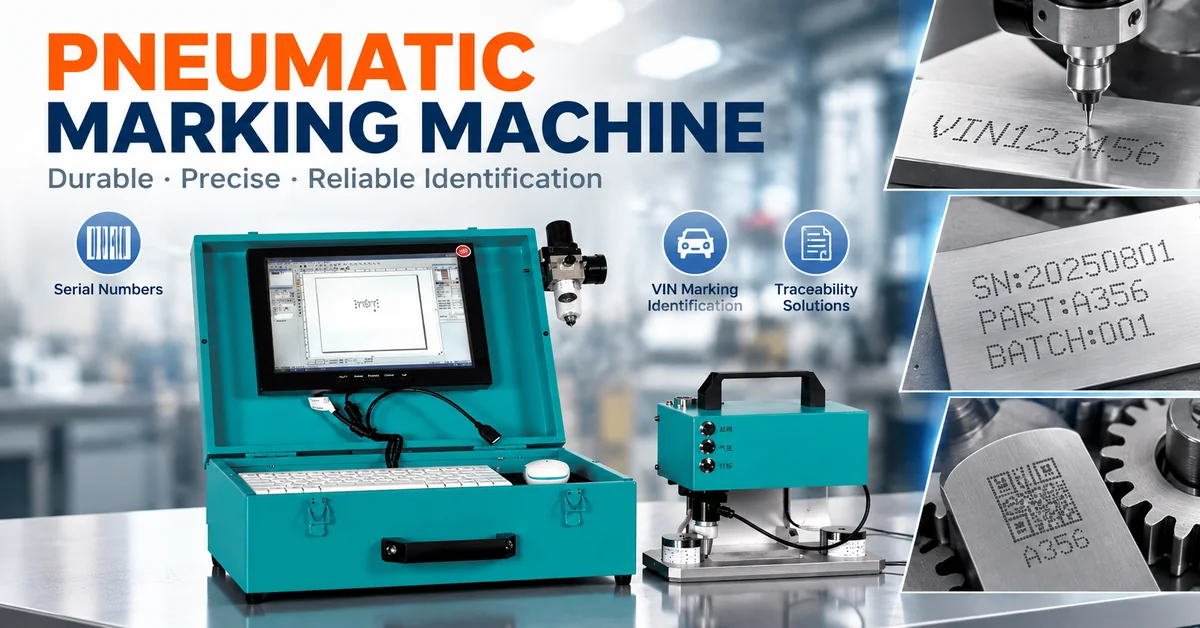
Dot-peen marking may be worth considering when indentation is specifically required.
Fiber laser marking may be advantageous for fine graphical identification and non-contact surface processing.
However, neither technology is universally superior.
The final decision should be based on the required mark, part material, relevant standards, and verified production cost.
10. How to Calculate Real Laser Marking Productivity
Laser scanning speed is not the same as finished-part production throughput.
The supplied specification lists a marking speed of up to 10,000mm/s, but this should be treated as a supplier-listed scanner or motion-related figure until its measurement basis is confirmed.
Actual cycle time depends on the marking content, surface response, fixture arrangement, and operator workflow.
A practical production calculation is:
Total Cycle Time = Loading + Positioning + Marking + Verification + Unloading
Production capacity should be calculated using accepted marked parts rather than theoretical scanning speed.
Example of a Comparative Qualification
Suppose a manufacturer is evaluating 30W and 50W configurations.
The same workpiece, marking content, and quality requirements should be used for both tests.
Measure total cycle time and the proportion of parts that meet the acceptance requirements.
If the 50W machine reduces laser-processing time but requires additional handling or inspection, the improvement in total production output may be smaller than expected.
This is why actual application testing is more reliable than selecting power from a catalog comparison.
11. Laser Safety and Production Environment Requirements
Laser safety is a fundamental purchasing requirement.
The featured machine has an open workstation arrangement, with the marking head positioned above the worktable.
Do not assume that the equipment is Class 1 or fully enclosed.
The buyer must establish an appropriate safety configuration for the actual laser source and installation.
Relevant requirements may include protective guarding, interlocks, controlled access, appropriate eyewear, warning signs, fume extraction, and operator training.
IEC 60825-1, Safety of Laser Products — Part 1: Equipment Classification and Requirements, provides an international reference for laser product classification.
Before buying, request the actual laser classification and documentation for the delivered machine.
Also confirm the plant's electrical supply, cooling requirements, ventilation, fixture space, and maintenance access.
The source table lists air cooling and a 220V/50Hz/3A power requirement. These should be checked against the selected laser power and the complete workstation's utility demand.
12. Factory Acceptance Test and Supplier Qualification
A Factory Acceptance Test (FAT) should prove that the proposed machine can meet the agreed requirements using representative components.
Recommended FAT Checklist
| Test Item | Verification Requirement |
|---|---|
| Laser configuration | Confirm selected 20W, 30W, 50W or 100W source |
| Wavelength | Verify the correct unit and source documentation |
| Working field | Confirm usable marking area |
| Workpiece compatibility | Test actual material and finish |
| Mark quality | Inspect contrast, geometry and surface condition |
| Positioning | Measure repeated marks on representative parts |
| Marking software | Demonstrate required content and job handling |
| Code verification | Check required DPM performance, if applicable |
| Cycle time | Measure complete production operation |
| Safety | Verify protective controls and documentation |
| Utilities | Confirm electrical and cooling requirements |
| Documentation | Review manuals, inspection records and warranty scope |
How Should Buyers Compare Samples?
Use identical workpieces and acceptance criteria across candidate configurations.
Document the source model, lens, marking parameters, sample identification, and results.
Inspect multiple parts rather than accepting one successful demonstration.
If marking must survive cleaning, abrasion, corrosion, or other service conditions, include the relevant durability checks.
The resulting qualification record provides a stronger purchasing basis than promotional figures alone.
13. What Determines Fiber Laser Marking Machine Price?
A fiber laser marking machine quotation may vary according to laser power, source manufacturer, optical configuration, workstation design, fixtures, software, and safety equipment.
Buyers should compare complete configurations rather than headline prices.
| Cost Factor | Procurement Question |
|---|---|
| Laser power | Which rated output is required? |
| Laser source | What manufacturer and model are supplied? |
| Marking lens | Which working field and focal distance? |
| Worktable | Are special fixtures included? |
| Software | Are variable data and required file types supported? |
| Safety equipment | What guarding and accessories are included? |
| Extraction | Is a fume extraction system included? |
| Training | What operator support is provided? |
| Spare parts | Which components are replaceable? |
| Warranty | What is covered and for how long? |
| Delivery | What are the confirmed availability and shipping terms? |
Total Cost per Accepted Part
A useful evaluation is:
Marking Cost per Accepted Part = Total Allocated Marking Cost ÷ Accepted Marked Parts
This considers the actual economic value of the marking process.
A more powerful machine is worthwhile only when its performance justifies the additional purchase and operating costs.
The product listing should be checked for current availability before submitting a purchase order.
14. Customization and RFQ Guidance for Industrial Buyers
Industrial identification requirements vary significantly between factories.
A standard marking workstation may suit simple serial-number applications, while other projects may require additional fixtures, rotary positioning, software integration, or production-line interfaces.
CHIKIN CNC's equipment portfolio includes industrial marking and related automation products, but specific customization options should be confirmed individually.
Technical RFQ Checklist
| Information Required | Details to Provide |
|---|---|
| Part material | Metal grade, coating and surface finish |
| Workpiece dimensions | Length, width, height and weight |
| Marking content | Text, logo, serial number or code |
| Marking requirements | Character size, contrast, location and durability |
| Preferred power | 20W, 30W, 50W, 100W or engineering recommendation |
| Production demand | Accepted parts per hour or shift |
| Workpiece handling | Manual fixture or requested automation |
| Software functions | DXF, variable data or other required features |
| Verification | Visual inspection or machine-readable code grading |
| Facility information | Electrical supply, extraction and available space |
| Commercial requirements | Quantity, destination and service scope |
Request a Fiber Laser Marking Machine Quotation from CHIKIN CNC
CHIKIN CNC, operated by Shenzhen ChiKin Automation Equipment Co., Ltd., supplies precision manufacturing and related industrial automation equipment.
For a fiber laser marking project, buyers should first define their production requirements and then compare the appropriate laser configurations.
Review the CHIKIN Fiber Laser Marking Machine for Traceability and Part ID.
Contact CHIKIN CNC to Discuss Laser Power, Workpiece Samples, and Quotation Requirements
Providing detailed information about materials, marking geometry, production volume, and quality standards will support a more accurate technical evaluation.
15. Frequently Asked Questions About Fiber Laser Marking Machines
1. What is a fiber laser marking machine used for?
A fiber laser marking machine is used for industrial part identification, including serial numbers, batch codes, logos, and suitable machine-readable markings. Applications depend on material compatibility and the selected configuration.
2. Is a 20W fiber laser marking machine enough for metal parts?
It may be suitable for selected surface-marking applications. Buyers should test actual metal samples and verify that the required contrast, durability, and cycle time can be achieved.
3. What is the difference between a 30W and 50W fiber laser marker?
The primary distinction is rated optical output. A 50W system provides more available power, but actual marking quality and productivity depend on pulse characteristics, optics, material, and process settings.
4. When should I choose a 100W fiber laser marking machine?
A 100W configuration may deserve evaluation for applications requiring more demanding material removal or shorter processing cycles. It should be selected only after comparing actual sample results and total cost.
5. Can fiber laser marking machines mark stainless steel and aluminum?
Both are common candidate materials for fiber laser marking. However, different alloys and surface finishes respond differently, so the process must be qualified for the actual component.
6. Can a fiber laser marker engrave deep marks?
Some systems can perform engraving, but achievable depth depends on the laser configuration, material, geometry, and processing time. The supplied 8mm depth figure should not be treated as a guaranteed capability without testing.
7. What determines the marking area of a fiber laser machine?
The marking field depends primarily on the optical configuration and applicable equipment design. CHIKIN lists several field-size options, but the usable dimensions and performance should be confirmed for the selected lens.
8. Can a fiber laser marking machine produce Data Matrix codes?
Fiber laser systems can be used for suitable direct-part-marking applications. Code generation, correct data formatting, and verification capability must be confirmed for the specific software and equipment configuration.
9. What maintenance does a fiber laser marking machine need?
Maintenance may involve optics inspection, lens cleaning, cooling checks, extraction equipment, fixtures, and electrical components. The exact maintenance requirements depend on the installed system.
10. How should I request a fiber laser marking machine quotation?
Provide the material, workpiece dimensions, marking content, required quality, production volume, preferred configuration, and delivery destination. Request sample marking and clearly defined acceptance criteria before finalizing the purchase.
Conclusion
Selecting the right fiber laser marking machine requires a complete understanding of laser power, material properties, marking quality, production throughput, and total ownership cost.
For many industrial identification tasks, a 20W or 30W configuration may be sufficient when the required mark quality and cycle time can be achieved. Higher-power 50W and 100W systems may offer additional processing capability, but their advantages must be demonstrated on the actual workpiece.
The CHIKIN CNC fiber laser marking workstation provides a practical equipment direction for manufacturers evaluating metal part identification, serial-number marking, and traceability applications.
Its adjustable workstation structure, computer-based operating arrangement, and published laser-power options provide a basis for technical comparison.
However, the final purchasing decision should be supported by verified machine specifications, representative marking samples, safety documentation, and agreed factory acceptance requirements.
For overseas B2B manufacturers, the most valuable investment is not necessarily the highest-powered laser, but the configuration that delivers consistent accepted marks at a predictable production cost.
Explore the CHIKIN CNC equipment portfolio and review the company's manufacturing and service capabilities.
Contact CHIKIN CNC for an Application-Based Fiber Laser Marking Machine Quotation and share your metal part drawings, marking requirements, expected production volume, and preferred laser configuration.
The right combination of qualified laser power, stable workholding, controlled marking parameters, and reliable verification is the foundation of an effective industrial traceability process.