






TL;DR — Quick Answer
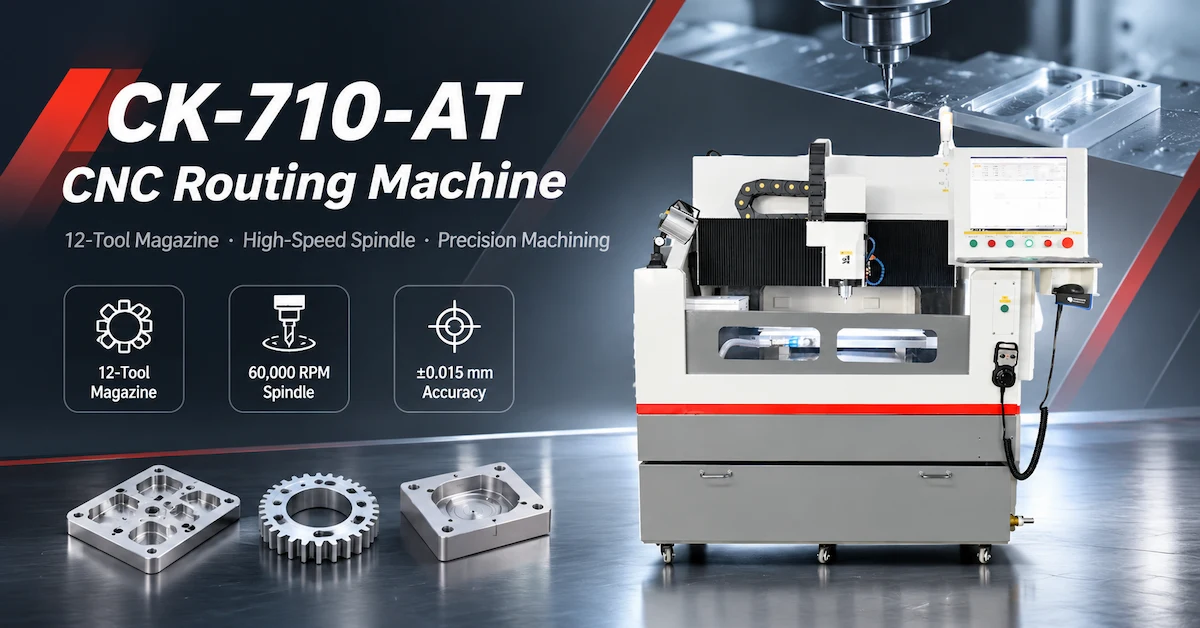
The CK-710-AT CNC routing machine is designed for precision machining applications requiring multiple cutting tools and consistent dimensional control. Equipped with a 12-position automatic tool magazine, a 2.5kW spindle rated at 60,000 RPM, and a published processing envelope of 600 × 500 × 100mm, it offers a practical configuration for evaluating multi-tool machining efficiency and reducing manual tool-change interruptions.
For precision manufacturing buyers, the main advantage to evaluate is not the number of available tools alone. It is whether the complete system can manage tool changes consistently, maintain acceptable machining accuracy, and reduce non-cutting time.
This guide covers the CK-710-AT specifications, tool-magazine planning, machining quality, first-article validation, and factory acceptance testing for B2B equipment procurement.
Key Takeaways
-
12-tool capacity: The CK-710-AT specification lists a 12-position automatic tool magazine.
-
Spindle configuration: A 2.5kW, 60,000 RPM spindle is specified for the CNC routing configuration.
-
Working envelope: Published processing dimensions are 600 × 500 × 100mm.
-
Accuracy: The datasheet lists ±0.015mm processing accuracy and 0.005mm repositioning accuracy; measurement conditions require confirmation.
-
Tool-change performance: Real productivity depends on the tool sequence, machining operations, tool-change time, and rejected parts.
-
Technical clarification: The product page describes Wire EDM, whereas the supplied CK-710-AT specification describes spindle-based CNC routing. Buyers must confirm the actual quoted machine type.
1. Why Does Automatic Tool Change Matter in CNC Routing?
Multi-operation machining often requires several cutting tools.
A component may need roughing, contour machining, finishing, drilling, and other approved machining operations.
When every tool replacement requires manual intervention, the machine may remain idle while an operator removes, installs, and checks the next tool.
An automatic tool-change system allows compatible tools to be stored and selected according to the programmed operation.
What Problems Can Automatic Tool Change Help Address?
For suitable production workflows, automatic tool changing can reduce:
-
Manual tool replacement interruptions.
-
Repeated tool-handling work.
-
Unnecessary operator involvement between programmed operations.
-
Variation associated with manual tool setup.
-
Non-cutting time in suitable multi-tool jobs.
However, automatic tool change does not independently guarantee shorter production cycles.
The system must be properly configured, the tools must be compatible, and the machining program must use an efficient sequence.
For factories handling multiple machining operations on a single workpiece, these details can influence overall equipment productivity.
2. What Are the CK-710-AT Technical Specifications?
The supplied CK-710-AT technical sheet identifies the equipment as a single-head CNC routing machine with a tool magazine.
CK-710-AT Specification Table
| Technical Parameter | Published Specification |
|---|---|
| Model | CK-710-AT |
| Equipment description | Single Head CNC Routing Machine |
| Tool magazine | 12 positions |
| Tool changing | Automatic |
| Table dimensions | 700 × 500mm |
| Processing envelope | 600 × 500 × 100mm |
| Z-axis height | 100–200mm |
| Processing accuracy | ±0.015mm |
| Repositioning accuracy | 0.005mm |
| Maximum processing speed | 9m/min |
| Maximum empty travel speed | 12m/min |
| Spindle-to-table distance | 100mm |
| Spindle power | 2.5kW |
| Spindle speed | 60,000 RPM |
| Machine power | 5kW |
| Machine appearance | Half cover |
| Power supply | AC220V ±10%, 50Hz |
| Machine weight | Approximately 2000kg |
| Machine dimensions | 1600 × 1550 × 1600mm, subject to actual configuration |
These are supplier-listed specifications. Final equipment configuration and machining performance should be confirmed through machine-specific documentation and testing.
Important: Confirm the Machine Technology
The CHIKIN CNC product page describes a Wire EDM machine, but the CK-710-AT specification identifies a spindle-driven CNC routing system.
Wire EDM uses electrical discharge through a wire electrode to cut conductive materials.
CNC routing uses a rotating cutting tool to remove material mechanically.
A CNC router's spindle power, rotational speed, and automatic tool magazine cannot be treated as Wire EDM specifications.
Before purchasing, request written confirmation that the quotation refers to the intended CK-710-AT CNC routing configuration.
3. Who Should Consider a 12-Tool CNC Routing Machine?
A multi-tool CNC routing configuration is worth evaluating when the production process requires several different cutters or repeated tool changes.
| Buyer Segment | Typical Application to Evaluate | Main Requirement |
|---|---|---|
| Precision component manufacturers | Multi-operation component machining | Dimensional consistency |
| Industrial tooling workshops | Fixtures and tooling components | Tool-change flexibility |
| Mold and die workshops | Suitable milling and profiling operations | Surface quality |
| Electronics equipment manufacturers | Machinable housings and fixtures | Repeatable geometry |
| CNC machining workshops | Small-batch multi-tool jobs | Reduced setup interruptions |
| Engineering laboratories | Prototype and development work | Flexible tool selection |
| Equipment procurement teams | CNC production investment | Acceptance testing and cost control |
These are potential application sectors, not a confirmed material compatibility list.
The actual workpiece material, cutting conditions, and required machining operations must be qualified for the machine being supplied.
When Is a 12-Tool Magazine Unnecessary?
If the factory normally processes one simple profile with a single cutter, a large tool magazine may offer limited additional value.
In that situation, working area, tool life, machine rigidity, and cutting performance may be more important purchasing considerations.
The number of tool stations should match actual machining requirements.
4. How Should a 12-Position Tool Magazine Be Planned?
A tool magazine should be organized around the operations required by the production program.
The goal is to provide the necessary tools while minimizing unnecessary changes and reducing tool-selection errors.
Example Multi-Tool Planning Matrix
| Tool Group | Possible Operation | Planning Consideration |
|---|---|---|
| Roughing tool | Initial material removal | Tool life and cutting load |
| Finishing tool | Final surface or contour | Dimensional tolerance |
| Small-diameter cutter | Fine details | Tool deflection and wear |
| Drilling tool | Qualified hole preparation | Diameter and location |
| Chamfering tool | Edge treatment | Required geometry |
| Spare tool | Replacement during production | Tool compatibility |
This table illustrates a possible tool-planning approach. It does not mean every listed operation or tool type is approved for the CK-710-AT without engineering verification.
Why Is Tool Identification Important?
Every tool must correspond to the correct program assignment.
An incorrect tool assignment can produce unwanted dimensions or collisions.
For production qualification, buyers should confirm the control system's tool-numbering method, magazine assignment procedure, available tool-length compensation, and error handling.
The provided datasheet confirms automatic tool changing but does not separately confirm tool-length detection, tool-diameter detection, or broken-tool detection.
These functions must be verified rather than assumed.
5. How Do Spindle Speed and Tool Selection Affect Machining?
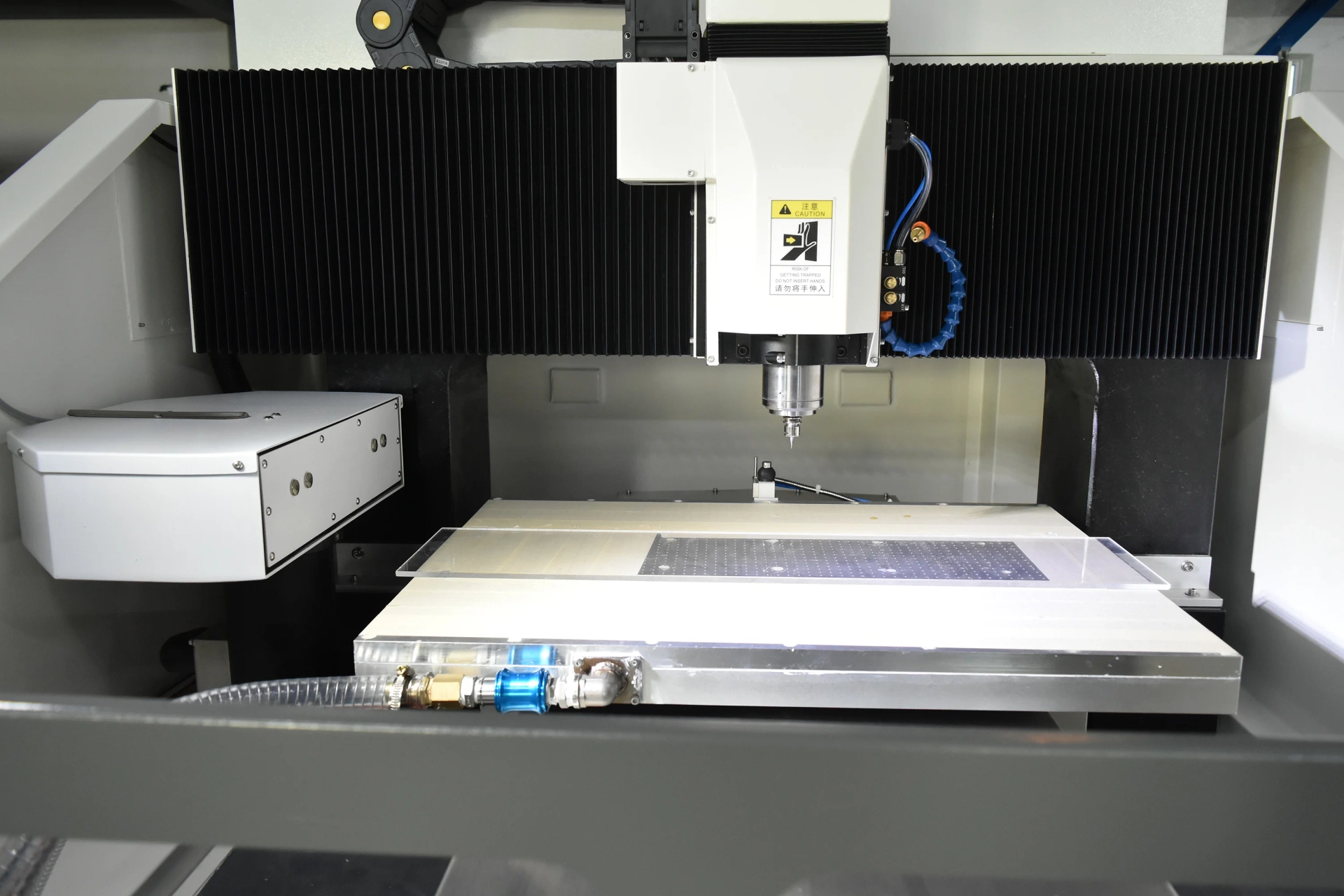
The CK-710-AT specification lists a 60,000 RPM spindle with 2.5kW power.
Spindle speed is an important machining parameter, but the correct operating condition depends on the cutting tool, workpiece material, cutting geometry, and machine configuration.
Why Is Maximum RPM Not Always the Best Setting?
High rotational speed may be useful for particular small-diameter tooling applications.
However, different materials and cutter diameters require different cutting speeds and feeds.
Using unsuitable parameters can increase tool wear, reduce edge quality, or create unacceptable cutting conditions.
Important Tooling Checks
| Tooling Factor | Buyer Verification |
|---|---|
| Tool diameter | Compatibility with the intended spindle and operation |
| Tool material | Suitability for the workpiece |
| Cutting geometry | Required profile and surface finish |
| Tool-holder interface | Compatibility with the automatic tool changer |
| Rated rotational speed | Safe operation at selected spindle speed |
| Tool length | Available working clearance |
| Spindle runout | Influence on cutting stability |
| Tool replacement | Availability and maintenance procedure |
The correct tool should be selected from the material, geometry, and required finished-part quality.
Machine qualification should include the actual cutters planned for production.
6. What Do the Published Accuracy Figures Mean?
The CK-710-AT datasheet lists processing accuracy of ±0.015mm and repositioning accuracy of 0.005mm.
These values describe different aspects of machine performance.
Processing Accuracy vs Repositioning Accuracy
| Specification | Engineering Meaning | Required Verification |
|---|---|---|
| Processing accuracy | Published machining performance criterion | Measure finished samples |
| Repositioning accuracy | Return-position performance | Defined repeated-position test |
| Tool-change repeatability | Consistency after tool replacement | Tool-change sample inspection |
| Finished-part accuracy | Actual conformity to drawing | Calibrated dimensional measurement |
A machine's nominal repositioning performance does not automatically establish the accuracy of a completed component.
Finished-part geometry also depends on tool condition, spindle behavior, workholding, and machining parameters.
Why Test Accuracy After Tool Changes?
A machine may achieve acceptable dimensions using one tool but show variation after multiple tool changes.
For example, incorrect tool-length compensation or inconsistent tool seating can influence machining results.
A useful qualification trial should therefore test the accuracy of the complete multi-tool process.
The correct acceptance question is whether the machine repeatedly produces conforming parts after the required tool changes.
7. How to Validate the Processing Area and Workpiece Setup
The CK-710-AT lists a 700 × 500mm table and 600 × 500 × 100mm processing envelope.
These figures should be reviewed alongside the actual workpiece dimensions and fixture arrangement.
Work Envelope Verification
| Requirement | Buyer Check |
|---|---|
| Table size | Does the fixture fit the available platform? |
| Processing area | Can the required toolpath fit within the envelope? |
| Z-axis clearance | Is there sufficient space for workpiece and tooling? |
| Tool-change clearance | Can the machine change tools safely? |
| Fixture height | Does it reduce the available machining space? |
| Tool access | Can all specified features be reached? |
Why Is Fixture Design Important?
A machining program may be dimensionally correct but still produce poor results if the workpiece moves during cutting.
Fixture stiffness and locating accuracy influence repeatability.
For multi-tool operations, the workpiece should remain properly positioned throughout the machining sequence.
Buyers should provide the supplier with complete workpiece drawings and any existing fixture information.
8. CNC Routing vs Wire EDM vs PCB Registration Drilling
These technologies serve different manufacturing purposes and should not be combined into a single machine description without technical evidence.
| Process | Material Removal | Primary Application |
|---|---|---|
| CNC routing / milling | Rotating cutting tool | Mechanical contours, slots and suitable machining operations |
| Wire EDM | Electrical discharge through wire electrode | Fine profiles in conductive materials |
| PCB registration drilling | Controlled hole drilling | PCB locating and tooling holes |
Wire EDM may be preferable for certain fine profiles in hardened conductive materials.
CNC routing may be more suitable for accessible profiles and operations requiring different rotating cutters.
A PCB Registration Hole Drilling Machine is intended for a different production requirement involving board positioning references.
What Should Buyers Do When a Product Page Combines Different Technologies?
Request clarification of the actual machine type, cutting mechanism, consumables, controller, work envelope, and technical specifications.
For a Wire EDM purchase, ask about wire feeding, dielectric fluid, filtration, and EDM-specific performance.
For a CK-710-AT routing purchase, ask about the spindle, tool magazine, tool holders, cutting-tool compatibility, and machining performance.
This prevents selecting equipment based on specifications belonging to another process.
9. How Can Buyers Measure Tool-Change Efficiency?
Automatic tool change should be evaluated through the complete production cycle.
A machine may have a 12-position magazine but still require substantial setup time if tool assignment, workholding, or program preparation is inefficient.
The CK-710-AT CNC routing machine is designed to support multi-tool machining workflows through its 12-position automatic tool magazine. For manufacturers, evaluating tool-change efficiency requires measuring actual cycle time, tool positioning consistency, and machining accuracy across repeated production runs. These factors help determine whether the equipment can reduce manual intervention while maintaining consistent finished-part quality.
Production Cycle Calculation
Total Cycle Time = Loading + Setup + Cutting + Tool Changes + Inspection + Unloading
For a more detailed evaluation, record the number of tool changes within a complete program.
Tool-Change Performance Checklist
| Evaluation Factor | What to Measure |
|---|---|
| Tool-change time | Actual duration per change |
| Tool-selection accuracy | Correct tool retrieved |
| Tool seating | Consistent installation |
| Program continuity | Correct restart after change |
| Tool-change failures | Frequency and cause |
| Operator intervention | Manual actions required |
| Total cycle time | Complete part production duration |
Is Automatic Tool Change Always Faster?
Not necessarily.
An inefficient tool sequence can still produce unnecessary tool changes.
For repeat production, toolpath planning and job organization should be evaluated alongside the tool magazine itself.
The real productivity benefit is the reduction in non-value-added time without compromising part quality.
10. First-Article Inspection: How to Verify Multi-Tool Machining
First-Article Inspection (FAI) helps confirm that a process can produce parts matching the approved requirements before full production begins.
For a CNC routing machine, inspection should include the complete machining sequence.
Recommended FAI Procedure
Step 1 — Confirm the Drawing
Verify the latest engineering revision, dimensions, tolerances, and required surface condition.
Step 2 — Inspect the Workpiece
Check material identification, dimensions, and initial condition.
Step 3 — Verify the Tool Magazine
Confirm the installed tools correspond to the approved program.
Step 4 — Establish Workpiece Position
Check fixture stability and the applicable coordinate references.
Step 5 — Run the Machining Program
Process the representative part using the intended tool-change sequence.
Step 6 — Inspect Finished Geometry
Measure critical features and inspect the surface condition.
Step 7 — Repeat the Process
Produce additional samples to evaluate repeatability.
Step 8 — Record the Results
Document the machine configuration, tools, settings, inspection findings, and any required adjustments.
First-Article Quality Checklist
| Quality Item | Acceptance Requirement |
|---|---|
| Overall dimensions | Approved drawing tolerance |
| Critical profiles | Defined dimensional limits |
| Hole and slot geometry | Drawing conformity |
| Surface condition | Customer-approved finish |
| Tool-change sequence | Correct operation |
| Tool seating | Consistent after replacement |
| Workpiece condition | No unacceptable damage |
| Repeatability | Consistent samples |
| Process documentation | Complete inspection records |
Acceptance should be based on measured finished parts rather than the machine's displayed positioning values alone.
11. What Should Buyers Check During Factory Acceptance Testing?
A Factory Acceptance Test (FAT) should confirm that the proposed machine meets the agreed production requirements before shipment.
For a 12-tool CNC routing configuration, the FAT should include both machining and tool-management performance.
CK-710-AT FAT Checklist
| FAT Item | Recommended Verification |
|---|---|
| Machine identification | Confirm exact CK-710-AT configuration |
| Machine type | Confirm CNC routing rather than Wire EDM |
| Table dimensions | Verify usable fixture area |
| Processing envelope | Demonstrate required workpiece access |
| Spindle | Confirm 2.5kW / 60,000 RPM specification |
| Tool magazine | Verify 12-position configuration |
| Tool changing | Demonstrate required change sequence |
| Processing accuracy | Measure representative machined samples |
| Repositioning accuracy | Review defined test results |
| Program handling | Demonstrate approved production files |
| Cycle time | Record complete machining time |
| Safety | Verify guarding and emergency functions |
| Electrical system | Confirm supply requirements |
| Documentation | Obtain manuals and inspection records |
Important Utility Clarification
The supplied CK-710-AT table contains a field labeled “Power requirement” with a value of 2MPa.
MPa is a pressure unit, not an electrical power measurement.
The supplier should clarify whether this relates to a pneumatic requirement, another subsystem, or a datasheet error.
It should not be treated as a verified factory air-supply requirement without confirmation.
What Is the Most Valuable FAT Result?
A successful test should demonstrate that the actual configuration can complete the buyer's representative machining job with acceptable accuracy, surface finish, and tool-change behavior.
A demonstration using only an empty machine cycle does not establish production capability.
12. How to Evaluate Operating Cost and Return on Investment
The purchase price of a CNC routing machine is only one part of its total cost.
Multi-tool manufacturing also involves cutting-tool consumption, maintenance, setup labor, inspection, and downtime.
Total Cost of Ownership
| Cost Factor | Main Consideration |
|---|---|
| Equipment price | Final machine configuration |
| Cutting tools | Tool replacement and wear |
| Tool holders | Compatibility and spare parts |
| Electricity | Actual machine power consumption |
| Labor | Setup and operator involvement |
| Tool changes | Downtime and programming |
| Maintenance | Spindle, magazine and moving components |
| Inspection | Dimensional verification |
| Material waste | Rejected components |
| Installation | Commissioning and training |
A useful economic metric is:
Machining Cost per Accepted Part = Total Allocated Machining Cost ÷ Accepted Parts
This metric helps buyers compare the investment with existing production methods.
When Is a 12-Tool CNC Routing Configuration Worthwhile?
It deserves consideration when a significant portion of existing cycle time comes from repeated manual tool changes.
However, the financial benefit should be verified through actual job data.
If the main production bottleneck is slow cutting, unsuitable tooling, or poor workholding, adding magazine capacity alone may not solve the problem.
13. What Should Overseas Buyers Include in an RFQ?
A technically complete Request for Quotation allows the equipment supplier to evaluate the actual production task.
CK-710-AT Technical RFQ Checklist
| Required Information | Buyer Details |
|---|---|
| Workpiece material | Material grade and condition |
| Part dimensions | Maximum length, width and height |
| Engineering drawings | CAD files and critical geometry |
| Required operations | Routing, milling, drilling or engraving |
| Number of tools | Tools required per program |
| Tool dimensions | Diameter, length and holder requirements |
| Machining tolerance | Critical finished-part specifications |
| Surface finish | Required condition |
| Production volume | Parts per shift or month |
| Existing bottleneck | Tool-change downtime, scrap or machining time |
| Fixture requirements | Workholding and available clearance |
| Factory utilities | Electrical and pneumatic requirements |
| Acceptance testing | FAI and FAT criteria |
| Commercial information | Quantity, delivery and service needs |
Why Consider CHIKIN CNC?
CHIKIN CNC supplies PCB manufacturing and related precision processing equipment.
Its published equipment information includes CNC routing, drilling, and other industrial machining technologies.
For CK-710-AT procurement, the most important first step is confirming the exact offered machine type and resolving the differences between the product description and technical specification.
Request a CK-710-AT Technical Configuration Review
If your factory requires multi-tool CNC machining, prepare your workpiece drawings, material specifications, machining operations, tool requirements, and expected output.
Review the CHIKIN CNC product listing.
Contact CHIKIN CNC for a Technical Review and Quotation.
Request written confirmation of the actual process type, 12-tool magazine configuration, spindle specifications, included accessories, and machine acceptance requirements.
14. Frequently Asked Questions About CK-710-AT CNC Routing
1. What is the CK-710-AT?
The supplied datasheet identifies the CK-710-AT as a single-head CNC routing machine with an automatic tool magazine. The associated product page also describes Wire EDM, so the exact quoted machine type must be confirmed.
2. How many tools can the CK-710-AT magazine hold?
The published specification lists a 12-position tool magazine with automatic tool changing. Compatible tool holders and accessories should be verified.
3. What is the spindle speed of the CK-710-AT?
The specification lists a 60,000 RPM spindle with 2.5kW rated power.
4. What is the processing area?
The published processing envelope is 600 × 500 × 100mm, with a 700 × 500mm table. Usable fixture space should be confirmed.
5. What machining accuracy is specified?
The datasheet lists ±0.015mm processing accuracy and 0.005mm repositioning accuracy. These figures require defined testing conditions.
6. Is automatic tool changing suitable for small-batch production?
It may be useful when individual jobs require several cutters. The benefit depends on the number of tool changes, setup time, and production workflow.
7. Can the machine perform Wire EDM cutting?
The CK-710-AT routing specification does not establish Wire EDM capability. Wire EDM requires different equipment and operating systems. Confirm the actual machine configuration with the supplier.
8. Does the CK-710-AT include tool-breakage detection?
The supplied CK-710-AT specification does not separately confirm broken-tool detection. Buyers should verify its availability before ordering.
9. How should tool-change accuracy be tested?
Run representative machining programs requiring several tool changes, then inspect finished dimensions, tool seating, and repeated processing results.
10. What information should I provide when requesting a quote?
Provide drawings, material specifications, required machining operations, tooling information, finished-part tolerances, production volume, and acceptance criteria.
Conclusion
Selecting an appropriate CNC routing machine with automatic tool change requires more than comparing spindle speed, tool-magazine capacity, or purchase price.
For precision manufacturing factories, the real objective is a stable multi-tool machining process that produces acceptable components while controlling setup variation and non-cutting time.
The CK-710-AT CNC routing machine provides a practical solution for manufacturers seeking reliable automatic tool changing, precision machining, and improved production efficiency. Its 12-position tool magazine, high-speed spindle, and CNC control system make it worth evaluating for multi-tool manufacturing applications where machining consistency and reduced setup time are important.
These characteristics provide a basis for evaluating a multi-tool CNC routing configuration.
However, buyers should first confirm the actual machine technology, because the associated product description includes Wire EDM information that differs from the routing-machine specification.
A reliable purchasing process should include technical configuration verification, representative sample machining, tool-change testing, finished-part inspection, and a documented Factory Acceptance Test.
For overseas manufacturers evaluating CNC routing and precision machining equipment, CHIKIN CNC offers an opportunity to discuss the required configuration in relation to actual production needs.
Contact CHIKIN CNC for a CK-710-AT Technical Review and Quotation and provide your machining drawings, material specifications, tool-change requirements, and target production volume.
The right combination of compatible tooling, controlled machining parameters, reliable tool changing, and measurable quality acceptance is the foundation of an effective CNC production investment.