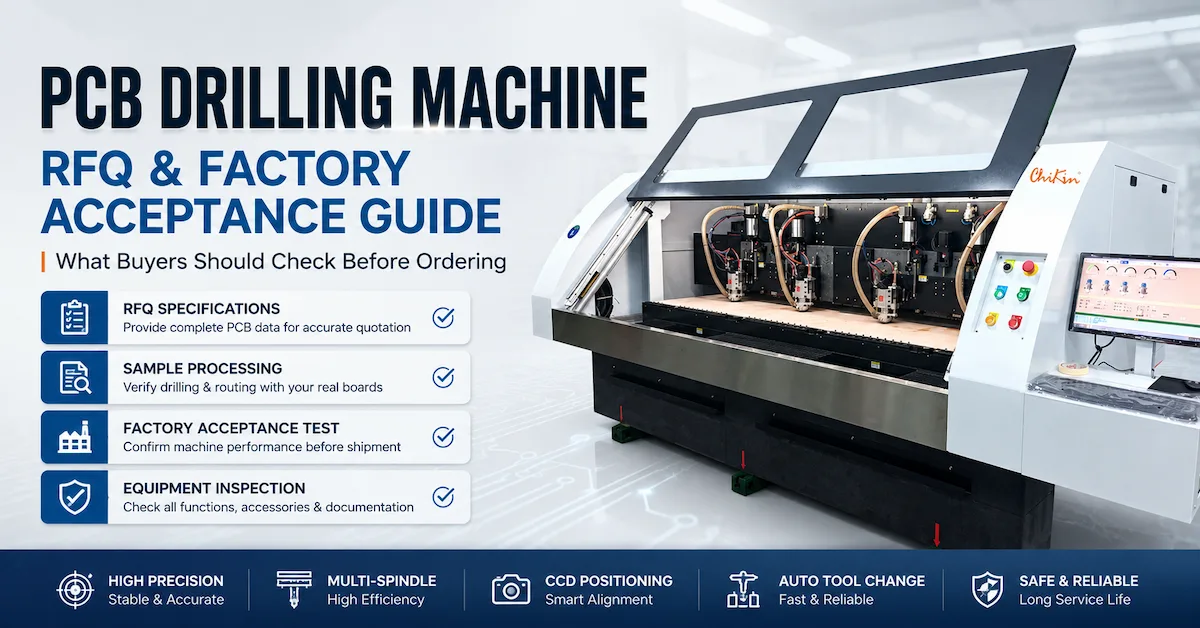




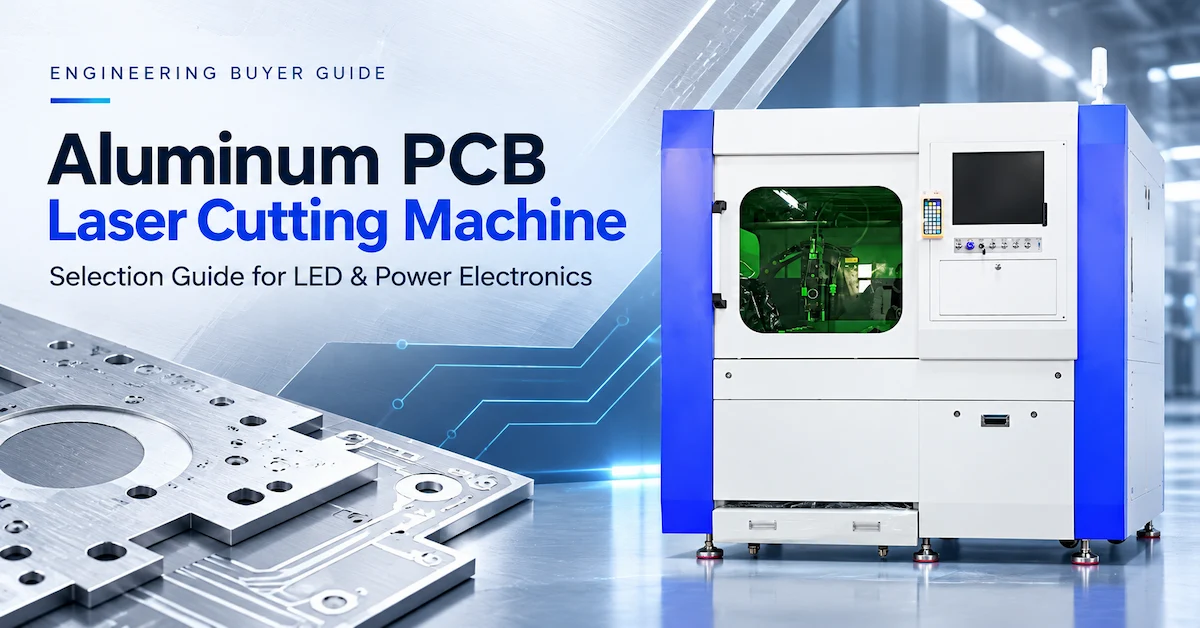
What Is an Aluminum PCB Laser Cutting Machine, and When Should You Use One?
An Aluminum PCB Laser Cutting Machine is a precision processing system used to cut or separate suitable aluminum-based printed circuit boards and metal substrate materials through controlled laser energy.
It is particularly relevant to manufacturers producing LED circuit boards, power electronics substrates, automotive electronic modules, and other metal-core PCB products where heat dissipation, dimensional accuracy, and reliable edge quality are important.
Unlike conventional FR4 printed circuit boards, aluminum PCBs typically combine a conductive circuit layer, an electrically insulating but thermally conductive dielectric, and an aluminum base.
This construction creates a unique manufacturing challenge.
The metal base must be cut to the required shape without causing unacceptable damage to the electrical insulation or copper circuitry.
A laser cutting machine can offer programmable, non-contact contour processing without mechanical cutting-tool wear. However, non-contact cutting does not automatically eliminate heat-related damage.
The correct machine is the one that produces dimensionally accurate aluminum PCB parts while maintaining the required dielectric integrity, acceptable edge condition, and stable production output.
For manufacturers comparing equipment, this means evaluating the complete PCB construction rather than only the aluminum thickness.
CHIKIN CNC provides a dedicated Metal Core PCB Laser Cutting Machine and a Metal Plate Laser Cutting Machine for metal substrate processing applications.
The following guide explains the differences between cutting bare aluminum substrates and finished aluminum PCBs, the technical risks to investigate, and the steps required to make a reliable purchasing decision.
Quick Answer: How Do You Choose the Right Aluminum PCB Cutting Machine?
For aluminum PCB manufacturers, the equipment selection should begin with seven questions.
-
Are you cutting bare aluminum sheets or completed metal-core PCB laminates? These are different processing applications.
-
What is the aluminum alloy and base thickness? Both influence laser interaction and cutting performance.
-
What dielectric and copper layers are present? Their thickness, location, and electrical requirements affect the acceptable process.
-
What finished edge quality is required? Evaluate burrs, dross, oxidation, distortion, and possible dielectric damage.
-
What positional accuracy is required relative to the circuit pattern? Finished-part accuracy matters more than motion specifications alone.
-
What production volume must the machine support? Measure complete panel cycle time and acceptable output.
-
Can the supplier demonstrate the process on the exact production material? Sample testing should precede final equipment acceptance.
If a supplier quotes only laser power, maximum cutting speed, and nominal precision, the purchasing evaluation is incomplete.
A useful proposal should address cutting quality, the PCB stack-up, required utilities, inspection methods, and total operating cost.
Why Is Aluminum PCB Cutting Different From Ordinary Metal Cutting?
A conventional aluminum sheet is primarily a metallic workpiece.
A finished aluminum PCB is an engineered electronic laminate.
That difference changes the risk associated with cutting.
Understanding Aluminum PCB Construction
A common insulated metal substrate construction includes three functional layers.
1. Copper circuit layer
This layer carries electrical current between components and connections.
Its thickness varies according to the design and electrical requirements.
Some power electronics applications use relatively heavy copper.
2. Thermally conductive dielectric layer
The dielectric electrically separates the copper circuit from the metal base.
At the same time, it allows heat to move toward the metal substrate.
Its composition, thickness, breakdown strength, bonding properties, and thermal characteristics influence PCB reliability.
3. Aluminum base layer
The aluminum provides mechanical support and helps spread heat away from components.
This is particularly useful in high-power LED and power electronics applications.
Metal-core PCB material suppliers describe a similar functional structure in their insulated metal substrate systems.
The important point for laser processing is that these layers react differently to heat.
Why the Dielectric Layer Deserves Special Attention
The dielectric layer is not merely a bonding material.
It performs an essential electrical function.
If cutting damages the dielectric near the board edge, the finished product may experience reduced insulation margin or other reliability concerns.
Potential problems include:
-
localized thermal degradation
-
dielectric recession
-
layer separation
-
exposed metal near copper features
-
conductive residues
-
weakened bonding near the cut
-
reduced insulation performance
These outcomes are not inevitable, but they must be considered during process qualification.
A machine that cuts a bare aluminum sample cleanly has not yet demonstrated that it can safely process the finished laminated PCB.
Copper-to-Edge Clearance
The location of copper circuitry relative to the finished board edge is another important consideration.
If metallic burrs, molten residues, or cut-path errors reduce the intended clearance between the circuit and the conductive aluminum base, electrical reliability may be affected.
For demanding applications, buyers should specify the required copper-to-edge distance and the inspection method.
A successful aluminum PCB cutting process must protect the functional relationship between copper, dielectric, and aluminum—not simply produce a visually attractive metal edge.
Bare Aluminum Substrate Cutting vs Finished MCPCB Cutting
This is one of the most important distinctions in equipment selection.
A manufacturer may cut aluminum before it is laminated with dielectric and copper.
Another manufacturer may need to cut a completed PCB after circuit fabrication.
The processes have different acceptance requirements.
| Evaluation factor | Bare aluminum substrate cutting | Finished aluminum PCB cutting |
|---|---|---|
| Workpiece | Aluminum sheet or prepared metal base | Aluminum, dielectric, copper and possible coatings |
| Main quality concern | Metal edge, dimensions, burrs and oxidation | Edge quality plus electrical insulation and circuit integrity |
| Thermal sensitivity | Primarily metal-related | Metal and laminate-related |
| Registration | Sheet datum or fixture reference | May require alignment to circuit features |
| Electrical testing | Not normally a PCB-level requirement | May be required according to product specification |
| Post-processing | Metal cleaning or deburring as appropriate | Must avoid damage to dielectric and circuitry |
| Sample qualification | Metal processing test | Full laminate and finished-board qualification |
When Bare Aluminum Cutting Is Appropriate
For some manufacturing workflows, cutting the metal base before subsequent PCB processing may reduce the risk of exposing dielectric and copper layers to the laser.
However, the selected process must still be compatible with downstream manufacturing.
Engineers should consider whether the cut base remains suitable for lamination, handling, coating, and circuit registration.
When Finished PCB Cutting Is Necessary
Other factories may require final contour cutting after the PCB structure has been manufactured.
This can support particular panelization or process-flow requirements.
In these cases, the full material stack must be tested.
The cutting process may need different parameters, protective strategies, or equipment than those used for bare aluminum sheet processing.
Can One Machine Perform Both Operations?
Possibly, but this should not be assumed.
A single machine may require different laser settings, fixtures, motion strategies, and inspection requirements for the two operations.
A purchasing specification should define whether the equipment must process bare metal, finished MCPCB, or both.
The supplier should provide evidence for each required application.
What Industries Use Aluminum PCB Laser Cutting Machines?
Aluminum PCBs are particularly relevant where electronic components generate significant heat and thermal management is important.
High-Power LED Lighting
LED boards are among the best-known applications of aluminum-based PCBs.
Examples include:
-
industrial LED luminaires
-
street lighting
-
commercial lighting modules
-
high-power LED assemblies
-
specialized architectural lighting
-
automotive LED lighting
A manufacturer may need circular, rectangular, elongated, or irregular board outlines.
The processing method should preserve the necessary edge dimensions and avoid damage that could affect electrical insulation.
For manufacturers processing large LED aluminum PCB panels, CHIKIN also lists PCB drilling and routing equipment that may be worth comparing with laser processing.
Automotive Power Electronics
Automotive electronic systems can require compact packaging, controlled thermal behavior, and reliable mechanical interfaces.
Metal-core substrates may be used in selected power conversion, control, and lighting applications.
For these buyers, equipment evaluation may include additional requirements for traceability, process stability, and product-specific qualification.
EV Charging Equipment
Charging systems contain power electronics that can generate substantial heat.
Selected metal-based PCB constructions may help manage thermal loads.
The cutting method should be compatible with the board design and its electrical isolation requirements.
Power Conversion Equipment
Power supplies, rectifiers, inverters, and related equipment may use thermally managed PCB substrates.
For these applications, insulation integrity and assembly fit are often more important than maximum nominal cutting speed.
Industrial Electronics
Motor controllers, industrial power modules, and high-power control systems may require specialized substrates and repeatable board outlines.
Their production requirements can differ from conventional consumer electronics.
Typical Buyer Groups
| Buyer segment | Main manufacturing concern | Equipment decision priority |
|---|---|---|
| LED PCB manufacturer | Board shape and consistent edge quality | Cutting speed, panel size and yield |
| Automotive electronics supplier | Reliability and traceability | Process validation and repeatability |
| EV charger PCB supplier | Insulation and thermal design | Dielectric protection and dimensional accuracy |
| Power electronics factory | Metal substrate compatibility | Material-specific cutting quality |
| MCPCB contract manufacturer | Multiple board designs | Program flexibility and changeover |
| PCB prototyping workshop | Small batches and varied contours | Setup efficiency and process flexibility |
| Electronics equipment distributor | Technical support and product scope | Supplier capability and service |
These customers have different production priorities.
A technically appropriate machine should be selected according to the actual product mix.
Fiber Laser Cutting for Aluminum PCB: What Should Buyers Understand?
Fiber laser systems are commonly evaluated for industrial metal cutting.
Their suitability comes from the interaction between the laser beam and the metal material under controlled processing conditions.
However, aluminum introduces several practical considerations.
Aluminum Reflectivity
Aluminum can reflect a substantial portion of incident laser energy at some wavelengths and surface conditions.
Its absorption behavior changes with temperature, surface condition, and processing state.
The source and optical system must be appropriate for the material.
A fiber laser machine that cuts stainless steel effectively should not automatically be assumed to process aluminum PCB materials with equivalent quality or speed.
Thermal Conductivity
Aluminum conducts heat efficiently.
During cutting, heat can move away from the processing zone.
This influences the energy required for material removal and the surrounding thermal response.
For finished MCPCB laminates, that heat may also affect adjacent dielectric and copper structures.
Laser Power
Laser power is important, but it is only one component of the process.
The required configuration depends on:
-
aluminum alloy
-
thickness
-
surface condition
-
laser wavelength
-
beam quality
-
focus position
-
cutting speed
-
assist gas
-
desired edge quality
Higher power does not automatically mean a better PCB processing result.
The objective is a stable cutting process within the required quality limits.
Fiber Laser vs UV Laser for Aluminum PCB
UV laser systems are frequently evaluated for fine polymer-rich electronic materials, including certain FPC constructions.
Fiber laser systems are generally more relevant to many metal-cutting applications.
These are different application directions.
An FPC UV laser machine should not be selected for aluminum-core cutting merely because both products are called laser cutting machines.
For an overview of other laser technologies, see CHIKIN's Laser Cutting Machine Selection Guide.
The Six Most Important Technical Factors for Aluminum PCB Laser Cutting
1. Material Thickness and Composition
The supplier must know the actual aluminum grade and thickness.
A machine may be capable of cutting a certain thickness of bare aluminum without meeting the quality requirements of a laminated metal-core PCB.
Always specify whether the quoted capability applies to sheet metal or completed PCB assemblies.
2. Laser Source and Beam Quality
Beam characteristics influence focus, kerf width, process stability, and achievable feature geometry.
The machine proposal should identify the source and relevant operating parameters.
3. Motion System and Machine Rigidity
Stable motion helps the machine follow the programmed path consistently.
Factors worth reviewing include machine structure, guide system, motion control, calibration, and vibration behavior.
A rigid platform is particularly important when processing large panels or complex contours.
4. Vision Alignment
CCD or another vision system can help locate panel edges or fiducial references.
This can be useful when the cutting path must be aligned with PCB circuitry.
However, the accuracy of the finished cut depends on more than the camera alone.
5. Focus Control
Variations in panel height can affect cutting conditions.
A suitable system may use focus adjustment or height sensing, depending on its design.
The equipment supplier should explain how the proposed configuration handles material flatness and thickness variation.
6. Assist Gas and Extraction
Metal cutting may use assist gas to influence melt removal and edge conditions.
Nitrogen and air can produce different results depending on the metal, process settings, and quality requirements.
No gas option should be assumed to guarantee an oxide-free or burr-free edge.
Extraction must also be evaluated for the actual process materials and workplace requirements.
How Do Heat-Affected Zones Affect Aluminum PCB Reliability?
A heat-affected zone, or HAZ, is the area around the cut that experiences thermal influence.
In ordinary metal cutting, the discussion may focus on changes in the metallic material and edge condition.
For aluminum PCB processing, the concern extends to the laminate structure.
Potential Thermal Effects
Depending on the process, undesirable effects may include:
-
dielectric discoloration
-
localized dielectric recession
-
weakened layer bonding
-
copper-edge damage
-
thermal distortion
-
residue formation
-
excessive oxide or recast material
These effects are process dependent.
They should not be assumed to occur on every board, but they must be evaluated where relevant.
Why Low HAZ Claims Require Evidence
Suppliers sometimes describe laser cutting as producing a minimal heat-affected zone.
The claim is meaningful only when the measurement conditions are known.
HAZ depends on laser parameters, material thickness, cutting speed, and the complete laminate construction.
A buyer should ask:
What thermal effects can the machine demonstrate on our actual aluminum PCB stack-up at the cycle time we require?
This question is more useful than requesting an abstract HAZ specification.
How to Evaluate Thermal Damage
Start with visual and dimensional inspection.
For demanding applications, cross-sectional analysis may reveal effects that are not visible from the surface.
Where electrical performance could be affected, additional insulation testing may be necessary.
The test method and acceptance limits should be agreed before equipment qualification.
Aluminum PCB Cutting Defects: Causes and Inspection Methods
Cutting defects should be evaluated according to their effect on the finished electronic product.
A small cosmetic imperfection may be acceptable in one application but unacceptable in another.
| Defect | Possible contributing factors | Recommended verification |
|---|---|---|
| Aluminum burrs | Melt ejection or unstable cutting conditions | Edge and underside inspection |
| Dross | Incomplete removal of molten material | Examine lower cut edge |
| Excessive oxidation | Gas and thermal process conditions | Surface and edge inspection |
| Wide kerf | Beam and process characteristics | Measure actual cutting width |
| Dimensional deviation | Motion, focus, fixture or compensation | Finished-part measurement |
| Dielectric recession | Excessive local thermal influence | Cross-sectional examination |
| Delamination | Local heating or laminate weakness | Layer-integrity inspection |
| Copper exposure | Incorrect clearance or material damage | Copper-to-edge measurement |
| Conductive residue | Metal particles or redeposition | Cleaning and electrical inspection |
| Warping | Thermal stress or inadequate support | Flatness measurement |
| Incomplete cutting | Insufficient effective material removal | Verify full separation |
The correct troubleshooting method starts by identifying the defect and isolating its likely cause.
Increasing laser power is not a universal solution.
It may improve separation while increasing melting, dross, or thermal damage.
The process should instead be optimized across the relevant variables.
How Important Is CCD Alignment for Aluminum PCB Cutting?
Vision alignment can be valuable when the cutting path must be registered to features already present on the board.
However, buyers should distinguish several types of accuracy.
Axis positioning accuracy describes motion-system behavior.
Repeatability describes consistency under defined conditions.
Vision recognition accuracy describes the ability to locate reference features.
Finished-part accuracy describes the actual dimensions and position of the cut component.
These values are not interchangeable.
For a completed aluminum PCB, the most important requirement may be the relationship between the finished board outline and the copper circuit.
A machine can have excellent axis repeatability while producing unacceptable boards if the panel is incorrectly positioned.
Fiducial-Based Processing
Where supported, a vision system may recognize fiducials or board edges and apply a position correction.
The correction strategy depends on the machine software and configuration.
Buyers should confirm the actual functions rather than assume that all CCD-equipped machines provide the same capabilities.
Test Across the Full Panel
One accurate measurement near the panel origin does not prove that the complete working area meets the required tolerance.
For large LED PCB panels, sample testing should include multiple positions.
Ask for measurements taken from the finished parts, not only the motion controller.
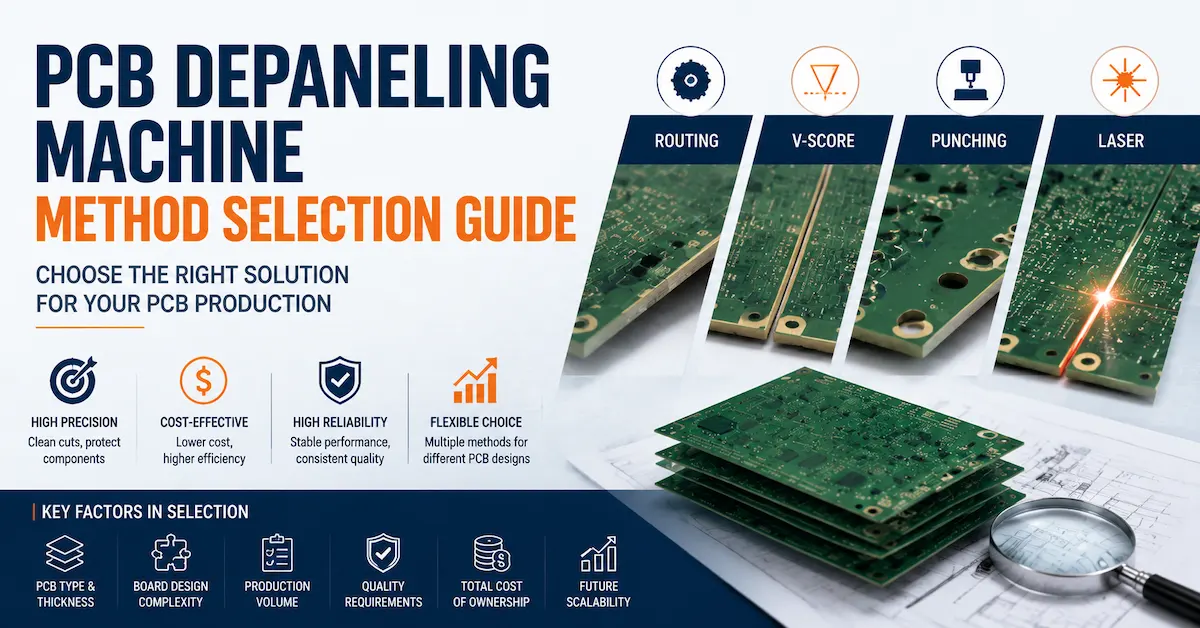
Aluminum PCB Laser Cutting vs CNC Routing vs Punching vs V-CUT
Laser processing offers advantages for some products, but conventional mechanical methods remain important in PCB manufacturing.
| Process | Main advantage | Important limitation | Suitable application |
|---|---|---|---|
| Laser cutting | Programmable non-contact processing | Thermal effects require control | Complex contours and qualified metal substrates |
| CNC routing | Flexible mechanical contouring | Tool wear, force and chips | Rigid PCB and aluminum PCB outlines |
| Punching | Fast repeated production | Dedicated tooling and mechanical force | Stable high-volume compatible designs |
| V-CUT | Efficient for appropriate straight scoring | Geometry and material/process limitations | Compatible pre-scored PCB panels |
| Mechanical shearing | Relatively simple straight cuts | Limited geometry and possible edge deformation | Suitable sheets and panel formats |
When Laser Cutting Is a Strong Candidate
Laser processing may be attractive when the product requires complex programmable contours, frequent design changes, or reduced mechanical cutting force.
It may also be considered when routing-tool wear or fixture complexity creates production limitations.
When CNC Routing May Be Better
Routing remains a practical solution for many aluminum PCB applications.
The process avoids laser-induced thermal effects but introduces mechanical force, cutting tools, chips, and tool wear.
A suitable router may deliver competitive economics for established board designs.
CHIKIN provides PCB Drilling and Routing Machines for customers evaluating mechanical board processing.
When Punching May Be Better
For stable, high-volume designs, dedicated tooling can provide productive cutting.
However, the initial tooling investment and possible mechanical deformation must be evaluated.
When V-CUT Is Appropriate
V-CUT is relevant to panel designs specifically engineered for compatible scoring and separation.
It should not be assumed suitable for every aluminum-core laminate.
The board construction, scoring method, residual thickness, and downstream separation requirements must be qualified.
For a broader method comparison, review CHIKIN's PCB Depaneling Machine Selection Guide.
How Should Manufacturers Evaluate Laser Cutting Quality?
Quality inspection must cover the requirements of the finished PCB, not merely the visible metal edge.
A useful inspection plan includes several layers.
Dimensional Inspection
Measure:
-
board length and width
-
critical outline features
-
internal slots or openings
-
hole-to-edge relationships
-
copper-to-edge clearance
-
panel-to-panel consistency
Use measurement methods appropriate to the required tolerance.
Edge Inspection
Inspect both the top and bottom edges.
Look for burrs, dross, oxidation, incomplete cutting, and visible damage.
Dielectric Inspection
Where the cut approaches electrically critical areas, inspect the laminate for recession, discoloration, cracks, or delamination.
Cross-sectional testing may be necessary for demanding products.
Electrical Insulation Verification
A completed aluminum PCB may require insulation-related testing between conductive circuits and the metal base.
The appropriate method depends on the board design and customer specification.
Possible evaluations include insulation resistance or dielectric withstand testing under agreed conditions.
These tests should not be performed using arbitrary voltages.
Acceptance limits must come from the approved electrical design and qualification requirements.
Functional Verification
For high-reliability products, the buyer may need additional product-level testing.
The exact requirements depend on the intended application.
For example, an automotive module and an LED lighting board may follow different qualification plans.
How to Develop a Stable Aluminum PCB Laser Cutting Process
A robust cutting process should tolerate normal manufacturing variation.
It should not depend on one ideal sample produced under unusually favorable conditions.
Stage 1: Material Review
Identify the aluminum alloy, base thickness, dielectric construction, copper layer, surface finish, and coatings.
Stage 2: Sample Design
Prepare representative samples that include difficult contours, corners, openings, and relevant copper clearances.
Stage 3: Initial Feasibility Testing
Determine whether the proposed equipment can achieve full separation and acceptable edge quality.
Stage 4: Parameter Optimization
Evaluate suitable combinations of laser power, focus, speed, gas conditions, and other process variables.
Record both cutting quality and cycle time.
Stage 5: Repeatability Testing
Run consecutive panels under the proposed production settings.
Do not rely on the single best sample.
Stage 6: Material Variation Testing
Where relevant, repeat the test using representative material lots or thickness variations.
Stage 7: Process Documentation
Record the approved recipe, fixture, inspection results, and operating limits.
The goal is to establish a repeatable manufacturing process rather than a one-time demonstration.
Sample Cutting Test: What Should Buyers Require?
Sample cutting is one of the most valuable stages of equipment procurement.
A supplier may demonstrate impressive results on an easy material that does not represent the buyer's actual application.
For aluminum PCB cutting, the sample package should include the complete production laminate when finished-board cutting is required.
Recommended Sample Test Matrix
| Test item | What should be measured | Purchasing significance |
|---|---|---|
| Material identification | Alloy, thickness and laminate construction | Confirms relevant test conditions |
| Cutting completeness | Full separation along required path | Establishes feasibility |
| Dimensional accuracy | Finished outline and critical features | Confirms process capability |
| Kerf width | Actual material removed | Supports geometry and nesting |
| Burr and dross | Top and underside edge condition | Indicates finishing requirement |
| HAZ | Agreed thermal-effect inspection | Evaluates laminate risk |
| Dielectric integrity | Product-specific inspection/testing | Supports electrical reliability |
| Copper-to-edge clearance | Finished conductor separation | Supports insulation design |
| Repeatability | Consecutive sample results | Evaluates production stability |
| Cycle time | Complete panel cycle | Supports capacity planning |
| Extraction result | Residues and workplace conditions | Supports factory integration |
What Makes a Sample Test Reliable?
The material, drawing revision, processing conditions, and measurement method should be documented.
A single successful panel demonstrates initial feasibility.
A series of accepted panels provides stronger evidence of repeatability.
For high-volume factories, test duration and sample quantity should reflect production requirements.
Before investing in an Aluminum PCB Laser Cutting Machine, request a sample-cutting evaluation based on your actual board stack-up and acceptance criteria.
CHIKIN's Metal Core PCB Laser Cutting Machine is one relevant product direction to discuss during technical evaluation.
How Do You Calculate Real Aluminum PCB Cutting Capacity?
Equipment suppliers frequently publish maximum movement or cutting speeds.
These figures should not be treated as finished-board output.
A complete production cycle may include:
-
panel loading
-
fixture positioning
-
vision alignment
-
focus verification
-
cutting
-
part retention
-
unloading
-
inspection
-
program changeover
Actual throughput depends on the complete sequence.
Production Capacity Formula
A basic planning equation is:
Gross boards per hour = 3,600 × boards per panel ÷ complete panel cycle time in seconds
For production forecasting, the result should be adjusted for equipment availability and conforming-product yield.
Illustrative Example
Suppose one panel contains 24 aluminum PCB units.
The complete panel cycle takes 90 seconds.
The theoretical output is:
24 × 3,600 ÷ 90 = 960 boards per hour.
If the equipment availability factor is 85% and the acceptable-product yield is 98%, the estimated output becomes approximately 800 good boards per hour.
This is a calculation example, not a performance claim for any CHIKIN model.
Actual production results require measured cycle times and realistic loss assumptions.
Why Quality Yield Changes the Calculation
A machine may process panels quickly but produce additional scrap or require extensive edge finishing.
That reduces the usable output.
A slightly slower process may be more economical if it produces consistently acceptable boards.
For procurement purposes, cost per conforming aluminum PCB is usually more useful than maximum cutting speed.
Aluminum PCB Laser Cutting Machine Price: What Determines the Cost?
The purchase price depends on the machine configuration, application difficulty, and supplied equipment scope.
Laser Source
Different laser source configurations affect equipment cost and processing capability.
A high-power source may be necessary for some applications but unnecessary for others.
Working Area
Large production panels require adequate machine capacity.
The effective cutting area should account for fixtures and alignment requirements.
Motion and Vision Systems
Precision guides, motion control, calibration, and vision alignment contribute to equipment cost.
Their value depends on whether they improve the required finished-part results.
Assist Gas and Cooling
Gas and cooling requirements affect both installation and operation.
The buyer should understand these costs before comparing quotations.
Extraction and Filtration
Extraction equipment may be necessary for the intended process.
Its specification and maintenance should be included in the purchasing evaluation.
Software and Automation
Additional functions may include path optimization, nesting, recipe management, automatic loading, and factory-system integration.
These should be separately identified in the quotation.
Installation and Training
Overseas buyers should confirm packaging, transportation, installation, documentation, operator training, spare parts, and technical support.
A low quoted machine price may not represent the full cost of production readiness.
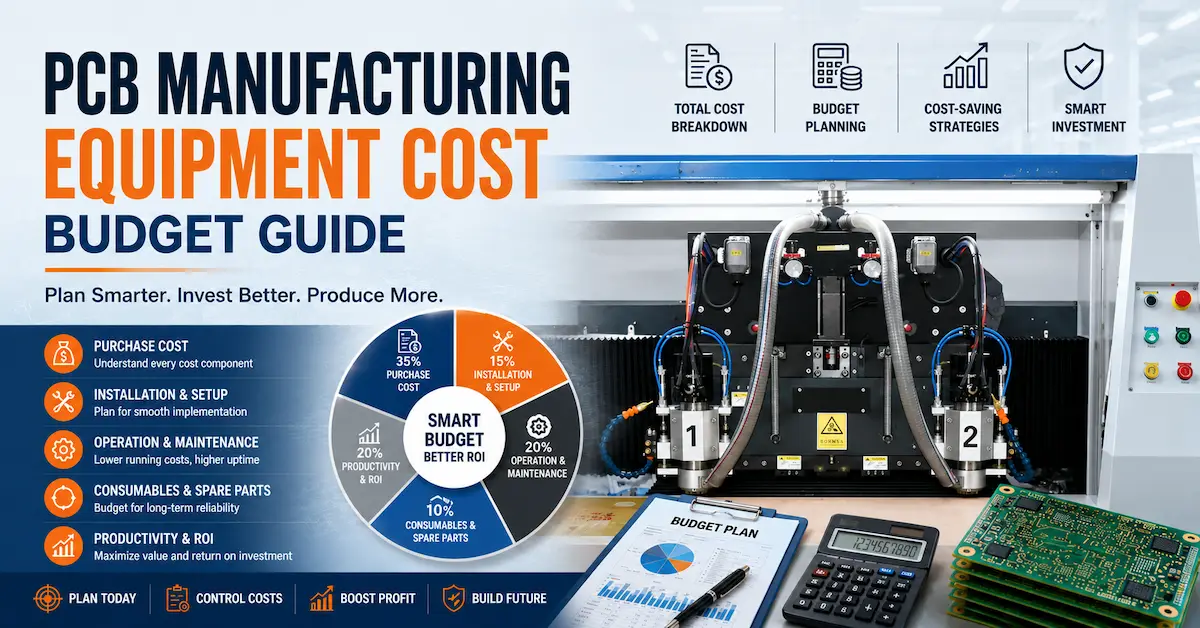
How to Calculate Total Cost of Ownership
Total Cost of Ownership (TCO) considers equipment and operating expenses throughout the expected service period.
For aluminum PCB laser cutting, the calculation should include:
Capital investment: machine, fixtures, extraction, cooling, shipping and installation.
Operating expenses: electricity, gas, maintenance, consumables, filters and labor.
Quality costs: scrap, rework, rejected boards and additional inspection.
Production costs: changeover, setup, calibration, downtime and handling.
Lifecycle costs: spare parts, service, software maintenance and future integration requirements.
Material Utilization
For large aluminum PCB sheets, nesting efficiency may influence raw material consumption.
However, tighter nesting should not compromise edge quality or electrical clearance.
Material utilization must therefore be evaluated alongside finished-product acceptance.
Compare Against Existing Equipment
If the factory currently uses CNC routing, record the actual routing cycle, tooling cost, maintenance, operator requirements, and scrap rate.
Compare the proposed laser process under equivalent production conditions.
Do not assume that eliminating mechanical cutting-tool wear eliminates all maintenance expenses.
Laser systems also require optical, cooling, extraction, and other maintenance activities.
Investment Decision
The most useful investment comparison combines:
-
acceptable production output
-
equipment investment
-
operating expenses
-
quality yield
-
material utilization
-
maintenance
-
future product flexibility
This provides a stronger purchasing basis than comparing initial quotations alone.
Factory Installation Requirements for Aluminum PCB Laser Cutting
Factory utilities should be reviewed before the purchase contract is finalized.
Electrical Supply
Confirm voltage, phase, frequency, connected load, grounding, and electrical protection.
Use the actual supplied machine configuration as the reference.
Cooling System
Cooling requirements vary by laser source and machine design.
Clarify whether a chiller is supplied and what maintenance is required.
Assist Gas
Confirm gas type, pressure, consumption, filtration, and supply arrangement where applicable.
Extraction and Ventilation
Metal processing can generate particles and fumes.
Finished PCB laminates may introduce additional process by-products.
The extraction system must be appropriate to the material and the facility's hazard assessment.
Machine Safety
Industrial laser machines require suitable protective measures.
ISO 11553-1:2020 addresses laser-processing machine safety requirements concerning laser radiation hazards.
IEC 60825-1 provides relevant laser-product classification and safety requirements.
Buyers should review machine-specific safety information, including enclosure, interlocks, emergency stop, and maintenance procedures.
Mentioning a standard does not establish that a particular machine has been certified to it.
Installation Space
Check equipment dimensions, access routes, floor conditions, maintenance clearance, and material handling.
A machine should fit the complete workflow, not merely the available floor footprint.
How Does CHIKIN CNC Support Aluminum PCB Laser Processing?
CHIKIN CNC provides equipment for different PCB manufacturing operations, including laser cutting and mechanical drilling/routing.
Two relevant laser product directions are available on its website.
Metal Core PCB Laser Cutting Machine
CHIKIN's Metal Core PCB Laser Cutting Machine is positioned for precision non-contact processing of metal-core PCB and related electronic materials.
The public product description emphasizes:
-
precision laser processing
-
stable machine construction
-
intelligent motion control
-
servo platform integration
-
complex contour capability
-
metal substrate applications
Specific equipment parameters should be confirmed for the proposed configuration.
Metal Plate Laser Cutting Machine
CHIKIN's Metal Plate Laser Cutting Machine is described as a fiber laser processing solution for metal substrate applications.
Its published information discusses granite-based construction, precision linear motion components, CCD alignment, focus-related functions, assist-gas options, and metal cutting.
These features are relevant to buyers evaluating aluminum substrate processing.
However, published metal-cutting thickness or positioning figures should not automatically be treated as guaranteed finished-MCPCB processing capability.
Final suitability must be verified on the buyer's material, including the dielectric and copper layers when completed-board cutting is required.
Mechanical Processing Alternatives
CHIKIN also supplies PCB Drilling and Routing Machines.
This allows buyers to investigate different processing methods according to board design, material thickness, production volume, and quality requirements.
Technical Support and Procurement
Information about CHIKIN's company background is available through its About Us page, with additional service information under Service Advantages.
For a specific project, buyers should request an application review and confirm the final machine configuration, acceptance plan, delivery scope, and support arrangements in writing.
Aluminum PCB Laser Cutting Machine RFQ Checklist
An effective Request for Quotation should provide enough information for a supplier to evaluate the actual manufacturing process.
A general request for machine price is unlikely to produce a complete technical proposal.
Material Information
Specify:
-
aluminum alloy
-
base thickness
-
dielectric material and thickness
-
copper layer thickness
-
surface finish
-
laminate supplier or material specification
-
complete board stack-up
Product Information
Provide:
-
maximum panel size
-
finished board dimensions
-
contour drawing
-
slots and openings
-
critical tolerances
-
copper-to-edge clearance
-
panelization design
Production Information
Include:
-
expected boards per hour
-
daily production target
-
shifts per day
-
product mix
-
annual volume
-
changeover frequency
Quality Requirements
Define:
-
acceptable burr and dross
-
finished dimensions
-
HAZ requirements
-
dielectric integrity
-
copper protection
-
electrical inspection
-
acceptable scrap level
Factory Information
State the installation country, electrical supply, available floor space, extraction arrangement, and desired automation level.
Commercial Information
Request clarification of:
-
delivered machine configuration
-
sample testing
-
FAT
-
installation
-
training
-
spare parts
-
warranty
-
documentation
-
delivery schedule
Recommended RFQ Summary Table
| RFQ category | Required information |
|---|---|
| Material | Aluminum alloy and complete MCPCB stack-up |
| Thickness | Base metal and laminate thickness |
| Board size | Maximum panel and finished dimensions |
| Processing stage | Bare aluminum or finished PCB |
| Drawing | Gerber, DXF, CAD or approved production file |
| Precision | Dimensional and registration tolerances |
| Edge quality | Burr, dross, oxide and thermal limits |
| Electrical | Dielectric and copper-clearance requirements |
| Production | Target output and product mix |
| Integration | Loading, software and factory systems |
| Utilities | Electrical, cooling, gas and extraction |
| Acceptance | Sample test and FAT requirements |
To discuss an application-specific configuration, submit the material stack-up and production drawings through the CHIKIN CNC Contact Page.
Factory Acceptance Testing: What Should Be Checked Before Shipment?
Factory Acceptance Testing should verify the machine and processing capability against agreed requirements.
The FAT should be defined before the equipment is ready for shipment.
Machine Configuration
Verify the supplied laser source, work area, controls, optics, motion platform, vision system, fixtures, cooling and extraction interfaces.
Processing Performance
Run the agreed customer material and representative cutting program.
Measure dimensions, edge condition, registration, and cycle time.
Dielectric Protection
For finished MCPCB applications, include the agreed laminate inspection and electrical acceptance requirements.
Repeatability
Test an appropriate number of consecutive samples.
The acceptance plan should define allowable variation.
Safety and Documentation
Review the supplied safety documentation, operating manual, maintenance instructions, and spare-parts information.
FAT Acceptance Checklist
| FAT item | Acceptance basis |
|---|---|
| Delivered configuration | Purchase specification |
| Material compatibility | Approved substrate stack-up |
| Cutting completeness | Full separation |
| Dimensional accuracy | Production drawing |
| Edge quality | Agreed burr and dross limits |
| HAZ | Defined inspection criteria |
| Dielectric integrity | Customer electrical specification |
| Registration | Finished cut-to-pattern requirement |
| Cycle time | Agreed measurement method |
| Repeatability | Defined sample plan |
| Safety functions | Applicable machine requirements |
| Documentation | Contract deliverables |
A successful FAT reduces uncertainty before shipping.
It does not eliminate the need for appropriate installation and commissioning at the buyer's factory.
How to Evaluate an Aluminum PCB Laser Cutting Machine Manufacturer
An equipment supplier should be evaluated by its ability to solve the specific manufacturing problem.
Application Understanding
Can the supplier distinguish bare aluminum cutting from finished MCPCB cutting?
Can the engineers explain the possible effects on copper and dielectric layers?
Sample Processing Capability
Can the supplier demonstrate actual cutting quality using the buyer's production material?
Can the sample results be measured and documented?
Machine Engineering
Can the supplier explain the laser source, motion system, focus control, fixture, software, cooling and extraction arrangement?
Quality Verification
Are the proposed acceptance criteria measurable?
Does the supplier distinguish machine positioning specifications from finished-product results?
Service and Maintenance
Can the supplier explain preventive maintenance, spare parts, installation requirements, and troubleshooting procedures?
Commercial Transparency
Does the quotation clearly identify standard equipment, optional functions, accessories, and service scope?
The best supplier is not necessarily the one offering the largest power rating or shortest delivery promise.
It is the one that can demonstrate a repeatable process and provide a clear plan for commissioning and long-term operation.
Frequently Asked Questions About Aluminum PCB Laser Cutting Machines
1.What is an Aluminum PCB Laser Cutting Machine used for?
An Aluminum PCB Laser Cutting Machine is used for precision cutting or separation of suitable aluminum-based PCB and metal substrate materials.
Potential applications include LED PCB outlines, metal-core PCB processing, power electronics substrates, and complex board geometries.
Its suitability depends on the aluminum alloy, thickness, PCB stack-up, and required finished quality.
The processing method should be validated on representative production material.
2. Can a fiber laser cut aluminum PCBs?
Fiber laser systems can process suitable aluminum materials, but the actual capability depends on the source configuration and process conditions.
Cutting a finished aluminum PCB introduces additional requirements involving dielectric and copper layers.
A successful bare aluminum sheet test does not establish complete MCPCB compatibility.
Buyers should request full-stack sample processing when finished-board cutting is required.
3. Is laser cutting better than CNC routing for aluminum PCBs?
Not always.
Laser cutting can be attractive for programmable contours and non-contact processing.
CNC routing may be more economical for certain rigid board designs and can avoid laser-induced thermal effects.
The best method depends on board construction, required geometry, edge quality, tooling cost, and production volume.
A fair comparison should use actual samples and complete operating costs.
4. Does laser cutting damage the dielectric layer?
Laser cutting can create thermal effects that may affect nearby dielectric material if the process is unsuitable.
However, damage is not inevitable.
The result depends on laser parameters, material composition, cut location, and processing conditions.
For finished aluminum PCBs, dielectric integrity should be included in qualification testing wherever relevant to product reliability.
5. What causes burrs and dross when laser cutting aluminum?
Burrs and dross may be associated with incomplete melt removal, process instability, focus conditions, gas settings, material variation, or unsuitable cutting parameters.
The correct remedy depends on the actual cause.
Increasing laser power without controlled testing may introduce additional thermal effects.
Buyers should ask for top-edge and underside inspection results.
6. How accurate is an Aluminum PCB Laser Cutting Machine?
Finished-part accuracy depends on the motion system, calibration, vision alignment, fixture, material stability, and cutting process.
A quoted axis repeatability figure should not be interpreted as a guarantee of finished board tolerance.
The buyer should request dimensional measurement results from actual aluminum PCB samples.
Critical copper-to-edge relationships may also require separate verification.
7. Which laser source is suitable for MCPCB cutting?
Fiber laser systems are commonly evaluated for aluminum and other metal-rich substrates.
However, the complete application determines the appropriate source.
Material thickness, dielectric construction, cutting geometry, edge quality, and output requirements must be considered.
For polymer-rich flexible circuits, another laser technology may be more appropriate.
Sample testing is the strongest basis for selection.
8. How much does an Aluminum PCB Laser Cutting Machine cost?
The price depends on the laser source, working area, motion platform, vision system, focus control, cooling, extraction, automation, and service package.
A meaningful quotation should include the actual delivered configuration.
The buyer should also evaluate operating expenses, scrap, maintenance, and cost per conforming board.
Initial machine price alone does not establish economic value.
9. What should I test before purchasing an MCPCB laser cutter?
Use representative production material and an approved drawing.
Verify complete separation, dimensions, edge quality, HAZ, repeatability, and complete cycle time.
For finished laminates, include dielectric and copper-related acceptance requirements.
The results should be documented and incorporated into the equipment acceptance agreement.
10. How can I request an Aluminum PCB Laser Cutting Machine quotation from CHIKIN CNC?
Prepare the aluminum alloy, base thickness, dielectric and copper construction, panel dimensions, cutting drawing, quality requirements, and production target.
Review CHIKIN's Metal Core PCB Laser Cutting Machine and Metal Plate Laser Cutting Machine.
Then contact CHIKIN CNC to discuss material compatibility, sample cutting, equipment configuration, and quotation requirements.
Conclusion
Choosing an Aluminum PCB Laser Cutting Machine requires careful consideration of aluminum thickness, PCB laminate construction, dielectric protection, edge quality, production capacity, and total operating cost. The most reliable purchasing decision comes from comparing laser cutting with feasible mechanical alternatives and validating the proposed process using actual production samples.
CHIKIN CNC provides laser processing equipment for metal-core PCB applications, alongside related drilling and routing solutions. Explore its Metal Core PCB Laser Cutting Machine and request a technical quotation with your aluminum PCB stack-up, drawings, quality requirements, and production targets to evaluate a suitable manufacturing solution.